
Summary
Effective Abandoned Cart Email Strategies for DTC Brands
DTC brands lose about 70% of carts on average. The ones actually recovering 15-25% of that lost revenue aren't doing it with magic. They're just using specific product imagery, real urgency, and copy that sounds like a human wrote it.
Most abandoned cart emails fail because they read like automated templates instead of someone actually talking to the customer. I've looked at a lot of these flows, and the ones that work share a few common traits. Let's break down real-world examples from DTC brands so you can see what separates a forgettable reminder from an email that brings people back to checkout.
Why Most Abandoned Cart Emails Underperform
These emails underperform because they default to generic reminders instead of addressing why someone actually left. Shoppers abandon carts for all sorts of reasons. Price hesitation. Shipping cost shock. Distraction. Or maybe they're just checking out a competitor.
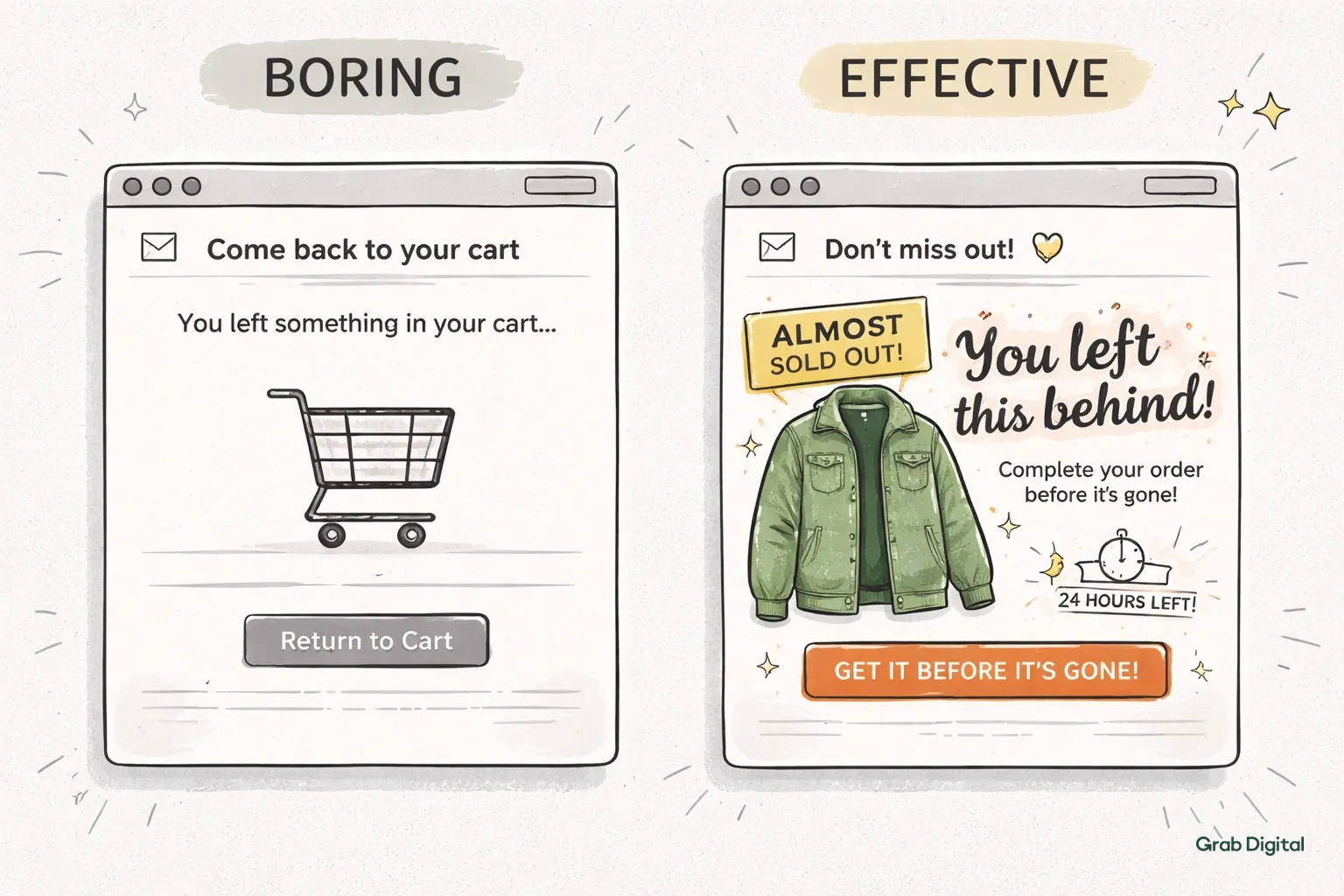
Put yourself in the shopper's shoes. They add a jacket to their cart, get distracted by a phone call, and three hours later they get an email saying "You left something behind!" with a generic stock photo of a shopping cart. It completely fails to remind them why they wanted the product in the first place.
The brands getting results do the opposite. They use real product photography, call out the exact item left behind, and write copy that feels like it came from an actual person on the team. This is the foundation of any high-ROI abandoned cart flow that actually moves the needle.
Example 1: The Product-First Reminder
A product-first reminder leads with a large, clear image of the exact abandoned item and minimal text. It works because it re-triggers the original desire without burying it under promotional garbage.
Rogue Industries and similar leather goods brands do this well. Picture an email with a single leather wallet shot on a clean background, the product name, the price, and one line: "Still thinking it over? It's waiting for you." No discount code. No countdown timer. No aggressive CTA button screaming "BUY NOW."
What makes this convert is simple. The image does the selling, not the copy. There's no pressure tactic that feels salesy, and the CTA is soft. It says "Pick up where you left off" instead of "Complete your purchase now."
This first email usually goes out within an hour of abandonment, while intent is still warm. Brands that get their abandoned cart email best practices dialed in know this first touch should never feel like a sales pitch.
Example 2: The Social Proof Follow-Up
A social proof follow-up email uses customer reviews or user-generated content to answer the unspoken objection: "is this actually worth it?" You send this about 24 hours after abandonment, assuming the initial reminder didn't do the trick.
Natural skincare brands like Beessential have this down. Instead of just saying "come back," their second email might feature three short reviews like "This changed my skin in two weeks" next to a star rating and a photo of the product in use. The messaging shifts from "remember this" to "here's proof it works."
Why does this format convert? Star ratings build instant trust, and short review quotes address skepticism directly. User photos show real-world use, not studio shots, and a soft CTA keeps pressure low.
Segmentation matters here too. A repeat customer doesn't need the same social proof as a first-time visitor. Strong email segmentation ensures the right proof point reaches the right person.
Example 3: The Urgency Email, Done Right
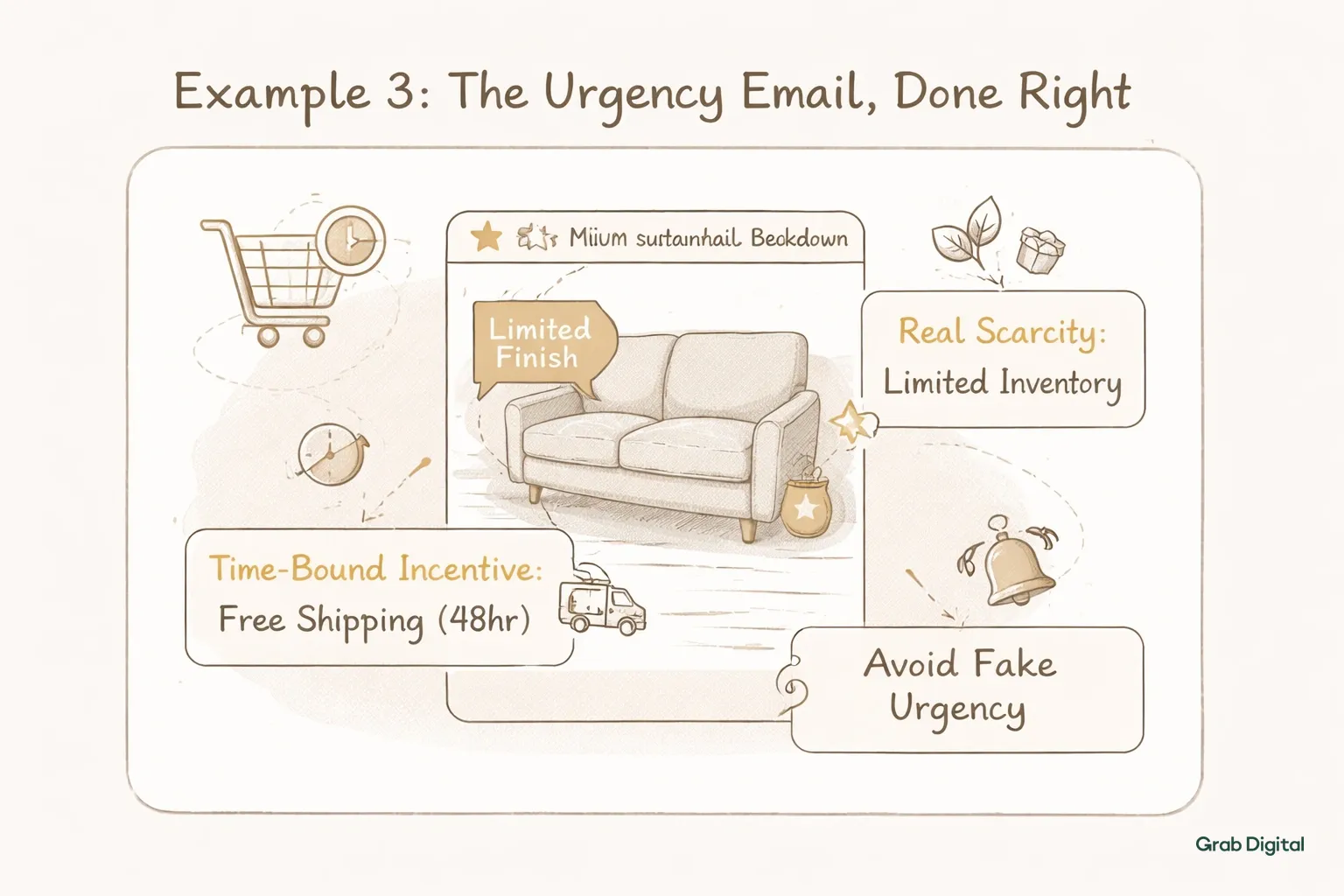
An urgency email done right uses real scarcity, not fake countdown timers. This third email in the sequence sends 48 to 72 hours after abandonment. It works because it gives the shopper an actual reason to act now instead of manufactured pressure.
Premium sustainable furniture brands like Model No. face a specific challenge here. Their products are considered purchases, not impulse buys, so fake urgency backfires badly. Instead, their third email might mention genuine limited inventory on a specific finish, or a small, time-bound incentive like free shipping that expires in 48 hours.
What separates this from spammy urgency tactics? The scarcity is tied to something real, like limited stock or seasonal availability. The discount, if offered, is modest not a 30% blowout that trains customers to wait. And the tone stays calm and informative, not panicked.
Brands that rely too heavily on discounting at this stage often end up training their list to abandon carts on purpose, just waiting for the inevitable coupon. A smarter cart abandonment solution builds urgency through genuine scarcity or bonus value, not price erosion.
Example 4: The "We Noticed" Personal Touch Email
A "we noticed" email uses first-person, conversational language to make the shopper feel seen rather than tracked. This works particularly well for DTC lifestyle brands with strong founder stories or distinct brand voices.
Instead of corporate phrasing like "We noticed you left items in your cart," a well-crafted version reads: "Hey, saw you were checking out our [product]. Questions about sizing, materials, or shipping? Just hit reply, we actually read these." This small shift from automated-sounding copy to a genuine note changes how the email lands in someone's inbox.
Elements that make this format effective include plain-text style formatting that mimics a real email, not a marketing blast. It includes an invitation to reply, which also signals to inbox providers that the email is engaged with. And the sender name is a real person, not "Team [Brand Name]."
This kind of email also supports better email deliverability because replies and opens tell Gmail and Outlook that recipients actually want this content.
What Ties All These Examples Together
Every high-converting abandoned cart example shares a common structure. Timing, personalization, and a clear next step. None of them rely on a single silver-bullet tactic. They work as a sequence where each email builds on the last.
Here's the typical cadence that performs well across DTC verticals. In hour one, send a product-first reminder with a soft tone and no discount. At hour 24, send a social proof email to address trust objections. Between hour 48 and 72, introduce real urgency or a bonus incentive that's time-bound. Then, on day five to seven, optionally send a personal, conversational check-in.
Brands running this as a disconnected set of emails instead of a true flow tend to see weaker results. The sequence needs to feel like a continued conversation, not four separate interruptions. This is exactly the kind of structure covered in our breakdown of the 3-email abandoned cart strategy that Klaviyo supports natively.
Common Mistakes That Kill Conversion Rates
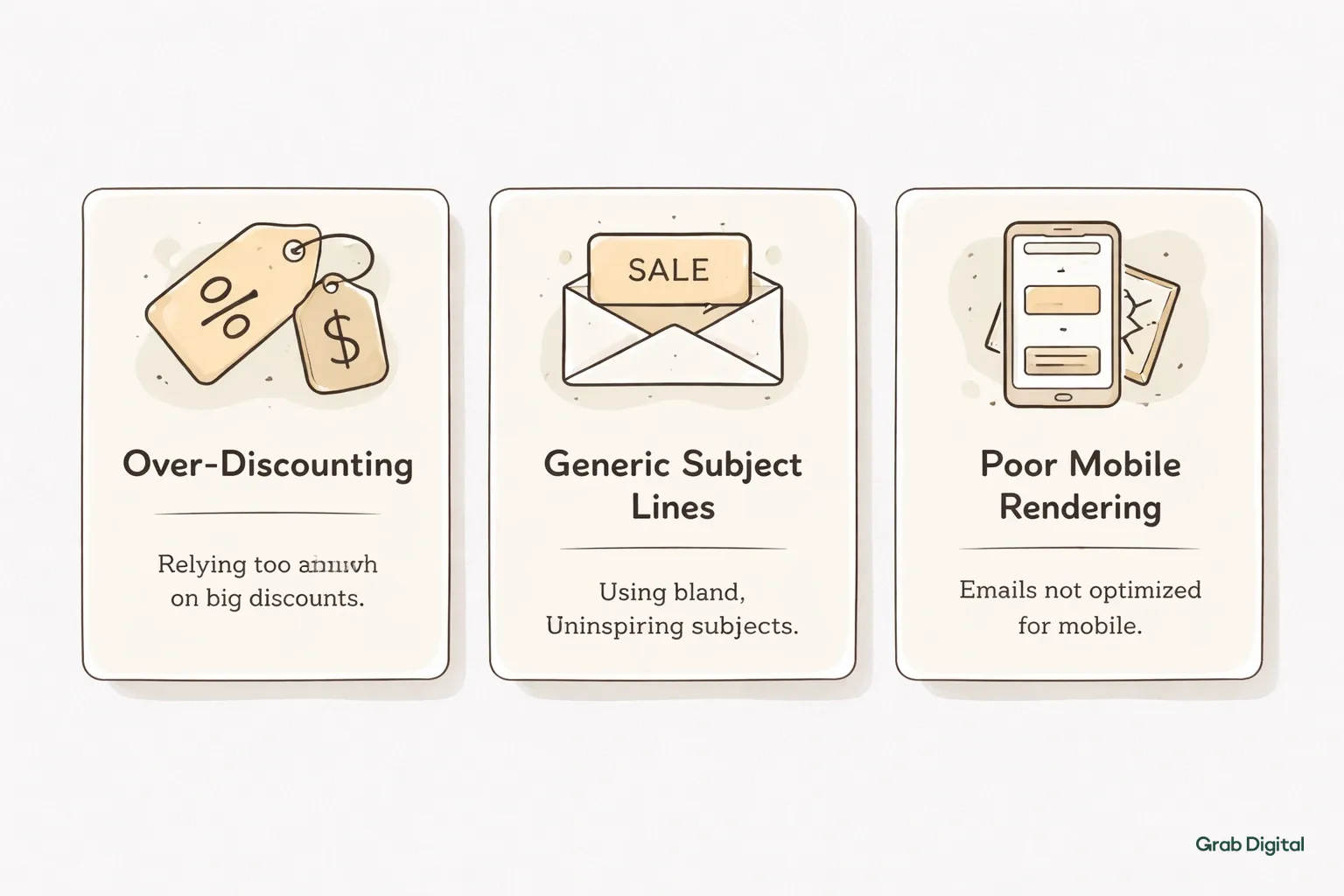
Common mistakes in abandoned cart emails include over-discounting, generic subject lines, and ignoring mobile rendering. These errors quietly erode what could otherwise be a strong recovery flow, often without the brand realizing why performance has stalled.
A few patterns show up repeatedly across underperforming flows. Subject lines that say "You forgot something" are overused and get ignored or filtered as spam-adjacent. Discounts offered too early like leading with 20% off in the first email train customers to always wait for a deal. Desktop-only testing is a trap, because over 60% of email opens happen on mobile, and a broken layout kills trust instantly. And no segmentation by product category means a $500 furniture piece and a $25 skincare bundle are getting the same cart recovery tones.
Getting this right consistently is hard to do manually, especially as a brand scales past the 10,000 subscriber mark. That's typically when brands realize they need a dedicated team rather than piecing together flows between other priorities. If your cart recovery emails aren't performing the way they should, you can book your free consultation to get a second set of eyes on what's currently live in your Klaviyo account.
How to Audit Your Own Abandoned Cart Flow
Auditing an abandoned cart flow starts with checking send timing, subject line variety, and whether each email in the sequence serves a distinct purpose. A flow with three emails that all say essentially the same thing isn't really a sequence. It's repetition.
Walk through your own flow and ask if each email has a different job, like reminder, trust-building, or urgency. Are subject lines tested against each other, or just assumed to work? Is the first email sending within the ideal 1 to 3 hour window? Does the flow pull in real product images dynamically, or static ones? Have you checked how each email renders on Apple Mail, Gmail, and Outlook?
This kind of audit is also a good moment to revisit your overall DTC email marketing checklist to make sure cart recovery fits into a broader, cohesive strategy rather than existing as an isolated flow. You can also browse examples of flows we've built for past clients on our portfolio page to see these principles applied in practice.
Final Thoughts
Abandoned cart email examples that convert all share restraint, relevance, and real product focus. They avoid generic templates in favor of copy and imagery that speaks directly to why the shopper hesitated in the first place.
If you're running a DTC brand doing $1M to $10M in revenue and your cart recovery flow feels more like guesswork than strategy, it might be time to bring in a dedicated email team. Check out our full list of services to see how we approach flows, campaigns, and segmentation as one connected system.
Quick Answers to Common Questions
How many emails should be in an abandoned cart flow? Most high-performing DTC flows use three to four emails spread across five to seven days. Three handles the core sequence (reminder, trust-building, urgency), while a fourth personal touch email can help recover stragglers who didn't respond to the first three.
When should the first abandoned cart email send? The first email should send within one to three hours of abandonment. This window captures the shopper while their interest is still warm, before they've moved on or found the product elsewhere.
Should I always include a discount in abandoned cart emails? No. Leading with a discount in the first email trains customers to abandon carts intentionally and wait for a deal. Save any discount or incentive for the second or third email, and keep it modest.
What's the biggest mistake brands make with cart recovery emails? Treating all three emails in the sequence as interchangeable reminders. Each email should serve a distinct purpose, whether that's reigniting desire, building trust, or creating genuine urgency.
Does abandoned cart email performance differ by product price point? Yes. Higher-priced, considered purchases like furniture need more trust-building and less urgency pressure. Lower-priced impulse items respond better to faster timelines and modest incentives.
How do I know if my abandoned cart flow needs an overhaul? If your recovery rate sits below 10% of abandoned carts, or if all your emails look and sound the same, it's a sign the flow needs restructuring rather than minor tweaks.
DTC brands lose about 70% of carts on average. The ones actually recovering 15-25% of that lost revenue aren't doing it with magic. They're just using specific product imagery, real urgency, and copy that sounds like a human wrote it.
Most abandoned cart emails fail because they read like automated templates instead of someone actually talking to the customer. I've looked at a lot of these flows, and the ones that work share a few common traits. Let's break down real-world examples from DTC brands so you can see what separates a forgettable reminder from an email that brings people back to checkout.
Why Most Abandoned Cart Emails Underperform
These emails underperform because they default to generic reminders instead of addressing why someone actually left. Shoppers abandon carts for all sorts of reasons. Price hesitation. Shipping cost shock. Distraction. Or maybe they're just checking out a competitor.
Put yourself in the shopper's shoes. They add a jacket to their cart, get distracted by a phone call, and three hours later they get an email saying "You left something behind!" with a generic stock photo of a shopping cart. It completely fails to remind them why they wanted the product in the first place.
The brands getting results do the opposite. They use real product photography, call out the exact item left behind, and write copy that feels like it came from an actual person on the team. This is the foundation of any high-ROI abandoned cart flow that actually moves the needle.
Example 1: The Product-First Reminder
A product-first reminder leads with a large, clear image of the exact abandoned item and minimal text. It works because it re-triggers the original desire without burying it under promotional garbage.
Rogue Industries and similar leather goods brands do this well. Picture an email with a single leather wallet shot on a clean background, the product name, the price, and one line: "Still thinking it over? It's waiting for you." No discount code. No countdown timer. No aggressive CTA button screaming "BUY NOW."
What makes this convert is simple. The image does the selling, not the copy. There's no pressure tactic that feels salesy, and the CTA is soft. It says "Pick up where you left off" instead of "Complete your purchase now."
This first email usually goes out within an hour of abandonment, while intent is still warm. Brands that get their abandoned cart email best practices dialed in know this first touch should never feel like a sales pitch.
Example 2: The Social Proof Follow-Up
A social proof follow-up email uses customer reviews or user-generated content to answer the unspoken objection: "is this actually worth it?" You send this about 24 hours after abandonment, assuming the initial reminder didn't do the trick.
Natural skincare brands like Beessential have this down. Instead of just saying "come back," their second email might feature three short reviews like "This changed my skin in two weeks" next to a star rating and a photo of the product in use. The messaging shifts from "remember this" to "here's proof it works."
Why does this format convert? Star ratings build instant trust, and short review quotes address skepticism directly. User photos show real-world use, not studio shots, and a soft CTA keeps pressure low.
Segmentation matters here too. A repeat customer doesn't need the same social proof as a first-time visitor. Strong email segmentation ensures the right proof point reaches the right person.
Example 3: The Urgency Email, Done Right
An urgency email done right uses real scarcity, not fake countdown timers. This third email in the sequence sends 48 to 72 hours after abandonment. It works because it gives the shopper an actual reason to act now instead of manufactured pressure.
Premium sustainable furniture brands like Model No. face a specific challenge here. Their products are considered purchases, not impulse buys, so fake urgency backfires badly. Instead, their third email might mention genuine limited inventory on a specific finish, or a small, time-bound incentive like free shipping that expires in 48 hours.
What separates this from spammy urgency tactics? The scarcity is tied to something real, like limited stock or seasonal availability. The discount, if offered, is modest not a 30% blowout that trains customers to wait. And the tone stays calm and informative, not panicked.
Brands that rely too heavily on discounting at this stage often end up training their list to abandon carts on purpose, just waiting for the inevitable coupon. A smarter cart abandonment solution builds urgency through genuine scarcity or bonus value, not price erosion.
Example 4: The "We Noticed" Personal Touch Email
A "we noticed" email uses first-person, conversational language to make the shopper feel seen rather than tracked. This works particularly well for DTC lifestyle brands with strong founder stories or distinct brand voices.
Instead of corporate phrasing like "We noticed you left items in your cart," a well-crafted version reads: "Hey, saw you were checking out our [product]. Questions about sizing, materials, or shipping? Just hit reply, we actually read these." This small shift from automated-sounding copy to a genuine note changes how the email lands in someone's inbox.
Elements that make this format effective include plain-text style formatting that mimics a real email, not a marketing blast. It includes an invitation to reply, which also signals to inbox providers that the email is engaged with. And the sender name is a real person, not "Team [Brand Name]."
This kind of email also supports better email deliverability because replies and opens tell Gmail and Outlook that recipients actually want this content.
What Ties All These Examples Together
Every high-converting abandoned cart example shares a common structure. Timing, personalization, and a clear next step. None of them rely on a single silver-bullet tactic. They work as a sequence where each email builds on the last.
Here's the typical cadence that performs well across DTC verticals. In hour one, send a product-first reminder with a soft tone and no discount. At hour 24, send a social proof email to address trust objections. Between hour 48 and 72, introduce real urgency or a bonus incentive that's time-bound. Then, on day five to seven, optionally send a personal, conversational check-in.
Brands running this as a disconnected set of emails instead of a true flow tend to see weaker results. The sequence needs to feel like a continued conversation, not four separate interruptions. This is exactly the kind of structure covered in our breakdown of the 3-email abandoned cart strategy that Klaviyo supports natively.
Common Mistakes That Kill Conversion Rates
Common mistakes in abandoned cart emails include over-discounting, generic subject lines, and ignoring mobile rendering. These errors quietly erode what could otherwise be a strong recovery flow, often without the brand realizing why performance has stalled.
A few patterns show up repeatedly across underperforming flows. Subject lines that say "You forgot something" are overused and get ignored or filtered as spam-adjacent. Discounts offered too early like leading with 20% off in the first email train customers to always wait for a deal. Desktop-only testing is a trap, because over 60% of email opens happen on mobile, and a broken layout kills trust instantly. And no segmentation by product category means a $500 furniture piece and a $25 skincare bundle are getting the same cart recovery tones.
Getting this right consistently is hard to do manually, especially as a brand scales past the 10,000 subscriber mark. That's typically when brands realize they need a dedicated team rather than piecing together flows between other priorities. If your cart recovery emails aren't performing the way they should, you can book your free consultation to get a second set of eyes on what's currently live in your Klaviyo account.
How to Audit Your Own Abandoned Cart Flow
Auditing an abandoned cart flow starts with checking send timing, subject line variety, and whether each email in the sequence serves a distinct purpose. A flow with three emails that all say essentially the same thing isn't really a sequence. It's repetition.
Walk through your own flow and ask if each email has a different job, like reminder, trust-building, or urgency. Are subject lines tested against each other, or just assumed to work? Is the first email sending within the ideal 1 to 3 hour window? Does the flow pull in real product images dynamically, or static ones? Have you checked how each email renders on Apple Mail, Gmail, and Outlook?
This kind of audit is also a good moment to revisit your overall DTC email marketing checklist to make sure cart recovery fits into a broader, cohesive strategy rather than existing as an isolated flow. You can also browse examples of flows we've built for past clients on our portfolio page to see these principles applied in practice.
Final Thoughts
Abandoned cart email examples that convert all share restraint, relevance, and real product focus. They avoid generic templates in favor of copy and imagery that speaks directly to why the shopper hesitated in the first place.
If you're running a DTC brand doing $1M to $10M in revenue and your cart recovery flow feels more like guesswork than strategy, it might be time to bring in a dedicated email team. Check out our full list of services to see how we approach flows, campaigns, and segmentation as one connected system.
Quick Answers to Common Questions
How many emails should be in an abandoned cart flow? Most high-performing DTC flows use three to four emails spread across five to seven days. Three handles the core sequence (reminder, trust-building, urgency), while a fourth personal touch email can help recover stragglers who didn't respond to the first three.
When should the first abandoned cart email send? The first email should send within one to three hours of abandonment. This window captures the shopper while their interest is still warm, before they've moved on or found the product elsewhere.
Should I always include a discount in abandoned cart emails? No. Leading with a discount in the first email trains customers to abandon carts intentionally and wait for a deal. Save any discount or incentive for the second or third email, and keep it modest.
What's the biggest mistake brands make with cart recovery emails? Treating all three emails in the sequence as interchangeable reminders. Each email should serve a distinct purpose, whether that's reigniting desire, building trust, or creating genuine urgency.
Does abandoned cart email performance differ by product price point? Yes. Higher-priced, considered purchases like furniture need more trust-building and less urgency pressure. Lower-priced impulse items respond better to faster timelines and modest incentives.
How do I know if my abandoned cart flow needs an overhaul? If your recovery rate sits below 10% of abandoned carts, or if all your emails look and sound the same, it's a sign the flow needs restructuring rather than minor tweaks.

Find out exactly what your email channel is leaving on the table.

Email Marketing for Scaling DTC Brands


