
Summary
Fix Cart Abandonment with Klaviyo: 3-Email Strategy (2026)
Cart abandonment is still bleeding revenue out of DTC brands in 2026. Industry benchmarks have hovered around 70% for years — for every ten shoppers who add something to cart, roughly seven leave without buying. That math hasn't moved much. What has changed is how good your flow needs to be to claw any of that back.
Klaviyo gives you the tools to recover those sales. The problem is most brands still set up one generic email and wonder why revenue doesn't move. A single nudge isn't a strategy. Here's how to build a flow that actually works right now, and what's different about running it this year.
What's Changed in Cart Abandonment Flows for 2026
If you built your cart abandonment flow more than a year ago, it's worth a rebuild rather than a tweak. A few things have shifted since then: Klaviyo's flow filters and AI-assisted subject line suggestions are more capable than the default templates most brands are still running, Shopify's checkout event data now treats cart and checkout drop-off as distinct signals worth tracking separately, and SMS opt-in rules have gotten stricter, so a flow that leaned on text messages without clean consent tracking is now a compliance risk, not just a deliverability one.
None of that changes the core structure below. It changes how much you can automate inside it, and it means a flow you haven't touched since last year is probably underperforming for reasons that have nothing to do with your offer.
Why Most Klaviyo Cart Abandonment Flows Fail
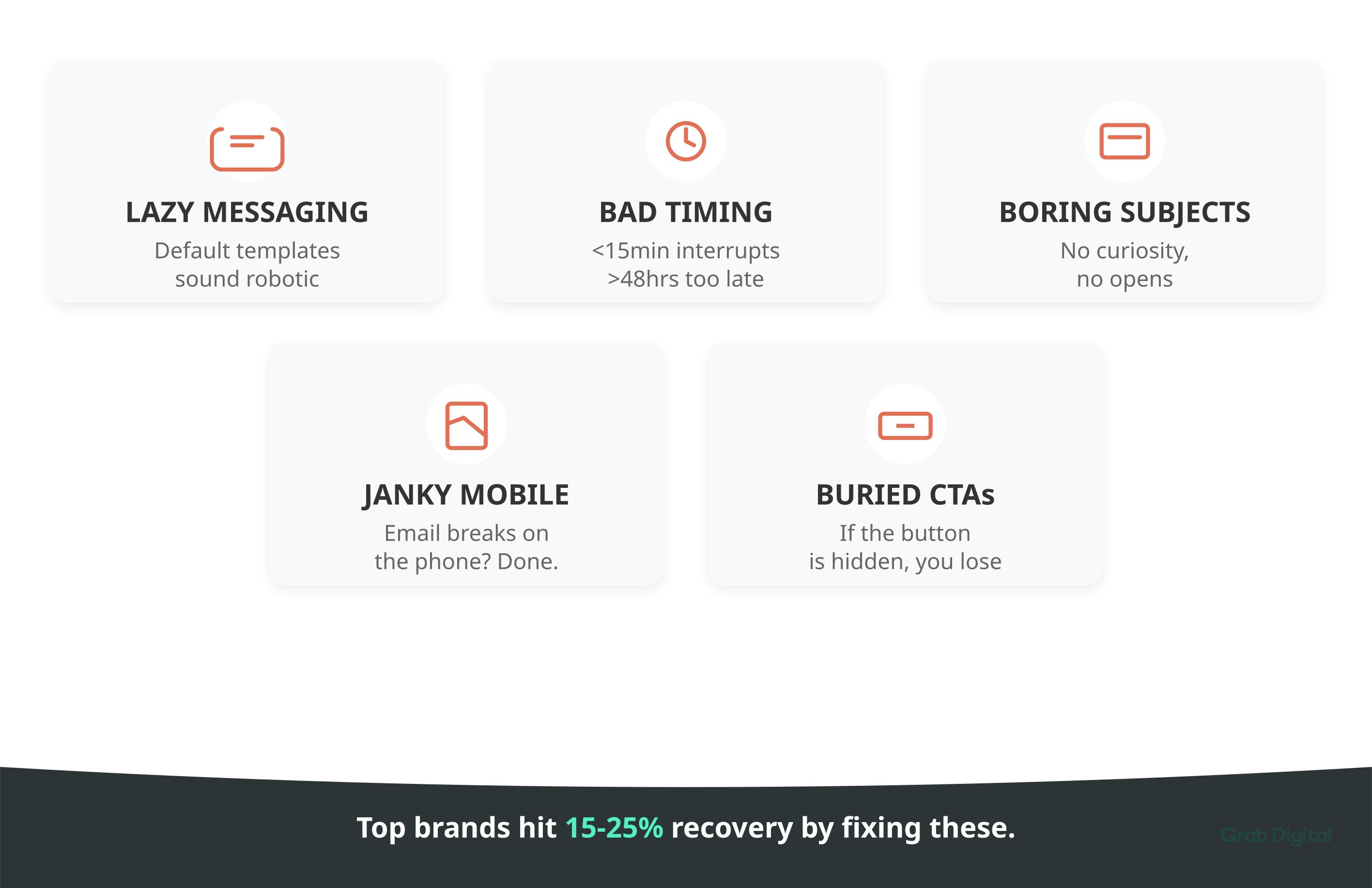
Most sequences fail for the same handful of reasons:
Lazy messaging. Default Klaviyo templates sound like nobody. If your email doesn't sound like your brand, it gets deleted.
Bad timing. Under 15 minutes is too early — you're interrupting someone mid-browse. Past 48 hours, they've moved on.
Boring subject lines. No curiosity, no urgency, no open. No open, no sale.
A broken mobile experience. Most email opens happen on a phone. If your layout breaks there, you're done before anyone reads the copy.
Buried CTAs. One job: get them back to the cart. If the button is hidden, you lose.
The pattern shows up in the numbers. Brands stuck at 5-8% recovery are usually running one email, sending it too late, or leaving Klaviyo's default template untouched. Brands hitting 15-25% recovery aren't sending more emails — they're sending smarter ones, with copy that sounds human and timing that matches how people actually shop.
How to Set Up a Klaviyo Cart Abandonment Flow
Get the technical foundation right before you write a single subject line. This is the part brands skip, and it's why rushed flows underperform for months before anyone notices.
1. Choose the right trigger. In Klaviyo, go to Flows > Create Flow > From Scratch. For Shopify stores, trigger off "Checkout Started," not "Added to Cart." Checkout Started fires once someone enters an email and moves toward payment, which gives you a real contact to email and filters out casual browsers who never intended to buy. Add a 1-4 hour delay before email one sends.
2. Set your filters. Don't email people who already bought or opted out:
- Has not placed an order since starting this flow
- Is not suppressed for email
- Has opted in to email marketing
3. Turn on dynamic content. This is non-negotiable. Show exactly what they abandoned — product image, name, price. Use a loop like {% for item in event.extra.line_items %} in Klaviyo to pull line-item details straight from the event. A flow without this looks like spam even when the copy is good.
4. Test in real inboxes. Klaviyo's live preview doesn't always match what Gmail, Outlook, or an iPhone actually render. Send tests to at least one of each before switching the flow live.
5. Decide who's exempt. A first-time visitor with no purchase history often needs a different message than a returning customer abandoning for the fourth time. If your list is big enough to support it, split the flow here instead of forcing everyone through identical copy.
If you'd rather see the whole build mapped out step by step, we've covered the full technical setup in our guide to building a high-ROI abandoned cart flow on Klaviyo.
Don't want to wrestle with setup yourself? Our team builds this for you — strategy and testing included.
The 3-Email Cart Abandonment Sequence That Works
One email isn't enough. Five is overkill for most stores. Three, timed correctly, is the sweet spot.
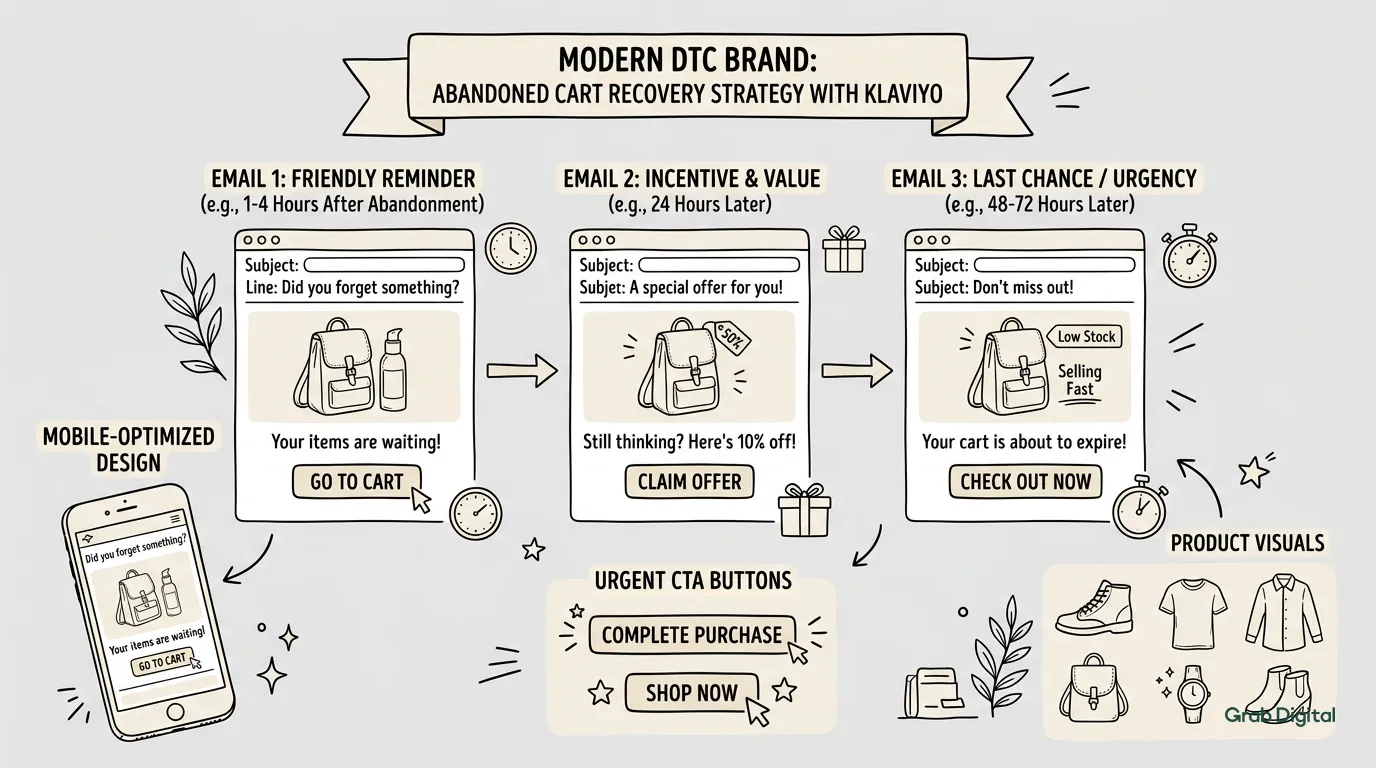
Email 1: The reminder (1-4 hours later)
Remind them. Make it easy to return.
Subject lines:
- "Still thinking about it?"
- "Your cart is waiting"
- "Did something get in the way?"
Structure:
- Use their name.
- "You left this in your cart."
- Show the product image and price.
- One CTA: "Complete Your Order"
- No discount. Not yet.
This email typically drives the majority of recovered revenue in the flow. Keep it simple. For more subject line formulas by stage, see our breakdown of high-converting cart abandonment subject lines for 2026.
Email 2: The reinforcement (24 hours later)
They didn't bite. Now sell them.
Subject lines:
- "Here's why [Product Name] is worth it"
- "Customers love this. Here's proof."
Structure:
- Show the product again.
- Add reviews, ratings, testimonials, or a short customer photo.
- Hit a key benefit.
- Address objections: shipping, returns, fit.
- CTA: "Complete My Order"
This catches people who needed a reason, not just a reminder.
Email 3: The push (48-72 hours later)
Last shot. Give them a reason to act now.
Subject lines:
- "Last call: 10% off your cart"
- "We saved your cart — here's 15% off"
Structure:
- Show the product again.
- Offer 10-15% off.
- Create urgency: "Expires in 24 hours" or "Only 2 left."
- CTA: "Claim My Discount"
Worried this trains people to abandon carts on purpose? It rarely happens in practice. Keep the offer exclusive to this email and treat loyal, repeat customers better through other channels. This last email usually recovers only a fraction of total flow revenue compared to email one, but it catches the holdouts who needed a real push. For a deeper library of proven structures and copy examples, see our abandoned cart email best practices guide.
What's the Difference Between Cart and Checkout Abandonment?
Cart abandonment and checkout abandonment get used interchangeably, but Klaviyo and Shopify treat them as separate events, and they call for different fixes. Cart abandonment happens when someone adds a product to their cart and leaves before starting checkout. Checkout abandonment happens further down the funnel — they've entered contact or shipping information, sometimes even payment details, and still bail.
Shopify fires "Added to Cart" early and "Checkout Started" once someone begins the checkout process. The three-email flow in this post is built on Checkout Started, because it captures people who've shown real purchase intent rather than just curiosity, and it gives you an email address to send to.
If most of your abandonment is concentrated at the payment step rather than the cart step, the fix looks different — usually surprise shipping costs, a clunky checkout flow, or missing payment methods rather than weak email copy. That's a separate diagnosis, and we cover it in our guide to fixing checkout abandonment with Klaviyo. Check both metrics in Shopify analytics before assuming email is the whole fix.
Advanced Cart Abandonment Tactics for Klaviyo
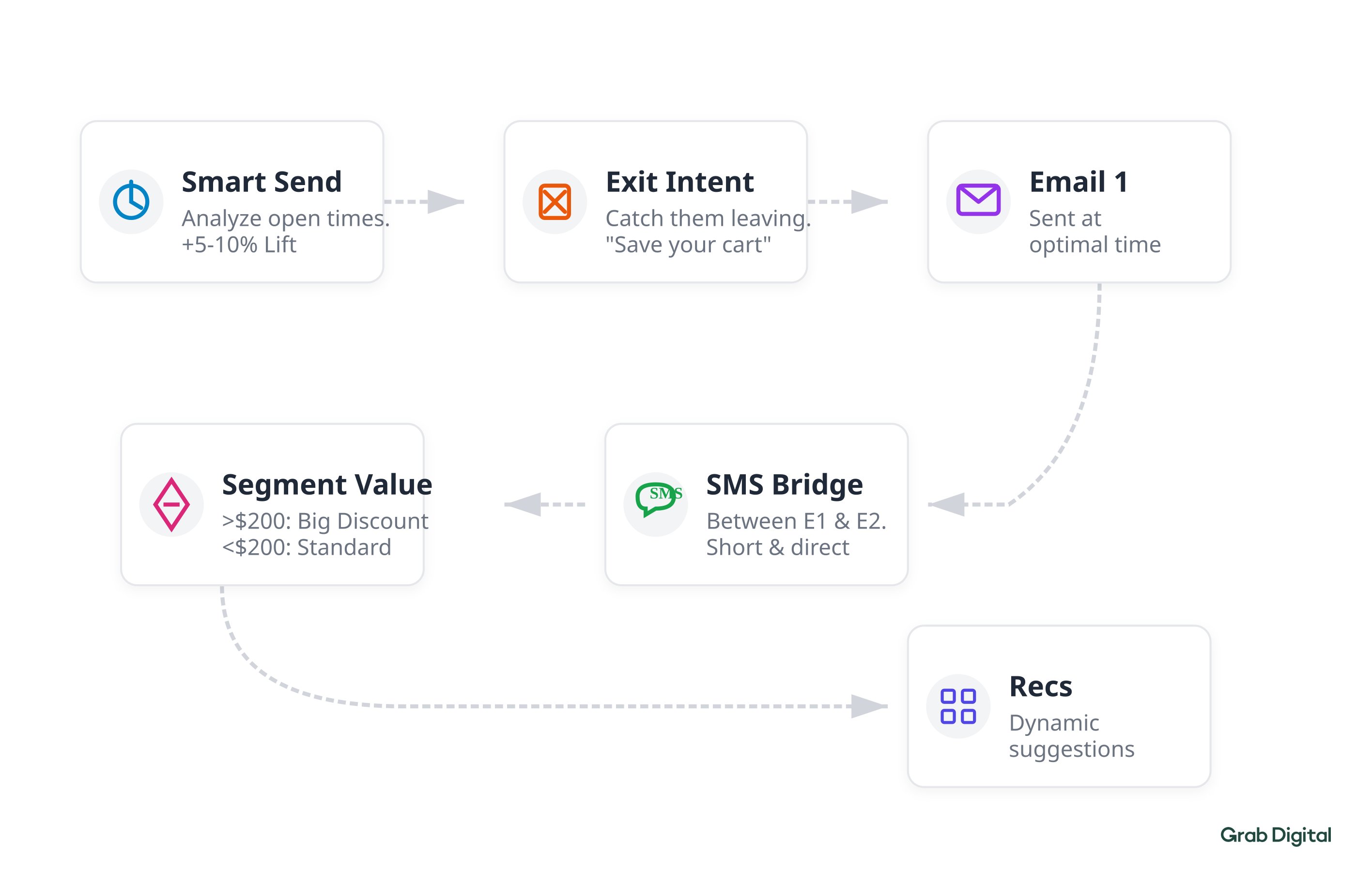
Once the three-email flow is live and converting, layer these on top:
Smart Send Time. Klaviyo analyzes when each person typically opens email and sends accordingly. It's a low-effort way to lift opens without touching copy.
Exit-intent popups. No email address means you can't message anyone. Catch abandoners on the way out with a "Save your cart" form.
SMS. If you have documented consent, one text between email 1 and 2 can work well. Keep it short: "Hey [Name], your cart is still here: [link]." Confirm your consent language is current — this is one of the areas that's tightened the most recently.
Segment by cart value. High-value carts might deserve a bigger discount or a personal note. Low-value carts might not need one at all. Use conditional splits on Checkout Started > Value.
Recommendations. If they abandoned one item, suggest a complementary one in email 2 or 3.
Inventory alerts. Low stock? Say so: "Only 3 left." Real scarcity works; fake scarcity gets noticed and erodes trust.
If you want dedicated software for popups, SMS, or list capture beyond what Klaviyo's flow builder handles natively, see our roundup of the top cart abandonment tools for DTC brands in 2026.
What Metrics to Track for Cart Abandonment Recovery
Check these monthly, not just when revenue looks off:
| Metric | Target range |
|---|---|
| Flow revenue (% of total email revenue) | 5-10% |
| Recovery rate | 15-25% |
| Open rate | 40-50% (email 1), 25-35% (emails 2-3) |
| Click rate | 10-15% |
| Conversion rate | 5-10% |
| Revenue per recipient | Trending up month over month |
Use the numbers to diagnose, not just report. If recovery sits under 15%, fix email 1 first — subject line or timing is usually the culprit. If opens are strong but clicks are weak, check CTA placement and image rendering on mobile. If clicks are fine but conversion still lags, the friction is probably at checkout, not in the email — revisit the cart-versus-checkout distinction above before touching copy again. A/B test one variable at a time and give it at least two weeks before calling a result.
Common Cart Abandonment Mistakes to Avoid
Emailing everyone. Someone hasn't opened in six months? Cut them. They'll just hurt your sender score.
Ignoring mobile. Buttons must be tappable. Text must be readable without zooming.
Being aggressive. "BUY NOW OR LOSE IT" is a turnoff. Sound like your brand, not a countdown timer.
Showing out-of-stock items. Hide them or swap in something else with conditional logic — nothing kills trust faster than promoting a product that's gone.
Broken integration. If Shopify and Klaviyo aren't syncing cleanly, nothing fires, and you won't notice until revenue quietly drops.
When to Get Help with Your Cart Abandonment Flow
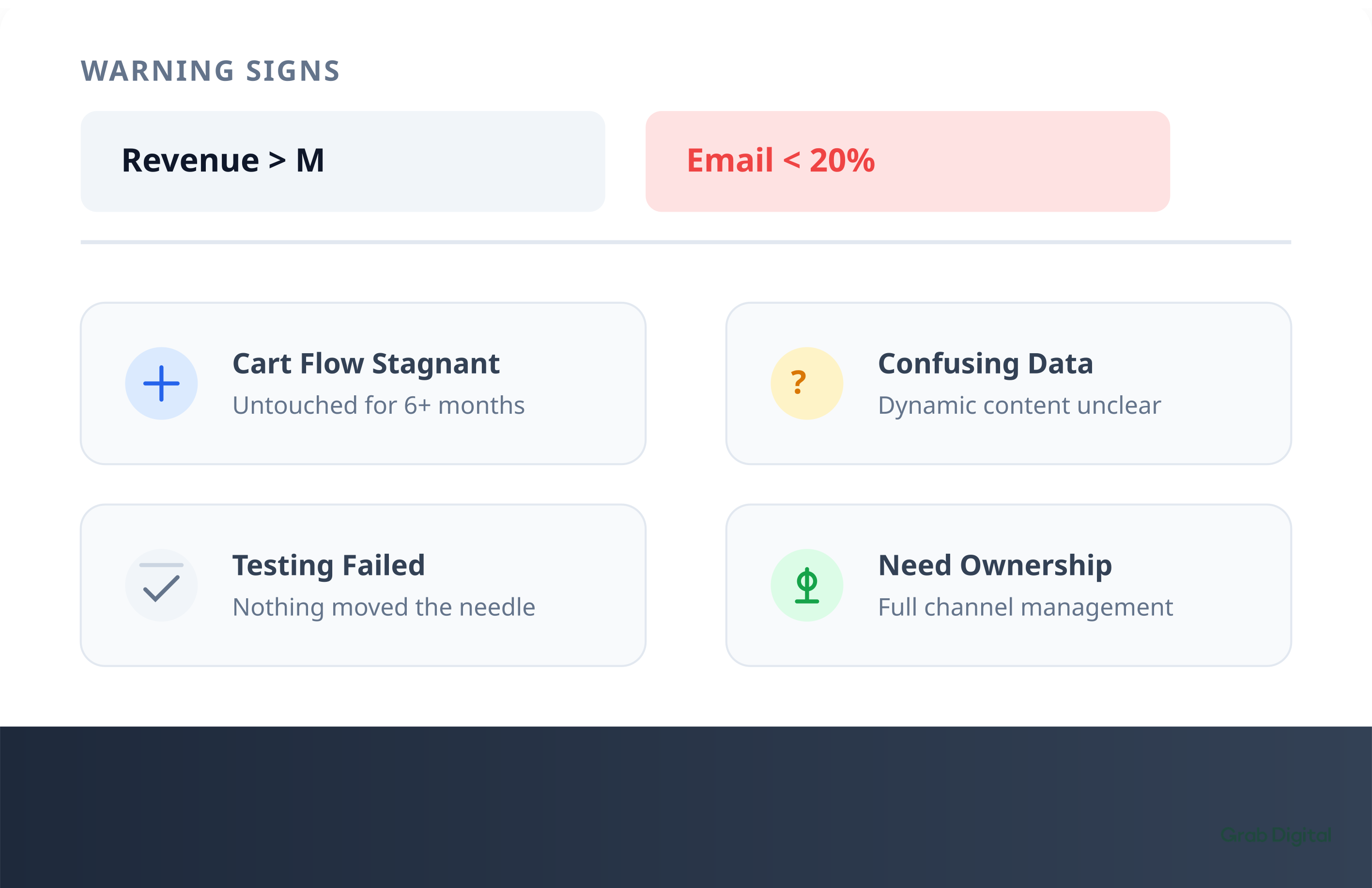
If you're doing $1M+ in revenue and email is under 20% of that, your flows are probably broken.
Get help if:
- The cart flow hasn't been touched in six months or more
- Dynamic content makes no sense or shows the wrong products
- You've tested changes and nothing moved
- You want someone to own the whole channel instead of patching it quarterly
At Grab Digital, we build abandoned cart flows as part of a full Klaviyo strategy. We guarantee 10% growth in email-attributed revenue within 60 days, baseline measured on day one, or a full refund. No asterisks.
Cart Abandonment Action Plan
- Build the three-email flow: 1-4 hours, 24 hours, 48-72 hours.
- Use dynamic content pulled from the actual line items.
- Write subject lines that spark curiosity or urgency, not generic reminders.
- Add proof — reviews, benefits, objection handling — in email 2.
- Put the discount in email 3 only, and make it urgent.
- Test everything on mobile before turning it on.
- Check the metrics table above monthly.
- A/B test one variable at a time and iterate.
If you're under 15% recovery, start with email 1 and work down the list.
Cart abandonment won't disappear. But with Klaviyo and a real three-email strategy, you can claw back a meaningful chunk of that lost revenue. Winners in 2026 aren't sending more emails. They're sending better ones.
FAQs
When should I send the first cart abandonment email?
1-4 hours after abandonment. Sooner interrupts someone mid-browse; later and you've lost their attention entirely. This single email typically drives most of the flow's recovered revenue, so get the timing and subject line right before touching anything else.
Should I include a discount in every cart abandonment email?
No. Save it for the third and final email. Discounting too early trains shoppers to expect a deal every time and erodes margin on sales you would have gotten anyway without one.
What's a good cart abandonment recovery rate in 2026?
15-25% is a solid target for a well-built three-email flow. Below that, something in timing, copy, or dynamic content is broken. Above 25%, keep iterating rather than assuming you've hit a ceiling.
Can I email people who didn't opt in to marketing?
It's legally risky and hurts deliverability. The safest approach is to only email subscribers who've explicitly opted in to marketing, and to filter unsubscribed or suppressed contacts out of the flow entirely.
What's the difference between cart abandonment and checkout abandonment?
Cart abandonment happens before checkout starts; checkout abandonment happens after someone has entered shipping or payment details and still leaves. They're different problems — email fixes the first, checkout friction usually explains the second.
Does Klaviyo have a built-in cart abandonment flow?
Yes, Klaviyo ships a default template triggered off "Checkout Started" for Shopify stores. It works as a starting point, but the default copy, timing, and filters rarely match your brand or your customers, which is why most brands need to rebuild it.
How do I keep cart abandonment emails out of spam?
Clean your list regularly, send from a verified domain, avoid spam-trigger words, and confirm your DKIM, SPF, and DMARC records are correctly configured. Sender reputation matters more for automated flows than for one-off campaigns.
What if someone abandoned a cart with a lot of items?
Show the top three or four items by value, then add a "View full cart" link instead of listing everything. Overloading the email with every product usually lowers click rate rather than raising it.
Cart abandonment is still bleeding revenue out of DTC brands in 2026. Industry benchmarks have hovered around 70% for years — for every ten shoppers who add something to cart, roughly seven leave without buying. That math hasn't moved much. What has changed is how good your flow needs to be to claw any of that back.
Klaviyo gives you the tools to recover those sales. The problem is most brands still set up one generic email and wonder why revenue doesn't move. A single nudge isn't a strategy. Here's how to build a flow that actually works right now, and what's different about running it this year.
What's Changed in Cart Abandonment Flows for 2026
If you built your cart abandonment flow more than a year ago, it's worth a rebuild rather than a tweak. A few things have shifted since then: Klaviyo's flow filters and AI-assisted subject line suggestions are more capable than the default templates most brands are still running, Shopify's checkout event data now treats cart and checkout drop-off as distinct signals worth tracking separately, and SMS opt-in rules have gotten stricter, so a flow that leaned on text messages without clean consent tracking is now a compliance risk, not just a deliverability one.
None of that changes the core structure below. It changes how much you can automate inside it, and it means a flow you haven't touched since last year is probably underperforming for reasons that have nothing to do with your offer.
Why Most Klaviyo Cart Abandonment Flows Fail
Most sequences fail for the same handful of reasons:
Lazy messaging. Default Klaviyo templates sound like nobody. If your email doesn't sound like your brand, it gets deleted.
Bad timing. Under 15 minutes is too early — you're interrupting someone mid-browse. Past 48 hours, they've moved on.
Boring subject lines. No curiosity, no urgency, no open. No open, no sale.
A broken mobile experience. Most email opens happen on a phone. If your layout breaks there, you're done before anyone reads the copy.
Buried CTAs. One job: get them back to the cart. If the button is hidden, you lose.
The pattern shows up in the numbers. Brands stuck at 5-8% recovery are usually running one email, sending it too late, or leaving Klaviyo's default template untouched. Brands hitting 15-25% recovery aren't sending more emails — they're sending smarter ones, with copy that sounds human and timing that matches how people actually shop.
How to Set Up a Klaviyo Cart Abandonment Flow
Get the technical foundation right before you write a single subject line. This is the part brands skip, and it's why rushed flows underperform for months before anyone notices.
1. Choose the right trigger. In Klaviyo, go to Flows > Create Flow > From Scratch. For Shopify stores, trigger off "Checkout Started," not "Added to Cart." Checkout Started fires once someone enters an email and moves toward payment, which gives you a real contact to email and filters out casual browsers who never intended to buy. Add a 1-4 hour delay before email one sends.
2. Set your filters. Don't email people who already bought or opted out:
- Has not placed an order since starting this flow
- Is not suppressed for email
- Has opted in to email marketing
3. Turn on dynamic content. This is non-negotiable. Show exactly what they abandoned — product image, name, price. Use a loop like {% for item in event.extra.line_items %} in Klaviyo to pull line-item details straight from the event. A flow without this looks like spam even when the copy is good.
4. Test in real inboxes. Klaviyo's live preview doesn't always match what Gmail, Outlook, or an iPhone actually render. Send tests to at least one of each before switching the flow live.
5. Decide who's exempt. A first-time visitor with no purchase history often needs a different message than a returning customer abandoning for the fourth time. If your list is big enough to support it, split the flow here instead of forcing everyone through identical copy.
If you'd rather see the whole build mapped out step by step, we've covered the full technical setup in our guide to building a high-ROI abandoned cart flow on Klaviyo.
Don't want to wrestle with setup yourself? Our team builds this for you — strategy and testing included.
The 3-Email Cart Abandonment Sequence That Works
One email isn't enough. Five is overkill for most stores. Three, timed correctly, is the sweet spot.
Email 1: The reminder (1-4 hours later)
Remind them. Make it easy to return.
Subject lines:
- "Still thinking about it?"
- "Your cart is waiting"
- "Did something get in the way?"
Structure:
- Use their name.
- "You left this in your cart."
- Show the product image and price.
- One CTA: "Complete Your Order"
- No discount. Not yet.
This email typically drives the majority of recovered revenue in the flow. Keep it simple. For more subject line formulas by stage, see our breakdown of high-converting cart abandonment subject lines for 2026.
Email 2: The reinforcement (24 hours later)
They didn't bite. Now sell them.
Subject lines:
- "Here's why [Product Name] is worth it"
- "Customers love this. Here's proof."
Structure:
- Show the product again.
- Add reviews, ratings, testimonials, or a short customer photo.
- Hit a key benefit.
- Address objections: shipping, returns, fit.
- CTA: "Complete My Order"
This catches people who needed a reason, not just a reminder.
Email 3: The push (48-72 hours later)
Last shot. Give them a reason to act now.
Subject lines:
- "Last call: 10% off your cart"
- "We saved your cart — here's 15% off"
Structure:
- Show the product again.
- Offer 10-15% off.
- Create urgency: "Expires in 24 hours" or "Only 2 left."
- CTA: "Claim My Discount"
Worried this trains people to abandon carts on purpose? It rarely happens in practice. Keep the offer exclusive to this email and treat loyal, repeat customers better through other channels. This last email usually recovers only a fraction of total flow revenue compared to email one, but it catches the holdouts who needed a real push. For a deeper library of proven structures and copy examples, see our abandoned cart email best practices guide.
What's the Difference Between Cart and Checkout Abandonment?
Cart abandonment and checkout abandonment get used interchangeably, but Klaviyo and Shopify treat them as separate events, and they call for different fixes. Cart abandonment happens when someone adds a product to their cart and leaves before starting checkout. Checkout abandonment happens further down the funnel — they've entered contact or shipping information, sometimes even payment details, and still bail.
Shopify fires "Added to Cart" early and "Checkout Started" once someone begins the checkout process. The three-email flow in this post is built on Checkout Started, because it captures people who've shown real purchase intent rather than just curiosity, and it gives you an email address to send to.
If most of your abandonment is concentrated at the payment step rather than the cart step, the fix looks different — usually surprise shipping costs, a clunky checkout flow, or missing payment methods rather than weak email copy. That's a separate diagnosis, and we cover it in our guide to fixing checkout abandonment with Klaviyo. Check both metrics in Shopify analytics before assuming email is the whole fix.
Advanced Cart Abandonment Tactics for Klaviyo
Once the three-email flow is live and converting, layer these on top:
Smart Send Time. Klaviyo analyzes when each person typically opens email and sends accordingly. It's a low-effort way to lift opens without touching copy.
Exit-intent popups. No email address means you can't message anyone. Catch abandoners on the way out with a "Save your cart" form.
SMS. If you have documented consent, one text between email 1 and 2 can work well. Keep it short: "Hey [Name], your cart is still here: [link]." Confirm your consent language is current — this is one of the areas that's tightened the most recently.
Segment by cart value. High-value carts might deserve a bigger discount or a personal note. Low-value carts might not need one at all. Use conditional splits on Checkout Started > Value.
Recommendations. If they abandoned one item, suggest a complementary one in email 2 or 3.
Inventory alerts. Low stock? Say so: "Only 3 left." Real scarcity works; fake scarcity gets noticed and erodes trust.
If you want dedicated software for popups, SMS, or list capture beyond what Klaviyo's flow builder handles natively, see our roundup of the top cart abandonment tools for DTC brands in 2026.
What Metrics to Track for Cart Abandonment Recovery
Check these monthly, not just when revenue looks off:
| Metric | Target range |
|---|---|
| Flow revenue (% of total email revenue) | 5-10% |
| Recovery rate | 15-25% |
| Open rate | 40-50% (email 1), 25-35% (emails 2-3) |
| Click rate | 10-15% |
| Conversion rate | 5-10% |
| Revenue per recipient | Trending up month over month |
Use the numbers to diagnose, not just report. If recovery sits under 15%, fix email 1 first — subject line or timing is usually the culprit. If opens are strong but clicks are weak, check CTA placement and image rendering on mobile. If clicks are fine but conversion still lags, the friction is probably at checkout, not in the email — revisit the cart-versus-checkout distinction above before touching copy again. A/B test one variable at a time and give it at least two weeks before calling a result.
Common Cart Abandonment Mistakes to Avoid
Emailing everyone. Someone hasn't opened in six months? Cut them. They'll just hurt your sender score.
Ignoring mobile. Buttons must be tappable. Text must be readable without zooming.
Being aggressive. "BUY NOW OR LOSE IT" is a turnoff. Sound like your brand, not a countdown timer.
Showing out-of-stock items. Hide them or swap in something else with conditional logic — nothing kills trust faster than promoting a product that's gone.
Broken integration. If Shopify and Klaviyo aren't syncing cleanly, nothing fires, and you won't notice until revenue quietly drops.
When to Get Help with Your Cart Abandonment Flow
If you're doing $1M+ in revenue and email is under 20% of that, your flows are probably broken.
Get help if:
- The cart flow hasn't been touched in six months or more
- Dynamic content makes no sense or shows the wrong products
- You've tested changes and nothing moved
- You want someone to own the whole channel instead of patching it quarterly
At Grab Digital, we build abandoned cart flows as part of a full Klaviyo strategy. We guarantee 10% growth in email-attributed revenue within 60 days, baseline measured on day one, or a full refund. No asterisks.
Cart Abandonment Action Plan
- Build the three-email flow: 1-4 hours, 24 hours, 48-72 hours.
- Use dynamic content pulled from the actual line items.
- Write subject lines that spark curiosity or urgency, not generic reminders.
- Add proof — reviews, benefits, objection handling — in email 2.
- Put the discount in email 3 only, and make it urgent.
- Test everything on mobile before turning it on.
- Check the metrics table above monthly.
- A/B test one variable at a time and iterate.
If you're under 15% recovery, start with email 1 and work down the list.
Cart abandonment won't disappear. But with Klaviyo and a real three-email strategy, you can claw back a meaningful chunk of that lost revenue. Winners in 2026 aren't sending more emails. They're sending better ones.
FAQs
When should I send the first cart abandonment email?
1-4 hours after abandonment. Sooner interrupts someone mid-browse; later and you've lost their attention entirely. This single email typically drives most of the flow's recovered revenue, so get the timing and subject line right before touching anything else.
Should I include a discount in every cart abandonment email?
No. Save it for the third and final email. Discounting too early trains shoppers to expect a deal every time and erodes margin on sales you would have gotten anyway without one.
What's a good cart abandonment recovery rate in 2026?
15-25% is a solid target for a well-built three-email flow. Below that, something in timing, copy, or dynamic content is broken. Above 25%, keep iterating rather than assuming you've hit a ceiling.
Can I email people who didn't opt in to marketing?
It's legally risky and hurts deliverability. The safest approach is to only email subscribers who've explicitly opted in to marketing, and to filter unsubscribed or suppressed contacts out of the flow entirely.
What's the difference between cart abandonment and checkout abandonment?
Cart abandonment happens before checkout starts; checkout abandonment happens after someone has entered shipping or payment details and still leaves. They're different problems — email fixes the first, checkout friction usually explains the second.
Does Klaviyo have a built-in cart abandonment flow?
Yes, Klaviyo ships a default template triggered off "Checkout Started" for Shopify stores. It works as a starting point, but the default copy, timing, and filters rarely match your brand or your customers, which is why most brands need to rebuild it.
How do I keep cart abandonment emails out of spam?
Clean your list regularly, send from a verified domain, avoid spam-trigger words, and confirm your DKIM, SPF, and DMARC records are correctly configured. Sender reputation matters more for automated flows than for one-off campaigns.
What if someone abandoned a cart with a lot of items?
Show the top three or four items by value, then add a "View full cart" link instead of listing everything. Overloading the email with every product usually lowers click rate rather than raising it.

Find out exactly what your email channel is leaving on the table.

Email Marketing for Scaling DTC Brands


