
Summary
Abandoned Cart Email Best Practices for DTC Brands in 2026
Abandoned cart email best practices separate DTC brands recovering 15-20% of lost sales from those stuck below 5%. The difference is timing, copy, design, and offer strategy working together inside a Klaviyo flow that actually gets sent. Get these right and abandoned cart becomes your highest-ROI automation or at least it should be.
Cart abandonment isn't a small leak. Roughly 70% of shopping carts get abandoned before checkout. Most brands recover a fraction of that revenue through generic, one-off emails that feel like afterthoughts. The brands doing better in 2026 treat abandoned cart as a system, not a single "did you forget something?" message that goes out whenever someone remembers to hit send.
What Are Abandoned Cart Email Best Practices?
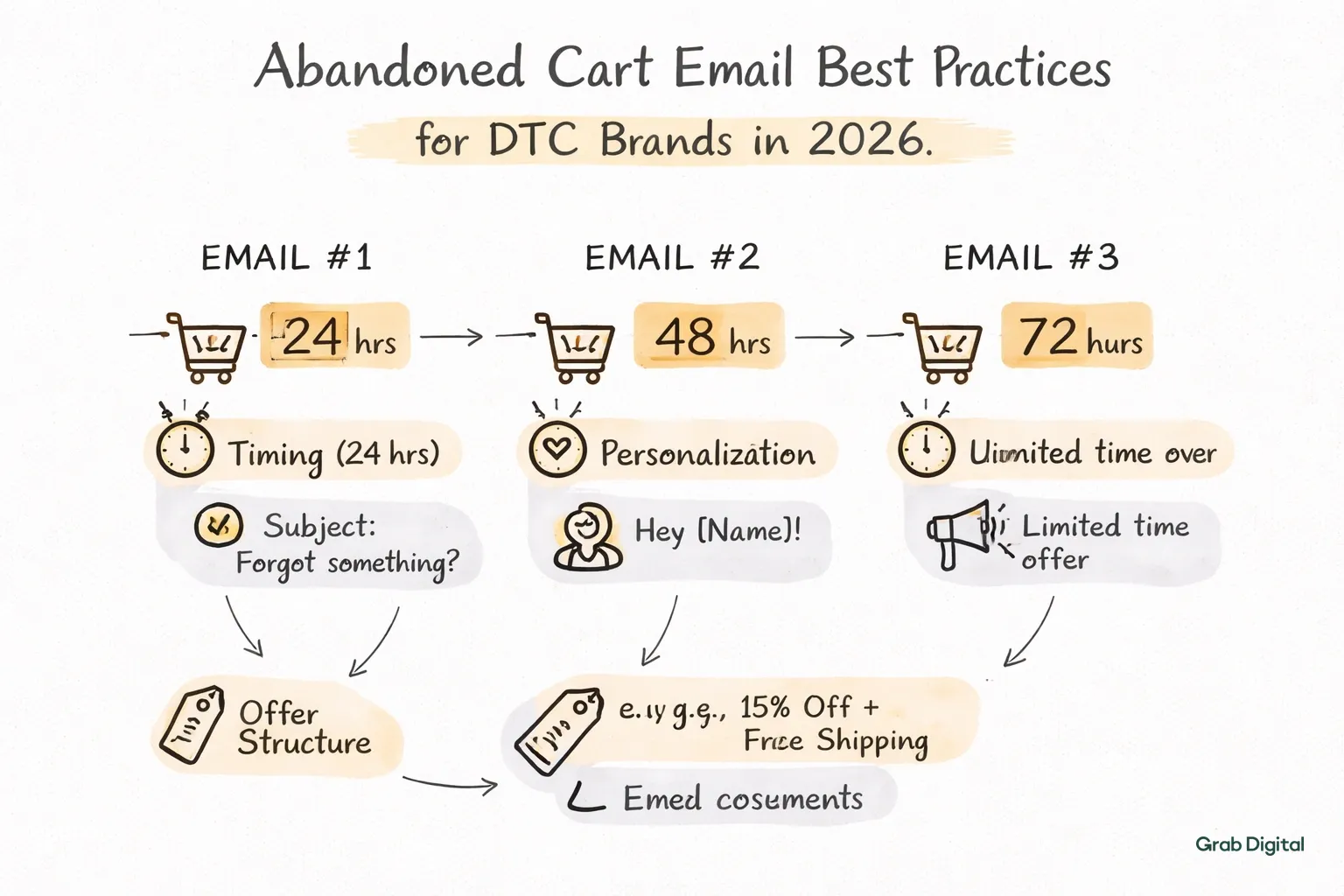
Abandoned cart email best practices are tactics for timing, content, and design that recover revenue from shoppers who leave items unpurchased. They cover send timing, subject lines, personalization, urgency, and offer structure. Done well, these lift recovery rates sometimes 2-3x compared to unoptimized flows, though your mileage will vary based on product category and price point.
Most brands still send a single email 24 hours after abandonment. That leaves money on the table. A decent Klaviyo flow uses multiple touchpoints, each with a job, spaced to match actual shopper behavior rather than whatever timing someone guessed at internally.
Timing: When Should Your First Email Send?
Timing determines whether your abandoned cart email gets opened or ignored. The first email should send within 1 hour of abandonment, while intent is still fresh. Wait longer than 3 hours and recovery rates drop shoppers move on, find the item elsewhere, or just lose interest.
Here's a timing structure that tends to work for DTC brands in the $1M-$10M range:
| Timing | Purpose | |
|---|---|---|
| Email 1 | 1 hour after abandonment | Gentle reminder, no discount |
| Email 2 | 24 hours after abandonment | Social proof, address objections |
| Email 3 | 48-72 hours after abandonment | Urgency or limited incentive |
This structure mirrors what we lay out in our guide on fixing cart abandonment with a 3-email strategy, which goes deeper on spacing and content for each send. The mistake I see constantly: brands skipping straight to discounting in email one. That trains customers to abandon on purpose and wait for the coupon. Hard to un-train that behavior once it sets in.
Subject Lines That Actually Get Opened
Subject lines decide whether your cart email gets read or deleted. The best ones are specific, low-pressure, and don't sound like a mass blast. Generic lines like "You left something behind" underperform. I've watched product-specific and curiosity-driven alternatives win consistently.
From testing across our client base:
- Product name mentions beat generic "your cart" language by a significant margin
- Questions ("Still thinking about the [product]?") tend to outperform statements
- Emoji use should be minimal only where it actually fits your brand voice
- Urgency language works better in email 2 or 3, not email 1
For deeper subject line testing frameworks, our post on crafting high-converting cart abandonment subject lines breaks down formulas by industry. If you're unsure which angle fits, A/B testing across your first two sends is the fastest way to learn what your list actually responds to.
Design and Copy: What Belongs in the Email?
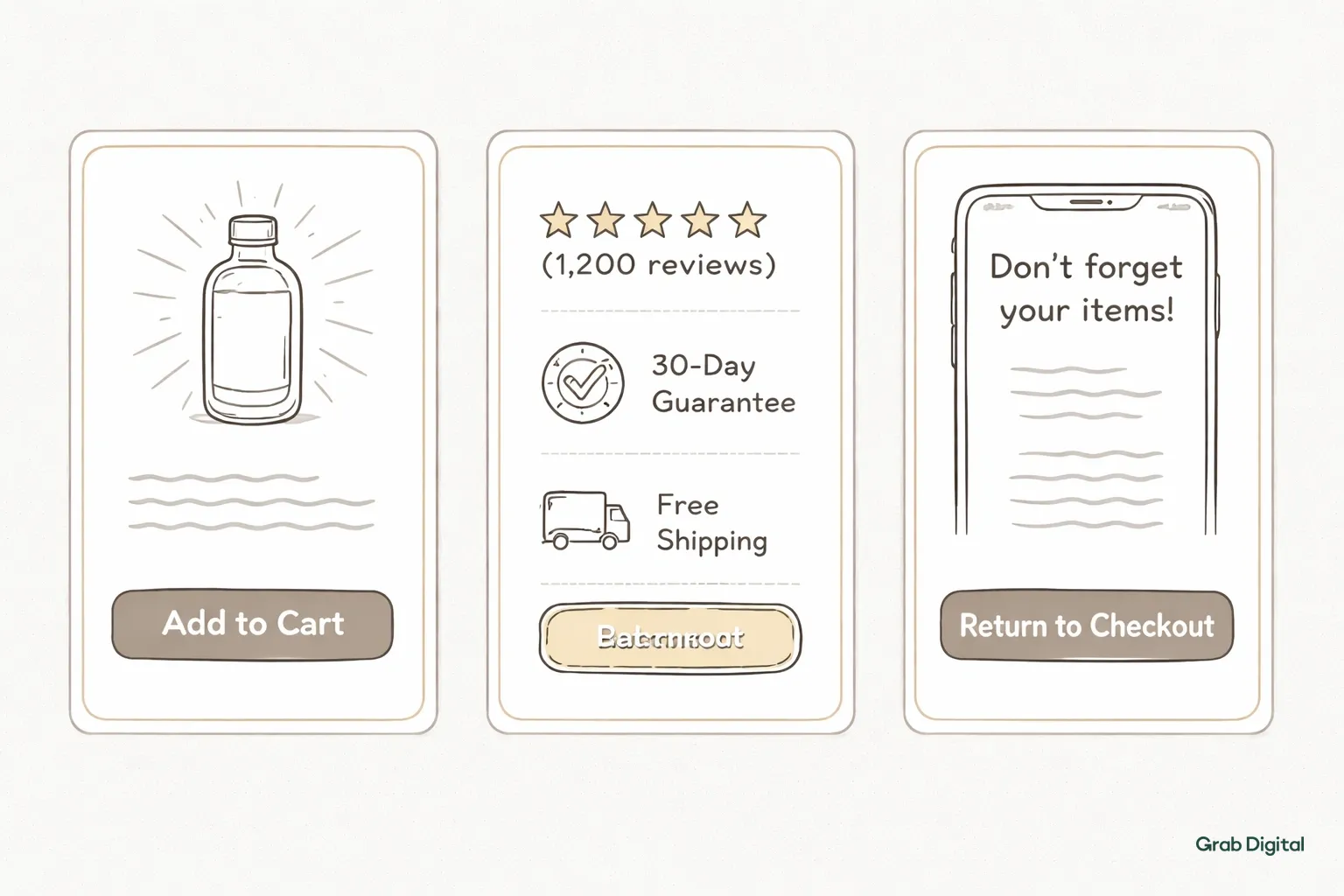
Design and copy in cart emails should reduce friction. Every element points toward one action: returning to checkout. Cluttered layouts, multiple CTAs, or unrelated product recommendations dilute the message and hurt conversion.
A solid abandoned cart email typically includes:
- A clear image of the abandoned product not a generic banner
- One primary CTA button, maybe repeated once below the fold
- Trust signals like reviews, guarantees, or shipping details
- Mobile-first formatting, since most opens happen on phones
Copy should sound like a person. Skip the robotic "Complete Your Purchase" tone. Write like you're following up with someone who almost bought something they liked. Short paragraphs. Subject-first sentences. Both make scanning easier on mobile.
Personalization and Segmentation Matter More Than Design
Personalization increases abandoned cart recovery more reliably than visual polish which surprises some clients who've spent months obsessing over templates. Segmenting by cart value, product category, and customer history lets you tailor messaging instead of blasting one generic flow at everyone. High-value carts deserve different treatment than low-value ones.
Consider these splits:
- First-time visitors need reassurance and brand trust signals
- Repeat customers respond better to loyalty language and faster CTAs
- High cart value shoppers may need a sales rep touch or phone-friendly CTA
- Mobile-only abandoners need simplified, thumb-friendly design
This kind of segmentation separates a generic email setup from something actually strategic. Our breakdown of advanced segmentation and personalization approaches shows how layering these signals inside Klaviyo drives higher recovery than flat, unsegmented flows.
Should You Always Offer a Discount?
Discounts shouldn't be the default. Overusing them trains customers to abandon intentionally and wait for the coupon. Reserve discount offers for email three, and only for segments showing genuine price sensitivity.
Alternatives that still drive recovery:
- Free shipping thresholds, if not already offered
- Limited stock messaging when it's actually true
- Bundling suggestions that increase perceived value
- Payment plan reminders for higher-ticket items
Brands selling premium goods (fine leather, sustainable furniture) often see stronger results from urgency and scarcity than from percentage-off codes. I've watched discount-first strategies quietly eat margin over time. Top-line recovery numbers look fine. The actual profit per order? Not so much.
Deliverability: The Silent Killer of Cart Flows
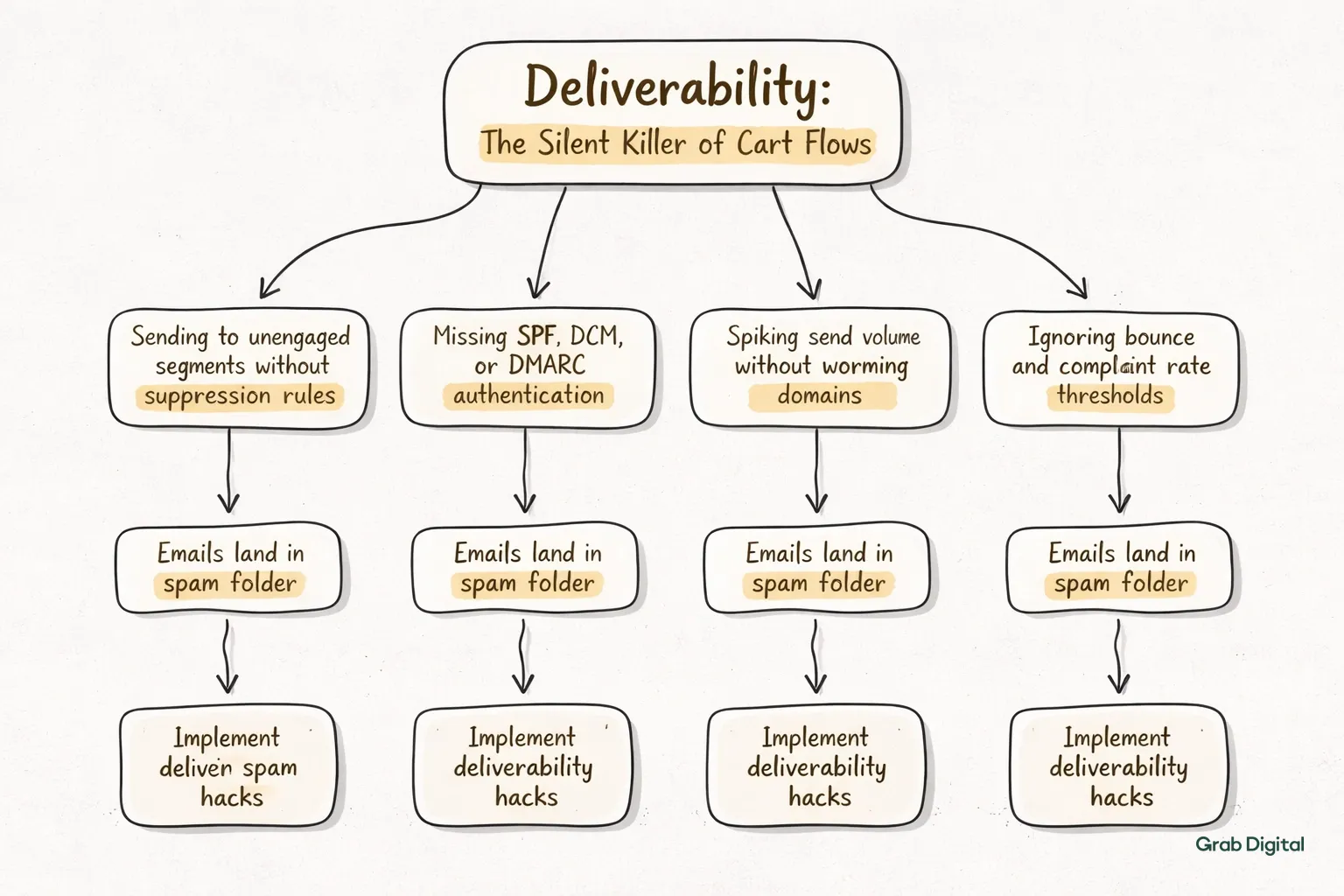
Deliverability problems destroy abandoned cart performance before anything else matters. If your emails land in spam, no amount of subject line testing helps. Sender reputation, list hygiene, and authentication protocols determine whether your flow reaches inboxes.
Common issues:
- Sending to unengaged segments without suppression rules
- Missing SPF, DKIM, or DMARC authentication
- Spiking send volume without warming domains
- Ignoring bounce and complaint rate thresholds
Our guide on email deliverability hacks for DTC brands covers technical setup most brands skip. If open rates on cart emails seem weirdly low compared to campaign sends, deliverability is probably the culprit not your copy.
Measuring What Actually Matters
Focus on revenue recovered, not just open or click rates. Klaviyo's attribution reporting tracks how much revenue each email generates. Vanity metrics like open rate don't mean much if they don't translate into completed checkouts.
Track these monthly:
| Metric | Why It Matters |
|---|---|
| Recovery rate | % of abandoned carts converted back |
| Revenue per recipient | Direct dollar impact |
| Flow-specific conversion rate | Isolates cart flow from campaign noise |
| Unsubscribe rate on flow | Signals if frequency feels intrusive |
If your reporting doesn't break this down granularly, revisit how your agency or internal team measures performance. This ties into broader flow strategy covered in our piece on the 8 core email flows every DTC brand needs cart abandonment doesn't perform in isolation from welcome and browse abandonment sequences.
Common Mistakes That Quietly Sabotage Recovery
Mistakes in cart flows go unnoticed because the flow still technically "runs." Sending too few emails, using stale templates, ignoring mobile rendering these are silent revenue killers. They don't throw errors. They just underperform for months while nobody notices.
Watch for:
- Flow hasn't been updated in 6+ months
- Same discount code across every touchpoint
- No A/B testing on send times or subject lines
- Popup and cart flow messaging contradict each other
That last point matters more than people realize. If your popup optimization promises 10% off but your cart flow offers 15% two days later, you're training customers to wait. Consistency across the journey from popup to cart to post-purchase protects margin and brand trust.
Bringing It All Together
Abandoned cart email best practices work as a system. Timing, subject lines, design, segmentation, and deliverability reinforce each other. Weakness anywhere drags down the whole flow.
If you're generating under 20% of revenue through email and don't have someone owning this channel, it might be time for outside help. Real examples of flows we've built are on our portfolio page, with detailed case studies on our our work page. We back our approach with a results guarantee. If you want a strategist to look at your setup and point out what's underperforming, you can book your free consultation.
For brands wondering whether email deserves attention in 2026, our piece on whether email is still the highest-ROI marketing channel lays out the data. Cart abandonment flows are often the highest-converting automation a DTC brand runs. Optimizing them is usually worth the time.
Frequently Asked Questions
Q: How many emails should be in an abandoned cart flow? A: Three is standard balances recovery against unsubscribe risk. Fewer leaves revenue behind. More than four starts to feel like harassment.
Q: Should the first abandoned cart email include a discount? A: No. Remind and reassure first. Save discounts for email two or three, and only for segments that look price-sensitive.
Q: How quickly should the first email send? A: Within an hour. Beyond three hours, recovery drops sharply.
Q: Does personalization actually improve recovery? A: Yes. Segmenting by cart value, history, and device beats one-size-fits-all flows. Tailored messaging addresses whatever hesitation caused the abandonment.
Q: Why might my cart emails have low open rates? A: Probably deliverability, not subject lines. Check authentication, sender reputation, and list hygiene before rewriting copy.
Q: Can cart flows hurt my brand? A: Done poorly, yes. Inconsistent offers or excessive discounting trains customers to wait for deals. That eats margin and degrades how people see your brand.
Abandoned cart email best practices separate DTC brands recovering 15-20% of lost sales from those stuck below 5%. The difference is timing, copy, design, and offer strategy working together inside a Klaviyo flow that actually gets sent. Get these right and abandoned cart becomes your highest-ROI automation or at least it should be.
Cart abandonment isn't a small leak. Roughly 70% of shopping carts get abandoned before checkout. Most brands recover a fraction of that revenue through generic, one-off emails that feel like afterthoughts. The brands doing better in 2026 treat abandoned cart as a system, not a single "did you forget something?" message that goes out whenever someone remembers to hit send.
What Are Abandoned Cart Email Best Practices?
Abandoned cart email best practices are tactics for timing, content, and design that recover revenue from shoppers who leave items unpurchased. They cover send timing, subject lines, personalization, urgency, and offer structure. Done well, these lift recovery rates sometimes 2-3x compared to unoptimized flows, though your mileage will vary based on product category and price point.
Most brands still send a single email 24 hours after abandonment. That leaves money on the table. A decent Klaviyo flow uses multiple touchpoints, each with a job, spaced to match actual shopper behavior rather than whatever timing someone guessed at internally.
Timing: When Should Your First Email Send?
Timing determines whether your abandoned cart email gets opened or ignored. The first email should send within 1 hour of abandonment, while intent is still fresh. Wait longer than 3 hours and recovery rates drop shoppers move on, find the item elsewhere, or just lose interest.
Here's a timing structure that tends to work for DTC brands in the $1M-$10M range:
| Timing | Purpose | |
|---|---|---|
| Email 1 | 1 hour after abandonment | Gentle reminder, no discount |
| Email 2 | 24 hours after abandonment | Social proof, address objections |
| Email 3 | 48-72 hours after abandonment | Urgency or limited incentive |
This structure mirrors what we lay out in our guide on fixing cart abandonment with a 3-email strategy, which goes deeper on spacing and content for each send. The mistake I see constantly: brands skipping straight to discounting in email one. That trains customers to abandon on purpose and wait for the coupon. Hard to un-train that behavior once it sets in.
Subject Lines That Actually Get Opened
Subject lines decide whether your cart email gets read or deleted. The best ones are specific, low-pressure, and don't sound like a mass blast. Generic lines like "You left something behind" underperform. I've watched product-specific and curiosity-driven alternatives win consistently.
From testing across our client base:
- Product name mentions beat generic "your cart" language by a significant margin
- Questions ("Still thinking about the [product]?") tend to outperform statements
- Emoji use should be minimal only where it actually fits your brand voice
- Urgency language works better in email 2 or 3, not email 1
For deeper subject line testing frameworks, our post on crafting high-converting cart abandonment subject lines breaks down formulas by industry. If you're unsure which angle fits, A/B testing across your first two sends is the fastest way to learn what your list actually responds to.
Design and Copy: What Belongs in the Email?
Design and copy in cart emails should reduce friction. Every element points toward one action: returning to checkout. Cluttered layouts, multiple CTAs, or unrelated product recommendations dilute the message and hurt conversion.
A solid abandoned cart email typically includes:
- A clear image of the abandoned product not a generic banner
- One primary CTA button, maybe repeated once below the fold
- Trust signals like reviews, guarantees, or shipping details
- Mobile-first formatting, since most opens happen on phones
Copy should sound like a person. Skip the robotic "Complete Your Purchase" tone. Write like you're following up with someone who almost bought something they liked. Short paragraphs. Subject-first sentences. Both make scanning easier on mobile.
Personalization and Segmentation Matter More Than Design
Personalization increases abandoned cart recovery more reliably than visual polish which surprises some clients who've spent months obsessing over templates. Segmenting by cart value, product category, and customer history lets you tailor messaging instead of blasting one generic flow at everyone. High-value carts deserve different treatment than low-value ones.
Consider these splits:
- First-time visitors need reassurance and brand trust signals
- Repeat customers respond better to loyalty language and faster CTAs
- High cart value shoppers may need a sales rep touch or phone-friendly CTA
- Mobile-only abandoners need simplified, thumb-friendly design
This kind of segmentation separates a generic email setup from something actually strategic. Our breakdown of advanced segmentation and personalization approaches shows how layering these signals inside Klaviyo drives higher recovery than flat, unsegmented flows.
Should You Always Offer a Discount?
Discounts shouldn't be the default. Overusing them trains customers to abandon intentionally and wait for the coupon. Reserve discount offers for email three, and only for segments showing genuine price sensitivity.
Alternatives that still drive recovery:
- Free shipping thresholds, if not already offered
- Limited stock messaging when it's actually true
- Bundling suggestions that increase perceived value
- Payment plan reminders for higher-ticket items
Brands selling premium goods (fine leather, sustainable furniture) often see stronger results from urgency and scarcity than from percentage-off codes. I've watched discount-first strategies quietly eat margin over time. Top-line recovery numbers look fine. The actual profit per order? Not so much.
Deliverability: The Silent Killer of Cart Flows
Deliverability problems destroy abandoned cart performance before anything else matters. If your emails land in spam, no amount of subject line testing helps. Sender reputation, list hygiene, and authentication protocols determine whether your flow reaches inboxes.
Common issues:
- Sending to unengaged segments without suppression rules
- Missing SPF, DKIM, or DMARC authentication
- Spiking send volume without warming domains
- Ignoring bounce and complaint rate thresholds
Our guide on email deliverability hacks for DTC brands covers technical setup most brands skip. If open rates on cart emails seem weirdly low compared to campaign sends, deliverability is probably the culprit not your copy.
Measuring What Actually Matters
Focus on revenue recovered, not just open or click rates. Klaviyo's attribution reporting tracks how much revenue each email generates. Vanity metrics like open rate don't mean much if they don't translate into completed checkouts.
Track these monthly:
| Metric | Why It Matters |
|---|---|
| Recovery rate | % of abandoned carts converted back |
| Revenue per recipient | Direct dollar impact |
| Flow-specific conversion rate | Isolates cart flow from campaign noise |
| Unsubscribe rate on flow | Signals if frequency feels intrusive |
If your reporting doesn't break this down granularly, revisit how your agency or internal team measures performance. This ties into broader flow strategy covered in our piece on the 8 core email flows every DTC brand needs cart abandonment doesn't perform in isolation from welcome and browse abandonment sequences.
Common Mistakes That Quietly Sabotage Recovery
Mistakes in cart flows go unnoticed because the flow still technically "runs." Sending too few emails, using stale templates, ignoring mobile rendering these are silent revenue killers. They don't throw errors. They just underperform for months while nobody notices.
Watch for:
- Flow hasn't been updated in 6+ months
- Same discount code across every touchpoint
- No A/B testing on send times or subject lines
- Popup and cart flow messaging contradict each other
That last point matters more than people realize. If your popup optimization promises 10% off but your cart flow offers 15% two days later, you're training customers to wait. Consistency across the journey from popup to cart to post-purchase protects margin and brand trust.
Bringing It All Together
Abandoned cart email best practices work as a system. Timing, subject lines, design, segmentation, and deliverability reinforce each other. Weakness anywhere drags down the whole flow.
If you're generating under 20% of revenue through email and don't have someone owning this channel, it might be time for outside help. Real examples of flows we've built are on our portfolio page, with detailed case studies on our our work page. We back our approach with a results guarantee. If you want a strategist to look at your setup and point out what's underperforming, you can book your free consultation.
For brands wondering whether email deserves attention in 2026, our piece on whether email is still the highest-ROI marketing channel lays out the data. Cart abandonment flows are often the highest-converting automation a DTC brand runs. Optimizing them is usually worth the time.
Frequently Asked Questions
Q: How many emails should be in an abandoned cart flow? A: Three is standard balances recovery against unsubscribe risk. Fewer leaves revenue behind. More than four starts to feel like harassment.
Q: Should the first abandoned cart email include a discount? A: No. Remind and reassure first. Save discounts for email two or three, and only for segments that look price-sensitive.
Q: How quickly should the first email send? A: Within an hour. Beyond three hours, recovery drops sharply.
Q: Does personalization actually improve recovery? A: Yes. Segmenting by cart value, history, and device beats one-size-fits-all flows. Tailored messaging addresses whatever hesitation caused the abandonment.
Q: Why might my cart emails have low open rates? A: Probably deliverability, not subject lines. Check authentication, sender reputation, and list hygiene before rewriting copy.
Q: Can cart flows hurt my brand? A: Done poorly, yes. Inconsistent offers or excessive discounting trains customers to wait for deals. That eats margin and degrades how people see your brand.

Find out exactly what your email channel is leaving on the table.

Email Marketing for Scaling DTC Brands


