
Summary
Klaviyo for Shopify: Native Integration & 8 Must-Have Email Flows
If you're running a Shopify store doing $1M–$10M, your email setup shouldn't be a bolted-on Mailchimp form. It needs to be Klaviyo, running natively, pulling live product data and checkout behavior. If you don't have automated flows and dynamic segmentation set up, you're leaving 15-25% of your revenue on the table every month. That's not a guess that's what we see every time we audit a store that's been "managing email in-house."
Shopify has changed, and so have customer expectations. The brands treating email as an afterthought are the ones losing ground to competitors who built actual systems. Here is what works right now.
Native integration is the only thing that matters
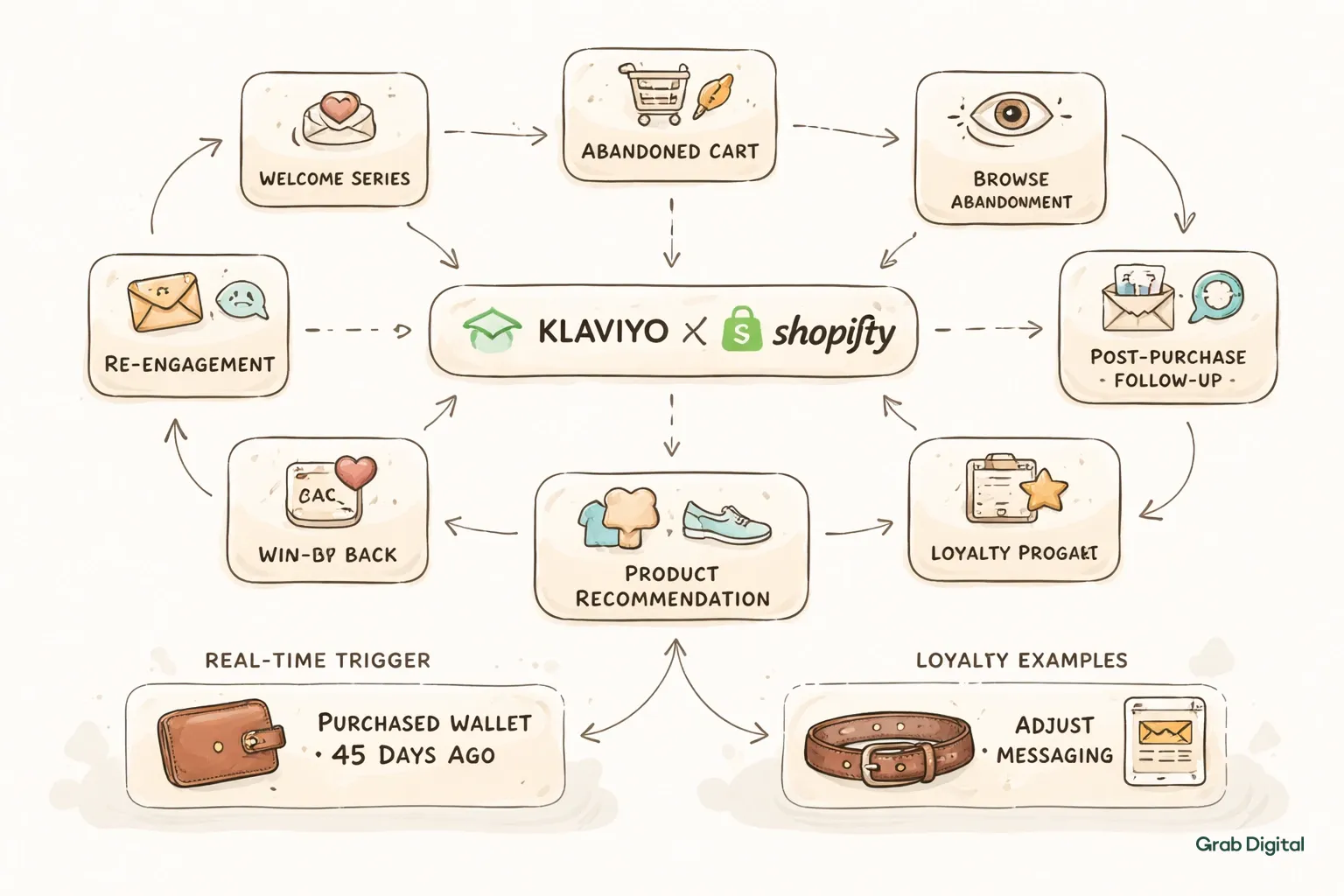
I don't mean to be harsh, but generic ESPs don't cut it for Shopify anymore. Klaviyo works because it talks to your store in real time. It knows a customer bought a leather wallet 45 days ago and can trigger a matching belt recommendation automatically. It knows someone browsed three times without buying and adjusts the messaging.
We saw Rogue Industries get a measurable lift simply by rebuilding flows around actual Shopify behavioral triggers instead of generic time-based sends. Data drives everything here.
The eight flows you can't ignore
Before you worry about your next campaign, you need eight core automated flows running. These capture revenue passively, 24/7. If you're skipping them, you're ignoring money sitting on your own site.
| Flow | Purpose | Typical Revenue Share |
|---|---|---|
| Welcome Series | Convert new subscribers | 10-15% |
| Abandoned Cart | Recover checkout drop-offs | 15-20% |
| Browse Abandonment | Re-engage window shoppers | 5-10% |
| Post-Purchase | Build repeat purchase habit | 10-15% |
| Win-Back | Reactivate lapsed customers | 5-8% |
| Sunset | Clean list, protect deliverability | N/A (health) |
| Cross-Sell | Increase AOV post-purchase | 5-10% |
| VIP/Loyalty | Reward top spenders | 5-10% |
We break down the setup for each of these in our 8 core email flows guide. If you're missing even two or three, you are under-monetizing your list.
Stop segmenting like it's 2016
Segmentation has to go deeper than "opened/didn't open." You need purchase frequency, AOV, product category preference, and predicted lifetime value. Klaviyo calculates this stuff automatically from your Shopify order data.
Also, kill your static segments. A "high spender" list from January is useless if those customers have gone quiet. Dynamic segments update in real time, so your VIP flow hits the people who qualify now.
Once a list grows past 10,000 subscribers, blasting everyone with the same campaign kills engagement and hurts your sender reputation. We build these systems for clients through our Klaviyo services, and the difference is in the details tailoring segments to actual buying patterns, not generic templates.
Popups that don't annoy people
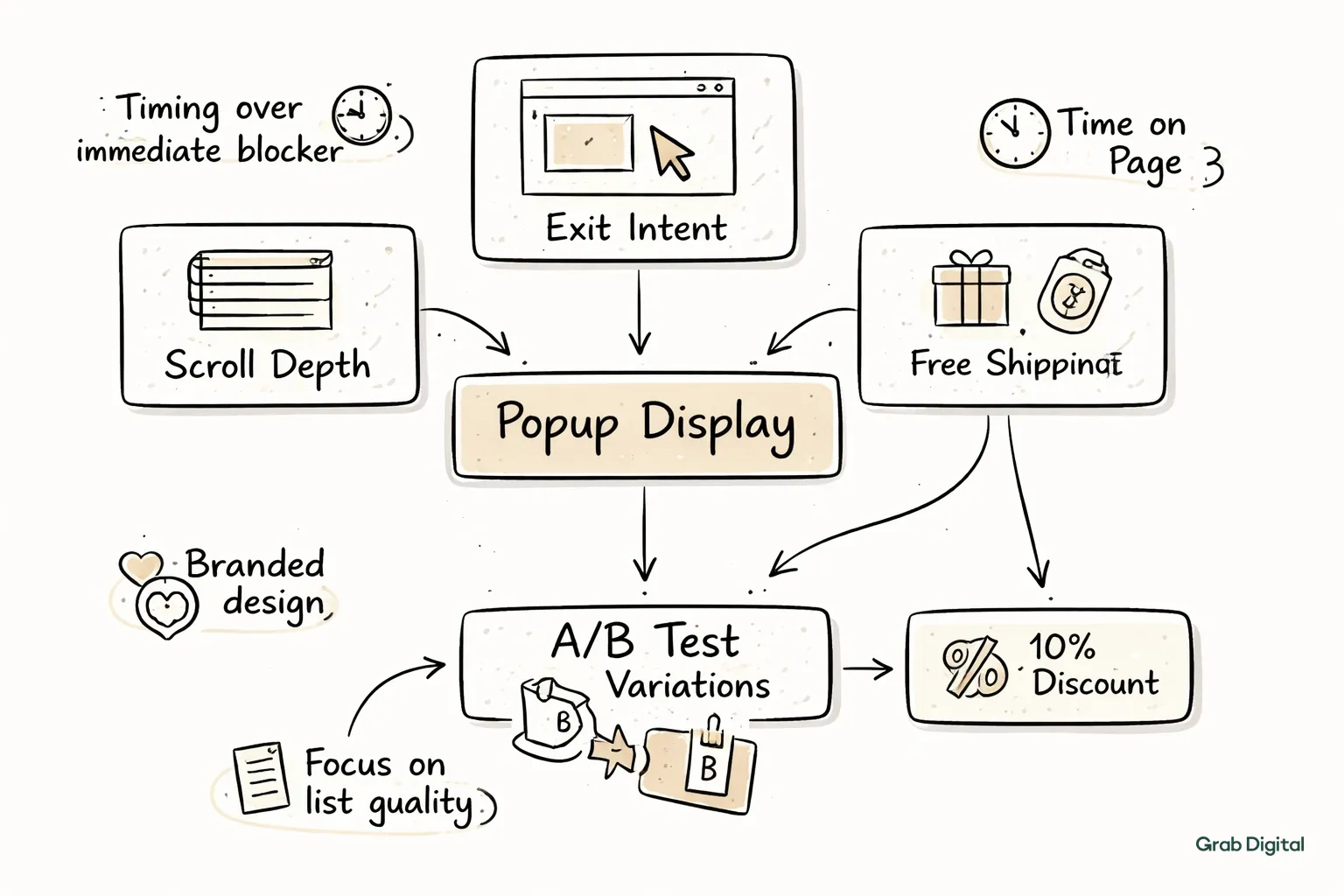
Popups need to respect the checkout journey. The best ones appear based on scroll depth, exit intent, or time-on-page never as an immediate blocker. Branded design helps, but timing matters more.
A/B testing is where you find the wins. Some brands find a 10% discount underperforms free shipping for their specific audience. You don't know until you test.
And please, focus on list quality over size. A clean 15,000-subscriber list will outsell a bloated 40,000-subscriber list full of dead addresses every time. This ties directly into deliverability.
Deliverability: The silent revenue killer
You can write the perfect email, but if Gmail dumps it in spam, it generates zero revenue. This is the most overlooked part of "best email marketing."
Google and Yahoo tightened the screws through 2025 and into 2026. Authentication protocols like DKIM, SPF, and DMARC are now baseline. Ignore them, and watch your open rates quietly collapse.
List hygiene matters here too. Pruning unengaged subscribers protects your sender score. We have specific tactics in our deliverability tips for DTC brands post worth a read quarterly, because inbox provider rules shift often.
Campaigns: More than just "blasts"
Campaigns fill the gaps flows can't. Flows react; campaigns announce launches and tell brand stories. You need both.
The mistake I see constantly? Sending the same campaign frequency to everyone. Someone who bought yesterday doesn't need the same sale email as someone who hasn't opened anything in 90 days. Segmented sends beat blanket sends.
Copywriting matters too. Subject lines and preview text need to sound like your brand, not a template. That's where having a real strategist beats a generic template library.
Why most brands fail at this
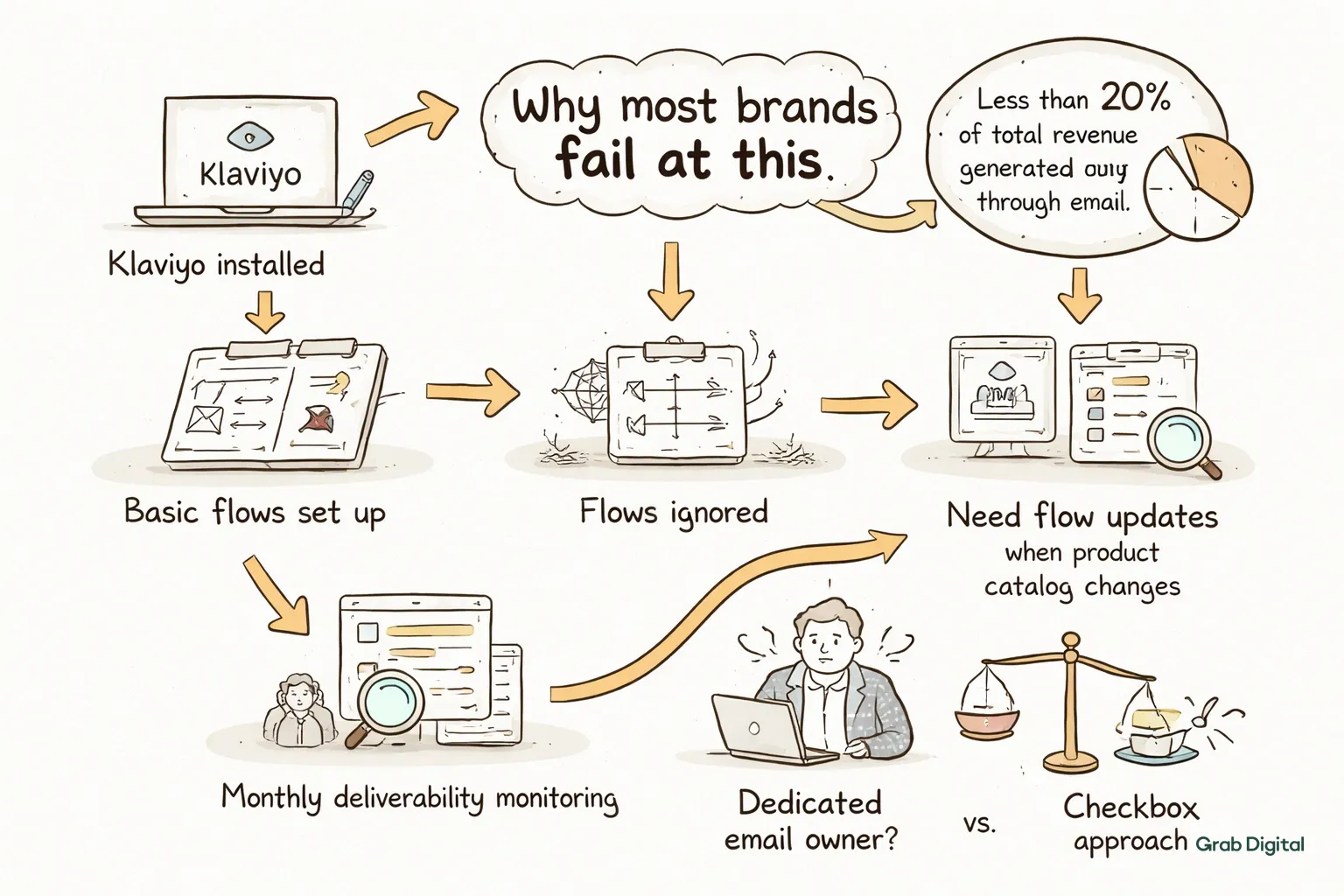
Most Shopify brands generate less than 20% of total revenue through email. They have Klaviyo installed. They have basic flows. But nobody touches them. The platform gets set up once and ignored.
Why? Because email requires attention that founders and small teams rarely have. Flows need updates when product catalogs change. Segments need refreshing. Deliverability needs monthly monitoring.
Brands winning at email treat it as a channel with an owner, not a checkbox. If your store fits this pattern good tools, weak results let's talk about what's possible. You can book your free consultation for a baseline read.
Klaviyo vs. everyone else
Klaviyo is the dominant choice for Shopify stores in 2026. The native integration depth and predictive analytics beat the alternatives. We broke this down in our Klaviyo vs Mailchimp breakdown.
Some brands stick with cheaper tools to save monthly costs. This usually backfires once you scale past $1M and personalization gets complex. Migrating later is expensive.
That said, a poorly configured Klaviyo account will underperform a well-run cheaper tool. Execution beats platform choice, but the ceiling is higher with Klaviyo.
What this means for you
If you have a strong subscriber list but underperforming email revenue, the problem is fixable. The flows, segmentation, and strategy I outlined aren't theory. They are standard practice for brands generating 25-30%+ of revenue from email.
Getting there takes investment or a specialized team doing this daily. Our approach guarantees 10% growth in email-attributed revenue within 60 days. Check the FAQ page for how that works, or browse our portfolio to see results.
Email marketing on Shopify isn't complicated in theory. It just falls apart in execution, which is where most brands stall out.
Frequently Asked Questions
Q: What's the best email marketing platform for Shopify stores in 2026? A: Klaviyo. The native Shopify integration, real-time data sync, and predictive analytics are features generic ESPs can't replicate right now.
Q: How many email flows does a Shopify store actually need? A: Eight. Welcome, abandoned cart, browse abandonment, post-purchase, win-back, sunset, cross-sell, and VIP/loyalty cover the revenue opportunities.
Q: What percentage of revenue should email generate for a healthy Shopify store? A: Well-optimized programs typically hit 25-30% or more of total revenue. Under 20% means you're leaving money on the table.
Q: How often should I clean my Shopify email list? A: Quarterly. Gmail and Yahoo tightened requirements in 2025 and 2026, so regular hygiene protects your sender reputation.
Q: Can popups actually hurt my Shopify conversion rate? A: Bad ones can. Immediate blockers annoy people. Exit-intent and scroll-based triggers generally work better.
Q: How quickly can I see results from improving my Shopify email strategy? A: With proper flow rebuilds and segmentation, you often see lift within 60 days. That's the timeframe our guarantee is built around.
If you're running a Shopify store doing $1M–$10M, your email setup shouldn't be a bolted-on Mailchimp form. It needs to be Klaviyo, running natively, pulling live product data and checkout behavior. If you don't have automated flows and dynamic segmentation set up, you're leaving 15-25% of your revenue on the table every month. That's not a guess that's what we see every time we audit a store that's been "managing email in-house."
Shopify has changed, and so have customer expectations. The brands treating email as an afterthought are the ones losing ground to competitors who built actual systems. Here is what works right now.
Native integration is the only thing that matters
I don't mean to be harsh, but generic ESPs don't cut it for Shopify anymore. Klaviyo works because it talks to your store in real time. It knows a customer bought a leather wallet 45 days ago and can trigger a matching belt recommendation automatically. It knows someone browsed three times without buying and adjusts the messaging.
We saw Rogue Industries get a measurable lift simply by rebuilding flows around actual Shopify behavioral triggers instead of generic time-based sends. Data drives everything here.
The eight flows you can't ignore
Before you worry about your next campaign, you need eight core automated flows running. These capture revenue passively, 24/7. If you're skipping them, you're ignoring money sitting on your own site.
| Flow | Purpose | Typical Revenue Share |
|---|---|---|
| Welcome Series | Convert new subscribers | 10-15% |
| Abandoned Cart | Recover checkout drop-offs | 15-20% |
| Browse Abandonment | Re-engage window shoppers | 5-10% |
| Post-Purchase | Build repeat purchase habit | 10-15% |
| Win-Back | Reactivate lapsed customers | 5-8% |
| Sunset | Clean list, protect deliverability | N/A (health) |
| Cross-Sell | Increase AOV post-purchase | 5-10% |
| VIP/Loyalty | Reward top spenders | 5-10% |
We break down the setup for each of these in our 8 core email flows guide. If you're missing even two or three, you are under-monetizing your list.
Stop segmenting like it's 2016
Segmentation has to go deeper than "opened/didn't open." You need purchase frequency, AOV, product category preference, and predicted lifetime value. Klaviyo calculates this stuff automatically from your Shopify order data.
Also, kill your static segments. A "high spender" list from January is useless if those customers have gone quiet. Dynamic segments update in real time, so your VIP flow hits the people who qualify now.
Once a list grows past 10,000 subscribers, blasting everyone with the same campaign kills engagement and hurts your sender reputation. We build these systems for clients through our Klaviyo services, and the difference is in the details tailoring segments to actual buying patterns, not generic templates.
Popups that don't annoy people
Popups need to respect the checkout journey. The best ones appear based on scroll depth, exit intent, or time-on-page never as an immediate blocker. Branded design helps, but timing matters more.
A/B testing is where you find the wins. Some brands find a 10% discount underperforms free shipping for their specific audience. You don't know until you test.
And please, focus on list quality over size. A clean 15,000-subscriber list will outsell a bloated 40,000-subscriber list full of dead addresses every time. This ties directly into deliverability.
Deliverability: The silent revenue killer
You can write the perfect email, but if Gmail dumps it in spam, it generates zero revenue. This is the most overlooked part of "best email marketing."
Google and Yahoo tightened the screws through 2025 and into 2026. Authentication protocols like DKIM, SPF, and DMARC are now baseline. Ignore them, and watch your open rates quietly collapse.
List hygiene matters here too. Pruning unengaged subscribers protects your sender score. We have specific tactics in our deliverability tips for DTC brands post worth a read quarterly, because inbox provider rules shift often.
Campaigns: More than just "blasts"
Campaigns fill the gaps flows can't. Flows react; campaigns announce launches and tell brand stories. You need both.
The mistake I see constantly? Sending the same campaign frequency to everyone. Someone who bought yesterday doesn't need the same sale email as someone who hasn't opened anything in 90 days. Segmented sends beat blanket sends.
Copywriting matters too. Subject lines and preview text need to sound like your brand, not a template. That's where having a real strategist beats a generic template library.
Why most brands fail at this
Most Shopify brands generate less than 20% of total revenue through email. They have Klaviyo installed. They have basic flows. But nobody touches them. The platform gets set up once and ignored.
Why? Because email requires attention that founders and small teams rarely have. Flows need updates when product catalogs change. Segments need refreshing. Deliverability needs monthly monitoring.
Brands winning at email treat it as a channel with an owner, not a checkbox. If your store fits this pattern good tools, weak results let's talk about what's possible. You can book your free consultation for a baseline read.
Klaviyo vs. everyone else
Klaviyo is the dominant choice for Shopify stores in 2026. The native integration depth and predictive analytics beat the alternatives. We broke this down in our Klaviyo vs Mailchimp breakdown.
Some brands stick with cheaper tools to save monthly costs. This usually backfires once you scale past $1M and personalization gets complex. Migrating later is expensive.
That said, a poorly configured Klaviyo account will underperform a well-run cheaper tool. Execution beats platform choice, but the ceiling is higher with Klaviyo.
What this means for you
If you have a strong subscriber list but underperforming email revenue, the problem is fixable. The flows, segmentation, and strategy I outlined aren't theory. They are standard practice for brands generating 25-30%+ of revenue from email.
Getting there takes investment or a specialized team doing this daily. Our approach guarantees 10% growth in email-attributed revenue within 60 days. Check the FAQ page for how that works, or browse our portfolio to see results.
Email marketing on Shopify isn't complicated in theory. It just falls apart in execution, which is where most brands stall out.
Frequently Asked Questions
Q: What's the best email marketing platform for Shopify stores in 2026? A: Klaviyo. The native Shopify integration, real-time data sync, and predictive analytics are features generic ESPs can't replicate right now.
Q: How many email flows does a Shopify store actually need? A: Eight. Welcome, abandoned cart, browse abandonment, post-purchase, win-back, sunset, cross-sell, and VIP/loyalty cover the revenue opportunities.
Q: What percentage of revenue should email generate for a healthy Shopify store? A: Well-optimized programs typically hit 25-30% or more of total revenue. Under 20% means you're leaving money on the table.
Q: How often should I clean my Shopify email list? A: Quarterly. Gmail and Yahoo tightened requirements in 2025 and 2026, so regular hygiene protects your sender reputation.
Q: Can popups actually hurt my Shopify conversion rate? A: Bad ones can. Immediate blockers annoy people. Exit-intent and scroll-based triggers generally work better.
Q: How quickly can I see results from improving my Shopify email strategy? A: With proper flow rebuilds and segmentation, you often see lift within 60 days. That's the timeframe our guarantee is built around.

Find out exactly what your email channel is leaving on the table.

Email Marketing for Scaling DTC Brands


