
Summary
Email Marketing in 2026: Strategies for DTC Brands to Boost Revenue
Email marketing in 2026 doesn't look like 2024. If you're still running the same campaigns, your open rates are probably showing it. Your revenue too.
DTC brands in the $1M–$10M range are dealing with rising acquisition costs, inbox algorithms that filter out low-engagement senders, and subscribers who've gotten good at ignoring anything that doesn't immediately matter. The brands that figure this out are pulling 30–40% of total revenue from email.
This is what's working in Klaviyo right now, from what we're seeing across dozens of DTC accounts.
Broadcast emails are dying
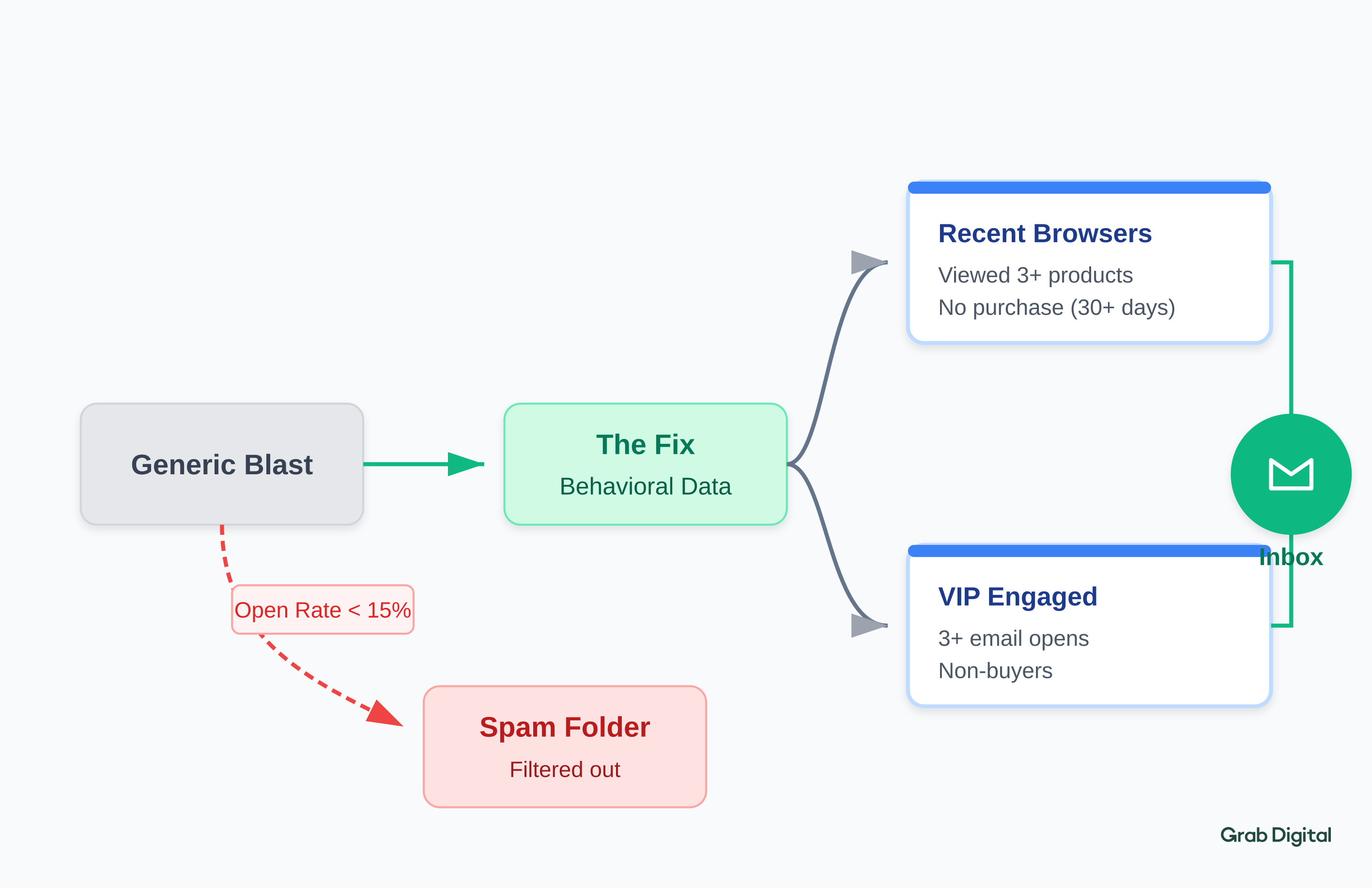
Generic blast emails aren't just performing worse. They're being filtered out entirely. Gmail and Apple Mail made significant algorithm changes in late 2025 that deprioritize senders with consistently low engagement. Campaigns that get opened by less than 15% of recipients start landing in spam or the Promotions tab.
The fix isn't a better subject line. It's segmentation based on what people actually do, not who they are.
Start with these behavioral segments:
Recent browsers who didn't buy: Viewed 3+ products in the last 7 days, no purchase in 30+ days
VIP engaged non-buyers: 3+ opens in last 30 days, no purchase in 90+ days
Lapsed high-value customers: 2+ purchases with above-average AOV, nothing in 120+ days
Active buyers: Purchased in the last 45 days
Each segment needs different messaging. VIPs who haven't bought need social proof and urgency. Lapsed high-value customers need to feel missed, with an offer that acknowledges past loyalty.
Flows that actually convert
This is where most brands leave money on the table. Klaviyo's default templates are a starting point, not a strategy.
Welcome series (3–5 emails)
Most brands send one welcome email. That's like spending thousands on acquisition and then mumbling "hi" before walking away.
Email 1 (immediate): Brand story, what makes you different, first-purchase incentive if that's your thing
Email 2 (Day 2): Hero products with social proof. Real customer photos, not stock.
Email 3 (Day 4): Educational content that positions your product as the solution to a specific problem
Email 4 (Day 7): Urgency. Limited-time offer expires, or a testimonial from someone who waited and regretted it
Email 5 (Day 10, optional): Last-touch remarketing with your best offer
Timing matters. Too frequent and you trigger spam filters. Too sparse and momentum dies.
Abandoned cart (3–4 emails)
Abandoned cart isn't about reminding people they forgot something. It's about addressing the objection that stopped them.
Email 1 (1 hour): Simple reminder, product image, one-click return to cart
Email 2 (24 hours): Address the most common objection. Shipping cost, return policy, or social proof.
Email 3 (48 hours): Inject urgency. Inventory warnings work if they're real. "This cart expires in 24 hours" always works.
Email 4 (72 hours, conditional): Final touch with a modest discount. Only send this to first-time abandoners, not repeat customers who've learned to wait for the deal.
Post-purchase (5–7 emails)
This is the most underused flow in DTC. You just earned someone's trust and money. The next 30 days determine whether they buy again or disappear.
Email 1 (immediate): Order confirmation with clear delivery expectations
Email 2 (Day 3): Shipping confirmation with tracking
Email 3 (Day 7–10): "How to get the most out of your [product]" with educational content
Email 4 (Day 14): Request review with photos. Incentivize with entry into monthly giveaway.
Email 5 (Day 21): Introduce complementary products
Email 6 (Day 30): Replenishment reminder if relevant, or cross-sell to different category
Email 7 (Day 45): Check-in email that feels personal, potentially with feedback request
Brands that implement this properly see second purchase rates increase 40–60%. I've seen it happen consistently.
Browse abandonment
This captures people who looked but didn't add to cart. Timing is tricky. Send too soon and it's creepy. Send too late and they've moved on.
Trigger: Viewed 2+ products in a collection without adding to cart
Wait time: 4–6 hours
Content: Show exactly what they looked at, plus 1–2 similar items. Include "complete the look" or "customers also loved."
This is where Klaviyo's product feed matters. Dynamic product blocks that pull exactly what someone viewed convert 3–4x better than generic "you might like" recommendations.
Campaigns need to earn inbox placement
Campaigns, your regular scheduled sends, have to prove they belong.
Frequency based on engagement tiers
Split your list three ways:
Hot (opened or clicked in last 30 days): 4–6 campaigns per month
Warm (opened in last 60 days but not last 30): 2–3 campaigns per month
Cold (no opens in 60+ days): 1 campaign per month max, focused on re-engagement
This protects sender reputation and prevents burning out engaged subscribers.
Content mix
The 60/30/10 rule:
60% value-driven (education, stories, user-generated content)
30% product-focused (new releases, restocks, collections)
10% aggressive promotional (sales, discounts, urgency)
Brands that stick to this maintain 35–45% open rates. Brands that flip it, mostly promotional, see opens drop below 20% within 90 days.
Subject lines that work in 2026
AI-written subject lines are easy to spot and perform worse. Authenticity beats cleverness.
What works:
"Sarah, I need to tell you something"
"This wasn't planned"
"I'm worried we made a mistake"
"Quick question about your order"
What doesn't:
Excessive emojis (🔥💰✨)
ALL CAPS
"RE:" or "FWD:" tricks
"[Name], this is for you"
Test everything. But you need at least 1,000 recipients per variant or the data is meaningless.
Deliverability is revenue
None of this works if emails don't reach the inbox. Deliverability in 2026 comes down to three things.
List hygiene
Cut unengaged subscribers aggressively. If someone hasn't opened in 120 days, send a final re-engagement campaign. If they don't respond, remove them. This shrinks your list but improves deliverability and revenue per subscriber.
We typically remove 15–25% of a new client's list in the first 60 days. Email revenue goes up, not down.
Technical setup
Make sure these are configured:
SPF and DKIM records
Custom sending domain (not klaviyomail.com)
DMARC policy set to at least p=none
Gmail Postmaster Tools monitoring for reputation issues
Your Klaviyo account health score should be 95+. Below 90 means deliverability problems costing you revenue.
Engagement signals
Inbox providers reward emails that get:
High open rates (30%+)
Clicks and replies
Forwarding and saving
Movement from Promotions to Primary (Gmail)
Design campaigns to encourage interaction. Ask questions. Invite replies. Create content worth saving.
If you're reading this and realizing your email setup is leaving money on the table, and you'd rather hand this off to people who live in Klaviyo every day, book a free consultation and we'll audit your account together.
Segmentation that scales
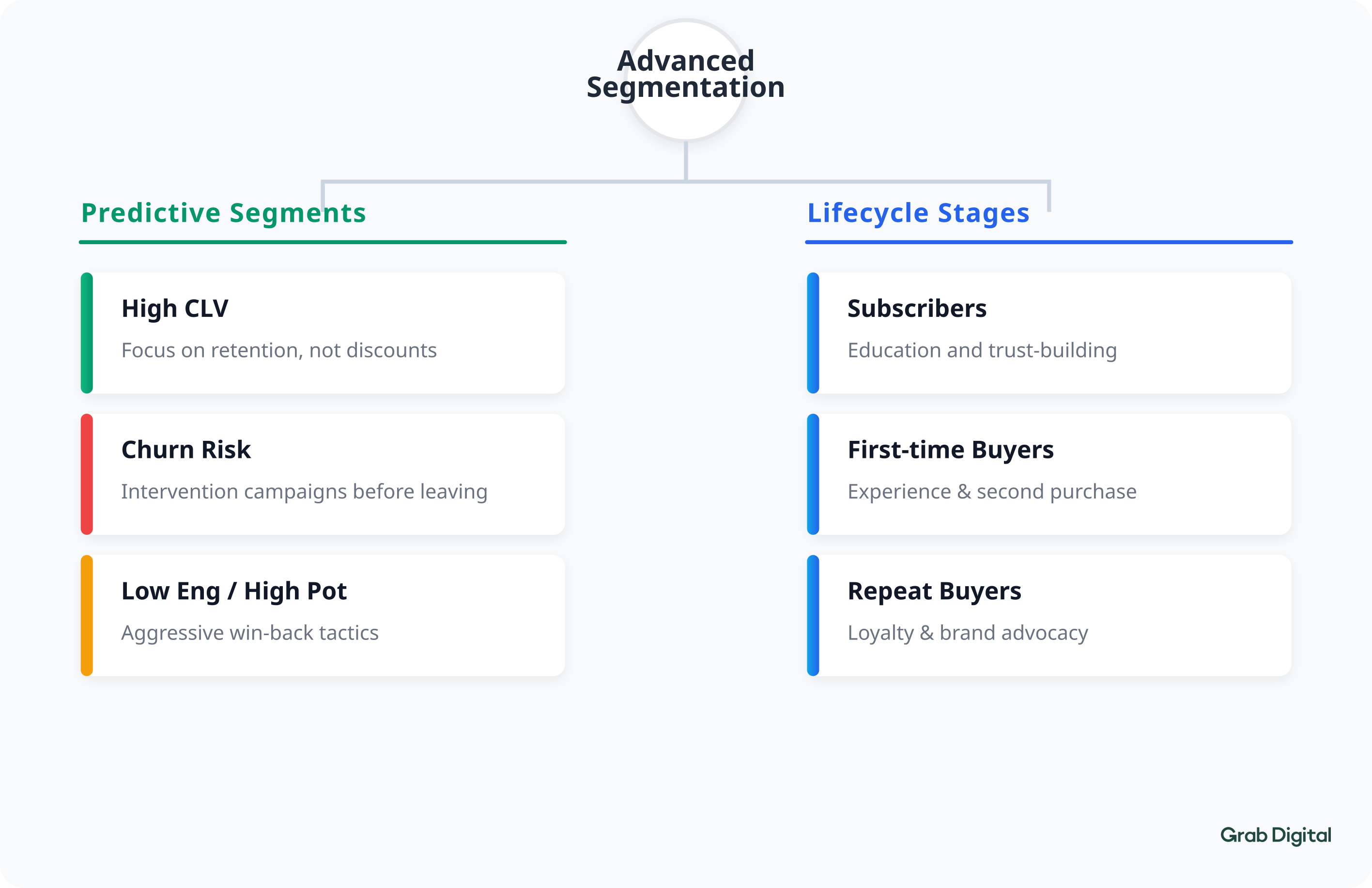
Basic segmentation is table stakes. Advanced segmentation is where brands separate themselves.
Predictive segments
Use Klaviyo's predictive analytics to identify:
High predicted lifetime value customers. Tailor messaging to retention, not discounts.
High churn risk customers. Intervention campaigns before they leave.
Low engagement, high potential. More aggressive win-back tactics.
Lifecycle stage segments
Map your customer journey and create segments for each stage:
Subscribers (no purchase yet): Education and trust-building
First-time buyers: Experience optimization and second purchase
Repeat customers: Loyalty, referrals, increasing purchase frequency
VIP/loyalists: Exclusivity, early access, community
At-risk: Win-back before they fully churn
Each segment gets a different campaign calendar and flow experience.
Product affinity segments
Group customers by what they've bought or shown interest in:
Skincare buyers vs. body care buyers
Premium product purchasers vs. entry-level
Gift buyers vs. self-purchasers
Seasonal buyers vs. year-round customers
Someone who only buys during holidays needs different messaging than your core year-round customer.
Attribution and measurement
Email's contribution to revenue is consistently underreported in default Klaviyo attribution.
Look beyond last-click
Most brands only count attributed revenue, email as the last touch before purchase. This misses all the touchpoint emails that moved someone toward buying.
Track:
Influenced revenue (email was anywhere in the customer journey)
Flow revenue vs. campaign revenue
Revenue per recipient by segment
Customer lifetime value by acquisition sources
Realistic benchmarks
For DTC brands in the $1M–$10M range, healthy email performance looks like:
25–35% of total revenue attributed to email
35–45% campaign open rate (engaged segments)
3.5–5% campaign click rate
15–20% flow open rate
$5–15 revenue per email sent (varies by AOV)
If you're significantly below these, there's revenue being left behind.
What's coming next
Email keeps evolving faster than most channels. Three trends we're tracking for the rest of 2026:
Interactive emails: AMP support is getting better. You'll be able to include working carousels, accordions, and add-to-cart functionality directly in email. Early adopters are seeing 40–60% engagement increases.
AI personalization at scale: Not AI-written copy. That's still obvious and underperforms. But AI-driven send time optimization, product recommendations, and dynamic content blocks that adapt based on predicted behavior.
Email-first loyalty programs: iOS privacy restrictions make SMS harder. Paid ads keep getting more expensive. Brands are rebuilding loyalty programs around email as the primary channel.
Frequently asked questions
How often should I email without annoying subscribers?
Frequency should be based on engagement, not a universal number. Your most engaged subscribers (opened/clicked in the last 30 days) can handle 4–6 emails per month. Less engaged segments should receive 1–2. Segment by engagement level and adjust frequency accordingly. If your unsubscribe rate stays below 0.3% per campaign, you're in a healthy range.
What's the single most impactful change I can make right now?
Implement a proper post-purchase flow. Most brands focus all their energy on acquisition emails and abandon customers immediately after they buy. A 5–7 email post-purchase series that educates, requests reviews, and introduces complementary products will increase repeat purchase rate by 40–60%, which compounds lifetime value.
Should I remove unengaged subscribers even if it shrinks my list?
Yes. Subscribers who haven't opened in 120+ days actively hurt your deliverability, which means your emails to engaged subscribers are less likely to reach the inbox. Send a final win-back campaign, and if they don't engage, remove them. Overall revenue increases even as list size decreases because engaged subscribers get better inbox placement.
How do I know if deliverability is actually a problem?
Check your Klaviyo account health score. It should be 95 or higher. Set up Gmail Postmaster Tools to monitor domain reputation. If your open rates are consistently below 25% for engaged segments or spam complaint rates are above 0.1%, you likely have deliverability issues that need immediate attention. Check that SPF, DKIM, and DMARC are properly configured.
What's the difference between flows and campaigns?
Flows are automated email sequences triggered by specific behaviors (welcome series, abandoned cart, post-purchase). Campaigns are one-time scheduled sends to segments of your list. Flows typically generate 60–70% of total email revenue because they're timely and behaviorally relevant. Campaigns drive 30–40% and are important for promotions, launches, and maintaining regular touchpoints. Both matter, but flows are higher leverage. Fix those first.
Is it worth offering a discount in my welcome series?
Depends on your brand positioning and margins. If you're a premium brand, a discount in the welcome series trains customers to wait for deals and devalues your products. Instead, offer early access, free shipping, or exclusive content. If you're in a highly competitive category where the first purchase barrier is high, a modest first-order discount (10–15%) can be effective. Test both approaches with a proper holdout group and measure 90-day customer lifetime value, not just conversion rate.
Email marketing in 2026 doesn't look like 2024. If you're still running the same campaigns, your open rates are probably showing it. Your revenue too.
DTC brands in the $1M–$10M range are dealing with rising acquisition costs, inbox algorithms that filter out low-engagement senders, and subscribers who've gotten good at ignoring anything that doesn't immediately matter. The brands that figure this out are pulling 30–40% of total revenue from email.
This is what's working in Klaviyo right now, from what we're seeing across dozens of DTC accounts.
Broadcast emails are dying
Generic blast emails aren't just performing worse. They're being filtered out entirely. Gmail and Apple Mail made significant algorithm changes in late 2025 that deprioritize senders with consistently low engagement. Campaigns that get opened by less than 15% of recipients start landing in spam or the Promotions tab.
The fix isn't a better subject line. It's segmentation based on what people actually do, not who they are.
Start with these behavioral segments:
Recent browsers who didn't buy: Viewed 3+ products in the last 7 days, no purchase in 30+ days
VIP engaged non-buyers: 3+ opens in last 30 days, no purchase in 90+ days
Lapsed high-value customers: 2+ purchases with above-average AOV, nothing in 120+ days
Active buyers: Purchased in the last 45 days
Each segment needs different messaging. VIPs who haven't bought need social proof and urgency. Lapsed high-value customers need to feel missed, with an offer that acknowledges past loyalty.
Flows that actually convert
This is where most brands leave money on the table. Klaviyo's default templates are a starting point, not a strategy.
Welcome series (3–5 emails)
Most brands send one welcome email. That's like spending thousands on acquisition and then mumbling "hi" before walking away.
Email 1 (immediate): Brand story, what makes you different, first-purchase incentive if that's your thing
Email 2 (Day 2): Hero products with social proof. Real customer photos, not stock.
Email 3 (Day 4): Educational content that positions your product as the solution to a specific problem
Email 4 (Day 7): Urgency. Limited-time offer expires, or a testimonial from someone who waited and regretted it
Email 5 (Day 10, optional): Last-touch remarketing with your best offer
Timing matters. Too frequent and you trigger spam filters. Too sparse and momentum dies.
Abandoned cart (3–4 emails)
Abandoned cart isn't about reminding people they forgot something. It's about addressing the objection that stopped them.
Email 1 (1 hour): Simple reminder, product image, one-click return to cart
Email 2 (24 hours): Address the most common objection. Shipping cost, return policy, or social proof.
Email 3 (48 hours): Inject urgency. Inventory warnings work if they're real. "This cart expires in 24 hours" always works.
Email 4 (72 hours, conditional): Final touch with a modest discount. Only send this to first-time abandoners, not repeat customers who've learned to wait for the deal.
Post-purchase (5–7 emails)
This is the most underused flow in DTC. You just earned someone's trust and money. The next 30 days determine whether they buy again or disappear.
Email 1 (immediate): Order confirmation with clear delivery expectations
Email 2 (Day 3): Shipping confirmation with tracking
Email 3 (Day 7–10): "How to get the most out of your [product]" with educational content
Email 4 (Day 14): Request review with photos. Incentivize with entry into monthly giveaway.
Email 5 (Day 21): Introduce complementary products
Email 6 (Day 30): Replenishment reminder if relevant, or cross-sell to different category
Email 7 (Day 45): Check-in email that feels personal, potentially with feedback request
Brands that implement this properly see second purchase rates increase 40–60%. I've seen it happen consistently.
Browse abandonment
This captures people who looked but didn't add to cart. Timing is tricky. Send too soon and it's creepy. Send too late and they've moved on.
Trigger: Viewed 2+ products in a collection without adding to cart
Wait time: 4–6 hours
Content: Show exactly what they looked at, plus 1–2 similar items. Include "complete the look" or "customers also loved."
This is where Klaviyo's product feed matters. Dynamic product blocks that pull exactly what someone viewed convert 3–4x better than generic "you might like" recommendations.
Campaigns need to earn inbox placement
Campaigns, your regular scheduled sends, have to prove they belong.
Frequency based on engagement tiers
Split your list three ways:
Hot (opened or clicked in last 30 days): 4–6 campaigns per month
Warm (opened in last 60 days but not last 30): 2–3 campaigns per month
Cold (no opens in 60+ days): 1 campaign per month max, focused on re-engagement
This protects sender reputation and prevents burning out engaged subscribers.
Content mix
The 60/30/10 rule:
60% value-driven (education, stories, user-generated content)
30% product-focused (new releases, restocks, collections)
10% aggressive promotional (sales, discounts, urgency)
Brands that stick to this maintain 35–45% open rates. Brands that flip it, mostly promotional, see opens drop below 20% within 90 days.
Subject lines that work in 2026
AI-written subject lines are easy to spot and perform worse. Authenticity beats cleverness.
What works:
"Sarah, I need to tell you something"
"This wasn't planned"
"I'm worried we made a mistake"
"Quick question about your order"
What doesn't:
Excessive emojis (🔥💰✨)
ALL CAPS
"RE:" or "FWD:" tricks
"[Name], this is for you"
Test everything. But you need at least 1,000 recipients per variant or the data is meaningless.
Deliverability is revenue
None of this works if emails don't reach the inbox. Deliverability in 2026 comes down to three things.
List hygiene
Cut unengaged subscribers aggressively. If someone hasn't opened in 120 days, send a final re-engagement campaign. If they don't respond, remove them. This shrinks your list but improves deliverability and revenue per subscriber.
We typically remove 15–25% of a new client's list in the first 60 days. Email revenue goes up, not down.
Technical setup
Make sure these are configured:
SPF and DKIM records
Custom sending domain (not klaviyomail.com)
DMARC policy set to at least p=none
Gmail Postmaster Tools monitoring for reputation issues
Your Klaviyo account health score should be 95+. Below 90 means deliverability problems costing you revenue.
Engagement signals
Inbox providers reward emails that get:
High open rates (30%+)
Clicks and replies
Forwarding and saving
Movement from Promotions to Primary (Gmail)
Design campaigns to encourage interaction. Ask questions. Invite replies. Create content worth saving.
If you're reading this and realizing your email setup is leaving money on the table, and you'd rather hand this off to people who live in Klaviyo every day, book a free consultation and we'll audit your account together.
Segmentation that scales
Basic segmentation is table stakes. Advanced segmentation is where brands separate themselves.
Predictive segments
Use Klaviyo's predictive analytics to identify:
High predicted lifetime value customers. Tailor messaging to retention, not discounts.
High churn risk customers. Intervention campaigns before they leave.
Low engagement, high potential. More aggressive win-back tactics.
Lifecycle stage segments
Map your customer journey and create segments for each stage:
Subscribers (no purchase yet): Education and trust-building
First-time buyers: Experience optimization and second purchase
Repeat customers: Loyalty, referrals, increasing purchase frequency
VIP/loyalists: Exclusivity, early access, community
At-risk: Win-back before they fully churn
Each segment gets a different campaign calendar and flow experience.
Product affinity segments
Group customers by what they've bought or shown interest in:
Skincare buyers vs. body care buyers
Premium product purchasers vs. entry-level
Gift buyers vs. self-purchasers
Seasonal buyers vs. year-round customers
Someone who only buys during holidays needs different messaging than your core year-round customer.
Attribution and measurement
Email's contribution to revenue is consistently underreported in default Klaviyo attribution.
Look beyond last-click
Most brands only count attributed revenue, email as the last touch before purchase. This misses all the touchpoint emails that moved someone toward buying.
Track:
Influenced revenue (email was anywhere in the customer journey)
Flow revenue vs. campaign revenue
Revenue per recipient by segment
Customer lifetime value by acquisition sources
Realistic benchmarks
For DTC brands in the $1M–$10M range, healthy email performance looks like:
25–35% of total revenue attributed to email
35–45% campaign open rate (engaged segments)
3.5–5% campaign click rate
15–20% flow open rate
$5–15 revenue per email sent (varies by AOV)
If you're significantly below these, there's revenue being left behind.
What's coming next
Email keeps evolving faster than most channels. Three trends we're tracking for the rest of 2026:
Interactive emails: AMP support is getting better. You'll be able to include working carousels, accordions, and add-to-cart functionality directly in email. Early adopters are seeing 40–60% engagement increases.
AI personalization at scale: Not AI-written copy. That's still obvious and underperforms. But AI-driven send time optimization, product recommendations, and dynamic content blocks that adapt based on predicted behavior.
Email-first loyalty programs: iOS privacy restrictions make SMS harder. Paid ads keep getting more expensive. Brands are rebuilding loyalty programs around email as the primary channel.
Frequently asked questions
How often should I email without annoying subscribers?
Frequency should be based on engagement, not a universal number. Your most engaged subscribers (opened/clicked in the last 30 days) can handle 4–6 emails per month. Less engaged segments should receive 1–2. Segment by engagement level and adjust frequency accordingly. If your unsubscribe rate stays below 0.3% per campaign, you're in a healthy range.
What's the single most impactful change I can make right now?
Implement a proper post-purchase flow. Most brands focus all their energy on acquisition emails and abandon customers immediately after they buy. A 5–7 email post-purchase series that educates, requests reviews, and introduces complementary products will increase repeat purchase rate by 40–60%, which compounds lifetime value.
Should I remove unengaged subscribers even if it shrinks my list?
Yes. Subscribers who haven't opened in 120+ days actively hurt your deliverability, which means your emails to engaged subscribers are less likely to reach the inbox. Send a final win-back campaign, and if they don't engage, remove them. Overall revenue increases even as list size decreases because engaged subscribers get better inbox placement.
How do I know if deliverability is actually a problem?
Check your Klaviyo account health score. It should be 95 or higher. Set up Gmail Postmaster Tools to monitor domain reputation. If your open rates are consistently below 25% for engaged segments or spam complaint rates are above 0.1%, you likely have deliverability issues that need immediate attention. Check that SPF, DKIM, and DMARC are properly configured.
What's the difference between flows and campaigns?
Flows are automated email sequences triggered by specific behaviors (welcome series, abandoned cart, post-purchase). Campaigns are one-time scheduled sends to segments of your list. Flows typically generate 60–70% of total email revenue because they're timely and behaviorally relevant. Campaigns drive 30–40% and are important for promotions, launches, and maintaining regular touchpoints. Both matter, but flows are higher leverage. Fix those first.
Is it worth offering a discount in my welcome series?
Depends on your brand positioning and margins. If you're a premium brand, a discount in the welcome series trains customers to wait for deals and devalues your products. Instead, offer early access, free shipping, or exclusive content. If you're in a highly competitive category where the first purchase barrier is high, a modest first-order discount (10–15%) can be effective. Test both approaches with a proper holdout group and measure 90-day customer lifetime value, not just conversion rate.

Find out exactly what your email channel is leaving on the table.

Email Marketing for Scaling DTC Brands


