
Summary
Fix Cart Abandonment for DTC Brands with Klaviyo Strategies
Shopping cart abandonment costs DTC brands 25–40% of potential revenue. Plugging that leak means removing friction at checkout, setting up the right retargeting emails, and using behavioral triggers to pull hesitant buyers back. Klaviyo automation is the best tool for the job.
The average cart abandonment rate for ecommerce hovered around 70% in 2026. Put another way: seven out of ten people who add something to their cart never actually buy it. If a brand is doing $3M a year, fixing even 10% of that leak adds $200K+ to the bottom line no new ad spend required. Here’s how to stop the bleeding.
Why Shopping Cart Abandonment Happens in the First Place
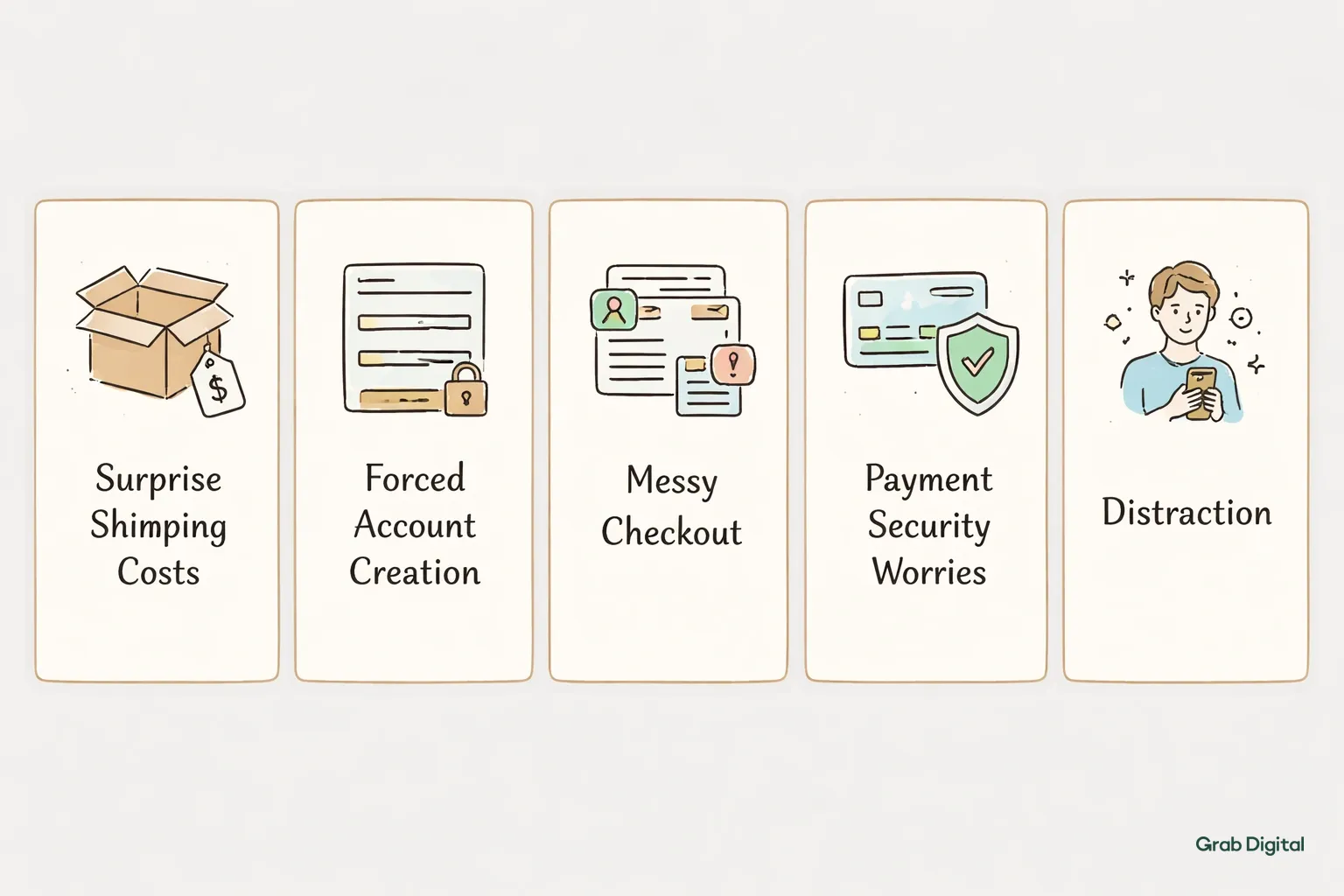
People rarely abandon carts because they hate the product. Usually, they wanted to buy but something got in the way. The top five reasons haven't changed much in 2026: surprise shipping costs, forced account creation, messy checkouts, payment security worries, and plain old distraction.
Shipping shock is the biggest offender. A customer adds a $60 candle, gets to checkout, and suddenly sees a $15 shipping fee. That’s a 25% upcharge they didn't expect. They leave to comparison shop or hunt for a promo code.
Forced account creation is the next dealbreaker. Brands that demand email, password, and profile setup before checkout lose 30% more carts than those offering guest checkout. The intent was there; the patience wasn't.
Mobile checkouts make it worse. If it takes more than three taps to buy on mobile, you're losing people. In 2026, 68% of DTC traffic comes from phones. A clunky mobile experience isn't just annoying it’s a broken funnel.
How to Reduce Cart Abandonment Before It Happens
It’s easier to keep a customer than win them back. The best recovery strategy is removing friction before the shopper has a reason to leave. Focus on transparent pricing, a streamlined checkout, trust signals, and mobile optimization.
Show shipping costs early. Don't wait until the final step. Put costs on the product page or in a sticky cart drawer. If you offer free shipping over a threshold, make that obvious immediately. A progress bar ("Add $25 more for free shipping") works double-duty: it prevents abandonment and boosts AOV.
Enable guest checkout. Ask for the bare minimum: email, shipping address, payment. Let them create an account after they buy. Shopify and most platforms have this as a toggle. It takes five minutes and typically lifts conversions by 10–15%.
Add trust badges at checkout. Security seals, return policy links, and payment icons (Visa, Mastercard, PayPal, Shop Pay) help with anxiety. Put them right under the payment field where people look for reassurance.
Optimize for mobile. Use big tap targets, forms that autofill, and one-tap options like Apple Pay or Google Pay. Test it on real devices. If buying takes more than 90 seconds on a phone, sales are leaking. If you need outside help, look for an email agency that understands the full journey from click to conversion.
The 3-Email Abandoned Cart Flow That Converts
Email is the highest-ROI recovery tool. A solid flow can recover 15–25% of lost revenue. The structure is simple: three emails sent at specific intervals, ramping up urgency and incentive.
Email 1 (1–2 hours after abandonment). Be direct. Subject lines like "You left something behind" or "Still thinking about it?" work. Include the product image, a clear CTA, and a reminder of shipping/return policies. Skip the discount for now most people just got distracted.
Email 2 (24 hours later). Shift tone. This is where social proof or scarcity comes in. Show a review snippet, mention low stock, or note how many people bought it recently. A gentle nudge "This is popular and might sell out" works better than a hard sell.
Email 3 (48–72 hours later). If margins allow, offer a discount. A 10–15% code or free shipping pushes the price-sensitive shoppers off the fence. Keep it urgent: "Last chance your cart expires soon." This is also a good place for an FAQ block addressing returns or sizing.
Building this in Klaviyo takes about 30 minutes if templates are ready. You can explore how to build a high-ROI abandoned cart flow for DTC brands on Klaviyo for deeper setup instructions.
Advanced Segmentation to Personalize Cart Recovery
Not all abandoners are the same. A first-time visitor needs a different approach than a VIP. Segmentation lets you adjust timing, messaging, and incentives.
Segment by status. New visitors get a softer touch brand storytelling and trust signals. Repeat customers get a shorter email referencing past buys or loyalty perks. VIPs might get a personal SMS or phone call instead of a third email.
Segment by value. High-value carts ($200+) earn white-glove treatment. Offer concierge support, expedited shipping, or a direct line to customer service. Low-value carts might not justify a discount in email three; test urgency instead.
Segment by category. Someone abandoning a subscription needs education and testimonials. Someone abandoning a one-time purchase needs urgency.
Klaviyo makes this layering easy. You can stack conditions "viewed product more than twice," "cart value over $150," "bought in last 90 days" to build relevant flows. Brands that segment see 20–30% higher recovery. If the setup feels daunting, book your free consultation to map a strategy.
How Popups and Exit-Intent Overlays Prevent Abandonment
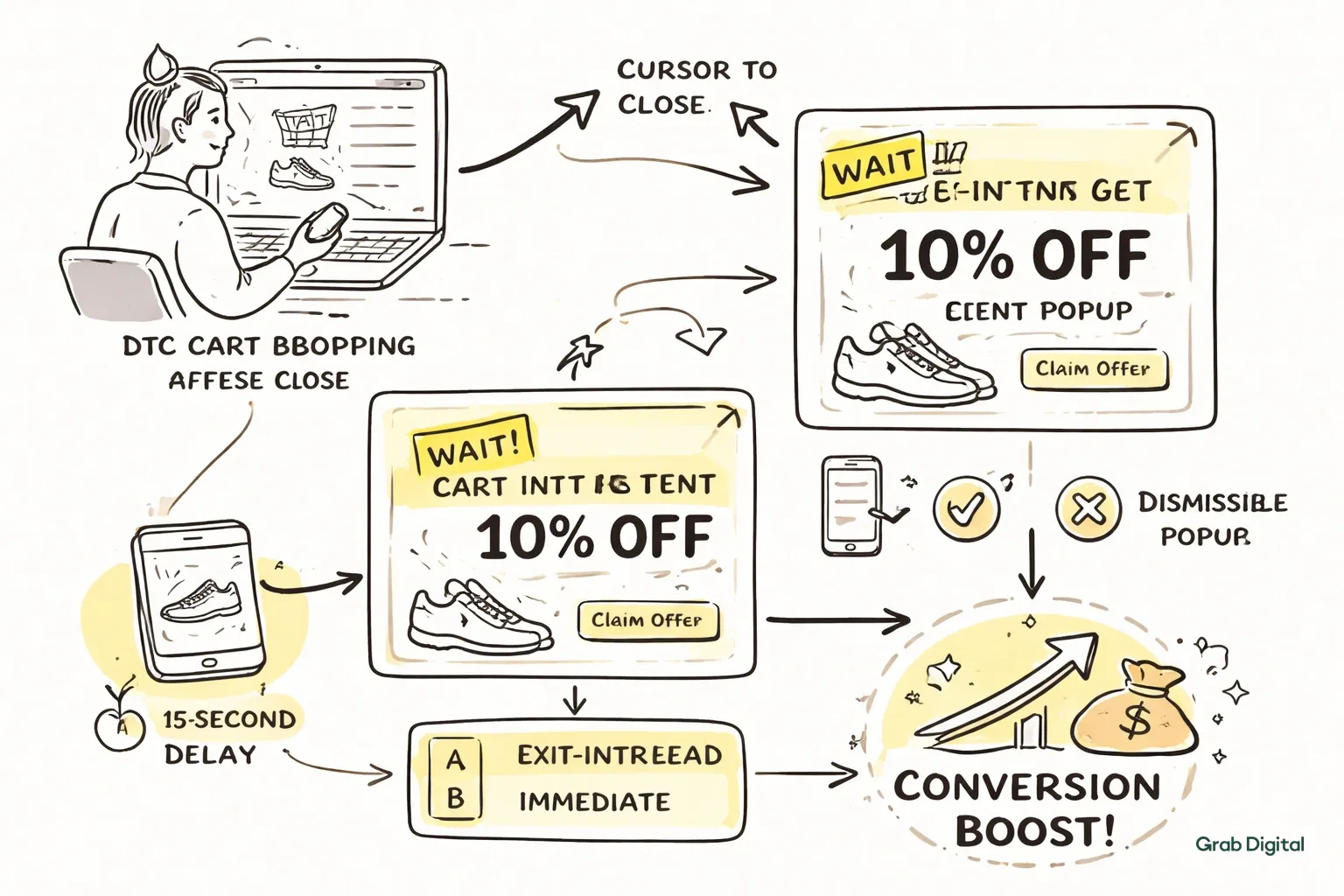
Exit-intent popups catch people on the way out. They trigger when the cursor heads for the close button. It’s a last-ditch effort to save the session.
Offer value. A simple "Wait! Get 10% off" code can recover 5–10% of abandoning visitors. Make sure the popup is dismissible and mobile-friendly. If it blocks the screen or lags, it hurts more than it helps.
Personalize it. If they have items in the cart, show those items. "Don't forget your [Product Name]" with a thumbnail beats a generic discount. Personalization lifts conversion rates by about 15%.
A/B test everything. Try a 15-second delay vs. immediate triggers. Test headlines like "Your cart is about to expire" vs. "Complete your order and save."
Popups also capture leads. If someone leaves without adding to cart, use the exit intent to grab their email for a first-order discount. Then you can retarget via flows. Learn more about popup optimization in a broader email strategy.
How SMS and Push Notifications Complement Email Recovery
Email does the heavy lifting, but SMS and push add urgency. SMS open rates top 90%, usually within three minutes. For high-intent abandoners, it's often the final push.
Send SMS 30–60 minutes after abandonment. Keep it short: "Hey [Name], you left [Product] in your cart. Finish here: [link]." An emoji is fine, but don't overdo it.
Reserve SMS for high-value carts or VIPs. Blasting SMS for every $20 cart wastes budget and annoys people. Set a threshold $75+ or SMS opt-ins only.
Push notifications work similarly but need app/browser opt-in. They’re best for brands with an app or high return traffic. The message should mirror the first email: quick reminder, product image, one-tap link.
Don’t spam. If someone gets an email, SMS, and push in an hour, they'll unsubscribe. Space it out: SMS at 1 hour, email at 24, second email at 48. Test to see what your audience tolerates.
The Role of Retargeting Ads in Cart Recovery
Retargeting ads catch the people who ignored emails. A shopper might ignore an email but click a Facebook or Instagram ad featuring the exact product they left behind.
Set up dynamic retargeting in Meta Ads Manager. Use your Shopify or Klaviyo feed to auto-populate ads. Pair it with "Still interested?" and a 10% code. Link straight to checkout, not the homepage.
Run them for 7–14 days. Intent drops off a cliff after two weeks. Most conversions happen in the first 72 hours, so spend your budget there. Cap frequency at about three impressions per week to avoid fatigue.
Layer it with email. Shoppers who see both email and ads convert 30% more often than those seeing just one. Make sure the creative matches across channels.
Google works too. Build cart abandonment audiences in Google Ads. Search ads for your brand name can grab people who left to compare prices. Display ads work for visual products like apparel or furniture.
How to Measure and Optimize Cart Abandonment Performance
You can’t fix what you don’t measure. The two big metrics are abandonment rate and recovery rate.
Cart abandonment rate = (carts created − completed checkouts) ÷ carts created × 100. Average is 70%. Below 60% is great. Above 75% means something is broken. Break it down by source, device, and product to find leaks.
Recovery rate = revenue from abandoned cart emails ÷ total potential cart value × 100. A good flow recovers 15–25%. Under 10% means the emails need work. Over 25% means you’ve dialed it in.
A/B test everything. Subject lines, send times, discounts, CTAs. Test one thing at a time. A 5% lift in opens or a 2% lift in clicks adds up.
Review monthly. Look for spikes on mobile or drops in email three. Use the data to tweak flows, UX, or pricing. If the numbers don’t make sense, check out the FAQ section or book a strategy call.
Common Mistakes DTC Brands Make with Cart Recovery
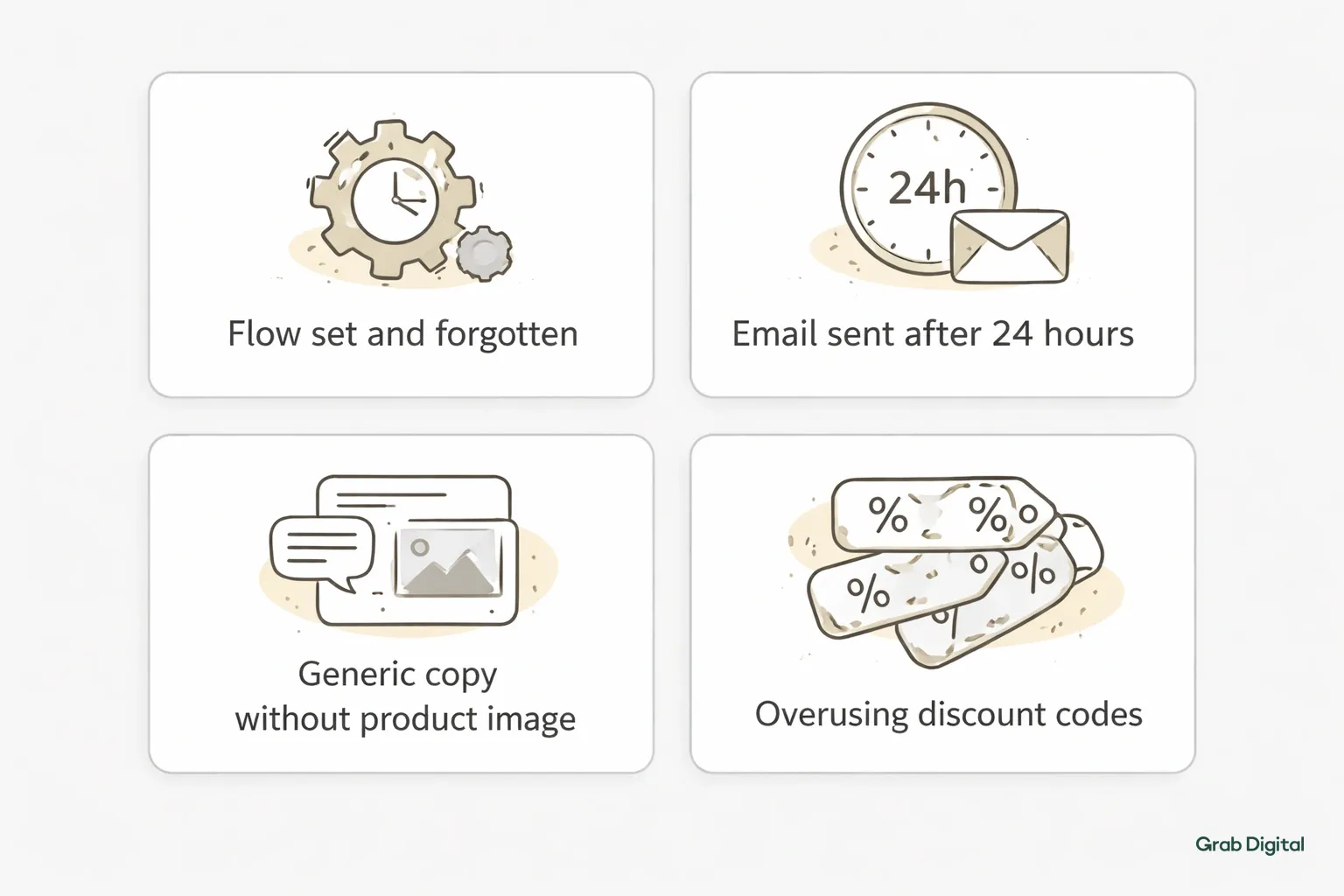
Most brands set a flow and forget it. That’s a mistake. Customer behavior changes, competitors adapt, and strategies that worked in 2024 might not work in 2026.
Sending emails too late. If the first email hits 24 hours later, you’ve lost the revenue. The sweet spot is 1–2 hours. Intent is warm. Waiting a day lets it go cold.
Using generic copy. "You left something behind" without an image or name gets ignored. Show the product, use their name, include a review. Personalization lifts recovery by 20–30%.
Overusing discounts. If every email has a 15% code, customers learn to abandon on purpose. Save codes for email three or high-value carts. Test urgency and scarcity first.
Ignoring mobile. If emails or checkout look bad on phones, you lose. Over two-thirds of DTC shoppers are on mobile. Optimize for the device they actually use.
Not excluding recent buyers. If someone abandons a cart but buys an hour later, they shouldn’t get a "come back" email. Klaviyo has a conditional split: "Has placed order zero times since starting this flow." Use it to avoid awkwardness.
For a full strategy, read about the 8 core email flows every DTC brand needs.
How Checkout UX Changes Reduce Abandonment by 20%+
Emails are reactive. Checkout fixes are proactive. Small UX tweaks often drive bigger gains than any flow.
Remove navigation during checkout. Hide the header, menu, and footer. The only button should be "Complete order." Every extra link is an exit. Brands that simplify checkout see 10–15% fewer abandonments.
Add a progress bar. A three-step visual (Shipping → Payment → Confirmation) cuts anxiety. People finish more often when they know they’re almost done. It works especially well on mobile.
Offer multiple payment options. Shop Pay, PayPal, Apple Pay, Google Pay, Afterpay, Klarna. More options mean fewer payment-related abandonments. One-click wallets can cut checkout time in half and lift conversions by 20%.
Show security signals. A lock icon, SSL badge, or "Your information is secure" near the payment field helps. In 2026, data breaches are top of mind. Reassure them.
Auto-save progress. If they fill out shipping but quit before paying, save it. Most platforms do this natively. It removes the friction of re-entry.
For brands over $1M, checkout optimization is required reading. Learn more about scaling DTC brands beyond $1M.
How Grab Digital Helps DTC Brands Reduce Cart Abandonment
Grab Digital builds and optimizes abandoned cart flows as part of our done-for-you Klaviyo service. We handle strategy, copywriting, design, segmentation, testing, and reporting. Our flows typically recover 15–25% of lost revenue.
We start with an audit. How many carts? How many checkouts? What’s the current recovery? We set benchmarks and attribution in Klaviyo. Then we rebuild or optimize using our three-email structure, segmentation, and mobile-first design.
We also fix popups and checkout UX. We test exit-intent overlays and trust signals to prevent abandonment before it happens. Brands that fix both prevention and recovery see 30%+ lifts in email revenue within 60 days.
We guarantee results. If we don’t grow email-attributed revenue by 10% in 60 days, we refund the investment. No fine print. This covers cart flows, welcome series, browse abandonment, and everything else we build. Explore our services to see how we function as your email team.
We’re also carbon-negative and a 1% for the Planet member. Every project funds reforestation and renewable offsets. If sustainability matters to your brand, it matters to us. Learn more about us.
Real-World Results: Cart Abandonment Recovery Case Studies
Rogue Industries, a leather goods brand, came to us with a 73% abandonment rate and a generic two-email flow recovering under 8%. We rebuilt it with segmentation and mobile design. Recovery hit 22% in 60 days, adding $48K in revenue.
Beessential, a skincare brand, had no exit popup and forced account creation. We added a 10% first-order popup, enabled guest checkout, and added UGC to emails. Abandonment dropped from 76% to 62%, and recovery hit 19%.
Model No., a furniture brand with $400+ AOV carts, had high-value cart abandonment issues. We built a segmented flow: longer copy, concierge offers, no discount until email three. Recovery for $400+ carts went from 11% to 26%, adding $120K in six months.
These wins come from treating abandonment as a system UX, timing, segmentation, and constant testing. If your recovery rate is under 15%, you’re leaving money behind. See more examples of our work.
When to Hire an Agency vs. Building In-House
Setting up a basic flow in Klaviyo is easy. Building one that recovers 20%+ while integrating popups, SMS, ads, and UX is hard. Most brands lack the bandwidth or specific expertise.
Hire an agency if you’re doing $1M+, have 10k+ subscribers, and lack a dedicated email person. Agencies like Grab Digital bring speed and expertise. We move faster than a new hire and show ROI in 60 days.
Build in-house if you’re pre-$1M or have a strong marketing team. You need a strategist, copywriter, and designer who know lifecycle marketing. If the team is stretched thin, outsource.
Hybrid models work too. Some brands hire us to build the foundation, then take campaigns in-house. We offer documentation and training. Cart abandonment is just one piece. A full strategy needs welcome series, post-purchase flows, winback flows, browse abandonment, and campaigns. If email drives less than 20% of revenue, there’s room to grow. Learn why DTC brands need an email agency for 30%+ revenue growth.
Frequently Asked Questions
Q: What is a good cart abandonment recovery rate for DTC brands? A: 15–25% is strong. That means you’re recapturing that percentage of lost revenue. Under 10% needs work. Over 25% means your timing and segmentation are solid.
Q: Should I offer a discount in my first abandoned cart email? A: No. Most people abandon because they got distracted, not because of price. Remind them of the product first. Save the discount for email three, and only if margins allow. Try urgency and social proof before you drop prices.
Q: How soon should I send the first abandoned cart email? A: 1–2 hours. That’s when intent is highest. Waiting 24 hours lets the purchase impulse fade. Faster emails almost always win.
Q: Can I reduce cart abandonment without offering discounts? A: Yes. Fix checkout UX: transparent shipping, guest checkout, trust signals, mobile speed. Pair that with a flow using urgency and social proof. Plenty of brands recover 20%+ without ever discounting.
Q: How do I prevent customers from gaming the system by abandoning to get discounts? A: Save discounts for email three. Segment by lifetime value. Don’t be predictable. Rotate tactics free shipping one month, urgency the next, gift-with-purchase the next.
Q: What tools do I need to build an effective cart abandonment strategy? A: Klaviyo for email, Shopify for tracking, an exit-intent tool (Justuno, Privy, or Klaviyo forms), and optionally SMS via Postscript or Attentive. Meta and Google retargeting ads round it out.
Shopping cart abandonment costs DTC brands 25–40% of potential revenue. Plugging that leak means removing friction at checkout, setting up the right retargeting emails, and using behavioral triggers to pull hesitant buyers back. Klaviyo automation is the best tool for the job.
The average cart abandonment rate for ecommerce hovered around 70% in 2026. Put another way: seven out of ten people who add something to their cart never actually buy it. If a brand is doing $3M a year, fixing even 10% of that leak adds $200K+ to the bottom line no new ad spend required. Here’s how to stop the bleeding.
Why Shopping Cart Abandonment Happens in the First Place
People rarely abandon carts because they hate the product. Usually, they wanted to buy but something got in the way. The top five reasons haven't changed much in 2026: surprise shipping costs, forced account creation, messy checkouts, payment security worries, and plain old distraction.
Shipping shock is the biggest offender. A customer adds a $60 candle, gets to checkout, and suddenly sees a $15 shipping fee. That’s a 25% upcharge they didn't expect. They leave to comparison shop or hunt for a promo code.
Forced account creation is the next dealbreaker. Brands that demand email, password, and profile setup before checkout lose 30% more carts than those offering guest checkout. The intent was there; the patience wasn't.
Mobile checkouts make it worse. If it takes more than three taps to buy on mobile, you're losing people. In 2026, 68% of DTC traffic comes from phones. A clunky mobile experience isn't just annoying it’s a broken funnel.
How to Reduce Cart Abandonment Before It Happens
It’s easier to keep a customer than win them back. The best recovery strategy is removing friction before the shopper has a reason to leave. Focus on transparent pricing, a streamlined checkout, trust signals, and mobile optimization.
Show shipping costs early. Don't wait until the final step. Put costs on the product page or in a sticky cart drawer. If you offer free shipping over a threshold, make that obvious immediately. A progress bar ("Add $25 more for free shipping") works double-duty: it prevents abandonment and boosts AOV.
Enable guest checkout. Ask for the bare minimum: email, shipping address, payment. Let them create an account after they buy. Shopify and most platforms have this as a toggle. It takes five minutes and typically lifts conversions by 10–15%.
Add trust badges at checkout. Security seals, return policy links, and payment icons (Visa, Mastercard, PayPal, Shop Pay) help with anxiety. Put them right under the payment field where people look for reassurance.
Optimize for mobile. Use big tap targets, forms that autofill, and one-tap options like Apple Pay or Google Pay. Test it on real devices. If buying takes more than 90 seconds on a phone, sales are leaking. If you need outside help, look for an email agency that understands the full journey from click to conversion.
The 3-Email Abandoned Cart Flow That Converts
Email is the highest-ROI recovery tool. A solid flow can recover 15–25% of lost revenue. The structure is simple: three emails sent at specific intervals, ramping up urgency and incentive.
Email 1 (1–2 hours after abandonment). Be direct. Subject lines like "You left something behind" or "Still thinking about it?" work. Include the product image, a clear CTA, and a reminder of shipping/return policies. Skip the discount for now most people just got distracted.
Email 2 (24 hours later). Shift tone. This is where social proof or scarcity comes in. Show a review snippet, mention low stock, or note how many people bought it recently. A gentle nudge "This is popular and might sell out" works better than a hard sell.
Email 3 (48–72 hours later). If margins allow, offer a discount. A 10–15% code or free shipping pushes the price-sensitive shoppers off the fence. Keep it urgent: "Last chance your cart expires soon." This is also a good place for an FAQ block addressing returns or sizing.
Building this in Klaviyo takes about 30 minutes if templates are ready. You can explore how to build a high-ROI abandoned cart flow for DTC brands on Klaviyo for deeper setup instructions.
Advanced Segmentation to Personalize Cart Recovery
Not all abandoners are the same. A first-time visitor needs a different approach than a VIP. Segmentation lets you adjust timing, messaging, and incentives.
Segment by status. New visitors get a softer touch brand storytelling and trust signals. Repeat customers get a shorter email referencing past buys or loyalty perks. VIPs might get a personal SMS or phone call instead of a third email.
Segment by value. High-value carts ($200+) earn white-glove treatment. Offer concierge support, expedited shipping, or a direct line to customer service. Low-value carts might not justify a discount in email three; test urgency instead.
Segment by category. Someone abandoning a subscription needs education and testimonials. Someone abandoning a one-time purchase needs urgency.
Klaviyo makes this layering easy. You can stack conditions "viewed product more than twice," "cart value over $150," "bought in last 90 days" to build relevant flows. Brands that segment see 20–30% higher recovery. If the setup feels daunting, book your free consultation to map a strategy.
How Popups and Exit-Intent Overlays Prevent Abandonment
Exit-intent popups catch people on the way out. They trigger when the cursor heads for the close button. It’s a last-ditch effort to save the session.
Offer value. A simple "Wait! Get 10% off" code can recover 5–10% of abandoning visitors. Make sure the popup is dismissible and mobile-friendly. If it blocks the screen or lags, it hurts more than it helps.
Personalize it. If they have items in the cart, show those items. "Don't forget your [Product Name]" with a thumbnail beats a generic discount. Personalization lifts conversion rates by about 15%.
A/B test everything. Try a 15-second delay vs. immediate triggers. Test headlines like "Your cart is about to expire" vs. "Complete your order and save."
Popups also capture leads. If someone leaves without adding to cart, use the exit intent to grab their email for a first-order discount. Then you can retarget via flows. Learn more about popup optimization in a broader email strategy.
How SMS and Push Notifications Complement Email Recovery
Email does the heavy lifting, but SMS and push add urgency. SMS open rates top 90%, usually within three minutes. For high-intent abandoners, it's often the final push.
Send SMS 30–60 minutes after abandonment. Keep it short: "Hey [Name], you left [Product] in your cart. Finish here: [link]." An emoji is fine, but don't overdo it.
Reserve SMS for high-value carts or VIPs. Blasting SMS for every $20 cart wastes budget and annoys people. Set a threshold $75+ or SMS opt-ins only.
Push notifications work similarly but need app/browser opt-in. They’re best for brands with an app or high return traffic. The message should mirror the first email: quick reminder, product image, one-tap link.
Don’t spam. If someone gets an email, SMS, and push in an hour, they'll unsubscribe. Space it out: SMS at 1 hour, email at 24, second email at 48. Test to see what your audience tolerates.
The Role of Retargeting Ads in Cart Recovery
Retargeting ads catch the people who ignored emails. A shopper might ignore an email but click a Facebook or Instagram ad featuring the exact product they left behind.
Set up dynamic retargeting in Meta Ads Manager. Use your Shopify or Klaviyo feed to auto-populate ads. Pair it with "Still interested?" and a 10% code. Link straight to checkout, not the homepage.
Run them for 7–14 days. Intent drops off a cliff after two weeks. Most conversions happen in the first 72 hours, so spend your budget there. Cap frequency at about three impressions per week to avoid fatigue.
Layer it with email. Shoppers who see both email and ads convert 30% more often than those seeing just one. Make sure the creative matches across channels.
Google works too. Build cart abandonment audiences in Google Ads. Search ads for your brand name can grab people who left to compare prices. Display ads work for visual products like apparel or furniture.
How to Measure and Optimize Cart Abandonment Performance
You can’t fix what you don’t measure. The two big metrics are abandonment rate and recovery rate.
Cart abandonment rate = (carts created − completed checkouts) ÷ carts created × 100. Average is 70%. Below 60% is great. Above 75% means something is broken. Break it down by source, device, and product to find leaks.
Recovery rate = revenue from abandoned cart emails ÷ total potential cart value × 100. A good flow recovers 15–25%. Under 10% means the emails need work. Over 25% means you’ve dialed it in.
A/B test everything. Subject lines, send times, discounts, CTAs. Test one thing at a time. A 5% lift in opens or a 2% lift in clicks adds up.
Review monthly. Look for spikes on mobile or drops in email three. Use the data to tweak flows, UX, or pricing. If the numbers don’t make sense, check out the FAQ section or book a strategy call.
Common Mistakes DTC Brands Make with Cart Recovery
Most brands set a flow and forget it. That’s a mistake. Customer behavior changes, competitors adapt, and strategies that worked in 2024 might not work in 2026.
Sending emails too late. If the first email hits 24 hours later, you’ve lost the revenue. The sweet spot is 1–2 hours. Intent is warm. Waiting a day lets it go cold.
Using generic copy. "You left something behind" without an image or name gets ignored. Show the product, use their name, include a review. Personalization lifts recovery by 20–30%.
Overusing discounts. If every email has a 15% code, customers learn to abandon on purpose. Save codes for email three or high-value carts. Test urgency and scarcity first.
Ignoring mobile. If emails or checkout look bad on phones, you lose. Over two-thirds of DTC shoppers are on mobile. Optimize for the device they actually use.
Not excluding recent buyers. If someone abandons a cart but buys an hour later, they shouldn’t get a "come back" email. Klaviyo has a conditional split: "Has placed order zero times since starting this flow." Use it to avoid awkwardness.
For a full strategy, read about the 8 core email flows every DTC brand needs.
How Checkout UX Changes Reduce Abandonment by 20%+
Emails are reactive. Checkout fixes are proactive. Small UX tweaks often drive bigger gains than any flow.
Remove navigation during checkout. Hide the header, menu, and footer. The only button should be "Complete order." Every extra link is an exit. Brands that simplify checkout see 10–15% fewer abandonments.
Add a progress bar. A three-step visual (Shipping → Payment → Confirmation) cuts anxiety. People finish more often when they know they’re almost done. It works especially well on mobile.
Offer multiple payment options. Shop Pay, PayPal, Apple Pay, Google Pay, Afterpay, Klarna. More options mean fewer payment-related abandonments. One-click wallets can cut checkout time in half and lift conversions by 20%.
Show security signals. A lock icon, SSL badge, or "Your information is secure" near the payment field helps. In 2026, data breaches are top of mind. Reassure them.
Auto-save progress. If they fill out shipping but quit before paying, save it. Most platforms do this natively. It removes the friction of re-entry.
For brands over $1M, checkout optimization is required reading. Learn more about scaling DTC brands beyond $1M.
How Grab Digital Helps DTC Brands Reduce Cart Abandonment
Grab Digital builds and optimizes abandoned cart flows as part of our done-for-you Klaviyo service. We handle strategy, copywriting, design, segmentation, testing, and reporting. Our flows typically recover 15–25% of lost revenue.
We start with an audit. How many carts? How many checkouts? What’s the current recovery? We set benchmarks and attribution in Klaviyo. Then we rebuild or optimize using our three-email structure, segmentation, and mobile-first design.
We also fix popups and checkout UX. We test exit-intent overlays and trust signals to prevent abandonment before it happens. Brands that fix both prevention and recovery see 30%+ lifts in email revenue within 60 days.
We guarantee results. If we don’t grow email-attributed revenue by 10% in 60 days, we refund the investment. No fine print. This covers cart flows, welcome series, browse abandonment, and everything else we build. Explore our services to see how we function as your email team.
We’re also carbon-negative and a 1% for the Planet member. Every project funds reforestation and renewable offsets. If sustainability matters to your brand, it matters to us. Learn more about us.
Real-World Results: Cart Abandonment Recovery Case Studies
Rogue Industries, a leather goods brand, came to us with a 73% abandonment rate and a generic two-email flow recovering under 8%. We rebuilt it with segmentation and mobile design. Recovery hit 22% in 60 days, adding $48K in revenue.
Beessential, a skincare brand, had no exit popup and forced account creation. We added a 10% first-order popup, enabled guest checkout, and added UGC to emails. Abandonment dropped from 76% to 62%, and recovery hit 19%.
Model No., a furniture brand with $400+ AOV carts, had high-value cart abandonment issues. We built a segmented flow: longer copy, concierge offers, no discount until email three. Recovery for $400+ carts went from 11% to 26%, adding $120K in six months.
These wins come from treating abandonment as a system UX, timing, segmentation, and constant testing. If your recovery rate is under 15%, you’re leaving money behind. See more examples of our work.
When to Hire an Agency vs. Building In-House
Setting up a basic flow in Klaviyo is easy. Building one that recovers 20%+ while integrating popups, SMS, ads, and UX is hard. Most brands lack the bandwidth or specific expertise.
Hire an agency if you’re doing $1M+, have 10k+ subscribers, and lack a dedicated email person. Agencies like Grab Digital bring speed and expertise. We move faster than a new hire and show ROI in 60 days.
Build in-house if you’re pre-$1M or have a strong marketing team. You need a strategist, copywriter, and designer who know lifecycle marketing. If the team is stretched thin, outsource.
Hybrid models work too. Some brands hire us to build the foundation, then take campaigns in-house. We offer documentation and training. Cart abandonment is just one piece. A full strategy needs welcome series, post-purchase flows, winback flows, browse abandonment, and campaigns. If email drives less than 20% of revenue, there’s room to grow. Learn why DTC brands need an email agency for 30%+ revenue growth.
Frequently Asked Questions
Q: What is a good cart abandonment recovery rate for DTC brands? A: 15–25% is strong. That means you’re recapturing that percentage of lost revenue. Under 10% needs work. Over 25% means your timing and segmentation are solid.
Q: Should I offer a discount in my first abandoned cart email? A: No. Most people abandon because they got distracted, not because of price. Remind them of the product first. Save the discount for email three, and only if margins allow. Try urgency and social proof before you drop prices.
Q: How soon should I send the first abandoned cart email? A: 1–2 hours. That’s when intent is highest. Waiting 24 hours lets the purchase impulse fade. Faster emails almost always win.
Q: Can I reduce cart abandonment without offering discounts? A: Yes. Fix checkout UX: transparent shipping, guest checkout, trust signals, mobile speed. Pair that with a flow using urgency and social proof. Plenty of brands recover 20%+ without ever discounting.
Q: How do I prevent customers from gaming the system by abandoning to get discounts? A: Save discounts for email three. Segment by lifetime value. Don’t be predictable. Rotate tactics free shipping one month, urgency the next, gift-with-purchase the next.
Q: What tools do I need to build an effective cart abandonment strategy? A: Klaviyo for email, Shopify for tracking, an exit-intent tool (Justuno, Privy, or Klaviyo forms), and optionally SMS via Postscript or Attentive. Meta and Google retargeting ads round it out.

Find out exactly what your email channel is leaving on the table.

Email Marketing for Scaling DTC Brands


