
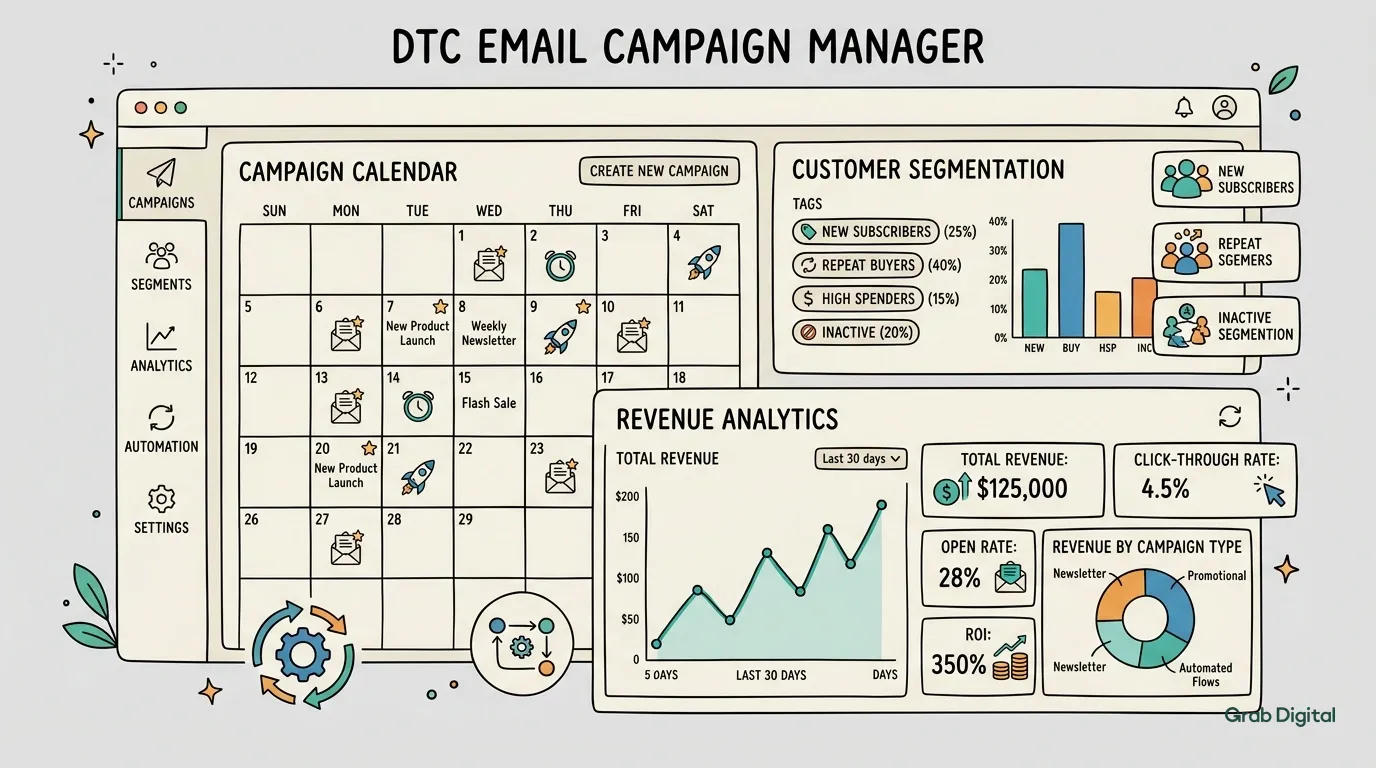
Summary
Master DTC Email Campaign Management for 30%+ Revenue Growth
Sending an email is easy. Managing a strategy across product launches, holidays, and the chaos of shifting customer behavior? That’s where most brands fall apart. For DTC brands doing $1M–$10M a year, campaign management isn't just about hitting "send." It's about building a system that drives revenue, not just noise.
If your email marketing feels reactive scrambling to write copy the morning of a send, or watching open rates slowly tank you need a better framework. Here’s how to build one that actually scales.
What Campaign Management Actually Means
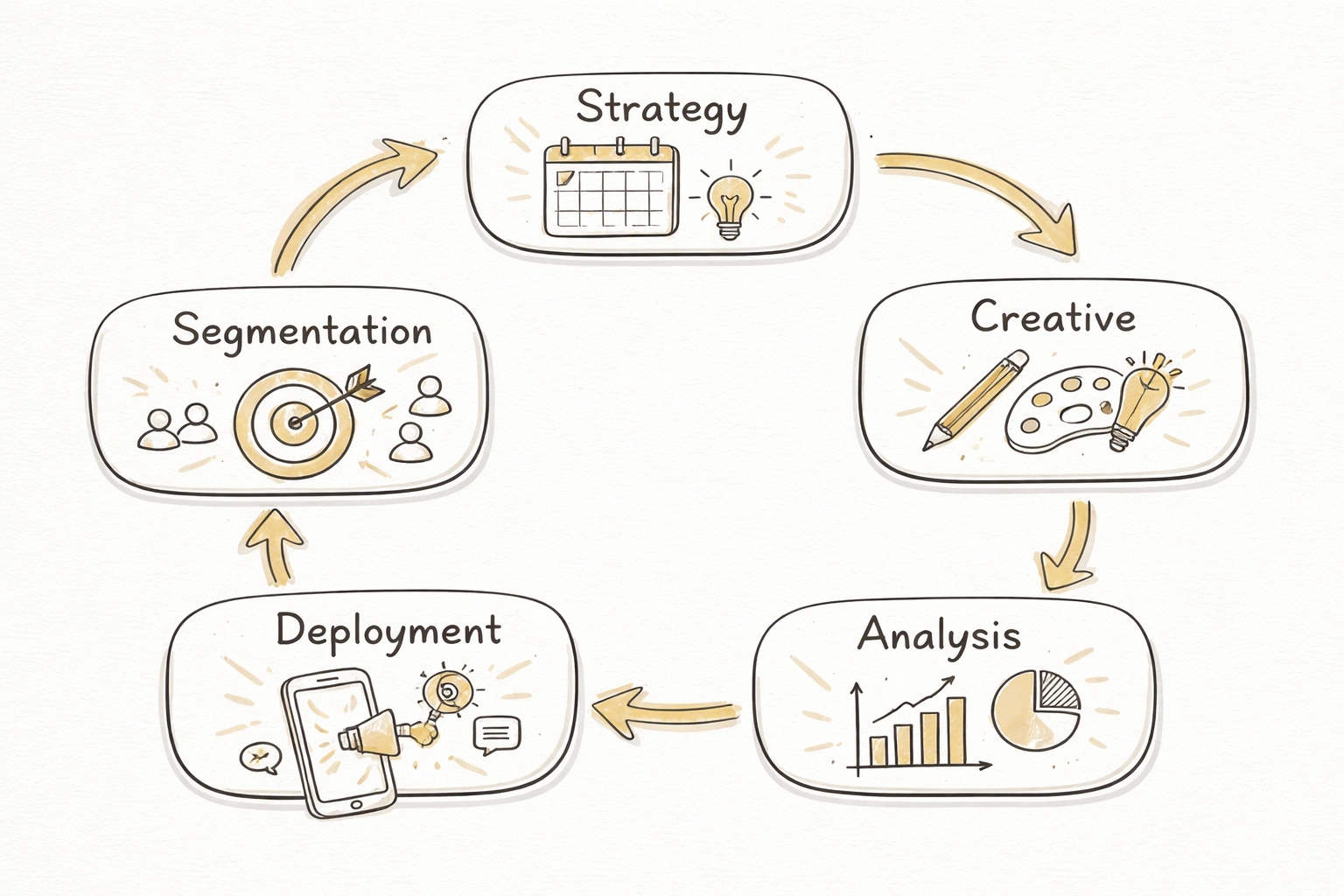
Campaign management is just the workflow of planning, building, sending, and reviewing your emails. It covers:
Strategy: Building a calendar that aligns with product launches and sales goals, not just random ideas.
Segmentation: Deciding who gets what message (and who doesn't).
Creative: Writing, designing, and coordinating assets without losing your mind.
Deployment: Pre-send QA, send-time optimization, and making sure it looks right on an iPhone and Android.
Analysis: Tracking what worked, what flopped, and feeding that back into the next campaign.
For DTC brands, this has to be tight with your Shopify store and Klaviyo setup. Brands that do this well see 30–40% of total revenue from email. The ones that don't usually stall around 15%.
Why Most DTC Brands Struggle Here
Most brands treat campaigns as one-off events. Someone has an idea for a sale, writes an email, whips up a design in Canva, schedules it, and forgets about it. No testing. No segmentation. No follow-up.
The breakdown usually looks like this:
No documented strategy: Reacting to the calendar instead of planning for it.
Generic messaging: Blasting the same email to everyone, regardless of whether they bought yesterday or three years ago.
Inconsistent frequency: Sending three emails one week, then ghosting the list for two weeks.
No testing framework: Guessing what works.
Poor integration with flows: Your automated flows and campaigns clash, sending conflicting offers to the same person.
Lack of analysis: Glancing at open rates but ignoring revenue per recipient or segment performance.
The result? Email becomes a weak channel that underperforms paid ads, even though it should be your highest-ROI lever.
Building a Calendar That Works
A solid campaign calendar is non-negotiable. It should map out:
Promotional campaigns: Sales, flash offers.
Product launches: New arrivals, restocks, limited editions.
Content campaigns: Education, storytelling.
Seasonal pushes: Black Friday, Valentine's Day, Mother's Day.
Lifecycle campaigns: Birthdays, anniversaries, VIP exclusives.
Build it 90 days out. Review it monthly. Keep it flexible enough to handle a product delay or a surprise competitor move.
A Monthly Rhythm That Works
Here’s a baseline that works for most brands:
Week | Type | Goal |
|---|---|---|
Week 1 | Product spotlight | Drive interest in a hero SKU |
Week 2 | Educational content | Build trust, answer questions |
Week 3 | Promotional offer | Convert fence-sitters |
Week 4 | Engagement or UGC | Boost opens, gather content |
This isn't rigid. Some brands send 3x/week during peak season and 1x/week during slow months. The point is consistency. If you're planning to scale your DTC brand, your frequency needs to grow with you.
Segmentation: The Lever Everyone Ignores
Sending the same campaign to your entire list is like running the same Instagram ad to everyone who visited your site in the last five years. It’s lazy and it wastes money.
Segment based on:
Purchase behavior: First-time buyers, repeat customers, VIPs.
Engagement level: People who open everything vs. people who haven't clicked in six months.
Product affinity: Customers who bought specific categories.
Lifecycle stage: New subscribers, active customers, people at risk of churning.
Geographic or demographic data: Location, device, signup source.
A product launch shouldn't be one email. It should be four:
VIPs: Early access, maybe an exclusive discount.
Repeat customers: Explain how the new product fits what they already own.
Engaged non-purchasers: Hit them with social proof and a deadline.
Dormant subscribers: Use a win-back angle.
Different subject lines, different copy, sometimes different offers. Strategic email segmentation can realistically double your campaign revenue.
Copy and Design: What Actually Matters
Your performance lives or dies on two things: open rates and click rates. Your subject line and your creative have to work together.
Subject Lines
Your subject line should:
Create curiosity or urgency.
Be specific.
Sound like your brand.
Avoid spam triggers like "FREE!!!"
Examples:
❌ "New products are here"
✅ "The wallets that sold out in 48 hours are back"
❌ "Check out our sale"
✅ "30% off ends tonight here's what's left"
Design
Your email should be:
Mobile-first: Over 60% of opens happen on mobile.
Scannable: Use headers, bullets, and whitespace.
Focused: One primary CTA, not five competing buttons.
Fast-loading: Compressed images, minimal code bloat.
Don't overdesign it. A well-written plain-text email often beats a heavily designed one, especially for storytelling. Test both.
Testing: What to Test and When
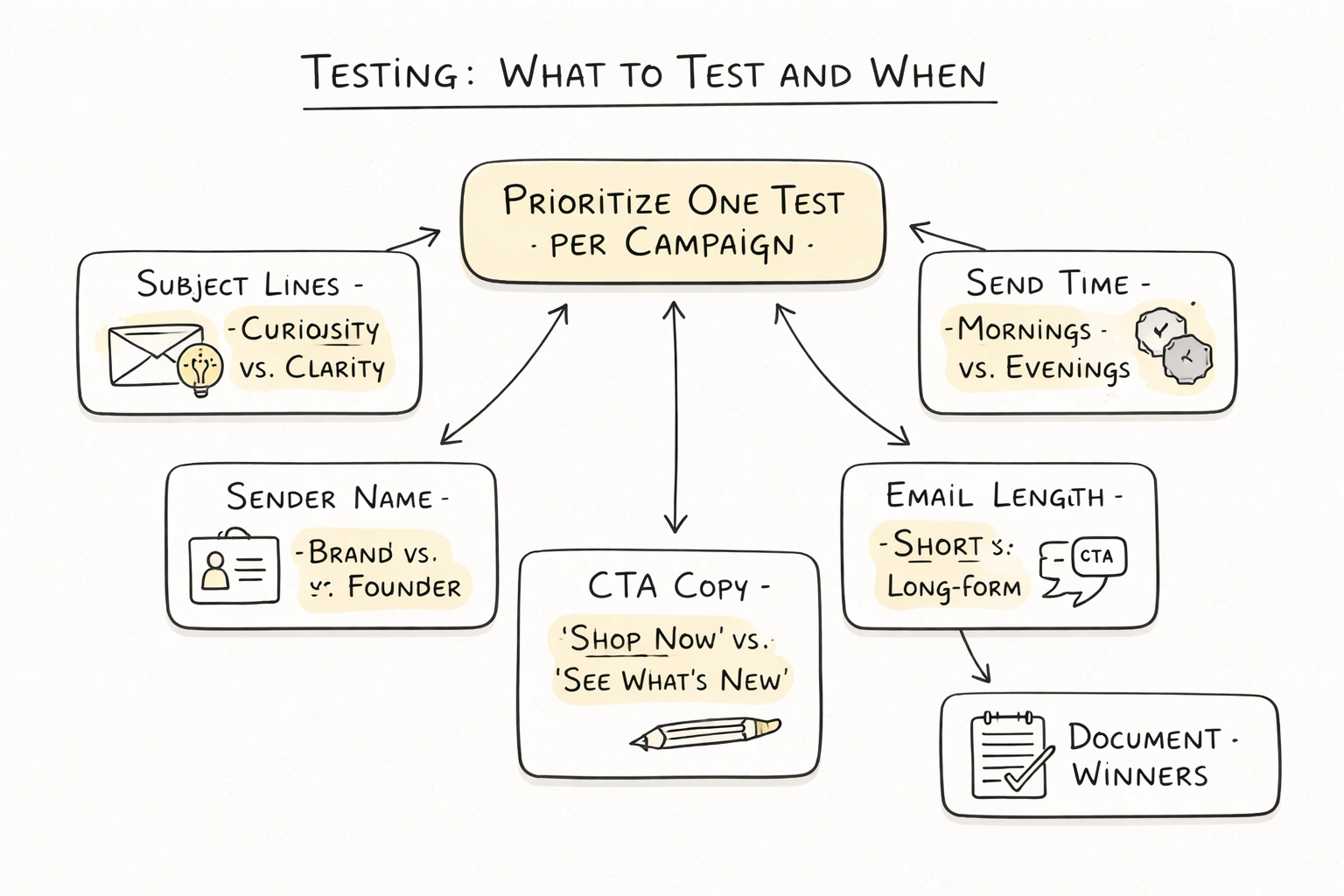
If you aren't testing, you're guessing. But trying to test everything at once leads to paralysis. Prioritize these:
Subject lines: Curiosity vs. clarity.
Send time: Mornings vs. evenings.
Sender name: Brand name vs. founder name.
CTA copy: "Shop Now" vs. "See What's New."
Email length: Short vs. long-form.
Run one test per campaign. If you test the subject line and send time simultaneously, you won't know which variable moved the needle. Document your winners so you aren't re-learning the same lessons later.
Campaign and Flow Coordination
Your campaigns and automated flows need to work together, not fight. Common conflicts:
Sending a promo campaign to someone mid-way through a welcome series.
Blasting a discount to someone who just got a cart abandonment email with a different offer.
Bombarding a new subscriber with a flow and two campaigns in 24 hours.
Smart Suppression Rules
Set up suppression logic in Klaviyo:
Exclude people in active flows from campaigns.
Suppress recent purchasers from promotional campaigns for 7–14 days.
Prioritize high-engagement VIPs for campaigns over win-back flows.
If this sounds complicated, it might be time to book your free consultation with a team that sets this up daily.
KPIs That Actually Matter
Vanity metrics don't pay the bills. Track these:
Revenue per recipient (RPR): Total campaign revenue ÷ total recipients.
Conversion rate: Purchasers ÷ recipients.
Click-to-open rate (CTOR): Clicks ÷ opens (shows if your content resonated).
Incremental revenue: Campaign revenue minus what you would have made anyway.
Look at these by segment. A 25% open rate looks fine until you realize your VIPs are only opening at 15%. For more on keeping metrics healthy, check our guide on email deliverability for DTC brands.
Managing Frequency Without Burning Out Your List
One of the most common questions: how often should I send?
It depends. But here are guardrails:
Minimum: 1–2/week to stay visible.
Maximum: 5–7/week during peak seasons.
Sweet spot for most: 2–4/week.
Watch your unsubscribe rate. If it spikes, dial it back or segment harder so only engaged users get the extra sends. Give subscribers control, too. A preference center where they choose frequency reduces unsubs.
The Tool Stack
For DTC brands on Shopify, Klaviyo is the standard. It integrates natively, offers solid segmentation, automation, and reporting.
Your stack:
ESP: Klaviyo.
Design: Figma, Canva, or Klaviyo's editor.
Testing: Litmus or Email on Acid for rendering.
Analytics: Klaviyo's reporting plus Google Analytics for crosscheck.
Calendar: Asana, Notion, or a shared Google Sheet.
If you're managing this in-house, make sure someone owns the calendar, someone owns creative, and someone owns analysis. If that's all you, you're going to burn out. That's where a Klaviyo agency helps you get a full team handling the grind.
Common Mistakes
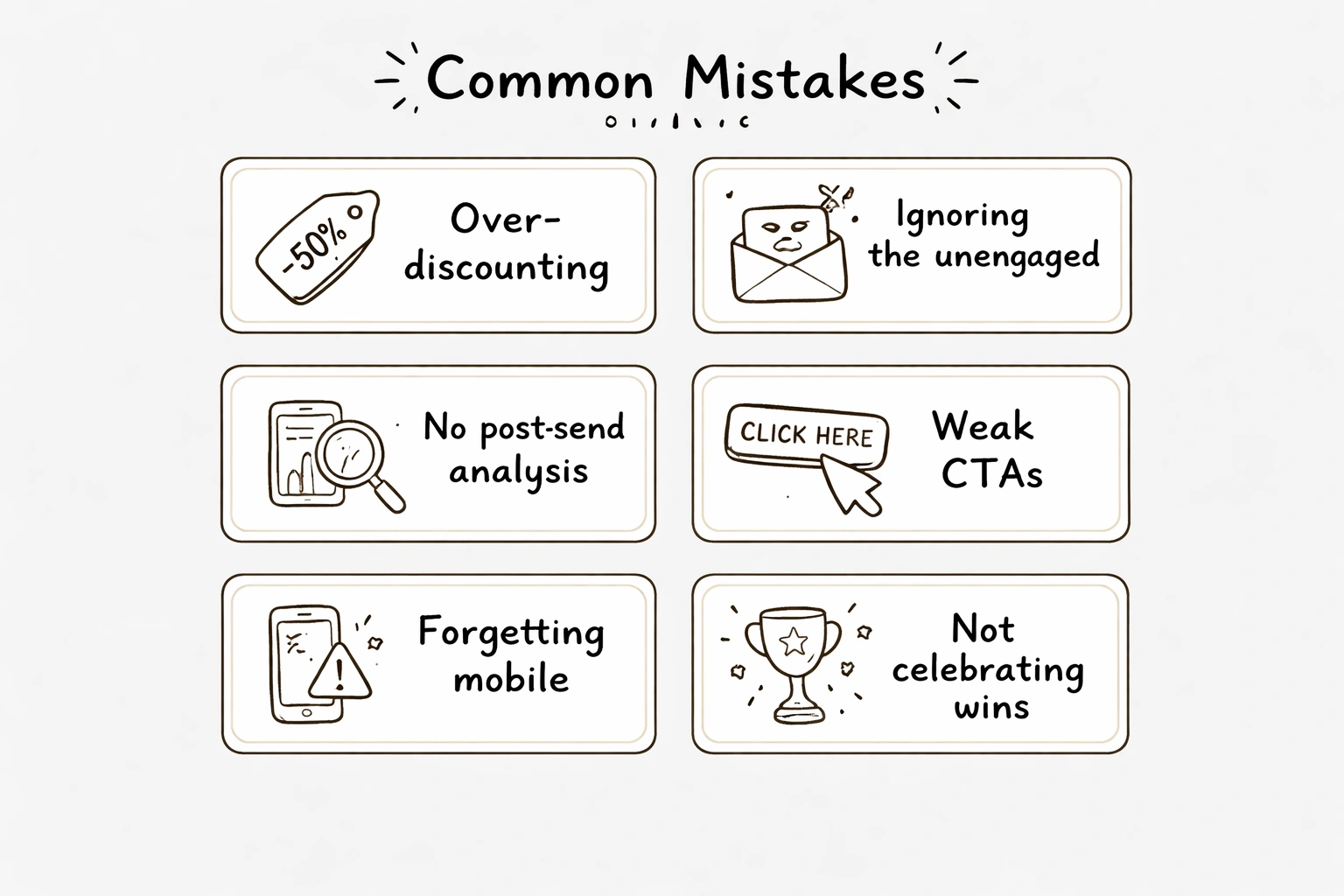
Even pros make these errors:
Over-discounting: Training customers to never buy full-price.
Ignoring the unengaged: Sending to everyone instead of cleaning the list.
No post-send analysis: Moving to the next campaign without learning.
Weak CTAs: Vague buttons like "Learn More."
Forgetting mobile: Designing for desktop when 60% open on phones.
Not celebrating wins: Email is a grind highlight the wins to your team.
When to Get Help
If any of these sound familiar, get help:
You're too swamped to plan more than a week ahead.
Email revenue is flat despite list growth.
You don't have a dedicated person for email.
Segmentation and suppression logic are a mystery.
You want email to go from 15% to 30%+ of revenue.
We've worked with brands like Rogue Industries, Beessential, and Model No. to overhaul their campaign management. Our services cover strategy, copy, design, testing, deployment, and reporting with a 10% revenue growth guarantee within 60 days.
Whether it's us or someone else, find a team that knows DTC and Klaviyo inside out. You can explore more about how DTC brands choose the right Klaviyo agency before making a decision.
Building a Repeatable System
The best systems are hand-off ready. You should be able to give your calendar, segmentation rules, and testing framework to someone else, and they should be able to run it without you.
Document everything:
Campaign templates for launches, promos, and content.
Segmentation criteria.
Subject line formulas that have won.
Design specs.
Testing logs.
This becomes your playbook. It makes onboarding easier and protects the brand if someone leaves. If you're new to email marketing automation, building this infrastructure early saves months of frustration.
The Bottom Line
Email campaign management isn't a set-it-and-forget-it task. It's a discipline that requires strategy, decent creative, and looking at the data.
When done right, it becomes your most reliable revenue channel. It scales with you, adapts to the season, and builds customer relationships paid ads can't touch.
Start by building your 90-day calendar, fixing your segmentation, and committing to testing. And if you want a team to handle the whole process from strategy to reporting check out our work or reach out to see how we've helped brands like yours grow email revenue by 30% or more.
Frequently Asked Questions
Q: How often should DTC brands send email campaigns?
A: Most do well with 2–4/week normally, and 5–7 during peak seasons like Black Friday. Watch engagement and unsubscribes. If they spike, back off or segment harder.
Q: What's the difference between campaigns and flows?
A: Campaigns are one-time broadcasts. Flows are automated sequences triggered by behavior (like abandoning a cart). You need both, and they need to be coordinated.
Q: How do I know if my campaigns are working?
A: Look at revenue per recipient (RPR), conversion rate, and incremental revenue. For DTC, $0.10–$0.50 RPR per campaign is solid. Check performance by segment.
Q: Should I send the same campaign to my whole list?
A: No. Segmenting based on history, engagement, and lifecycle stage can double or triple revenue per send. At minimum, split VIPs, repeat buyers, engaged non-purchasers, and dormant subscribers.
Q: What's the biggest mistake brands make?
A: Not planning ahead. Reacting to the calendar instead of building a strategic one 90 days out leads to inconsistent messaging and burnout.
Q: When should I hire an agency?
A: When you don't have a dedicated in-house person, when email revenue is stuck below 20% of total sales, or when you're too busy to plan strategically. A good agency often delivers 30%+ growth in the first few months.
Sending an email is easy. Managing a strategy across product launches, holidays, and the chaos of shifting customer behavior? That’s where most brands fall apart. For DTC brands doing $1M–$10M a year, campaign management isn't just about hitting "send." It's about building a system that drives revenue, not just noise.
If your email marketing feels reactive scrambling to write copy the morning of a send, or watching open rates slowly tank you need a better framework. Here’s how to build one that actually scales.
What Campaign Management Actually Means
Campaign management is just the workflow of planning, building, sending, and reviewing your emails. It covers:
Strategy: Building a calendar that aligns with product launches and sales goals, not just random ideas.
Segmentation: Deciding who gets what message (and who doesn't).
Creative: Writing, designing, and coordinating assets without losing your mind.
Deployment: Pre-send QA, send-time optimization, and making sure it looks right on an iPhone and Android.
Analysis: Tracking what worked, what flopped, and feeding that back into the next campaign.
For DTC brands, this has to be tight with your Shopify store and Klaviyo setup. Brands that do this well see 30–40% of total revenue from email. The ones that don't usually stall around 15%.
Why Most DTC Brands Struggle Here
Most brands treat campaigns as one-off events. Someone has an idea for a sale, writes an email, whips up a design in Canva, schedules it, and forgets about it. No testing. No segmentation. No follow-up.
The breakdown usually looks like this:
No documented strategy: Reacting to the calendar instead of planning for it.
Generic messaging: Blasting the same email to everyone, regardless of whether they bought yesterday or three years ago.
Inconsistent frequency: Sending three emails one week, then ghosting the list for two weeks.
No testing framework: Guessing what works.
Poor integration with flows: Your automated flows and campaigns clash, sending conflicting offers to the same person.
Lack of analysis: Glancing at open rates but ignoring revenue per recipient or segment performance.
The result? Email becomes a weak channel that underperforms paid ads, even though it should be your highest-ROI lever.
Building a Calendar That Works
A solid campaign calendar is non-negotiable. It should map out:
Promotional campaigns: Sales, flash offers.
Product launches: New arrivals, restocks, limited editions.
Content campaigns: Education, storytelling.
Seasonal pushes: Black Friday, Valentine's Day, Mother's Day.
Lifecycle campaigns: Birthdays, anniversaries, VIP exclusives.
Build it 90 days out. Review it monthly. Keep it flexible enough to handle a product delay or a surprise competitor move.
A Monthly Rhythm That Works
Here’s a baseline that works for most brands:
Week | Type | Goal |
|---|---|---|
Week 1 | Product spotlight | Drive interest in a hero SKU |
Week 2 | Educational content | Build trust, answer questions |
Week 3 | Promotional offer | Convert fence-sitters |
Week 4 | Engagement or UGC | Boost opens, gather content |
This isn't rigid. Some brands send 3x/week during peak season and 1x/week during slow months. The point is consistency. If you're planning to scale your DTC brand, your frequency needs to grow with you.
Segmentation: The Lever Everyone Ignores
Sending the same campaign to your entire list is like running the same Instagram ad to everyone who visited your site in the last five years. It’s lazy and it wastes money.
Segment based on:
Purchase behavior: First-time buyers, repeat customers, VIPs.
Engagement level: People who open everything vs. people who haven't clicked in six months.
Product affinity: Customers who bought specific categories.
Lifecycle stage: New subscribers, active customers, people at risk of churning.
Geographic or demographic data: Location, device, signup source.
A product launch shouldn't be one email. It should be four:
VIPs: Early access, maybe an exclusive discount.
Repeat customers: Explain how the new product fits what they already own.
Engaged non-purchasers: Hit them with social proof and a deadline.
Dormant subscribers: Use a win-back angle.
Different subject lines, different copy, sometimes different offers. Strategic email segmentation can realistically double your campaign revenue.
Copy and Design: What Actually Matters
Your performance lives or dies on two things: open rates and click rates. Your subject line and your creative have to work together.
Subject Lines
Your subject line should:
Create curiosity or urgency.
Be specific.
Sound like your brand.
Avoid spam triggers like "FREE!!!"
Examples:
❌ "New products are here"
✅ "The wallets that sold out in 48 hours are back"
❌ "Check out our sale"
✅ "30% off ends tonight here's what's left"
Design
Your email should be:
Mobile-first: Over 60% of opens happen on mobile.
Scannable: Use headers, bullets, and whitespace.
Focused: One primary CTA, not five competing buttons.
Fast-loading: Compressed images, minimal code bloat.
Don't overdesign it. A well-written plain-text email often beats a heavily designed one, especially for storytelling. Test both.
Testing: What to Test and When
If you aren't testing, you're guessing. But trying to test everything at once leads to paralysis. Prioritize these:
Subject lines: Curiosity vs. clarity.
Send time: Mornings vs. evenings.
Sender name: Brand name vs. founder name.
CTA copy: "Shop Now" vs. "See What's New."
Email length: Short vs. long-form.
Run one test per campaign. If you test the subject line and send time simultaneously, you won't know which variable moved the needle. Document your winners so you aren't re-learning the same lessons later.
Campaign and Flow Coordination
Your campaigns and automated flows need to work together, not fight. Common conflicts:
Sending a promo campaign to someone mid-way through a welcome series.
Blasting a discount to someone who just got a cart abandonment email with a different offer.
Bombarding a new subscriber with a flow and two campaigns in 24 hours.
Smart Suppression Rules
Set up suppression logic in Klaviyo:
Exclude people in active flows from campaigns.
Suppress recent purchasers from promotional campaigns for 7–14 days.
Prioritize high-engagement VIPs for campaigns over win-back flows.
If this sounds complicated, it might be time to book your free consultation with a team that sets this up daily.
KPIs That Actually Matter
Vanity metrics don't pay the bills. Track these:
Revenue per recipient (RPR): Total campaign revenue ÷ total recipients.
Conversion rate: Purchasers ÷ recipients.
Click-to-open rate (CTOR): Clicks ÷ opens (shows if your content resonated).
Incremental revenue: Campaign revenue minus what you would have made anyway.
Look at these by segment. A 25% open rate looks fine until you realize your VIPs are only opening at 15%. For more on keeping metrics healthy, check our guide on email deliverability for DTC brands.
Managing Frequency Without Burning Out Your List
One of the most common questions: how often should I send?
It depends. But here are guardrails:
Minimum: 1–2/week to stay visible.
Maximum: 5–7/week during peak seasons.
Sweet spot for most: 2–4/week.
Watch your unsubscribe rate. If it spikes, dial it back or segment harder so only engaged users get the extra sends. Give subscribers control, too. A preference center where they choose frequency reduces unsubs.
The Tool Stack
For DTC brands on Shopify, Klaviyo is the standard. It integrates natively, offers solid segmentation, automation, and reporting.
Your stack:
ESP: Klaviyo.
Design: Figma, Canva, or Klaviyo's editor.
Testing: Litmus or Email on Acid for rendering.
Analytics: Klaviyo's reporting plus Google Analytics for crosscheck.
Calendar: Asana, Notion, or a shared Google Sheet.
If you're managing this in-house, make sure someone owns the calendar, someone owns creative, and someone owns analysis. If that's all you, you're going to burn out. That's where a Klaviyo agency helps you get a full team handling the grind.
Common Mistakes
Even pros make these errors:
Over-discounting: Training customers to never buy full-price.
Ignoring the unengaged: Sending to everyone instead of cleaning the list.
No post-send analysis: Moving to the next campaign without learning.
Weak CTAs: Vague buttons like "Learn More."
Forgetting mobile: Designing for desktop when 60% open on phones.
Not celebrating wins: Email is a grind highlight the wins to your team.
When to Get Help
If any of these sound familiar, get help:
You're too swamped to plan more than a week ahead.
Email revenue is flat despite list growth.
You don't have a dedicated person for email.
Segmentation and suppression logic are a mystery.
You want email to go from 15% to 30%+ of revenue.
We've worked with brands like Rogue Industries, Beessential, and Model No. to overhaul their campaign management. Our services cover strategy, copy, design, testing, deployment, and reporting with a 10% revenue growth guarantee within 60 days.
Whether it's us or someone else, find a team that knows DTC and Klaviyo inside out. You can explore more about how DTC brands choose the right Klaviyo agency before making a decision.
Building a Repeatable System
The best systems are hand-off ready. You should be able to give your calendar, segmentation rules, and testing framework to someone else, and they should be able to run it without you.
Document everything:
Campaign templates for launches, promos, and content.
Segmentation criteria.
Subject line formulas that have won.
Design specs.
Testing logs.
This becomes your playbook. It makes onboarding easier and protects the brand if someone leaves. If you're new to email marketing automation, building this infrastructure early saves months of frustration.
The Bottom Line
Email campaign management isn't a set-it-and-forget-it task. It's a discipline that requires strategy, decent creative, and looking at the data.
When done right, it becomes your most reliable revenue channel. It scales with you, adapts to the season, and builds customer relationships paid ads can't touch.
Start by building your 90-day calendar, fixing your segmentation, and committing to testing. And if you want a team to handle the whole process from strategy to reporting check out our work or reach out to see how we've helped brands like yours grow email revenue by 30% or more.
Frequently Asked Questions
Q: How often should DTC brands send email campaigns?
A: Most do well with 2–4/week normally, and 5–7 during peak seasons like Black Friday. Watch engagement and unsubscribes. If they spike, back off or segment harder.
Q: What's the difference between campaigns and flows?
A: Campaigns are one-time broadcasts. Flows are automated sequences triggered by behavior (like abandoning a cart). You need both, and they need to be coordinated.
Q: How do I know if my campaigns are working?
A: Look at revenue per recipient (RPR), conversion rate, and incremental revenue. For DTC, $0.10–$0.50 RPR per campaign is solid. Check performance by segment.
Q: Should I send the same campaign to my whole list?
A: No. Segmenting based on history, engagement, and lifecycle stage can double or triple revenue per send. At minimum, split VIPs, repeat buyers, engaged non-purchasers, and dormant subscribers.
Q: What's the biggest mistake brands make?
A: Not planning ahead. Reacting to the calendar instead of building a strategic one 90 days out leads to inconsistent messaging and burnout.
Q: When should I hire an agency?
A: When you don't have a dedicated in-house person, when email revenue is stuck below 20% of total sales, or when you're too busy to plan strategically. A good agency often delivers 30%+ growth in the first few months.

Find out exactly what your email channel is leaving on the table.

Email Marketing for Scaling DTC Brands


