
Summary
Master Email Marketing for DTC Brands in 2026
Email used to be easy. You wrote something, hit send, and watched orders come in. Since 2022, the inbox has turned into a minefield. Apple's privacy updates killed open rates as a reliable metric. Gmail's filtering got smarter. And customers are drowning in brand emails that all sound the same.
If you run a DTC brand doing seven figures and email isn't driving 25-35% of total revenue, you aren't failing. You're just playing by rules that expired last year.
The Metrics That Actually Matter
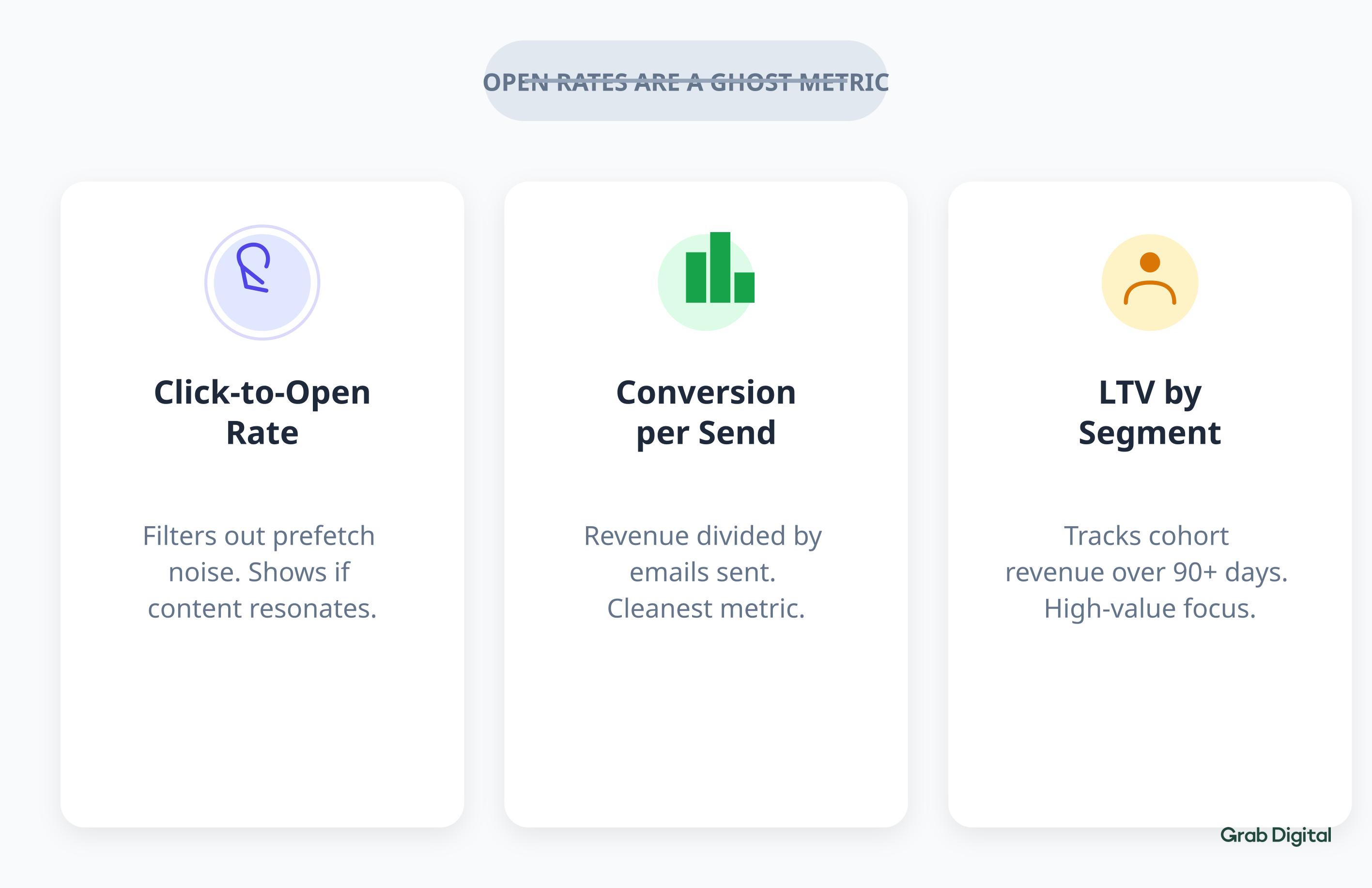
Open rates are effectively dead. Apple Mail Privacy Protection means 40-50% of your "opens" are servers prefetching images, not humans. Optimizing for open rates is now optimizing for a ghost metric.
What actually matters:
Click-to-open rate (CTOR). Of the people who opened, how many clicked? This filters out prefetch noise and tells you if your content resonates.
Conversion rate per send. Revenue divided by emails sent. This is the cleanest performance metric without attribution gymnastics.
Subscriber lifetime value by segment. Not all subscribers are equal. Track cohort revenue over 90, 180, 365 days.
List attrition rate. How many engaged subscribers are you losing monthly? If it's over 5%, something's broken upstream.
Your email program should be measured like a P&L. Every send has a cost time, deliverability risk, unsubscribe probability. Every send needs a measurable return.
Segmentation: The Gap Between Okay and Good
Most DTC brands segment the same way: new subscribers, repeat buyers, lapsed customers. Maybe a VIP segment for high spenders. That worked when inboxes were less crowded.
Your customers expect you to know them now. They expect emails that reflect actual behavior, not some broad bucket. If someone bought a leather wallet three months ago, why send a blanket "shop all accessories" campaign? Send a leather care guide. Or a discount on a matching cardholder.
Advanced segmentation in 2026 looks different:
Behavioral triggers beyond basics. Not just abandoned cart. Abandoned category browse. Repeat view without purchase. High engagement but no conversion. Someone who opened five emails but hasn't bought in 90 days is a different problem than someone who hasn't opened anything.
Predictive segments. Klaviyo's predictive analytics can identify who's likely to churn, make a second purchase, or become high-value. Intervene before the behavior happens.
Hybrid segments. Combine behavioral and demographic data. Customers who bought skincare in winter, live in dry climates, and are due for a restock. That's not a campaign. That's a conversation.
You don't need a data science team. Platforms like Klaviyo have this baked in. If you're unsure where to start, book your consultation and we'll audit your current segmentation for free.
Content That Converts
Segmentation doesn't matter if your copy is boring.
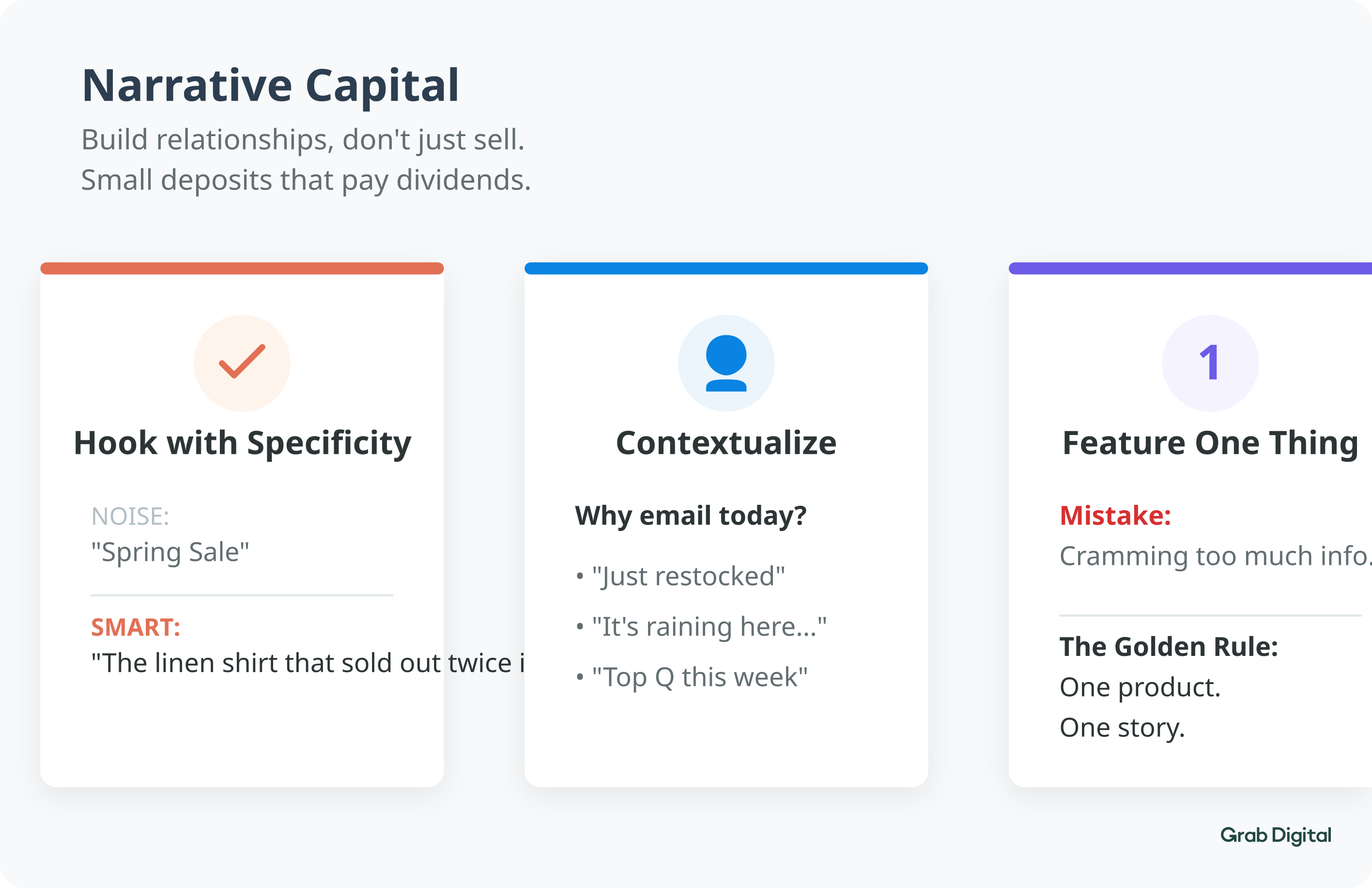
Brands winning in email aren't just selling products. They're building narrative capital small deposits in a relationship that pays dividends.
Hook with specificity. "Spring Sale" is noise. "The linen shirt that sold out twice is back" is specific and urgent without being manipulative.
Contextualize the send. Why are you emailing today? "We just restocked." "It's raining here and we're thinking about…" "Three people asked us this question this week."
Feature one thing. The most common mistake is cramming too much in. One product, one story, one call to action. Go deep. Show behind-the-scenes. Explain the material choice. Let the founder tell a story.
CTA clarity. One button, one goal. "Shop Now" or "Read More." Ask people to do three things and they'll do none.
Post-click experience. This is where brands fumble. You send a gorgeous email about a product launch, the customer clicks, and lands on a generic collection page with 47 products. That disconnect kills conversion. Link to dedicated landing pages. Make the post-click experience feel like a continuation, not a detour.
Automation: The Money Is in the Flows
Campaigns get attention. Flows make money. If automated flows aren't generating 15-20% of email revenue, you're leaving cash on the table.
Welcome series (3-5 emails). Don't just say "Thanks for subscribing, here's 10% off." Introduce the brand story. Explain what makes you different. Build anticipation. Pitch the sale in email three or four, not one.
Abandoned cart (3 emails over 48 hours). First email: soft reminder. Second: social proof or urgency. Third: incentive if needed. Make sure cart links are dynamic.
Post-purchase (4-6 emails). Confirmation, shipping, delivery. Then the real work: how to use the product, care instructions, cross-sells, review requests. This is your window to turn first-time buyers into repeat customers.
Browse abandonment. Someone looked at a product but didn't add to cart. Subtler than cart abandonment, but still high-intent. Trigger after 24 hours with a soft nudge.
Win-back series. No purchase in 90-180 days? They're at risk. Re-engage with newness, a story, or a time-limited offer. Test incentive depths.
Sunset flow. No engagement in 120+ days? Give them one last chance, then suppress. Unengaged subscribers hurt deliverability.
Run A/B tests continuously on these flows. Subject lines, send times, discount depths. Flows aren't set-and-forget. They're compounding assets.
Deliverability: The Invisible Ceiling

You can have great copy, design, and segmentation. If emails aren't landing in the inbox, none of it matters.
Gmail and Apple Mail use engagement-based filtering. Get ignored consistently, you get demoted. Not spam-foldered. Just deprioritized. Your emails arrive buried under "important" senders.
How to stay out of trouble:
Clean your list. Suppress anyone who hasn't opened in 120+ days. Yes, it shrinks your list. A smaller, engaged list beats a bloated, cold one.
Authenticate properly. SPF, DKIM, DMARC. If you don't know these, ask your developer or email platform to audit domain authentication.
Avoid engagement bait. Subject lines like "Did you see this?" juice open rates short-term but train people to ignore you.
Watch metrics obsessively. Bounce rates, complaint rates, unsubscribe rates. A sudden spike means something broke.
Warm up new domains slowly. Blasting 100k emails from a cold domain is a one-way ticket to spam.
Campaigns: Strategy Over Spam
Flows make money consistently. Campaigns spike revenue when you need it.
The mistake is cadence without relevance. Either over-sending (daily blasts that train subscribers to tune out) or under-sending (silence for weeks, then a desperate sale).
The sweet spot is 2-4 campaigns per week for most DTC brands. But frequency matters less than fit. Every email needs a reason beyond "we need revenue."
Product launches. Teaser, launch, social proof. Three-email arc over 5-7 days.
Content-first emails. Recipes, how-to guides, founder stories, customer spotlights. Build affinity without selling. Then you've earned the right to pitch.
Seasonal relevance. Not "Summer Sale." "What to pack for long weekends." Tie products to moments.
Restock alerts. Scarcity is real. Use it.
Personalized offers. Different offers for different segments. High-value customers get early access. At-risk customers get win-back discounts.
Don't treat every send as a promotion. If every email is 20% off, customers learn to wait for 25%. Build a rhythm: educate, entertain, sell.
Testing Like You Mean It
Email isn't set-and-forget. It's a lab.
Test:
Subject line length, tone, emoji usage
Preview text (criminally underutilized)
Send time and day by segment
Email length: short vs. long-form
Single CTA vs. multiple
Discount framing (20% off vs. $20 off)
Visual hierarchy
Run one test at a time. Isolate variables. Let tests run to statistical significance (5k+ sends per variant). Then actually apply the learnings.
Document everything. What worked, what flopped, why. Build a playbook unique to your audience.
What's Next
Email isn't dying. But it's evolving faster than most brands can track. Interactive emails (AMP) are gaining traction browsing products, answering quizzes, submitting forms without leaving the inbox. AI-generated content is getting better and cheaper, but still lacks the voice that converts.
The brands winning in 2026 won't have the biggest lists. They'll treat email like a relationship, not a megaphone. Segment intelligently. Write like humans. Test like scientists.
If your email program feels stuck, it probably is. The good news? Most competitors are stuck too. A little strategy and execution discipline puts you miles ahead.
Frequently Asked Questions
How often should I clean my email list?
Every 90 days minimum. Suppress anyone who hasn't opened or clicked in 120+ days. Most ESPs penalize sending to unengaged subscribers, so dead weight actively hurts deliverability.
What's a realistic email revenue target for a DTC brand doing $3M annually?
25-35% of total revenue for a mature brand. Under 20% means opportunity in segmentation, flows, and campaign strategy. Under 10% usually signals fundamental issues.
Should I use discount codes in every email?
No. Over-discounting trains customers to wait for sales and erodes brand value. Use discounts strategically: win-backs, first-purchase conversions, limited launches.
How do I know if my flows are working?
Check flow-attributed revenue. Welcome series should convert 3-8% of new subscribers within 30 days. Abandoned cart should recover 5-15%. Post-purchase should drive 10-20% to a second purchase within 60 days.
What's the biggest email mistake DTC brands make?
Treating email like broadcast, not conversation. Sending the same message to everyone, ignoring behavior, over-promoting without building equity.
Is migrating to Klaviyo worth it?
If email is a serious revenue channel, yes. The segmentation, predictive analytics, and ecommerce integrations are built for DTC. Migration takes 2-4 weeks. ROI improvement usually pays for itself in 60-90 days.
Email used to be easy. You wrote something, hit send, and watched orders come in. Since 2022, the inbox has turned into a minefield. Apple's privacy updates killed open rates as a reliable metric. Gmail's filtering got smarter. And customers are drowning in brand emails that all sound the same.
If you run a DTC brand doing seven figures and email isn't driving 25-35% of total revenue, you aren't failing. You're just playing by rules that expired last year.
The Metrics That Actually Matter
Open rates are effectively dead. Apple Mail Privacy Protection means 40-50% of your "opens" are servers prefetching images, not humans. Optimizing for open rates is now optimizing for a ghost metric.
What actually matters:
Click-to-open rate (CTOR). Of the people who opened, how many clicked? This filters out prefetch noise and tells you if your content resonates.
Conversion rate per send. Revenue divided by emails sent. This is the cleanest performance metric without attribution gymnastics.
Subscriber lifetime value by segment. Not all subscribers are equal. Track cohort revenue over 90, 180, 365 days.
List attrition rate. How many engaged subscribers are you losing monthly? If it's over 5%, something's broken upstream.
Your email program should be measured like a P&L. Every send has a cost time, deliverability risk, unsubscribe probability. Every send needs a measurable return.
Segmentation: The Gap Between Okay and Good
Most DTC brands segment the same way: new subscribers, repeat buyers, lapsed customers. Maybe a VIP segment for high spenders. That worked when inboxes were less crowded.
Your customers expect you to know them now. They expect emails that reflect actual behavior, not some broad bucket. If someone bought a leather wallet three months ago, why send a blanket "shop all accessories" campaign? Send a leather care guide. Or a discount on a matching cardholder.
Advanced segmentation in 2026 looks different:
Behavioral triggers beyond basics. Not just abandoned cart. Abandoned category browse. Repeat view without purchase. High engagement but no conversion. Someone who opened five emails but hasn't bought in 90 days is a different problem than someone who hasn't opened anything.
Predictive segments. Klaviyo's predictive analytics can identify who's likely to churn, make a second purchase, or become high-value. Intervene before the behavior happens.
Hybrid segments. Combine behavioral and demographic data. Customers who bought skincare in winter, live in dry climates, and are due for a restock. That's not a campaign. That's a conversation.
You don't need a data science team. Platforms like Klaviyo have this baked in. If you're unsure where to start, book your consultation and we'll audit your current segmentation for free.
Content That Converts
Segmentation doesn't matter if your copy is boring.
Brands winning in email aren't just selling products. They're building narrative capital small deposits in a relationship that pays dividends.
Hook with specificity. "Spring Sale" is noise. "The linen shirt that sold out twice is back" is specific and urgent without being manipulative.
Contextualize the send. Why are you emailing today? "We just restocked." "It's raining here and we're thinking about…" "Three people asked us this question this week."
Feature one thing. The most common mistake is cramming too much in. One product, one story, one call to action. Go deep. Show behind-the-scenes. Explain the material choice. Let the founder tell a story.
CTA clarity. One button, one goal. "Shop Now" or "Read More." Ask people to do three things and they'll do none.
Post-click experience. This is where brands fumble. You send a gorgeous email about a product launch, the customer clicks, and lands on a generic collection page with 47 products. That disconnect kills conversion. Link to dedicated landing pages. Make the post-click experience feel like a continuation, not a detour.
Automation: The Money Is in the Flows
Campaigns get attention. Flows make money. If automated flows aren't generating 15-20% of email revenue, you're leaving cash on the table.
Welcome series (3-5 emails). Don't just say "Thanks for subscribing, here's 10% off." Introduce the brand story. Explain what makes you different. Build anticipation. Pitch the sale in email three or four, not one.
Abandoned cart (3 emails over 48 hours). First email: soft reminder. Second: social proof or urgency. Third: incentive if needed. Make sure cart links are dynamic.
Post-purchase (4-6 emails). Confirmation, shipping, delivery. Then the real work: how to use the product, care instructions, cross-sells, review requests. This is your window to turn first-time buyers into repeat customers.
Browse abandonment. Someone looked at a product but didn't add to cart. Subtler than cart abandonment, but still high-intent. Trigger after 24 hours with a soft nudge.
Win-back series. No purchase in 90-180 days? They're at risk. Re-engage with newness, a story, or a time-limited offer. Test incentive depths.
Sunset flow. No engagement in 120+ days? Give them one last chance, then suppress. Unengaged subscribers hurt deliverability.
Run A/B tests continuously on these flows. Subject lines, send times, discount depths. Flows aren't set-and-forget. They're compounding assets.
Deliverability: The Invisible Ceiling
You can have great copy, design, and segmentation. If emails aren't landing in the inbox, none of it matters.
Gmail and Apple Mail use engagement-based filtering. Get ignored consistently, you get demoted. Not spam-foldered. Just deprioritized. Your emails arrive buried under "important" senders.
How to stay out of trouble:
Clean your list. Suppress anyone who hasn't opened in 120+ days. Yes, it shrinks your list. A smaller, engaged list beats a bloated, cold one.
Authenticate properly. SPF, DKIM, DMARC. If you don't know these, ask your developer or email platform to audit domain authentication.
Avoid engagement bait. Subject lines like "Did you see this?" juice open rates short-term but train people to ignore you.
Watch metrics obsessively. Bounce rates, complaint rates, unsubscribe rates. A sudden spike means something broke.
Warm up new domains slowly. Blasting 100k emails from a cold domain is a one-way ticket to spam.
Campaigns: Strategy Over Spam
Flows make money consistently. Campaigns spike revenue when you need it.
The mistake is cadence without relevance. Either over-sending (daily blasts that train subscribers to tune out) or under-sending (silence for weeks, then a desperate sale).
The sweet spot is 2-4 campaigns per week for most DTC brands. But frequency matters less than fit. Every email needs a reason beyond "we need revenue."
Product launches. Teaser, launch, social proof. Three-email arc over 5-7 days.
Content-first emails. Recipes, how-to guides, founder stories, customer spotlights. Build affinity without selling. Then you've earned the right to pitch.
Seasonal relevance. Not "Summer Sale." "What to pack for long weekends." Tie products to moments.
Restock alerts. Scarcity is real. Use it.
Personalized offers. Different offers for different segments. High-value customers get early access. At-risk customers get win-back discounts.
Don't treat every send as a promotion. If every email is 20% off, customers learn to wait for 25%. Build a rhythm: educate, entertain, sell.
Testing Like You Mean It
Email isn't set-and-forget. It's a lab.
Test:
Subject line length, tone, emoji usage
Preview text (criminally underutilized)
Send time and day by segment
Email length: short vs. long-form
Single CTA vs. multiple
Discount framing (20% off vs. $20 off)
Visual hierarchy
Run one test at a time. Isolate variables. Let tests run to statistical significance (5k+ sends per variant). Then actually apply the learnings.
Document everything. What worked, what flopped, why. Build a playbook unique to your audience.
What's Next
Email isn't dying. But it's evolving faster than most brands can track. Interactive emails (AMP) are gaining traction browsing products, answering quizzes, submitting forms without leaving the inbox. AI-generated content is getting better and cheaper, but still lacks the voice that converts.
The brands winning in 2026 won't have the biggest lists. They'll treat email like a relationship, not a megaphone. Segment intelligently. Write like humans. Test like scientists.
If your email program feels stuck, it probably is. The good news? Most competitors are stuck too. A little strategy and execution discipline puts you miles ahead.
Frequently Asked Questions
How often should I clean my email list?
Every 90 days minimum. Suppress anyone who hasn't opened or clicked in 120+ days. Most ESPs penalize sending to unengaged subscribers, so dead weight actively hurts deliverability.
What's a realistic email revenue target for a DTC brand doing $3M annually?
25-35% of total revenue for a mature brand. Under 20% means opportunity in segmentation, flows, and campaign strategy. Under 10% usually signals fundamental issues.
Should I use discount codes in every email?
No. Over-discounting trains customers to wait for sales and erodes brand value. Use discounts strategically: win-backs, first-purchase conversions, limited launches.
How do I know if my flows are working?
Check flow-attributed revenue. Welcome series should convert 3-8% of new subscribers within 30 days. Abandoned cart should recover 5-15%. Post-purchase should drive 10-20% to a second purchase within 60 days.
What's the biggest email mistake DTC brands make?
Treating email like broadcast, not conversation. Sending the same message to everyone, ignoring behavior, over-promoting without building equity.
Is migrating to Klaviyo worth it?
If email is a serious revenue channel, yes. The segmentation, predictive analytics, and ecommerce integrations are built for DTC. Migration takes 2-4 weeks. ROI improvement usually pays for itself in 60-90 days.

Find out exactly what your email channel is leaving on the table.

Email Marketing for Scaling DTC Brands


