
Summary
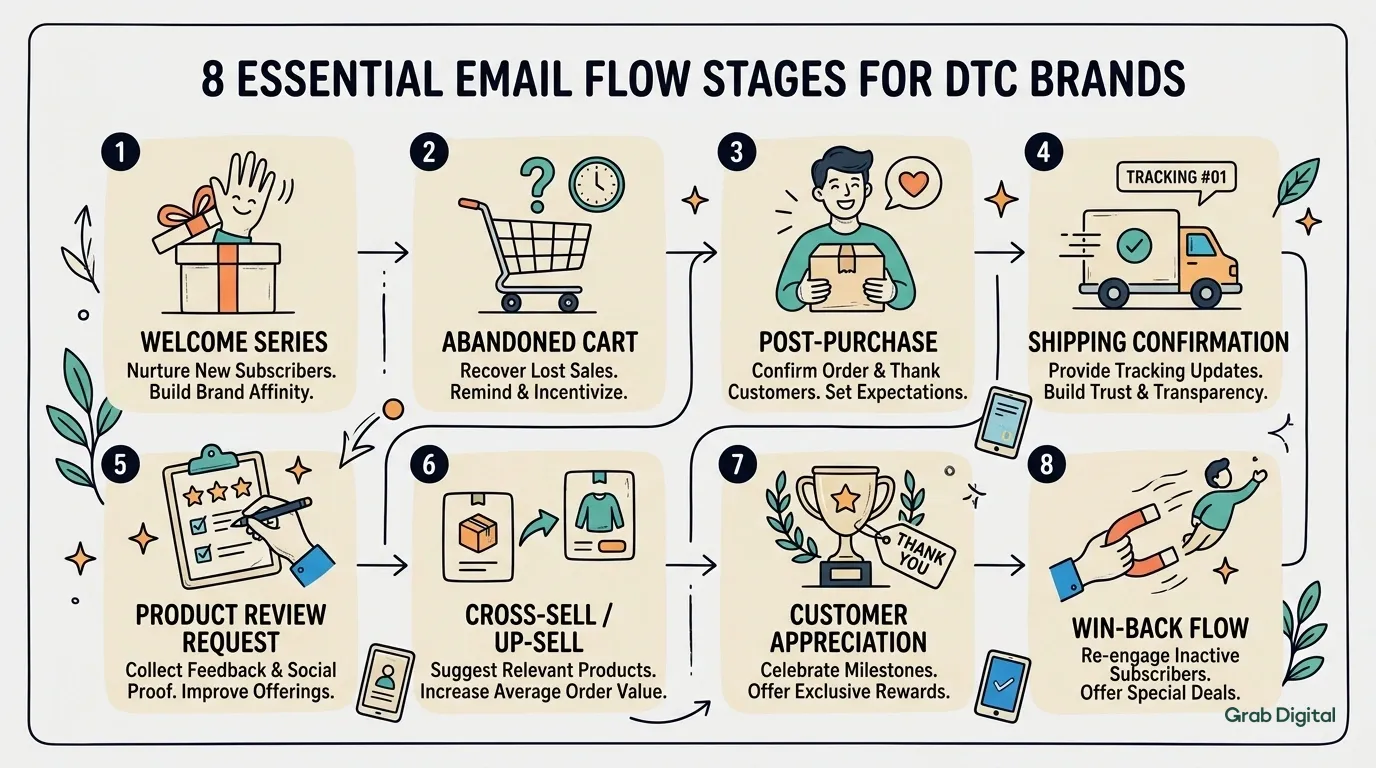
The 8 Core Email Flows Every DTC Brand Needs
Email flows are the closest thing DTC brands have to a money printer. I'm not talking about campaigns. I'm not talking about ads. I'm talking about flows.
Campaigns need constant feeding. Ads need constant budget. But flows? You set them up once, they run on customer behavior, and they quietly handle a huge chunk of your revenue.
If you're a DTC brand doing over $1M and email isn't driving at least 30% of revenue, your flows are probably broken, basic, or nonexistent.
What Are Email Flows?
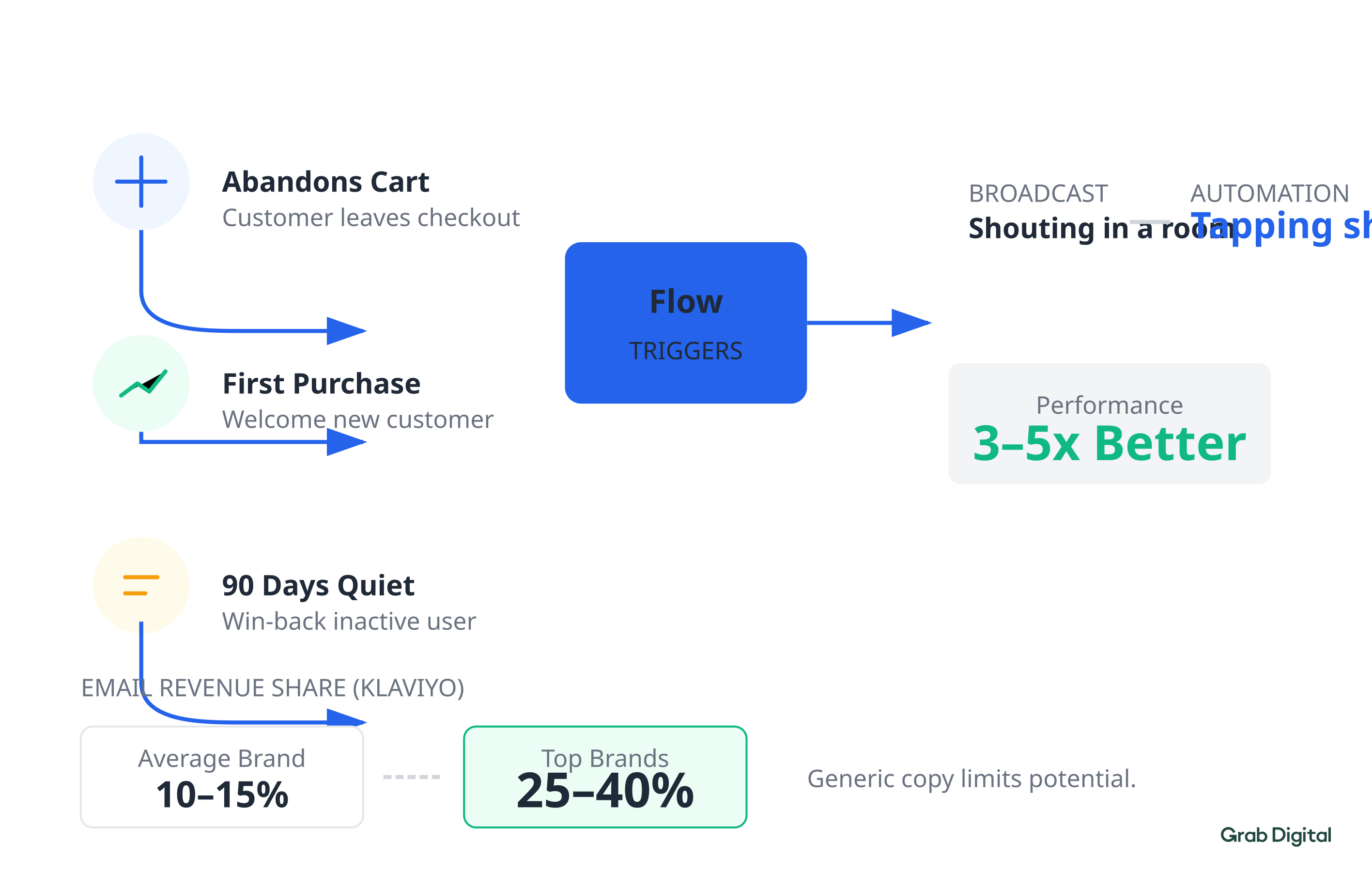
An email flow is a sequence that triggers based on what a customer does. Abandons cart? Flow triggers. Buys for the first time? Flow triggers. Goes quiet for 90 days? Flow triggers.
Flows respond to behavior in real time. That's why they convert 3–5x better than broadcast campaigns.
Think of it this way: campaigns are you shouting into a room. Flows are you tapping someone on the shoulder at the exact right moment.
For DTC brands on Klaviyo, flows usually drive 25–40% of email revenue. But most brands we audit are stuck at 10–15% because they run maybe two flows with generic copy.
That's five figures a month left on the table. At least.
The 8 Core Email Flows Every DTC Brand Needs
Some flows matter more than others. Here's the hierarchy.
1. Welcome Series
This is your first impression. Someone gave you their email probably for a discount. What happens next determines if they buy or ghost you.
A solid welcome series is 3–5 emails over 5–10 days. It should:
Deliver the promised discount immediately
Tell your brand story
Show bestsellers
Build trust with reviews or press
Create urgency with a deadline
One thing: don't burn the discount in email one. Thread it through the series. Remind them it expires. Show them what to buy.
We've seen welcome series drive 15–25% of total email revenue. Not a typo.
2. Abandoned Cart Flow
Obvious but still underutilized.
Average cart abandonment in DTC is 70%. Seven out of ten people who add to cart leave without buying. If you're not following up, you're burning money.
A solid flow is 3–4 emails:
Email 1 (1 hour later): "You left something behind." Show the product. Make it one click to return.
Email 2 (24 hours later): Add urgency. "Still thinking?" Include reviews or a size guide.
Email 3 (48–72 hours later): Offer a small incentive if needed. 10% off or free shipping. Not always necessary, but effective for higher AOV products.
We wrote a full guide on how to build a high-ROI abandoned cart flow. If you're not recovering 10–15% of abandoned carts, read it.
3. Browse Abandonment Flow
People who browse but don't add to cart are warm. They're interested. Not ready yet.
This flow triggers when someone views products but doesn't act. A gentle nudge: "Saw you checking this out."
A 2-email flow can capture 2–5% of traffic that would otherwise disappear. Works well for higher-consideration products furniture, skincare, leather goods, anything over $100.
Include the viewed product, a benefit headline, maybe a testimonial. Keep it helpful, not pushy. More on setting up browse abandonment emails in Klaviyo.
4. Post-Purchase Flow
A thank-you email is table stakes. A post-purchase flow is strategic.
Use it to:
Confirm order and set expectations
Teach them how to use the product
Cross-sell or upsell
Ask for a review (wait until they've received it)
Invite them to social or a community
A 3–5 email series does three things: reduces buyer's remorse, increases repeat purchase rate, and generates social proof.
Brands that nail this see 20–30% higher repeat purchase rates within 90 days.
5. Win-Back Flow
Customers go quiet. Life happens.
A win-back flow is your last shot to re-engage someone. It triggers after 60, 90, or 120 days of inactivity depending on your cycle.
Usually 2–3 emails:
Email 1: "We miss you." Warm, low-pressure. Show what's new.
Email 2: Offer an incentive. 15–20% off, free shipping, gift with purchase.
Email 3: Last call. Time-limited offer.
Win-back flows can reactivate 5–10% of lapsed customers. Because they've bought before, their LTV beats a cold lead. Full guide here: how to build a Klaviyo win-back flow that works.
6. Sunset Flow
This is the flow that stops emailing people.
If someone hasn't opened or clicked in 6–12 months, they're hurting your deliverability. Gmail and Apple see that inactivity and filter you to spam.
A sunset flow is a final 2-email attempt:
Email 1: "Are you still interested?" Offer a preference center or opt-down.
Email 2: "Last chance." If no engagement, suppress them.
Keeps your list healthy. Not sexy, but critical.
7. Customer Milestone Flow
Anniversaries. Birthdays. First-purchase anniversaries. VIP tier unlocks.
These flows make customers feel seen. They're retention drivers, not just revenue.
A "Happy Birthday" email with 15% off can generate $5–15 per recipient. A "You've been with us a year" email with a surprise reward does even better.
Milestone flows have the highest engagement rates because they feel personal, even when automated.
8. Re-Order/Replenishment Flow
If you sell consumables skincare, supplements, coffee, pet food this is free money.
Triggers based on product lifespan. If a 30-day serum was bought 25 days ago: "Running low? Restock now."
Bonus: offer subscription. Replenishment flows can drive 10–20% of revenue for consumable brands.
How to Prioritize Which Flows to Build First
Don't build all eight at once. Prioritize by impact.
Start here:
Abandoned cart (highest revenue, easiest build)
Welcome series (sets tone for every subscriber)
Post-purchase (builds loyalty and repeat)
Then:
Browse abandonment (captures warm traffic)
Win-back (reactivates lapsed customers)
Finally:
Sunset (protects deliverability)
Milestones (enhances retention)
Replenishment (if applicable)
If you want a team to handle the build, strategy, and optimization, book a consultation and we'll map out a custom roadmap.
Flow Copy That Actually Works
Flows fail when copy is boring or salesy.
"Oops, you forgot something!" isn't a subject line. It's a cliché.
Here's what works:
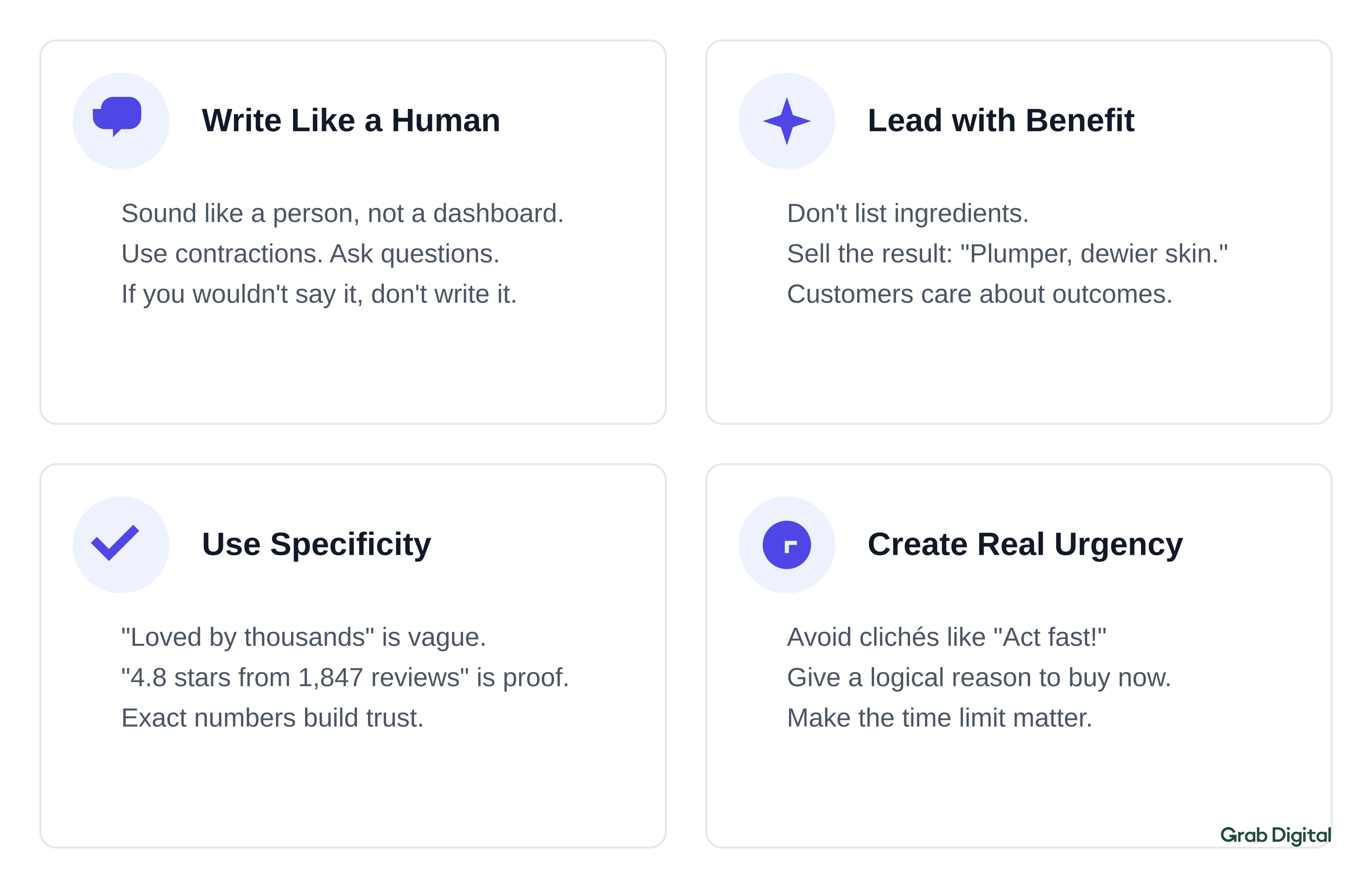
Write like a human
Emails should sound like a person, not a dashboard. Use contractions. Ask questions. Be conversational. If you wouldn't say it out loud, don't write it.
Lead with benefit
Don't say "Our serum contains hyaluronic acid." Say "Plumper, dewier skin in 7 days." Customers care about results, not ingredients.
Use specificity
"Loved by thousands" is vague. "4.8 stars from 1,847 reviews" is proof. Specificity builds trust.
Create real urgency
"Your cart expires in 24 hours" works if true. "Only 2 left!" works if real. Fake urgency kills trust. Real urgency drives action.
Make the CTA obvious
One clear next step per email. "Shop Now." "Complete Your Order." Don't make people guess.
Flow Design: Keep It Simple
Good design isn't about being flashy. It's about clarity.
Your emails should:
Load fast (under 3 seconds)
Work on mobile (70%+ of opens are on phones)
Have clear hierarchy (headline → image → CTA)
Match your brand
Be accessible (alt text, high contrast)
Test across devices. Gmail renders differently than Apple Mail. Dark mode changes everything. If you're not testing, you're guessing.
We handle design and testing for clients. Every email is device-tested before it goes live. More on our services here.
Flow Timing: When to Send
Timing can make or break a flow.
Send abandoned cart too soon, you annoy someone still shopping. Send too late, they bought elsewhere.
What works:
Abandoned cart 1: 1–2 hours after abandonment
Abandoned cart 2: 24 hours
Abandoned cart 3: 48–72 hours
Welcome 1: Immediately (within 5 minutes)
Welcome 2: 2 days later
Welcome 3: 5–7 days later
Win-back 1: 60–90 days post-purchase
Win-back 2: 7 days after email 1
Post-purchase 1: Immediately (confirmation)
Post-purchase 2: 3–5 days (education or cross-sell)
Post-purchase 3: 14–21 days (review request)
These are starting points. Test and adjust based on your cycle and audience.
How to Measure Flow Performance
You can't optimize what you don't measure.
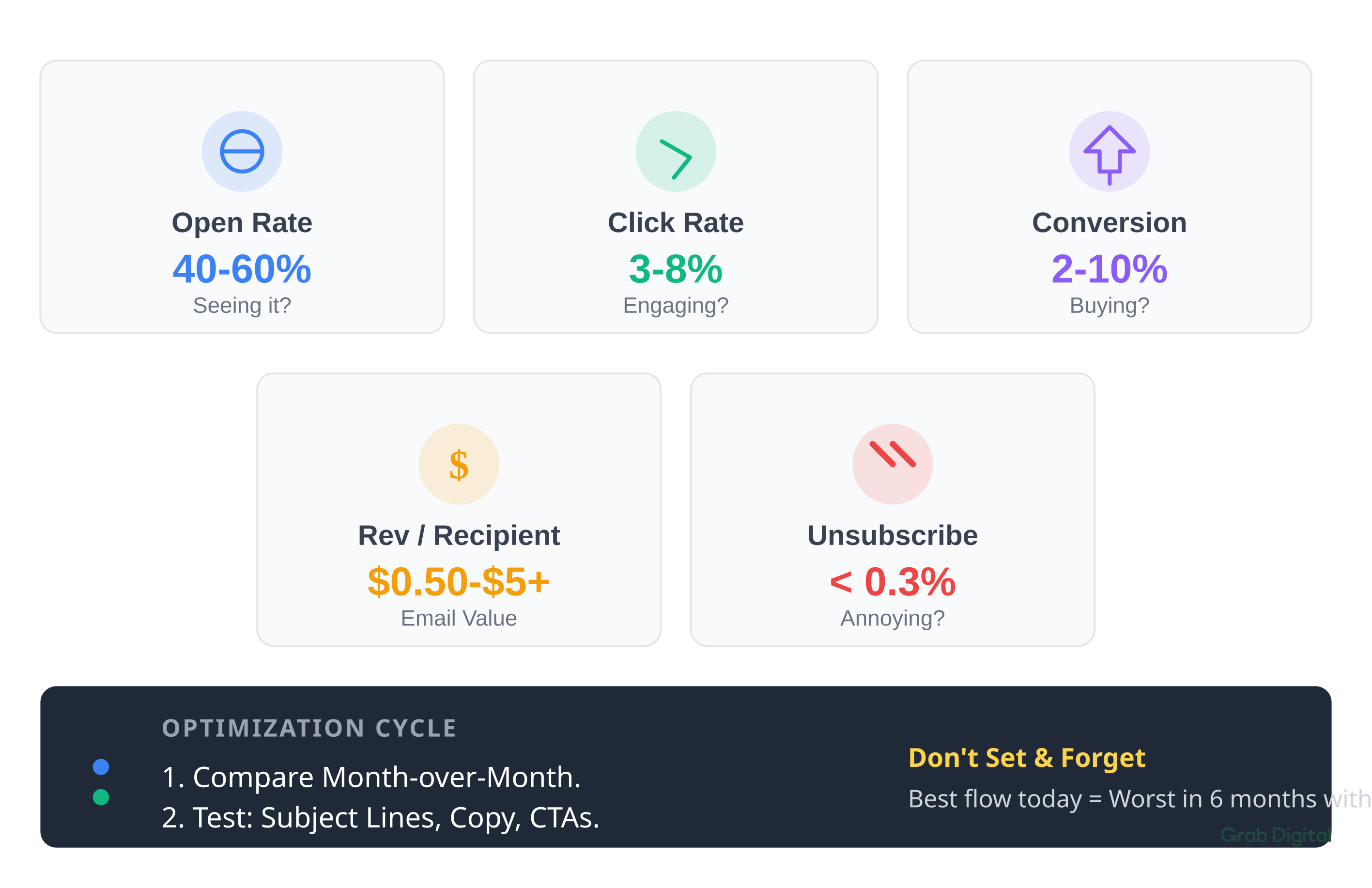
Track these for every flow:
Open rate: Are they seeing it? (Benchmark: 40–60%)
Click rate: Are they engaging? (Benchmark: 3–8%)
Conversion rate: Are they buying? (Benchmark: 2–10%)
Revenue per recipient: What's each email worth? (Benchmark: $0.50–$5+)
Unsubscribe rate: Are you annoying them? (Benchmark: under 0.3%)
Compare month-over-month. If a flow underperforms, test subject lines, copy, CTAs, timing. Small tweaks compound.
Most brands don't revisit flows after launch. That's a mistake. Your best flow today could be your worst in six months if you stop iterating.
Common Flow Mistakes
Even brands with flows screw this up:
Sending too many emails too fast
Three abandoned cart emails in 12 hours gets you unsubscribed. Space them out.
Using the same discount everywhere
If every flow offers 15% off, customers wait for deals. Use urgency and value instead. Save discounts for win-backs and new subscribers.
Forgetting mobile
If it doesn't work on an iPhone, it doesn't work.
No testing
You're guessing if you're not A/B testing subject lines, send times, CTAs. Test one variable. Run it for two weeks. Use data, not gut.
Set and forget
Flows drift. Products get cut. Copy gets stale. Review quarterly. Update images, refresh copy, swap bestsellers.
When to DIY vs. Hire an Agency
You can build flows yourself. Klaviyo's builder is solid.
But building a flow and building a flow that converts are different skills.
DIY makes sense if:
You're under 10,000 subscribers
You have time to learn Klaviyo
You're comfortable with copy, design, and data
You're okay with slower iteration
Hire an agency if:
You're doing $1M+ in revenue
Email is under 20% of revenue
You don't have a dedicated email person
You want flows built by people who do this full-time
At Grab Digital, we build and manage all flows for DTC brands on Klaviyo. Strategy, copy, design, testing done for you. We guarantee 10% revenue growth in 60 days or full refund. See our work here or book a consultation.
Frequently Asked Questions
How many emails should be in a flow?
Depends on the flow. Welcome series: 3–5. Abandoned cart: 3. Win-back: 2–3. Post-purchase: 3–5. Start small, test, add more if performance holds.
Should every flow include a discount?
No. Overusing discounts trains customers to wait. Use them strategically in welcome, win-back, and cart abandonment (if needed). Focus on value and urgency elsewhere.
How often should I update flows?
Review quarterly. Update images, refresh copy, check links. If a product is cut or a bestseller changes, update immediately.
Can I run the same flow for all customers?
You can, but segmentation helps. VIPs, first-time buyers, and lapsed customers should get different messaging. Segment by history and engagement.
What's the difference between a flow and a campaign?
Flows are automated, triggered by behavior. Campaigns are one-time broadcasts. Flows are evergreen. Campaigns are timely.
Do I need all eight flows right away?
No. Start with abandoned cart, welcome, and post-purchase. Those drive the most revenue. Add others as you scale.
Email flows are the closest thing DTC brands have to a money printer. I'm not talking about campaigns. I'm not talking about ads. I'm talking about flows.
Campaigns need constant feeding. Ads need constant budget. But flows? You set them up once, they run on customer behavior, and they quietly handle a huge chunk of your revenue.
If you're a DTC brand doing over $1M and email isn't driving at least 30% of revenue, your flows are probably broken, basic, or nonexistent.
What Are Email Flows?
An email flow is a sequence that triggers based on what a customer does. Abandons cart? Flow triggers. Buys for the first time? Flow triggers. Goes quiet for 90 days? Flow triggers.
Flows respond to behavior in real time. That's why they convert 3–5x better than broadcast campaigns.
Think of it this way: campaigns are you shouting into a room. Flows are you tapping someone on the shoulder at the exact right moment.
For DTC brands on Klaviyo, flows usually drive 25–40% of email revenue. But most brands we audit are stuck at 10–15% because they run maybe two flows with generic copy.
That's five figures a month left on the table. At least.
The 8 Core Email Flows Every DTC Brand Needs
Some flows matter more than others. Here's the hierarchy.
1. Welcome Series
This is your first impression. Someone gave you their email probably for a discount. What happens next determines if they buy or ghost you.
A solid welcome series is 3–5 emails over 5–10 days. It should:
Deliver the promised discount immediately
Tell your brand story
Show bestsellers
Build trust with reviews or press
Create urgency with a deadline
One thing: don't burn the discount in email one. Thread it through the series. Remind them it expires. Show them what to buy.
We've seen welcome series drive 15–25% of total email revenue. Not a typo.
2. Abandoned Cart Flow
Obvious but still underutilized.
Average cart abandonment in DTC is 70%. Seven out of ten people who add to cart leave without buying. If you're not following up, you're burning money.
A solid flow is 3–4 emails:
Email 1 (1 hour later): "You left something behind." Show the product. Make it one click to return.
Email 2 (24 hours later): Add urgency. "Still thinking?" Include reviews or a size guide.
Email 3 (48–72 hours later): Offer a small incentive if needed. 10% off or free shipping. Not always necessary, but effective for higher AOV products.
We wrote a full guide on how to build a high-ROI abandoned cart flow. If you're not recovering 10–15% of abandoned carts, read it.
3. Browse Abandonment Flow
People who browse but don't add to cart are warm. They're interested. Not ready yet.
This flow triggers when someone views products but doesn't act. A gentle nudge: "Saw you checking this out."
A 2-email flow can capture 2–5% of traffic that would otherwise disappear. Works well for higher-consideration products furniture, skincare, leather goods, anything over $100.
Include the viewed product, a benefit headline, maybe a testimonial. Keep it helpful, not pushy. More on setting up browse abandonment emails in Klaviyo.
4. Post-Purchase Flow
A thank-you email is table stakes. A post-purchase flow is strategic.
Use it to:
Confirm order and set expectations
Teach them how to use the product
Cross-sell or upsell
Ask for a review (wait until they've received it)
Invite them to social or a community
A 3–5 email series does three things: reduces buyer's remorse, increases repeat purchase rate, and generates social proof.
Brands that nail this see 20–30% higher repeat purchase rates within 90 days.
5. Win-Back Flow
Customers go quiet. Life happens.
A win-back flow is your last shot to re-engage someone. It triggers after 60, 90, or 120 days of inactivity depending on your cycle.
Usually 2–3 emails:
Email 1: "We miss you." Warm, low-pressure. Show what's new.
Email 2: Offer an incentive. 15–20% off, free shipping, gift with purchase.
Email 3: Last call. Time-limited offer.
Win-back flows can reactivate 5–10% of lapsed customers. Because they've bought before, their LTV beats a cold lead. Full guide here: how to build a Klaviyo win-back flow that works.
6. Sunset Flow
This is the flow that stops emailing people.
If someone hasn't opened or clicked in 6–12 months, they're hurting your deliverability. Gmail and Apple see that inactivity and filter you to spam.
A sunset flow is a final 2-email attempt:
Email 1: "Are you still interested?" Offer a preference center or opt-down.
Email 2: "Last chance." If no engagement, suppress them.
Keeps your list healthy. Not sexy, but critical.
7. Customer Milestone Flow
Anniversaries. Birthdays. First-purchase anniversaries. VIP tier unlocks.
These flows make customers feel seen. They're retention drivers, not just revenue.
A "Happy Birthday" email with 15% off can generate $5–15 per recipient. A "You've been with us a year" email with a surprise reward does even better.
Milestone flows have the highest engagement rates because they feel personal, even when automated.
8. Re-Order/Replenishment Flow
If you sell consumables skincare, supplements, coffee, pet food this is free money.
Triggers based on product lifespan. If a 30-day serum was bought 25 days ago: "Running low? Restock now."
Bonus: offer subscription. Replenishment flows can drive 10–20% of revenue for consumable brands.
How to Prioritize Which Flows to Build First
Don't build all eight at once. Prioritize by impact.
Start here:
Abandoned cart (highest revenue, easiest build)
Welcome series (sets tone for every subscriber)
Post-purchase (builds loyalty and repeat)
Then:
Browse abandonment (captures warm traffic)
Win-back (reactivates lapsed customers)
Finally:
Sunset (protects deliverability)
Milestones (enhances retention)
Replenishment (if applicable)
If you want a team to handle the build, strategy, and optimization, book a consultation and we'll map out a custom roadmap.
Flow Copy That Actually Works
Flows fail when copy is boring or salesy.
"Oops, you forgot something!" isn't a subject line. It's a cliché.
Here's what works:
Write like a human
Emails should sound like a person, not a dashboard. Use contractions. Ask questions. Be conversational. If you wouldn't say it out loud, don't write it.
Lead with benefit
Don't say "Our serum contains hyaluronic acid." Say "Plumper, dewier skin in 7 days." Customers care about results, not ingredients.
Use specificity
"Loved by thousands" is vague. "4.8 stars from 1,847 reviews" is proof. Specificity builds trust.
Create real urgency
"Your cart expires in 24 hours" works if true. "Only 2 left!" works if real. Fake urgency kills trust. Real urgency drives action.
Make the CTA obvious
One clear next step per email. "Shop Now." "Complete Your Order." Don't make people guess.
Flow Design: Keep It Simple
Good design isn't about being flashy. It's about clarity.
Your emails should:
Load fast (under 3 seconds)
Work on mobile (70%+ of opens are on phones)
Have clear hierarchy (headline → image → CTA)
Match your brand
Be accessible (alt text, high contrast)
Test across devices. Gmail renders differently than Apple Mail. Dark mode changes everything. If you're not testing, you're guessing.
We handle design and testing for clients. Every email is device-tested before it goes live. More on our services here.
Flow Timing: When to Send
Timing can make or break a flow.
Send abandoned cart too soon, you annoy someone still shopping. Send too late, they bought elsewhere.
What works:
Abandoned cart 1: 1–2 hours after abandonment
Abandoned cart 2: 24 hours
Abandoned cart 3: 48–72 hours
Welcome 1: Immediately (within 5 minutes)
Welcome 2: 2 days later
Welcome 3: 5–7 days later
Win-back 1: 60–90 days post-purchase
Win-back 2: 7 days after email 1
Post-purchase 1: Immediately (confirmation)
Post-purchase 2: 3–5 days (education or cross-sell)
Post-purchase 3: 14–21 days (review request)
These are starting points. Test and adjust based on your cycle and audience.
How to Measure Flow Performance
You can't optimize what you don't measure.
Track these for every flow:
Open rate: Are they seeing it? (Benchmark: 40–60%)
Click rate: Are they engaging? (Benchmark: 3–8%)
Conversion rate: Are they buying? (Benchmark: 2–10%)
Revenue per recipient: What's each email worth? (Benchmark: $0.50–$5+)
Unsubscribe rate: Are you annoying them? (Benchmark: under 0.3%)
Compare month-over-month. If a flow underperforms, test subject lines, copy, CTAs, timing. Small tweaks compound.
Most brands don't revisit flows after launch. That's a mistake. Your best flow today could be your worst in six months if you stop iterating.
Common Flow Mistakes
Even brands with flows screw this up:
Sending too many emails too fast
Three abandoned cart emails in 12 hours gets you unsubscribed. Space them out.
Using the same discount everywhere
If every flow offers 15% off, customers wait for deals. Use urgency and value instead. Save discounts for win-backs and new subscribers.
Forgetting mobile
If it doesn't work on an iPhone, it doesn't work.
No testing
You're guessing if you're not A/B testing subject lines, send times, CTAs. Test one variable. Run it for two weeks. Use data, not gut.
Set and forget
Flows drift. Products get cut. Copy gets stale. Review quarterly. Update images, refresh copy, swap bestsellers.
When to DIY vs. Hire an Agency
You can build flows yourself. Klaviyo's builder is solid.
But building a flow and building a flow that converts are different skills.
DIY makes sense if:
You're under 10,000 subscribers
You have time to learn Klaviyo
You're comfortable with copy, design, and data
You're okay with slower iteration
Hire an agency if:
You're doing $1M+ in revenue
Email is under 20% of revenue
You don't have a dedicated email person
You want flows built by people who do this full-time
At Grab Digital, we build and manage all flows for DTC brands on Klaviyo. Strategy, copy, design, testing done for you. We guarantee 10% revenue growth in 60 days or full refund. See our work here or book a consultation.
Frequently Asked Questions
How many emails should be in a flow?
Depends on the flow. Welcome series: 3–5. Abandoned cart: 3. Win-back: 2–3. Post-purchase: 3–5. Start small, test, add more if performance holds.
Should every flow include a discount?
No. Overusing discounts trains customers to wait. Use them strategically in welcome, win-back, and cart abandonment (if needed). Focus on value and urgency elsewhere.
How often should I update flows?
Review quarterly. Update images, refresh copy, check links. If a product is cut or a bestseller changes, update immediately.
Can I run the same flow for all customers?
You can, but segmentation helps. VIPs, first-time buyers, and lapsed customers should get different messaging. Segment by history and engagement.
What's the difference between a flow and a campaign?
Flows are automated, triggered by behavior. Campaigns are one-time broadcasts. Flows are evergreen. Campaigns are timely.
Do I need all eight flows right away?
No. Start with abandoned cart, welcome, and post-purchase. Those drive the most revenue. Add others as you scale.

Find out exactly what your email channel is leaving on the table.

Email Marketing for Scaling DTC Brands


