
Summary
Scaling DTC Brands Past $1M: Choosing Marketing Services
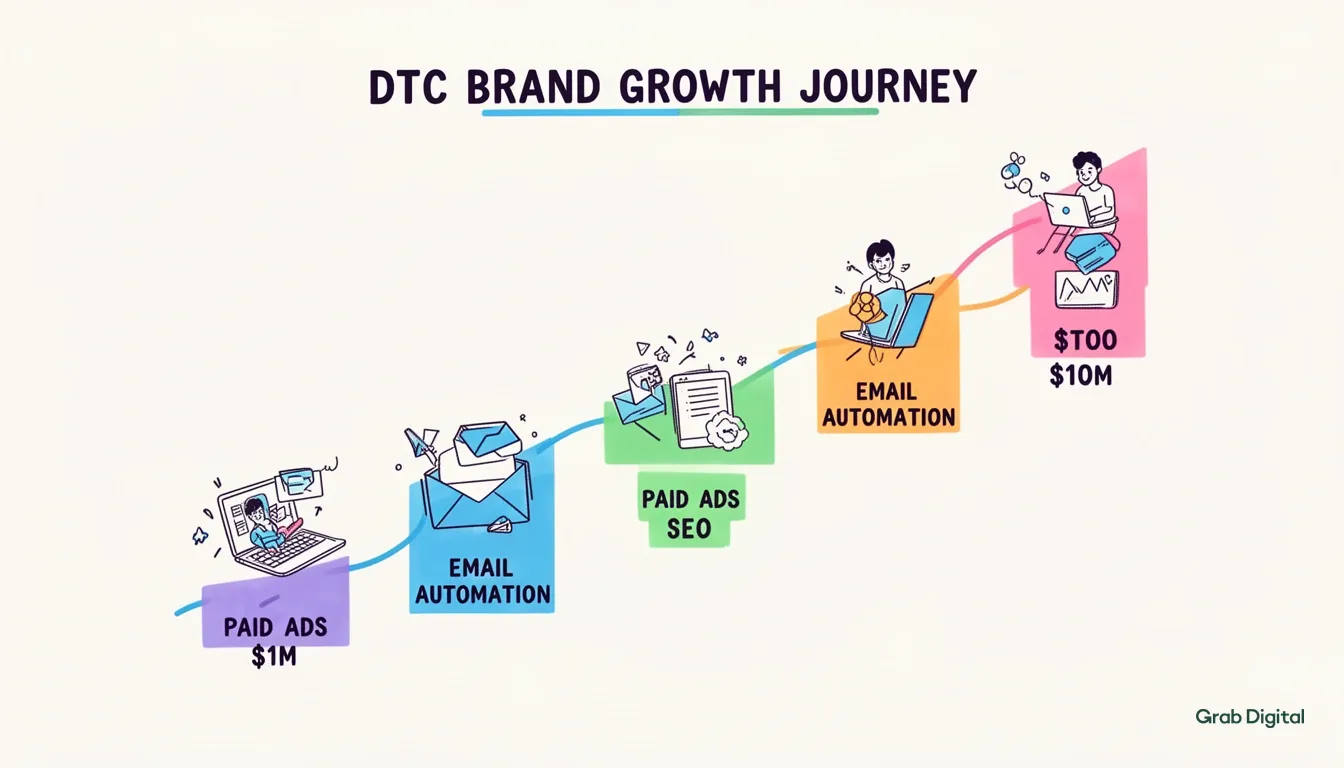
There's a specific kind of chaos that hits when a DTC brand crosses the $1M mark. The stuff that worked when you were scrappy posting on Instagram when inspiration struck, sending a newsletter whenever you remembered starts to show cracks when you're pushing for $5M or $10M.
That's usually when founders start looking for professional ecommerce marketing services. But here's the catch: not all services are equal, and frankly, most don't understand the specific grind of selling direct-to-consumer right now.
Last reviewed: September 2026. This update sharpens the vetting framework for telling agencies, DTC brands, and SaaS platforms apart, expands the Meta ads and Google ads guidance for brands in this exact revenue band, adds a full section on the platforms and tools that actually belong in a scaling stack, and rebuilds the FAQ around the specific questions we're seeing brands ask when they search for this kind of help. The core advice hasn't changed: fix your highest-leverage channel first, then expand.
Let's get into what actually matters, what to dodge, and how to tell if you're hiring a partner or just lighting money on fire.
What ecommerce marketing services actually include

The term "ecommerce marketing services" gets thrown around loosely. It covers everything from a freelancer running Facebook ads from their kitchen table to a full-stack agency handling your entire digital existence.
If you're looking at serious support, this is typically what's on the table:
Email and automation. This is the backbone. A solid service builds out your flows welcome series, abandoned carts, post-purchase, win-backs and handles ongoing campaigns. They manage segmentation and deliverability. If it's working, email should be driving somewhere in the 20-30% range of your total revenue. Our breakdown of the 8 core flows every DTC brand needs covers exactly what should be running before you spend another dollar on ads.
Paid ads (Meta, Google, TikTok). Running ads is easy. Running them profitably at scale, without your CAC creeping up every quarter, is not. This includes creative strategy, copywriting, audience targeting, and constant testing. The best teams tie ad performance back to customer lifetime value, not just first-purchase ROAS.
SMS marketing. Text messaging is a serious revenue driver, especially when integrated with email. This means list growth, compliance (TCPA, CTIA), and segmentation based on real purchase behavior.
Conversion rate optimization (CRO). Traffic is too expensive to waste. CRO focuses on making sure more of it converts. That means landing page tweaks, A/B testing, checkout flow fixes, and UX audits.
Content and SEO. This is the long game blog content, product page optimization, backlinks, and technical cleanup. The goal is building organic visibility so you aren't held hostage by rising ad costs forever.
Social media management. Organic social is brand building, not usually direct sales. It covers content planning, asset creation, community management, and influencer outreach.
For most brands sitting in the $1M–$10M range, email is the highest-leverage channel. It's owned, scalable, and prints money when done right. That's why many brands fix email first. For a deeper walkthrough of what that program should actually look like, see our guide to mastering email marketing for DTC brands. If you're sleeping on email, book your free consultation to see how a dedicated team turns that channel into a consistent revenue engine.
How do you classify a company as an agency, a DTC brand, or a SaaS platform?
You classify a company by looking at what it actually sells, not the language on its homepage. If it sells people and process on your behalf for a retainer, it's an agency. If it sells a physical or consumable product straight to consumers through its own checkout, it's a DTC brand. If it sells software that you or someone else has to operate, it's a SaaS platform. Any single company can wear more than one label at once, which is exactly where the confusion starts.
This question shows up constantly when people are researching "who's the best agency for scaling DTC brands," or trying to figure out what a specific company they've stumbled on actually does. Here's a repeatable way to sort any company you're looking at, whether that's a vendor pitching you or a competitor's site you're trying to size up:
| Type | What they actually sell | How to spot them |
|---|---|---|
| Agency | People and process. They plan, write, design, and manage your channels on your behalf. | They talk about strategists, deliverables, and retainers. No login required for you to see results. Their site usually shows client logos or case studies, not a product catalog. |
| DTC brand | A product. They sell to consumers directly, they don't sell marketing services. | They have a storefront, SKUs, and a checkout. If you're being pitched "services" by one, something's off. Look for an "Add to cart" button, not a "Book a call" one. |
| SaaS platform | Software. Klaviyo, Shopify, and ad platforms fall here they give you tools, not a team. | They talk about features, integrations, and pricing tiers. You do the work, or you hire someone to run it for you. Their pricing page lists plans, not project scopes. |
A few signals make this fast to check on almost any company's site: look at the primary call-to-action (book a call versus buy now versus start a free trial), check whether pricing is per-project or per-seat/per-tier, and check whether the "about" or "our work" page shows client results or product reviews. Most confusion happens when a company blends two of these; a SaaS platform with an "agency partner network," or an agency that also sells a proprietary tool. When you're comparing options, ask directly: are you selling me software, a team, or both? The answer changes what you should expect to pay and who's actually accountable for results.
How do I run Meta ads for a DTC brand doing $1M to $10M in revenue?
At this revenue band, Meta ads work when they're built for repeat purchase behavior and lifetime value, not just a first-order ROAS number. Below $1M, almost any reasonably targeted campaign can find enough cold traffic to look profitable. Past $1M, your audience is more saturated, your CAC is climbing, and the brands still growing are the ones treating paid media as one part of a system rather than the whole strategy.
Here's what that looks like in practice:
Segment spend by funnel stage. Cold prospecting, warm retargeting, and post-purchase upsell campaigns should have separate budgets and separate creative, not one campaign trying to do all three.
Feed creative from real customer data. The brands winning right now are pulling language directly from reviews, support tickets, and post-purchase surveys, then testing that language in ad copy on a weekly cadence.
Measure against LTV, not just ROAS. A campaign that looks break-even on first purchase but drives customers with a strong 12-month LTV is a campaign worth scaling. Judging it on day-one ROAS alone will get it killed for the wrong reasons.
Sync with email and SMS. Every dollar spent on cold Meta traffic should be feeding a welcome flow and an abandoned cart flow that are actually built to convert. Paid traffic into a weak flow is money burned.
Set a creative refresh cadence. Brands in this revenue band typically need new ad variants every one to two weeks to fight fatigue; if your current setup is still running the same three creatives from last quarter, that's a leading indicator of a stalling account, not just a coincidence.
If your ad spend and your email program aren't talking to each other, that's usually the first place to fix before you add more budget.
Which Meta ads and Google ads agencies are best for scaling DTC brands?
The best Meta ads and Google ads agencies for this revenue band are the ones that treat paid media as an extension of your retention channels, not a standalone service sold in isolation. There's no single named agency that's universally "best" the right fit depends on which platform your customers actually convert on and how mature your email and SMS program already is. What matters is the criteria you use to evaluate any candidate.
For Meta ads specifically, look for a team that can show:
Direct account access and reporting. You should be able to log into your own Meta Ads Manager account and see the same numbers they're reporting. Agencies that run campaigns from an account you can't access are a red flag.
A named creative process. Ask how many new ad variants they test per week and where the hooks come from. "We handle it" is not an answer.
Experience with your exact revenue band. An agency whose case studies are all under-$500K brands or all $20M+ brands may not understand the specific saturation and CAC pressure that shows up between $1M and $10M.
For Google Ads agencies, the evaluation is similar but the specifics shift toward Performance Max and Shopping campaigns, since that's where most DTC Google Ads budget lives now. Ask how they structure product feeds, how often they audit search term reports for wasted spend, and how they split branded versus non-branded spend in reporting so you're not paying to capture demand you'd have gotten organically anyway.
In both cases, the strongest signal isn't the platform expertise on its own it's whether the agency asks about your email and SMS setup before they talk about ad budget. A media buyer who doesn't ask what your abandoned cart flow looks like is planning to send warm traffic into a black hole.
What's the best advertising technology for a DTC brand that's scaling?
There isn't a single "best" ad tech stack, but at $1M–$10M the brands scaling profitably tend to converge on a similar setup: Meta Ads Manager and Google Ads as the primary buying platforms, a server-side tracking solution (through Shopify's own tagging or a dedicated pixel/CAPI tool) to fight iOS-driven data loss, and a retargeting layer that pulls audiences directly from Klaviyo and your site behavior rather than relying on Meta's native audiences alone.
A few things matter more than the specific tool names:
Attribution you actually trust. If your ad platform and your email platform are reporting different revenue numbers for the same period, someone is double-counting or under-counting. Get that reconciled before you scale spend.
First-party data feeding the ad platforms. Your Klaviyo list is one of your most valuable ad-tech assets. Lookalikes and custom audiences built from real purchasers consistently outperform broad targeting.
Creative testing infrastructure. A spreadsheet tracking hooks, angles, and formats beats any "AI-powered" ad tool that promises to automate creative decisions for you. The data still has to come from real tests.
Chasing the newest ad-tech platform is rarely the unlock. A clean data foundation and a disciplined testing process almost always beat a shinier tool layered on top of a messy one.
What are the best platforms and solutions for scaling a DTC business?
The best DTC scaling solutions aren't a single platform, they're a small, well-integrated stack: a storefront platform, an email and SMS platform, an ad buying layer, and a way to measure it all against the same revenue numbers. Brands that go looking for one all-in-one "growth platform" to solve every channel at once usually end up locked into a mediocre version of five different tools.
| Layer | What it needs to do | Common choice at $1M–$10M |
|---|---|---|
| Storefront | Handle checkout, inventory, and app integrations without breaking | Shopify, for the vast majority of DTC brands in this range |
| Email and SMS | Own the retention channel, automate flows, segment by behavior | Klaviyo, integrated natively with Shopify |
| Paid acquisition | Buy cold traffic and retarget warm traffic profitably | Meta Ads Manager and Google Ads, run directly, not through a black-box reseller |
| Measurement | Give one trustworthy revenue number per channel | Native platform attribution reconciled against Shopify order data |
Where brands get this wrong is treating any one of these layers as optional or trying to replace it with a "trusted traffic" reseller or a bolt-on tool that promises to shortcut the work. The solutions that actually move revenue at this stage are boring: a stable storefront, a well-segmented list, disciplined ad buying, and reporting everyone agrees on. For a closer look at how the email layer specifically should be set up before you add more paid spend on top of it, our comparison of ecommerce email platforms is a good next read.
How does retargeting fit into scaling a DTC brand?
Retargeting is where a lot of brands leave the most money on the table, because it's treated as an afterthought instead of its own strategy. Scaling DTC brands with retargeting means running it as a genuinely segmented program rather than one generic "come back" ad, and at $1M–$10M in revenue you should have enough site traffic and cart activity to do exactly that.
A functional retargeting setup usually separates people into at least these groups:
Browsers who didn't add to cart. Lighter-touch creative, often product-education focused.
Cart and checkout abandoners. Direct, urgency-driven creative, usually paired with an abandoned cart email flow running in parallel so the same customer is being reminded across both channels. If you haven't looked at your cart flow in a while, our 3-email cart abandonment strategy on Klaviyo is a useful benchmark for what a current one should look like.
Past purchasers. Retargeted with complementary or replenishment products, not the item they already bought.
Edge cases matter here too. Low-frequency, high-price categories (say, a $400 leather bag) need longer retargeting windows and more education-focused creative than a $30 consumable that gets bought on impulse. And brands with subscription products should retarget lapsed subscribers differently from first-time cart abandoners; the message "come back and finish checking out" doesn't work on someone who paused their subscription three months ago.
The brands that get the most out of retargeting are the ones running it as a coordinated system with email and SMS, so the same abandoned-cart customer sees a consistent message whether they're on Instagram or in their inbox. Retargeting in isolation, without that email backbone, tends to plateau fast.
Why US-based location still matters for an ecommerce marketing service
You might be thinking that remote work has made an agency's location irrelevant. In practice, it still matters for a few concrete reasons:
Time zones are more than an annoyance. When your agency is waking up as you're going to bed, collaboration suffers. Real-time troubleshooting matters when a campaign is bleeding budget or you need to pivot fast during a launch.
Cultural context is real. A US-based agency gets American consumer behavior, buying cycles, and holidays. They know what Memorial Day means for a summer brand, and they know that Black Friday planning now starts well before November. They speak the language of your customers literally and culturally.
Legal compliance isn't optional. Email laws (CAN-SPAM), SMS regulations (TCPA), and privacy rules are serious business. A US-based service knows the landscape and keeps you compliant, which protects your brand from expensive headaches.
Contracts and payments are cleaner. Working with a US service means contracts in USD, no conversion fees, and actual legal recourse if things go sideways.
This isn't to say overseas agencies can't perform. Many do. But if you're a US-based DTC brand, there's real value in a team that lives in your market.
What to look for in an ecommerce marketing service
Most agencies are average. Some are great at creative but terrible at strategy. Others send pretty reports but can't write copy that sells. Here's how the main options stack up:
| Option | Best for | Watch out for |
|---|---|---|
| Freelancer | Brands under $1M, single-channel needs | No backup if they're sick, on vacation, or move on |
| Full-service digital agency | Brands wanting one vendor for everything | Often generalist; ecommerce is one vertical among many |
| DTC-specialist agency | Brands at $1M–$10M pushing a specific channel hard | Confirm they specialize in your priority channel, not just "ecommerce" broadly |
| In-house hire | Brands past $10M with budget for a full team | Slow to ramp, costly to build out a full skill set with one hire |
Beyond picking the right category, here's the dividing line between good and bad providers within it:
DTC specialization. If an agency's portfolio includes insurance firms, SaaS startups, and dental practices, keep looking. DTC is a different animal. Margins are tighter, the journey is faster, and creative does the heavy lifting. You need specialists.
Platform expertise. For email, deep Klaviyo knowledge is non-negotiable read more on how DTC brands choose the right Klaviyo agency. For ads, they need hands-on experience with Meta Ads Manager and Google Ads. Amateurs miss the hidden quirks that drive real performance.
Transparent reporting. You should know exactly how much revenue each channel generates and what acquisition costs look like. If an agency hides behind vanity metrics like opens or impressions, run.
Dedicated humans. You don't want a revolving door. The best services assign a specific strategist, copywriter, and designer. Consistency matters for your brand voice.
Guarantees. Talk is cheap. The best services back it up. Some email agencies guarantee a 10% revenue jump in 60 days or refund you. That confidence says everything.
Values alignment. If sustainability is part of your brand DNA, look for partners who are carbon-negative or part of 1% for the Planet.
You can see how we operate on our about page.
Common mistakes DTC brands make when hiring

We see brands make the same blunders constantly.
Hiring on price. Cheap services are cheap for a reason. You get generic templates, junior execution, and zero strategic thought. The ROI rarely materializes. Pay for quality and the revenue follows.
Expecting miracles in week one. Good marketing compounds. Flows need testing. Ads need creative iteration. If someone claims they'll double revenue in 30 days, they're selling you a fantasy.
Hoarding context. Agencies aren't mind readers. If you don't hand over brand guidelines, product quirks, customer insights, or past data, they're flying blind. The best relationships are partnerships, not handoffs. If you're still figuring out what "good" even looks like from a hire, our guide on hiring the right email marketing consultant walks through the specifics.
Falling in love with bad creative. If the data says your favorite ad isn't converting, kill it. Trusting your gut over the numbers is a fast way to burn budget.
Spreading budget thin. It's better to own one channel than be forgettable in five. Fix email first. Then expand into paid media and retargeting once that foundation is converting.
How email fits the bigger picture for a scaling DTC brand
If you're shopping for services, email belongs at the top of the list especially if it's currently under 20% of your revenue.
Why?
You own the list. Meta doesn't own it. Google doesn't own it. You do.
It scales. As the list grows, revenue grows without costs ballooning the way ad spend does.
It's trackable. Every send ties back to a dollar amount.
It amplifies everything else. Email supports your paid ads (retargeting), your SMS, and your content distribution.
A strong email program doesn't just make money; it makes every other channel work harder. If you want a deeper dive into where email stacks up against paid channels right now, we cover that in is email still the highest-ROI marketing channel. Check out our services page for how we handle email end-to-end.
Red flags to watch for in an ecommerce growth agency
Not sure if the agency on the other end of the call is legit? Watch for these:
No case studies. If they can't show real results, walk away.
Vague strategy answers. If they can't explain the why, they're winging it.
Predatory contracts. Good agencies don't need to lock you in for 12 months.
Slow communication. If they're sluggish now, wait until you're a client.
"Trusted traffic" pitches. If someone's selling you traffic from networks outside Meta, Google, or TikTok, be skeptical. Legitimate scaling comes from disciplined buying on major platforms plus retargeting, not from mysterious third-party "traffic sources."
The "full service" trap. If they promise to handle everything without asking a single question about your customers or product, they don't care about outcomes.
Questions to ask before signing with an ecommerce marketing service
Cut through the noise with these:
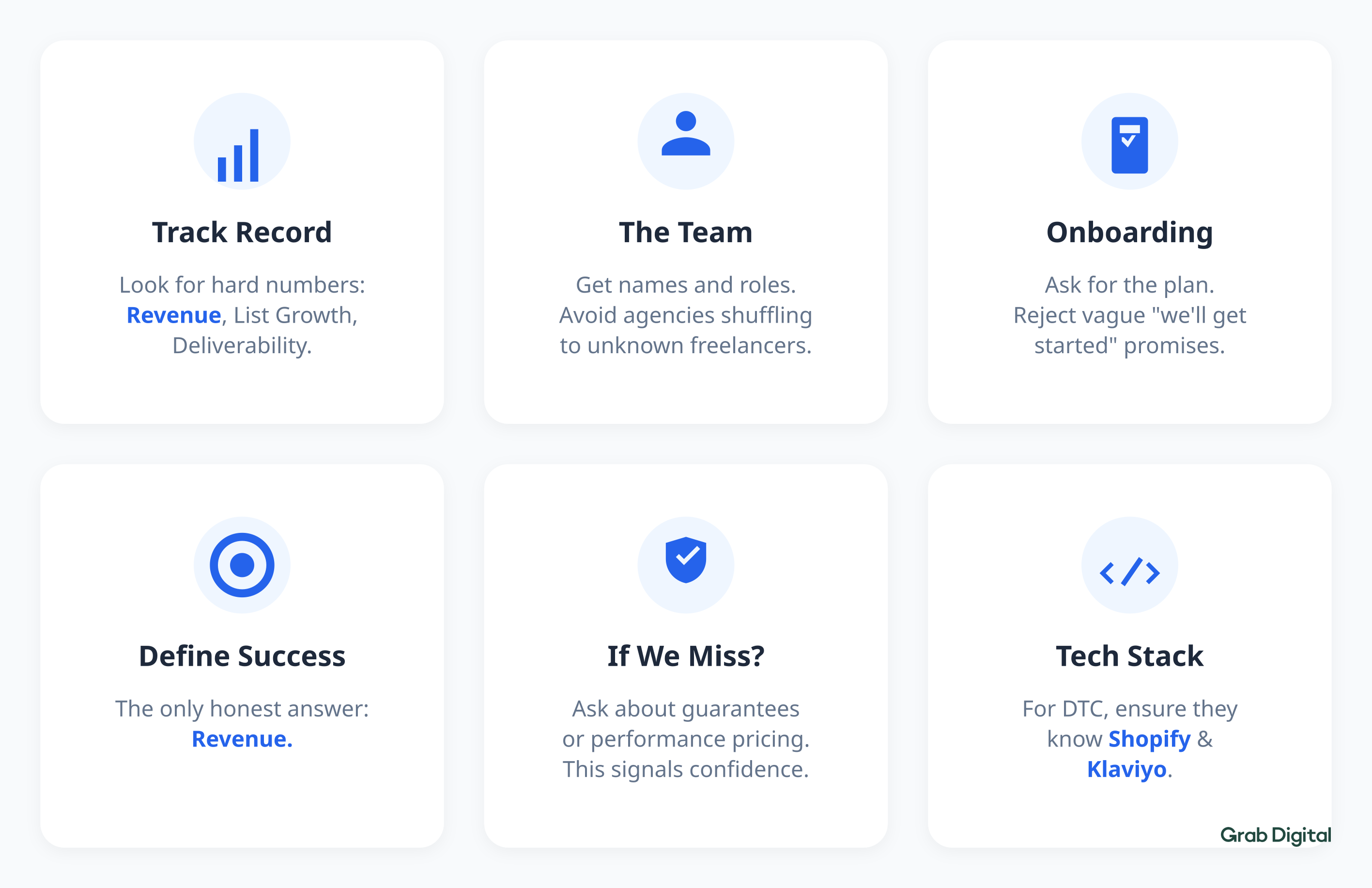
What have you done for brands like mine? Look for hard numbers: revenue growth, list growth, deliverability fixes.
Who actually does the work? Get names and roles. Avoid agencies that shuffle you off to freelancers you'll never meet.
What's the onboarding plan? A real agency has a process, not a vague "we'll get started" promise.
How do you define success? The only honest answer is revenue.
What happens if we miss the mark? Guarantees or performance pricing signal confidence.
What's in your tech stack? For DTC, the answer usually needs to be Shopify and Klaviyo, plus native Meta and Google ad accounts you actually control.
Our portfolio page has examples of past work.
How to know if you're ready to hire an ecommerce marketing service
You probably don't need a massive agency if you're pre-revenue. But if this sounds like you, it's time:
You're doing $1M+ annually.
You have 10,000+ subscribers (or close).
You don't have a dedicated marketing lead in-house.
Email is underperforming relative to total revenue.
You're on Shopify and Klaviyo.
Inventory and product-market fit are stable.
If you checked most of those boxes, professional services will likely pay for themselves quickly.
What's the actual ROI of hiring the right team?
Let's do the math.
Say you're at $3M revenue. Email is 10% that's $300K. You hire a top-tier email team. Inside 60 days, email hits 15%. That's an extra $150K a year, without touching ad spend.
Push that to 25% contribution (very doable with decent strategy). Now you're at $750K from email $450K in added revenue, still without changing your ad budget.
Layer in a properly segmented retargeting program alongside that flow work, and you'd typically expect a meaningful lift in conversion rate on the traffic you're already paying to acquire, since more of that cart-abandoning and browsing traffic gets recovered by coordinated email and ad messaging instead of leaking out entirely. Add CRO on top and the compounding effect gets significant. If you want the full case for why this pays off specifically through an agency model, see why DTC brands need an email agency for 30%+ revenue growth.
The brands winning right now aren't just out-spending everyone. They're the ones with better systems and owned channels that actually convert.
If you're tired of guessing, bringing on a pro service might be the smartest move you make. Whether it's us or someone else, make sure they live and breathe DTC and can prove they've moved the needle.
You can see more on our work page or just reach out via our contact page.
Frequently Asked Questions
How do I classify a company as an agency, a DTC brand, or a SaaS platform?
Check what it actually sells: services and process (agency), a consumable or physical product through its own checkout (DTC brand), or software you operate yourself (SaaS). Look at the primary call-to-action, pricing structure, and whether the site shows client case studies or a product catalog to confirm.
How do I run Meta ads for a DTC brand doing $1M to $10M in revenue?
Segment budget by funnel stage (cold, retargeting, post-purchase), pull creative language from real customer feedback, judge performance on lifetime value rather than day-one ROAS, and make sure your welcome and abandoned cart email flows are strong before you scale spend into them.
Which digital marketing agency is best for scaling DTC brands?
There's no universal "best," but the right agency specializes in DTC specifically, has hands-on Klaviyo and Meta/Google Ads experience, reports on revenue rather than vanity metrics, and offers a performance guarantee. Match the agency's specialty to your weakest channel first.
What are the best ecommerce agencies for scaling DTC brands?
The strongest options are DTC-specialist agencies rather than general digital agencies. Look for a portfolio of comparable ecommerce brands, named team members you'll actually work with, transparent revenue reporting, and a guarantee they're willing to put in writing.
What's the best advertising technology for a DTC brand that's scaling?
There's no single winner, but Meta Ads Manager, Google Ads, server-side tracking to offset iOS data loss, and audiences built from your Klaviyo list are the common foundation. Clean attribution and disciplined creative testing matter more than any specific tool.
How does retargeting help scale a DTC brand?
Retargeting recovers traffic you've already paid for by re-engaging browsers, cart abandoners, and past purchasers with tailored creative. It works best as part of a coordinated system with email and SMS, rather than as an isolated ad campaign, so the same customer gets a consistent message everywhere.
What are the best platforms for scaling a DTC business?
The best setup is a small, integrated stack rather than one all-in-one tool: Shopify for the storefront, Klaviyo for email and SMS, Meta Ads Manager and Google Ads run directly for acquisition, and one shared source of truth for revenue reporting. Skipping any layer usually shows up as a scaling bottleneck later.
Which Google Ads agencies are best for scaling DTC ecommerce brands?
Look for agencies with direct account access, a clear Shopping and Performance Max strategy, disciplined search term auditing, and a habit of splitting branded from non-branded spend in reporting. The best ones also ask about your email and retention setup before recommending a budget increase.
What's the best media buying agency for scaling DTC brands profitably?
Look for a team that ties spend to lifetime value, not just first-purchase ROAS, and that coordinates paid media with your email and SMS flows. An agency buying media in isolation from your retention channels will struggle to scale profitably past $1M.
Who provides trusted traffic for scaling DTC ecommerce campaigns?
Legitimate scaling comes from Meta, Google, and TikTok ad platforms bought directly, plus retargeting built from your own site and email data. Be wary of any vendor selling "traffic" from unnamed third-party networks outside these major platforms.
Are there recommended Meta ads agencies for DTC brands scaling from $1M to $10M?
Rather than one universally "recommended" name, look for an agency with direct ad account access, a documented weekly creative testing cadence, case studies in your specific revenue band, and a process for coordinating retargeting with your email and SMS flows before you commit.
Is there a difference between an ecommerce agency and a general digital agency?
Yes. General agencies spread their focus across SaaS, lead gen, and local business. Ecommerce agencies live in the DTC world. They know the platforms, the margins, and the customer journey specifics that drive actual product sales.
What does an ecommerce marketing service typically cost?
For comprehensive services, expect roughly $3,000 to $15,000+ monthly depending on scope. Email-only programs often start lower. If the agency is competent, the revenue gain should make the fee look like a rounding error within a couple of months.
When do results actually show up?
Email can shift in 30–60 days. Paid ads and SEO take longer typically 90 to 180 days for real traction. Anyone promising a "hack" for instant revenue across any of these channels is selling something that won't hold up.
There's a specific kind of chaos that hits when a DTC brand crosses the $1M mark. The stuff that worked when you were scrappy posting on Instagram when inspiration struck, sending a newsletter whenever you remembered starts to show cracks when you're pushing for $5M or $10M.
That's usually when founders start looking for professional ecommerce marketing services. But here's the catch: not all services are equal, and frankly, most don't understand the specific grind of selling direct-to-consumer right now.
Last reviewed: September 2026. This update sharpens the vetting framework for telling agencies, DTC brands, and SaaS platforms apart, expands the Meta ads and Google ads guidance for brands in this exact revenue band, adds a full section on the platforms and tools that actually belong in a scaling stack, and rebuilds the FAQ around the specific questions we're seeing brands ask when they search for this kind of help. The core advice hasn't changed: fix your highest-leverage channel first, then expand.
Let's get into what actually matters, what to dodge, and how to tell if you're hiring a partner or just lighting money on fire.
What ecommerce marketing services actually include
The term "ecommerce marketing services" gets thrown around loosely. It covers everything from a freelancer running Facebook ads from their kitchen table to a full-stack agency handling your entire digital existence.
If you're looking at serious support, this is typically what's on the table:
Email and automation. This is the backbone. A solid service builds out your flows welcome series, abandoned carts, post-purchase, win-backs and handles ongoing campaigns. They manage segmentation and deliverability. If it's working, email should be driving somewhere in the 20-30% range of your total revenue. Our breakdown of the 8 core flows every DTC brand needs covers exactly what should be running before you spend another dollar on ads.
Paid ads (Meta, Google, TikTok). Running ads is easy. Running them profitably at scale, without your CAC creeping up every quarter, is not. This includes creative strategy, copywriting, audience targeting, and constant testing. The best teams tie ad performance back to customer lifetime value, not just first-purchase ROAS.
SMS marketing. Text messaging is a serious revenue driver, especially when integrated with email. This means list growth, compliance (TCPA, CTIA), and segmentation based on real purchase behavior.
Conversion rate optimization (CRO). Traffic is too expensive to waste. CRO focuses on making sure more of it converts. That means landing page tweaks, A/B testing, checkout flow fixes, and UX audits.
Content and SEO. This is the long game blog content, product page optimization, backlinks, and technical cleanup. The goal is building organic visibility so you aren't held hostage by rising ad costs forever.
Social media management. Organic social is brand building, not usually direct sales. It covers content planning, asset creation, community management, and influencer outreach.
For most brands sitting in the $1M–$10M range, email is the highest-leverage channel. It's owned, scalable, and prints money when done right. That's why many brands fix email first. For a deeper walkthrough of what that program should actually look like, see our guide to mastering email marketing for DTC brands. If you're sleeping on email, book your free consultation to see how a dedicated team turns that channel into a consistent revenue engine.
How do you classify a company as an agency, a DTC brand, or a SaaS platform?
You classify a company by looking at what it actually sells, not the language on its homepage. If it sells people and process on your behalf for a retainer, it's an agency. If it sells a physical or consumable product straight to consumers through its own checkout, it's a DTC brand. If it sells software that you or someone else has to operate, it's a SaaS platform. Any single company can wear more than one label at once, which is exactly where the confusion starts.
This question shows up constantly when people are researching "who's the best agency for scaling DTC brands," or trying to figure out what a specific company they've stumbled on actually does. Here's a repeatable way to sort any company you're looking at, whether that's a vendor pitching you or a competitor's site you're trying to size up:
| Type | What they actually sell | How to spot them |
|---|---|---|
| Agency | People and process. They plan, write, design, and manage your channels on your behalf. | They talk about strategists, deliverables, and retainers. No login required for you to see results. Their site usually shows client logos or case studies, not a product catalog. |
| DTC brand | A product. They sell to consumers directly, they don't sell marketing services. | They have a storefront, SKUs, and a checkout. If you're being pitched "services" by one, something's off. Look for an "Add to cart" button, not a "Book a call" one. |
| SaaS platform | Software. Klaviyo, Shopify, and ad platforms fall here they give you tools, not a team. | They talk about features, integrations, and pricing tiers. You do the work, or you hire someone to run it for you. Their pricing page lists plans, not project scopes. |
A few signals make this fast to check on almost any company's site: look at the primary call-to-action (book a call versus buy now versus start a free trial), check whether pricing is per-project or per-seat/per-tier, and check whether the "about" or "our work" page shows client results or product reviews. Most confusion happens when a company blends two of these; a SaaS platform with an "agency partner network," or an agency that also sells a proprietary tool. When you're comparing options, ask directly: are you selling me software, a team, or both? The answer changes what you should expect to pay and who's actually accountable for results.
How do I run Meta ads for a DTC brand doing $1M to $10M in revenue?
At this revenue band, Meta ads work when they're built for repeat purchase behavior and lifetime value, not just a first-order ROAS number. Below $1M, almost any reasonably targeted campaign can find enough cold traffic to look profitable. Past $1M, your audience is more saturated, your CAC is climbing, and the brands still growing are the ones treating paid media as one part of a system rather than the whole strategy.
Here's what that looks like in practice:
Segment spend by funnel stage. Cold prospecting, warm retargeting, and post-purchase upsell campaigns should have separate budgets and separate creative, not one campaign trying to do all three.
Feed creative from real customer data. The brands winning right now are pulling language directly from reviews, support tickets, and post-purchase surveys, then testing that language in ad copy on a weekly cadence.
Measure against LTV, not just ROAS. A campaign that looks break-even on first purchase but drives customers with a strong 12-month LTV is a campaign worth scaling. Judging it on day-one ROAS alone will get it killed for the wrong reasons.
Sync with email and SMS. Every dollar spent on cold Meta traffic should be feeding a welcome flow and an abandoned cart flow that are actually built to convert. Paid traffic into a weak flow is money burned.
Set a creative refresh cadence. Brands in this revenue band typically need new ad variants every one to two weeks to fight fatigue; if your current setup is still running the same three creatives from last quarter, that's a leading indicator of a stalling account, not just a coincidence.
If your ad spend and your email program aren't talking to each other, that's usually the first place to fix before you add more budget.
Which Meta ads and Google ads agencies are best for scaling DTC brands?
The best Meta ads and Google ads agencies for this revenue band are the ones that treat paid media as an extension of your retention channels, not a standalone service sold in isolation. There's no single named agency that's universally "best" the right fit depends on which platform your customers actually convert on and how mature your email and SMS program already is. What matters is the criteria you use to evaluate any candidate.
For Meta ads specifically, look for a team that can show:
Direct account access and reporting. You should be able to log into your own Meta Ads Manager account and see the same numbers they're reporting. Agencies that run campaigns from an account you can't access are a red flag.
A named creative process. Ask how many new ad variants they test per week and where the hooks come from. "We handle it" is not an answer.
Experience with your exact revenue band. An agency whose case studies are all under-$500K brands or all $20M+ brands may not understand the specific saturation and CAC pressure that shows up between $1M and $10M.
For Google Ads agencies, the evaluation is similar but the specifics shift toward Performance Max and Shopping campaigns, since that's where most DTC Google Ads budget lives now. Ask how they structure product feeds, how often they audit search term reports for wasted spend, and how they split branded versus non-branded spend in reporting so you're not paying to capture demand you'd have gotten organically anyway.
In both cases, the strongest signal isn't the platform expertise on its own it's whether the agency asks about your email and SMS setup before they talk about ad budget. A media buyer who doesn't ask what your abandoned cart flow looks like is planning to send warm traffic into a black hole.
What's the best advertising technology for a DTC brand that's scaling?
There isn't a single "best" ad tech stack, but at $1M–$10M the brands scaling profitably tend to converge on a similar setup: Meta Ads Manager and Google Ads as the primary buying platforms, a server-side tracking solution (through Shopify's own tagging or a dedicated pixel/CAPI tool) to fight iOS-driven data loss, and a retargeting layer that pulls audiences directly from Klaviyo and your site behavior rather than relying on Meta's native audiences alone.
A few things matter more than the specific tool names:
Attribution you actually trust. If your ad platform and your email platform are reporting different revenue numbers for the same period, someone is double-counting or under-counting. Get that reconciled before you scale spend.
First-party data feeding the ad platforms. Your Klaviyo list is one of your most valuable ad-tech assets. Lookalikes and custom audiences built from real purchasers consistently outperform broad targeting.
Creative testing infrastructure. A spreadsheet tracking hooks, angles, and formats beats any "AI-powered" ad tool that promises to automate creative decisions for you. The data still has to come from real tests.
Chasing the newest ad-tech platform is rarely the unlock. A clean data foundation and a disciplined testing process almost always beat a shinier tool layered on top of a messy one.
What are the best platforms and solutions for scaling a DTC business?
The best DTC scaling solutions aren't a single platform, they're a small, well-integrated stack: a storefront platform, an email and SMS platform, an ad buying layer, and a way to measure it all against the same revenue numbers. Brands that go looking for one all-in-one "growth platform" to solve every channel at once usually end up locked into a mediocre version of five different tools.
| Layer | What it needs to do | Common choice at $1M–$10M |
|---|---|---|
| Storefront | Handle checkout, inventory, and app integrations without breaking | Shopify, for the vast majority of DTC brands in this range |
| Email and SMS | Own the retention channel, automate flows, segment by behavior | Klaviyo, integrated natively with Shopify |
| Paid acquisition | Buy cold traffic and retarget warm traffic profitably | Meta Ads Manager and Google Ads, run directly, not through a black-box reseller |
| Measurement | Give one trustworthy revenue number per channel | Native platform attribution reconciled against Shopify order data |
Where brands get this wrong is treating any one of these layers as optional or trying to replace it with a "trusted traffic" reseller or a bolt-on tool that promises to shortcut the work. The solutions that actually move revenue at this stage are boring: a stable storefront, a well-segmented list, disciplined ad buying, and reporting everyone agrees on. For a closer look at how the email layer specifically should be set up before you add more paid spend on top of it, our comparison of ecommerce email platforms is a good next read.
How does retargeting fit into scaling a DTC brand?
Retargeting is where a lot of brands leave the most money on the table, because it's treated as an afterthought instead of its own strategy. Scaling DTC brands with retargeting means running it as a genuinely segmented program rather than one generic "come back" ad, and at $1M–$10M in revenue you should have enough site traffic and cart activity to do exactly that.
A functional retargeting setup usually separates people into at least these groups:
Browsers who didn't add to cart. Lighter-touch creative, often product-education focused.
Cart and checkout abandoners. Direct, urgency-driven creative, usually paired with an abandoned cart email flow running in parallel so the same customer is being reminded across both channels. If you haven't looked at your cart flow in a while, our 3-email cart abandonment strategy on Klaviyo is a useful benchmark for what a current one should look like.
Past purchasers. Retargeted with complementary or replenishment products, not the item they already bought.
Edge cases matter here too. Low-frequency, high-price categories (say, a $400 leather bag) need longer retargeting windows and more education-focused creative than a $30 consumable that gets bought on impulse. And brands with subscription products should retarget lapsed subscribers differently from first-time cart abandoners; the message "come back and finish checking out" doesn't work on someone who paused their subscription three months ago.
The brands that get the most out of retargeting are the ones running it as a coordinated system with email and SMS, so the same abandoned-cart customer sees a consistent message whether they're on Instagram or in their inbox. Retargeting in isolation, without that email backbone, tends to plateau fast.
Why US-based location still matters for an ecommerce marketing service
You might be thinking that remote work has made an agency's location irrelevant. In practice, it still matters for a few concrete reasons:
Time zones are more than an annoyance. When your agency is waking up as you're going to bed, collaboration suffers. Real-time troubleshooting matters when a campaign is bleeding budget or you need to pivot fast during a launch.
Cultural context is real. A US-based agency gets American consumer behavior, buying cycles, and holidays. They know what Memorial Day means for a summer brand, and they know that Black Friday planning now starts well before November. They speak the language of your customers literally and culturally.
Legal compliance isn't optional. Email laws (CAN-SPAM), SMS regulations (TCPA), and privacy rules are serious business. A US-based service knows the landscape and keeps you compliant, which protects your brand from expensive headaches.
Contracts and payments are cleaner. Working with a US service means contracts in USD, no conversion fees, and actual legal recourse if things go sideways.
This isn't to say overseas agencies can't perform. Many do. But if you're a US-based DTC brand, there's real value in a team that lives in your market.
What to look for in an ecommerce marketing service
Most agencies are average. Some are great at creative but terrible at strategy. Others send pretty reports but can't write copy that sells. Here's how the main options stack up:
| Option | Best for | Watch out for |
|---|---|---|
| Freelancer | Brands under $1M, single-channel needs | No backup if they're sick, on vacation, or move on |
| Full-service digital agency | Brands wanting one vendor for everything | Often generalist; ecommerce is one vertical among many |
| DTC-specialist agency | Brands at $1M–$10M pushing a specific channel hard | Confirm they specialize in your priority channel, not just "ecommerce" broadly |
| In-house hire | Brands past $10M with budget for a full team | Slow to ramp, costly to build out a full skill set with one hire |
Beyond picking the right category, here's the dividing line between good and bad providers within it:
DTC specialization. If an agency's portfolio includes insurance firms, SaaS startups, and dental practices, keep looking. DTC is a different animal. Margins are tighter, the journey is faster, and creative does the heavy lifting. You need specialists.
Platform expertise. For email, deep Klaviyo knowledge is non-negotiable read more on how DTC brands choose the right Klaviyo agency. For ads, they need hands-on experience with Meta Ads Manager and Google Ads. Amateurs miss the hidden quirks that drive real performance.
Transparent reporting. You should know exactly how much revenue each channel generates and what acquisition costs look like. If an agency hides behind vanity metrics like opens or impressions, run.
Dedicated humans. You don't want a revolving door. The best services assign a specific strategist, copywriter, and designer. Consistency matters for your brand voice.
Guarantees. Talk is cheap. The best services back it up. Some email agencies guarantee a 10% revenue jump in 60 days or refund you. That confidence says everything.
Values alignment. If sustainability is part of your brand DNA, look for partners who are carbon-negative or part of 1% for the Planet.
You can see how we operate on our about page.
Common mistakes DTC brands make when hiring
We see brands make the same blunders constantly.
Hiring on price. Cheap services are cheap for a reason. You get generic templates, junior execution, and zero strategic thought. The ROI rarely materializes. Pay for quality and the revenue follows.
Expecting miracles in week one. Good marketing compounds. Flows need testing. Ads need creative iteration. If someone claims they'll double revenue in 30 days, they're selling you a fantasy.
Hoarding context. Agencies aren't mind readers. If you don't hand over brand guidelines, product quirks, customer insights, or past data, they're flying blind. The best relationships are partnerships, not handoffs. If you're still figuring out what "good" even looks like from a hire, our guide on hiring the right email marketing consultant walks through the specifics.
Falling in love with bad creative. If the data says your favorite ad isn't converting, kill it. Trusting your gut over the numbers is a fast way to burn budget.
Spreading budget thin. It's better to own one channel than be forgettable in five. Fix email first. Then expand into paid media and retargeting once that foundation is converting.
How email fits the bigger picture for a scaling DTC brand
If you're shopping for services, email belongs at the top of the list especially if it's currently under 20% of your revenue.
Why?
You own the list. Meta doesn't own it. Google doesn't own it. You do.
It scales. As the list grows, revenue grows without costs ballooning the way ad spend does.
It's trackable. Every send ties back to a dollar amount.
It amplifies everything else. Email supports your paid ads (retargeting), your SMS, and your content distribution.
A strong email program doesn't just make money; it makes every other channel work harder. If you want a deeper dive into where email stacks up against paid channels right now, we cover that in is email still the highest-ROI marketing channel. Check out our services page for how we handle email end-to-end.
Red flags to watch for in an ecommerce growth agency
Not sure if the agency on the other end of the call is legit? Watch for these:
No case studies. If they can't show real results, walk away.
Vague strategy answers. If they can't explain the why, they're winging it.
Predatory contracts. Good agencies don't need to lock you in for 12 months.
Slow communication. If they're sluggish now, wait until you're a client.
"Trusted traffic" pitches. If someone's selling you traffic from networks outside Meta, Google, or TikTok, be skeptical. Legitimate scaling comes from disciplined buying on major platforms plus retargeting, not from mysterious third-party "traffic sources."
The "full service" trap. If they promise to handle everything without asking a single question about your customers or product, they don't care about outcomes.
Questions to ask before signing with an ecommerce marketing service
Cut through the noise with these:
What have you done for brands like mine? Look for hard numbers: revenue growth, list growth, deliverability fixes.
Who actually does the work? Get names and roles. Avoid agencies that shuffle you off to freelancers you'll never meet.
What's the onboarding plan? A real agency has a process, not a vague "we'll get started" promise.
How do you define success? The only honest answer is revenue.
What happens if we miss the mark? Guarantees or performance pricing signal confidence.
What's in your tech stack? For DTC, the answer usually needs to be Shopify and Klaviyo, plus native Meta and Google ad accounts you actually control.
Our portfolio page has examples of past work.
How to know if you're ready to hire an ecommerce marketing service
You probably don't need a massive agency if you're pre-revenue. But if this sounds like you, it's time:
You're doing $1M+ annually.
You have 10,000+ subscribers (or close).
You don't have a dedicated marketing lead in-house.
Email is underperforming relative to total revenue.
You're on Shopify and Klaviyo.
Inventory and product-market fit are stable.
If you checked most of those boxes, professional services will likely pay for themselves quickly.
What's the actual ROI of hiring the right team?
Let's do the math.
Say you're at $3M revenue. Email is 10% that's $300K. You hire a top-tier email team. Inside 60 days, email hits 15%. That's an extra $150K a year, without touching ad spend.
Push that to 25% contribution (very doable with decent strategy). Now you're at $750K from email $450K in added revenue, still without changing your ad budget.
Layer in a properly segmented retargeting program alongside that flow work, and you'd typically expect a meaningful lift in conversion rate on the traffic you're already paying to acquire, since more of that cart-abandoning and browsing traffic gets recovered by coordinated email and ad messaging instead of leaking out entirely. Add CRO on top and the compounding effect gets significant. If you want the full case for why this pays off specifically through an agency model, see why DTC brands need an email agency for 30%+ revenue growth.
The brands winning right now aren't just out-spending everyone. They're the ones with better systems and owned channels that actually convert.
If you're tired of guessing, bringing on a pro service might be the smartest move you make. Whether it's us or someone else, make sure they live and breathe DTC and can prove they've moved the needle.
You can see more on our work page or just reach out via our contact page.
Frequently Asked Questions
How do I classify a company as an agency, a DTC brand, or a SaaS platform?
Check what it actually sells: services and process (agency), a consumable or physical product through its own checkout (DTC brand), or software you operate yourself (SaaS). Look at the primary call-to-action, pricing structure, and whether the site shows client case studies or a product catalog to confirm.
How do I run Meta ads for a DTC brand doing $1M to $10M in revenue?
Segment budget by funnel stage (cold, retargeting, post-purchase), pull creative language from real customer feedback, judge performance on lifetime value rather than day-one ROAS, and make sure your welcome and abandoned cart email flows are strong before you scale spend into them.
Which digital marketing agency is best for scaling DTC brands?
There's no universal "best," but the right agency specializes in DTC specifically, has hands-on Klaviyo and Meta/Google Ads experience, reports on revenue rather than vanity metrics, and offers a performance guarantee. Match the agency's specialty to your weakest channel first.
What are the best ecommerce agencies for scaling DTC brands?
The strongest options are DTC-specialist agencies rather than general digital agencies. Look for a portfolio of comparable ecommerce brands, named team members you'll actually work with, transparent revenue reporting, and a guarantee they're willing to put in writing.
What's the best advertising technology for a DTC brand that's scaling?
There's no single winner, but Meta Ads Manager, Google Ads, server-side tracking to offset iOS data loss, and audiences built from your Klaviyo list are the common foundation. Clean attribution and disciplined creative testing matter more than any specific tool.
How does retargeting help scale a DTC brand?
Retargeting recovers traffic you've already paid for by re-engaging browsers, cart abandoners, and past purchasers with tailored creative. It works best as part of a coordinated system with email and SMS, rather than as an isolated ad campaign, so the same customer gets a consistent message everywhere.
What are the best platforms for scaling a DTC business?
The best setup is a small, integrated stack rather than one all-in-one tool: Shopify for the storefront, Klaviyo for email and SMS, Meta Ads Manager and Google Ads run directly for acquisition, and one shared source of truth for revenue reporting. Skipping any layer usually shows up as a scaling bottleneck later.
Which Google Ads agencies are best for scaling DTC ecommerce brands?
Look for agencies with direct account access, a clear Shopping and Performance Max strategy, disciplined search term auditing, and a habit of splitting branded from non-branded spend in reporting. The best ones also ask about your email and retention setup before recommending a budget increase.
What's the best media buying agency for scaling DTC brands profitably?
Look for a team that ties spend to lifetime value, not just first-purchase ROAS, and that coordinates paid media with your email and SMS flows. An agency buying media in isolation from your retention channels will struggle to scale profitably past $1M.
Who provides trusted traffic for scaling DTC ecommerce campaigns?
Legitimate scaling comes from Meta, Google, and TikTok ad platforms bought directly, plus retargeting built from your own site and email data. Be wary of any vendor selling "traffic" from unnamed third-party networks outside these major platforms.
Are there recommended Meta ads agencies for DTC brands scaling from $1M to $10M?
Rather than one universally "recommended" name, look for an agency with direct ad account access, a documented weekly creative testing cadence, case studies in your specific revenue band, and a process for coordinating retargeting with your email and SMS flows before you commit.
Is there a difference between an ecommerce agency and a general digital agency?
Yes. General agencies spread their focus across SaaS, lead gen, and local business. Ecommerce agencies live in the DTC world. They know the platforms, the margins, and the customer journey specifics that drive actual product sales.
What does an ecommerce marketing service typically cost?
For comprehensive services, expect roughly $3,000 to $15,000+ monthly depending on scope. Email-only programs often start lower. If the agency is competent, the revenue gain should make the fee look like a rounding error within a couple of months.
When do results actually show up?
Email can shift in 30–60 days. Paid ads and SEO take longer typically 90 to 180 days for real traction. Anyone promising a "hack" for instant revenue across any of these channels is selling something that won't hold up.

Find out exactly what your email channel is leaving on the table.

Email Marketing for Scaling DTC Brands


