
Summary
Andrew Bialecki & Klaviyo: CEO Background and 2026 Vision
Andrew Bialecki is the co-founder and CEO of Klaviyo, the email and SMS platform built specifically for direct-to-consumer ecommerce brands. He started the company in 2012 with Ed Hallen, bootstrapped it to profitability without outside funding for years, and took it public in September 2023.
Why does this matter to you? Because Bialecki isn't a marketing guy, he's an engineer. His approach, treating email as a data problem rather than a creative one, changed how DTC brands handle retention. If you run a brand doing $1M to $10M in revenue, his decisions on pricing and features hit your P&L directly.
Here's a breakdown of who Andrew Bialecki is, his specific vision for Klaviyo, and what his leadership means for your email strategy in 2026.
Who Is Andrew Bialecki? Background and Education
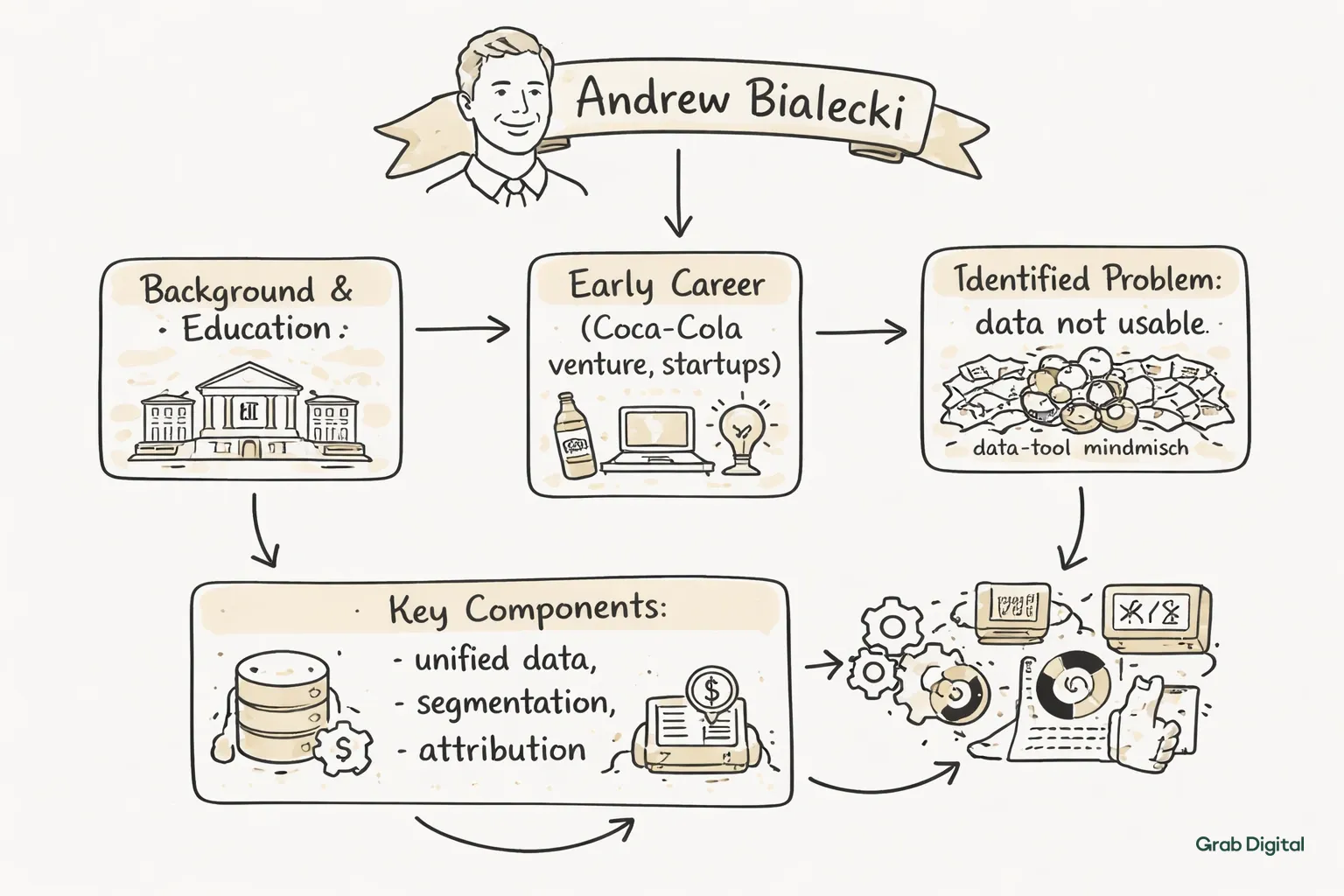
Andrew Bialecki grew up in Massachusetts and studied Computer Science and Math at MIT. Before Klaviyo, he worked as a software engineer at a Coca-Cola venture and several early-stage startups. In those roles, he saw a recurring issue: marketing teams had data, but their tools couldn't actually use it.
This technical background sets him apart from most email marketing leaders. He didn't want to build a better drag-and-drop email builder. He wanted to fix the infrastructure problem: unifying customer data, enabling granular segmentation, and attributing revenue accurately. That was the thesis behind Klaviyo from day one.
Bialecki met Ed Hallen through MIT connections. Both were frustrated with tools like MailChimp that treated subscribers as static lists. In 2012, they launched Klaviyo from a small Boston office to build an email platform specifically for ecommerce.
How Did Andrew Bialecki Start Klaviyo?
Bialecki started Klaviyo as a bootstrapped operation with no venture funding, which meant he and Hallen had to build things people actually paid for. They targeted Shopify and Magento merchants who were outgrowing generic ESPs.
The early product focused on three things: deep integrations, behavioral segmentation, and revenue attribution. Bialecki insisted on showing revenue per email, not just open rates. This focus on ROI clicked with DTC founders who needed to justify every dollar. By 2015, Klaviyo had thousands of paying customers, growing mostly through word-of-mouth.
Raising venture capital in 2015 was a turning point. Bialecki secured $15 million in Series A funding from Accomplice, eventually raising over $775 million before the IPO. The cash fueled hiring and expansion into SMS. But he refused to chase enterprise clients or B2B markets, keeping the product focused on ecommerce.
He emphasized profitability early on. Klaviyo reached cash-flow positivity before raising late-stage funding, a rarity in SaaS. This discipline reflected an engineering mindset: build sustainable systems rather than burning cash for growth.
As covered in Klaviyo Stock 2026: Private Company Status Explained, Bialecki's leadership through the IPO positioned Klaviyo as a profitable growth company. His focus on net revenue retention gave investors confidence that the company could sustain growth without burning through its balance sheet.
What Is Andrew Bialecki's Vision for Email Marketing?
Bialecki views email as a primary revenue channel, not a supporting act. His bet is on "owned data." While platforms like Facebook control the audience relationship, email gives brands direct access to customer profiles. Klaviyo's architecture centralizes this data, making it actionable.
He often states that email should drive 25-30% of total revenue for healthy DTC brands. This benchmark comes from Klaviyo's internal data. Brands hitting this number typically have sophisticated email flows and advanced segmentation. Bialecki's product roadmap pushes users toward this standard, and it's worth checking your own Klaviyo dashboard against it before assuming your program is healthy.
He also pushed for personalization at scale. Features like dynamic content blocks let brands tailor emails to individual profiles. This turned generic batch-and-blast campaigns into actual conversations. For instance, browse abandonment flows can insert products a subscriber actually viewed, converting 3-5x better than static emails.
When Klaviyo launched SMS in 2020, Bialecki positioned it as an extension of email rather than a separate product. The unified customer profile meant brands could coordinate email and SMS based on engagement signals. This integration gave Klaviyo an edge over tools that treated channels as silos.
For brands working with a Klaviyo agency, understanding this vision helps align strategy. If you're comparing options, our guide on how DTC brands choose the right Klaviyo agency for growth covers what to look for. Klaviyo rewards depth: you get better results by maximizing segmentation and flow sophistication than by adding more tools to your stack.
What Product Decisions Has Andrew Bialecki Made at Klaviyo?
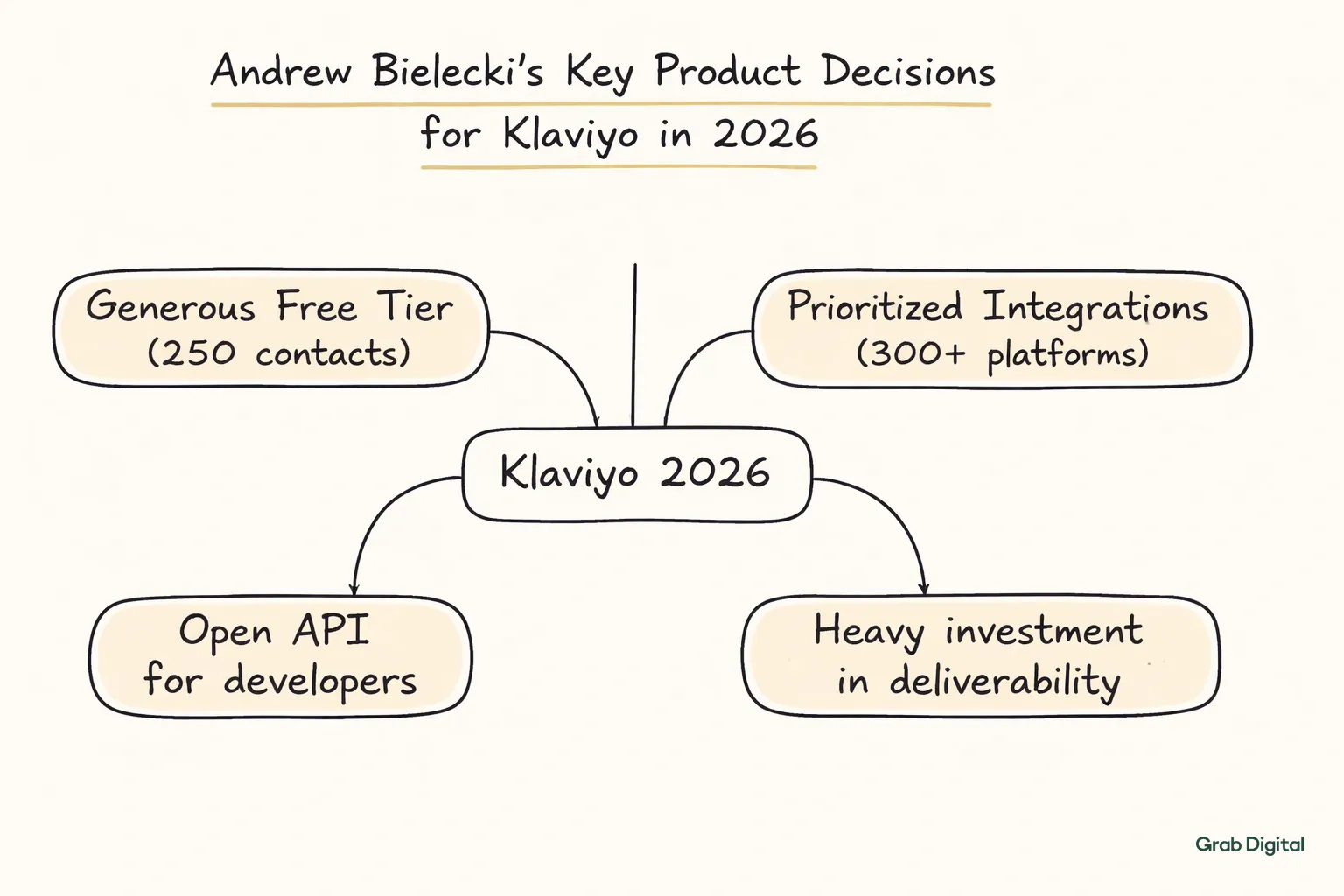
Bialecki made four specific bets that defined Klaviyo's position: a generous free tier, an integrations-first strategy, in-house deliverability infrastructure, and a hard focus on email and SMS instead of feature bloat.
He insisted on a generous free tier. The free plan supports up to 250 contacts, giving early-stage brands access to enterprise-grade segmentation. This built loyalty and created a pipeline of brands scaling into paid plans as their lists grew.
He prioritized integrations over native features. Klaviyo connects with over 300 platforms, including Shopify's own ecosystem, as covered in our breakdown of Klaviyo's native Shopify integration and must-have email flows. This ecosystem approach let brands centralize data without replacing existing systems. The open API gave developers flexibility, strengthening Klaviyo's position as the data hub.
He invested heavily in deliverability infrastructure. Klaviyo built its own sending infrastructure rather than relying entirely on third parties. This control improved inbox placement. As outlined in our email deliverability guide, sender reputation directly impacts revenue, and Bialecki understood this earlier than most.
He also launched benchmarking and reporting to make data transparent. Brands can compare metrics against industry averages. This helps brands identify gaps in their email marketing strategy.
He also resisted feature bloat. While competitors added social scheduling and CRM tools, Klaviyo stayed focused on email, SMS, and data activation. This kept the platform learnable and prevented the "Swiss army knife" problem that dilutes most marketing platforms.
How Does Andrew Bialecki's Leadership Affect DTC Brands in 2026?
Bialecki's influence extends into how DTC brands approach retention. His push for data ownership forced brands to invest in first-party strategies, especially with third-party cookies deprecating. Klaviyo's CDP capabilities let brands build unified profiles without buying a separate tool.
His public statements about benchmarks set industry standards. When Bialecki said healthy brands should generate 25-30% of revenue from email, it became a target for founders. Brands falling short started asking why, driving demand for email marketing agencies and consultants.
Bialecki's focus on profitability shaped pricing, too. Klaviyo's costs scale with contacts and SMS credits. This aligns cost with growth, but can feel expensive for brands underutilizing the platform. The lesson: maximize Klaviyo's capabilities, or it becomes a cost center.
The 2023 IPO brought scrutiny and transparency. Public reporting means Klaviyo discloses detailed metrics on retention and growth. For DTC brands, this validates the platform's stability. You can invest in deep Klaviyo implementations knowing the company isn't at risk of disappearing, a real concern with smaller ESPs.
In 2026, Bialecki is focused on AI and predictive features. Klaviyo now offers predictive analytics for churn risk and customer lifetime value. If you aren't using these tools, you're leaving money on the table. Book your free consultation to audit your account for quick wins.
How Does Bialecki's Approach Compare to Competitors?
Bialecki's strategy differs from competitors like Mailchimp (Intuit), Omnisend, and Attentive mainly in one word: focus. He kept Klaviyo narrow while rivals broadened.
Mailchimp's acquisition by Intuit shifted its focus toward small business accounting and horizontal tools. Bialecki kept Klaviyo vertical, doubling down on ecommerce depth instead of trying to serve every type of small business.
Omnisend positions itself as an affordable alternative. But Bialecki's investment in infrastructure gives Klaviyo an edge in inbox placement and uptime. API reliability matters more as brands scale past $5M, where downtime directly impacts revenue.
Attentive focuses exclusively on SMS. Bialecki's response was to integrate SMS directly into Klaviyo's platform. This bundling strategy creates switching costs and simplifies vendor management. You can coordinate email and SMS from one dashboard rather than reconciling two separate tools.
Bialecki also diverged on data portability. Klaviyo lets brands export data freely. This aligns with his belief that brands should own their data, even if they switch platforms.
The result: Klaviyo dominates the $1M to $50M DTC segment. Brands in this range need sophisticated segmentation but don't require enterprise features. Bialecki optimized Klaviyo's product and pricing for exactly this segment, which is also the range where a dedicated Klaviyo agency tends to pay for itself fastest.
What Can DTC Brands Learn From Andrew Bialecki's Strategy?
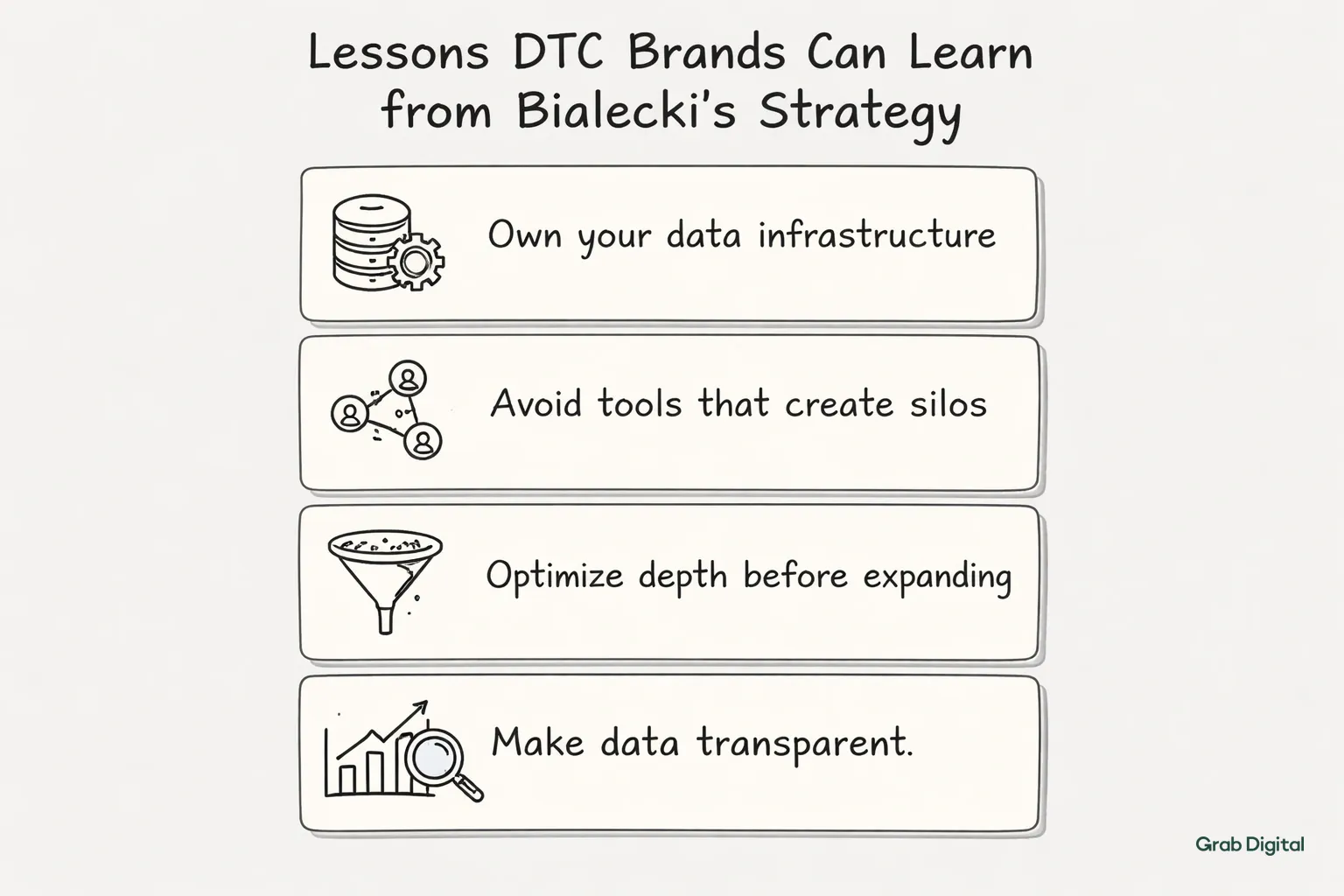
There are five clear takeaways for founders from how Bialecki built Klaviyo.
Own your data infrastructure. Klaviyo succeeded because it centralized data. Apply this to your stack. Avoid tools that create silos. Prioritize integrations that unify customer profiles.
Optimize for depth before expanding. Bialecki didn't turn Klaviyo into an all-in-one platform. He perfected email and SMS first. For DTC brands, this means maximizing email revenue attribution before chasing new channels. Fix email before diversifying.
Make data transparent. Bialecki built benchmarking directly into the product. Do the same with your team. Share KPIs. Compare against benchmarks. Use attribution data to allocate budget.
Prioritize unit economics. Bialecki bootstrapped to profitability before raising big rounds. For DTC brands, this means focusing on LTV and contribution margin, not just revenue growth. Use advanced segmentation to identify high-LTV cohorts.
Build systems that scale. Klaviyo's automation lets brands grow revenue without linearly increasing headcount. Invest in email flows and automation that generate revenue 24/7.
What Has Bialecki Said About Klaviyo's Future?
Bialecki's interviews and earnings calls hint at the roadmap, and they point in three directions: more AI, a bigger role in the customer data stack, and no change to Klaviyo's ecommerce-only focus.
He frequently emphasizes AI. Klaviyo's predictive analytics already suggest send times and product recommendations. Expect more AI-driven features that automate decisions marketers currently handle manually.
He also talks about expanding Klaviyo's role in the customer data stack. Klaviyo's CDP capabilities position it as a potential replacement for tools like Segment in mid-market companies. Bialecki envisions Klaviyo as the central data repository, feeding ad platforms, helpdesks, and subscription tools.
Bialecki has stated Klaviyo will remain ecommerce-focused. He views adjacent markets like B2B as distractions. This commitment reassures DTC brands that Klaviyo won't pivot to chase enterprise contracts.
On pricing, Bialecki defends the contact-based model. He argues it aligns Klaviyo's success with customer growth. The subtext: list hygiene and segmentation matter more than list size.
For more context on financial performance, read Klaviyo Stock Not Available: Why DTC Brands Should Care, which explores how Bialecki's leadership affects valuation.
How Do You Maximize Klaviyo Under Bialecki's Vision?
To align with Bialecki's vision, focus on data unification, automation sophistication, and attribution, in that order.
Audit integrations. Klaviyo should ingest data from Shopify, subscriptions, and loyalty programs. Incomplete data limits segmentation.
Build out core flows. Bialecki designed Klaviyo to automate revenue through core email flows. If welcome, abandoned cart, and post-purchase flows are missing, you're losing money.
Implement advanced segmentation. Go beyond basic RFM. Use predictive analytics to identify churn risk or likely repeat purchasers. Target these segments specifically. Subscription email strategies and loyalty marketing work best with predictive signals.
Measure attribution rigorously. Klaviyo's default attribution window is five days for email. Adjust if your purchase cycle is longer. Compare Klaviyo's revenue data against Google Analytics to understand the full picture.
Stay current. Bialecki's team ships features monthly. Test new capabilities like AI-powered send time optimization early, and check our 2026 email marketing best practices for DTC brands periodically for what's changed.
What Are Common Misconceptions About Andrew Bialecki and Klaviyo?
"Klaviyo is only for large brands." Bialecki built Klaviyo to scale from early-stage to mature. The free tier exists for a reason. Brands doing $500K to $1M can use the same segmentation as $10M brands.
"Klaviyo is just expensive Mailchimp." Bialecki positioned Klaviyo as a revenue platform, not an email tool. The difference is in attribution, integrations, and dynamic content. Mailchimp treats email as broadcast. Klaviyo treats it as a revenue engine. That architecture justifies the price for serious brands.
"You need an agency to manage it." While expert help is beneficial, Klaviyo's templates and guides make core flows accessible to non-technical users. Brands without budget for a dedicated hire can still get solid results using built-in best practices, though if you're weighing that decision, our guide on how to hire the right Klaviyo expert for DTC brands lays out what to look for.
"Klaviyo wants to replace your whole stack." Bialecki designed Klaviyo to complement tools like Shopify and Yotpo, not replace them. Klaviyo activates data but doesn't replicate core functionality. This reduces lock-in.
"Engineers don't care about design." Bialecki's engineering mindset extends to design systems. Klaviyo invests in design tools, mobile optimization, and accessibility. The platform ensures emails look professional across devices.
Frequently Asked Questions
Q: Who is Andrew Bialecki at Klaviyo? A: Andrew Bialecki is Klaviyo's co-founder and CEO. He started the company with Ed Hallen in 2012, bootstrapped it to profitability, and led it through its September 2023 IPO. He's an MIT-trained engineer, not a marketer, and that shows in Klaviyo's data-first product design.
Q: Is Andrew Bialecki still the CEO of Klaviyo in 2026? A: Yes. Bialecki remains CEO and continues to lead product strategy. There is no indication of succession planning.
Q: How did Andrew Bialecki's background influence Klaviyo's product design? A: His MIT degrees shaped Klaviyo's data-first architecture. He approached email as an infrastructure problem, resulting in a focus on segmentation and revenue tracking rather than just templates.
Q: What makes Andrew Bialecki's vision different from other email marketing CEOs? A: Bialecki maintained vertical focus on ecommerce while competitors expanded horizontally. He prioritized data ownership and deep integrations over feature breadth.
Q: Does Andrew Bialecki's strategy affect which DTC brands should use Klaviyo? A: Yes. Bialecki optimized Klaviyo for brands doing $500K to $50M who want 25-30% of revenue from email. Brands outside this profile or needing simple broadcast tools might find better value elsewhere.
Q: How can DTC brands align their email strategy with Bialecki's vision for Klaviyo? A: Focus on unifying data, building sophisticated flows, using predictive analytics, and measuring attribution. Bialecki designed Klaviyo to reward depth in these areas.
Q: What has Bialecki said about Klaviyo's AI and machine learning roadmap? A: He positions AI as the next frontier. Klaviyo already offers predictive analytics. Future development focuses on AI-driven content generation and automated flow optimization.
Andrew Bialecki is the co-founder and CEO of Klaviyo, the email and SMS platform built specifically for direct-to-consumer ecommerce brands. He started the company in 2012 with Ed Hallen, bootstrapped it to profitability without outside funding for years, and took it public in September 2023.
Why does this matter to you? Because Bialecki isn't a marketing guy, he's an engineer. His approach, treating email as a data problem rather than a creative one, changed how DTC brands handle retention. If you run a brand doing $1M to $10M in revenue, his decisions on pricing and features hit your P&L directly.
Here's a breakdown of who Andrew Bialecki is, his specific vision for Klaviyo, and what his leadership means for your email strategy in 2026.
Who Is Andrew Bialecki? Background and Education
Andrew Bialecki grew up in Massachusetts and studied Computer Science and Math at MIT. Before Klaviyo, he worked as a software engineer at a Coca-Cola venture and several early-stage startups. In those roles, he saw a recurring issue: marketing teams had data, but their tools couldn't actually use it.
This technical background sets him apart from most email marketing leaders. He didn't want to build a better drag-and-drop email builder. He wanted to fix the infrastructure problem: unifying customer data, enabling granular segmentation, and attributing revenue accurately. That was the thesis behind Klaviyo from day one.
Bialecki met Ed Hallen through MIT connections. Both were frustrated with tools like MailChimp that treated subscribers as static lists. In 2012, they launched Klaviyo from a small Boston office to build an email platform specifically for ecommerce.
How Did Andrew Bialecki Start Klaviyo?
Bialecki started Klaviyo as a bootstrapped operation with no venture funding, which meant he and Hallen had to build things people actually paid for. They targeted Shopify and Magento merchants who were outgrowing generic ESPs.
The early product focused on three things: deep integrations, behavioral segmentation, and revenue attribution. Bialecki insisted on showing revenue per email, not just open rates. This focus on ROI clicked with DTC founders who needed to justify every dollar. By 2015, Klaviyo had thousands of paying customers, growing mostly through word-of-mouth.
Raising venture capital in 2015 was a turning point. Bialecki secured $15 million in Series A funding from Accomplice, eventually raising over $775 million before the IPO. The cash fueled hiring and expansion into SMS. But he refused to chase enterprise clients or B2B markets, keeping the product focused on ecommerce.
He emphasized profitability early on. Klaviyo reached cash-flow positivity before raising late-stage funding, a rarity in SaaS. This discipline reflected an engineering mindset: build sustainable systems rather than burning cash for growth.
As covered in Klaviyo Stock 2026: Private Company Status Explained, Bialecki's leadership through the IPO positioned Klaviyo as a profitable growth company. His focus on net revenue retention gave investors confidence that the company could sustain growth without burning through its balance sheet.
What Is Andrew Bialecki's Vision for Email Marketing?
Bialecki views email as a primary revenue channel, not a supporting act. His bet is on "owned data." While platforms like Facebook control the audience relationship, email gives brands direct access to customer profiles. Klaviyo's architecture centralizes this data, making it actionable.
He often states that email should drive 25-30% of total revenue for healthy DTC brands. This benchmark comes from Klaviyo's internal data. Brands hitting this number typically have sophisticated email flows and advanced segmentation. Bialecki's product roadmap pushes users toward this standard, and it's worth checking your own Klaviyo dashboard against it before assuming your program is healthy.
He also pushed for personalization at scale. Features like dynamic content blocks let brands tailor emails to individual profiles. This turned generic batch-and-blast campaigns into actual conversations. For instance, browse abandonment flows can insert products a subscriber actually viewed, converting 3-5x better than static emails.
When Klaviyo launched SMS in 2020, Bialecki positioned it as an extension of email rather than a separate product. The unified customer profile meant brands could coordinate email and SMS based on engagement signals. This integration gave Klaviyo an edge over tools that treated channels as silos.
For brands working with a Klaviyo agency, understanding this vision helps align strategy. If you're comparing options, our guide on how DTC brands choose the right Klaviyo agency for growth covers what to look for. Klaviyo rewards depth: you get better results by maximizing segmentation and flow sophistication than by adding more tools to your stack.
What Product Decisions Has Andrew Bialecki Made at Klaviyo?
Bialecki made four specific bets that defined Klaviyo's position: a generous free tier, an integrations-first strategy, in-house deliverability infrastructure, and a hard focus on email and SMS instead of feature bloat.
He insisted on a generous free tier. The free plan supports up to 250 contacts, giving early-stage brands access to enterprise-grade segmentation. This built loyalty and created a pipeline of brands scaling into paid plans as their lists grew.
He prioritized integrations over native features. Klaviyo connects with over 300 platforms, including Shopify's own ecosystem, as covered in our breakdown of Klaviyo's native Shopify integration and must-have email flows. This ecosystem approach let brands centralize data without replacing existing systems. The open API gave developers flexibility, strengthening Klaviyo's position as the data hub.
He invested heavily in deliverability infrastructure. Klaviyo built its own sending infrastructure rather than relying entirely on third parties. This control improved inbox placement. As outlined in our email deliverability guide, sender reputation directly impacts revenue, and Bialecki understood this earlier than most.
He also launched benchmarking and reporting to make data transparent. Brands can compare metrics against industry averages. This helps brands identify gaps in their email marketing strategy.
He also resisted feature bloat. While competitors added social scheduling and CRM tools, Klaviyo stayed focused on email, SMS, and data activation. This kept the platform learnable and prevented the "Swiss army knife" problem that dilutes most marketing platforms.
How Does Andrew Bialecki's Leadership Affect DTC Brands in 2026?
Bialecki's influence extends into how DTC brands approach retention. His push for data ownership forced brands to invest in first-party strategies, especially with third-party cookies deprecating. Klaviyo's CDP capabilities let brands build unified profiles without buying a separate tool.
His public statements about benchmarks set industry standards. When Bialecki said healthy brands should generate 25-30% of revenue from email, it became a target for founders. Brands falling short started asking why, driving demand for email marketing agencies and consultants.
Bialecki's focus on profitability shaped pricing, too. Klaviyo's costs scale with contacts and SMS credits. This aligns cost with growth, but can feel expensive for brands underutilizing the platform. The lesson: maximize Klaviyo's capabilities, or it becomes a cost center.
The 2023 IPO brought scrutiny and transparency. Public reporting means Klaviyo discloses detailed metrics on retention and growth. For DTC brands, this validates the platform's stability. You can invest in deep Klaviyo implementations knowing the company isn't at risk of disappearing, a real concern with smaller ESPs.
In 2026, Bialecki is focused on AI and predictive features. Klaviyo now offers predictive analytics for churn risk and customer lifetime value. If you aren't using these tools, you're leaving money on the table. Book your free consultation to audit your account for quick wins.
How Does Bialecki's Approach Compare to Competitors?
Bialecki's strategy differs from competitors like Mailchimp (Intuit), Omnisend, and Attentive mainly in one word: focus. He kept Klaviyo narrow while rivals broadened.
Mailchimp's acquisition by Intuit shifted its focus toward small business accounting and horizontal tools. Bialecki kept Klaviyo vertical, doubling down on ecommerce depth instead of trying to serve every type of small business.
Omnisend positions itself as an affordable alternative. But Bialecki's investment in infrastructure gives Klaviyo an edge in inbox placement and uptime. API reliability matters more as brands scale past $5M, where downtime directly impacts revenue.
Attentive focuses exclusively on SMS. Bialecki's response was to integrate SMS directly into Klaviyo's platform. This bundling strategy creates switching costs and simplifies vendor management. You can coordinate email and SMS from one dashboard rather than reconciling two separate tools.
Bialecki also diverged on data portability. Klaviyo lets brands export data freely. This aligns with his belief that brands should own their data, even if they switch platforms.
The result: Klaviyo dominates the $1M to $50M DTC segment. Brands in this range need sophisticated segmentation but don't require enterprise features. Bialecki optimized Klaviyo's product and pricing for exactly this segment, which is also the range where a dedicated Klaviyo agency tends to pay for itself fastest.
What Can DTC Brands Learn From Andrew Bialecki's Strategy?
There are five clear takeaways for founders from how Bialecki built Klaviyo.
Own your data infrastructure. Klaviyo succeeded because it centralized data. Apply this to your stack. Avoid tools that create silos. Prioritize integrations that unify customer profiles.
Optimize for depth before expanding. Bialecki didn't turn Klaviyo into an all-in-one platform. He perfected email and SMS first. For DTC brands, this means maximizing email revenue attribution before chasing new channels. Fix email before diversifying.
Make data transparent. Bialecki built benchmarking directly into the product. Do the same with your team. Share KPIs. Compare against benchmarks. Use attribution data to allocate budget.
Prioritize unit economics. Bialecki bootstrapped to profitability before raising big rounds. For DTC brands, this means focusing on LTV and contribution margin, not just revenue growth. Use advanced segmentation to identify high-LTV cohorts.
Build systems that scale. Klaviyo's automation lets brands grow revenue without linearly increasing headcount. Invest in email flows and automation that generate revenue 24/7.
What Has Bialecki Said About Klaviyo's Future?
Bialecki's interviews and earnings calls hint at the roadmap, and they point in three directions: more AI, a bigger role in the customer data stack, and no change to Klaviyo's ecommerce-only focus.
He frequently emphasizes AI. Klaviyo's predictive analytics already suggest send times and product recommendations. Expect more AI-driven features that automate decisions marketers currently handle manually.
He also talks about expanding Klaviyo's role in the customer data stack. Klaviyo's CDP capabilities position it as a potential replacement for tools like Segment in mid-market companies. Bialecki envisions Klaviyo as the central data repository, feeding ad platforms, helpdesks, and subscription tools.
Bialecki has stated Klaviyo will remain ecommerce-focused. He views adjacent markets like B2B as distractions. This commitment reassures DTC brands that Klaviyo won't pivot to chase enterprise contracts.
On pricing, Bialecki defends the contact-based model. He argues it aligns Klaviyo's success with customer growth. The subtext: list hygiene and segmentation matter more than list size.
For more context on financial performance, read Klaviyo Stock Not Available: Why DTC Brands Should Care, which explores how Bialecki's leadership affects valuation.
How Do You Maximize Klaviyo Under Bialecki's Vision?
To align with Bialecki's vision, focus on data unification, automation sophistication, and attribution, in that order.
Audit integrations. Klaviyo should ingest data from Shopify, subscriptions, and loyalty programs. Incomplete data limits segmentation.
Build out core flows. Bialecki designed Klaviyo to automate revenue through core email flows. If welcome, abandoned cart, and post-purchase flows are missing, you're losing money.
Implement advanced segmentation. Go beyond basic RFM. Use predictive analytics to identify churn risk or likely repeat purchasers. Target these segments specifically. Subscription email strategies and loyalty marketing work best with predictive signals.
Measure attribution rigorously. Klaviyo's default attribution window is five days for email. Adjust if your purchase cycle is longer. Compare Klaviyo's revenue data against Google Analytics to understand the full picture.
Stay current. Bialecki's team ships features monthly. Test new capabilities like AI-powered send time optimization early, and check our 2026 email marketing best practices for DTC brands periodically for what's changed.
What Are Common Misconceptions About Andrew Bialecki and Klaviyo?
"Klaviyo is only for large brands." Bialecki built Klaviyo to scale from early-stage to mature. The free tier exists for a reason. Brands doing $500K to $1M can use the same segmentation as $10M brands.
"Klaviyo is just expensive Mailchimp." Bialecki positioned Klaviyo as a revenue platform, not an email tool. The difference is in attribution, integrations, and dynamic content. Mailchimp treats email as broadcast. Klaviyo treats it as a revenue engine. That architecture justifies the price for serious brands.
"You need an agency to manage it." While expert help is beneficial, Klaviyo's templates and guides make core flows accessible to non-technical users. Brands without budget for a dedicated hire can still get solid results using built-in best practices, though if you're weighing that decision, our guide on how to hire the right Klaviyo expert for DTC brands lays out what to look for.
"Klaviyo wants to replace your whole stack." Bialecki designed Klaviyo to complement tools like Shopify and Yotpo, not replace them. Klaviyo activates data but doesn't replicate core functionality. This reduces lock-in.
"Engineers don't care about design." Bialecki's engineering mindset extends to design systems. Klaviyo invests in design tools, mobile optimization, and accessibility. The platform ensures emails look professional across devices.
Frequently Asked Questions
Q: Who is Andrew Bialecki at Klaviyo? A: Andrew Bialecki is Klaviyo's co-founder and CEO. He started the company with Ed Hallen in 2012, bootstrapped it to profitability, and led it through its September 2023 IPO. He's an MIT-trained engineer, not a marketer, and that shows in Klaviyo's data-first product design.
Q: Is Andrew Bialecki still the CEO of Klaviyo in 2026? A: Yes. Bialecki remains CEO and continues to lead product strategy. There is no indication of succession planning.
Q: How did Andrew Bialecki's background influence Klaviyo's product design? A: His MIT degrees shaped Klaviyo's data-first architecture. He approached email as an infrastructure problem, resulting in a focus on segmentation and revenue tracking rather than just templates.
Q: What makes Andrew Bialecki's vision different from other email marketing CEOs? A: Bialecki maintained vertical focus on ecommerce while competitors expanded horizontally. He prioritized data ownership and deep integrations over feature breadth.
Q: Does Andrew Bialecki's strategy affect which DTC brands should use Klaviyo? A: Yes. Bialecki optimized Klaviyo for brands doing $500K to $50M who want 25-30% of revenue from email. Brands outside this profile or needing simple broadcast tools might find better value elsewhere.
Q: How can DTC brands align their email strategy with Bialecki's vision for Klaviyo? A: Focus on unifying data, building sophisticated flows, using predictive analytics, and measuring attribution. Bialecki designed Klaviyo to reward depth in these areas.
Q: What has Bialecki said about Klaviyo's AI and machine learning roadmap? A: He positions AI as the next frontier. Klaviyo already offers predictive analytics. Future development focuses on AI-driven content generation and automated flow optimization.

Find out exactly what your email channel is leaving on the table.

Email Marketing for Scaling DTC Brands


