
Summary
Loyalty Marketing for DTC Brands in 2026: Complete Guide
Loyalty programs used to be simple: buy ten coffees, get one free. Punch cards. Points. Maybe a birthday discount if the brand was feeling generous.
In 2026, that doesn't work. Not for DTC brands fighting rising acquisition costs and customers who have more options than they can scroll through in a lunch break.
What changed / last updated: loyalty platforms now ship with deeper native Klaviyo integrations out of the box, more brands are blending loyalty with subscription mechanics instead of treating them as separate programs, and "points for purchases" alone no longer moves repeat-purchase rate on its own. This update refreshes the platform landscape, expands the KPI and launch sections, and adds a step-by-step guide for brands starting from zero.
If you run a direct-to-consumer brand and aren't thinking strategically about loyalty, you're leaving money on the table. If your loyalty program isn't integrated with your email marketing, you're leaving relationships and revenue behind.
Here is what modern loyalty marketing actually involves, why it matters now, how to launch one without wasting a quarter, and how to build a system that drives purchases, not just rewards them.
Why does loyalty marketing matter more in 2026?
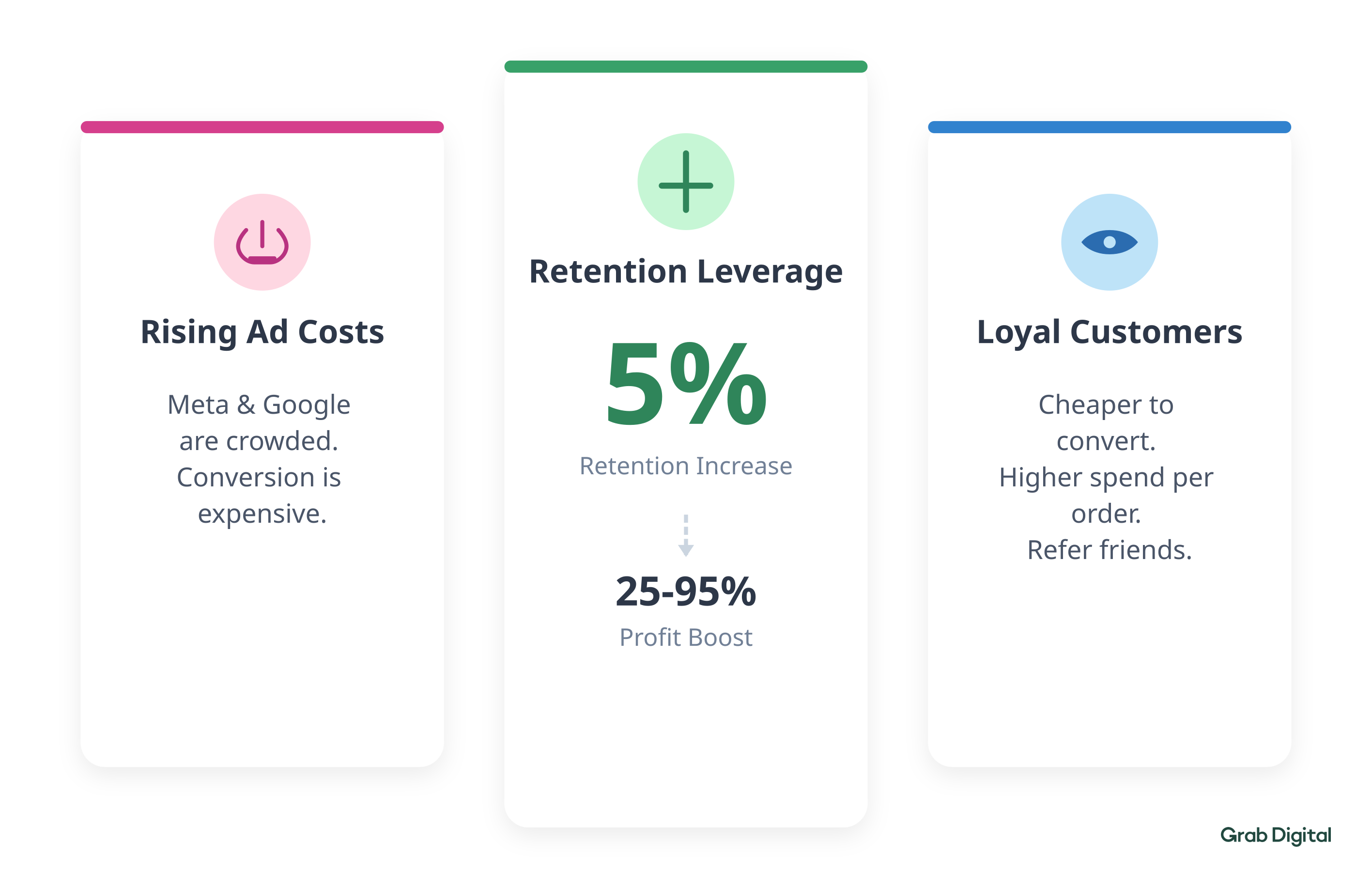
Loyalty marketing matters more now because paid acquisition has gotten more expensive and less reliable, while repeat customers remain cheaper to convert and higher-margin. Brands that don't build a retention system are stuck refilling the top of the funnel forever.
The economics of ecommerce have shifted. Meta ads are expensive and getting more so. Google Shopping is crowded. Customers are skeptical and less brand-loyal by default, and it's easier than ever for them to compare you against a competitor mid-checkout.
But the customers who do come back are valuable. A repeat customer typically costs less to convert on the next order, spends more per transaction, and is more likely to refer friends. Retention has consistently outperformed acquisition as a growth lever, which is why so many brands with mature email programs treat loyalty as core infrastructure rather than a discount widget.
Loyalty marketing isn't a "nice-to-have" anymore. It's a core revenue channel. For DTC brands doing $1M–$10M annually, it's one of the highest-leverage strategies you can invest in, especially when tied to email and SMS. If you're still deciding where email ranks against other channels in your budget, our breakdown on whether email is still the highest-ROI marketing channel in 2026 is a useful companion read. And if you're weighing loyalty against other services as you scale, our guide on choosing marketing services once you're past $1M puts it in context.
The brands winning in 2026 aren't just acquiring customers. They're building systems that turn first-time buyers into repeat buyers, and repeat buyers into advocates. That's where loyalty marketing solutions come in.
What does a modern loyalty program actually look like?
A modern loyalty program is dynamic, personalized, and wired directly into your email and SMS marketing rather than sitting as a static widget on your site. Forget the punch card. Here is what that means in practice.
Points-based rewards. Customers earn points for purchases, referrals, social shares, and email engagement. They redeem them for discounts, free products, or exclusive perks. The key is removing friction: if it takes more than two clicks to redeem, you've lost them.
Tiered memberships. VIP tiers give your best customers a reason to spend more. Bronze, Silver, Gold — whatever you call them — these tiers unlock perks like early access, free shipping, or bonus point multipliers. The psychology is simple: people want to level up, and a visible tier gives them a concrete reason to cross a spend threshold.
Exclusive experiences. Top-tier loyalty isn't just about discounts. It's about access: early product drops, members-only sales, behind-the-scenes content, or event invites. For DTC brands with strong identities, this is where loyalty becomes a competitive moat that a competitor's coupon code can't easily copy.
Referral rewards. Your best customers are your best marketers. A referral program baked into your loyalty system turns happy buyers into advocates. Give them a reason to share, not just permission to.
Birthday and anniversary perks. Personalized rewards create emotional touchpoints. A birthday discount or anniversary gift shows you're paying attention and drives repeat purchases at a moment when the customer is already thinking about themselves.
All of this can be automated and tied directly into Klaviyo. Your loyalty program shouldn't be a static widget on your site; it should be a living part of your email strategy.
If you're ready to build a loyalty system that drives revenue, book your free consultation.
How do you launch a loyalty program without wasting three months?
You launch a working loyalty program in weeks, not quarters, by sequencing four things in order: platform setup, Klaviyo sync, one clean earn-and-redeem structure, and a promotion plan — in that order, not all at once. Most delays come from brands trying to design the "perfect" tier structure before anything is live.
Here's a realistic launch sequence for a $1M–$10M DTC brand:
- Week 1 — Platform selection and setup. Pick a platform (see the comparison below), connect it to Shopify, and configure a single earn rate. Don't build three tiers yet. Get points earning and redeeming correctly first.
- Week 2 — Klaviyo integration. Sync points balance, tier status, and redemption history as Klaviyo profile properties. Test that a test purchase actually updates a test profile before you go live to real customers.
- Week 3 — Core flows. Build the welcome onboarding email, the post-purchase points confirmation, and one points-reminder flow. These three alone will drive most of your early redemptions.
- Week 4 — Promotion and launch. Announce the program via campaign, add it to your footer and homepage, and mention it in your next few post-purchase and browse-abandonment emails. Silence is the single biggest killer of new loyalty programs.
- Month two onward — Tiers, referrals, and win-back. Once the basics are running and you can see real redemption data, layer in tiers, referral mechanics, and win-back flows that reference points balance.
The mistake we see most often is brands spending six to eight weeks designing tier names, perk structures, and branded widget graphics before a single customer has earned a point. Ship the simple version, watch how customers actually behave, then add complexity. If you want a broader launch checklist for everything around loyalty too, our DTC email marketing checklist for 2026 is a useful companion.
How do you integrate loyalty marketing with email the right way?
You integrate loyalty with email by building it into the flows customers already open, not by treating it as a separate program. Most brands drop the ball here: they set up a loyalty program, maybe send a welcome email, and then stop. The program sits ignored while customers forget they have points.
A loyalty program only works if it's visible, valuable, and reinforced. That's where email comes in. Here are the flows that make loyalty a revenue driver instead of a forgotten feature:
Welcome series with loyalty onboarding. Your welcome series should introduce new subscribers to the loyalty program immediately. Explain how it works and how to start earning. Make it simple, ideally in one short email, not a wall of terms and conditions.
Post-purchase flows with points balance. After every purchase, send an email confirming the order and showing points earned. Remind them what they can do with those points. Give them a concrete reason to return before the item they just bought even arrives.
Points reminder campaigns. Set up a flow that triggers when points sit idle for 60 or 90 days. A simple "You've got 500 points, here's what you can get" email drives immediate redemptions and prevents point balances from becoming abandoned inventory.
Tier upgrade notifications. When a customer moves up a tier, celebrate it. Send a congratulatory email with their new perks spelled out clearly. Make them feel like they earned something, because they did.
Birthday and anniversary emails. Combine milestone emails with loyalty rewards. "Happy birthday — here's 200 bonus points and 15% off" is thoughtful and converts better than a generic discount blast.
Win-back flows with loyalty incentives. For lapsed customers, use points as a re-engagement hook. "You've got 300 points waiting, don't let them expire" is softer and more personal than a generic discount and taps into a sense of loss the customer already feels.
All of these flows can be built and tested in Klaviyo. When done right, they turn your loyalty program from a passive feature into an active revenue driver. For the full picture of which automations matter most beyond loyalty, see our post on the 8 core email flows every DTC brand needs.
Which loyalty platform is right for your DTC brand?
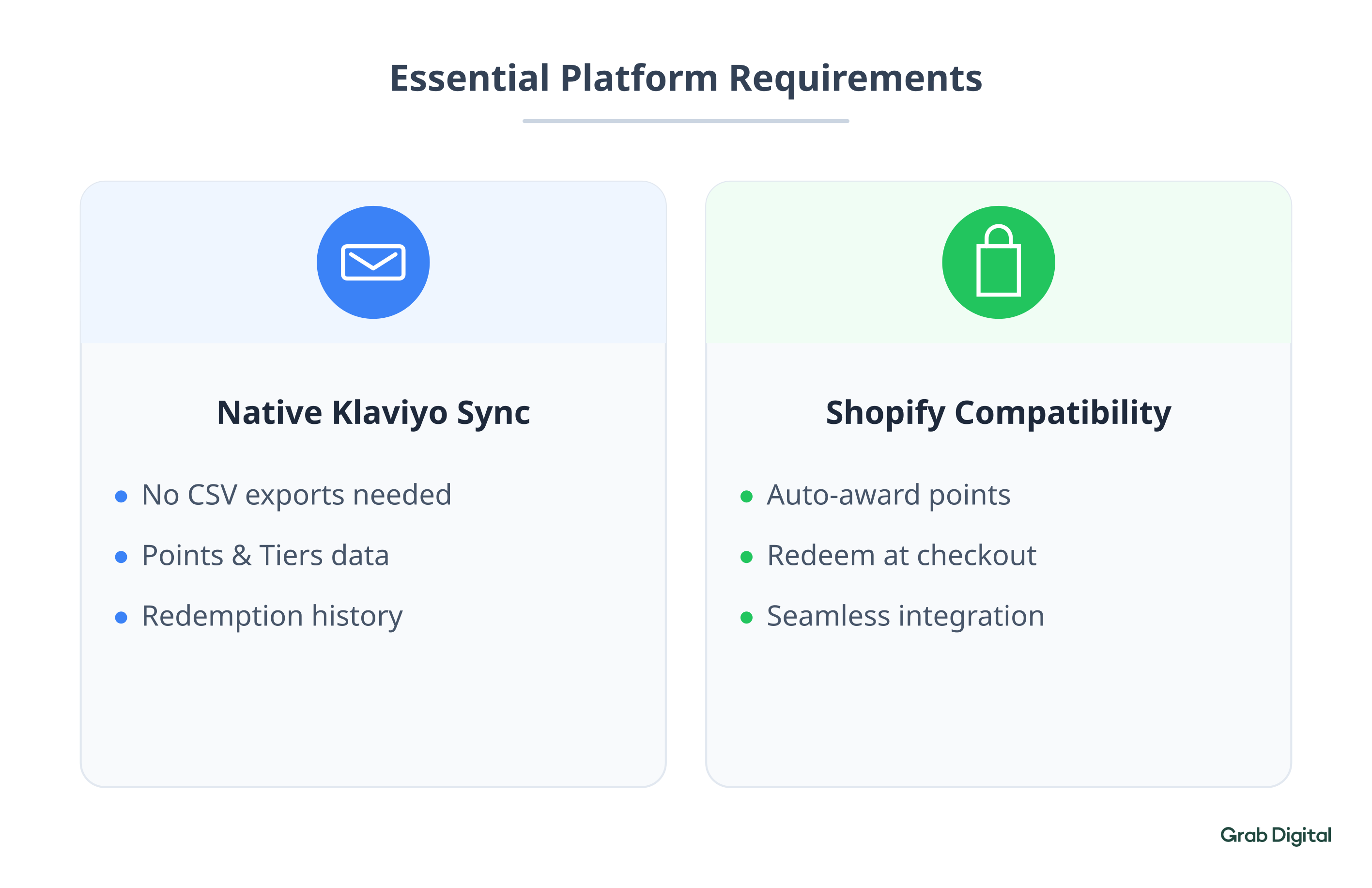
The right loyalty platform is the one that syncs cleanly with Klaviyo and Shopify, matches your brand's design and voice, and gives you real revenue attribution — not the one with the flashiest demo. Not all loyalty platforms are equal. Some are clunky. Some are expensive. Some look great in a sales call but break when you actually try to connect them to your email and checkout stack.
Here's what to check before you commit to a platform:
| What to check | Why it matters | What "good" looks like |
|---|---|---|
| Native Klaviyo integration | Non-negotiable for automation | Points, tier status, and redemption history sync as Klaviyo profile properties automatically |
| Shopify compatibility | Points and redemptions need to work at checkout | Points award automatically post-purchase; balance is visible without leaving your site |
| Customization options | Your program should read like your brand, not a template | Full control over widget copy, colors, and reward naming |
| Referral and social sharing | Referrals are some of the highest-ROI mechanics available | Built-in referral links and social-share triggers, not a bolt-on add-on |
| Analytics and reporting | You need to prove loyalty is driving revenue, not just issuing points | Redemption rate, repeat purchase rate, CLV by tier, and revenue attributed to loyalty members |
| Pricing structure | Costs usually scale with active members or order volume, not flat | A pricing page that lets you model cost at your current and projected member count, with no surprise fees for Klaviyo sync |
Popular options going into 2026 include Smile.io, Yotpo, LoyaltyLion, and Okendo. Each has strengths depending on your size, budget, and how much of your stack is already on Shopify and Klaviyo. Pricing tiers and feature sets change frequently enough — new AI-driven segmentation features, new referral tools, revised member caps — that it's worth pulling current plans directly from each vendor's pricing page before you commit rather than relying on a comparison written months earlier. If you're unsure where to start, we help clients evaluate and implement platforms as part of our done-for-you Klaviyo services.
Should you build a loyalty program or a subscription program first?
If your product is genuinely repurchasable — skincare, supplements, coffee, pet food — a subscription model will usually move retention faster than a points program alone, because it removes the decision to reorder entirely. Loyalty programs are the better first move for brands with more considered or occasional purchases, where the goal is to bring the customer back rather than automate the reorder.
The two aren't competitors, though. The most effective retention systems we build combine both: subscribers earn loyalty points on every recurring order, get a tier bump for staying subscribed past a certain number of cycles, and receive win-back offers that reference both their subscription status and their points balance. If subscriptions are relevant to your catalog, our guide to subscription email strategies for DTC brands in 2026 covers how to layer that on top of what's in this post.
A simple way to decide which to prioritize:
- Build subscription first if more than a third of your catalog is a true consumable and your reorder cycle is predictable.
- Build loyalty first if your average customer reorders on their own timeline, or your catalog is broad enough that "subscribe and save" doesn't map cleanly to one SKU.
- Build both, sequenced if you have the resourcing — loyalty as the retention layer for everyone, subscription as an accelerant for your consumable lines.
What does loyalty marketing actually do to repeat revenue?
Consider a hypothetical but representative skincare brand doing roughly $3M annually. They have 25,000 email subscribers, but only 15% of customers make a second purchase.
They implement a points-based loyalty program with three tiers: Glow, Radiant, and Luminous. Customers earn 1 point per dollar spent, and 100 points equals $10 off. Radiant tier unlocks free shipping. Luminous gets early access and bonus points.
They integrate with Klaviyo and set up a welcome series, post-purchase points notifications, tier upgrade emails, and win-back flows.
In a scenario like this, the typical pattern we see over the following months looks like:
- Repeat purchase rate climbs meaningfully off a low starting base
- Average order value for loyalty members runs noticeably higher than non-members
- A measurable share of loyalty members refer at least one friend
- Email-attributed revenue as a share of total revenue grows month over month
Now contrast that with a brand where loyalty underperforms: a considered-purchase brand — say, furniture or outdoor gear — where customers might buy once every year or two. Here, points redemption stays low simply because the natural repurchase window is long, and a tiered discount structure copied straight from a skincare brand won't fit. The fix isn't to abandon loyalty, it's to shift the reward mix toward referrals, reviews, and early access rather than "buy again soon" discount pressure, since that's the behavior you actually want from a customer who won't reorder for months.
That is loyalty marketing done right — matched to how often the customer actually buys. It's not just a program, it's a system that turns one-time buyers into long-term customers. See more examples on our portfolio page.
What are the most common loyalty marketing mistakes?
The most common mistakes are making the program too complicated, failing to promote it, and tracking vanity metrics instead of revenue. Here's how each one shows up in practice and what to do instead.
Making it too complicated. If customers can't figure out how to earn or redeem points in 10 seconds, the program fails. A program with six ways to earn points and three redemption tiers sounds generous but usually just confuses people into ignoring it. Keep it simple: one clear earn rate, one clear redemption path.
Not promoting the program. A loyalty program only works if people know about it. Promote it in your footer, homepage, post-purchase emails, and campaigns. If a customer has to dig through your account settings to discover they have points, you've already lost most of the value.
Ignoring low-engaged members. Not everyone will be a superfan, but don't ignore them. Use segmentation to target low-engaged members with campaigns designed to re-engage rather than just letting them sit in the "inactive" bucket.
Offering rewards that don't matter. If rewards aren't compelling, people won't care. A $5 discount on a $150 average order value doesn't move behavior. Test different reward types and ask customers directly what they'd actually redeem points for.
Not tracking the right metrics. "Total points issued" is a vanity metric. What matters is redemption rate, repeat purchase rate, CLV by tier, and revenue attributed to loyalty.
Which KPIs actually prove your loyalty program is working?
Four numbers tell you whether a loyalty program is paying for itself:
- Redemption rate — the percentage of earned points that get redeemed. A healthy program typically sees the majority of points redeemed within a year; a program where points pile up unredeemed usually means the rewards aren't compelling enough or aren't visible enough.
- Repeat purchase rate — the share of customers who buy a second time, ideally tracked separately for loyalty members versus non-members so you can see the lift the program is actually creating.
- CLV by tier — customer lifetime value broken out by loyalty tier. If your top tier isn't meaningfully outspending your entry tier, your tier perks aren't compelling enough to drive upgrades.
- Revenue attributed to loyalty — the share of total revenue that comes from loyalty members' purchases, tracked through Klaviyo alongside your other email-attributed revenue.
We help brands avoid these mistakes by building integrated, optimized programs from day one, and if your broader email program isn't pulling its weight either, our post on why DTC brands need a dedicated email agency for 30%+ revenue growth covers the same underlying problem from a different angle. For a wider set of current best practices, see our 2026 email marketing best practices for DTC brands, or check out our FAQ page.
How does loyalty marketing fit into your bigger email strategy?
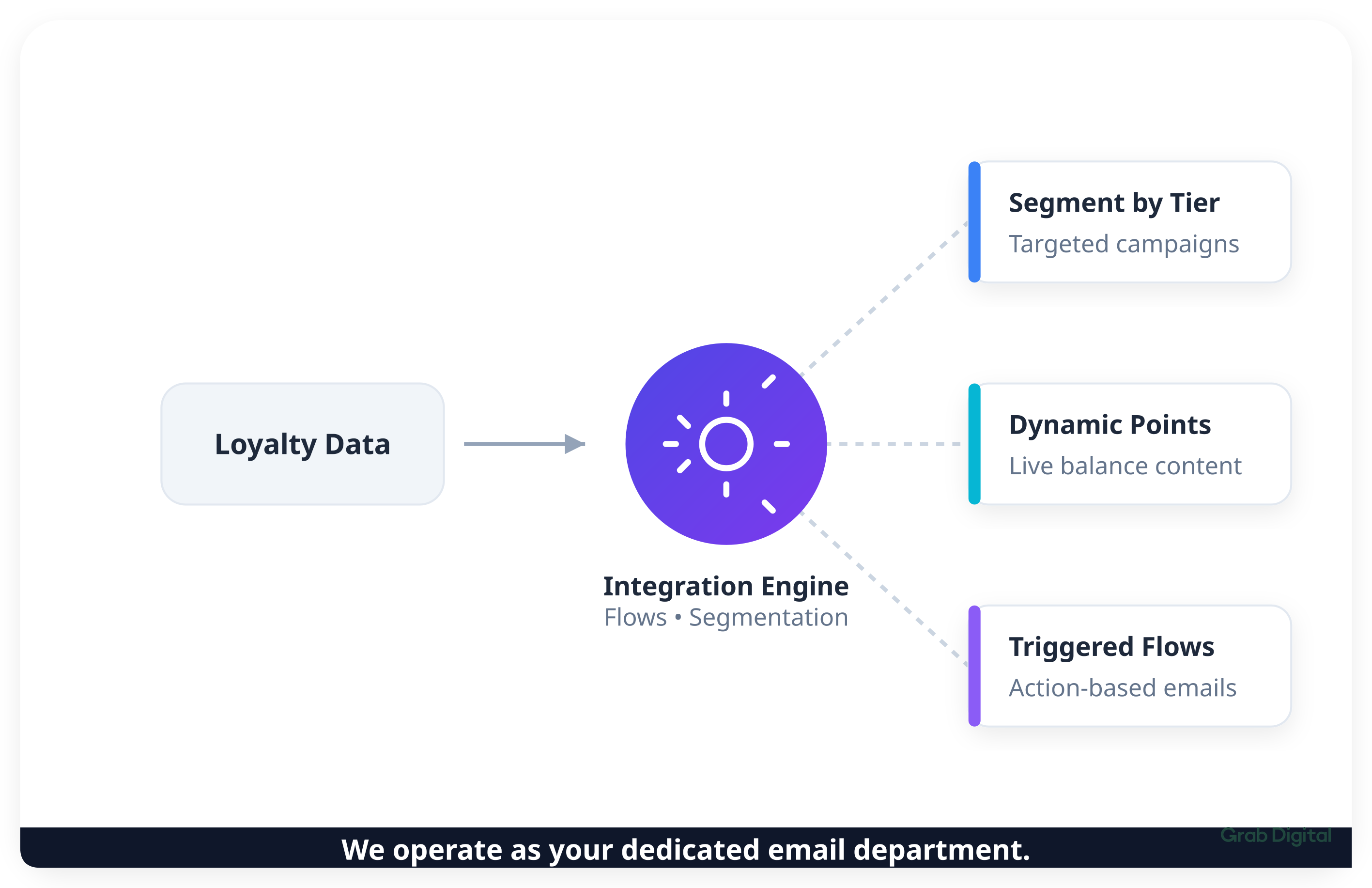
Loyalty marketing works best as one component of a broader retention engine, not a standalone tactic bolted onto your website. It's part of a system that includes flows, campaigns, segmentation, and personalization.
When loyalty is integrated with email, you can segment campaigns by tier, use points balance as dynamic content inside a template, trigger flows based on loyalty actions like a tier upgrade or an expiring points balance, and personalize product recommendations based on loyalty status.
Building and optimizing this integration takes time and expertise, and it only works if the rest of your email program — welcome series, abandoned cart, campaigns, segmentation — is already solid. For a broader view of where loyalty sits inside a full email strategy for the year, see our guide on email marketing strategies for DTC brands in 2026. If you don't have that expertise in-house, that's what we do. We operate as your dedicated email department. Learn more on our about page.
Is loyalty marketing worth it for a DTC brand in 2026?
Yes, if you're willing to treat it as an ongoing system rather than a one-time setup. Loyalty marketing isn't a quick win. It's an investment in customer relationships. When done right, it's one of the highest-ROI strategies you can implement, because it compounds: every new loyalty member you onboard well keeps paying back for years, not weeks.
In 2026, winning brands aren't just chasing new customers — they're building systems that turn customers into repeat buyers, and repeat buyers into advocates.
If your email program isn't driving a healthy share of revenue and you aren't using loyalty as a retention lever, you're missing an opportunity. With the right platform, flows, and strategy, loyalty can become one of your most profitable channels.
Frequently Asked Questions
What is loyalty marketing?
Loyalty marketing is the practice of rewarding customers for repeat behavior — purchases, referrals, reviews, social shares — to increase how often and how much they buy. In DTC, it works best when tied directly into email and SMS so points, tiers, and rewards are visible in every relevant message, not just on an account page.
What's the difference between a loyalty program and a referral program?
A loyalty program rewards customers for their own actions: purchases, reviews, social shares. A referral program rewards them for bringing in new buyers. Many platforms combine both, which is ideal for DTC brands that want both retention and acquisition from the same system.
How much does a loyalty program cost?
Platform costs vary by vendor and by how many active members you have, so it's worth getting current pricing directly from each platform rather than relying on a fixed number. Implementation and Klaviyo integration work adds to that, but the ROI is typically worth it if you already have an engaged customer base.
How long does it take to launch a loyalty program?
A basic, functioning program — platform connected, points syncing to Klaviyo, welcome and post-purchase flows live — can realistically launch in about four weeks. Tiers, referrals, and advanced win-back mechanics are best added after launch, once you have real redemption data to design around.
Can I run a loyalty program on Shopify?
Yes. Most modern platforms integrate natively with Shopify, making it easy to award points and manage redemptions at checkout. Klaviyo integration handles the email automation — welcome onboarding, points reminders, tier upgrades, and win-back flows.
What are the best loyalty platforms in 2026?
Smile.io, Yotpo, LoyaltyLion, and Okendo remain the most common choices for DTC brands on Shopify and Klaviyo. The "best" one depends on your catalog, budget, and how deeply you need referral and analytics features baked in rather than added on — compare current feature sets directly before deciding.
Does loyalty marketing work for brands with infrequent purchases?
It works differently, not less well. For brands where customers reorder rarely, shift reward weight toward referrals, reviews, and early access instead of discounts meant to speed up reorders, since that mirrors how those customers actually engage with the brand between purchases.
How do I know if my loyalty program is working?
Track repeat purchase rate, average order value by tier, redemption rate, and revenue attributed to loyalty members. If those metrics are trending up, it's working. If not, revisit your reward structure or how visible the program is in your emails before assuming the platform itself is the problem.
Should I offer discounts or experiences as rewards?
It depends on your brand. Discount-heavy brands can lean into tiered discounts and free shipping. Premium brands often see better results with exclusive experiences or early access, since a discount can undercut the premium positioning. Test both with a segment of your list before rolling out broadly.
Can Grab Digital help set up a loyalty program?
Yes. We help DTC brands choose, implement, and integrate loyalty platforms with Klaviyo. We build the flows and segmentation to make sure your program drives measurable revenue rather than sitting as an unused widget.
Loyalty programs used to be simple: buy ten coffees, get one free. Punch cards. Points. Maybe a birthday discount if the brand was feeling generous.
In 2026, that doesn't work. Not for DTC brands fighting rising acquisition costs and customers who have more options than they can scroll through in a lunch break.
What changed / last updated: loyalty platforms now ship with deeper native Klaviyo integrations out of the box, more brands are blending loyalty with subscription mechanics instead of treating them as separate programs, and "points for purchases" alone no longer moves repeat-purchase rate on its own. This update refreshes the platform landscape, expands the KPI and launch sections, and adds a step-by-step guide for brands starting from zero.
If you run a direct-to-consumer brand and aren't thinking strategically about loyalty, you're leaving money on the table. If your loyalty program isn't integrated with your email marketing, you're leaving relationships and revenue behind.
Here is what modern loyalty marketing actually involves, why it matters now, how to launch one without wasting a quarter, and how to build a system that drives purchases, not just rewards them.
Why does loyalty marketing matter more in 2026?
Loyalty marketing matters more now because paid acquisition has gotten more expensive and less reliable, while repeat customers remain cheaper to convert and higher-margin. Brands that don't build a retention system are stuck refilling the top of the funnel forever.
The economics of ecommerce have shifted. Meta ads are expensive and getting more so. Google Shopping is crowded. Customers are skeptical and less brand-loyal by default, and it's easier than ever for them to compare you against a competitor mid-checkout.
But the customers who do come back are valuable. A repeat customer typically costs less to convert on the next order, spends more per transaction, and is more likely to refer friends. Retention has consistently outperformed acquisition as a growth lever, which is why so many brands with mature email programs treat loyalty as core infrastructure rather than a discount widget.
Loyalty marketing isn't a "nice-to-have" anymore. It's a core revenue channel. For DTC brands doing $1M–$10M annually, it's one of the highest-leverage strategies you can invest in, especially when tied to email and SMS. If you're still deciding where email ranks against other channels in your budget, our breakdown on whether email is still the highest-ROI marketing channel in 2026 is a useful companion read. And if you're weighing loyalty against other services as you scale, our guide on choosing marketing services once you're past $1M puts it in context.
The brands winning in 2026 aren't just acquiring customers. They're building systems that turn first-time buyers into repeat buyers, and repeat buyers into advocates. That's where loyalty marketing solutions come in.
What does a modern loyalty program actually look like?
A modern loyalty program is dynamic, personalized, and wired directly into your email and SMS marketing rather than sitting as a static widget on your site. Forget the punch card. Here is what that means in practice.
Points-based rewards. Customers earn points for purchases, referrals, social shares, and email engagement. They redeem them for discounts, free products, or exclusive perks. The key is removing friction: if it takes more than two clicks to redeem, you've lost them.
Tiered memberships. VIP tiers give your best customers a reason to spend more. Bronze, Silver, Gold — whatever you call them — these tiers unlock perks like early access, free shipping, or bonus point multipliers. The psychology is simple: people want to level up, and a visible tier gives them a concrete reason to cross a spend threshold.
Exclusive experiences. Top-tier loyalty isn't just about discounts. It's about access: early product drops, members-only sales, behind-the-scenes content, or event invites. For DTC brands with strong identities, this is where loyalty becomes a competitive moat that a competitor's coupon code can't easily copy.
Referral rewards. Your best customers are your best marketers. A referral program baked into your loyalty system turns happy buyers into advocates. Give them a reason to share, not just permission to.
Birthday and anniversary perks. Personalized rewards create emotional touchpoints. A birthday discount or anniversary gift shows you're paying attention and drives repeat purchases at a moment when the customer is already thinking about themselves.
All of this can be automated and tied directly into Klaviyo. Your loyalty program shouldn't be a static widget on your site; it should be a living part of your email strategy.
If you're ready to build a loyalty system that drives revenue, book your free consultation.
How do you launch a loyalty program without wasting three months?
You launch a working loyalty program in weeks, not quarters, by sequencing four things in order: platform setup, Klaviyo sync, one clean earn-and-redeem structure, and a promotion plan — in that order, not all at once. Most delays come from brands trying to design the "perfect" tier structure before anything is live.
Here's a realistic launch sequence for a $1M–$10M DTC brand:
- Week 1 — Platform selection and setup. Pick a platform (see the comparison below), connect it to Shopify, and configure a single earn rate. Don't build three tiers yet. Get points earning and redeeming correctly first.
- Week 2 — Klaviyo integration. Sync points balance, tier status, and redemption history as Klaviyo profile properties. Test that a test purchase actually updates a test profile before you go live to real customers.
- Week 3 — Core flows. Build the welcome onboarding email, the post-purchase points confirmation, and one points-reminder flow. These three alone will drive most of your early redemptions.
- Week 4 — Promotion and launch. Announce the program via campaign, add it to your footer and homepage, and mention it in your next few post-purchase and browse-abandonment emails. Silence is the single biggest killer of new loyalty programs.
- Month two onward — Tiers, referrals, and win-back. Once the basics are running and you can see real redemption data, layer in tiers, referral mechanics, and win-back flows that reference points balance.
The mistake we see most often is brands spending six to eight weeks designing tier names, perk structures, and branded widget graphics before a single customer has earned a point. Ship the simple version, watch how customers actually behave, then add complexity. If you want a broader launch checklist for everything around loyalty too, our DTC email marketing checklist for 2026 is a useful companion.
How do you integrate loyalty marketing with email the right way?
You integrate loyalty with email by building it into the flows customers already open, not by treating it as a separate program. Most brands drop the ball here: they set up a loyalty program, maybe send a welcome email, and then stop. The program sits ignored while customers forget they have points.
A loyalty program only works if it's visible, valuable, and reinforced. That's where email comes in. Here are the flows that make loyalty a revenue driver instead of a forgotten feature:
Welcome series with loyalty onboarding. Your welcome series should introduce new subscribers to the loyalty program immediately. Explain how it works and how to start earning. Make it simple, ideally in one short email, not a wall of terms and conditions.
Post-purchase flows with points balance. After every purchase, send an email confirming the order and showing points earned. Remind them what they can do with those points. Give them a concrete reason to return before the item they just bought even arrives.
Points reminder campaigns. Set up a flow that triggers when points sit idle for 60 or 90 days. A simple "You've got 500 points, here's what you can get" email drives immediate redemptions and prevents point balances from becoming abandoned inventory.
Tier upgrade notifications. When a customer moves up a tier, celebrate it. Send a congratulatory email with their new perks spelled out clearly. Make them feel like they earned something, because they did.
Birthday and anniversary emails. Combine milestone emails with loyalty rewards. "Happy birthday — here's 200 bonus points and 15% off" is thoughtful and converts better than a generic discount blast.
Win-back flows with loyalty incentives. For lapsed customers, use points as a re-engagement hook. "You've got 300 points waiting, don't let them expire" is softer and more personal than a generic discount and taps into a sense of loss the customer already feels.
All of these flows can be built and tested in Klaviyo. When done right, they turn your loyalty program from a passive feature into an active revenue driver. For the full picture of which automations matter most beyond loyalty, see our post on the 8 core email flows every DTC brand needs.
Which loyalty platform is right for your DTC brand?
The right loyalty platform is the one that syncs cleanly with Klaviyo and Shopify, matches your brand's design and voice, and gives you real revenue attribution — not the one with the flashiest demo. Not all loyalty platforms are equal. Some are clunky. Some are expensive. Some look great in a sales call but break when you actually try to connect them to your email and checkout stack.
Here's what to check before you commit to a platform:
| What to check | Why it matters | What "good" looks like |
|---|---|---|
| Native Klaviyo integration | Non-negotiable for automation | Points, tier status, and redemption history sync as Klaviyo profile properties automatically |
| Shopify compatibility | Points and redemptions need to work at checkout | Points award automatically post-purchase; balance is visible without leaving your site |
| Customization options | Your program should read like your brand, not a template | Full control over widget copy, colors, and reward naming |
| Referral and social sharing | Referrals are some of the highest-ROI mechanics available | Built-in referral links and social-share triggers, not a bolt-on add-on |
| Analytics and reporting | You need to prove loyalty is driving revenue, not just issuing points | Redemption rate, repeat purchase rate, CLV by tier, and revenue attributed to loyalty members |
| Pricing structure | Costs usually scale with active members or order volume, not flat | A pricing page that lets you model cost at your current and projected member count, with no surprise fees for Klaviyo sync |
Popular options going into 2026 include Smile.io, Yotpo, LoyaltyLion, and Okendo. Each has strengths depending on your size, budget, and how much of your stack is already on Shopify and Klaviyo. Pricing tiers and feature sets change frequently enough — new AI-driven segmentation features, new referral tools, revised member caps — that it's worth pulling current plans directly from each vendor's pricing page before you commit rather than relying on a comparison written months earlier. If you're unsure where to start, we help clients evaluate and implement platforms as part of our done-for-you Klaviyo services.
Should you build a loyalty program or a subscription program first?
If your product is genuinely repurchasable — skincare, supplements, coffee, pet food — a subscription model will usually move retention faster than a points program alone, because it removes the decision to reorder entirely. Loyalty programs are the better first move for brands with more considered or occasional purchases, where the goal is to bring the customer back rather than automate the reorder.
The two aren't competitors, though. The most effective retention systems we build combine both: subscribers earn loyalty points on every recurring order, get a tier bump for staying subscribed past a certain number of cycles, and receive win-back offers that reference both their subscription status and their points balance. If subscriptions are relevant to your catalog, our guide to subscription email strategies for DTC brands in 2026 covers how to layer that on top of what's in this post.
A simple way to decide which to prioritize:
- Build subscription first if more than a third of your catalog is a true consumable and your reorder cycle is predictable.
- Build loyalty first if your average customer reorders on their own timeline, or your catalog is broad enough that "subscribe and save" doesn't map cleanly to one SKU.
- Build both, sequenced if you have the resourcing — loyalty as the retention layer for everyone, subscription as an accelerant for your consumable lines.
What does loyalty marketing actually do to repeat revenue?
Consider a hypothetical but representative skincare brand doing roughly $3M annually. They have 25,000 email subscribers, but only 15% of customers make a second purchase.
They implement a points-based loyalty program with three tiers: Glow, Radiant, and Luminous. Customers earn 1 point per dollar spent, and 100 points equals $10 off. Radiant tier unlocks free shipping. Luminous gets early access and bonus points.
They integrate with Klaviyo and set up a welcome series, post-purchase points notifications, tier upgrade emails, and win-back flows.
In a scenario like this, the typical pattern we see over the following months looks like:
- Repeat purchase rate climbs meaningfully off a low starting base
- Average order value for loyalty members runs noticeably higher than non-members
- A measurable share of loyalty members refer at least one friend
- Email-attributed revenue as a share of total revenue grows month over month
Now contrast that with a brand where loyalty underperforms: a considered-purchase brand — say, furniture or outdoor gear — where customers might buy once every year or two. Here, points redemption stays low simply because the natural repurchase window is long, and a tiered discount structure copied straight from a skincare brand won't fit. The fix isn't to abandon loyalty, it's to shift the reward mix toward referrals, reviews, and early access rather than "buy again soon" discount pressure, since that's the behavior you actually want from a customer who won't reorder for months.
That is loyalty marketing done right — matched to how often the customer actually buys. It's not just a program, it's a system that turns one-time buyers into long-term customers. See more examples on our portfolio page.
What are the most common loyalty marketing mistakes?
The most common mistakes are making the program too complicated, failing to promote it, and tracking vanity metrics instead of revenue. Here's how each one shows up in practice and what to do instead.
Making it too complicated. If customers can't figure out how to earn or redeem points in 10 seconds, the program fails. A program with six ways to earn points and three redemption tiers sounds generous but usually just confuses people into ignoring it. Keep it simple: one clear earn rate, one clear redemption path.
Not promoting the program. A loyalty program only works if people know about it. Promote it in your footer, homepage, post-purchase emails, and campaigns. If a customer has to dig through your account settings to discover they have points, you've already lost most of the value.
Ignoring low-engaged members. Not everyone will be a superfan, but don't ignore them. Use segmentation to target low-engaged members with campaigns designed to re-engage rather than just letting them sit in the "inactive" bucket.
Offering rewards that don't matter. If rewards aren't compelling, people won't care. A $5 discount on a $150 average order value doesn't move behavior. Test different reward types and ask customers directly what they'd actually redeem points for.
Not tracking the right metrics. "Total points issued" is a vanity metric. What matters is redemption rate, repeat purchase rate, CLV by tier, and revenue attributed to loyalty.
Which KPIs actually prove your loyalty program is working?
Four numbers tell you whether a loyalty program is paying for itself:
- Redemption rate — the percentage of earned points that get redeemed. A healthy program typically sees the majority of points redeemed within a year; a program where points pile up unredeemed usually means the rewards aren't compelling enough or aren't visible enough.
- Repeat purchase rate — the share of customers who buy a second time, ideally tracked separately for loyalty members versus non-members so you can see the lift the program is actually creating.
- CLV by tier — customer lifetime value broken out by loyalty tier. If your top tier isn't meaningfully outspending your entry tier, your tier perks aren't compelling enough to drive upgrades.
- Revenue attributed to loyalty — the share of total revenue that comes from loyalty members' purchases, tracked through Klaviyo alongside your other email-attributed revenue.
We help brands avoid these mistakes by building integrated, optimized programs from day one, and if your broader email program isn't pulling its weight either, our post on why DTC brands need a dedicated email agency for 30%+ revenue growth covers the same underlying problem from a different angle. For a wider set of current best practices, see our 2026 email marketing best practices for DTC brands, or check out our FAQ page.
How does loyalty marketing fit into your bigger email strategy?
Loyalty marketing works best as one component of a broader retention engine, not a standalone tactic bolted onto your website. It's part of a system that includes flows, campaigns, segmentation, and personalization.
When loyalty is integrated with email, you can segment campaigns by tier, use points balance as dynamic content inside a template, trigger flows based on loyalty actions like a tier upgrade or an expiring points balance, and personalize product recommendations based on loyalty status.
Building and optimizing this integration takes time and expertise, and it only works if the rest of your email program — welcome series, abandoned cart, campaigns, segmentation — is already solid. For a broader view of where loyalty sits inside a full email strategy for the year, see our guide on email marketing strategies for DTC brands in 2026. If you don't have that expertise in-house, that's what we do. We operate as your dedicated email department. Learn more on our about page.
Is loyalty marketing worth it for a DTC brand in 2026?
Yes, if you're willing to treat it as an ongoing system rather than a one-time setup. Loyalty marketing isn't a quick win. It's an investment in customer relationships. When done right, it's one of the highest-ROI strategies you can implement, because it compounds: every new loyalty member you onboard well keeps paying back for years, not weeks.
In 2026, winning brands aren't just chasing new customers — they're building systems that turn customers into repeat buyers, and repeat buyers into advocates.
If your email program isn't driving a healthy share of revenue and you aren't using loyalty as a retention lever, you're missing an opportunity. With the right platform, flows, and strategy, loyalty can become one of your most profitable channels.
Frequently Asked Questions
What is loyalty marketing?
Loyalty marketing is the practice of rewarding customers for repeat behavior — purchases, referrals, reviews, social shares — to increase how often and how much they buy. In DTC, it works best when tied directly into email and SMS so points, tiers, and rewards are visible in every relevant message, not just on an account page.
What's the difference between a loyalty program and a referral program?
A loyalty program rewards customers for their own actions: purchases, reviews, social shares. A referral program rewards them for bringing in new buyers. Many platforms combine both, which is ideal for DTC brands that want both retention and acquisition from the same system.
How much does a loyalty program cost?
Platform costs vary by vendor and by how many active members you have, so it's worth getting current pricing directly from each platform rather than relying on a fixed number. Implementation and Klaviyo integration work adds to that, but the ROI is typically worth it if you already have an engaged customer base.
How long does it take to launch a loyalty program?
A basic, functioning program — platform connected, points syncing to Klaviyo, welcome and post-purchase flows live — can realistically launch in about four weeks. Tiers, referrals, and advanced win-back mechanics are best added after launch, once you have real redemption data to design around.
Can I run a loyalty program on Shopify?
Yes. Most modern platforms integrate natively with Shopify, making it easy to award points and manage redemptions at checkout. Klaviyo integration handles the email automation — welcome onboarding, points reminders, tier upgrades, and win-back flows.
What are the best loyalty platforms in 2026?
Smile.io, Yotpo, LoyaltyLion, and Okendo remain the most common choices for DTC brands on Shopify and Klaviyo. The "best" one depends on your catalog, budget, and how deeply you need referral and analytics features baked in rather than added on — compare current feature sets directly before deciding.
Does loyalty marketing work for brands with infrequent purchases?
It works differently, not less well. For brands where customers reorder rarely, shift reward weight toward referrals, reviews, and early access instead of discounts meant to speed up reorders, since that mirrors how those customers actually engage with the brand between purchases.
How do I know if my loyalty program is working?
Track repeat purchase rate, average order value by tier, redemption rate, and revenue attributed to loyalty members. If those metrics are trending up, it's working. If not, revisit your reward structure or how visible the program is in your emails before assuming the platform itself is the problem.
Should I offer discounts or experiences as rewards?
It depends on your brand. Discount-heavy brands can lean into tiered discounts and free shipping. Premium brands often see better results with exclusive experiences or early access, since a discount can undercut the premium positioning. Test both with a segment of your list before rolling out broadly.
Can Grab Digital help set up a loyalty program?
Yes. We help DTC brands choose, implement, and integrate loyalty platforms with Klaviyo. We build the flows and segmentation to make sure your program drives measurable revenue rather than sitting as an unused widget.

Find out exactly what your email channel is leaving on the table.

Email Marketing for Scaling DTC Brands


