
Summary
Subscription Email Strategy for DTC Brands: 2026 Guide
Subscription Email Strategy for DTC Brands: 2026 Guide
The subscription email strategy that actually protects revenue in 2026 isn't a bigger send calendar, it's a set of lifecycle flows built around when subscribers are most likely to churn: sign-up, renewal, and the first sign of disengagement. Acquisition gets the glory and the budget, but retention is where the money is. With customer acquisition costs still climbing, you can't afford to keep losing subscribers you already paid to acquire.
If you're running a DTC subscription brand on Shopify or ReCharge and sending through Klaviyo, you already have the tools. The real question is whether you're using them strategically, or just blasting the same "your order ships tomorrow" email to everyone on the list.
What changed: this guide was refreshed in October 2026. We tightened the flow timing recommendations, replaced vague benchmarks with clearer ranges, added a new section on price-increase communication (one of the top reasons subscribers cancel in a single week when it's handled badly), and expanded the deliverability guidance to reflect how much more exposed subscription senders are to reputation problems. The core flow structure below is the same approach we build for clients, just sharpened.
Let's walk through what actually works in subscription email marketing right now, from onboarding sequences that reduce first-order churn to win-back flows that reactivate canceled subscribers before they forget you exist.
Why Subscription Brands Need a Different Email Strategy
Most DTC brands treat email like a megaphone: new products, sales, restocks. That works fine for one-off purchases. Subscriptions are different, because your customer isn't buying a product once, they're entering a recurring relationship, and that relationship needs timing and personalization built around real events, not a promo calendar.
Here's what makes subscription email different:
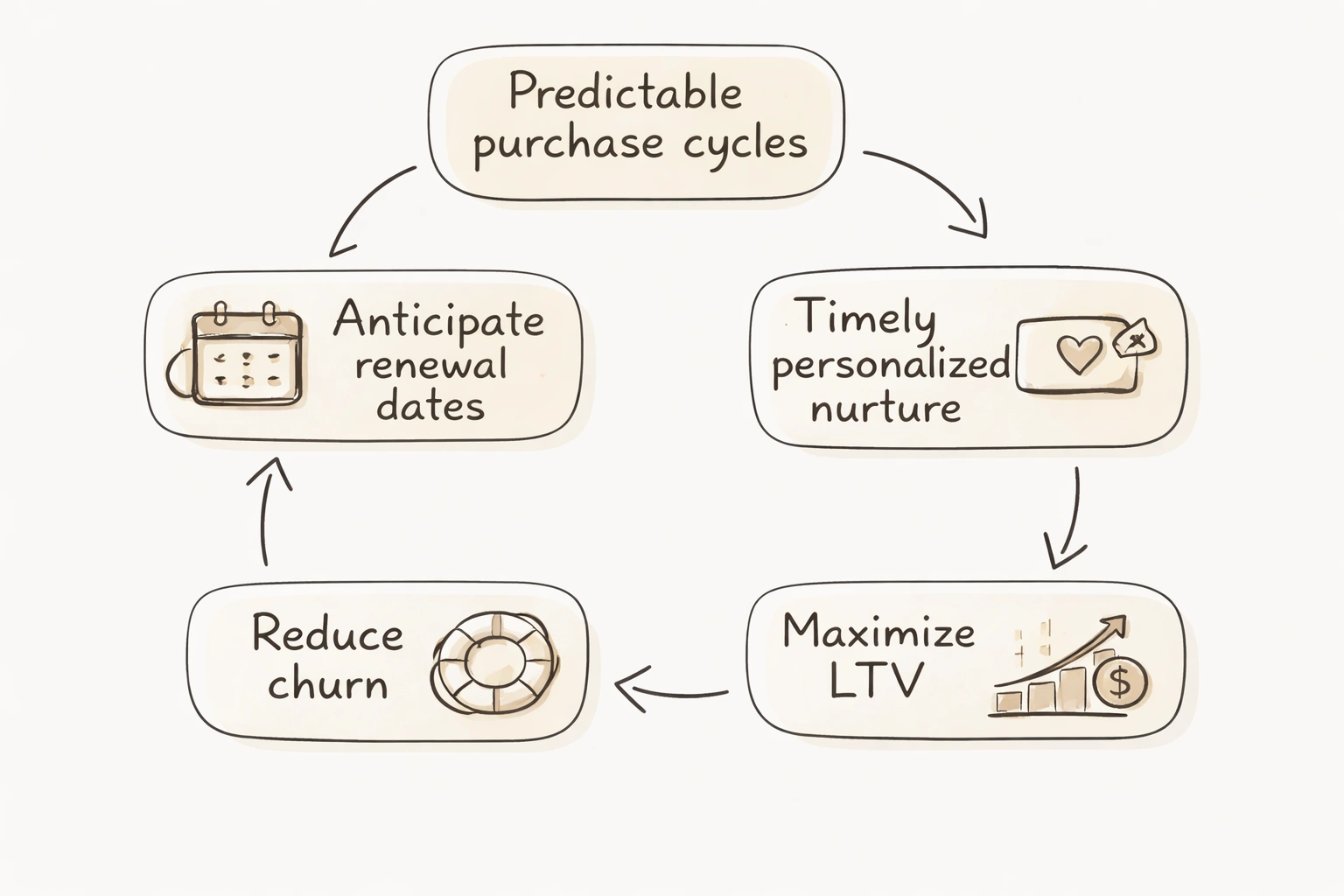
- Predictable purchase cycles. You know exactly when someone's next order ships, when their subscription renews, and roughly when they're most likely to cancel.
- Churn costs you months of LTV. Losing a subscriber doesn't just cost you one sale, it costs you every renewal that subscriber would have made.
- Engagement predicts retention. Subscribers who open and click your emails cancel less often. That correlation holds across most subscription accounts we've reviewed.
- You're managing expectations constantly. Shipping delays, billing issues, product substitutions: every friction point is a chance to lose a customer unless you communicate proactively.
Your email strategy can't be "send more campaigns." It needs to be built around the subscriber lifecycle: onboarding, engagement, retention, reactivation. Every message should have one job. For a wider view of how this lifecycle thinking applies across all of DTC email, not just subscriptions, see our guide to mastering email marketing for DTC brands.
What Email Flows Does a Subscription Brand Actually Need?
A subscription brand needs six lifecycle flows: welcome, pre-renewal reminder, engagement/education, churn prevention, cancellation, and win-back. If you're not running these, or they're stock templates you installed and haven't touched in a year, you're leaving retention revenue on the table. For a broader list of the flows every DTC brand should have running regardless of business model, see the 8 core email flows every DTC brand needs.
| Flow | Trigger | Length | Primary goal |
|---|---|---|---|
| Welcome series | New subscription sign-up | 3-4 emails, 7 days | Reduce first-order churn |
| Pre-renewal reminder | 3-5 days before billing | 1 email | Cut refunds and surprise cancellations |
| Engagement/education | Ongoing, monthly or bi-weekly | Recurring | Keep the brand top of mind |
| Churn prevention | Disengagement signal detected | 3 emails, 14 days | Re-engage before cancel intent |
| Cancellation flow | Cancel button clicked | 3 emails, 7 days | Save the subscription or gather feedback |
| Win-back | Subscription canceled | 3 emails, 60-90 days | Reactivate |
1. Subscription Welcome Series
This isn't a regular welcome series. A new subscriber just committed to recurring billing, which is a bigger leap than a one-time purchase and comes with more anxiety about being charged again without noticing. Your welcome series needs to:
- Reinforce the value of the subscription (remind them why they signed up)
- Set clear expectations (when orders ship, how to skip or cancel, what to expect)
- Provide immediate value (tips, recipes, how-tos related to the product)
- Build trust (brand story, reviews, social proof)
Send at least three or four emails in the first seven days:
- Immediately after sign-up: confirm the subscription, set the billing date in plain language, and link directly to account management so they never have to search for it.
- Two to three days later: educational or lifestyle content tied to the product. If they subscribed to a coffee plan, this is a brewing guide, not a discount code.
- Four to five days later (optional for higher-ticket or more complex products): social proof. A short review or UGC clip works better here than a brand-written testimonial.
- Just before the first order ships: reinforce excitement and address common concerns head-on, specifically billing dates, how to skip, and how to cancel. Burying the cancel process doesn't reduce churn, it just moves the cancellation to a support ticket or a chargeback instead of a clean self-serve flow.
Brands that skip the fourth email see more "I forgot I was subscribed" disputes at the first charge than at any later renewal, so it's worth the extra send even though it feels redundant internally.
2. Pre-Renewal and Upcoming Order Reminders
Most subscription platforms send a generic "your order is processing" email. That's not enough. Reach subscribers before they're charged, giving them a chance to customize, skip, or add products. This single change reduces refund requests and last-minute cancellations more reliably than almost any other flow on this list.
Send a reminder three to five days before the next billing cycle. Include:
- A clear summary of what's coming and when
- One-click options to skip, swap, or modify
- Upsell opportunities (add-ons, upgrades, bundles)
- A reassurance that they're in control
This email should feel like a helpful nudge, not a hard sell. If you're looking to rebuild your entire email strategy around retention and lifecycle marketing, book your free consultation to see where the biggest gaps are.
3. Engagement and Education Series
Subscribers who don't engage with your emails cancel more often, so ongoing education matters as a retention tool, not just a content nice-to-have. This isn't about pushing sales, it's about deepening the relationship between renewal dates.
Send a monthly or bi-weekly email that provides value. A simple four-week rotation that works well for most subscription brands looks like this:
- Week 1: a how-to or tip that helps them get more out of the product they already have.
- Week 2: a customer story or testimonial, ideally tied to a specific use case rather than a generic quote.
- Week 3: behind-the-scenes content: sourcing, production, or a team update that builds brand affinity.
- Week 4: a soft product nudge, an add-on, upgrade, or seasonal variant, framed as a suggestion rather than a sale.
These should read like content, not marketing. If a subscriber only ever gets emails asking them to buy, they'll tune out well before they ever click cancel. If you're mapping out a full send calendar for the year, our DTC email marketing checklist covers how to structure this alongside your promotional campaigns.
4. Churn Prevention Flow (At-Risk Subscriber)
This is one of the most underused flows in subscription marketing, and it's the one with the highest leverage. You can predict churn before it happens by tracking engagement signals: email opens, site visits, login activity, skipped orders. When someone shows signs of disengagement, say no opens in 30 days or two consecutive skipped orders, trigger a flow designed to re-engage them before they reach the cancel button.
Here's a simple three-email sequence, with what each email should actually say:
Email 1 (Day 0): Check in. "We noticed you haven't opened our emails in a while, everything okay?" Offer help or a chance to customize their subscription. Keep the tone human, this is not the email to lead with a discount.
Email 2 (Day 7): Provide value. Share a testimonial, case study, or tip that reminds them why the product matters. If they skipped an order rather than going fully dark, acknowledge that directly: "Looks like you skipped your last box, here's how to adjust your plan instead of pausing entirely."
Email 3 (Day 14): Offer an incentive. A discount on their next order, a free add-on, or the option to pause instead of cancel. This is the only email in the sequence where a discount belongs, lead with it too early and you train subscribers to go quiet on purpose to earn one.
This flow won't save every subscriber. But it will save some, and those saves add up fast when you're running them across your entire at-risk segment every month rather than reacting one cancellation at a time.
5. Cancellation Flow (Exit Intent)
When someone clicks "cancel," don't just let them go. Trigger a flow that tries to save the subscription or at least gathers feedback. This works in Klaviyo as long as your subscription platform, such as ReCharge, sends a cancellation event you can build the flow on.
Email 1 (Immediately): Offer an alternative. "Before you go, would pausing for a month work better?" or "How about 20% off your next order?"
Email 2 (2 days later): Ask why. A short survey or open-ended question. The answers are genuinely useful for improving your product and positioning, not just for the flow itself.
Email 3 (7 days later): Leave the door open. "We'd love to have you back whenever you're ready, here's a discount if you reactivate soon."
Even if they don't reactivate immediately, you've planted a seed and shown you care about their experience, which builds long-term brand equity. Whether that's worth the effort depends on your margins, but for most subscription brands, it is.
6. Win-Back Flow (Cancelled Subscribers)
Once someone cancels, they move into a win-back sequence. Run this for 60 to 90 days and vary the messaging as it goes:
Email 1 (14 days post-cancel): "We miss you." Simple, human, no hard sell.
Email 2 (30 days post-cancel): Highlight what's new: products, features, brand updates.
Email 3 (60 days post-cancel): Offer a compelling incentive. A discount, free shipping, or a bonus gift with reactivation.
Track performance, and if someone engages with one of these emails, consider triggering an additional email or SMS to close the loop. A reactivated subscriber is also a good candidate for a loyalty or rewards tier once they're back; see our guide on loyalty marketing for DTC brands for how to layer that on top of your win-back flow.
How Do You Email Subscribers About a Price Increase Without Spiking Cancellations?
You announce a price increase early, explain the reason in one sentence, and give subscribers a way to lock in the old price or adjust their plan before the change hits. Subscription brands lose more subscribers to badly handled price-increase emails than to almost any other single message, and it's almost always a timing or tone problem, not the increase itself.
A sequence that minimizes cancellations usually looks like this:
- 21-30 days before the change: send a dedicated email, not a line item buried in a newsletter. State the new price, the effective date, and a brief, honest reason (ingredient costs, shipping, product improvements). One sentence is enough, a paragraph of justification reads as defensive.
- 7-10 days before the change: a reminder to anyone who hasn't opened the first email, with a clear action: "lock in your current price if you renew before [date]" or "adjust your plan size to offset the increase."
- On the effective date: a short confirmation email, not a surprise charge. Even subscribers who read the first two emails appreciate seeing the new amount reflected clearly on the actual billing notice.
A few things that make this worse if you get them wrong: announcing the increase in the same email as a renewal reminder, using vague language like "due to rising costs" without any specific framing, and failing to offer any alternative (switching to a smaller size, skipping a cycle, locking in a legacy rate for existing subscribers). Give people a lever to pull and most will pull it instead of canceling.
What's the Best Way to Segment Subscription Email Lists?
The best way to segment a subscription list is by tenure, engagement, order cadence, and product, not just active-versus-canceled. Basic segmentation misses the subscribers who are technically active but already disengaging, which is exactly the group your churn-prevention flow needs to catch.
| Segment type | Example groups | Why it matters |
|---|---|---|
| Tenure | 0-3 months, 3-12 months, 12+ months | New subscribers need reassurance, long-term subscribers need appreciation |
| Engagement | Highly engaged, moderately engaged, at-risk (no engagement in 30+ days) | Determines whether they get a campaign or a churn-prevention flow |
| Order frequency | Monthly, quarterly, custom cadence | Message timing should match their rhythm, not yours |
| Product preference | By SKU, plan, or category | Lets you cross-sell relevant add-ons instead of guessing |
| Churn risk score | Low, medium, high risk | Prioritizes who gets manual attention versus automated flows |
These segments let you send the right message to the right person at the right time, which is where retention actually happens. To see how this fits into a full-account audit, check out our services page.
How Should Subscription Brands Balance Flows and Campaigns?
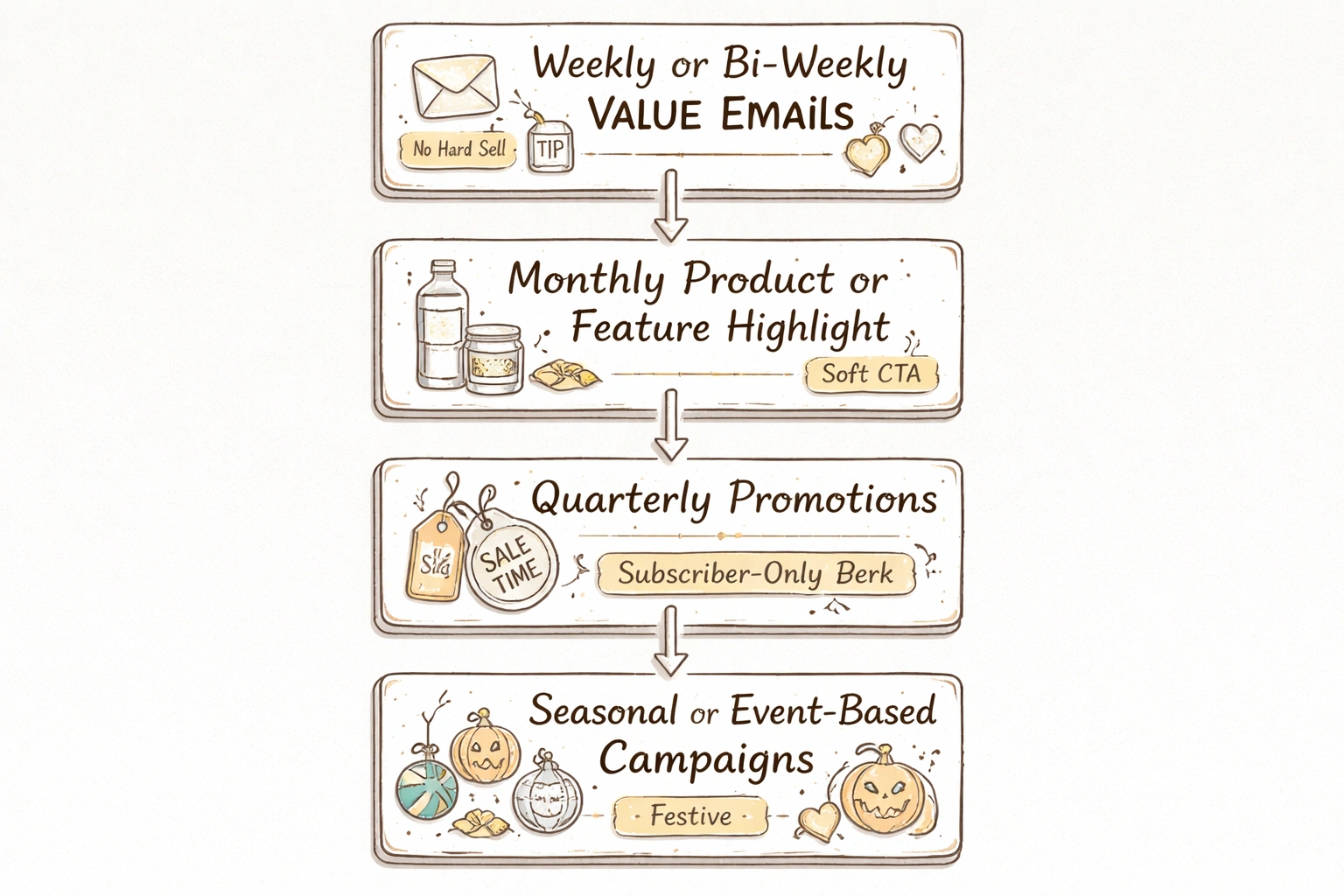
Flows handle the lifecycle. Campaigns handle everything else: launches, promotions, content, engagement. Too many promotional emails train subscribers to ignore you. Not enough, and you miss opportunities to upsell. A balanced calendar looks like this:
- Weekly or bi-weekly value emails: Tips, stories, how-tos. No hard sell.
- Monthly product or feature highlight: Spotlight a product, ingredient, or benefit. Educational tone, soft CTA.
- Quarterly promotions: Sales, limited-time offers, subscriber-only perks. Use sparingly.
- Seasonal or event-based campaigns: Holidays, brand milestones, cultural moments that align with your brand.
Always segment before you send a campaign. Don't send a "reactivate your subscription" offer to active subscribers, and don't upsell a product they already have. Relevance is the difference between a campaign that adds revenue and one that quietly increases unsubscribes. If you're building this calendar in Klaviyo on top of Shopify, our guide to Klaviyo's native Shopify integration covers the data syncing that makes this kind of segmentation possible in the first place.
Which KPIs Actually Matter for Subscription Email in 2026?
For subscription brands, the KPIs that matter are churn rate, email-attributed revenue share, and win-back conversion, not open rate. Open rate tells you almost nothing about whether a subscriber is about to cancel. Here's what to track and what a healthy range typically looks like:
| Metric | What it tells you | Healthy range |
|---|---|---|
| Monthly churn rate | Percentage of subscribers who cancel each month | Below 8-10%; above that, something's wrong |
| Retention by cohort | How long subscribers stay based on sign-up month | Improving over time, not flat or declining |
| Email-attributed revenue share | Percentage of total revenue email is responsible for | 25-35% for a mature subscription program |
| Win-back conversion rate | Percentage of canceled subscribers who reactivate | Varies by industry, track your own trend |
| Subscriber AOV vs. one-time buyer AOV | Whether your upsell strategy is working | Subscriber AOV should be equal to or higher |
If you're not hitting at least a quarter of total revenue from email, there's room to improve. For a broader view of where email fits against other channels, see whether email is still the highest-ROI marketing channel. For help auditing your own numbers, explore our consultation options.
How Much Personalization Does Subscription Email Actually Need?
Subscription email needs enough personalization that a long-term subscriber and a brand-new one never see the identical message. Static, one-size-fits-all emails read as impersonal to someone who's been paying you monthly for a year. Klaviyo makes this manageable with dynamic blocks, conditional logic, and native Shopify data. Here's how to use it without overbuilding:
- Product recommendations based on subscription type: If they subscribe to coffee, recommend grinders, mugs, or brewing guides, not an unrelated bestseller.
- Personalized subject lines: First name, product name, or membership tier, used sparingly so it doesn't feel automated.
- Dynamic content blocks: Show different messaging to new versus long-term subscribers inside the same campaign send, rather than building two full campaigns.
- Behavioral triggers: If someone visits your site but doesn't log in, send a reminder tied to that specific action, not a generic nudge.
Start with two or three of these rather than trying to personalize everything at once. The more relevant your emails feel without feeling watched, the more likely subscribers are to engage instead of tuning out.
How Does Deliverability Affect Subscription Email Performance?
Deliverability matters more for subscription brands than for typical DTC senders because you're emailing the same list far more frequently, which means a reputation problem compounds faster. If your welcome series, renewal reminders, and win-back flow are all landing in spam or promotions tabs, none of the strategy above matters.
A few things worth checking specifically for subscription programs:
- Sunset your disengaged segment. Subscribers who haven't opened anything in 60-90 days and aren't responding to churn-prevention flows should be suppressed from regular sends, not kept on the list "just in case." Continuing to email unengaged addresses drags down your sender reputation for everyone else.
- Watch send frequency spikes. A pre-renewal reminder landing the same week as a promotional campaign and a win-back email can push a normally engaged subscriber into spam-report territory.
- Authenticate properly. SPF, DKIM, and DMARC should be set up correctly before you scale send volume, not after deliverability starts slipping. Gmail and Yahoo's bulk sender requirements have made this non-negotiable for any list over a few thousand subscribers, not just an advanced-user checklist item anymore.
For a full checklist, see our guide on email deliverability essentials for DTC brands.
What Mistakes Do Subscription Brands Make with Email?
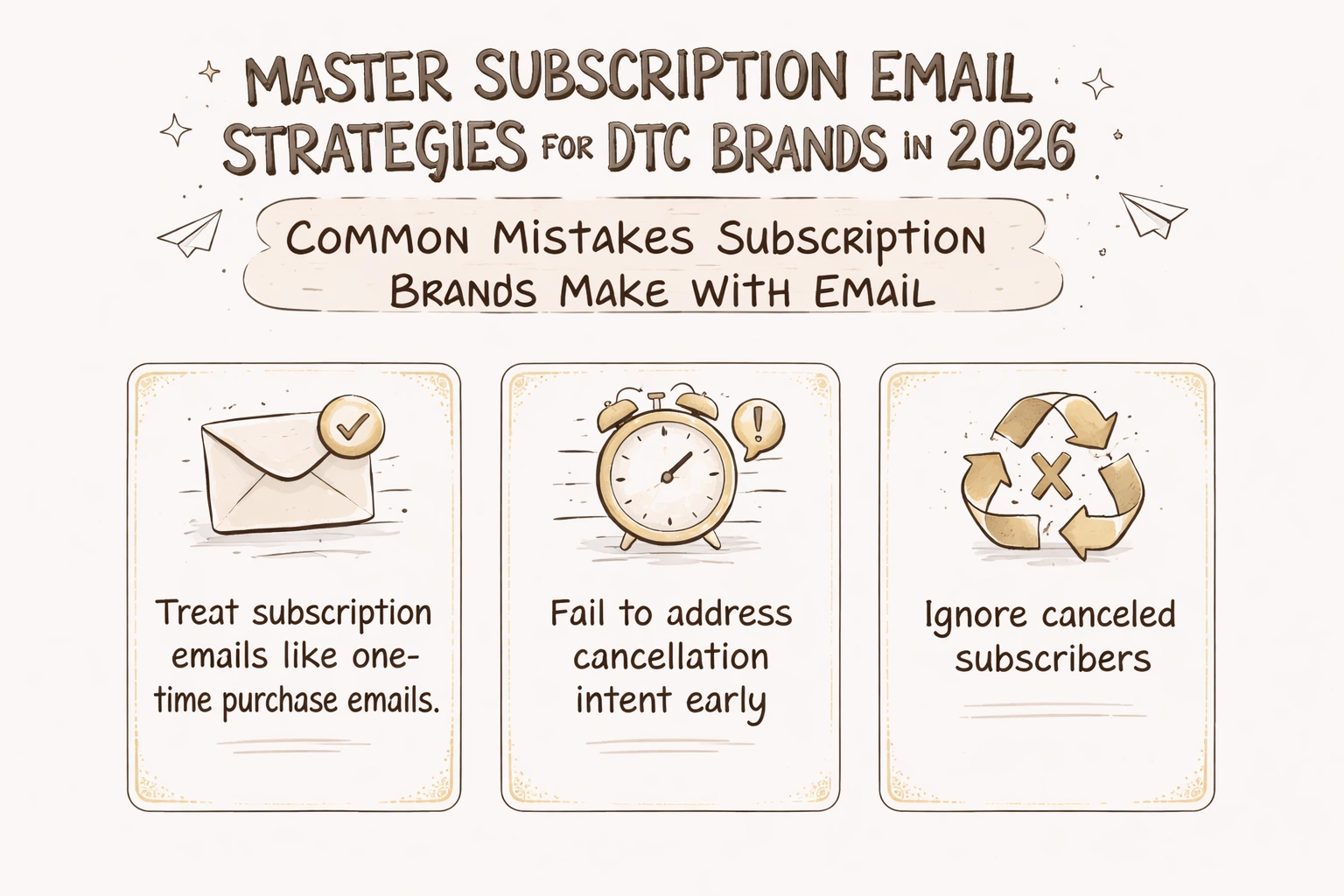
The most common mistake is treating subscription emails like one-time purchase emails. Beyond that, here's what shows up most often in accounts we review:
- Copy-pasting standard flows. The messaging, timing, and goals of subscription emails are different from one-time purchase flows. They need their own build.
- Not addressing cancellation intent proactively. By the time someone clicks "cancel," it's often too late. Intervene with a churn-prevention flow earlier.
- Ignoring canceled subscribers. Your win-back list is one of your most valuable segments. These people already know your product, and reactivating them is cheaper than acquiring new customers.
- Over-promoting and under-educating. Subscription brands need to build habits, and that requires content, not just offers.
- Skipping segmentation. Sending the same message to everyone undoes most of the value the flows above are designed to create.
- Mishandling price increases. Announcing a price change without warning or without an alternative is one of the fastest ways to spike cancellations in a single week.
If these sound familiar, it's worth revisiting your setup. Working with a team that has audited how DTC brands choose the right Klaviyo agency can help you compare your current program against what a well-run one actually looks like before you decide what to fix first.
Is Retention Really the New Growth for Subscription Brands?
Subscription brands that win in 2026 won't have the flashiest ads or the biggest influencer budgets. They'll be the ones that keep subscribers engaged, reduce churn, and maximize lifetime value. Email is one of the most effective tools for that, but only if you use it strategically rather than as a promotional megaphone.
Build flows around the subscriber lifecycle. Segment relentlessly. Personalize where it counts. Protect your deliverability. Handle price changes transparently. Measure churn and revenue share, not open rate. Treat email like the retention engine it actually is.
Frequently Asked Questions
Q: How often should I email my active subscribers?
A: Two to four emails per month is a reasonable baseline, mixing educational content, lifecycle emails, and occasional promotions. Watch your engagement and churn metrics after each send and adjust frequency up or down based on how the list responds.
Q: What's the best way to reduce churn for subscription brands?
A: Proactive communication. Use pre-renewal reminders, engagement emails, and at-risk subscriber flows to intervene before someone cancels. Make pausing or skipping easy too, it's a far better outcome than losing the subscriber entirely.
Q: Should I offer discounts to prevent cancellations?
A: Use discounts strategically, inside your cancellation or churn-prevention flows, not as your opening move. Lead with value-based messaging and save the discount for the final touchpoint, when someone's already decided to leave.
Q: How do I segment subscribers by churn risk?
A: Track engagement signals: email opens, clicks, login activity, skipped orders. Build a segment for anyone with no engagement in 30+ days or two or more consecutive skipped orders, then trigger your churn-prevention flow for that specific group.
Q: What's a good email-attributed revenue target for subscription brands?
A: Aim for 25-35% of total revenue attributed to email. Below 20% usually means gaps in your flows, segmentation, or campaign cadence rather than a product or list-quality problem.
Q: Can I use the same welcome series for subscription and one-time buyers?
A: No. Subscription buyers need a welcome series that reinforces their decision, sets billing expectations, and reduces first-order churn. One-time buyers need a series focused on conversion and product education instead.
Q: Does deliverability really matter more for subscription brands than other DTC brands?
A: Yes. You're emailing the same list more often, so a reputation problem shows up faster. Suppress disengaged subscribers, watch for send-frequency spikes across overlapping flows, and confirm SPF, DKIM, and DMARC are set up correctly.
Q: How far in advance should I tell subscribers about a price increase?
A: Send the first notice 21 to 30 days before the change takes effect, followed by a reminder about a week before. Give subscribers a concrete alternative, like locking in the current price by a deadline or adjusting plan size, rather than just announcing the new amount.
Q: Does subscription email frequency need to change over a subscriber's lifecycle?
A: Yes. New subscribers need more frequent, reassurance-focused emails in the first week. Established subscribers need less frequent, more content-driven sends. At-risk subscribers need a tighter, shorter sequence focused on re-engagement rather than general campaigns.
Subscription Email Strategy for DTC Brands: 2026 Guide
The subscription email strategy that actually protects revenue in 2026 isn't a bigger send calendar, it's a set of lifecycle flows built around when subscribers are most likely to churn: sign-up, renewal, and the first sign of disengagement. Acquisition gets the glory and the budget, but retention is where the money is. With customer acquisition costs still climbing, you can't afford to keep losing subscribers you already paid to acquire.
If you're running a DTC subscription brand on Shopify or ReCharge and sending through Klaviyo, you already have the tools. The real question is whether you're using them strategically, or just blasting the same "your order ships tomorrow" email to everyone on the list.
What changed: this guide was refreshed in October 2026. We tightened the flow timing recommendations, replaced vague benchmarks with clearer ranges, added a new section on price-increase communication (one of the top reasons subscribers cancel in a single week when it's handled badly), and expanded the deliverability guidance to reflect how much more exposed subscription senders are to reputation problems. The core flow structure below is the same approach we build for clients, just sharpened.
Let's walk through what actually works in subscription email marketing right now, from onboarding sequences that reduce first-order churn to win-back flows that reactivate canceled subscribers before they forget you exist.
Why Subscription Brands Need a Different Email Strategy
Most DTC brands treat email like a megaphone: new products, sales, restocks. That works fine for one-off purchases. Subscriptions are different, because your customer isn't buying a product once, they're entering a recurring relationship, and that relationship needs timing and personalization built around real events, not a promo calendar.
Here's what makes subscription email different:
- Predictable purchase cycles. You know exactly when someone's next order ships, when their subscription renews, and roughly when they're most likely to cancel.
- Churn costs you months of LTV. Losing a subscriber doesn't just cost you one sale, it costs you every renewal that subscriber would have made.
- Engagement predicts retention. Subscribers who open and click your emails cancel less often. That correlation holds across most subscription accounts we've reviewed.
- You're managing expectations constantly. Shipping delays, billing issues, product substitutions: every friction point is a chance to lose a customer unless you communicate proactively.
Your email strategy can't be "send more campaigns." It needs to be built around the subscriber lifecycle: onboarding, engagement, retention, reactivation. Every message should have one job. For a wider view of how this lifecycle thinking applies across all of DTC email, not just subscriptions, see our guide to mastering email marketing for DTC brands.
What Email Flows Does a Subscription Brand Actually Need?
A subscription brand needs six lifecycle flows: welcome, pre-renewal reminder, engagement/education, churn prevention, cancellation, and win-back. If you're not running these, or they're stock templates you installed and haven't touched in a year, you're leaving retention revenue on the table. For a broader list of the flows every DTC brand should have running regardless of business model, see the 8 core email flows every DTC brand needs.
| Flow | Trigger | Length | Primary goal |
|---|---|---|---|
| Welcome series | New subscription sign-up | 3-4 emails, 7 days | Reduce first-order churn |
| Pre-renewal reminder | 3-5 days before billing | 1 email | Cut refunds and surprise cancellations |
| Engagement/education | Ongoing, monthly or bi-weekly | Recurring | Keep the brand top of mind |
| Churn prevention | Disengagement signal detected | 3 emails, 14 days | Re-engage before cancel intent |
| Cancellation flow | Cancel button clicked | 3 emails, 7 days | Save the subscription or gather feedback |
| Win-back | Subscription canceled | 3 emails, 60-90 days | Reactivate |
1. Subscription Welcome Series
This isn't a regular welcome series. A new subscriber just committed to recurring billing, which is a bigger leap than a one-time purchase and comes with more anxiety about being charged again without noticing. Your welcome series needs to:
- Reinforce the value of the subscription (remind them why they signed up)
- Set clear expectations (when orders ship, how to skip or cancel, what to expect)
- Provide immediate value (tips, recipes, how-tos related to the product)
- Build trust (brand story, reviews, social proof)
Send at least three or four emails in the first seven days:
- Immediately after sign-up: confirm the subscription, set the billing date in plain language, and link directly to account management so they never have to search for it.
- Two to three days later: educational or lifestyle content tied to the product. If they subscribed to a coffee plan, this is a brewing guide, not a discount code.
- Four to five days later (optional for higher-ticket or more complex products): social proof. A short review or UGC clip works better here than a brand-written testimonial.
- Just before the first order ships: reinforce excitement and address common concerns head-on, specifically billing dates, how to skip, and how to cancel. Burying the cancel process doesn't reduce churn, it just moves the cancellation to a support ticket or a chargeback instead of a clean self-serve flow.
Brands that skip the fourth email see more "I forgot I was subscribed" disputes at the first charge than at any later renewal, so it's worth the extra send even though it feels redundant internally.
2. Pre-Renewal and Upcoming Order Reminders
Most subscription platforms send a generic "your order is processing" email. That's not enough. Reach subscribers before they're charged, giving them a chance to customize, skip, or add products. This single change reduces refund requests and last-minute cancellations more reliably than almost any other flow on this list.
Send a reminder three to five days before the next billing cycle. Include:
- A clear summary of what's coming and when
- One-click options to skip, swap, or modify
- Upsell opportunities (add-ons, upgrades, bundles)
- A reassurance that they're in control
This email should feel like a helpful nudge, not a hard sell. If you're looking to rebuild your entire email strategy around retention and lifecycle marketing, book your free consultation to see where the biggest gaps are.
3. Engagement and Education Series
Subscribers who don't engage with your emails cancel more often, so ongoing education matters as a retention tool, not just a content nice-to-have. This isn't about pushing sales, it's about deepening the relationship between renewal dates.
Send a monthly or bi-weekly email that provides value. A simple four-week rotation that works well for most subscription brands looks like this:
- Week 1: a how-to or tip that helps them get more out of the product they already have.
- Week 2: a customer story or testimonial, ideally tied to a specific use case rather than a generic quote.
- Week 3: behind-the-scenes content: sourcing, production, or a team update that builds brand affinity.
- Week 4: a soft product nudge, an add-on, upgrade, or seasonal variant, framed as a suggestion rather than a sale.
These should read like content, not marketing. If a subscriber only ever gets emails asking them to buy, they'll tune out well before they ever click cancel. If you're mapping out a full send calendar for the year, our DTC email marketing checklist covers how to structure this alongside your promotional campaigns.
4. Churn Prevention Flow (At-Risk Subscriber)
This is one of the most underused flows in subscription marketing, and it's the one with the highest leverage. You can predict churn before it happens by tracking engagement signals: email opens, site visits, login activity, skipped orders. When someone shows signs of disengagement, say no opens in 30 days or two consecutive skipped orders, trigger a flow designed to re-engage them before they reach the cancel button.
Here's a simple three-email sequence, with what each email should actually say:
Email 1 (Day 0): Check in. "We noticed you haven't opened our emails in a while, everything okay?" Offer help or a chance to customize their subscription. Keep the tone human, this is not the email to lead with a discount.
Email 2 (Day 7): Provide value. Share a testimonial, case study, or tip that reminds them why the product matters. If they skipped an order rather than going fully dark, acknowledge that directly: "Looks like you skipped your last box, here's how to adjust your plan instead of pausing entirely."
Email 3 (Day 14): Offer an incentive. A discount on their next order, a free add-on, or the option to pause instead of cancel. This is the only email in the sequence where a discount belongs, lead with it too early and you train subscribers to go quiet on purpose to earn one.
This flow won't save every subscriber. But it will save some, and those saves add up fast when you're running them across your entire at-risk segment every month rather than reacting one cancellation at a time.
5. Cancellation Flow (Exit Intent)
When someone clicks "cancel," don't just let them go. Trigger a flow that tries to save the subscription or at least gathers feedback. This works in Klaviyo as long as your subscription platform, such as ReCharge, sends a cancellation event you can build the flow on.
Email 1 (Immediately): Offer an alternative. "Before you go, would pausing for a month work better?" or "How about 20% off your next order?"
Email 2 (2 days later): Ask why. A short survey or open-ended question. The answers are genuinely useful for improving your product and positioning, not just for the flow itself.
Email 3 (7 days later): Leave the door open. "We'd love to have you back whenever you're ready, here's a discount if you reactivate soon."
Even if they don't reactivate immediately, you've planted a seed and shown you care about their experience, which builds long-term brand equity. Whether that's worth the effort depends on your margins, but for most subscription brands, it is.
6. Win-Back Flow (Cancelled Subscribers)
Once someone cancels, they move into a win-back sequence. Run this for 60 to 90 days and vary the messaging as it goes:
Email 1 (14 days post-cancel): "We miss you." Simple, human, no hard sell.
Email 2 (30 days post-cancel): Highlight what's new: products, features, brand updates.
Email 3 (60 days post-cancel): Offer a compelling incentive. A discount, free shipping, or a bonus gift with reactivation.
Track performance, and if someone engages with one of these emails, consider triggering an additional email or SMS to close the loop. A reactivated subscriber is also a good candidate for a loyalty or rewards tier once they're back; see our guide on loyalty marketing for DTC brands for how to layer that on top of your win-back flow.
How Do You Email Subscribers About a Price Increase Without Spiking Cancellations?
You announce a price increase early, explain the reason in one sentence, and give subscribers a way to lock in the old price or adjust their plan before the change hits. Subscription brands lose more subscribers to badly handled price-increase emails than to almost any other single message, and it's almost always a timing or tone problem, not the increase itself.
A sequence that minimizes cancellations usually looks like this:
- 21-30 days before the change: send a dedicated email, not a line item buried in a newsletter. State the new price, the effective date, and a brief, honest reason (ingredient costs, shipping, product improvements). One sentence is enough, a paragraph of justification reads as defensive.
- 7-10 days before the change: a reminder to anyone who hasn't opened the first email, with a clear action: "lock in your current price if you renew before [date]" or "adjust your plan size to offset the increase."
- On the effective date: a short confirmation email, not a surprise charge. Even subscribers who read the first two emails appreciate seeing the new amount reflected clearly on the actual billing notice.
A few things that make this worse if you get them wrong: announcing the increase in the same email as a renewal reminder, using vague language like "due to rising costs" without any specific framing, and failing to offer any alternative (switching to a smaller size, skipping a cycle, locking in a legacy rate for existing subscribers). Give people a lever to pull and most will pull it instead of canceling.
What's the Best Way to Segment Subscription Email Lists?
The best way to segment a subscription list is by tenure, engagement, order cadence, and product, not just active-versus-canceled. Basic segmentation misses the subscribers who are technically active but already disengaging, which is exactly the group your churn-prevention flow needs to catch.
| Segment type | Example groups | Why it matters |
|---|---|---|
| Tenure | 0-3 months, 3-12 months, 12+ months | New subscribers need reassurance, long-term subscribers need appreciation |
| Engagement | Highly engaged, moderately engaged, at-risk (no engagement in 30+ days) | Determines whether they get a campaign or a churn-prevention flow |
| Order frequency | Monthly, quarterly, custom cadence | Message timing should match their rhythm, not yours |
| Product preference | By SKU, plan, or category | Lets you cross-sell relevant add-ons instead of guessing |
| Churn risk score | Low, medium, high risk | Prioritizes who gets manual attention versus automated flows |
These segments let you send the right message to the right person at the right time, which is where retention actually happens. To see how this fits into a full-account audit, check out our services page.
How Should Subscription Brands Balance Flows and Campaigns?
Flows handle the lifecycle. Campaigns handle everything else: launches, promotions, content, engagement. Too many promotional emails train subscribers to ignore you. Not enough, and you miss opportunities to upsell. A balanced calendar looks like this:
- Weekly or bi-weekly value emails: Tips, stories, how-tos. No hard sell.
- Monthly product or feature highlight: Spotlight a product, ingredient, or benefit. Educational tone, soft CTA.
- Quarterly promotions: Sales, limited-time offers, subscriber-only perks. Use sparingly.
- Seasonal or event-based campaigns: Holidays, brand milestones, cultural moments that align with your brand.
Always segment before you send a campaign. Don't send a "reactivate your subscription" offer to active subscribers, and don't upsell a product they already have. Relevance is the difference between a campaign that adds revenue and one that quietly increases unsubscribes. If you're building this calendar in Klaviyo on top of Shopify, our guide to Klaviyo's native Shopify integration covers the data syncing that makes this kind of segmentation possible in the first place.
Which KPIs Actually Matter for Subscription Email in 2026?
For subscription brands, the KPIs that matter are churn rate, email-attributed revenue share, and win-back conversion, not open rate. Open rate tells you almost nothing about whether a subscriber is about to cancel. Here's what to track and what a healthy range typically looks like:
| Metric | What it tells you | Healthy range |
|---|---|---|
| Monthly churn rate | Percentage of subscribers who cancel each month | Below 8-10%; above that, something's wrong |
| Retention by cohort | How long subscribers stay based on sign-up month | Improving over time, not flat or declining |
| Email-attributed revenue share | Percentage of total revenue email is responsible for | 25-35% for a mature subscription program |
| Win-back conversion rate | Percentage of canceled subscribers who reactivate | Varies by industry, track your own trend |
| Subscriber AOV vs. one-time buyer AOV | Whether your upsell strategy is working | Subscriber AOV should be equal to or higher |
If you're not hitting at least a quarter of total revenue from email, there's room to improve. For a broader view of where email fits against other channels, see whether email is still the highest-ROI marketing channel. For help auditing your own numbers, explore our consultation options.
How Much Personalization Does Subscription Email Actually Need?
Subscription email needs enough personalization that a long-term subscriber and a brand-new one never see the identical message. Static, one-size-fits-all emails read as impersonal to someone who's been paying you monthly for a year. Klaviyo makes this manageable with dynamic blocks, conditional logic, and native Shopify data. Here's how to use it without overbuilding:
- Product recommendations based on subscription type: If they subscribe to coffee, recommend grinders, mugs, or brewing guides, not an unrelated bestseller.
- Personalized subject lines: First name, product name, or membership tier, used sparingly so it doesn't feel automated.
- Dynamic content blocks: Show different messaging to new versus long-term subscribers inside the same campaign send, rather than building two full campaigns.
- Behavioral triggers: If someone visits your site but doesn't log in, send a reminder tied to that specific action, not a generic nudge.
Start with two or three of these rather than trying to personalize everything at once. The more relevant your emails feel without feeling watched, the more likely subscribers are to engage instead of tuning out.
How Does Deliverability Affect Subscription Email Performance?
Deliverability matters more for subscription brands than for typical DTC senders because you're emailing the same list far more frequently, which means a reputation problem compounds faster. If your welcome series, renewal reminders, and win-back flow are all landing in spam or promotions tabs, none of the strategy above matters.
A few things worth checking specifically for subscription programs:
- Sunset your disengaged segment. Subscribers who haven't opened anything in 60-90 days and aren't responding to churn-prevention flows should be suppressed from regular sends, not kept on the list "just in case." Continuing to email unengaged addresses drags down your sender reputation for everyone else.
- Watch send frequency spikes. A pre-renewal reminder landing the same week as a promotional campaign and a win-back email can push a normally engaged subscriber into spam-report territory.
- Authenticate properly. SPF, DKIM, and DMARC should be set up correctly before you scale send volume, not after deliverability starts slipping. Gmail and Yahoo's bulk sender requirements have made this non-negotiable for any list over a few thousand subscribers, not just an advanced-user checklist item anymore.
For a full checklist, see our guide on email deliverability essentials for DTC brands.
What Mistakes Do Subscription Brands Make with Email?
The most common mistake is treating subscription emails like one-time purchase emails. Beyond that, here's what shows up most often in accounts we review:
- Copy-pasting standard flows. The messaging, timing, and goals of subscription emails are different from one-time purchase flows. They need their own build.
- Not addressing cancellation intent proactively. By the time someone clicks "cancel," it's often too late. Intervene with a churn-prevention flow earlier.
- Ignoring canceled subscribers. Your win-back list is one of your most valuable segments. These people already know your product, and reactivating them is cheaper than acquiring new customers.
- Over-promoting and under-educating. Subscription brands need to build habits, and that requires content, not just offers.
- Skipping segmentation. Sending the same message to everyone undoes most of the value the flows above are designed to create.
- Mishandling price increases. Announcing a price change without warning or without an alternative is one of the fastest ways to spike cancellations in a single week.
If these sound familiar, it's worth revisiting your setup. Working with a team that has audited how DTC brands choose the right Klaviyo agency can help you compare your current program against what a well-run one actually looks like before you decide what to fix first.
Is Retention Really the New Growth for Subscription Brands?
Subscription brands that win in 2026 won't have the flashiest ads or the biggest influencer budgets. They'll be the ones that keep subscribers engaged, reduce churn, and maximize lifetime value. Email is one of the most effective tools for that, but only if you use it strategically rather than as a promotional megaphone.
Build flows around the subscriber lifecycle. Segment relentlessly. Personalize where it counts. Protect your deliverability. Handle price changes transparently. Measure churn and revenue share, not open rate. Treat email like the retention engine it actually is.
Frequently Asked Questions
Q: How often should I email my active subscribers?
A: Two to four emails per month is a reasonable baseline, mixing educational content, lifecycle emails, and occasional promotions. Watch your engagement and churn metrics after each send and adjust frequency up or down based on how the list responds.
Q: What's the best way to reduce churn for subscription brands?
A: Proactive communication. Use pre-renewal reminders, engagement emails, and at-risk subscriber flows to intervene before someone cancels. Make pausing or skipping easy too, it's a far better outcome than losing the subscriber entirely.
Q: Should I offer discounts to prevent cancellations?
A: Use discounts strategically, inside your cancellation or churn-prevention flows, not as your opening move. Lead with value-based messaging and save the discount for the final touchpoint, when someone's already decided to leave.
Q: How do I segment subscribers by churn risk?
A: Track engagement signals: email opens, clicks, login activity, skipped orders. Build a segment for anyone with no engagement in 30+ days or two or more consecutive skipped orders, then trigger your churn-prevention flow for that specific group.
Q: What's a good email-attributed revenue target for subscription brands?
A: Aim for 25-35% of total revenue attributed to email. Below 20% usually means gaps in your flows, segmentation, or campaign cadence rather than a product or list-quality problem.
Q: Can I use the same welcome series for subscription and one-time buyers?
A: No. Subscription buyers need a welcome series that reinforces their decision, sets billing expectations, and reduces first-order churn. One-time buyers need a series focused on conversion and product education instead.
Q: Does deliverability really matter more for subscription brands than other DTC brands?
A: Yes. You're emailing the same list more often, so a reputation problem shows up faster. Suppress disengaged subscribers, watch for send-frequency spikes across overlapping flows, and confirm SPF, DKIM, and DMARC are set up correctly.
Q: How far in advance should I tell subscribers about a price increase?
A: Send the first notice 21 to 30 days before the change takes effect, followed by a reminder about a week before. Give subscribers a concrete alternative, like locking in the current price by a deadline or adjusting plan size, rather than just announcing the new amount.
Q: Does subscription email frequency need to change over a subscriber's lifecycle?
A: Yes. New subscribers need more frequent, reassurance-focused emails in the first week. Established subscribers need less frequent, more content-driven sends. At-risk subscribers need a tighter, shorter sequence focused on re-engagement rather than general campaigns.

Find out exactly what your email channel is leaving on the table.

Email Marketing for Scaling DTC Brands


