

Summary
How to Hire the Right Klaviyo Expert for DTC Brands
Hiring the right Klaviyo expert can add 30–40% to your email revenue in 90 days. But finding that person is tricky. You need someone with the technical skills to work the platform and the strategic brain to understand DTC growth. They should own the results. Look for proof: flow architecture that makes sense, segmentation that goes deeper than "purchased vs. not purchased," and campaign performance from brands like yours.
Most DTC brands waste months on the wrong hire. They get an implementer who builds flows but can't strategize. Or a strategist who won't touch the tech. Or an agency that treats Klaviyo like a nicer MailChimp. The cost isn't just the retainer. It's the stalled revenue while your list churns and your flows sit there, underperforming. Here is how to spot the right fit, ask the right questions, and structure the relationship so you see returns quickly.
What a Klaviyo Expert Actually Does
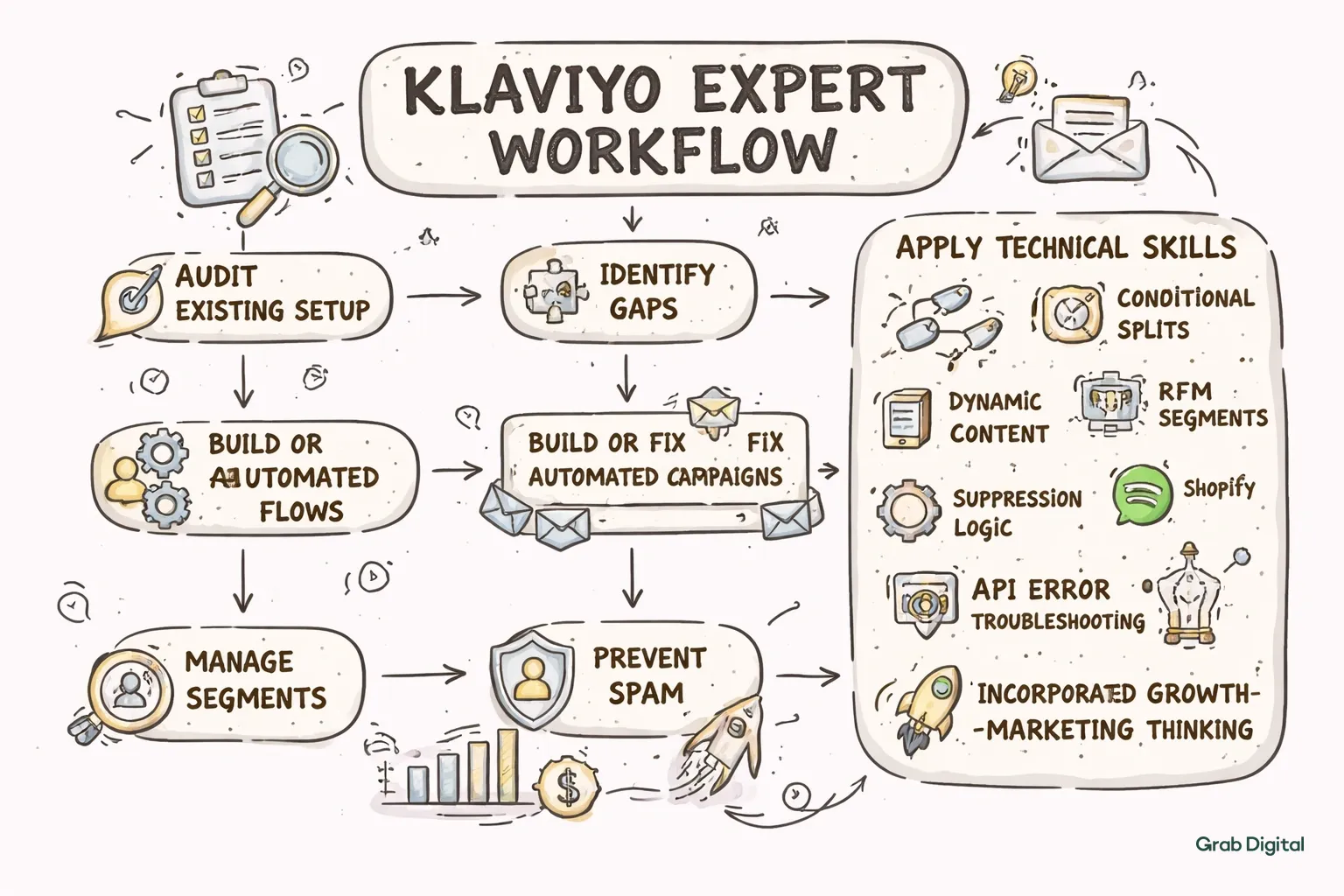
A real Klaviyo expert runs the whole channel. They don't just wait for instructions. They audit what you have, find the gaps, build or fix your automated flows, design and send campaigns, manage your segments, keep you out of the spam folder, and tell you where the money came from.
Yes, technical skills matter. They need to know how to build complex conditional splits, set up dynamic content blocks, configure RFM segments, manage suppression logic, integrate with Shopify, and troubleshoot weird API errors. But technical ability is the baseline. The best experts think like growth marketers. They get the customer lifecycle, understand your brand voice, know how to structure an offer, and test hypotheses rather than guessing.
You want someone who can look at your Klaviyo dashboard and, within 15 minutes, tell you what is broken and what to fix first. If they can't do that, they are still learning.
Red Flags When You Hire Klaviyo Expert Candidates
Watch out for candidates who lean too hard on certifications. Klaviyo Partner badges and course certificates mean they passed a test. They don't mean they've taken a brand from 15% to 35% email revenue. Ask for case studies with hard numbers, specifically email-attributed revenue, not vanity metrics like open rates.
Generic portfolios are another bad sign. If their work samples include insurance, SaaS, nonprofits, and DTC, they are generalists. DTC email is different. You have short consideration windows, visual storytelling, product education, and repeat purchase loops. You need someone who lives in that world, not someone who visits it occasionally.
Be wary of anyone promising quick wins without asking difficult questions first. A real expert wants to know your AOV, repeat purchase rate, list health, current flow performance, and brand positioning before they talk timelines. If they pitch a standard package without doing any discovery, walk away.
If they rely heavily on Klaviyo's template library, that's a deal-breaker. Templates are a starting point, not a strategy. Your brand needs flows and campaigns built around your customer behavior and product catalog. Cookie-cutter setups hit a wall fast.
Must-Have Skills Every Klaviyo Expert Should Have
Flow architecture is the foundation. They should build or audit your welcome series, abandoned cart, browse abandonment, post-purchase, win-back, sunset, replenishment, and VIP flows. They need to use conditional logic that adapts to what customers actually do. Every flow needs a clear goal, tested messaging, and measurable lift.
Campaign execution is non-negotiable. They need to plan, write, design, schedule, and analyze promotional and content emails at least twice a week. That means segmenting sends based on engagement, purchase history, and lifecycle stage. Batch-and-blast is dead. Your expert should know better.
Segmentation depth is where good becomes great. Beyond basic "engaged vs. unengaged" splits, they should build RFM segments, predicted LTV cohorts, product affinity groups, and behavioral triggers. Advanced segmentation is what makes personalization actually work.
Deliverability management keeps you out of the spam folder. They should monitor sender reputation, clean your list with sunset flows, authenticate your domains (SPF/DKIM/DMARC), warm up IP addresses if necessary, and fix placement issues. A flow that hits the spam folder is worthless.
Design and copy skills matter more than people think. Your expert doesn't need to be a professional designer or copywriter, but they must understand visual hierarchy, mobile optimization, and persuasive writing. Ugly emails kill trust. Boring copy kills conversions.
Analytics close the loop. They should track email-attributed revenue, flow performance, campaign ROI, list growth, engagement trends, and deliverability stats. Monthly reports need insights and actions, not just charts. If you work with a Klaviyo agency, this should be standard practice.
How to Evaluate Klaviyo Expert Portfolios
Ask for three case studies with full context. You want the starting metrics, the specific changes they made, the timeline, and the end results. Look for email revenue as a percentage of total revenue, placed order rates from flows, campaign contribution, and list growth. If they only show open and click rates, they are hiding the lack of revenue impact.
Request access to sample flows in a demo account. Walk through a welcome series or abandoned cart flow together. Ask them why they structured it that way, what they would test next, and how they would change it for your brand. Their answers will tell you if they are a strategic thinker or a copy-paster.
Review email creative samples on different devices. Open them on desktop, mobile, and a tablet. Check for broken layouts, slow loading images, confusing CTAs, and off-brand design. If their work only looks good on a desktop monitor, they aren't ready for DTC.
Check client retention. If they've worked with the same clients for over a year, that usually means results and trust. High churn suggests they overpromise and underdeliver. Ask why previous clients left and how they handled periods of underperformance.
Questions to Ask Before You Hire Klaviyo Expert
Start with their DTC experience. How many brands have they worked with? What revenue range? What product categories? The closer their background is to your niche, the faster they will deliver. Someone who has done email marketing for DTC brands in your vertical will already understand your customer psychology.
Ask about their onboarding process. A strong expert will outline the discovery, audit, strategy, implementation, testing, and reporting phases with clear deliverables. If they're vague, they're winging it.
Dig into their testing philosophy. What do they test first? How do they structure A/B tests? How do they decide when to roll out a winner? Testing is how good programs become great. You want a systematic tester, not someone throwing things at the wall.
Understand their reporting cadence. Monthly is standard. They should report on revenue, flow performance, ROI, list health, deliverability, and engagement. Ask to see a sample report. If it's confusing or lacks actionable insights, you'll struggle to use it.
Clarify communication and revisions. How often will you talk? How many revisions are included? What is the turnaround time? Misaligned expectations here cause friction quickly. Some agencies, like Grab Digital, offer unlimited revisions, which removes the bottleneck.
Freelancer vs Agency: Which Klaviyo Expert Model Fits Your Brand
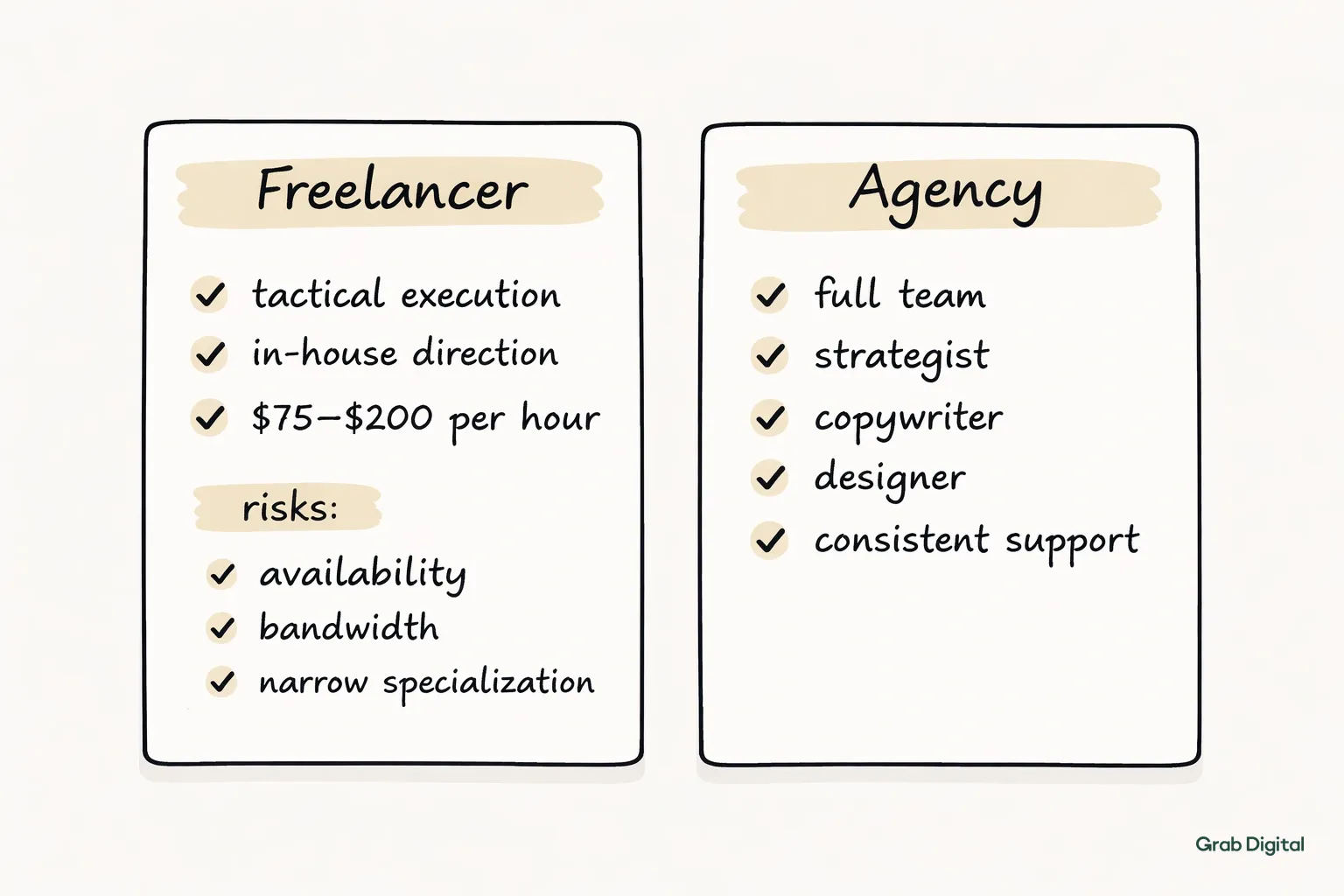
Freelancers work well if you need tactical execution and have someone in-house to direct the strategy. If you have a strong marketing lead who can steer the ship, a skilled freelancer can handle the flow builds and campaign sends. Rates usually fall between $75 and $200 per hour.
The risks with freelancers are availability and bandwidth. If they get sick or book too many clients, your program stalls. They also tend to specialize you might get someone great at flows who is weak at design, or strong on strategy but slow at execution.
Agencies give you a full team. You get a strategist, copywriter, designer, and implementer working together. This usually means faster turnarounds, consistent quality, and no single point of failure. Choosing the right Klaviyo agency means looking at team structure and client results.
The trade-off with agencies is cost and access. Retainers often start at $3,000 per month. But for brands doing over $1M in revenue, the ROI usually justifies it. A good agency should lift email revenue by 30–40%, which covers their fee multiple times over.
Consider a hybrid model if you're between $500K and $1M. Hire a fractional strategist or email marketing consultant to own the strategy and a freelancer to execute. You get senior thinking without the full agency price tag.
Pricing Models and What You Should Expect to Pay
Hourly rates for freelancers range from $75 to $200. Junior implementers are at the low end; senior strategists with DTC portfolios are at the high end. Hourly works for one-off audits or projects, but it's inefficient for ongoing management.
Retainers are standard for long-term partnerships. Expect $2,500 to $5,000 for basic management flows, a few campaigns a month, and reporting. Mid-tier packages ($5,000 to $10,000) add advanced segmentation and design work. High-touch engagements ($10,000+) include full-channel ownership and dedicated teams.
Performance-based pricing ties cost to results. Some experts charge a lower base fee plus a percentage of revenue lift. This aligns incentives, but you need a clear agreement on attribution. If you consider this, check the metrics that matter for scaling DTC brands beyond $1M.
Project-based pricing fits specific scopes, like building a flow suite or migrating platforms. A full flow suite typically costs $5,000 to $15,000. Migrations usually run $2,000 to $8,000.
Don't pay for a one-time setup without ongoing support. Email programs decay without maintenance. Lists churn, flows drift, and deliverability slips. To make the investment worth it, book your free consultation to find the right model for your stage.
How to Onboard Your Klaviyo Expert for Fast Results
Grant full Klaviyo access on day one. Your expert needs admin permissions to audit, analyze, and fix things. Delayed access means delayed revenue.
Share your brand guidelines, past campaign examples, and customer feedback. The more they understand your voice and customer pain points, the faster they'll produce work that fits. If you sell complex products, include educational materials.
Give them access to data beyond Klaviyo. They should see Shopify analytics, Google Analytics, support tickets, and loyalty platform data. Email attribution works better with full-funnel context.
Set a baseline and goals in the first week. Look at current revenue contribution, flow performance, and list growth. Agree on targets for 30, 60, and 90 days. This prevents misalignment.
Schedule recurring check-ins. Start weekly for the first month, then move to bi-weekly or monthly. Use these to review performance and adjust course. Don't skip them.
Red Flags After You Hire Klaviyo Expert
Watch for slow communication. If they take days to reply or miss calls without warning, that's a bad sign. DTC moves fast. Delays cost money.
Declining metrics without a plan are a major warning. Revenue dips happen, but your expert should diagnose the cause and propose a fix immediately. If they blame external factors without offering solutions, you hired the wrong person.
Lack of proactive ideas means they're reactive, not strategic. Good experts bring new ideas to every meeting new flows to test, segments to build, or deliverability fixes to implement. If you're always asking "what next?", you aren't getting strategic value. Read up on DTC email strategy to know what to expect.
Generic or off-brand creative shows they aren't listening. Every email should sound like your brand. If you're constantly correcting tone or design, they don't understand your identity.
What Great Klaviyo Experts Do Differently
They obsess over the customer lifecycle. They map every step from the first visit to the tenth purchase. They build flows that nurture each stage and campaigns that push people forward. Email is a relationship channel for them, not a megaphone.
They test relentlessly, but smartly. They test subject lines, send times, offers, and creative. But they don't test randomly. They prioritize high-impact variables and let tests run long enough to matter. Look at abandoned cart optimization for examples of intelligent testing.
They understand unit economics. They know your margins, CAC, and LTV. They structure offers to protect profit, not just chase revenue. A $10 discount on a $50 AOV is often better than a $20 discount on $60 if your margins are tight.
They communicate clearly. They tell you what's working, what's failing, and what they're doing about it. They don't hide behind jargon. You should always know where you stand.
They stay current. Klaviyo updates constantly. Great experts adopt useful features and ignore the noise. They also follow broader DTC trends shipping issues, privacy changes, economic shifts and adapt your strategy. Check out 2026 email trends to see what top experts focus on.
How to Measure Success After You Hire Klaviyo Expert
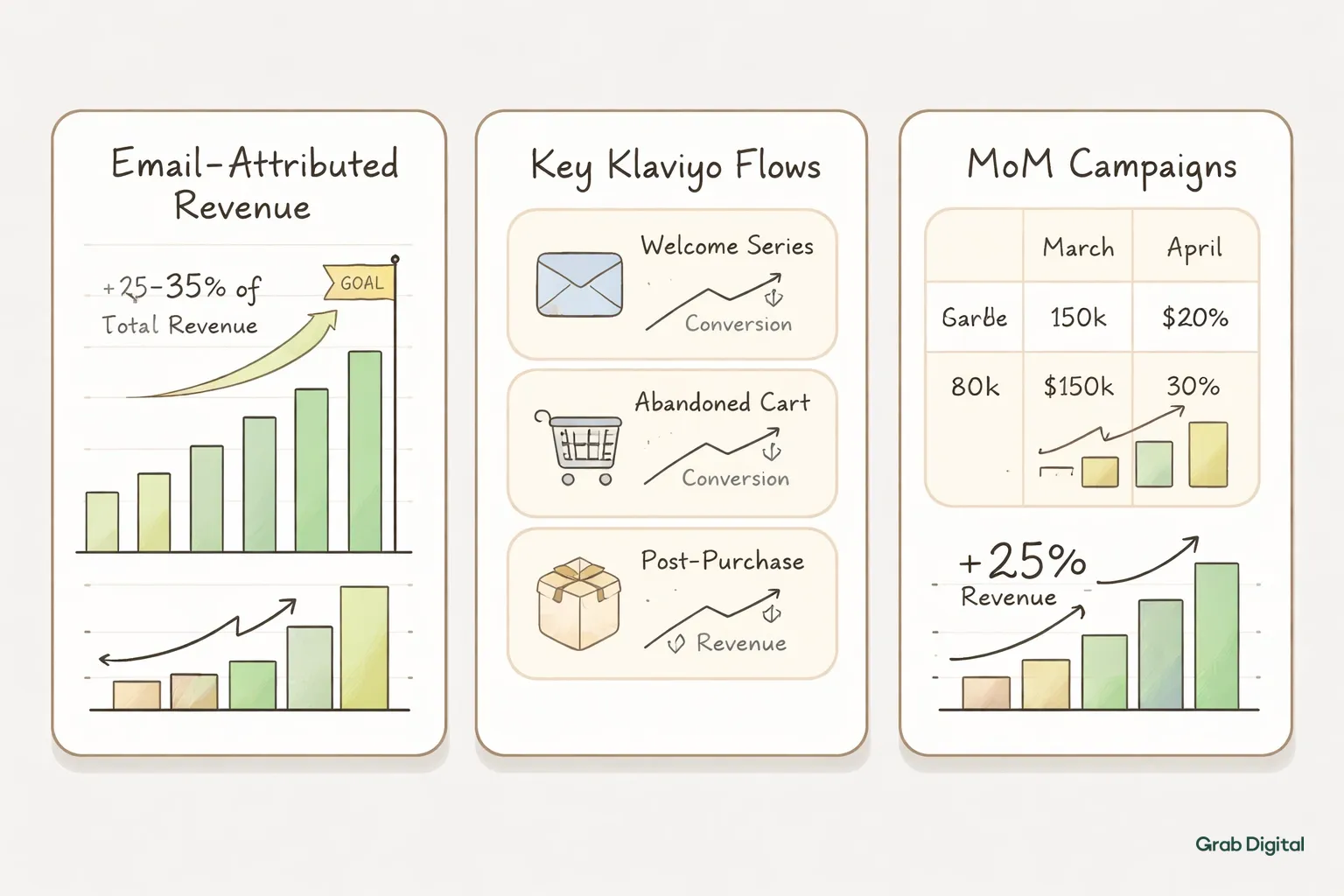
Track email-attributed revenue as your main metric. This is the revenue Klaviyo attributes to email within your attribution window (usually 5 days). It should grow in total dollars and as a percentage of revenue. Aim for 25–35% for a mature DTC brand.
Monitor individual flow performance. Welcome series, abandoned cart, and post-purchase flows should have clear revenue and conversion stats. Compare them month-over-month. They should improve as your expert tests and refines. See the 8 core email flows for benchmarks.
Measure campaign contribution separately. Promotional and content campaigns should drive at least 40% of email revenue if you send 2–4 per week. Track revenue per campaign, ROI on discounts, and engagement.
Watch list health. Your expert should grow the list with engaged subscribers and prune inactive ones. Monitor growth rate, engagement rate (opens/clicks from recent subscribers), and unsubscribe rate. A healthy list grows engaged subscribers faster than it loses them.
Check deliverability stats. Placement rate (inbox vs. spam) and bounce rate matter. Your expert should keep bounce rate under 2% and aim for 95%+ inbox placement. If these slip, revenue drops. Learn more about email deliverability.
When to Switch Klaviyo Experts
Give new hires 60–90 days. Email programs take time to compound. Flows need people to enter them. Tests need volume to prove out. Two months is the minimum fair trial.
Switch if goals are missed and there's no recovery plan. If they promised 20% growth in 60 days and you're at 12% with no explanation, that's a problem. One bad month happens. A pattern without accountability is a dealbreaker.
Switch if communication falls apart. You shouldn't chase your expert. If you've raised the issue and nothing changes, cut ties.
Switch if you outgrow them. A freelancer who was perfect at $500K might struggle at $2M. If your needs evolve, it's okay to upgrade. If you're ready for a team that scales with you, look into why DTC brands work with email agencies.
Klaviyo Expert vs Full Email Marketing Team
A Klaviyo expert focuses on one platform. A full email team might include strategists, copywriters, designers, and analysts working across multiple tools.
For brands under $5M, an expert or specialized agency usually offers better ROI than an in-house team. Building a team costs $200K+ in salaries and overhead. An agency team costs $60K–$120K.
Full teams make sense above $10M. At that scale, you have larger lists, more SKUs, and complex segmentation. You have the budget for the dedicated resources required.
Hybrid models work well between $5M and $10M. Hire a senior strategist in-house and partner with a Klaviyo agency for execution. You get control and bandwidth without the full overhead.
Legal and Compliance Considerations
Your expert must understand CAN-SPAM, GDPR, and CASL. Non-compliance risks fines and deliverability damage. They need to know consent rules and suppression requirements.
Data access agreements are necessary. Your expert will see customer names, emails, and purchase history. Use a contract with confidentiality and termination clauses. Check agency privacy policies.
List acquisition must be clean. They should only add subscribers who opted in. Bought lists and scraped emails ruin deliverability and violate laws. Ask how they plan to grow the list.
Intellectual property should be clear. Who owns the flows and templates? Some agreements give ownership to the brand. Others let experts reuse structures. Clarify this early.
Building a Long-Term Partnership
Treat your expert as a partner, not a vendor. Share goals, roadmaps, and challenges. The more they know, the better they can align email with your business.
Invest in their knowledge of your brand. Share product updates and customer feedback. Email works best when it's informed by deep understanding.
Celebrate the wins. When a campaign crushes it, acknowledge their work. Recognition builds loyalty. If you work with an email marketing agency, good relationships drive better work.
Review scope as you grow. Your needs at $1M differ from $5M. Check in quarterly. Add services like SMS or advanced personalization as budget allows.
Plan for continuity. If you have a freelancer, ask about backup coverage. With an agency, know the team structure. Good partners have a plan so your program never stops.
Frequently Asked Questions
Q: How quickly should I see results after I hire a Klaviyo expert? A: Expect movement in 30–45 days for flow fixes. Full-channel impact usually takes 60–90 days. Quick wins like abandoned cart tweaks show up fast. Strategic shifts take longer to compound. Set baselines and 60-day targets during onboarding.
Q: Should I hire a Klaviyo expert if I'm already using another platform? A: If you're serious about email revenue, migrate to Klaviyo first. It is the best platform for DTC segmentation and Shopify integration. Hiring a Klaviyo expert to run Mailchimp is like hiring a Ferrari mechanic to fix a Honda. Switch the platform, then hire the expert.
Q: Can a Klaviyo expert also handle SMS marketing? A: Some can, especially with Klaviyo's SMS features. Strategy overlaps flows, segmentation, cadence. But SMS copy is different: shorter, more urgent. Ask about specific SMS experience if you want one person handling both.
Q: What's the difference between a Klaviyo expert and a Klaviyo Partner agency? A: Partner status means an agency passed Klaviyo's certification and has a minimum number of clients. It proves platform knowledge, not DTC expertise. Look past the badge. Evaluate portfolios and retention. Some of the best experts aren't official partners.
Q: How involved do I need to be after I hire a Klaviyo expert? A: Expect 2–4 hours per month for check-ins and approvals. They should handle daily execution. Your role is brand guidance and strategic input. If you spend more than 5 hours, either the scope is wrong or they need too much hand-holding.
Q: Should my Klaviyo expert also manage my email design system? A: Yes, if you don't have a dedicated brand designer. They should build modular templates that match your guidelines. If you have an in-house design team, they can handle creative while your expert focuses on strategy and implementation.
Hiring the right Klaviyo expert can add 30–40% to your email revenue in 90 days. But finding that person is tricky. You need someone with the technical skills to work the platform and the strategic brain to understand DTC growth. They should own the results. Look for proof: flow architecture that makes sense, segmentation that goes deeper than "purchased vs. not purchased," and campaign performance from brands like yours.
Most DTC brands waste months on the wrong hire. They get an implementer who builds flows but can't strategize. Or a strategist who won't touch the tech. Or an agency that treats Klaviyo like a nicer MailChimp. The cost isn't just the retainer. It's the stalled revenue while your list churns and your flows sit there, underperforming. Here is how to spot the right fit, ask the right questions, and structure the relationship so you see returns quickly.
What a Klaviyo Expert Actually Does
A real Klaviyo expert runs the whole channel. They don't just wait for instructions. They audit what you have, find the gaps, build or fix your automated flows, design and send campaigns, manage your segments, keep you out of the spam folder, and tell you where the money came from.
Yes, technical skills matter. They need to know how to build complex conditional splits, set up dynamic content blocks, configure RFM segments, manage suppression logic, integrate with Shopify, and troubleshoot weird API errors. But technical ability is the baseline. The best experts think like growth marketers. They get the customer lifecycle, understand your brand voice, know how to structure an offer, and test hypotheses rather than guessing.
You want someone who can look at your Klaviyo dashboard and, within 15 minutes, tell you what is broken and what to fix first. If they can't do that, they are still learning.
Red Flags When You Hire Klaviyo Expert Candidates
Watch out for candidates who lean too hard on certifications. Klaviyo Partner badges and course certificates mean they passed a test. They don't mean they've taken a brand from 15% to 35% email revenue. Ask for case studies with hard numbers, specifically email-attributed revenue, not vanity metrics like open rates.
Generic portfolios are another bad sign. If their work samples include insurance, SaaS, nonprofits, and DTC, they are generalists. DTC email is different. You have short consideration windows, visual storytelling, product education, and repeat purchase loops. You need someone who lives in that world, not someone who visits it occasionally.
Be wary of anyone promising quick wins without asking difficult questions first. A real expert wants to know your AOV, repeat purchase rate, list health, current flow performance, and brand positioning before they talk timelines. If they pitch a standard package without doing any discovery, walk away.
If they rely heavily on Klaviyo's template library, that's a deal-breaker. Templates are a starting point, not a strategy. Your brand needs flows and campaigns built around your customer behavior and product catalog. Cookie-cutter setups hit a wall fast.
Must-Have Skills Every Klaviyo Expert Should Have
Flow architecture is the foundation. They should build or audit your welcome series, abandoned cart, browse abandonment, post-purchase, win-back, sunset, replenishment, and VIP flows. They need to use conditional logic that adapts to what customers actually do. Every flow needs a clear goal, tested messaging, and measurable lift.
Campaign execution is non-negotiable. They need to plan, write, design, schedule, and analyze promotional and content emails at least twice a week. That means segmenting sends based on engagement, purchase history, and lifecycle stage. Batch-and-blast is dead. Your expert should know better.
Segmentation depth is where good becomes great. Beyond basic "engaged vs. unengaged" splits, they should build RFM segments, predicted LTV cohorts, product affinity groups, and behavioral triggers. Advanced segmentation is what makes personalization actually work.
Deliverability management keeps you out of the spam folder. They should monitor sender reputation, clean your list with sunset flows, authenticate your domains (SPF/DKIM/DMARC), warm up IP addresses if necessary, and fix placement issues. A flow that hits the spam folder is worthless.
Design and copy skills matter more than people think. Your expert doesn't need to be a professional designer or copywriter, but they must understand visual hierarchy, mobile optimization, and persuasive writing. Ugly emails kill trust. Boring copy kills conversions.
Analytics close the loop. They should track email-attributed revenue, flow performance, campaign ROI, list growth, engagement trends, and deliverability stats. Monthly reports need insights and actions, not just charts. If you work with a Klaviyo agency, this should be standard practice.
How to Evaluate Klaviyo Expert Portfolios
Ask for three case studies with full context. You want the starting metrics, the specific changes they made, the timeline, and the end results. Look for email revenue as a percentage of total revenue, placed order rates from flows, campaign contribution, and list growth. If they only show open and click rates, they are hiding the lack of revenue impact.
Request access to sample flows in a demo account. Walk through a welcome series or abandoned cart flow together. Ask them why they structured it that way, what they would test next, and how they would change it for your brand. Their answers will tell you if they are a strategic thinker or a copy-paster.
Review email creative samples on different devices. Open them on desktop, mobile, and a tablet. Check for broken layouts, slow loading images, confusing CTAs, and off-brand design. If their work only looks good on a desktop monitor, they aren't ready for DTC.
Check client retention. If they've worked with the same clients for over a year, that usually means results and trust. High churn suggests they overpromise and underdeliver. Ask why previous clients left and how they handled periods of underperformance.
Questions to Ask Before You Hire Klaviyo Expert
Start with their DTC experience. How many brands have they worked with? What revenue range? What product categories? The closer their background is to your niche, the faster they will deliver. Someone who has done email marketing for DTC brands in your vertical will already understand your customer psychology.
Ask about their onboarding process. A strong expert will outline the discovery, audit, strategy, implementation, testing, and reporting phases with clear deliverables. If they're vague, they're winging it.
Dig into their testing philosophy. What do they test first? How do they structure A/B tests? How do they decide when to roll out a winner? Testing is how good programs become great. You want a systematic tester, not someone throwing things at the wall.
Understand their reporting cadence. Monthly is standard. They should report on revenue, flow performance, ROI, list health, deliverability, and engagement. Ask to see a sample report. If it's confusing or lacks actionable insights, you'll struggle to use it.
Clarify communication and revisions. How often will you talk? How many revisions are included? What is the turnaround time? Misaligned expectations here cause friction quickly. Some agencies, like Grab Digital, offer unlimited revisions, which removes the bottleneck.
Freelancer vs Agency: Which Klaviyo Expert Model Fits Your Brand
Freelancers work well if you need tactical execution and have someone in-house to direct the strategy. If you have a strong marketing lead who can steer the ship, a skilled freelancer can handle the flow builds and campaign sends. Rates usually fall between $75 and $200 per hour.
The risks with freelancers are availability and bandwidth. If they get sick or book too many clients, your program stalls. They also tend to specialize you might get someone great at flows who is weak at design, or strong on strategy but slow at execution.
Agencies give you a full team. You get a strategist, copywriter, designer, and implementer working together. This usually means faster turnarounds, consistent quality, and no single point of failure. Choosing the right Klaviyo agency means looking at team structure and client results.
The trade-off with agencies is cost and access. Retainers often start at $3,000 per month. But for brands doing over $1M in revenue, the ROI usually justifies it. A good agency should lift email revenue by 30–40%, which covers their fee multiple times over.
Consider a hybrid model if you're between $500K and $1M. Hire a fractional strategist or email marketing consultant to own the strategy and a freelancer to execute. You get senior thinking without the full agency price tag.
Pricing Models and What You Should Expect to Pay
Hourly rates for freelancers range from $75 to $200. Junior implementers are at the low end; senior strategists with DTC portfolios are at the high end. Hourly works for one-off audits or projects, but it's inefficient for ongoing management.
Retainers are standard for long-term partnerships. Expect $2,500 to $5,000 for basic management flows, a few campaigns a month, and reporting. Mid-tier packages ($5,000 to $10,000) add advanced segmentation and design work. High-touch engagements ($10,000+) include full-channel ownership and dedicated teams.
Performance-based pricing ties cost to results. Some experts charge a lower base fee plus a percentage of revenue lift. This aligns incentives, but you need a clear agreement on attribution. If you consider this, check the metrics that matter for scaling DTC brands beyond $1M.
Project-based pricing fits specific scopes, like building a flow suite or migrating platforms. A full flow suite typically costs $5,000 to $15,000. Migrations usually run $2,000 to $8,000.
Don't pay for a one-time setup without ongoing support. Email programs decay without maintenance. Lists churn, flows drift, and deliverability slips. To make the investment worth it, book your free consultation to find the right model for your stage.
How to Onboard Your Klaviyo Expert for Fast Results
Grant full Klaviyo access on day one. Your expert needs admin permissions to audit, analyze, and fix things. Delayed access means delayed revenue.
Share your brand guidelines, past campaign examples, and customer feedback. The more they understand your voice and customer pain points, the faster they'll produce work that fits. If you sell complex products, include educational materials.
Give them access to data beyond Klaviyo. They should see Shopify analytics, Google Analytics, support tickets, and loyalty platform data. Email attribution works better with full-funnel context.
Set a baseline and goals in the first week. Look at current revenue contribution, flow performance, and list growth. Agree on targets for 30, 60, and 90 days. This prevents misalignment.
Schedule recurring check-ins. Start weekly for the first month, then move to bi-weekly or monthly. Use these to review performance and adjust course. Don't skip them.
Red Flags After You Hire Klaviyo Expert
Watch for slow communication. If they take days to reply or miss calls without warning, that's a bad sign. DTC moves fast. Delays cost money.
Declining metrics without a plan are a major warning. Revenue dips happen, but your expert should diagnose the cause and propose a fix immediately. If they blame external factors without offering solutions, you hired the wrong person.
Lack of proactive ideas means they're reactive, not strategic. Good experts bring new ideas to every meeting new flows to test, segments to build, or deliverability fixes to implement. If you're always asking "what next?", you aren't getting strategic value. Read up on DTC email strategy to know what to expect.
Generic or off-brand creative shows they aren't listening. Every email should sound like your brand. If you're constantly correcting tone or design, they don't understand your identity.
What Great Klaviyo Experts Do Differently
They obsess over the customer lifecycle. They map every step from the first visit to the tenth purchase. They build flows that nurture each stage and campaigns that push people forward. Email is a relationship channel for them, not a megaphone.
They test relentlessly, but smartly. They test subject lines, send times, offers, and creative. But they don't test randomly. They prioritize high-impact variables and let tests run long enough to matter. Look at abandoned cart optimization for examples of intelligent testing.
They understand unit economics. They know your margins, CAC, and LTV. They structure offers to protect profit, not just chase revenue. A $10 discount on a $50 AOV is often better than a $20 discount on $60 if your margins are tight.
They communicate clearly. They tell you what's working, what's failing, and what they're doing about it. They don't hide behind jargon. You should always know where you stand.
They stay current. Klaviyo updates constantly. Great experts adopt useful features and ignore the noise. They also follow broader DTC trends shipping issues, privacy changes, economic shifts and adapt your strategy. Check out 2026 email trends to see what top experts focus on.
How to Measure Success After You Hire Klaviyo Expert
Track email-attributed revenue as your main metric. This is the revenue Klaviyo attributes to email within your attribution window (usually 5 days). It should grow in total dollars and as a percentage of revenue. Aim for 25–35% for a mature DTC brand.
Monitor individual flow performance. Welcome series, abandoned cart, and post-purchase flows should have clear revenue and conversion stats. Compare them month-over-month. They should improve as your expert tests and refines. See the 8 core email flows for benchmarks.
Measure campaign contribution separately. Promotional and content campaigns should drive at least 40% of email revenue if you send 2–4 per week. Track revenue per campaign, ROI on discounts, and engagement.
Watch list health. Your expert should grow the list with engaged subscribers and prune inactive ones. Monitor growth rate, engagement rate (opens/clicks from recent subscribers), and unsubscribe rate. A healthy list grows engaged subscribers faster than it loses them.
Check deliverability stats. Placement rate (inbox vs. spam) and bounce rate matter. Your expert should keep bounce rate under 2% and aim for 95%+ inbox placement. If these slip, revenue drops. Learn more about email deliverability.
When to Switch Klaviyo Experts
Give new hires 60–90 days. Email programs take time to compound. Flows need people to enter them. Tests need volume to prove out. Two months is the minimum fair trial.
Switch if goals are missed and there's no recovery plan. If they promised 20% growth in 60 days and you're at 12% with no explanation, that's a problem. One bad month happens. A pattern without accountability is a dealbreaker.
Switch if communication falls apart. You shouldn't chase your expert. If you've raised the issue and nothing changes, cut ties.
Switch if you outgrow them. A freelancer who was perfect at $500K might struggle at $2M. If your needs evolve, it's okay to upgrade. If you're ready for a team that scales with you, look into why DTC brands work with email agencies.
Klaviyo Expert vs Full Email Marketing Team
A Klaviyo expert focuses on one platform. A full email team might include strategists, copywriters, designers, and analysts working across multiple tools.
For brands under $5M, an expert or specialized agency usually offers better ROI than an in-house team. Building a team costs $200K+ in salaries and overhead. An agency team costs $60K–$120K.
Full teams make sense above $10M. At that scale, you have larger lists, more SKUs, and complex segmentation. You have the budget for the dedicated resources required.
Hybrid models work well between $5M and $10M. Hire a senior strategist in-house and partner with a Klaviyo agency for execution. You get control and bandwidth without the full overhead.
Legal and Compliance Considerations
Your expert must understand CAN-SPAM, GDPR, and CASL. Non-compliance risks fines and deliverability damage. They need to know consent rules and suppression requirements.
Data access agreements are necessary. Your expert will see customer names, emails, and purchase history. Use a contract with confidentiality and termination clauses. Check agency privacy policies.
List acquisition must be clean. They should only add subscribers who opted in. Bought lists and scraped emails ruin deliverability and violate laws. Ask how they plan to grow the list.
Intellectual property should be clear. Who owns the flows and templates? Some agreements give ownership to the brand. Others let experts reuse structures. Clarify this early.
Building a Long-Term Partnership
Treat your expert as a partner, not a vendor. Share goals, roadmaps, and challenges. The more they know, the better they can align email with your business.
Invest in their knowledge of your brand. Share product updates and customer feedback. Email works best when it's informed by deep understanding.
Celebrate the wins. When a campaign crushes it, acknowledge their work. Recognition builds loyalty. If you work with an email marketing agency, good relationships drive better work.
Review scope as you grow. Your needs at $1M differ from $5M. Check in quarterly. Add services like SMS or advanced personalization as budget allows.
Plan for continuity. If you have a freelancer, ask about backup coverage. With an agency, know the team structure. Good partners have a plan so your program never stops.
Frequently Asked Questions
Q: How quickly should I see results after I hire a Klaviyo expert? A: Expect movement in 30–45 days for flow fixes. Full-channel impact usually takes 60–90 days. Quick wins like abandoned cart tweaks show up fast. Strategic shifts take longer to compound. Set baselines and 60-day targets during onboarding.
Q: Should I hire a Klaviyo expert if I'm already using another platform? A: If you're serious about email revenue, migrate to Klaviyo first. It is the best platform for DTC segmentation and Shopify integration. Hiring a Klaviyo expert to run Mailchimp is like hiring a Ferrari mechanic to fix a Honda. Switch the platform, then hire the expert.
Q: Can a Klaviyo expert also handle SMS marketing? A: Some can, especially with Klaviyo's SMS features. Strategy overlaps flows, segmentation, cadence. But SMS copy is different: shorter, more urgent. Ask about specific SMS experience if you want one person handling both.
Q: What's the difference between a Klaviyo expert and a Klaviyo Partner agency? A: Partner status means an agency passed Klaviyo's certification and has a minimum number of clients. It proves platform knowledge, not DTC expertise. Look past the badge. Evaluate portfolios and retention. Some of the best experts aren't official partners.
Q: How involved do I need to be after I hire a Klaviyo expert? A: Expect 2–4 hours per month for check-ins and approvals. They should handle daily execution. Your role is brand guidance and strategic input. If you spend more than 5 hours, either the scope is wrong or they need too much hand-holding.
Q: Should my Klaviyo expert also manage my email design system? A: Yes, if you don't have a dedicated brand designer. They should build modular templates that match your guidelines. If you have an in-house design team, they can handle creative while your expert focuses on strategy and implementation.

Find out exactly what your email channel is leaving on the table.

Email Marketing for Scaling DTC Brands


