
Summary
Reverse-Engineering Winning Email Campaigns for DTC Brands
You can learn a lot by reverse-engineering emails that actually work. I’m talking about subject lines that beg to be opened, hero images that stop the scroll, and single CTAs that don’t make you think. Real campaigns from brands that are actually winning show you the structure and copy choices that turn subscribers into buyers.
Here’s the hard truth: most DTC brands don't struggle because their products aren't good. They struggle because their emails feel generic. Studying proven examples gives you a blueprint that actually drives revenue. We’re going to break down real structures, dissect why they work, and show you how to adapt them without losing your brand's voice. If you need a refresher on the basics first, check out our guide on proven ecommerce email strategy.
What Makes a Strong Email Campaign Example Worth Studying
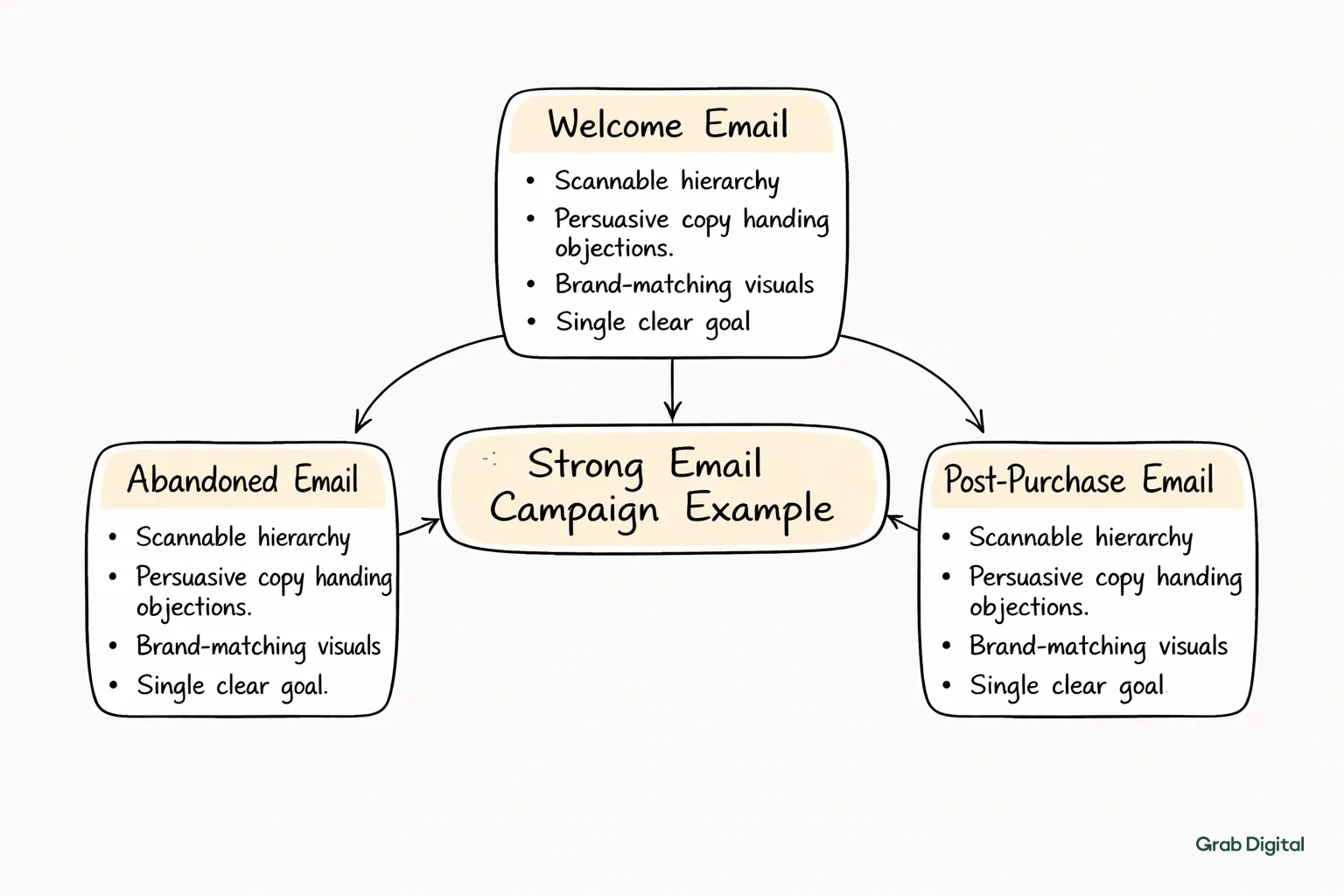
Good examples share specific traits: a scannable hierarchy that guides the eye, persuasive copy that handles objections, visuals that match the brand, and one clear goal that isn't fighting with itself. These elements move people from "what is this?" to "take my money" in seconds.
The best examples solve specific problems. A welcome email introduces the story. An abandoned cart email removes friction. A post-purchase email builds loyalty. Each type follows patterns that have been tested thousands of times across DTC email marketing channels.
Technical execution matters just as much as creative. Strong examples render correctly on mobile, load fast, and include plain-text versions. They also segment audiences so people who are ready to buy get different messages than people who are just looking.
Welcome Email Campaign Examples That Set Expectations
Welcome campaigns generate 320% more revenue per email than standard promotional sends. That’s not a typo. The best ones establish personality immediately and offer a clear next step. A skincare brand might lead with the founder's story. A furniture brand might show off its design philosophy.
The structure usually looks like this: a simple, benefit-focused subject line (often with the first name), a single compelling hero image, two or three sentences on what makes the brand different, some social proof like customer counts or press mentions, and a first action like "Shop New Arrivals" or "Claim Your Discount." The footer should have a brief story, sustainability info, and contact details.
The most effective welcome emails send immediately after signup. If you promised weekly tips, the welcome email should mention that and actually deliver on it.
Personalization goes beyond just using a first name. Dynamic content can show different products based on where someone signed up. Someone who joined through a post about vegan skincare should see different products than someone who came from an ad for anti-aging serums. Book your free consultation to see how this could work for your catalog.
Abandoned Cart Campaign Examples That Convert Browsers
Cart abandonment emails recover 15 to 25% of lost sales when done right. Good examples remind without nagging, remove objections, and create urgency without sounding desperate. The three-email sequence is still the standard for DTC brands.
Email one sends 30 minutes after abandonment. It’s a gentle nudge. Show the cart contents, the hero product image, and a clear CTA. Include trust signals like "free shipping" or "easy returns." The subject line should be neutral: "You left something behind" or "Still thinking it over?"
Email two goes out 24 hours later. Now you’re persuading. Add social proof like reviews. Address objections with FAQs or sizing guides. You might include a small discount for fence-sitters. The tone shifts from "did you forget?" to "here’s why you should buy."
Email three arrives 48 to 72 hours later. This is the final nudge. It might have a founder’s message, scarcity language if stock is actually low, or alternative product recommendations. Some brands go hard on urgency here; others keep it soft with "we’ll be here when you’re ready."
Design should match your checkout page so it feels familiar. Product images should link to the cart, not the homepage. Prices should be clear. Mobile optimization is non-negotiable since 65% of these emails are opened on phones. For more detail, see our guide on how to fix cart abandonment with Klaviyo.
Post-Purchase Campaign Examples That Build Loyalty
Post-purchase emails turn one-time buyers into repeat customers. Good examples thank the buyer genuinely, educate them on the product, and open the door to cross-sells without being pushy. The sequence usually runs 30 to 60 days.
Order confirmation sends immediately. It’s transactional but doesn't have to feel robotic. Include the order summary, delivery date, support contact, and a brief thank you. Some brands add a founder photo here to humanize it.
Shipping notification follows. Include tracking and delivery expectations. Smart brands add product care tips here. If someone bought leather goods, link to a leather care guide.
Delivery confirmation or check-in arrives 3-5 days after delivery. Ask how the product is working. Link to support. Gently ask for a review. This should feel like customer service, not marketing.
Educational content sends 10-14 days later. Show them how to get more value. Styling tips, recipes, maintenance advice. This positions you as an expert, not just a vendor.
Replenishment or cross-sell email deploys 30-45 days out. If they bought a 30-day coffee supply, remind them to reorder on day 25. If they bought a couch, introduce throw pillows. The tone should prioritize relationship over transaction. For more on automated sequences, see our breakdown of the 8 core email flows every DTC brand needs.
Promotional Campaign Examples That Drive Urgency Without Fatigue
Promotional sends make money now but burn your list out if you overdo it. Good examples balance frequency, offer strength, and creative execution. The best campaigns tell stories, they don't just announce discounts.
Holiday campaigns need multiple emails. Early access for VIPs, a general launch, then last-chance reminders. Change the creative for each one: first a gift guide, then bestsellers, then shipping cutoffs. Subject lines should move from hopeful to urgent.
Flash sale campaigns live or die by real scarcity. If stock or time is limited, prove it with a countdown or inventory counter. Fake urgency breaks trust. Real urgency converts. Keep the copy short and the design bold.
Product launch campaigns should educate and excite. Tease features early. Lead with benefits, not specs, in the launch email. Add social proof if you have beta testers. Follow up by answering objections.
Seasonal campaigns connect products to moments: back to school, wedding season, summer travel. They work because they’re relevant without needing a discount. Position products as solutions to seasonal problems.
Cadence varies. A 50,000-person list with high engagement can handle 2-3 promotional emails a week. A smaller list showing fatigue should stick to one. Advanced email segmentation lets you send more to people who want it and less to people who don't.
Browse Abandonment Campaign Examples That Recapture Interest
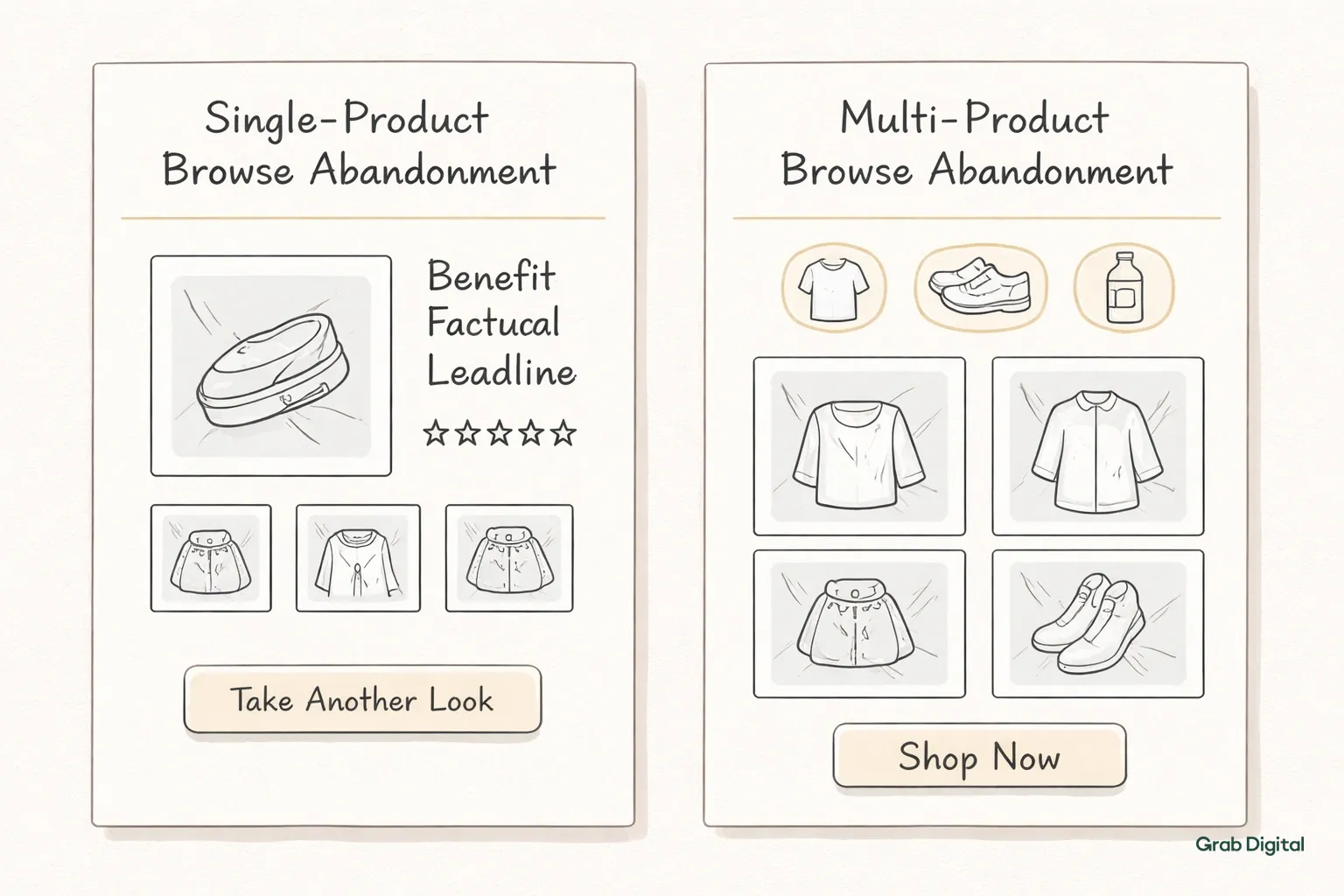
These target people who viewed products but didn't add to cart. They convert 2-5% of recipients. They require good tracking, which is why they work best with specialized email campaign software.
Single-product browse abandonment triggers when someone spends time on one product page. Feature that product. Write a headline focused on benefits. Add 3-5 reviews. Suggest related products. Use a soft CTA like "Take Another Look."
Multi-product browse abandonment triggers when someone browses multiple categories without adding anything. Show 2-4 products they viewed. Recommend categories based on their behavior. Offer a "complete the look" angle if it fits.
Category-level abandonment targets people who browsed a category page but didn't click specific products. Highlight bestsellers from that category. Add testimonials. Provide educational content to build confidence.
Timing is tricky. Send too fast and you interrupt. Wait too long and they lose interest. 24 hours after the session ends usually works best, with a follow-up 48 hours later if they don't click.
Winback Campaign Examples That Revive Dormant Subscribers
Winback campaigns target subscribers who haven't engaged in 60-120 days. These emails either bring them back or help you clean your list. Good examples acknowledge the silence, offer a reason to return, and make it easy.
First winback email usually sends at 60 days. Keep it friendly. "We miss you" or "It's been a while." Show what's new. Feature bestsellers. Offer a modest incentive like free shipping if it fits your brand.
Second winback attempt comes 30 days later if the first one flops. Increase the incentive or change the creative entirely. Some brands use a founder video or a "we want your feedback" survey.
Final email comes at 120-180 days. It's a list-cleaning mechanism. Be direct: "Should we keep sending emails?" or "One last message." Subscribers who don't click get removed, which improves your deliverability.
Winback emails are a good place to take risks. Your standard template isn't working for these people. Try a plain-text email with a personal tone. It often outperforms a designed template. The goal is to break the pattern. For more, see our guide on how to build a Klaviyo winback flow that works.
Design Elements That Make Campaign Examples Effective
Email design for DTC balances looking good with being clear. Campaigns that convert share specific design patterns proven by testing.
Visual hierarchy guides the eye. Headlines are big and bold. Body copy is readable 14px minimum. CTAs stand out with contrasting color and padding. White space keeps it from feeling cramped.
Mobile-first layout stacks vertically. Single-column design works on every screen. Touch targets need to be at least 44px square so people don't mis-tap. Images scale without forcing horizontal scrolling.
Brand consistency builds recognition. Your color palette, fonts, logo placement, and photography style should make subscribers know it's you before they read a word.
Strategic imagery shows products in use. Lifestyle shots help people see themselves owning it. Close-ups show texture. Models should look like your actual customers, not stock photo models.
Accessibility matters. Sufficient color contrast, descriptive alt text, and logical reading order make emails readable for everyone. This also helps deliverability since some clients prioritize accessible content.
Your template needs to be flexible. Promotional emails, educational content, and transactional messages should all feel like they come from the same place while doing different jobs.
Copy Patterns in High-Converting Campaign Examples
Email copywriting for DTC balances persuasion with personality. The best campaigns use voice, structure, and psychology strategically.
Subject lines decide if you get opened. Keep them under 50 characters. Create curiosity without clickbait. Use personalization when it fits. Test questions against statements, emoji against plain text, urgency against benefit.
Preheader text is valuable real estate. Don't let it default to "View in browser." Use those 80 characters to extend the subject line or add urgency: "Plus free shipping ends tonight."
Opening lines have to hook attention immediately. Skip the fluff. Don't say "Hope you're having a great day." Lead with a benefit, a question, or a surprising statement. Make them want to read more before images load.
Body copy should use short paragraphs and a conversational tone. Focus on "you" and customer benefits. Break up text with subheadings or bullets. Read it aloud. If it sounds corporate, rewrite it.
CTAs should appear multiple times. Put the primary one above the fold and repeat it at the end. Use first-person language on the button: "Show Me the Collection" beats "View Collection."
Closing elements should include a real person's signature, support info, and a brief restatement of value. A P.S. is a great place for a final push.
Testing reveals what your specific audience likes. One brand's list might love playful language; another's might want straight facts. Let the data guide you.
Segmentation Strategies Behind Targeted Campaign Examples
Sending the same email to everyone underperforms. Campaigns from sophisticated DTC brands use strategic segmentation.
Engagement-based segments separate active subscribers from dormant ones. Send frequency and content depth should vary. Engaged subscribers can handle more emails. Dormant ones need winback sequences first.
Purchase behavior segments group by recency, frequency, and money spent. First-time buyers get different messages than VIPs. High-value customers might get early access. One-time buyers get retention messaging.
Product interest segments form when subscribers browse categories or click specific content. Someone who bought running shoes shouldn't see dress shoe recommendations. Relevance improves clicks and conversions.
Lifecycle stage segments target based on where someone is in the journey. New subscribers get onboarding. Active customers get retention content. Lapsed customers get winback. This ensures appropriateness.
Predictive segments use data to find people likely to buy soon or likely to churn. These require sophisticated email marketing automation platforms but deliver high ROI.
Geographic and demographic segments let you do regional promos and seasonal adjustments. A winter coat sale in Florida doesn't make sense.
Testing Framework for Campaign Optimization
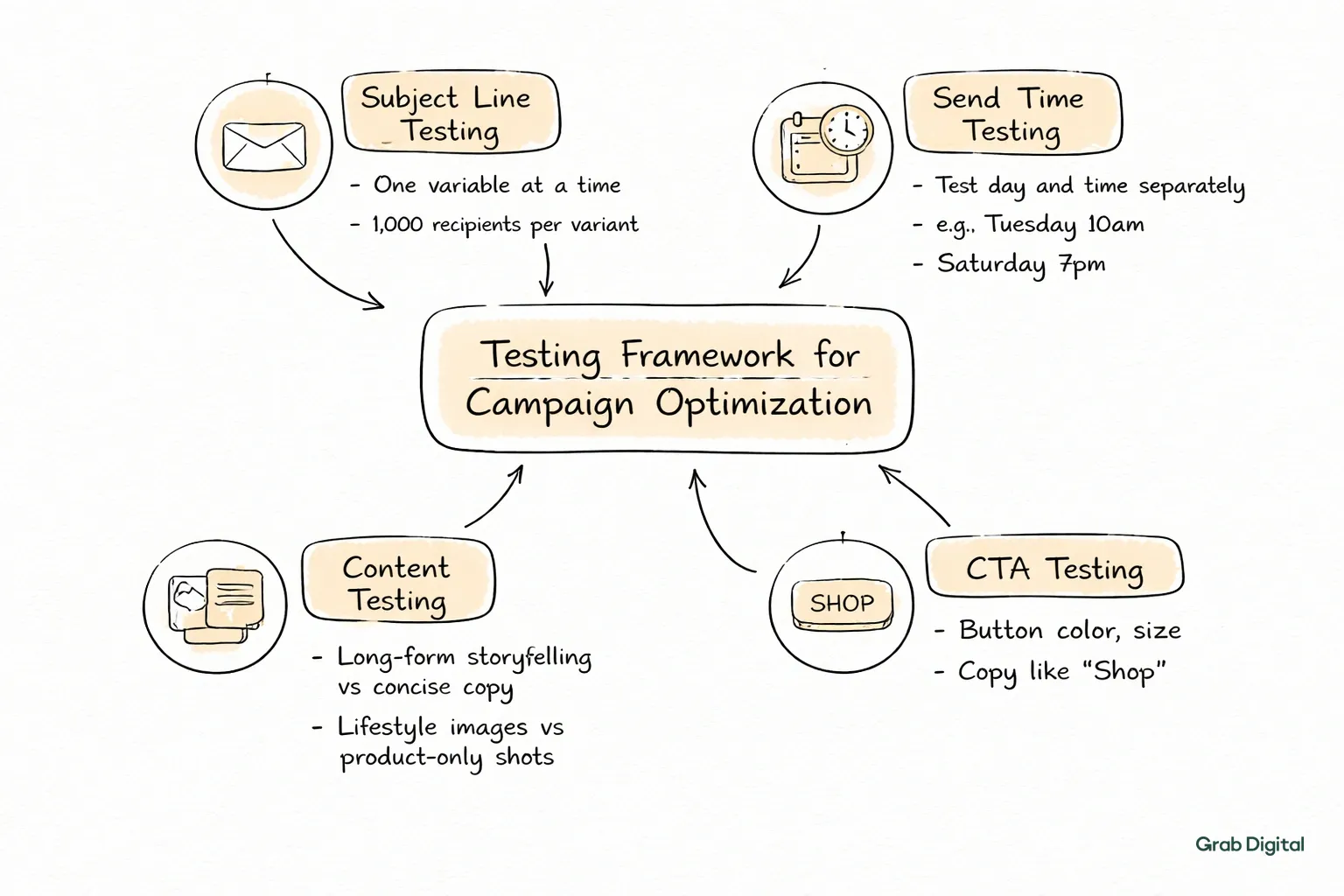
Improvement comes from systematic testing, not guessing. Campaigns that convert reflect hundreds of prior tests.
Subject line testing compares one variable at a time. Test sample size needs statistical significance usually 1,000 recipients per variant.
Send time testing reveals when your audience buys. Tuesday at 10am might work for one brand, Saturday at 7pm for another. Test day and time separately.
Content testing compares structures and copy. Does long-form storytelling beat concise copy? Do lifestyle images beat product-only shots?
CTA testing looks at button color, size, and copy. "Shop Now" vs "Add to Cart" vs "See the Collection" can have dramatically different results.
Template testing checks if designed HTML beats plain text. Promotional emails usually need design. Some lifecycle emails do better with simple text that feels personal.
Offer testing reveals price sensitivity. Does a percentage discount beat a dollar amount? Does free shipping drive more revenue?
Document every test. This history becomes institutional knowledge. For comprehensive strategies, see our master guide to DTC email campaign management.
Technical Execution Details That Make Examples Work
Behind every high-converting email is technical execution that ensures it actually arrives and works.
Email authentication (SPF, DKIM, DMARC) proves to inbox providers you are who you say you are. Without it, you go to spam. Work with your IT team to set this up.
List hygiene removes invalid addresses and respects unsubscribes immediately. Sending to bad addresses hurts your reputation. Regular cleaning improves deliverability for the valid ones. See our email deliverability tips for more.
Rendering testing catches display issues. Gmail, Outlook, and Apple Mail all show emails differently. Use tools like Litmus to preview before you send.
Link tracking with UTM parameters attributes revenue correctly. Track campaign name, date, segment, and variant at minimum.
A/B testing infrastructure needs to split audiences randomly and track results accurately. Confirm your setup works before relying on it for big decisions.
Backup systems prepare for mistakes. Every platform should have send cancellation windows and approval workflows. Even pros make mistakes.
Frequency and Cadence Patterns in Successful Examples
Email frequency impacts engagement, unsubscribes, and revenue. Top DTC brands use strategic cadence.
Core promotional frequency for most brands is 1-3 sends weekly to the main list. Higher frequency needs strong segmentation. Lower frequency works for luxury or considered purchases.
Flow emails don't count against this. They trigger based on behavior. A subscriber might get a welcome series, cart abandonment, and a promotional email all in the same week. That's fine.
Seasonal adjustment increases frequency during holidays. Black Friday might mean daily emails. Slow months might mean weekly.
Segment-specific frequency sends more to engaged people and less to at-risk ones. VIPs might want daily deals. One-time buyers might want a weekly digest.
Preference centers let people choose. Offer a weekly digest option alongside real-time alerts. Some people want daily emails; others need monthly touchpoints.
Plan your calendar. Map promos, launches, and educational series across quarters so you don't overlap or burn out.
Revenue Attribution Models Behind Campaign Examples
Knowing what drives revenue requires accurate attribution. A campaign might look successful but actually be stealing credit.
Last-click attribution credits the final email before purchase. It overvalues bottom-funnel emails like abandoned cart and ignores top-funnel awareness. Most platforms default to this because it's easy, but it's not the whole story.
First-click attribution credits the first email that introduced the offer. It overvalues top-funnel and ignores the nurture that closed the deal.
Linear attribution splits credit equally across all touchpoints. If someone got four emails before buying, each gets 25%. It’s better but still simple.
Position-based attribution gives 40% to the first and last touchpoints, and 20% to the middle ones. This acknowledges that starting and finishing the journey matter most.
Custom attribution weights different campaign types based on your priorities. You might value post-purchase campaigns higher because retention revenue is more profitable.
Your platform matters. Klaviyo’s native Shopify integration offers reliable revenue attribution through direct order tracking. Less integrated platforms rely on cookies, which miss cross-device journeys.
Industry-Specific Campaign Example Variations
Strategy varies by product. What works for fashion might flop for supplements.
Fashion and apparel campaigns need aspirational lifestyle imagery, frequent new arrival alerts, and styling content. Frequency runs high because customers browse even when not buying. User-generated content converts well.
Beauty and skincare needs education on ingredients and routines. Replenishment reminders drive revenue because products run out on a schedule. Quizzes that recommend products work very well.
Food and beverage leverages recipes and seasonal flavors. Urgency around freshness creates real scarcity. Testimonials focus on taste since they can't sample it.
Home goods and furniture need longer nurture sequences. Purchases take weeks or months. Room inspiration and designer interviews build affinity. Financing offers address objections.
Supplement and wellness must navigate regulatory constraints while building proof. Subscription acquisition is the main goal since recurring revenue is high value.
Understand your category norms but find ways to differentiate. Study competitors, but don't copy. Adapt patterns to your voice and customers.
Frequently Asked Questions
Q: How long should email campaigns be for DTC brands? Most promotional emails do best at 200-400 words with clear visuals. Educational emails can go to 600 if the content is actually helpful. Mobile readers want short and scannable. Test it with your audience; preferences vary.
Q: What's the ideal email send frequency for DTC brands? Most brands do well with 1-3 promotional emails a week, plus triggered flows. Higher frequency needs better segmentation. Watch your unsubscribes. If they spike, you're sending too much.
Q: Should DTC brands use plain text or HTML designed emails? HTML usually wins for promos and launches because it shows off the product. Plain text can work better for lifecycle messages like founder notes where a human touch matters more. Test it.
Q: How many CTAs should appear in one email campaign? Put your primary CTA at least twice: above the fold and at the end. For longer emails, repeat it every 300-400 words. Secondary CTAs are fine, but they shouldn't distract from the main goal.
Q: What subject line length works best for open rates? 35-50 characters is the sweet spot. It displays fully on mobile and desktop. Test shorter punchy lines against longer benefit-focused ones. Mobile is 60%+ of opens for most brands, so optimize for the small screen first.
Q: How do you measure email campaign success beyond open and click rates? Look at revenue per recipient, conversion rate, and list growth. Watch unsubscribes to make sure you aren't burning the list. Track customer lifetime value for email-acquired customers vs. other channels. Connect email activity directly to order data for the real picture.
You can learn a lot by reverse-engineering emails that actually work. I’m talking about subject lines that beg to be opened, hero images that stop the scroll, and single CTAs that don’t make you think. Real campaigns from brands that are actually winning show you the structure and copy choices that turn subscribers into buyers.
Here’s the hard truth: most DTC brands don't struggle because their products aren't good. They struggle because their emails feel generic. Studying proven examples gives you a blueprint that actually drives revenue. We’re going to break down real structures, dissect why they work, and show you how to adapt them without losing your brand's voice. If you need a refresher on the basics first, check out our guide on proven ecommerce email strategy.
What Makes a Strong Email Campaign Example Worth Studying
Good examples share specific traits: a scannable hierarchy that guides the eye, persuasive copy that handles objections, visuals that match the brand, and one clear goal that isn't fighting with itself. These elements move people from "what is this?" to "take my money" in seconds.
The best examples solve specific problems. A welcome email introduces the story. An abandoned cart email removes friction. A post-purchase email builds loyalty. Each type follows patterns that have been tested thousands of times across DTC email marketing channels.
Technical execution matters just as much as creative. Strong examples render correctly on mobile, load fast, and include plain-text versions. They also segment audiences so people who are ready to buy get different messages than people who are just looking.
Welcome Email Campaign Examples That Set Expectations
Welcome campaigns generate 320% more revenue per email than standard promotional sends. That’s not a typo. The best ones establish personality immediately and offer a clear next step. A skincare brand might lead with the founder's story. A furniture brand might show off its design philosophy.
The structure usually looks like this: a simple, benefit-focused subject line (often with the first name), a single compelling hero image, two or three sentences on what makes the brand different, some social proof like customer counts or press mentions, and a first action like "Shop New Arrivals" or "Claim Your Discount." The footer should have a brief story, sustainability info, and contact details.
The most effective welcome emails send immediately after signup. If you promised weekly tips, the welcome email should mention that and actually deliver on it.
Personalization goes beyond just using a first name. Dynamic content can show different products based on where someone signed up. Someone who joined through a post about vegan skincare should see different products than someone who came from an ad for anti-aging serums. Book your free consultation to see how this could work for your catalog.
Abandoned Cart Campaign Examples That Convert Browsers
Cart abandonment emails recover 15 to 25% of lost sales when done right. Good examples remind without nagging, remove objections, and create urgency without sounding desperate. The three-email sequence is still the standard for DTC brands.
Email one sends 30 minutes after abandonment. It’s a gentle nudge. Show the cart contents, the hero product image, and a clear CTA. Include trust signals like "free shipping" or "easy returns." The subject line should be neutral: "You left something behind" or "Still thinking it over?"
Email two goes out 24 hours later. Now you’re persuading. Add social proof like reviews. Address objections with FAQs or sizing guides. You might include a small discount for fence-sitters. The tone shifts from "did you forget?" to "here’s why you should buy."
Email three arrives 48 to 72 hours later. This is the final nudge. It might have a founder’s message, scarcity language if stock is actually low, or alternative product recommendations. Some brands go hard on urgency here; others keep it soft with "we’ll be here when you’re ready."
Design should match your checkout page so it feels familiar. Product images should link to the cart, not the homepage. Prices should be clear. Mobile optimization is non-negotiable since 65% of these emails are opened on phones. For more detail, see our guide on how to fix cart abandonment with Klaviyo.
Post-Purchase Campaign Examples That Build Loyalty
Post-purchase emails turn one-time buyers into repeat customers. Good examples thank the buyer genuinely, educate them on the product, and open the door to cross-sells without being pushy. The sequence usually runs 30 to 60 days.
Order confirmation sends immediately. It’s transactional but doesn't have to feel robotic. Include the order summary, delivery date, support contact, and a brief thank you. Some brands add a founder photo here to humanize it.
Shipping notification follows. Include tracking and delivery expectations. Smart brands add product care tips here. If someone bought leather goods, link to a leather care guide.
Delivery confirmation or check-in arrives 3-5 days after delivery. Ask how the product is working. Link to support. Gently ask for a review. This should feel like customer service, not marketing.
Educational content sends 10-14 days later. Show them how to get more value. Styling tips, recipes, maintenance advice. This positions you as an expert, not just a vendor.
Replenishment or cross-sell email deploys 30-45 days out. If they bought a 30-day coffee supply, remind them to reorder on day 25. If they bought a couch, introduce throw pillows. The tone should prioritize relationship over transaction. For more on automated sequences, see our breakdown of the 8 core email flows every DTC brand needs.
Promotional Campaign Examples That Drive Urgency Without Fatigue
Promotional sends make money now but burn your list out if you overdo it. Good examples balance frequency, offer strength, and creative execution. The best campaigns tell stories, they don't just announce discounts.
Holiday campaigns need multiple emails. Early access for VIPs, a general launch, then last-chance reminders. Change the creative for each one: first a gift guide, then bestsellers, then shipping cutoffs. Subject lines should move from hopeful to urgent.
Flash sale campaigns live or die by real scarcity. If stock or time is limited, prove it with a countdown or inventory counter. Fake urgency breaks trust. Real urgency converts. Keep the copy short and the design bold.
Product launch campaigns should educate and excite. Tease features early. Lead with benefits, not specs, in the launch email. Add social proof if you have beta testers. Follow up by answering objections.
Seasonal campaigns connect products to moments: back to school, wedding season, summer travel. They work because they’re relevant without needing a discount. Position products as solutions to seasonal problems.
Cadence varies. A 50,000-person list with high engagement can handle 2-3 promotional emails a week. A smaller list showing fatigue should stick to one. Advanced email segmentation lets you send more to people who want it and less to people who don't.
Browse Abandonment Campaign Examples That Recapture Interest
These target people who viewed products but didn't add to cart. They convert 2-5% of recipients. They require good tracking, which is why they work best with specialized email campaign software.
Single-product browse abandonment triggers when someone spends time on one product page. Feature that product. Write a headline focused on benefits. Add 3-5 reviews. Suggest related products. Use a soft CTA like "Take Another Look."
Multi-product browse abandonment triggers when someone browses multiple categories without adding anything. Show 2-4 products they viewed. Recommend categories based on their behavior. Offer a "complete the look" angle if it fits.
Category-level abandonment targets people who browsed a category page but didn't click specific products. Highlight bestsellers from that category. Add testimonials. Provide educational content to build confidence.
Timing is tricky. Send too fast and you interrupt. Wait too long and they lose interest. 24 hours after the session ends usually works best, with a follow-up 48 hours later if they don't click.
Winback Campaign Examples That Revive Dormant Subscribers
Winback campaigns target subscribers who haven't engaged in 60-120 days. These emails either bring them back or help you clean your list. Good examples acknowledge the silence, offer a reason to return, and make it easy.
First winback email usually sends at 60 days. Keep it friendly. "We miss you" or "It's been a while." Show what's new. Feature bestsellers. Offer a modest incentive like free shipping if it fits your brand.
Second winback attempt comes 30 days later if the first one flops. Increase the incentive or change the creative entirely. Some brands use a founder video or a "we want your feedback" survey.
Final email comes at 120-180 days. It's a list-cleaning mechanism. Be direct: "Should we keep sending emails?" or "One last message." Subscribers who don't click get removed, which improves your deliverability.
Winback emails are a good place to take risks. Your standard template isn't working for these people. Try a plain-text email with a personal tone. It often outperforms a designed template. The goal is to break the pattern. For more, see our guide on how to build a Klaviyo winback flow that works.
Design Elements That Make Campaign Examples Effective
Email design for DTC balances looking good with being clear. Campaigns that convert share specific design patterns proven by testing.
Visual hierarchy guides the eye. Headlines are big and bold. Body copy is readable 14px minimum. CTAs stand out with contrasting color and padding. White space keeps it from feeling cramped.
Mobile-first layout stacks vertically. Single-column design works on every screen. Touch targets need to be at least 44px square so people don't mis-tap. Images scale without forcing horizontal scrolling.
Brand consistency builds recognition. Your color palette, fonts, logo placement, and photography style should make subscribers know it's you before they read a word.
Strategic imagery shows products in use. Lifestyle shots help people see themselves owning it. Close-ups show texture. Models should look like your actual customers, not stock photo models.
Accessibility matters. Sufficient color contrast, descriptive alt text, and logical reading order make emails readable for everyone. This also helps deliverability since some clients prioritize accessible content.
Your template needs to be flexible. Promotional emails, educational content, and transactional messages should all feel like they come from the same place while doing different jobs.
Copy Patterns in High-Converting Campaign Examples
Email copywriting for DTC balances persuasion with personality. The best campaigns use voice, structure, and psychology strategically.
Subject lines decide if you get opened. Keep them under 50 characters. Create curiosity without clickbait. Use personalization when it fits. Test questions against statements, emoji against plain text, urgency against benefit.
Preheader text is valuable real estate. Don't let it default to "View in browser." Use those 80 characters to extend the subject line or add urgency: "Plus free shipping ends tonight."
Opening lines have to hook attention immediately. Skip the fluff. Don't say "Hope you're having a great day." Lead with a benefit, a question, or a surprising statement. Make them want to read more before images load.
Body copy should use short paragraphs and a conversational tone. Focus on "you" and customer benefits. Break up text with subheadings or bullets. Read it aloud. If it sounds corporate, rewrite it.
CTAs should appear multiple times. Put the primary one above the fold and repeat it at the end. Use first-person language on the button: "Show Me the Collection" beats "View Collection."
Closing elements should include a real person's signature, support info, and a brief restatement of value. A P.S. is a great place for a final push.
Testing reveals what your specific audience likes. One brand's list might love playful language; another's might want straight facts. Let the data guide you.
Segmentation Strategies Behind Targeted Campaign Examples
Sending the same email to everyone underperforms. Campaigns from sophisticated DTC brands use strategic segmentation.
Engagement-based segments separate active subscribers from dormant ones. Send frequency and content depth should vary. Engaged subscribers can handle more emails. Dormant ones need winback sequences first.
Purchase behavior segments group by recency, frequency, and money spent. First-time buyers get different messages than VIPs. High-value customers might get early access. One-time buyers get retention messaging.
Product interest segments form when subscribers browse categories or click specific content. Someone who bought running shoes shouldn't see dress shoe recommendations. Relevance improves clicks and conversions.
Lifecycle stage segments target based on where someone is in the journey. New subscribers get onboarding. Active customers get retention content. Lapsed customers get winback. This ensures appropriateness.
Predictive segments use data to find people likely to buy soon or likely to churn. These require sophisticated email marketing automation platforms but deliver high ROI.
Geographic and demographic segments let you do regional promos and seasonal adjustments. A winter coat sale in Florida doesn't make sense.
Testing Framework for Campaign Optimization
Improvement comes from systematic testing, not guessing. Campaigns that convert reflect hundreds of prior tests.
Subject line testing compares one variable at a time. Test sample size needs statistical significance usually 1,000 recipients per variant.
Send time testing reveals when your audience buys. Tuesday at 10am might work for one brand, Saturday at 7pm for another. Test day and time separately.
Content testing compares structures and copy. Does long-form storytelling beat concise copy? Do lifestyle images beat product-only shots?
CTA testing looks at button color, size, and copy. "Shop Now" vs "Add to Cart" vs "See the Collection" can have dramatically different results.
Template testing checks if designed HTML beats plain text. Promotional emails usually need design. Some lifecycle emails do better with simple text that feels personal.
Offer testing reveals price sensitivity. Does a percentage discount beat a dollar amount? Does free shipping drive more revenue?
Document every test. This history becomes institutional knowledge. For comprehensive strategies, see our master guide to DTC email campaign management.
Technical Execution Details That Make Examples Work
Behind every high-converting email is technical execution that ensures it actually arrives and works.
Email authentication (SPF, DKIM, DMARC) proves to inbox providers you are who you say you are. Without it, you go to spam. Work with your IT team to set this up.
List hygiene removes invalid addresses and respects unsubscribes immediately. Sending to bad addresses hurts your reputation. Regular cleaning improves deliverability for the valid ones. See our email deliverability tips for more.
Rendering testing catches display issues. Gmail, Outlook, and Apple Mail all show emails differently. Use tools like Litmus to preview before you send.
Link tracking with UTM parameters attributes revenue correctly. Track campaign name, date, segment, and variant at minimum.
A/B testing infrastructure needs to split audiences randomly and track results accurately. Confirm your setup works before relying on it for big decisions.
Backup systems prepare for mistakes. Every platform should have send cancellation windows and approval workflows. Even pros make mistakes.
Frequency and Cadence Patterns in Successful Examples
Email frequency impacts engagement, unsubscribes, and revenue. Top DTC brands use strategic cadence.
Core promotional frequency for most brands is 1-3 sends weekly to the main list. Higher frequency needs strong segmentation. Lower frequency works for luxury or considered purchases.
Flow emails don't count against this. They trigger based on behavior. A subscriber might get a welcome series, cart abandonment, and a promotional email all in the same week. That's fine.
Seasonal adjustment increases frequency during holidays. Black Friday might mean daily emails. Slow months might mean weekly.
Segment-specific frequency sends more to engaged people and less to at-risk ones. VIPs might want daily deals. One-time buyers might want a weekly digest.
Preference centers let people choose. Offer a weekly digest option alongside real-time alerts. Some people want daily emails; others need monthly touchpoints.
Plan your calendar. Map promos, launches, and educational series across quarters so you don't overlap or burn out.
Revenue Attribution Models Behind Campaign Examples
Knowing what drives revenue requires accurate attribution. A campaign might look successful but actually be stealing credit.
Last-click attribution credits the final email before purchase. It overvalues bottom-funnel emails like abandoned cart and ignores top-funnel awareness. Most platforms default to this because it's easy, but it's not the whole story.
First-click attribution credits the first email that introduced the offer. It overvalues top-funnel and ignores the nurture that closed the deal.
Linear attribution splits credit equally across all touchpoints. If someone got four emails before buying, each gets 25%. It’s better but still simple.
Position-based attribution gives 40% to the first and last touchpoints, and 20% to the middle ones. This acknowledges that starting and finishing the journey matter most.
Custom attribution weights different campaign types based on your priorities. You might value post-purchase campaigns higher because retention revenue is more profitable.
Your platform matters. Klaviyo’s native Shopify integration offers reliable revenue attribution through direct order tracking. Less integrated platforms rely on cookies, which miss cross-device journeys.
Industry-Specific Campaign Example Variations
Strategy varies by product. What works for fashion might flop for supplements.
Fashion and apparel campaigns need aspirational lifestyle imagery, frequent new arrival alerts, and styling content. Frequency runs high because customers browse even when not buying. User-generated content converts well.
Beauty and skincare needs education on ingredients and routines. Replenishment reminders drive revenue because products run out on a schedule. Quizzes that recommend products work very well.
Food and beverage leverages recipes and seasonal flavors. Urgency around freshness creates real scarcity. Testimonials focus on taste since they can't sample it.
Home goods and furniture need longer nurture sequences. Purchases take weeks or months. Room inspiration and designer interviews build affinity. Financing offers address objections.
Supplement and wellness must navigate regulatory constraints while building proof. Subscription acquisition is the main goal since recurring revenue is high value.
Understand your category norms but find ways to differentiate. Study competitors, but don't copy. Adapt patterns to your voice and customers.
Frequently Asked Questions
Q: How long should email campaigns be for DTC brands? Most promotional emails do best at 200-400 words with clear visuals. Educational emails can go to 600 if the content is actually helpful. Mobile readers want short and scannable. Test it with your audience; preferences vary.
Q: What's the ideal email send frequency for DTC brands? Most brands do well with 1-3 promotional emails a week, plus triggered flows. Higher frequency needs better segmentation. Watch your unsubscribes. If they spike, you're sending too much.
Q: Should DTC brands use plain text or HTML designed emails? HTML usually wins for promos and launches because it shows off the product. Plain text can work better for lifecycle messages like founder notes where a human touch matters more. Test it.
Q: How many CTAs should appear in one email campaign? Put your primary CTA at least twice: above the fold and at the end. For longer emails, repeat it every 300-400 words. Secondary CTAs are fine, but they shouldn't distract from the main goal.
Q: What subject line length works best for open rates? 35-50 characters is the sweet spot. It displays fully on mobile and desktop. Test shorter punchy lines against longer benefit-focused ones. Mobile is 60%+ of opens for most brands, so optimize for the small screen first.
Q: How do you measure email campaign success beyond open and click rates? Look at revenue per recipient, conversion rate, and list growth. Watch unsubscribes to make sure you aren't burning the list. Track customer lifetime value for email-acquired customers vs. other channels. Connect email activity directly to order data for the real picture.

Find out exactly what your email channel is leaving on the table.

Email Marketing for Scaling DTC Brands


