
Summary
E-commerce Email Marketing Strategies for DTC Brands
E-commerce email marketing turns subscribers into paying customers through automated flows and targeted campaigns. Done right, it drives 25–40% of total revenue for DTC brands. It's also the highest-ROI channel you've got.
Most DTC brands treat email as an afterthought. They dump sale announcements and product launches into it and call it a day. That's wasteful. When you actually build it out properly, email becomes your most reliable revenue driver nurturing leads, recovering abandoned carts, and turning one-time buyers into repeat customers. For brands doing $1M–$10M annually, email should account for at least 30% of total revenue. If you're not hitting that, something's broken.
Why Email Beats Everything Else
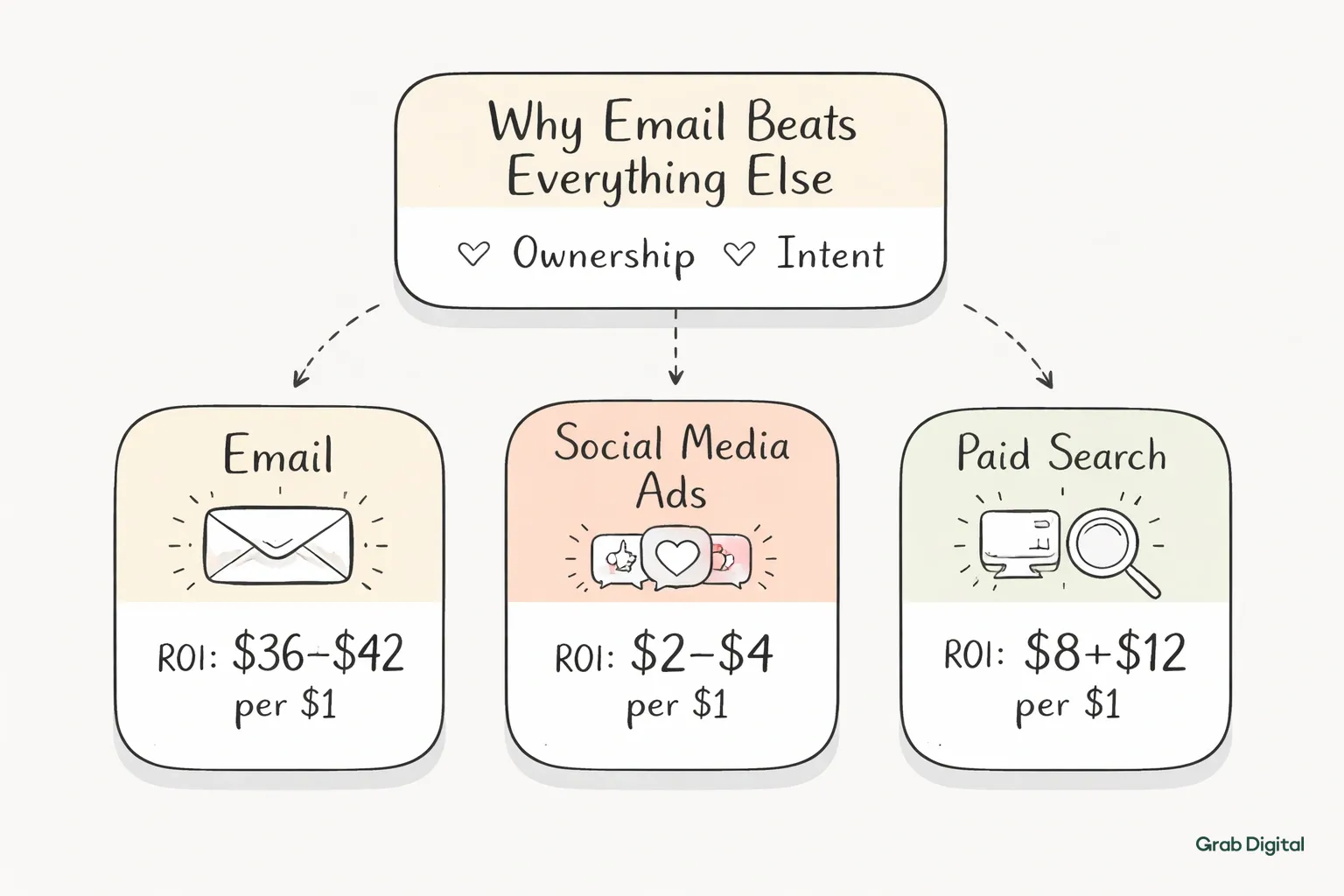
Email returns $36–$42 for every dollar spent. Social media ads? You're lucky to get $2–$4. Paid search? $8–$12 on a good day. The gap comes down to two things: ownership and intent.
You own your email list. Instagram can nuke your account tomorrow. Google can triple your CPCs next week. Your email list stays yours no algorithm decides who sees what.
Intent matters too. Someone who hands over their email address is raising their hand. They want to hear from you. That's different from interrupting someone's TikTok scroll with a product ad they didn't ask for.
Higher intent, lower cost, full ownership. That's why smart DTC brands prioritize email before pouring money into paid acquisition.
The 8 Core Flows You Actually Need
Automated flows do the heavy lifting. They trigger based on what customers do and run without you touching them. Here are the eight that matter:
Welcome Series New subscribers get introduced to your brand story, best-sellers, and value proposition. Send 3–5 emails over 7–10 days. First email immediately. Discount code in email two. Testimonials in email three.
A solid welcome series converts 30–50% of new subscribers into customers within the first month.
Abandoned Cart This recovers 15–25% of lost sales. Three emails: one hour after abandonment, 24 hours later, 48 hours after that. Show product images, handle objections, offer help if they're stuck.
A well-built abandoned cart flow adds $50K–$200K annually for a brand doing $3M–$5M. That's not nothing.
Browse Abandonment Target people who viewed products but never added to cart. Send one email 4–6 hours later showing exactly what they looked at. Add social proof. Create some urgency.
Setting this up in Klaviyo takes 30 minutes and typically generates 5–8% more revenue.
Checkout Abandonment Not the same as cart abandonment. These people started entering payment info and bailed. They're close. Send two emails within two hours, then 24 hours later.
Remove friction. Offer support. Make shipping and returns clear. These convert at 40–60%.
Post-Purchase This is where you reduce returns, get reviews, and set up the next purchase. Thank-you email immediately. Shipping updates. Product care tips. Review request 14 days after delivery.
For consumables, add a replenishment reminder. For durables, cross-sell something complementary.
Win-Back Re-engage people who haven't bought in 90–180 days. Remind them what they liked. Offer a reason to come back. Make it feel personal.
Test "We miss you" against "Here's 20% off to come back." A good winback flow recovers 8–12% of lapsed customers.
Sunset Clean your list. Suppress subscribers who haven't engaged in 6+ months. Send one final "Still want to hear from us?" email. If they don't click, remove them.
Your deliverability depends on this. Your sender reputation depends on this.
Customer Anniversary Celebrate their first purchase or signup date. Send something personal with a special offer. These convert at 25–35% and generate genuine goodwill.
These flows should work together, not in silos. A good agency can orchestrate them into something cohesive.
Campaigns: Beyond "Big Sale This Weekend"
Campaigns are broadcast emails messages you send to segments of your list at specific times. They complement flows and create short-term revenue spikes.
How Often to Send Most profitable DTC brands send 4–6 campaigns per month. Call it one every 5–7 days. Consistency beats volume here. Send on predictable days and subscribers start expecting you.
The 60/30/10 Mix
- 60% promotional: new products, sales, limited offers
- 30% educational: how-to guides, styling tips, ingredient breakdowns
- 10% community: brand stories, sustainability stuff, customer spotlights
This keeps people engaged without exhausting them with constant sales.
Segment or Waste Your Time Blasting your entire list underperforms by 40–60%. Don't do it. Segment by:
- Purchase history (VIPs, one-timers, never-buyers)
- Engagement (active, lukewarm, cold)
- Product preferences (what they've browsed or bought)
- Demographics if relevant (location, age, gender)
Klaviyo makes this segmentation pretty straightforward with predictive analytics and dynamic lists.
Design That Works on Phones
Your emails need to look like your brand and work on mobile. In 2026, 68% of opens happen on phones.
One Column Multiple columns break on mobile. Stick to one. Images should be big enough to see but compressed enough to load.
One Clear CTA Each email has one primary action. Make that button obvious contrasting color, above the fold. Secondary CTAs go lower and shouldn't compete.
Hero vs. Grid Test both. Hero images for storytelling and seasonal campaigns. Product grids for cross-selling. Most brands use heroes for new arrivals and grids for replenishment.
Match Your Brand Use your fonts, colors, tone. Subscribers should know it's you before reading the sender name. That consistency builds trust.
Accessibility Isn't Optional Alt text on all images. Decent color contrast. Font size at 16px minimum for body text. This helps deliverability and opens you to more customers.
Growing Your List Without Buying Sketchy Contacts
You need 10,000+ engaged subscribers before email moves the revenue needle. Here's how to get them.
Popup Optimization Your website popup does most of the work. Test timing (scroll depth vs. time on site), test the offer (discount vs. free shipping vs. exclusive content), test design.
Best approach for 2026: intent-based triggers. Show the popup when someone adds to cart or spends 60+ seconds on a product page. Exit-intent still works but converts 20–30% worse than behavior triggers.
Lead Magnets That Aren't Just Discounts Not everyone needs a coupon to subscribe. Try:
- Size guides and fit finders (apparel)
- Care instructions (leather goods, furniture)
- Ingredient glossaries (skincare, supplements)
- Style quizzes that lead to recommendations
These attract people who actually care about your products not just bargain hunters.
Gated Content Build something valuable a guide, lookbook, video series and require an email to access it. Works well for technical or educational products.
Post-Purchase Capture If someone buys without subscribing, add them to a post-purchase welcome series. Be clear they're subscribed. Let them manage preferences or unsubscribe easily.
Referrals Existing subscribers can refer friends for store credit or exclusive perks. Email still gets shared more than any social post.
Deliverability: The Thing That Kills Your Revenue Quietly
Deliverability determines whether you hit the inbox or land in spam. Bad deliverability can cut your revenue in half overnight. I've seen it happen.
Authentication SPF, DKIM, and DMARC aren't optional in 2026. They verify your emails actually come from your domain. Gmail and Outlook will throttle or block sends without them.
On Klaviyo, these are easy to set up through DNS. Do it once. Verify quarterly.
Sender Reputation ISPs watch how you send. High bounces, spam complaints, low engagement they all damage your reputation. Clean your list. Kill hard bounces immediately. Suppress unengaged subscribers every 90 days.
Regular list cleaning protects your sender score. It's not exciting work, but it matters.
Engagement Signals Opens, clicks, replies these tell ISPs people want your emails. Low engagement signals spam. Fix it by:
- Sending to people who actually want to hear from you
- Writing subject lines worth opening
- Delivering consistent value
- Removing people who've stopped caring
Spam Triggers Words like "FREE!!!" and "Act now" trigger filters, especially when overused. Write like a human. Focus on benefits, not hype.
Copy That Gets Clicks
Your copy bridges the open and the click. Strong copy respects time and communicates value quickly.
Subject Lines Good subject lines use curiosity, urgency, personalization, or direct benefit. Test these:
- "The one ingredient we'll never use"
- "24 hours left: your exclusive preview"
- "Sarah, your cart is waiting"
- "Finally a wallet that lasts 10+ years"
Keep it under 50 characters. Mobile truncates everything longer.
Preview Text Don't waste it. Extend your subject line or add context. Bad: "View this email in your browser" Good: "Plus free shipping on all orders this weekend"
Body Copy
- Lead with benefit, not feature
- Short sentences, short paragraphs
- Write in second person ("you" and "your")
- One primary CTA per email
- Clear next step at the end
Storytelling Works E-commerce emails don't have to be transactional. Share founder stories, customer wins, behind-the-scenes moments. Grab Digital's client Rogue Industries increased engagement 40% by putting craftsman stories into product launches.
Attribution: Proving Email's Value
Klaviyo tracks how much revenue your emails generate. You need to understand this if you're going to scale or justify the investment.
How Klaviyo Attributes Last-click attribution within 5 days. Someone clicks an email and buys within five days? That sale counts as email revenue. This model undercounts email's influence but gives you a conservative baseline.
Monthly Metrics That Matter
- Revenue per recipient: Total email revenue ÷ recipients. Target $1.50–$3.00.
- Conversion rate: Clicks that become purchases. Target 3–6%.
- AOV from email: Compare to site-wide AOV. Email subscribers usually spend 15–25% more.
- List growth rate: (New subscribers − unsubscribes/bounces) ÷ list size. Target 3–5% monthly.
- Engagement rate: (Opens + clicks) ÷ delivered. Target 25–40%.
Flows vs. Campaigns Separate these in your reporting. Flows should drive 60–70% of email revenue. Campaigns, 30–40%. If campaigns are doing more, your flows need work.
The Real Impact: Incrementality Holdout tests show the truth. Suppress 10% of your list from all emails for 30 days. Compare their purchase behavior to the 90% who got emails. The difference is incrementality revenue you wouldn't have without email.
Most brands find email drives 35–50% more revenue than last-click attribution shows.
When to Do It Yourself vs. Hire Someone
Brands under $500K can usually handle email in-house with a founder or generalist running it. Once you pass $1M, email becomes too valuable to treat as a side project.
You Need Help If:
- Email is under 20% of revenue
- You send fewer than 4 campaigns per month
- You have fewer than 5 automated flows
- Open rates are dropping quarter over quarter
- You don't have time to test and optimize
- You're not sure how to segment
A dedicated Klaviyo agency gives you specialists strategist, copywriter, designer, implementer who own the channel. Brands doing $1M–$10M typically add $300K–$1M in annual email revenue.
What an Agency Should Do
- Full audit and 90-day roadmap
- Design and implement all core flows
- Write, design, send 4–6 campaigns monthly
- A/B test subject lines, send times, content
- Clean your list, monitor deliverability
- Monthly reporting with insights you can act on
- Unlimited revisions, fast turnaround
The best ones guarantee results. Grab Digital offers 10% revenue growth within 60 days or a full refund. If you're serious about scaling email, book a consultation.
Klaviyo vs. Mailchimp vs. Shopify Email
Not all platforms are built for e-commerce. Here's how they compare in 2026.
Klaviyo Built for e-commerce. Deep Shopify integration, advanced segmentation, predictive analytics, strong deliverability. Pricing scales with list size but ROI usually justifies it.
Use this if you're doing $500K+ and want sophisticated automation.
Mailchimp General-purpose. Easier to learn but limited for e-commerce. Segmentation is basic. Reporting is shallow. Deliverability has gotten worse.
Use this for content creators, service businesses, or very early-stage brands under $250K.
Shopify Email Native to Shopify. Cheap and simple. Basic campaigns and a few flow templates. No advanced segmentation. Minimal reporting.
Use this if you're just starting and want the absolute simplest setup.
For serious e-commerce email, Klaviyo wins. It's the only one built specifically for DTC brands.
Advanced Stuff: Personalization and Predictive Sending
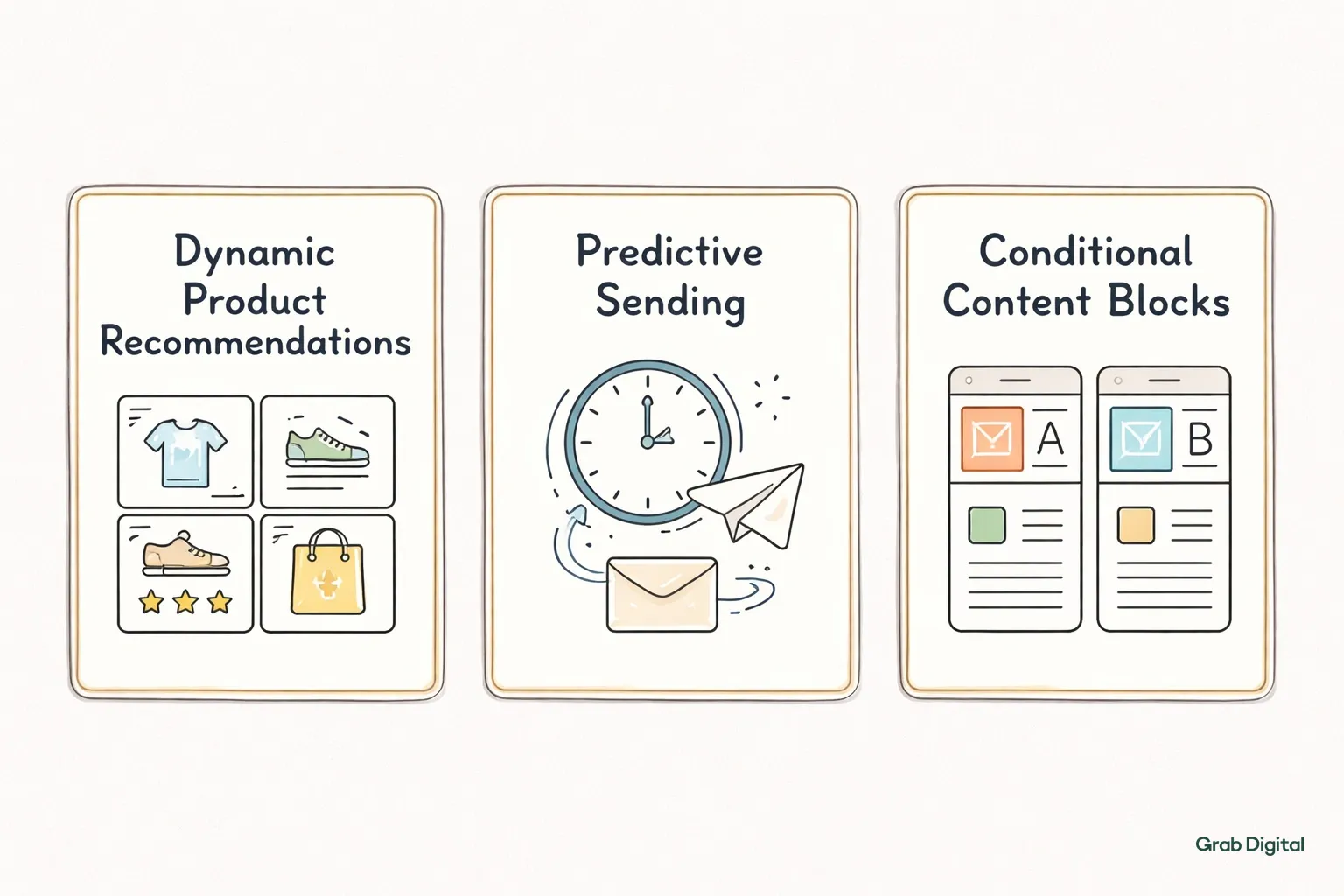
Once the basics are solid flows running, campaigns consistent, list growing add advanced tactics.
Dynamic Product Recommendations Klaviyo's AI inserts personalized recommendations based on browsing and purchase history. Show each subscriber what they're most likely to buy.
This raises email AOV by 15–25% without extra sends.
Predictive Sending Send when each subscriber is most likely to open. Klaviyo's Smart Send Time analyzes behavior and optimizes timing per person.
Brands using this see 8–12% higher open rates.
Conditional Content Blocks Show different content in the same email based on subscriber attributes. VIPs get early access. First-time buyers get how-to guides. Lapsed customers get win-back offers.
Fewer campaigns to build, more relevance per send.
Geolocation Segment by location. Promote region-specific products, events, weather-appropriate items. A furniture brand could push outdoor pieces to warm climates and indoor pieces to cold ones same email, different content.
Lifecycle Automation Move subscribers through stages automatically: prospect → first-time buyer → repeat customer → VIP → at-risk → lapsed. Message each stage differently.
This can raise lifetime value 30–50% compared to one-size-fits-all.
Compliance and Privacy
CAN-SPAM, GDPR, and CCPA all govern how you collect, store, and use email addresses. 2026 isn't the time to get sloppy here.
Consent Requirements
- CAN-SPAM (US): Clear unsubscribe links, accurate sender info. Doesn't require explicit opt-in.
- GDPR (EU): Explicit affirmative consent. Pre-checked boxes don't count.
- CCPA (California): Consumers can know what data you collect and request deletion.
Sell internationally? Follow GDPR across your entire list. It's the strictest.
Unsubscribe Best Practices Make it easy. Visible link in every footer. Process immediately. No login required, no confirmation step.
Forcing people to stay subscribed hurts deliverability and your reputation.
Data Security Use encrypted platforms like Klaviyo. Don't sell or share addresses without explicit permission.
Your privacy practices should be transparent and understandable.
Connecting Everything Else
E-commerce email works best when integrated with your other tools.
Shopify + Klaviyo The integration syncs customer data, orders, products, refunds automatically. This powers personalized flows and dynamic content.
Takes 10 minutes to set up. Unlocks everything.
Direct Mail Email plus direct mail can boost conversions 20–30% for high-value segments. Send postcards to VIPs, handwritten notes to big first purchases.
Klaviyo integrates with Postal.io and PostPilot for behavior-triggered mail.
SMS SMS and email should complement each other. SMS for time-sensitive stuff and shipping updates. Email for storytelling and longer content.
Klaviyo handles both, which makes coordination easier.
Loyalty Programs Connect Smile.io, LoyaltyLion, or Yotpo to send point reminders, tier upgrades, exclusive rewards.
Subscriptions For subscription brands, connect Recharge or Skio for subscription-specific flows: shipment reminders, pause prevention, churn reduction, upsells.
These integrations turn email into your marketing hub, connecting every touchpoint.
Mistakes I See Constantly
Even good brands mess these up. Fix them and you'll beat 80% of competitors.
Ignoring list hygiene Sending to unengaged subscribers destroys deliverability. Clean quarterly. Suppress anyone who hasn't opened in 180+ days.
Not testing flows Flows break. Products get discontinued. Links rot. Review every flow monthly. Send test emails. Click everything.
Overcomplicating design Fancy animations and complex layouts usually hurt performance. Simple, mobile-friendly, fast-loading wins.
Hiding the unsubscribe link It's legally required and good for deliverability. Make it visible. Don't bury it in tiny gray text.
Blasting the entire list Segmentation isn't optional. Same message to everyone underperforms by 40–60%. Use segments to tailor messages.
Not testing subject lines A/B test on every campaign. Small open rate improvements compound into thousands of dollars.
Sending without a purpose Every email needs one clear goal: drive a purchase, get feedback, build loyalty. If you can't state the goal, don't send.
How Much Revenue Should Email Drive?
For established DTC brands, 25–40% of total revenue. Here's the math.
Baseline Calculation
- 25,000 subscribers
- $2.00 revenue per recipient monthly
- $50,000 monthly email revenue
- $600,000 annual email revenue
If your total revenue is $2M, email is contributing 30% right on target. If it's $3M and email is 20%, you're underperforming.
By List Size
- 10K subscribers: $150K–$300K annual email revenue
- 25K subscribers: $400K–$750K
- 50K subscribers: $900K–$1.5M
- 100K subscribers: $2M–$3.5M
These assume moderate engagement, proper segmentation, and full flows.
Fixing Underperforming Email
- Implement all 8 core flows
- Send 4–6 campaigns monthly
- Segment by engagement and purchase behavior
- Test subject lines and CTAs
- Clean your list
Or work with an agency that guarantees results.
Quarterly Checklist
Audit your program every quarter:
Foundations
- SPF, DKIM, DMARC configured
- Branded sender name and email
- Klaviyo or similar platform
- Shopify integration active
List Growth
- Optimized popup
- Lead magnet available
- Post-purchase capture enabled
- Growing 3–5% monthly
Flows
- Welcome series (3–5 emails)
- Abandoned cart (3 emails)
- Browse abandonment (1 email)
- Checkout abandonment (2 emails)
- Post-purchase (3–4 emails)
- Win-back (2–3 emails)
- Sunset (1–2 emails)
- Customer anniversary (1 email)
Campaigns
- 4–6 sends monthly
- Segmented sends
- A/B tested subject lines
- 60/30/10 content mix
Deliverability
- Quarterly list cleaning
- Hard bounces removed immediately
- Engagement rate above 25%
- Spam complaints below 0.1%
Measurement
- Revenue per recipient tracked
- Flow performance reviewed monthly
- Campaign performance reviewed weekly
- Email at 25–40% of total revenue
Missing more than three? Email is probably underperforming. Get help and turn it around in 60–90 days.
Frequently Asked Questions
How often should I send?
Most profitable DTC brands send 4–6 campaigns per month roughly one every 5–7 days. That's enough to stay top-of-mind without overwhelming people. Flows run separately based on behavior, so don't count those. Test with your audience. Some can handle 8–10 monthly; others want fewer.
Flows vs. campaigns what's the difference?
Flows trigger automatically when someone takes an action: signs up, abandons a cart, buys something. They run in the background. Campaigns are one-time broadcasts you send manually to segments weekend sales, product launches. Flows typically drive 60–70% of email revenue; campaigns do 30–40%.
How do I stay out of spam?
Set up SPF, DKIM, DMARC authentication. Clean your list quarterly remove people who haven't opened in 180+ days. Run a sunset flow to suppress inactive contacts. Avoid spam trigger words. Monitor your sender reputation in Klaviyo. Segment sends to engaged subscribers ISPs notice when people actually want your emails.
Is Klaviyo worth it compared to cheaper platforms?
For e-commerce brands doing $500K+, yes. The advanced segmentation, predictive analytics, and Shopify integration generate way more revenue than Mailchimp or basic platforms. Most brands see 25–40% higher email revenue after switching. The cost scales with list size, but ROI usually pays for itself within 90 days. Klaviyo was built for DTC not for general email marketing.
What metrics matter?
Revenue per recipient (target $1.50–$3.00 monthly), email-attributed revenue as percentage of total (target 25–40%), conversion rate (3–6%), AOV from email. Also watch list growth rate (3–5% monthly), engagement rate (25–40%), and flow vs. campaign split. Klaviyo surfaces all of this automatically.
How do I grow my list without constant discounts?
Build lead magnets: size guides, care instructions, ingredient glossaries, style quizzes. Use behavior-based popup triggers show when someone adds to cart or spends time on a product page. Gate premium content behind signup. Capture emails at checkout and add buyers to a post-purchase series. Attract people who care about your brand, not just deal-hunters.
E-commerce email marketing turns subscribers into paying customers through automated flows and targeted campaigns. Done right, it drives 25–40% of total revenue for DTC brands. It's also the highest-ROI channel you've got.
Most DTC brands treat email as an afterthought. They dump sale announcements and product launches into it and call it a day. That's wasteful. When you actually build it out properly, email becomes your most reliable revenue driver nurturing leads, recovering abandoned carts, and turning one-time buyers into repeat customers. For brands doing $1M–$10M annually, email should account for at least 30% of total revenue. If you're not hitting that, something's broken.
Why Email Beats Everything Else
Email returns $36–$42 for every dollar spent. Social media ads? You're lucky to get $2–$4. Paid search? $8–$12 on a good day. The gap comes down to two things: ownership and intent.
You own your email list. Instagram can nuke your account tomorrow. Google can triple your CPCs next week. Your email list stays yours no algorithm decides who sees what.
Intent matters too. Someone who hands over their email address is raising their hand. They want to hear from you. That's different from interrupting someone's TikTok scroll with a product ad they didn't ask for.
Higher intent, lower cost, full ownership. That's why smart DTC brands prioritize email before pouring money into paid acquisition.
The 8 Core Flows You Actually Need
Automated flows do the heavy lifting. They trigger based on what customers do and run without you touching them. Here are the eight that matter:
Welcome Series New subscribers get introduced to your brand story, best-sellers, and value proposition. Send 3–5 emails over 7–10 days. First email immediately. Discount code in email two. Testimonials in email three.
A solid welcome series converts 30–50% of new subscribers into customers within the first month.
Abandoned Cart This recovers 15–25% of lost sales. Three emails: one hour after abandonment, 24 hours later, 48 hours after that. Show product images, handle objections, offer help if they're stuck.
A well-built abandoned cart flow adds $50K–$200K annually for a brand doing $3M–$5M. That's not nothing.
Browse Abandonment Target people who viewed products but never added to cart. Send one email 4–6 hours later showing exactly what they looked at. Add social proof. Create some urgency.
Setting this up in Klaviyo takes 30 minutes and typically generates 5–8% more revenue.
Checkout Abandonment Not the same as cart abandonment. These people started entering payment info and bailed. They're close. Send two emails within two hours, then 24 hours later.
Remove friction. Offer support. Make shipping and returns clear. These convert at 40–60%.
Post-Purchase This is where you reduce returns, get reviews, and set up the next purchase. Thank-you email immediately. Shipping updates. Product care tips. Review request 14 days after delivery.
For consumables, add a replenishment reminder. For durables, cross-sell something complementary.
Win-Back Re-engage people who haven't bought in 90–180 days. Remind them what they liked. Offer a reason to come back. Make it feel personal.
Test "We miss you" against "Here's 20% off to come back." A good winback flow recovers 8–12% of lapsed customers.
Sunset Clean your list. Suppress subscribers who haven't engaged in 6+ months. Send one final "Still want to hear from us?" email. If they don't click, remove them.
Your deliverability depends on this. Your sender reputation depends on this.
Customer Anniversary Celebrate their first purchase or signup date. Send something personal with a special offer. These convert at 25–35% and generate genuine goodwill.
These flows should work together, not in silos. A good agency can orchestrate them into something cohesive.
Campaigns: Beyond "Big Sale This Weekend"
Campaigns are broadcast emails messages you send to segments of your list at specific times. They complement flows and create short-term revenue spikes.
How Often to Send Most profitable DTC brands send 4–6 campaigns per month. Call it one every 5–7 days. Consistency beats volume here. Send on predictable days and subscribers start expecting you.
The 60/30/10 Mix
- 60% promotional: new products, sales, limited offers
- 30% educational: how-to guides, styling tips, ingredient breakdowns
- 10% community: brand stories, sustainability stuff, customer spotlights
This keeps people engaged without exhausting them with constant sales.
Segment or Waste Your Time Blasting your entire list underperforms by 40–60%. Don't do it. Segment by:
- Purchase history (VIPs, one-timers, never-buyers)
- Engagement (active, lukewarm, cold)
- Product preferences (what they've browsed or bought)
- Demographics if relevant (location, age, gender)
Klaviyo makes this segmentation pretty straightforward with predictive analytics and dynamic lists.
Design That Works on Phones
Your emails need to look like your brand and work on mobile. In 2026, 68% of opens happen on phones.
One Column Multiple columns break on mobile. Stick to one. Images should be big enough to see but compressed enough to load.
One Clear CTA Each email has one primary action. Make that button obvious contrasting color, above the fold. Secondary CTAs go lower and shouldn't compete.
Hero vs. Grid Test both. Hero images for storytelling and seasonal campaigns. Product grids for cross-selling. Most brands use heroes for new arrivals and grids for replenishment.
Match Your Brand Use your fonts, colors, tone. Subscribers should know it's you before reading the sender name. That consistency builds trust.
Accessibility Isn't Optional Alt text on all images. Decent color contrast. Font size at 16px minimum for body text. This helps deliverability and opens you to more customers.
Growing Your List Without Buying Sketchy Contacts
You need 10,000+ engaged subscribers before email moves the revenue needle. Here's how to get them.
Popup Optimization Your website popup does most of the work. Test timing (scroll depth vs. time on site), test the offer (discount vs. free shipping vs. exclusive content), test design.
Best approach for 2026: intent-based triggers. Show the popup when someone adds to cart or spends 60+ seconds on a product page. Exit-intent still works but converts 20–30% worse than behavior triggers.
Lead Magnets That Aren't Just Discounts Not everyone needs a coupon to subscribe. Try:
- Size guides and fit finders (apparel)
- Care instructions (leather goods, furniture)
- Ingredient glossaries (skincare, supplements)
- Style quizzes that lead to recommendations
These attract people who actually care about your products not just bargain hunters.
Gated Content Build something valuable a guide, lookbook, video series and require an email to access it. Works well for technical or educational products.
Post-Purchase Capture If someone buys without subscribing, add them to a post-purchase welcome series. Be clear they're subscribed. Let them manage preferences or unsubscribe easily.
Referrals Existing subscribers can refer friends for store credit or exclusive perks. Email still gets shared more than any social post.
Deliverability: The Thing That Kills Your Revenue Quietly
Deliverability determines whether you hit the inbox or land in spam. Bad deliverability can cut your revenue in half overnight. I've seen it happen.
Authentication SPF, DKIM, and DMARC aren't optional in 2026. They verify your emails actually come from your domain. Gmail and Outlook will throttle or block sends without them.
On Klaviyo, these are easy to set up through DNS. Do it once. Verify quarterly.
Sender Reputation ISPs watch how you send. High bounces, spam complaints, low engagement they all damage your reputation. Clean your list. Kill hard bounces immediately. Suppress unengaged subscribers every 90 days.
Regular list cleaning protects your sender score. It's not exciting work, but it matters.
Engagement Signals Opens, clicks, replies these tell ISPs people want your emails. Low engagement signals spam. Fix it by:
- Sending to people who actually want to hear from you
- Writing subject lines worth opening
- Delivering consistent value
- Removing people who've stopped caring
Spam Triggers Words like "FREE!!!" and "Act now" trigger filters, especially when overused. Write like a human. Focus on benefits, not hype.
Copy That Gets Clicks
Your copy bridges the open and the click. Strong copy respects time and communicates value quickly.
Subject Lines Good subject lines use curiosity, urgency, personalization, or direct benefit. Test these:
- "The one ingredient we'll never use"
- "24 hours left: your exclusive preview"
- "Sarah, your cart is waiting"
- "Finally a wallet that lasts 10+ years"
Keep it under 50 characters. Mobile truncates everything longer.
Preview Text Don't waste it. Extend your subject line or add context. Bad: "View this email in your browser" Good: "Plus free shipping on all orders this weekend"
Body Copy
- Lead with benefit, not feature
- Short sentences, short paragraphs
- Write in second person ("you" and "your")
- One primary CTA per email
- Clear next step at the end
Storytelling Works E-commerce emails don't have to be transactional. Share founder stories, customer wins, behind-the-scenes moments. Grab Digital's client Rogue Industries increased engagement 40% by putting craftsman stories into product launches.
Attribution: Proving Email's Value
Klaviyo tracks how much revenue your emails generate. You need to understand this if you're going to scale or justify the investment.
How Klaviyo Attributes Last-click attribution within 5 days. Someone clicks an email and buys within five days? That sale counts as email revenue. This model undercounts email's influence but gives you a conservative baseline.
Monthly Metrics That Matter
- Revenue per recipient: Total email revenue ÷ recipients. Target $1.50–$3.00.
- Conversion rate: Clicks that become purchases. Target 3–6%.
- AOV from email: Compare to site-wide AOV. Email subscribers usually spend 15–25% more.
- List growth rate: (New subscribers − unsubscribes/bounces) ÷ list size. Target 3–5% monthly.
- Engagement rate: (Opens + clicks) ÷ delivered. Target 25–40%.
Flows vs. Campaigns Separate these in your reporting. Flows should drive 60–70% of email revenue. Campaigns, 30–40%. If campaigns are doing more, your flows need work.
The Real Impact: Incrementality Holdout tests show the truth. Suppress 10% of your list from all emails for 30 days. Compare their purchase behavior to the 90% who got emails. The difference is incrementality revenue you wouldn't have without email.
Most brands find email drives 35–50% more revenue than last-click attribution shows.
When to Do It Yourself vs. Hire Someone
Brands under $500K can usually handle email in-house with a founder or generalist running it. Once you pass $1M, email becomes too valuable to treat as a side project.
You Need Help If:
- Email is under 20% of revenue
- You send fewer than 4 campaigns per month
- You have fewer than 5 automated flows
- Open rates are dropping quarter over quarter
- You don't have time to test and optimize
- You're not sure how to segment
A dedicated Klaviyo agency gives you specialists strategist, copywriter, designer, implementer who own the channel. Brands doing $1M–$10M typically add $300K–$1M in annual email revenue.
What an Agency Should Do
- Full audit and 90-day roadmap
- Design and implement all core flows
- Write, design, send 4–6 campaigns monthly
- A/B test subject lines, send times, content
- Clean your list, monitor deliverability
- Monthly reporting with insights you can act on
- Unlimited revisions, fast turnaround
The best ones guarantee results. Grab Digital offers 10% revenue growth within 60 days or a full refund. If you're serious about scaling email, book a consultation.
Klaviyo vs. Mailchimp vs. Shopify Email
Not all platforms are built for e-commerce. Here's how they compare in 2026.
Klaviyo Built for e-commerce. Deep Shopify integration, advanced segmentation, predictive analytics, strong deliverability. Pricing scales with list size but ROI usually justifies it.
Use this if you're doing $500K+ and want sophisticated automation.
Mailchimp General-purpose. Easier to learn but limited for e-commerce. Segmentation is basic. Reporting is shallow. Deliverability has gotten worse.
Use this for content creators, service businesses, or very early-stage brands under $250K.
Shopify Email Native to Shopify. Cheap and simple. Basic campaigns and a few flow templates. No advanced segmentation. Minimal reporting.
Use this if you're just starting and want the absolute simplest setup.
For serious e-commerce email, Klaviyo wins. It's the only one built specifically for DTC brands.
Advanced Stuff: Personalization and Predictive Sending
Once the basics are solid flows running, campaigns consistent, list growing add advanced tactics.
Dynamic Product Recommendations Klaviyo's AI inserts personalized recommendations based on browsing and purchase history. Show each subscriber what they're most likely to buy.
This raises email AOV by 15–25% without extra sends.
Predictive Sending Send when each subscriber is most likely to open. Klaviyo's Smart Send Time analyzes behavior and optimizes timing per person.
Brands using this see 8–12% higher open rates.
Conditional Content Blocks Show different content in the same email based on subscriber attributes. VIPs get early access. First-time buyers get how-to guides. Lapsed customers get win-back offers.
Fewer campaigns to build, more relevance per send.
Geolocation Segment by location. Promote region-specific products, events, weather-appropriate items. A furniture brand could push outdoor pieces to warm climates and indoor pieces to cold ones same email, different content.
Lifecycle Automation Move subscribers through stages automatically: prospect → first-time buyer → repeat customer → VIP → at-risk → lapsed. Message each stage differently.
This can raise lifetime value 30–50% compared to one-size-fits-all.
Compliance and Privacy
CAN-SPAM, GDPR, and CCPA all govern how you collect, store, and use email addresses. 2026 isn't the time to get sloppy here.
Consent Requirements
- CAN-SPAM (US): Clear unsubscribe links, accurate sender info. Doesn't require explicit opt-in.
- GDPR (EU): Explicit affirmative consent. Pre-checked boxes don't count.
- CCPA (California): Consumers can know what data you collect and request deletion.
Sell internationally? Follow GDPR across your entire list. It's the strictest.
Unsubscribe Best Practices Make it easy. Visible link in every footer. Process immediately. No login required, no confirmation step.
Forcing people to stay subscribed hurts deliverability and your reputation.
Data Security Use encrypted platforms like Klaviyo. Don't sell or share addresses without explicit permission.
Your privacy practices should be transparent and understandable.
Connecting Everything Else
E-commerce email works best when integrated with your other tools.
Shopify + Klaviyo The integration syncs customer data, orders, products, refunds automatically. This powers personalized flows and dynamic content.
Takes 10 minutes to set up. Unlocks everything.
Direct Mail Email plus direct mail can boost conversions 20–30% for high-value segments. Send postcards to VIPs, handwritten notes to big first purchases.
Klaviyo integrates with Postal.io and PostPilot for behavior-triggered mail.
SMS SMS and email should complement each other. SMS for time-sensitive stuff and shipping updates. Email for storytelling and longer content.
Klaviyo handles both, which makes coordination easier.
Loyalty Programs Connect Smile.io, LoyaltyLion, or Yotpo to send point reminders, tier upgrades, exclusive rewards.
Subscriptions For subscription brands, connect Recharge or Skio for subscription-specific flows: shipment reminders, pause prevention, churn reduction, upsells.
These integrations turn email into your marketing hub, connecting every touchpoint.
Mistakes I See Constantly
Even good brands mess these up. Fix them and you'll beat 80% of competitors.
Ignoring list hygiene Sending to unengaged subscribers destroys deliverability. Clean quarterly. Suppress anyone who hasn't opened in 180+ days.
Not testing flows Flows break. Products get discontinued. Links rot. Review every flow monthly. Send test emails. Click everything.
Overcomplicating design Fancy animations and complex layouts usually hurt performance. Simple, mobile-friendly, fast-loading wins.
Hiding the unsubscribe link It's legally required and good for deliverability. Make it visible. Don't bury it in tiny gray text.
Blasting the entire list Segmentation isn't optional. Same message to everyone underperforms by 40–60%. Use segments to tailor messages.
Not testing subject lines A/B test on every campaign. Small open rate improvements compound into thousands of dollars.
Sending without a purpose Every email needs one clear goal: drive a purchase, get feedback, build loyalty. If you can't state the goal, don't send.
How Much Revenue Should Email Drive?
For established DTC brands, 25–40% of total revenue. Here's the math.
Baseline Calculation
- 25,000 subscribers
- $2.00 revenue per recipient monthly
- $50,000 monthly email revenue
- $600,000 annual email revenue
If your total revenue is $2M, email is contributing 30% right on target. If it's $3M and email is 20%, you're underperforming.
By List Size
- 10K subscribers: $150K–$300K annual email revenue
- 25K subscribers: $400K–$750K
- 50K subscribers: $900K–$1.5M
- 100K subscribers: $2M–$3.5M
These assume moderate engagement, proper segmentation, and full flows.
Fixing Underperforming Email
- Implement all 8 core flows
- Send 4–6 campaigns monthly
- Segment by engagement and purchase behavior
- Test subject lines and CTAs
- Clean your list
Or work with an agency that guarantees results.
Quarterly Checklist
Audit your program every quarter:
Foundations
- SPF, DKIM, DMARC configured
- Branded sender name and email
- Klaviyo or similar platform
- Shopify integration active
List Growth
- Optimized popup
- Lead magnet available
- Post-purchase capture enabled
- Growing 3–5% monthly
Flows
- Welcome series (3–5 emails)
- Abandoned cart (3 emails)
- Browse abandonment (1 email)
- Checkout abandonment (2 emails)
- Post-purchase (3–4 emails)
- Win-back (2–3 emails)
- Sunset (1–2 emails)
- Customer anniversary (1 email)
Campaigns
- 4–6 sends monthly
- Segmented sends
- A/B tested subject lines
- 60/30/10 content mix
Deliverability
- Quarterly list cleaning
- Hard bounces removed immediately
- Engagement rate above 25%
- Spam complaints below 0.1%
Measurement
- Revenue per recipient tracked
- Flow performance reviewed monthly
- Campaign performance reviewed weekly
- Email at 25–40% of total revenue
Missing more than three? Email is probably underperforming. Get help and turn it around in 60–90 days.
Frequently Asked Questions
How often should I send?
Most profitable DTC brands send 4–6 campaigns per month roughly one every 5–7 days. That's enough to stay top-of-mind without overwhelming people. Flows run separately based on behavior, so don't count those. Test with your audience. Some can handle 8–10 monthly; others want fewer.
Flows vs. campaigns what's the difference?
Flows trigger automatically when someone takes an action: signs up, abandons a cart, buys something. They run in the background. Campaigns are one-time broadcasts you send manually to segments weekend sales, product launches. Flows typically drive 60–70% of email revenue; campaigns do 30–40%.
How do I stay out of spam?
Set up SPF, DKIM, DMARC authentication. Clean your list quarterly remove people who haven't opened in 180+ days. Run a sunset flow to suppress inactive contacts. Avoid spam trigger words. Monitor your sender reputation in Klaviyo. Segment sends to engaged subscribers ISPs notice when people actually want your emails.
Is Klaviyo worth it compared to cheaper platforms?
For e-commerce brands doing $500K+, yes. The advanced segmentation, predictive analytics, and Shopify integration generate way more revenue than Mailchimp or basic platforms. Most brands see 25–40% higher email revenue after switching. The cost scales with list size, but ROI usually pays for itself within 90 days. Klaviyo was built for DTC not for general email marketing.
What metrics matter?
Revenue per recipient (target $1.50–$3.00 monthly), email-attributed revenue as percentage of total (target 25–40%), conversion rate (3–6%), AOV from email. Also watch list growth rate (3–5% monthly), engagement rate (25–40%), and flow vs. campaign split. Klaviyo surfaces all of this automatically.
How do I grow my list without constant discounts?
Build lead magnets: size guides, care instructions, ingredient glossaries, style quizzes. Use behavior-based popup triggers show when someone adds to cart or spends time on a product page. Gate premium content behind signup. Capture emails at checkout and add buyers to a post-purchase series. Attract people who care about your brand, not just deal-hunters.

Find out exactly what your email channel is leaving on the table.

Email Marketing for Scaling DTC Brands


