
Summary
Crafting High-Converting Cart Abandonment Subject Lines 2026
You have about three seconds. That's how long the average DTC shopper gives your subject line before swiping it into the void. You can write the most brilliant email copy in the world, have a killer discount, and design a layout that converts at 10% none of it matters if the subject line flops.
Cart abandonment bleeds DTC brands dry. Billions, annually. Email is still the cheapest way to plug that leak, and Klaviyo's data backs this up: abandoned cart flows are almost always the highest-revenue automation in an account. The subject line is the lever that makes the math work.
Why Subject Lines Are a Deliverability Issue in 2026
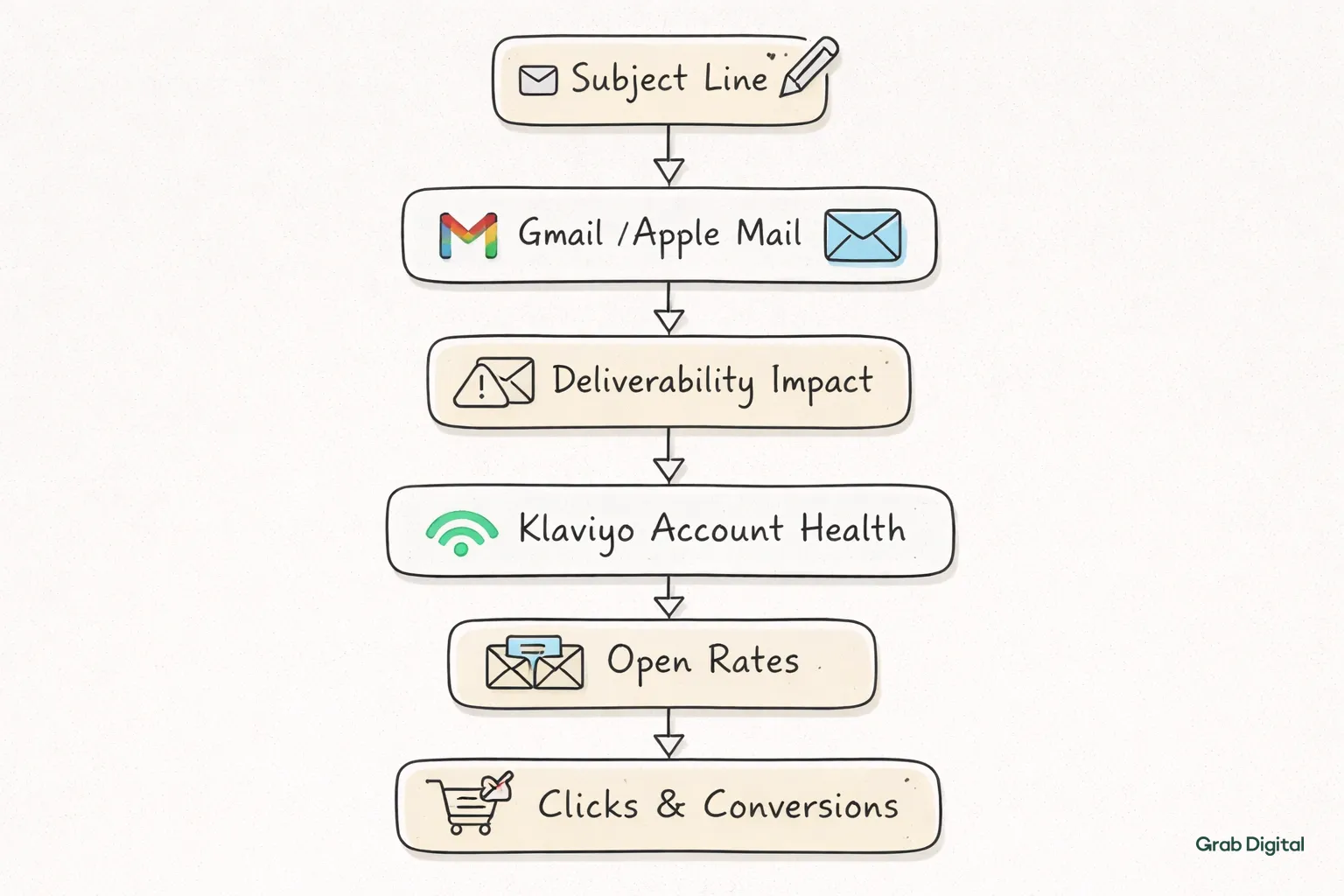
Gmail and Apple Mail don't just sort email; they judge it. Your subject line is a primary signal. If people don't open it, inbox algorithms notice. A weak subject line today hurts your deliverability tomorrow, which drags down your entire Klaviyo account.
Apple's Mail Privacy Protection made open rates fuzzy, but clicks and conversions still start with the subject. Inbox providers reward relevance. An abandoned cart email sent to a shopper who was just on your site gets better placement than a cold blast to a list you bought three years ago. A solid cart abandonment strategy starts with subject lines designed for actual humans, not generic templates.
A few things shifted recently that you need to know:
- Inbox providers now prioritize recent engagement over raw list size.
- Gen Z ignores corporate-speak; they want casual, human language.
- Emojis are fine, but using three of them is a great way to land in spam.
- "Hey [First Name]" is dead. Referencing the actual product or category is what works now.
What a Good Subject Line Actually Looks Like
A high-converting subject line is specific, short, and doesn't sound like a marketing bot. It names the product, hints at urgency (if real), and fits in under 50 characters.
Specificity wins. "You left something behind" is lazy. "Your Rogue Industries wallet is still waiting" stops the scroll. Klaviyo makes this easy pull product data from the checkout event and drop it into the subject line.
Keep it short because most people open on mobile. Over 50 characters, and your brilliant line gets cut off on an iPhone before they see the point.
Emotional relevance is harder. Scarcity works if it's actually true. Curiosity works if the email delivers on the tease. Don't bait and switch.
Formulas You Can Steal
Human psychology around loss and curiosity doesn't change much. You can use these frameworks, but you have to plug in your own brand voice.
| Flow Position | Formula | Example |
|---|---|---|
| Email 1 (1 hour) | Reminder + product name | "Still thinking about the Beessential lip balm set?" |
| Email 1 (1 hour) | Curiosity + benefit | "Psst, your cart misses you already" |
| Email 2 (24 hours) | Social proof | "Other shoppers grabbed this before it sold out" |
| Email 2 (24 hours) | Question format | "Forget something? It's still in your cart" |
| Email 3 (48-72 hours) | Urgency + incentive | "Last chance: 10% off your cart expires tonight" |
| Email 3 (48-72 hours) | Loss aversion | "Your cart is about to disappear" |
Context matters. A furniture brand like Model No. sells high-ticket items; a pushy subject line feels desperate. A skincare brand can get away with more urgency because the purchase risk is lower.
Personalization Beyond "Hey [First Name]"
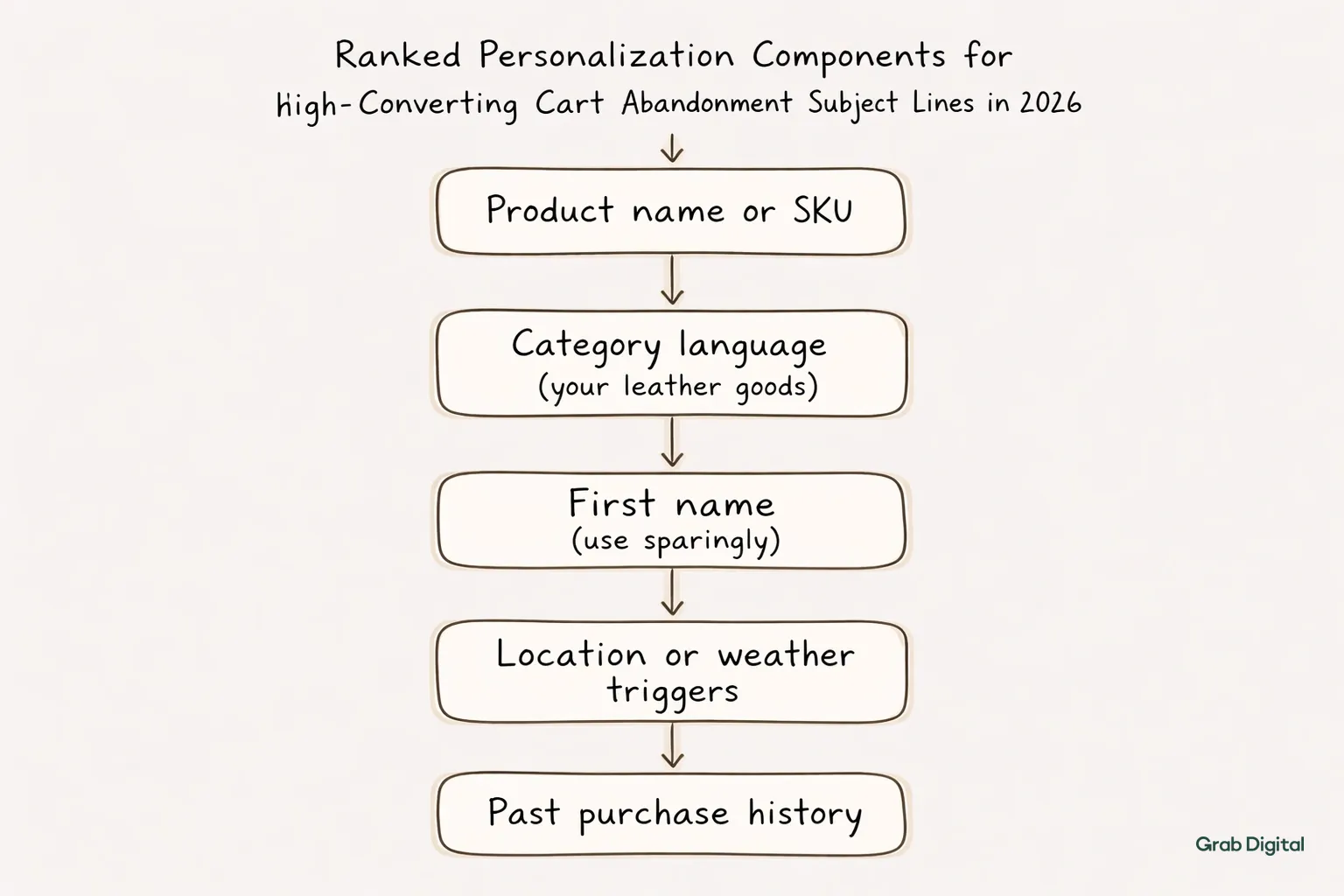
If you aren't using Klaviyo's segmentation to reference the specific product or category in the subject line, you're leaving money on the table. Generic subject lines get generic results.
Ranked by impact, here’s what actually moves the needle:
- Product name or SKU pulled from the cart.
- Category language ("your leather goods" vs "your items").
- First name (use sparingly only when it fits naturally).
- Location or weather triggers for relevant products.
- Past purchase history for returning customers.
Advanced customer segmentation strategies make this scalable. Split first-time visitors from repeat customers. First-timers need reassurance; repeat customers respond to loyalty language. Don't send the same message to both.
Timing: When to Send
Timing dictates tone. Send an email an hour after abandonment, and you're being helpful. Send it three days later with the same tone, and you're annoying.
Most solid flows follow a three-email cadence:
- Email 1 (1 hour): Nudge. No discount.
- Email 2 (24 hours): Social proof or objection handling.
- Email 3 (48-72 hours): The incentive. Last chance.
If you lead with a discount in email one, you train customers to abandon carts on purpose just to get the coupon. Pacing the urgency protects your margins. A proper checkout abandonment strategy is about timing as much as copy.
The Mistakes That Kill Your Open Rates
Most failures trace back to the same few errors. Brands copy competitors without testing, lean too hard on discounts, or ignore mobile truncation. Fixing just these can shift your numbers.
Watch for these traps:
- Discount-first framing: Leading with "20% off" trains people to wait for the coupon.
- Excessive punctuation: All-caps and exclamation points trigger spam filters.
- Vague reminders: "Don't forget your cart" tells them nothing.
- Ignoring send time: A great subject line sent at 3 AM underperforms.
- Static copy: Sending the same three lines to every segment is lazy.
A weak subject line also hurts deliverability. Low open rates tell inbox providers your email isn't wanted, which hurts future sends. Email deliverability and subject line strategy are the same thing.
How to Actually Test Subject Lines
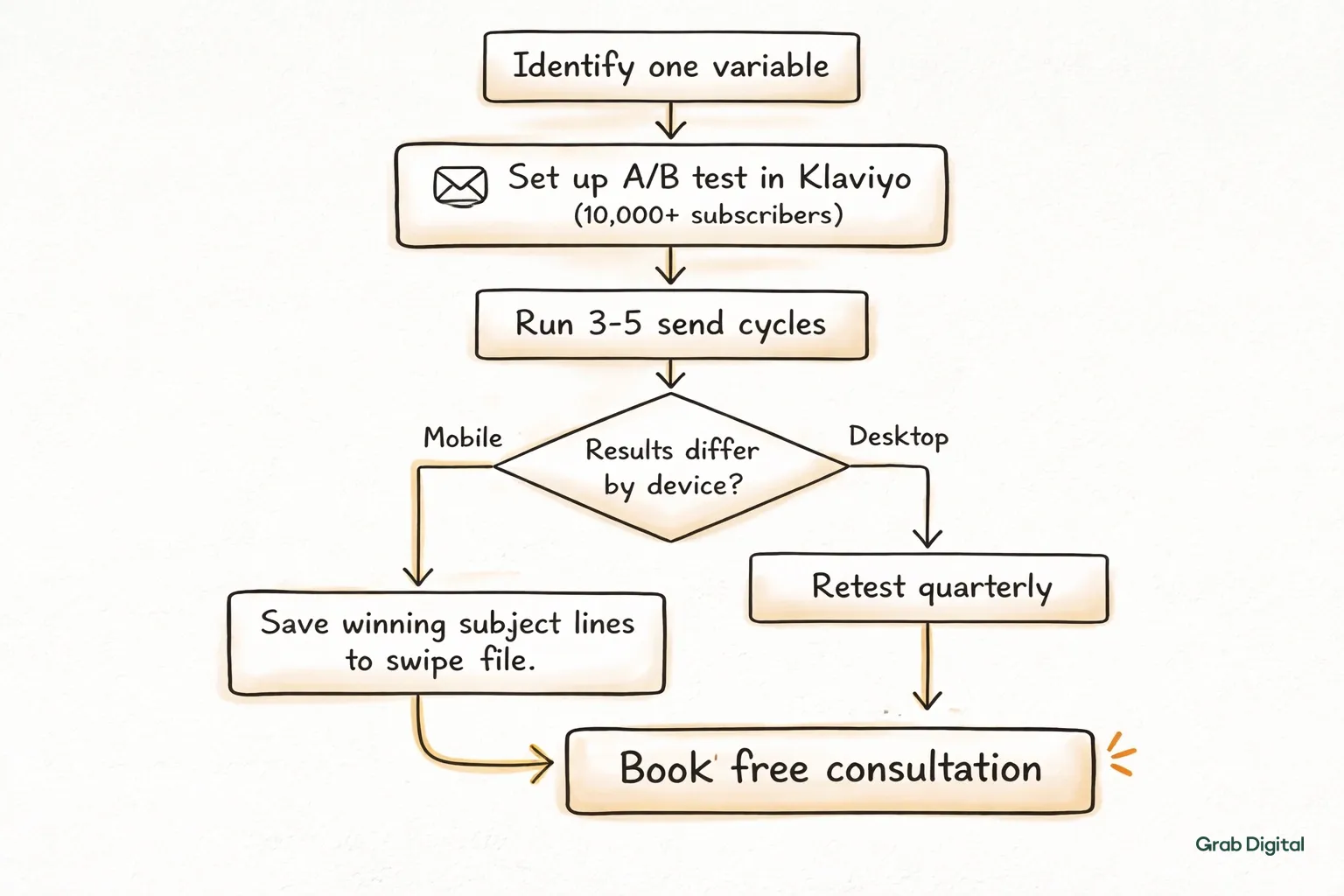
You need volume and patience to test this correctly. Klaviyo's A/B testing works for brands with 10,000+ subscribers, but many brands call the test too early. A structured cadence beats guessing.
Here is a process that works:
- Test one variable at a time.
- Run it for 3-5 send cycles minimum before deciding.
- Check results by device mobile and desktop behave differently.
- Save what works in a swipe file.
- Retest quarterly. Algorithms change. So does behavior.
If you don't have the bandwidth for this, book your free consultation. We'll show you what a tested flow looks like for your specific vertical.
Pulling It Together in Klaviyo
A subject line strategy in Klaviyo connects triggers, segmentation, and testing into one system. The abandoned cart flow is only as strong as the subject lines driving people back to it. Treat it as an ongoing discipline, not a set-it-and-forget-it task.
This is the kind of grind a dedicated email team handles. Our cart abandonment solutions cover the full build, and our email marketing services include ongoing testing in our reporting. You can see proof in our client portfolio or browse our work directly.
If you're debating building this in-house vs. hiring out, read our guide on hiring a Klaviyo expert. If you're still wondering if email is worth it, our analysis on whether email is still the highest-ROI channel has the numbers.
Frequently Asked Questions
Q: How long should an abandoned cart subject line be? A: Under 50 characters. Anything longer gets cut off on mobile.
Q: Should I always mention a discount? A: No. If you do it in the first email, you teach customers to abandon carts on purpose to get a deal. Save it for the last email.
Q: How often should I test? A: Test constantly in small batches, but review your whole approach quarterly.
Q: Does personalization actually help? A: Yes. Referencing the specific product beats a generic "forgot this?" line almost every time.
Q: What's the right number of emails? A: Three. One at 1 hour, one at 24 hours, one at 48-72 hours. Enough to convert, not enough to annoy.
Q: Do emojis hurt deliverability? A: Overuse does. One emoji is usually fine. Three is a risk.
You have about three seconds. That's how long the average DTC shopper gives your subject line before swiping it into the void. You can write the most brilliant email copy in the world, have a killer discount, and design a layout that converts at 10% none of it matters if the subject line flops.
Cart abandonment bleeds DTC brands dry. Billions, annually. Email is still the cheapest way to plug that leak, and Klaviyo's data backs this up: abandoned cart flows are almost always the highest-revenue automation in an account. The subject line is the lever that makes the math work.
Why Subject Lines Are a Deliverability Issue in 2026
Gmail and Apple Mail don't just sort email; they judge it. Your subject line is a primary signal. If people don't open it, inbox algorithms notice. A weak subject line today hurts your deliverability tomorrow, which drags down your entire Klaviyo account.
Apple's Mail Privacy Protection made open rates fuzzy, but clicks and conversions still start with the subject. Inbox providers reward relevance. An abandoned cart email sent to a shopper who was just on your site gets better placement than a cold blast to a list you bought three years ago. A solid cart abandonment strategy starts with subject lines designed for actual humans, not generic templates.
A few things shifted recently that you need to know:
- Inbox providers now prioritize recent engagement over raw list size.
- Gen Z ignores corporate-speak; they want casual, human language.
- Emojis are fine, but using three of them is a great way to land in spam.
- "Hey [First Name]" is dead. Referencing the actual product or category is what works now.
What a Good Subject Line Actually Looks Like
A high-converting subject line is specific, short, and doesn't sound like a marketing bot. It names the product, hints at urgency (if real), and fits in under 50 characters.
Specificity wins. "You left something behind" is lazy. "Your Rogue Industries wallet is still waiting" stops the scroll. Klaviyo makes this easy pull product data from the checkout event and drop it into the subject line.
Keep it short because most people open on mobile. Over 50 characters, and your brilliant line gets cut off on an iPhone before they see the point.
Emotional relevance is harder. Scarcity works if it's actually true. Curiosity works if the email delivers on the tease. Don't bait and switch.
Formulas You Can Steal
Human psychology around loss and curiosity doesn't change much. You can use these frameworks, but you have to plug in your own brand voice.
| Flow Position | Formula | Example |
|---|---|---|
| Email 1 (1 hour) | Reminder + product name | "Still thinking about the Beessential lip balm set?" |
| Email 1 (1 hour) | Curiosity + benefit | "Psst, your cart misses you already" |
| Email 2 (24 hours) | Social proof | "Other shoppers grabbed this before it sold out" |
| Email 2 (24 hours) | Question format | "Forget something? It's still in your cart" |
| Email 3 (48-72 hours) | Urgency + incentive | "Last chance: 10% off your cart expires tonight" |
| Email 3 (48-72 hours) | Loss aversion | "Your cart is about to disappear" |
Context matters. A furniture brand like Model No. sells high-ticket items; a pushy subject line feels desperate. A skincare brand can get away with more urgency because the purchase risk is lower.
Personalization Beyond "Hey [First Name]"
If you aren't using Klaviyo's segmentation to reference the specific product or category in the subject line, you're leaving money on the table. Generic subject lines get generic results.
Ranked by impact, here’s what actually moves the needle:
- Product name or SKU pulled from the cart.
- Category language ("your leather goods" vs "your items").
- First name (use sparingly only when it fits naturally).
- Location or weather triggers for relevant products.
- Past purchase history for returning customers.
Advanced customer segmentation strategies make this scalable. Split first-time visitors from repeat customers. First-timers need reassurance; repeat customers respond to loyalty language. Don't send the same message to both.
Timing: When to Send
Timing dictates tone. Send an email an hour after abandonment, and you're being helpful. Send it three days later with the same tone, and you're annoying.
Most solid flows follow a three-email cadence:
- Email 1 (1 hour): Nudge. No discount.
- Email 2 (24 hours): Social proof or objection handling.
- Email 3 (48-72 hours): The incentive. Last chance.
If you lead with a discount in email one, you train customers to abandon carts on purpose just to get the coupon. Pacing the urgency protects your margins. A proper checkout abandonment strategy is about timing as much as copy.
The Mistakes That Kill Your Open Rates
Most failures trace back to the same few errors. Brands copy competitors without testing, lean too hard on discounts, or ignore mobile truncation. Fixing just these can shift your numbers.
Watch for these traps:
- Discount-first framing: Leading with "20% off" trains people to wait for the coupon.
- Excessive punctuation: All-caps and exclamation points trigger spam filters.
- Vague reminders: "Don't forget your cart" tells them nothing.
- Ignoring send time: A great subject line sent at 3 AM underperforms.
- Static copy: Sending the same three lines to every segment is lazy.
A weak subject line also hurts deliverability. Low open rates tell inbox providers your email isn't wanted, which hurts future sends. Email deliverability and subject line strategy are the same thing.
How to Actually Test Subject Lines
You need volume and patience to test this correctly. Klaviyo's A/B testing works for brands with 10,000+ subscribers, but many brands call the test too early. A structured cadence beats guessing.
Here is a process that works:
- Test one variable at a time.
- Run it for 3-5 send cycles minimum before deciding.
- Check results by device mobile and desktop behave differently.
- Save what works in a swipe file.
- Retest quarterly. Algorithms change. So does behavior.
If you don't have the bandwidth for this, book your free consultation. We'll show you what a tested flow looks like for your specific vertical.
Pulling It Together in Klaviyo
A subject line strategy in Klaviyo connects triggers, segmentation, and testing into one system. The abandoned cart flow is only as strong as the subject lines driving people back to it. Treat it as an ongoing discipline, not a set-it-and-forget-it task.
This is the kind of grind a dedicated email team handles. Our cart abandonment solutions cover the full build, and our email marketing services include ongoing testing in our reporting. You can see proof in our client portfolio or browse our work directly.
If you're debating building this in-house vs. hiring out, read our guide on hiring a Klaviyo expert. If you're still wondering if email is worth it, our analysis on whether email is still the highest-ROI channel has the numbers.
Frequently Asked Questions
Q: How long should an abandoned cart subject line be? A: Under 50 characters. Anything longer gets cut off on mobile.
Q: Should I always mention a discount? A: No. If you do it in the first email, you teach customers to abandon carts on purpose to get a deal. Save it for the last email.
Q: How often should I test? A: Test constantly in small batches, but review your whole approach quarterly.
Q: Does personalization actually help? A: Yes. Referencing the specific product beats a generic "forgot this?" line almost every time.
Q: What's the right number of emails? A: Three. One at 1 hour, one at 24 hours, one at 48-72 hours. Enough to convert, not enough to annoy.
Q: Do emojis hurt deliverability? A: Overuse does. One emoji is usually fine. Three is a risk.

Find out exactly what your email channel is leaving on the table.

Email Marketing for Scaling DTC Brands


