
Summary
Fix Checkout Abandonment for DTC Brands with Klaviyo Strategies
Checkout abandonment is the heartbreak of e-commerce. A customer goes through the effort of entering shipping details and payment info, only to vanish right before the finish line. It's different from cart abandonment, where someone is just browsing. These people were ready to buy. For DTC brands on Klaviyo, fixing this leak is the fastest way to recover lost revenue.
The distinction matters more than you might think. Checkout abandoners are 3–5x more likely to convert than people who just left something in their cart. They’ve already invested their time. They just need a nudge (or a fix). Brands that separate checkout flows from cart flows typically see 8–12% higher email-attributed revenue within 60 days.
Why You Can't Treat Checkout Like Cart Abandonment
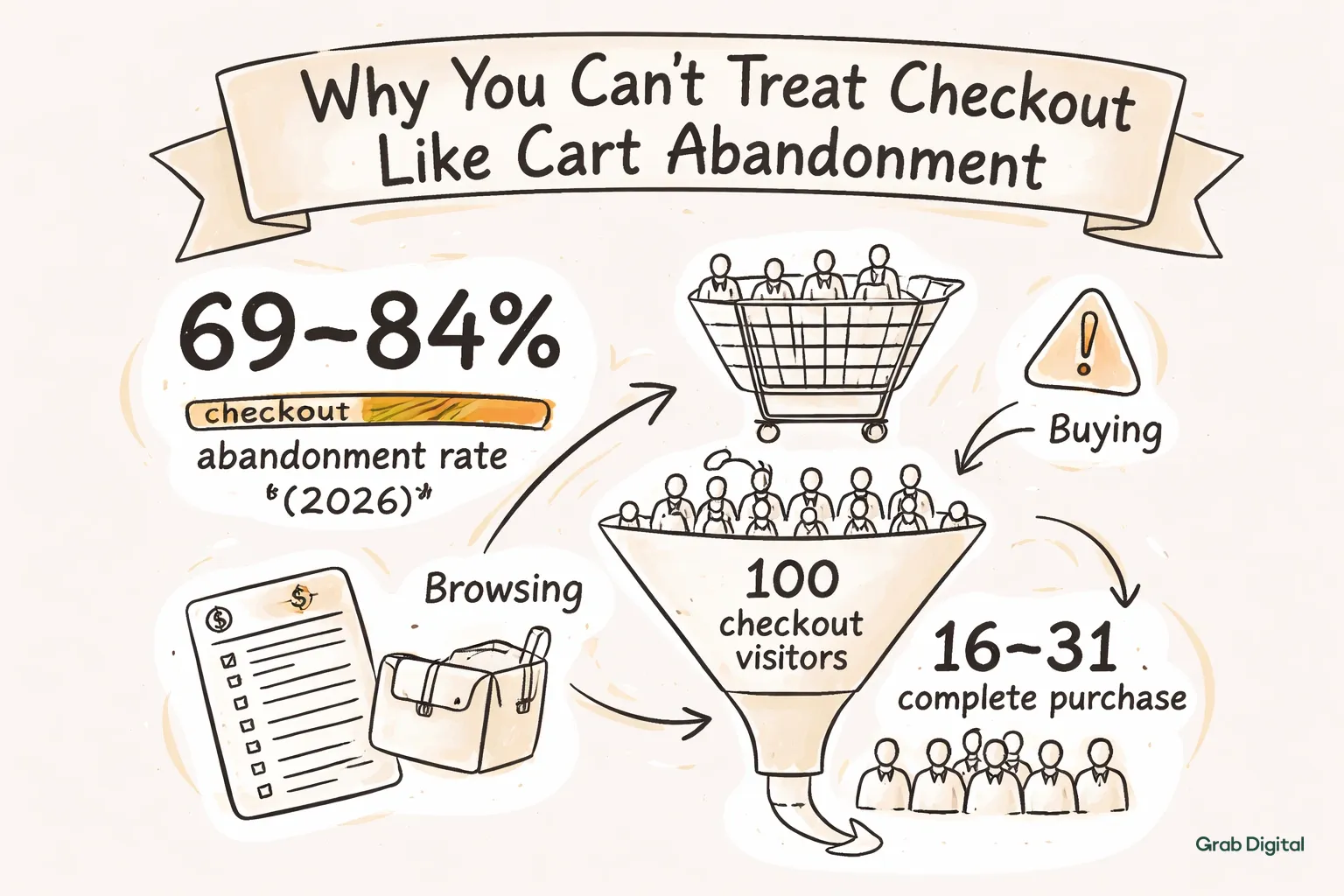
Checkout abandonment isn't just cart abandonment in a different costume. It’s a different psychological stage.
Cart abandoners are browsing. They're considering, comparing, maybe just killing time. Checkout abandoners have decided to buy. Then something stopped them a technical glitch, a shock at the shipping cost, or a moment of doubt.
The stats are brutal. The average checkout abandonment rate sits between 69–84% across DTC brands in 2026. For every 100 people who reach your checkout page, only 16–31 actually finish the job.
If you treat checkout abandoners like cart abandoners, you’re wasting your best leads. They need faster emails, sharper copy, and solutions to specific problems, not generic "still thinking about it?" nudges. Most DTC brands using our DTC email strategy see checkout abandonment flows drive 15–25% of total automated flow revenue once they get the segmentation right.
How to Build the Flow in Klaviyo
Klaviyo sees these events differently. "Added to Cart" fires when someone dumps a product in the cart. "Started Checkout" fires when they hit the checkout URL.
To build this flow, create a new flow in Klaviyo using the "Started Checkout" trigger. This ensures you're catching the people who actually started typing in their credit card number.
Here’s what needs to change vs. your cart flow:
- Speed is everything. Cart flows usually wait 1–4 hours. Checkout flows should fire in 30–90 minutes. Wait too long, and they’ve moved on.
- Keep it short. Cart flows can stretch over a week. Checkout flows should be done in 48 hours. Two emails max.
- Don't sell, solve. Cart flows build desire. Checkout flows should remove friction.
- Watch your exclusions. Make sure you aren’t emailing people who already bought, or who bailed because the item went out of stock.
If you're still running a combined flow, split them up. Brands that distinguish between cart and checkout abandonment see 22–40% higher recovery rates on the checkout emails alone.
The 2-Email Sequence That Actually Works
You don’t need a long drip campaign here. You need speed.
Email 1: The Nudge (30–90 minutes after abandonment) Subject: "Complete your order still waiting for you"
Keep it transactional. Don’t try to be clever. Remind them the order is incomplete. Include a big, obvious CTA that links right back to checkout pre-filled with their info. Show the product image and the total price.
Focus on friction. Reassure them about shipping speed, returns, and security. Throw trust badges above the fold. This isn’t a marketing email; it’s a service email.
Email 2: The Help (18–24 hours later, if they didn’t convert) Subject: "Need help with your order? We're here"
Shift to problem-solving. Ask: "Did you run into an issue?" Put your customer service email or chat link front and center. Address the obvious fears: price, sizing, security.
If you’re going to offer a discount, this is the place. But frame it as a solution, not a bribe. "To help you finish your order today, here's 10% off" works better than "Here’s a coupon because you left."
For more specifics on building these, check our guide on building abandoned cart flows for DTC brands.
Why People Really Leave (And What to Do About It)
They usually don't leave because they stopped wanting the product. They leave because something went wrong.
Unexpected costs. Shipping fees appearing at the last second is the #1 killer. Restate the total clearly in your first email. If you can, offer free shipping or make the threshold obvious earlier in the journey.
Forced account creation. Making people create an account before buying increases abandonment by 23–35%. If your checkout does this, make sure your recovery email mentions guest checkout.
Security fears. If they don’t trust you with their card info, they’re gone. Show trust badges (Shopify Secure, SSL, payment logos) in both emails. Remind them about your return policy.
Mobile issues. Over 60% of your traffic is mobile. If your checkout is clunky on a phone, they’ll bail. Your email can offer a lifeline: "Easier on desktop? Finish here."
Technical failures. Sometimes the payment gateway crashes. Use Klaviyo’s conditional logic to suppress emails if the abandonment was caused by an inventory error on your end.
Good checkout abandonment emails feel like customer support, not marketing. To see how other brands handle this, look through our portfolio of client work.
Segmenting for Better Recovery
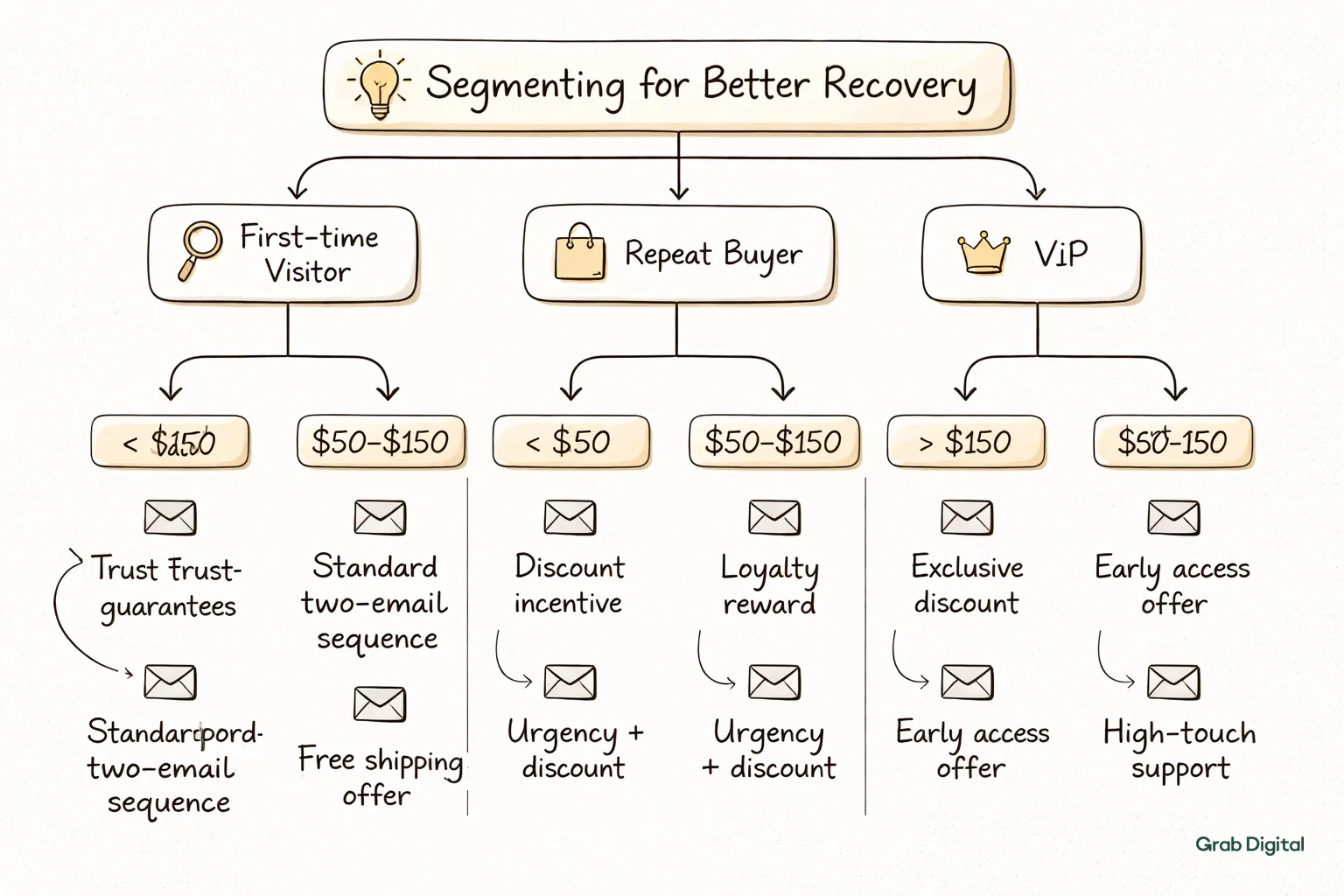
Not all abandoners are the same. A first-time visitor needs different handling than a repeat customer.
By customer status:
- First-timers: Emphasize trust. Show guarantees and easy returns. They don't know you yet.
- Repeat buyers: Skip the trust-building. Acknowledge they’ve bought before. "Welcome back your order is waiting" is enough.
- VIPs: Treat them like gold. Give them a direct line to your support team.
By cart value:
- Under $50: Standard two-email sequence. No discount needed.
- $50–$150: Consider free shipping or a small discount in Email 2 if your margins allow.
- Over $150: High-touch recovery. Offer priority support or white-glove delivery.
By product type:
- High-consideration items (furniture, luxury): Give them time. Space the emails out.
- Low-consideration items (consumables): Go fast. Email 1 within 30 minutes.
Brands that segment their flows see 18–30% higher revenue per recipient. We cover this in more depth in our post on email segmentation for DTC brands.
Making Sure Klaviyo is Actually Tracking This
None of this works if Klaviyo isn't seeing the "Started Checkout" event. Most Shopify integrations handle this, but it breaks easily especially with custom checkouts or headless builds.
Verify it: Go to Analytics > Metrics in Klaviyo. Search for "Started Checkout." Check that events are coming in with recent timestamps. Click one to make sure it has the email and cart contents.
If it's empty, check your Shopify integration in Klaviyo. You might need to re-authorize.
Common headaches:
- Guest checkout: If Shopify doesn't capture the email before the event fires, Klaviyo can't trigger the flow. Make sure email collection happens early.
- Custom checkouts: If you’re on Shopify Plus with a custom checkout, make sure the Klaviyo script is actually on that page.
- Privacy blockers: You'll never catch everyone. Some people block scripts. Just make sure Klaviyo loads before your other analytics junk.
Once tracking is live, set filters to exclude anyone who bought after triggering the flow. Add a conditional split: "If Placed Order since starting this flow, exit."
If you're looking for tools to help, we have a list of top cart abandonment tools that play nice with Klaviyo.
Measuring Performance
Don't lump these stats in with your cart abandonment flow. Look at them separately.
Watch these numbers:
- Recovery rate: (Conversions / Recipients). You want 8–15%.
- Revenue per recipient: This should be 2–3x higher than your cart flow because intent is higher.
- Time to conversion: Most sales happen within 4 hours of the first email.
- Segment performance: See how first-timers compare to VIPs.
If recovery is under 8%, check your timing (too slow?), copy (too vague?), or friction points (unaddressed?).
Brands we work with usually see checkout flows drive 6–10% of total email revenue once optimized. If you want a second pair of eyes, book your consultation and we'll audit it live.
Discounts: When to Use Them (and When to Hold Back)
The biggest mistake I see is throwing a discount at every checkout abandoner. These people already decided to buy. Price wasn't the blocker. If you always discount, you train them to leave on purpose next time.
Avoid discounts if:
- You are a premium brand.
- The cart is small (under $75).
- It’s a repeat customer.
- They bailed minutes ago (probably a tech issue).
Consider them if:
- Email 2 failed.
- The cart is huge and you can afford the margin hit.
- They are a first-time buyer comparing you to a competitor.
If you do discount, make it expire in 24 hours. And try non-discount perks first free shipping, faster delivery, or a bonus gift. These fix problems without making your product feel cheap.
Read more on this in our guide on why DTC brands need an email agency.
Adding SMS to the Mix
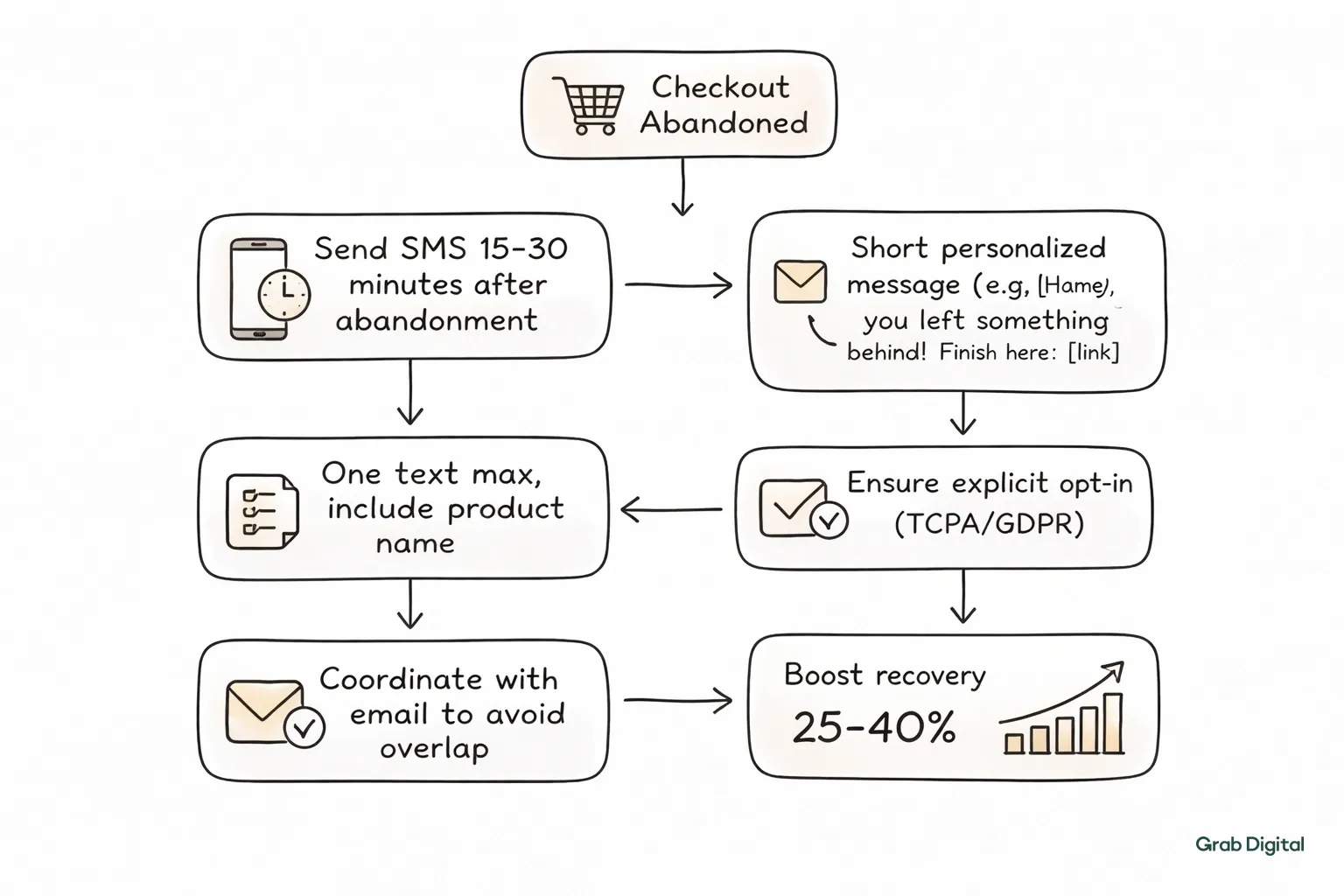
Checkout abandonment is perfect for SMS. Texts have 98% open rates, and 90% are read in 3 minutes.
SMS rules:
- Send it fast. 15–30 minutes after they bail.
- Keep it short. "Hey [Name], you left something behind! Finish up here: [Link]"
- Personalize. Mention the product name.
- Don't spam. One text max. Coordinate it so you aren't texting and emailing at the same time.
Make sure you have consent (TCPA/GDPR). You need explicit opt-in for marketing texts.
Combining SMS and email usually boosts recovery rates by 25–40%. Use the same "Started Checkout" trigger in Klaviyo and add a time delay to separate it from the email.
Testing and Tweaking
Test this flow quarterly. Small tweaks matter.
What to test:
- Timing: 30 minutes vs. 60 minutes for Email 1.
- Subject lines: Urgency ("Your order is waiting") vs. Help ("Need a hand?").
- CTA copy: "Complete My Order" vs. "Return to Checkout."
- Offer: Email 2 with a discount vs. without.
Run the test for 2–3 weeks. Klaviyo lets you A/B test inside the flow.
For brands doing $1M–$10M, this optimization usually recovers an extra $15K–$50K a year. If you haven't touched your flows in 6 months, they're stale. We handle this as part of our DTC email marketing services.
The Template
Here’s a plug-and-play structure for Klaviyo.
Trigger: Started Checkout Filters: Email isn't suppressed; hasn't bought since starting the flow.
Email 1 (60 min delay) Subject: Complete your order still waiting for you Preview: Your items are reserved. Finish checkout in 2 minutes. Body:
- "You left something behind"
- [Product Image + Price]
- Button: "Complete My Order"
- Trust signals (returns, secure checkout, shipping)
- Support contact in footer
Split: If they bought, exit. If not, wait 20 hours.
Email 2 (24 hours after Email 1) Subject: Need help with your order? We're here Preview: Questions? Our team is standing by. Body:
- "Did you run into an issue?"
- Brief reassurance
- Button: "Complete My Order"
- Optional: 10% off or free shipping offer
- Secondary button: "Contact Support"
- Trust signals + testimonials
End flow.
This works for most brands. Adjust the voice to fit yours. For more on automation, see our guide on email marketing automation for DTC brands.
FAQ
Q: Cart abandonment vs. checkout abandonment? A: Cart abandonment is adding to cart but not starting checkout. Checkout abandonment is starting checkout but not paying. Checkout abandoners are hotter leads they need faster, more direct help.
Q: How fast should I send the first email? A: 30–90 minutes. They’re hot leads. Don't wait. Second email goes out 18–24 hours later if they don't buy.
Q: Should I offer a discount? A: Not always. They already want to buy. If you use one, save it for Email 2 and frame it as help. Try free shipping or expedited delivery first.
Q: How do I track this in Klaviyo? A: Check Analytics > Metrics for "Started Checkout." If it's tracking, build the flow with that trigger. Filter out people who already bought.
Q: What’s a good recovery rate? A: 8–15%. If you're below that, check your timing and friction points.
Q: Can I use one flow for both? A: No. Checkout abandoners need different timing and messaging. Keep the flows separate.
Checkout abandonment is the heartbreak of e-commerce. A customer goes through the effort of entering shipping details and payment info, only to vanish right before the finish line. It's different from cart abandonment, where someone is just browsing. These people were ready to buy. For DTC brands on Klaviyo, fixing this leak is the fastest way to recover lost revenue.
The distinction matters more than you might think. Checkout abandoners are 3–5x more likely to convert than people who just left something in their cart. They’ve already invested their time. They just need a nudge (or a fix). Brands that separate checkout flows from cart flows typically see 8–12% higher email-attributed revenue within 60 days.
Why You Can't Treat Checkout Like Cart Abandonment
Checkout abandonment isn't just cart abandonment in a different costume. It’s a different psychological stage.
Cart abandoners are browsing. They're considering, comparing, maybe just killing time. Checkout abandoners have decided to buy. Then something stopped them a technical glitch, a shock at the shipping cost, or a moment of doubt.
The stats are brutal. The average checkout abandonment rate sits between 69–84% across DTC brands in 2026. For every 100 people who reach your checkout page, only 16–31 actually finish the job.
If you treat checkout abandoners like cart abandoners, you’re wasting your best leads. They need faster emails, sharper copy, and solutions to specific problems, not generic "still thinking about it?" nudges. Most DTC brands using our DTC email strategy see checkout abandonment flows drive 15–25% of total automated flow revenue once they get the segmentation right.
How to Build the Flow in Klaviyo
Klaviyo sees these events differently. "Added to Cart" fires when someone dumps a product in the cart. "Started Checkout" fires when they hit the checkout URL.
To build this flow, create a new flow in Klaviyo using the "Started Checkout" trigger. This ensures you're catching the people who actually started typing in their credit card number.
Here’s what needs to change vs. your cart flow:
- Speed is everything. Cart flows usually wait 1–4 hours. Checkout flows should fire in 30–90 minutes. Wait too long, and they’ve moved on.
- Keep it short. Cart flows can stretch over a week. Checkout flows should be done in 48 hours. Two emails max.
- Don't sell, solve. Cart flows build desire. Checkout flows should remove friction.
- Watch your exclusions. Make sure you aren’t emailing people who already bought, or who bailed because the item went out of stock.
If you're still running a combined flow, split them up. Brands that distinguish between cart and checkout abandonment see 22–40% higher recovery rates on the checkout emails alone.
The 2-Email Sequence That Actually Works
You don’t need a long drip campaign here. You need speed.
Email 1: The Nudge (30–90 minutes after abandonment) Subject: "Complete your order still waiting for you"
Keep it transactional. Don’t try to be clever. Remind them the order is incomplete. Include a big, obvious CTA that links right back to checkout pre-filled with their info. Show the product image and the total price.
Focus on friction. Reassure them about shipping speed, returns, and security. Throw trust badges above the fold. This isn’t a marketing email; it’s a service email.
Email 2: The Help (18–24 hours later, if they didn’t convert) Subject: "Need help with your order? We're here"
Shift to problem-solving. Ask: "Did you run into an issue?" Put your customer service email or chat link front and center. Address the obvious fears: price, sizing, security.
If you’re going to offer a discount, this is the place. But frame it as a solution, not a bribe. "To help you finish your order today, here's 10% off" works better than "Here’s a coupon because you left."
For more specifics on building these, check our guide on building abandoned cart flows for DTC brands.
Why People Really Leave (And What to Do About It)
They usually don't leave because they stopped wanting the product. They leave because something went wrong.
Unexpected costs. Shipping fees appearing at the last second is the #1 killer. Restate the total clearly in your first email. If you can, offer free shipping or make the threshold obvious earlier in the journey.
Forced account creation. Making people create an account before buying increases abandonment by 23–35%. If your checkout does this, make sure your recovery email mentions guest checkout.
Security fears. If they don’t trust you with their card info, they’re gone. Show trust badges (Shopify Secure, SSL, payment logos) in both emails. Remind them about your return policy.
Mobile issues. Over 60% of your traffic is mobile. If your checkout is clunky on a phone, they’ll bail. Your email can offer a lifeline: "Easier on desktop? Finish here."
Technical failures. Sometimes the payment gateway crashes. Use Klaviyo’s conditional logic to suppress emails if the abandonment was caused by an inventory error on your end.
Good checkout abandonment emails feel like customer support, not marketing. To see how other brands handle this, look through our portfolio of client work.
Segmenting for Better Recovery
Not all abandoners are the same. A first-time visitor needs different handling than a repeat customer.
By customer status:
- First-timers: Emphasize trust. Show guarantees and easy returns. They don't know you yet.
- Repeat buyers: Skip the trust-building. Acknowledge they’ve bought before. "Welcome back your order is waiting" is enough.
- VIPs: Treat them like gold. Give them a direct line to your support team.
By cart value:
- Under $50: Standard two-email sequence. No discount needed.
- $50–$150: Consider free shipping or a small discount in Email 2 if your margins allow.
- Over $150: High-touch recovery. Offer priority support or white-glove delivery.
By product type:
- High-consideration items (furniture, luxury): Give them time. Space the emails out.
- Low-consideration items (consumables): Go fast. Email 1 within 30 minutes.
Brands that segment their flows see 18–30% higher revenue per recipient. We cover this in more depth in our post on email segmentation for DTC brands.
Making Sure Klaviyo is Actually Tracking This
None of this works if Klaviyo isn't seeing the "Started Checkout" event. Most Shopify integrations handle this, but it breaks easily especially with custom checkouts or headless builds.
Verify it: Go to Analytics > Metrics in Klaviyo. Search for "Started Checkout." Check that events are coming in with recent timestamps. Click one to make sure it has the email and cart contents.
If it's empty, check your Shopify integration in Klaviyo. You might need to re-authorize.
Common headaches:
- Guest checkout: If Shopify doesn't capture the email before the event fires, Klaviyo can't trigger the flow. Make sure email collection happens early.
- Custom checkouts: If you’re on Shopify Plus with a custom checkout, make sure the Klaviyo script is actually on that page.
- Privacy blockers: You'll never catch everyone. Some people block scripts. Just make sure Klaviyo loads before your other analytics junk.
Once tracking is live, set filters to exclude anyone who bought after triggering the flow. Add a conditional split: "If Placed Order since starting this flow, exit."
If you're looking for tools to help, we have a list of top cart abandonment tools that play nice with Klaviyo.
Measuring Performance
Don't lump these stats in with your cart abandonment flow. Look at them separately.
Watch these numbers:
- Recovery rate: (Conversions / Recipients). You want 8–15%.
- Revenue per recipient: This should be 2–3x higher than your cart flow because intent is higher.
- Time to conversion: Most sales happen within 4 hours of the first email.
- Segment performance: See how first-timers compare to VIPs.
If recovery is under 8%, check your timing (too slow?), copy (too vague?), or friction points (unaddressed?).
Brands we work with usually see checkout flows drive 6–10% of total email revenue once optimized. If you want a second pair of eyes, book your consultation and we'll audit it live.
Discounts: When to Use Them (and When to Hold Back)
The biggest mistake I see is throwing a discount at every checkout abandoner. These people already decided to buy. Price wasn't the blocker. If you always discount, you train them to leave on purpose next time.
Avoid discounts if:
- You are a premium brand.
- The cart is small (under $75).
- It’s a repeat customer.
- They bailed minutes ago (probably a tech issue).
Consider them if:
- Email 2 failed.
- The cart is huge and you can afford the margin hit.
- They are a first-time buyer comparing you to a competitor.
If you do discount, make it expire in 24 hours. And try non-discount perks first free shipping, faster delivery, or a bonus gift. These fix problems without making your product feel cheap.
Read more on this in our guide on why DTC brands need an email agency.
Adding SMS to the Mix
Checkout abandonment is perfect for SMS. Texts have 98% open rates, and 90% are read in 3 minutes.
SMS rules:
- Send it fast. 15–30 minutes after they bail.
- Keep it short. "Hey [Name], you left something behind! Finish up here: [Link]"
- Personalize. Mention the product name.
- Don't spam. One text max. Coordinate it so you aren't texting and emailing at the same time.
Make sure you have consent (TCPA/GDPR). You need explicit opt-in for marketing texts.
Combining SMS and email usually boosts recovery rates by 25–40%. Use the same "Started Checkout" trigger in Klaviyo and add a time delay to separate it from the email.
Testing and Tweaking
Test this flow quarterly. Small tweaks matter.
What to test:
- Timing: 30 minutes vs. 60 minutes for Email 1.
- Subject lines: Urgency ("Your order is waiting") vs. Help ("Need a hand?").
- CTA copy: "Complete My Order" vs. "Return to Checkout."
- Offer: Email 2 with a discount vs. without.
Run the test for 2–3 weeks. Klaviyo lets you A/B test inside the flow.
For brands doing $1M–$10M, this optimization usually recovers an extra $15K–$50K a year. If you haven't touched your flows in 6 months, they're stale. We handle this as part of our DTC email marketing services.
The Template
Here’s a plug-and-play structure for Klaviyo.
Trigger: Started Checkout Filters: Email isn't suppressed; hasn't bought since starting the flow.
Email 1 (60 min delay) Subject: Complete your order still waiting for you Preview: Your items are reserved. Finish checkout in 2 minutes. Body:
- "You left something behind"
- [Product Image + Price]
- Button: "Complete My Order"
- Trust signals (returns, secure checkout, shipping)
- Support contact in footer
Split: If they bought, exit. If not, wait 20 hours.
Email 2 (24 hours after Email 1) Subject: Need help with your order? We're here Preview: Questions? Our team is standing by. Body:
- "Did you run into an issue?"
- Brief reassurance
- Button: "Complete My Order"
- Optional: 10% off or free shipping offer
- Secondary button: "Contact Support"
- Trust signals + testimonials
End flow.
This works for most brands. Adjust the voice to fit yours. For more on automation, see our guide on email marketing automation for DTC brands.
FAQ
Q: Cart abandonment vs. checkout abandonment? A: Cart abandonment is adding to cart but not starting checkout. Checkout abandonment is starting checkout but not paying. Checkout abandoners are hotter leads they need faster, more direct help.
Q: How fast should I send the first email? A: 30–90 minutes. They’re hot leads. Don't wait. Second email goes out 18–24 hours later if they don't buy.
Q: Should I offer a discount? A: Not always. They already want to buy. If you use one, save it for Email 2 and frame it as help. Try free shipping or expedited delivery first.
Q: How do I track this in Klaviyo? A: Check Analytics > Metrics for "Started Checkout." If it's tracking, build the flow with that trigger. Filter out people who already bought.
Q: What’s a good recovery rate? A: 8–15%. If you're below that, check your timing and friction points.
Q: Can I use one flow for both? A: No. Checkout abandoners need different timing and messaging. Keep the flows separate.

Find out exactly what your email channel is leaving on the table.

Email Marketing for Scaling DTC Brands


