
Summary
Klaviyo Audit: Uncover Hidden Revenue Leaks
A Klaviyo audit finds the revenue leaks you're probably ignoring.
Most DTC brands set up Klaviyo once and forget about it. Flows get built, campaigns go out when someone remembers, and then everyone's surprised when open rates tank or a flow stops triggering for three weeks. An audit catches that stuff before it bleeds revenue.
What an Email Marketing Audit Actually Covers

Everything in your account that touches revenue. Flows, campaigns, list health, segmentation, popups, deliverability.
The goal is simple: find the gap between what Klaviyo can do and what your account is actually doing.
Most brands we onboard have the same pattern. Klaviyo connected to Shopify, a handful of flows turned on, campaigns going out sporadically. Nobody has looked at sender reputation in months. Nobody knows which segments make money and which are dead weight.
If you're generating less than 20% of revenue through email which is where most brands start the audit usually explains why pretty fast.
The Complete Klaviyo Account Audit Checklist
Six areas. Each gets scored against benchmarks, not vague impressions.
| Audit Area | What to Check | Red Flag |
|---|---|---|
| Flows | All 8 core flows live | Missing browse abandonment or win-back |
| Campaigns | Frequency, open rate trend | Fewer than 4 sends per month |
| Segmentation | Active segments tied to behavior | Only using "all subscribers" |
| List Health | Engaged vs. suppressed ratio | Over 30% unengaged in 90 days |
| Deliverability | Spam rate, bounce rate | Spam complaints above 0.1% |
| Popups | Conversion rate, A/B tests | No test in 60+ days |
Flow Audit
Flows are where the automated revenue lives. We've written about the 8 core email flows every DTC brand needs this checks whether they're actually running.
Most accounts we audit have three or four active. The rest are disabled or built with outdated logic. A flow from two years ago that hasn't been touched is almost certainly underperforming.
Check triggers, too. We see abandoned cart flows firing on page views instead of cart additions. That inflates send volume and tanks relevance. See our guide on a high-ROI abandoned cart flow for specifics.
Campaign Audit
Campaigns show how consistently you're showing up. Pull the last 90 days. Check frequency, open rate trend, click-through rate.
Brands sending fewer than four campaigns a month are leaving money on the table. We cover this in our email campaign management post. Also flag any campaign sent to the entire list without segmentation that's a fast way to hurt deliverability.
Segmentation Audit
Segments determine if your emails feel relevant or generic. Check whether they're built on actual behavior purchase recency, browsing, engagement not just demographics.
Sending every campaign to your entire list is the single biggest flag we see. A healthy account has 8 to 15 active segments feeding flows and campaigns. More on this in our customer segmentation strategies piece.
List Health and Deliverability
List health decides whether your emails even get seen.
Calculate engaged vs. unengaged over 90 days. Flag anything over 30% unengaged. That's a deliverability risk.
Spam complaints above 0.1%, bounce rates over 2%, declining sender reputation these are the real story behind dropping open rates. Our post on suppressing inactive subscribers has the logic we use. Our email deliverability tips pairs well with this.
Popup Audit
Popups are the entry point. If they're broken, list quality suffers.
Review conversion rate, offer, and whether any test has run in the last 60 days. Under 2% on desktop or 1.5% on mobile usually means a redesign is due.
Why November

November is the window before Q4 peak and 2027 planning. Audit now, catch issues before Black Friday volume hits, and walk into January with a clean baseline.
You're also reviewing a full year of data. Seasonal patterns, holiday performance, flow behavior across 12 months way clearer than a quarterly snapshot. Same logic behind our holiday email marketing strategies post.
Wait until January and you're reacting to problems that already cost you Black Friday revenue.
Scoring
Red means broken. Yellow means underperforming. Green means healthy.
- Red: Flow missing, spam rate above 0.1%, list over 30% unengaged
- Yellow: Flow live but outdated, campaign frequency under 4/month
- Green: Benchmarks met, tests running
Most accounts land between two and four red flags. That's normal. The point is building a fix list ranked by revenue impact, not shaming the account.
After the Audit
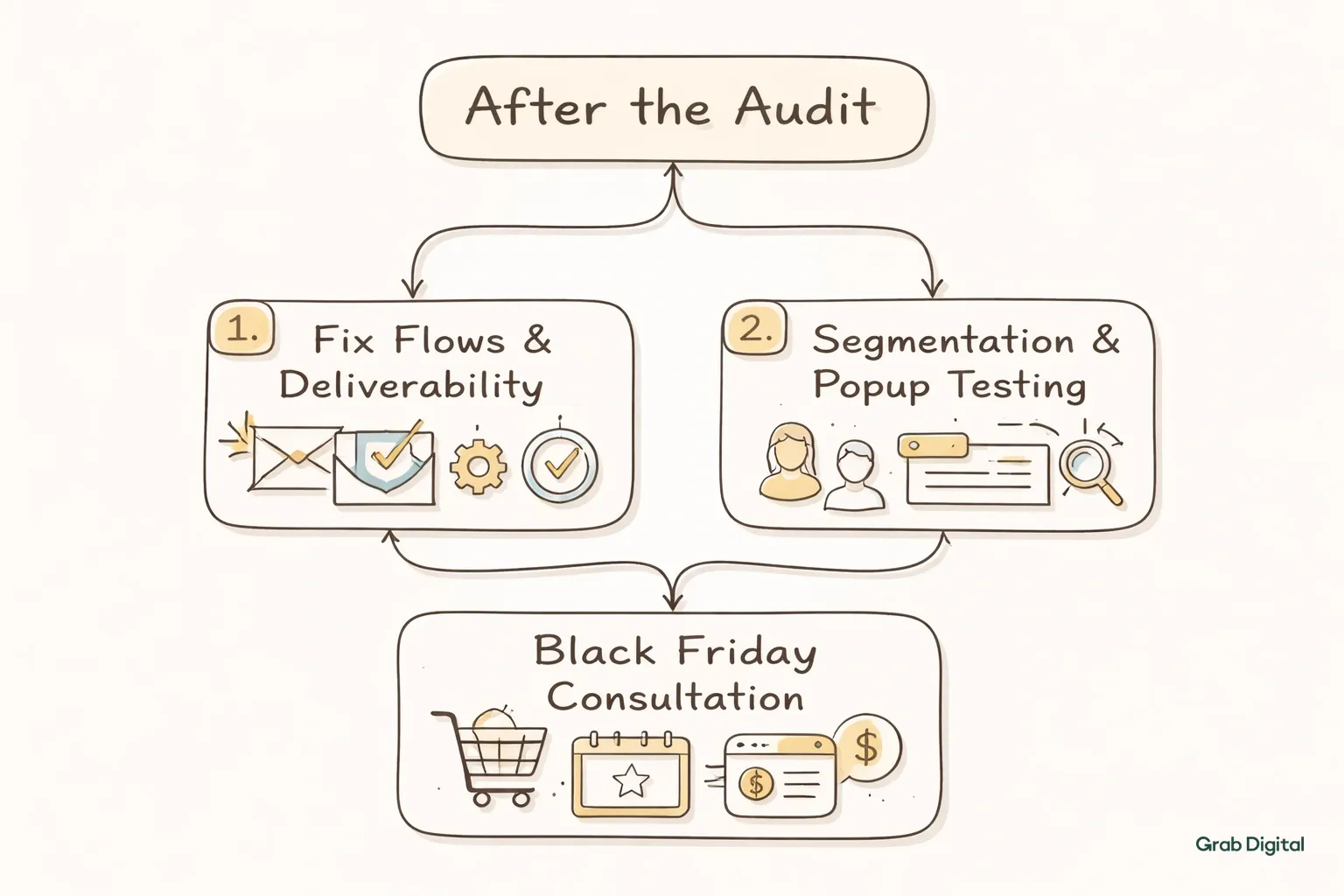
An audit without action is just a document.
Fix the highest-impact items first. Usually flows and deliverability. Then segmentation and popup testing.
Biggest lift typically comes from abandoned cart and browse abandonment flows they're capturing intent. Deliverability fixes protect everything sent after. Segmentation and popup work compound over months.
If you want eyes on your account before Black Friday, book a consultation. We'll walk through the checklist on your data. We back every engagement with a 10% revenue growth guarantee within 60 days.
Common Mistakes
Treating Klaviyo as set-and-forget. Flows built once and never revisited.
- Flows with outdated copy or broken links
- Popups never retested
- Segments based on signup date, not behavior
- No suppression strategy sender reputation quietly dies
- Campaigns sent without checking previous performance
Fixable within weeks. The hard part is noticing them.
For brands considering help, our post on hiring an ecommerce email marketing agency covers what to look for.
FAQ
How often should I audit? Full audit every 90 days. Light deliverability check monthly. Accounts over $1M benefit from quarterly audits tied to seasonal planning.
Biggest red flag? Broken flows. Abandoned cart and post-purchase run constantly. Every day they're off costs revenue.
Can I do this myself? The checklist covers what to review. The hard part is knowing realistic benchmarks for your size and actually fixing what you find.
How long does it take? 5 to 8 hours if you know Klaviyo. Agencies with a framework do it faster.
What revenue percentage should email drive? 25 to 35% for healthy DTC. Under 20% usually means multiple areas need work.
Does this help deliverability? Yes. The list health and deliverability sections identify what's hurting inbox placement. Fixing suppression and engagement segmentation is often the fastest route to better sender reputation.
A Klaviyo audit finds the revenue leaks you're probably ignoring.
Most DTC brands set up Klaviyo once and forget about it. Flows get built, campaigns go out when someone remembers, and then everyone's surprised when open rates tank or a flow stops triggering for three weeks. An audit catches that stuff before it bleeds revenue.
What an Email Marketing Audit Actually Covers
Everything in your account that touches revenue. Flows, campaigns, list health, segmentation, popups, deliverability.
The goal is simple: find the gap between what Klaviyo can do and what your account is actually doing.
Most brands we onboard have the same pattern. Klaviyo connected to Shopify, a handful of flows turned on, campaigns going out sporadically. Nobody has looked at sender reputation in months. Nobody knows which segments make money and which are dead weight.
If you're generating less than 20% of revenue through email which is where most brands start the audit usually explains why pretty fast.
The Complete Klaviyo Account Audit Checklist
Six areas. Each gets scored against benchmarks, not vague impressions.
| Audit Area | What to Check | Red Flag |
|---|---|---|
| Flows | All 8 core flows live | Missing browse abandonment or win-back |
| Campaigns | Frequency, open rate trend | Fewer than 4 sends per month |
| Segmentation | Active segments tied to behavior | Only using "all subscribers" |
| List Health | Engaged vs. suppressed ratio | Over 30% unengaged in 90 days |
| Deliverability | Spam rate, bounce rate | Spam complaints above 0.1% |
| Popups | Conversion rate, A/B tests | No test in 60+ days |
Flow Audit
Flows are where the automated revenue lives. We've written about the 8 core email flows every DTC brand needs this checks whether they're actually running.
Most accounts we audit have three or four active. The rest are disabled or built with outdated logic. A flow from two years ago that hasn't been touched is almost certainly underperforming.
Check triggers, too. We see abandoned cart flows firing on page views instead of cart additions. That inflates send volume and tanks relevance. See our guide on a high-ROI abandoned cart flow for specifics.
Campaign Audit
Campaigns show how consistently you're showing up. Pull the last 90 days. Check frequency, open rate trend, click-through rate.
Brands sending fewer than four campaigns a month are leaving money on the table. We cover this in our email campaign management post. Also flag any campaign sent to the entire list without segmentation that's a fast way to hurt deliverability.
Segmentation Audit
Segments determine if your emails feel relevant or generic. Check whether they're built on actual behavior purchase recency, browsing, engagement not just demographics.
Sending every campaign to your entire list is the single biggest flag we see. A healthy account has 8 to 15 active segments feeding flows and campaigns. More on this in our customer segmentation strategies piece.
List Health and Deliverability
List health decides whether your emails even get seen.
Calculate engaged vs. unengaged over 90 days. Flag anything over 30% unengaged. That's a deliverability risk.
Spam complaints above 0.1%, bounce rates over 2%, declining sender reputation these are the real story behind dropping open rates. Our post on suppressing inactive subscribers has the logic we use. Our email deliverability tips pairs well with this.
Popup Audit
Popups are the entry point. If they're broken, list quality suffers.
Review conversion rate, offer, and whether any test has run in the last 60 days. Under 2% on desktop or 1.5% on mobile usually means a redesign is due.
Why November
November is the window before Q4 peak and 2027 planning. Audit now, catch issues before Black Friday volume hits, and walk into January with a clean baseline.
You're also reviewing a full year of data. Seasonal patterns, holiday performance, flow behavior across 12 months way clearer than a quarterly snapshot. Same logic behind our holiday email marketing strategies post.
Wait until January and you're reacting to problems that already cost you Black Friday revenue.
Scoring
Red means broken. Yellow means underperforming. Green means healthy.
- Red: Flow missing, spam rate above 0.1%, list over 30% unengaged
- Yellow: Flow live but outdated, campaign frequency under 4/month
- Green: Benchmarks met, tests running
Most accounts land between two and four red flags. That's normal. The point is building a fix list ranked by revenue impact, not shaming the account.
After the Audit
An audit without action is just a document.
Fix the highest-impact items first. Usually flows and deliverability. Then segmentation and popup testing.
Biggest lift typically comes from abandoned cart and browse abandonment flows they're capturing intent. Deliverability fixes protect everything sent after. Segmentation and popup work compound over months.
If you want eyes on your account before Black Friday, book a consultation. We'll walk through the checklist on your data. We back every engagement with a 10% revenue growth guarantee within 60 days.
Common Mistakes
Treating Klaviyo as set-and-forget. Flows built once and never revisited.
- Flows with outdated copy or broken links
- Popups never retested
- Segments based on signup date, not behavior
- No suppression strategy sender reputation quietly dies
- Campaigns sent without checking previous performance
Fixable within weeks. The hard part is noticing them.
For brands considering help, our post on hiring an ecommerce email marketing agency covers what to look for.
FAQ
How often should I audit? Full audit every 90 days. Light deliverability check monthly. Accounts over $1M benefit from quarterly audits tied to seasonal planning.
Biggest red flag? Broken flows. Abandoned cart and post-purchase run constantly. Every day they're off costs revenue.
Can I do this myself? The checklist covers what to review. The hard part is knowing realistic benchmarks for your size and actually fixing what you find.
How long does it take? 5 to 8 hours if you know Klaviyo. Agencies with a framework do it faster.
What revenue percentage should email drive? 25 to 35% for healthy DTC. Under 20% usually means multiple areas need work.
Does this help deliverability? Yes. The list health and deliverability sections identify what's hurting inbox placement. Fixing suppression and engagement segmentation is often the fastest route to better sender reputation.

Find out exactly what your email channel is leaving on the table.

Email Marketing for Scaling DTC Brands


