
Summary
Integrating Direct Mail with Klaviyo: Boost Conversions
Integrating direct mail with Klaviyo lets you trigger postcards, catalogs, and letters based on what people actually do on your site email behaviors, cart activity, purchase history. You're turning existing customer data into physical touchpoints. Brands I work with see 15-40% higher conversion rates than email alone when they get this right.
Why bother? Because inboxes are a mess. Your subscribers get 121 emails a day on average. Physical mail? They get 3-5 pieces daily. That difference matters. When you coordinate both channels through Klaviyo, you catch customers who've tuned out your emails.
Why DTC Brands Are Adding Direct Mail to Klaviyo in 2026
Physical mail open rates sit between 80-90%. Email struggles to hit 15-25%. I'm not saying print is magic, but that gap is real attention you can't buy through digital ads.
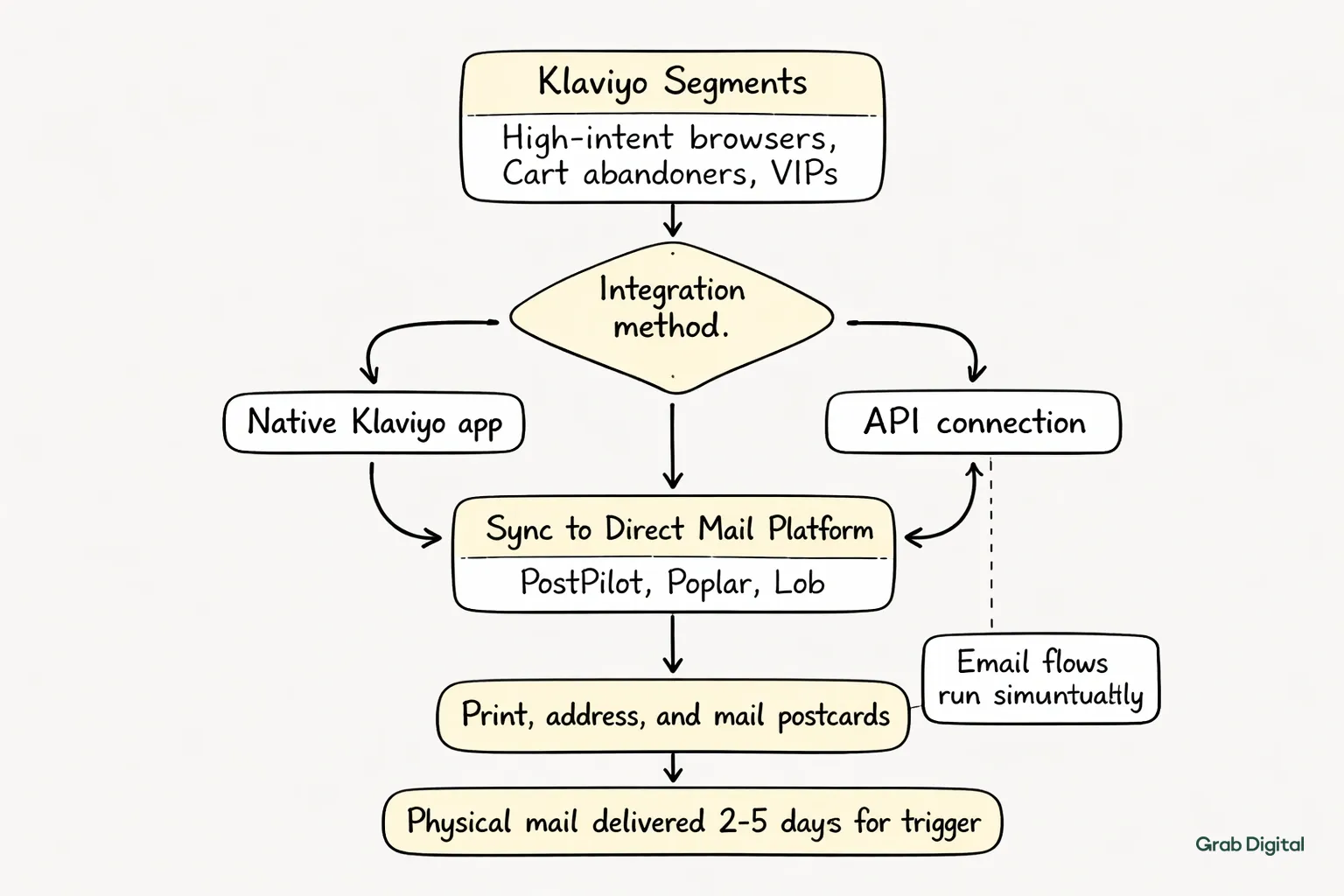
The integration works through native Klaviyo apps or API connections. You build segments high-intent browsers, cart abandoners, VIPs and sync them to direct mail platforms like PostPilot, Poplar, or Lob. Those platforms print, address, and mail postcards based on triggers you define. The customer gets physical mail 2-5 days after the trigger, while your email flows run in parallel.
Cost efficiency comes from not mailing everyone. Sending to your entire list costs $0.75-$2.50 per piece. Sending only to high-intent segments cart abandoners over $150, or customers inactive for 90 days turns direct mail into a targeted recovery tool.
DTC email marketing strategies that use multiple touchpoints outperform single-channel approaches by 25-35% in revenue attribution. Direct mail extends your existing Klaviyo workflows into physical space without needing new customer data.
How Direct Mail Integration Actually Works in Klaviyo
The setup connects Klaviyo segments to direct mail platforms through apps or webhooks. You install a direct mail app from Klaviyo's integrations marketplace, authenticate your accounts, and map Klaviyo properties (name, address, order history) to mail merge fields in your templates.
Triggers work just like email flows. A customer enters a segment abandoned cart over $100 and Klaviyo sends their profile data to the direct mail platform. The platform generates a personalized postcard, prints it, and mails it within 24-48 hours. The customer receives it 3-5 days later, depending on postal speed.
Suppression logic keeps you from annoying people. You can set frequency caps (no more than one piece per 30 days), exclude recent purchasers, or remove customers who've already converted from the triggered email. This works just like email segmentation best practices but applies to physical mail.
Tracking happens through unique promo codes or QR codes printed on each piece. When a customer uses the code at checkout, Klaviyo attributes the conversion to the direct mail send. You can also track mail delivery status through USPS Informed Delivery data.
Which Klaviyo Flows Benefit Most from Direct Mail
Abandoned cart flows see the highest lift. Email alone recovers 5-10% of abandoned carts. Adding a postcard on day 3 or 5 increases recovery to 8-15%. Timing matters here most brands send emails within 1-24 hours of abandonment. Mail arrives days later, creating a second chance when the customer has moved on.
Win-back flows targeting 90-180 day inactive customers convert 20-40% better with direct mail. These customers have stopped opening emails. A postcard breaks through because it's unexpected. Pair it with a compelling offer (20% off, free shipping) to drive re-engagement.
VIP appreciation campaigns use direct mail to reward top customers. Instead of another email discount, send a handwritten-style note with early access to new products. The physical gesture signals exclusivity. Brands using this see 10-25% increases in repeat purchase rates among VIP segments.
Browse abandonment strategies can incorporate direct mail too, though the economics are tighter. Use it for browsers who viewed high-AOV products multiple times but never added to cart.
Direct Mail Platforms That Integrate with Klaviyo
PostPilot is the go-to for DTC-focused direct mail. It connects directly to Klaviyo through a native app, syncs segments in real-time, and offers pre-built postcard templates. Pricing starts at $0.75 per postcard including design, printing, and postage.
Poplar focuses on QR code and personalized URL tracking. Each mail piece includes a unique code that links back to Klaviyo for precise attribution. Poplar supports multi-touch campaigns where a postcard sequence follows email flows. Pricing ranges from $0.85-$1.50 per piece.
Lob provides API-driven direct mail for brands with engineering resources. You can build custom integrations that trigger mail based on any Klaviyo event. Lob supports postcards, letters, checks, and self-mailers. Pricing starts at $0.50 per postcard for high-volume accounts.
If you're choosing between platforms: PostPilot and Poplar require no dev work. Lob delivers more customization but assumes you have technical capacity. Brands sending under 1,000 pieces per month typically start with PostPilot or Poplar.
Understanding which ecommerce email platform features matter helps you evaluate whether your Klaviyo setup supports the integrations you need.
Setting Up Your First Direct Mail Campaign in Klaviyo
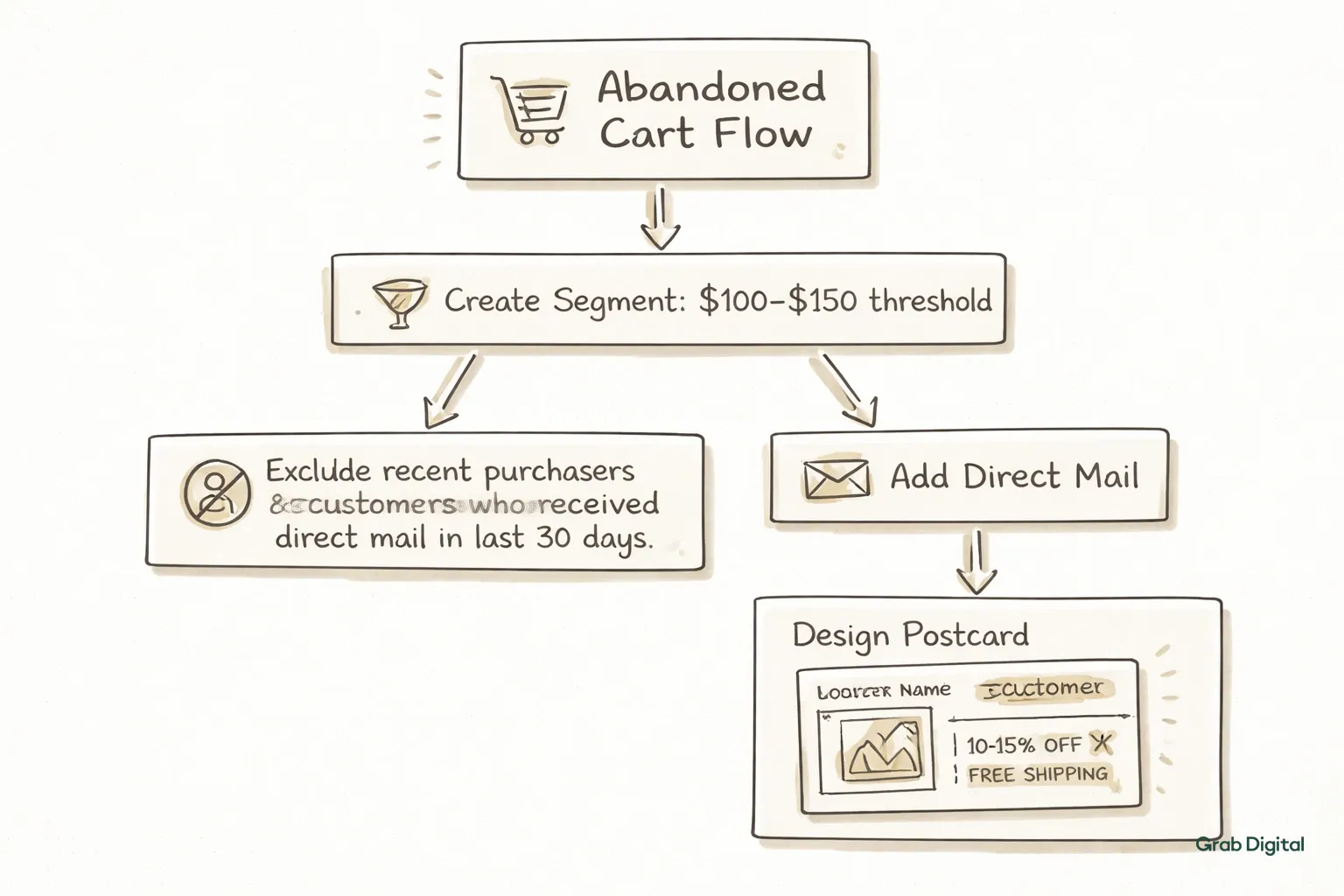
Start with a single flow. Abandoned cart is the safest bet it targets high-intent users and has clear ROI. Build the flow in Klaviyo first, then add direct mail as a parallel branch.
Create a segment for abandoned carts over a specific dollar threshold. Use $100-$150 as a starting point so customer lifetime value justifies the mail cost. Exclude recent purchasers and anyone who's received direct mail in the past 30 days.
Design your postcard with one clear call to action. Include the customer's name, the abandoned product image, and a promo code offering 10-15% off or free shipping. Use Klaviyo's dynamic content blocks to personalize based on what they abandoned.
Set timing for 3-5 days after cart abandonment. This gives your email sequence time to work first. If they haven't converted by day 3, the mail piece becomes your second touchpoint. Use a unique promo code that ties back to Klaviyo to measure conversions.
Test against a control group. Send direct mail to 50% of your abandoned cart segment and emails only to the other 50%. Run the test for 30 days or 500+ conversions. Measure incremental revenue, not just direct mail conversions you're looking for lift over email alone.
Book your free consultation if you want help scoping which flows deliver the highest ROI for your specific customer data.
Cost Structure and ROI Expectations for Integrated Campaigns
Direct mail costs $0.75-$2.50 per piece depending on format and volume. Postcards run $0.75-$1.25. Letters cost $1.00-$1.75. Catalogs range from $1.50-$2.50+.
Break-even depends on your AOV and conversion lift. If your AOV is $100 with 50% margin, you make $50 per order. A $1.00 postcard needs to convert 2% of recipients to break even. Abandoned cart postcards typically convert 3-8%, making them profitable for AOVs above $50-75.
ROI improves when you layer direct mail on top of email. A coordinated campaign three emails plus one postcard converts 8-15% of abandoned carts. Emails alone convert 5-10%. The incremental 3-5% lift comes from the mail piece, and that lift pays for the campaign.
Campaign economics favor targeted segments. Mailing your entire list costs thousands and dilutes ROI. Mailing only high-intent segments concentrates spend on customers most likely to convert. Brands typically allocate 5-15% of their email marketing budget to direct mail.
Attribution windows matter. Track conversions for 30 days after mail delivery, not just 7-14 days like email. Physical mail has a longer shelf life customers keep postcards on counters or desks. Delayed conversions still count toward ROI.
Compliance and Data Requirements for Direct Mail Integration
Direct mail requires physical addresses. Klaviyo profiles need complete address data street, city, state, ZIP. Most DTC brands collect addresses at checkout, but email-only subscribers won't have addresses on file. You can't mail to email-only profiles without collecting additional data.
Address verification reduces waste. Use address validation tools built into direct mail platforms to catch incomplete or invalid addresses before mail prints. Invalid addresses cost the same as valid ones but deliver zero ROI. Verification typically costs $0.02-$0.05 per address and prevents 5-10% delivery failures.
GDPR and CCPA apply to direct mail. Customers who've opted out of marketing should be excluded from direct mail unless they've given separate consent. Klaviyo's suppression lists carry over to integrations, but double-check that your direct mail platform respects opt-out preferences.
CAN-SPAM doesn't regulate physical mail, but FTC rules prohibit deceptive marketing regardless of channel. Your postcards must include your brand name, physical address, and clear identification that the piece is marketing.
Direct mail and CRM integration best practices emphasize clean data and compliance frameworks that protect both customer experience and brand reputation.
Measuring Performance Across Email and Direct Mail
Attribution models determine how you credit conversions. Direct attribution counts only conversions that use a unique promo code from the mail piece. Multi-touch attribution credits both email and mail when a customer interacts with both channels before purchasing.
Klaviyo's native attribution reports conversions to the last click by default. If a customer receives an email and a postcard, then clicks the email before buying, the email gets credit. To measure direct mail's contribution, create custom metrics that track promo code usage or tagged UTM parameters from mail-specific QR codes.
Incrementality testing isolates direct mail's impact. Run a holdout group that receives emails only, and compare conversion rates to a test group receiving emails plus direct mail. The difference is incremental lift. This controls for external variables like seasonality that affect both groups equally.
Time-to-conversion metrics differ between channels. Email drives 60-70% of conversions within 24 hours. Direct mail drives 40-50% within 7 days and another 20-30% within 14-30 days. Adjust your reporting windows to capture delayed conversions, or direct mail will appear less effective than it actually is.
Track cost per acquisition alongside conversion rate. A 5% conversion rate on a $1.00 postcard costs $20 per acquisition. If your AOV is $120 with 50% margins, that's $60 profit minus $20 acquisition cost, yielding $40 per customer. Compare that to your email CPA and other channels to evaluate relative efficiency.
Modern email marketing automation relies on accurate multi-channel reporting to allocate budget and optimize workflows.
Advanced Tactics: Sequencing and Multi-Touch Campaigns
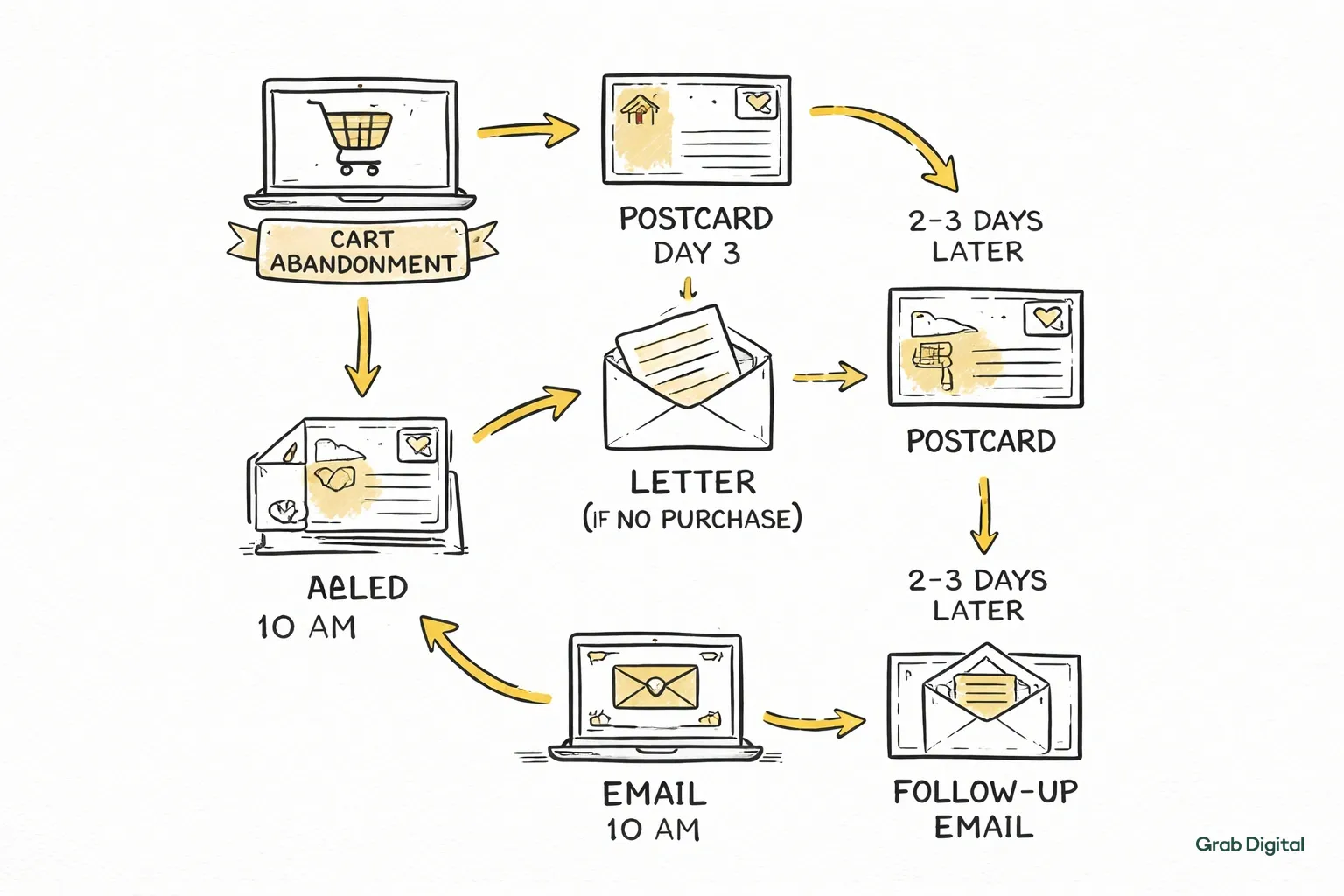
Sequential campaigns layer multiple mail touches into a single flow. Send a postcard on day 3 after cart abandonment, then a letter on day 10 if they still haven't purchased. Each piece escalates urgency or increases the offer. This approach converts 12-18% of abandoners compared to 8-12% for single-touch campaigns.
Coordinated timing creates reinforcement. Send an email at 10 AM, and trigger a postcard to arrive 2-3 days later when the email has been forgotten. The mail piece reactivates interest, and a follow-up email 2-3 days after that closes the loop. This three-touch sequence outperforms single-channel efforts by 20-35%.
Lookalike audiences extend direct mail beyond your Klaviyo list. Export your VIP segment (top 10% by LTV), upload it to Facebook or Google, and create a lookalike audience. Run digital ads to drive traffic, then use direct mail to retarget site visitors who don't convert. This combines paid acquisition with direct mail conversion optimization.
Product launches work well with coordinated multi-channel rollouts. Email your list with a teaser, mail a postcard with early access details, and follow with SMS or push notifications on launch day. Customers receive the message through three channels over 5-7 days.
Direct mail automation strategies that combine triggered sends with strategic sequencing maximize ROI.
Common Mistakes and How to Avoid Them
Over-mailing segments kills ROI. Sending multiple postcards to the same person within 30 days wastes budget and annoys customers. Set frequency caps in Klaviyo. Use suppression logic to exclude anyone who's received mail recently or who's already converted.
Generic creative tanks performance. Postcards that look like junk mail get thrown away. Use brand-consistent design, personalization (name, product image), and clear, specific offers. Test headlines the same way you test email subject lines.
Ignoring address quality wastes 10-15% of budget. Invalid, incomplete, or outdated addresses result in undeliverable mail. Run address verification before integrating direct mail, and clean your list periodically. Klaviyo profiles without complete addresses should be excluded automatically.
Short attribution windows undercount conversions. Direct mail drives action over weeks, not hours. If you measure results within 7 days, you'll miss 30-40% of conversions. Extend reporting windows to 30 days and use promo codes to capture delayed purchases.
Launching without testing leads to expensive failures. Start with a small segment (500-1,000 profiles) and run a 30-day test. Measure incremental conversions and calculate true ROI before scaling. Testing costs $500-$1,000 but prevents wasting $5,000-$10,000 on unoptimized campaigns.
When Direct Mail Integration Makes Sense for Your Brand
AOV thresholds determine viability. Brands with AOVs above $75 can justify direct mail costs more easily than those under $50. If your AOV is $200+ with healthy margins, direct mail becomes a high-leverage channel. For AOVs under $50, focus on email and paid social first.
List size affects testing capacity. You need at least 10,000 active email subscribers to build meaningful test segments. Smaller lists don't generate enough volume to reach statistical significance. Grow your email list to 10,000+ before adding direct mail.
Email saturation signals opportunity. If your open rates are declining, click rates are stagnant, and revenue per email is flat, your audience is fatigued. Direct mail breaks through inbox clutter and reactivates attention. Brands seeing diminishing returns from email alone benefit most.
Competitive differentiation matters. If every competitor sends the same discount emails, direct mail creates a memorable brand moment. Use it strategically VIP appreciation, product launches, major sales events to stand out.
Choosing the right Klaviyo agency helps you evaluate whether direct mail fits your current strategy, budget, and customer data capabilities.
Implementation Checklist for Klaviyo Direct Mail Integration
Start by auditing address data completeness in Klaviyo. Export your active subscriber list and calculate what percentage has complete mailing addresses (street, city, state, ZIP). You need 60%+ coverage to build meaningful mail segments. If coverage is lower, add address collection prompts at checkout and in preference centers.
Choose a direct mail platform based on your technical capacity and budget. PostPilot and Poplar require no dev work and integrate through native Klaviyo apps. Lob offers more customization but needs API configuration. Compare pricing, features, and customer support before committing.
Define your first campaign scope. Pick a single high-ROI flow abandoned cart, win-back, or VIP appreciation and build a test segment of 500-1,000 profiles. Set clear success metrics (conversion rate, incremental revenue, cost per acquisition) before launching.
Design your mail creative with the same rigor you apply to email. Use brand fonts, colors, and voice. Include personalization (name, product image). Write a clear headline and a single call to action. Test multiple designs if your platform supports A/B testing.
Configure tracking mechanisms. Add unique promo codes, QR codes with UTM parameters, or personalized URLs (PURLs) to each mail piece. Set up custom metrics in Klaviyo to capture conversions attributed to these codes. Extend your attribution window to 30 days.
Launch your test and monitor daily. Check delivery rates, address validation failures, and early conversion signals. Don't judge results until the campaign has run for at least 21 days physical mail delivers slower than email.
Next Steps for Scaling Direct Mail Strategy
Expand to additional flows once your first test proves profitable. Win-back campaigns typically deliver the second-highest ROI after abandoned cart. VIP appreciation and product launch campaigns follow. Add flows incrementally to manage budget and operational complexity.
Increase segmentation sophistication as you scale. Layer predicted LTV, purchase frequency, and product affinity into your mail segments. Send different offers or creative to high-value customers versus one-time buyers. Use Klaviyo's predictive analytics to prioritize who receives mail.
Test cadence and frequency. Run monthly experiments comparing single-touch versus multi-touch campaigns, or test sending mail on day 3 versus day 7 of a flow. Small timing and sequencing changes can yield 10-20% lift in conversions without additional cost.
Integrate direct mail reporting into your monthly performance reviews. Track mail-attributed revenue alongside email, paid social, and organic channels. Calculate blended CAC and ROAS to evaluate direct mail's contribution to overall growth.
Explore subscription email strategies and loyalty marketing tactics that pair naturally with direct mail for retention-focused brands.
Frequently Asked Questions
Q: How much does direct mail integration with Klaviyo cost?
A: Direct mail pieces cost $0.75-$2.50 each including design, printing, and postage. Klaviyo integration through platforms like PostPilot or Poplar is free you pay only per piece sent. Most DTC brands allocate $500-$2,000 monthly for direct mail, focusing on high-ROI segments like cart abandoners and VIP customers.
Q: Can I send direct mail to customers who only gave me their email address?
A: No. Direct mail requires a complete physical address. Klaviyo profiles with only email addresses can't receive mail. Collect addresses at checkout, through preference centers, or via pop-ups offering incentives for complete profile information. Expect 60-80% of email subscribers to have addresses on file if you collect at checkout.
Q: How do I prevent sending too much direct mail to the same person?
A: Set frequency caps in Klaviyo to limit mail sends to once every 30-60 days per customer. Use suppression logic to exclude anyone who's converted recently or received mail from another campaign. Most direct mail platforms inherit Klaviyo's suppression lists automatically, but verify this before launching.
Q: What's a realistic conversion rate for direct mail integrated with email flows?
A: Abandoned cart postcards convert 3-8% of recipients when integrated with email. Win-back campaigns targeting 90-180 day inactive customers convert 2-5%. VIP appreciation campaigns drive 10-25% increases in repeat purchase rates. Actual performance depends on offer strength, creative quality, and audience size.
Q: How long does it take to see results from a direct mail campaign?
A: Mail pieces arrive 3-5 days after triggers fire, and conversions happen over 14-30 days. Expect 40-50% of total conversions within the first week after delivery, and another 30-40% over weeks 2-4. Track results for at least 30 days before judging campaign success or scaling investment.
Q: Do I need a designer to create direct mail pieces for Klaviyo integration?
A: Most direct mail platforms offer pre-built templates optimized for DTC brands. You can customize colors, images, and copy without design skills. If you want fully custom designs, hire a designer or work with a Klaviyo agency that includes direct mail creative in their services. Template-based campaigns typically perform within 10-15% of custom designs at a fraction of the cost.
Integrating direct mail with Klaviyo lets you trigger postcards, catalogs, and letters based on what people actually do on your site email behaviors, cart activity, purchase history. You're turning existing customer data into physical touchpoints. Brands I work with see 15-40% higher conversion rates than email alone when they get this right.
Why bother? Because inboxes are a mess. Your subscribers get 121 emails a day on average. Physical mail? They get 3-5 pieces daily. That difference matters. When you coordinate both channels through Klaviyo, you catch customers who've tuned out your emails.
Why DTC Brands Are Adding Direct Mail to Klaviyo in 2026
Physical mail open rates sit between 80-90%. Email struggles to hit 15-25%. I'm not saying print is magic, but that gap is real attention you can't buy through digital ads.
The integration works through native Klaviyo apps or API connections. You build segments high-intent browsers, cart abandoners, VIPs and sync them to direct mail platforms like PostPilot, Poplar, or Lob. Those platforms print, address, and mail postcards based on triggers you define. The customer gets physical mail 2-5 days after the trigger, while your email flows run in parallel.
Cost efficiency comes from not mailing everyone. Sending to your entire list costs $0.75-$2.50 per piece. Sending only to high-intent segments cart abandoners over $150, or customers inactive for 90 days turns direct mail into a targeted recovery tool.
DTC email marketing strategies that use multiple touchpoints outperform single-channel approaches by 25-35% in revenue attribution. Direct mail extends your existing Klaviyo workflows into physical space without needing new customer data.
How Direct Mail Integration Actually Works in Klaviyo
The setup connects Klaviyo segments to direct mail platforms through apps or webhooks. You install a direct mail app from Klaviyo's integrations marketplace, authenticate your accounts, and map Klaviyo properties (name, address, order history) to mail merge fields in your templates.
Triggers work just like email flows. A customer enters a segment abandoned cart over $100 and Klaviyo sends their profile data to the direct mail platform. The platform generates a personalized postcard, prints it, and mails it within 24-48 hours. The customer receives it 3-5 days later, depending on postal speed.
Suppression logic keeps you from annoying people. You can set frequency caps (no more than one piece per 30 days), exclude recent purchasers, or remove customers who've already converted from the triggered email. This works just like email segmentation best practices but applies to physical mail.
Tracking happens through unique promo codes or QR codes printed on each piece. When a customer uses the code at checkout, Klaviyo attributes the conversion to the direct mail send. You can also track mail delivery status through USPS Informed Delivery data.
Which Klaviyo Flows Benefit Most from Direct Mail
Abandoned cart flows see the highest lift. Email alone recovers 5-10% of abandoned carts. Adding a postcard on day 3 or 5 increases recovery to 8-15%. Timing matters here most brands send emails within 1-24 hours of abandonment. Mail arrives days later, creating a second chance when the customer has moved on.
Win-back flows targeting 90-180 day inactive customers convert 20-40% better with direct mail. These customers have stopped opening emails. A postcard breaks through because it's unexpected. Pair it with a compelling offer (20% off, free shipping) to drive re-engagement.
VIP appreciation campaigns use direct mail to reward top customers. Instead of another email discount, send a handwritten-style note with early access to new products. The physical gesture signals exclusivity. Brands using this see 10-25% increases in repeat purchase rates among VIP segments.
Browse abandonment strategies can incorporate direct mail too, though the economics are tighter. Use it for browsers who viewed high-AOV products multiple times but never added to cart.
Direct Mail Platforms That Integrate with Klaviyo
PostPilot is the go-to for DTC-focused direct mail. It connects directly to Klaviyo through a native app, syncs segments in real-time, and offers pre-built postcard templates. Pricing starts at $0.75 per postcard including design, printing, and postage.
Poplar focuses on QR code and personalized URL tracking. Each mail piece includes a unique code that links back to Klaviyo for precise attribution. Poplar supports multi-touch campaigns where a postcard sequence follows email flows. Pricing ranges from $0.85-$1.50 per piece.
Lob provides API-driven direct mail for brands with engineering resources. You can build custom integrations that trigger mail based on any Klaviyo event. Lob supports postcards, letters, checks, and self-mailers. Pricing starts at $0.50 per postcard for high-volume accounts.
If you're choosing between platforms: PostPilot and Poplar require no dev work. Lob delivers more customization but assumes you have technical capacity. Brands sending under 1,000 pieces per month typically start with PostPilot or Poplar.
Understanding which ecommerce email platform features matter helps you evaluate whether your Klaviyo setup supports the integrations you need.
Setting Up Your First Direct Mail Campaign in Klaviyo
Start with a single flow. Abandoned cart is the safest bet it targets high-intent users and has clear ROI. Build the flow in Klaviyo first, then add direct mail as a parallel branch.
Create a segment for abandoned carts over a specific dollar threshold. Use $100-$150 as a starting point so customer lifetime value justifies the mail cost. Exclude recent purchasers and anyone who's received direct mail in the past 30 days.
Design your postcard with one clear call to action. Include the customer's name, the abandoned product image, and a promo code offering 10-15% off or free shipping. Use Klaviyo's dynamic content blocks to personalize based on what they abandoned.
Set timing for 3-5 days after cart abandonment. This gives your email sequence time to work first. If they haven't converted by day 3, the mail piece becomes your second touchpoint. Use a unique promo code that ties back to Klaviyo to measure conversions.
Test against a control group. Send direct mail to 50% of your abandoned cart segment and emails only to the other 50%. Run the test for 30 days or 500+ conversions. Measure incremental revenue, not just direct mail conversions you're looking for lift over email alone.
Book your free consultation if you want help scoping which flows deliver the highest ROI for your specific customer data.
Cost Structure and ROI Expectations for Integrated Campaigns
Direct mail costs $0.75-$2.50 per piece depending on format and volume. Postcards run $0.75-$1.25. Letters cost $1.00-$1.75. Catalogs range from $1.50-$2.50+.
Break-even depends on your AOV and conversion lift. If your AOV is $100 with 50% margin, you make $50 per order. A $1.00 postcard needs to convert 2% of recipients to break even. Abandoned cart postcards typically convert 3-8%, making them profitable for AOVs above $50-75.
ROI improves when you layer direct mail on top of email. A coordinated campaign three emails plus one postcard converts 8-15% of abandoned carts. Emails alone convert 5-10%. The incremental 3-5% lift comes from the mail piece, and that lift pays for the campaign.
Campaign economics favor targeted segments. Mailing your entire list costs thousands and dilutes ROI. Mailing only high-intent segments concentrates spend on customers most likely to convert. Brands typically allocate 5-15% of their email marketing budget to direct mail.
Attribution windows matter. Track conversions for 30 days after mail delivery, not just 7-14 days like email. Physical mail has a longer shelf life customers keep postcards on counters or desks. Delayed conversions still count toward ROI.
Compliance and Data Requirements for Direct Mail Integration
Direct mail requires physical addresses. Klaviyo profiles need complete address data street, city, state, ZIP. Most DTC brands collect addresses at checkout, but email-only subscribers won't have addresses on file. You can't mail to email-only profiles without collecting additional data.
Address verification reduces waste. Use address validation tools built into direct mail platforms to catch incomplete or invalid addresses before mail prints. Invalid addresses cost the same as valid ones but deliver zero ROI. Verification typically costs $0.02-$0.05 per address and prevents 5-10% delivery failures.
GDPR and CCPA apply to direct mail. Customers who've opted out of marketing should be excluded from direct mail unless they've given separate consent. Klaviyo's suppression lists carry over to integrations, but double-check that your direct mail platform respects opt-out preferences.
CAN-SPAM doesn't regulate physical mail, but FTC rules prohibit deceptive marketing regardless of channel. Your postcards must include your brand name, physical address, and clear identification that the piece is marketing.
Direct mail and CRM integration best practices emphasize clean data and compliance frameworks that protect both customer experience and brand reputation.
Measuring Performance Across Email and Direct Mail
Attribution models determine how you credit conversions. Direct attribution counts only conversions that use a unique promo code from the mail piece. Multi-touch attribution credits both email and mail when a customer interacts with both channels before purchasing.
Klaviyo's native attribution reports conversions to the last click by default. If a customer receives an email and a postcard, then clicks the email before buying, the email gets credit. To measure direct mail's contribution, create custom metrics that track promo code usage or tagged UTM parameters from mail-specific QR codes.
Incrementality testing isolates direct mail's impact. Run a holdout group that receives emails only, and compare conversion rates to a test group receiving emails plus direct mail. The difference is incremental lift. This controls for external variables like seasonality that affect both groups equally.
Time-to-conversion metrics differ between channels. Email drives 60-70% of conversions within 24 hours. Direct mail drives 40-50% within 7 days and another 20-30% within 14-30 days. Adjust your reporting windows to capture delayed conversions, or direct mail will appear less effective than it actually is.
Track cost per acquisition alongside conversion rate. A 5% conversion rate on a $1.00 postcard costs $20 per acquisition. If your AOV is $120 with 50% margins, that's $60 profit minus $20 acquisition cost, yielding $40 per customer. Compare that to your email CPA and other channels to evaluate relative efficiency.
Modern email marketing automation relies on accurate multi-channel reporting to allocate budget and optimize workflows.
Advanced Tactics: Sequencing and Multi-Touch Campaigns
Sequential campaigns layer multiple mail touches into a single flow. Send a postcard on day 3 after cart abandonment, then a letter on day 10 if they still haven't purchased. Each piece escalates urgency or increases the offer. This approach converts 12-18% of abandoners compared to 8-12% for single-touch campaigns.
Coordinated timing creates reinforcement. Send an email at 10 AM, and trigger a postcard to arrive 2-3 days later when the email has been forgotten. The mail piece reactivates interest, and a follow-up email 2-3 days after that closes the loop. This three-touch sequence outperforms single-channel efforts by 20-35%.
Lookalike audiences extend direct mail beyond your Klaviyo list. Export your VIP segment (top 10% by LTV), upload it to Facebook or Google, and create a lookalike audience. Run digital ads to drive traffic, then use direct mail to retarget site visitors who don't convert. This combines paid acquisition with direct mail conversion optimization.
Product launches work well with coordinated multi-channel rollouts. Email your list with a teaser, mail a postcard with early access details, and follow with SMS or push notifications on launch day. Customers receive the message through three channels over 5-7 days.
Direct mail automation strategies that combine triggered sends with strategic sequencing maximize ROI.
Common Mistakes and How to Avoid Them
Over-mailing segments kills ROI. Sending multiple postcards to the same person within 30 days wastes budget and annoys customers. Set frequency caps in Klaviyo. Use suppression logic to exclude anyone who's received mail recently or who's already converted.
Generic creative tanks performance. Postcards that look like junk mail get thrown away. Use brand-consistent design, personalization (name, product image), and clear, specific offers. Test headlines the same way you test email subject lines.
Ignoring address quality wastes 10-15% of budget. Invalid, incomplete, or outdated addresses result in undeliverable mail. Run address verification before integrating direct mail, and clean your list periodically. Klaviyo profiles without complete addresses should be excluded automatically.
Short attribution windows undercount conversions. Direct mail drives action over weeks, not hours. If you measure results within 7 days, you'll miss 30-40% of conversions. Extend reporting windows to 30 days and use promo codes to capture delayed purchases.
Launching without testing leads to expensive failures. Start with a small segment (500-1,000 profiles) and run a 30-day test. Measure incremental conversions and calculate true ROI before scaling. Testing costs $500-$1,000 but prevents wasting $5,000-$10,000 on unoptimized campaigns.
When Direct Mail Integration Makes Sense for Your Brand
AOV thresholds determine viability. Brands with AOVs above $75 can justify direct mail costs more easily than those under $50. If your AOV is $200+ with healthy margins, direct mail becomes a high-leverage channel. For AOVs under $50, focus on email and paid social first.
List size affects testing capacity. You need at least 10,000 active email subscribers to build meaningful test segments. Smaller lists don't generate enough volume to reach statistical significance. Grow your email list to 10,000+ before adding direct mail.
Email saturation signals opportunity. If your open rates are declining, click rates are stagnant, and revenue per email is flat, your audience is fatigued. Direct mail breaks through inbox clutter and reactivates attention. Brands seeing diminishing returns from email alone benefit most.
Competitive differentiation matters. If every competitor sends the same discount emails, direct mail creates a memorable brand moment. Use it strategically VIP appreciation, product launches, major sales events to stand out.
Choosing the right Klaviyo agency helps you evaluate whether direct mail fits your current strategy, budget, and customer data capabilities.
Implementation Checklist for Klaviyo Direct Mail Integration
Start by auditing address data completeness in Klaviyo. Export your active subscriber list and calculate what percentage has complete mailing addresses (street, city, state, ZIP). You need 60%+ coverage to build meaningful mail segments. If coverage is lower, add address collection prompts at checkout and in preference centers.
Choose a direct mail platform based on your technical capacity and budget. PostPilot and Poplar require no dev work and integrate through native Klaviyo apps. Lob offers more customization but needs API configuration. Compare pricing, features, and customer support before committing.
Define your first campaign scope. Pick a single high-ROI flow abandoned cart, win-back, or VIP appreciation and build a test segment of 500-1,000 profiles. Set clear success metrics (conversion rate, incremental revenue, cost per acquisition) before launching.
Design your mail creative with the same rigor you apply to email. Use brand fonts, colors, and voice. Include personalization (name, product image). Write a clear headline and a single call to action. Test multiple designs if your platform supports A/B testing.
Configure tracking mechanisms. Add unique promo codes, QR codes with UTM parameters, or personalized URLs (PURLs) to each mail piece. Set up custom metrics in Klaviyo to capture conversions attributed to these codes. Extend your attribution window to 30 days.
Launch your test and monitor daily. Check delivery rates, address validation failures, and early conversion signals. Don't judge results until the campaign has run for at least 21 days physical mail delivers slower than email.
Next Steps for Scaling Direct Mail Strategy
Expand to additional flows once your first test proves profitable. Win-back campaigns typically deliver the second-highest ROI after abandoned cart. VIP appreciation and product launch campaigns follow. Add flows incrementally to manage budget and operational complexity.
Increase segmentation sophistication as you scale. Layer predicted LTV, purchase frequency, and product affinity into your mail segments. Send different offers or creative to high-value customers versus one-time buyers. Use Klaviyo's predictive analytics to prioritize who receives mail.
Test cadence and frequency. Run monthly experiments comparing single-touch versus multi-touch campaigns, or test sending mail on day 3 versus day 7 of a flow. Small timing and sequencing changes can yield 10-20% lift in conversions without additional cost.
Integrate direct mail reporting into your monthly performance reviews. Track mail-attributed revenue alongside email, paid social, and organic channels. Calculate blended CAC and ROAS to evaluate direct mail's contribution to overall growth.
Explore subscription email strategies and loyalty marketing tactics that pair naturally with direct mail for retention-focused brands.
Frequently Asked Questions
Q: How much does direct mail integration with Klaviyo cost?
A: Direct mail pieces cost $0.75-$2.50 each including design, printing, and postage. Klaviyo integration through platforms like PostPilot or Poplar is free you pay only per piece sent. Most DTC brands allocate $500-$2,000 monthly for direct mail, focusing on high-ROI segments like cart abandoners and VIP customers.
Q: Can I send direct mail to customers who only gave me their email address?
A: No. Direct mail requires a complete physical address. Klaviyo profiles with only email addresses can't receive mail. Collect addresses at checkout, through preference centers, or via pop-ups offering incentives for complete profile information. Expect 60-80% of email subscribers to have addresses on file if you collect at checkout.
Q: How do I prevent sending too much direct mail to the same person?
A: Set frequency caps in Klaviyo to limit mail sends to once every 30-60 days per customer. Use suppression logic to exclude anyone who's converted recently or received mail from another campaign. Most direct mail platforms inherit Klaviyo's suppression lists automatically, but verify this before launching.
Q: What's a realistic conversion rate for direct mail integrated with email flows?
A: Abandoned cart postcards convert 3-8% of recipients when integrated with email. Win-back campaigns targeting 90-180 day inactive customers convert 2-5%. VIP appreciation campaigns drive 10-25% increases in repeat purchase rates. Actual performance depends on offer strength, creative quality, and audience size.
Q: How long does it take to see results from a direct mail campaign?
A: Mail pieces arrive 3-5 days after triggers fire, and conversions happen over 14-30 days. Expect 40-50% of total conversions within the first week after delivery, and another 30-40% over weeks 2-4. Track results for at least 30 days before judging campaign success or scaling investment.
Q: Do I need a designer to create direct mail pieces for Klaviyo integration?
A: Most direct mail platforms offer pre-built templates optimized for DTC brands. You can customize colors, images, and copy without design skills. If you want fully custom designs, hire a designer or work with a Klaviyo agency that includes direct mail creative in their services. Template-based campaigns typically perform within 10-15% of custom designs at a fraction of the cost.

Find out exactly what your email channel is leaving on the table.

Email Marketing for Scaling DTC Brands


