
Summary
ActiveCampaign vs Klaviyo: Which is Better for DTC Brands?
The ActiveCampaign vs Klaviyo debate usually boils down to one thing: what you sell. ActiveCampaign is a general-purpose marketing automation tool built for dozens of industries. Klaviyo was built specifically for ecommerce data. If you run a DTC brand on Shopify, Klaviyo’s native commerce integrations almost always win on revenue attribution, segmentation, and automation triggers tied to actual purchase behavior.
Picking the wrong platform isn't just a headache. It actively leaks revenue every month. Both tools claim ecommerce credibility, but we’ve seen firsthand how their data models, automation builders, and pricing structures look very different once you actually try to build campaigns inside them. Here is a breakdown of what matters for brands doing $1M to $10M in annual revenue trying to make this call right now.
How their backgrounds shape the tools
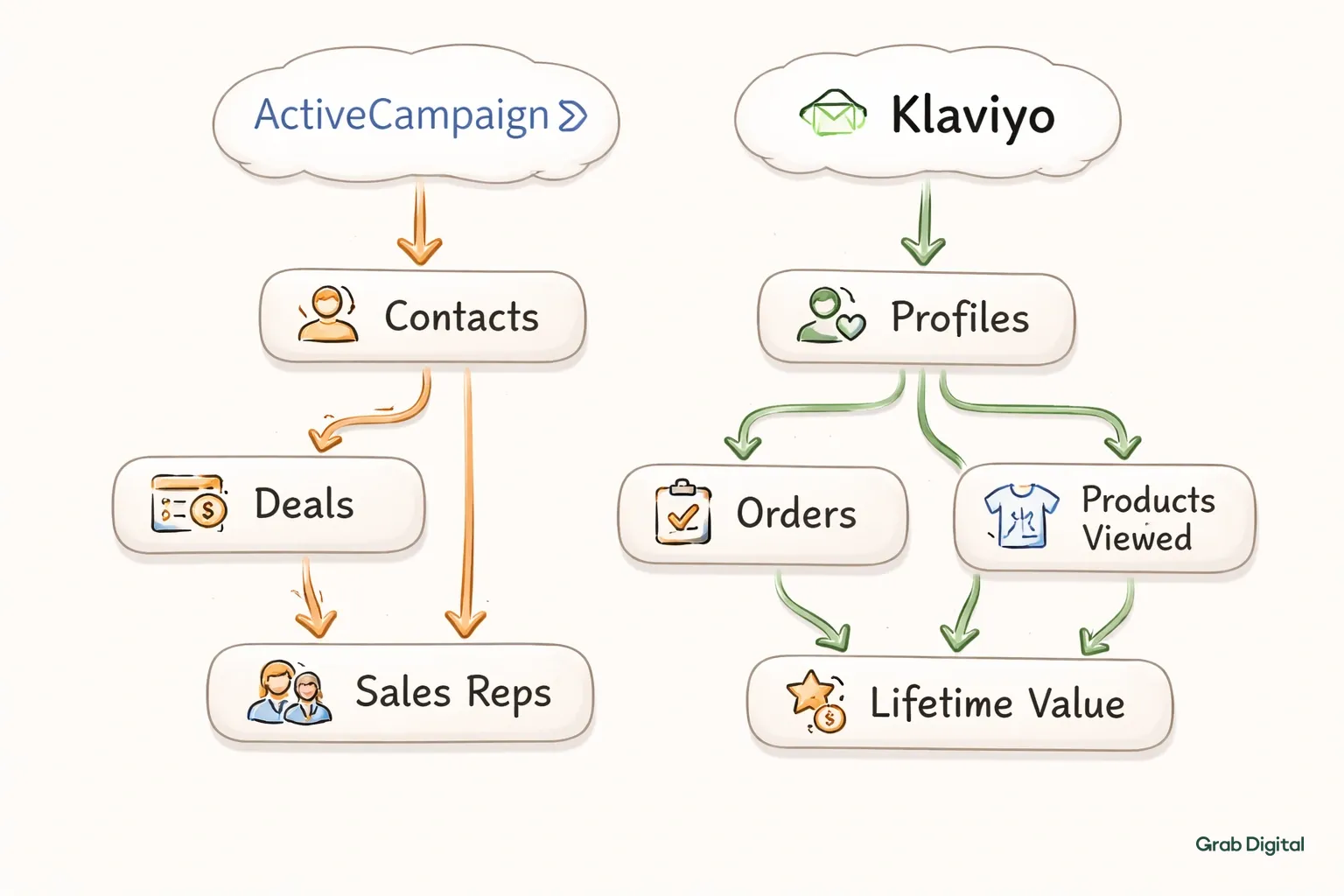
ActiveCampaign started as a CRM and sales automation tool for B2B and service businesses. Klaviyo was built from day one around Shopify data and ecommerce events. That founding difference still drives every feature decision both companies make today.
ActiveCampaign treats "contacts" as the primary object. Deals, pipelines, and sales reps sit at the center of its architecture. Klaviyo treats "profiles" as living records tied directly to orders, products viewed, cart contents, and lifetime value. If your business sells physical products through a Shopify store, Klaviyo’s data model matches your actual customer journey much more naturally than ActiveCampaign’s sales-pipeline-first approach.
Ecommerce data and integrations
This is where the comparison ends for most DTC brands. Klaviyo pulls detailed ecommerce events directly from Shopify in real time: product views, checkout starts, specific SKUs purchased, and predicted customer lifetime value. ActiveCampaign requires more manual setup and third-party connectors to capture that same level of detail.
Here is a side-by-side look at how the two platforms handle ecommerce data:
| Data Feature | Klaviyo | ActiveCampaign |
|---|---|---|
| Native Shopify integration | Deep, real-time | Basic, via app |
| Predictive analytics (CLV, churn) | Built-in | Limited |
| Product-level event tracking | Automatic | Requires setup |
| Pre-built ecommerce segments | Yes | Minimal |
| RFM and purchase-based filters | Native | Manual workarounds |
Klaviyo calculates expected customer lifetime value and churn risk without extra configuration. ActiveCampaign can approximate some of this with custom fields and tagging rules, but it takes considerably more manual effort. For brands already struggling with limited internal resources, that gap matters. If you want a deeper look at how platform choice affects overall strategy, our breakdown on ecommerce email platforms covers this in more detail.
Automation capabilities: Flows vs Workflows
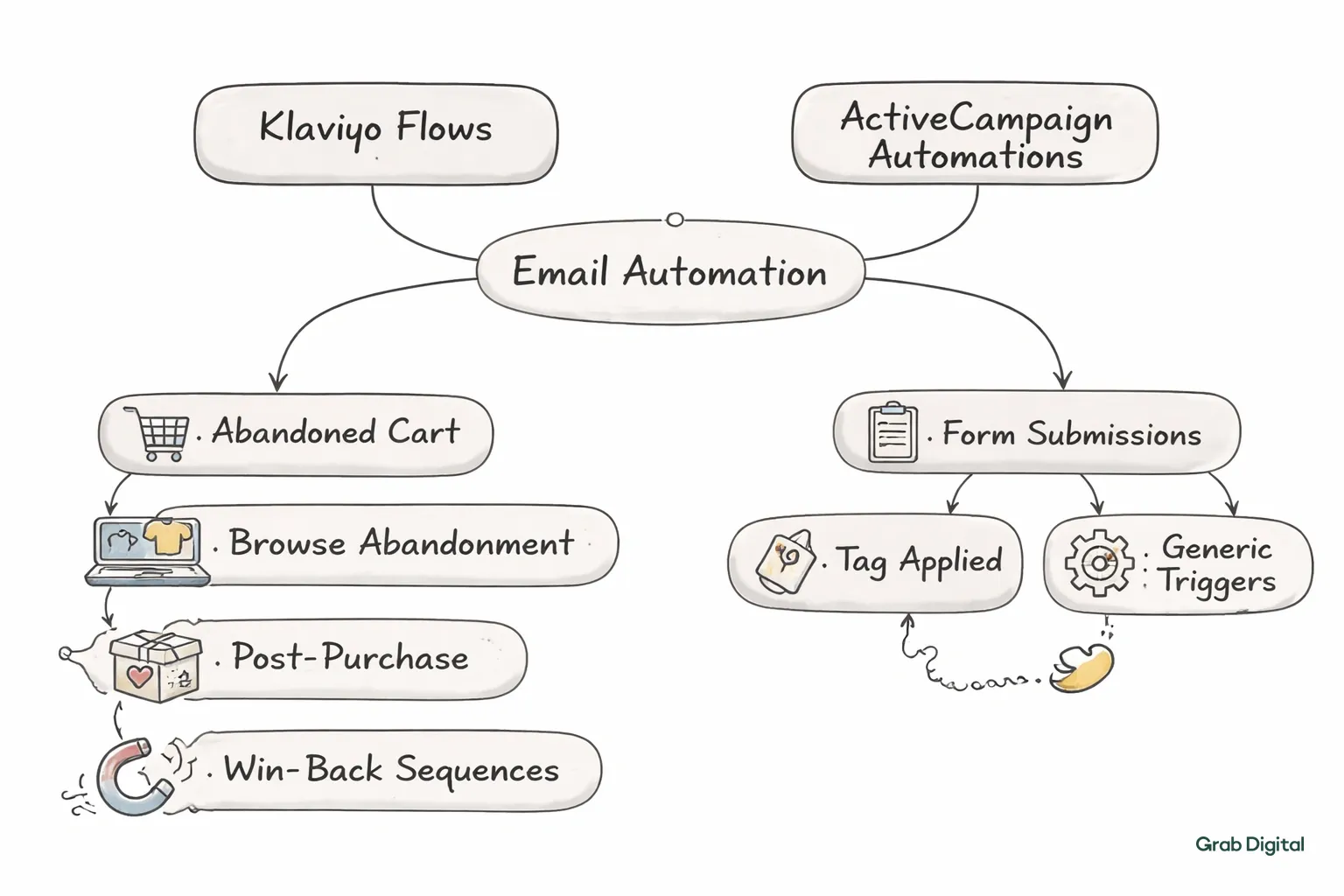
They use different naming conventions, but the real gap is in ecommerce-specific triggers. Klaviyo calls automations "flows" and ships with pre-built templates for abandoned cart, browse abandonment, post-purchase, and win-back sequences. ActiveCampaign calls them "automations" and relies more heavily on generic triggers like form submissions and tag applications.
Klaviyo’s flow triggers include things ActiveCampaign simply doesn't track natively, like specific product categories browsed or items left in a cart. That makes building an abandoned cart sequence or a proper win-back flow dramatically faster inside Klaviyo.
A few practical differences we always point out to clients:
- Klaviyo flows auto-populate with product images, prices, and names pulled directly from your store.
- ActiveCampaign automations need custom content blocks and manual data mapping to achieve the same result.
- ActiveCampaign’s visual automation builder is arguably more flexible for complex, multi-branch logic outside of ecommerce.
- Klaviyo’s SMS and email flows share the same trigger logic, simplifying omnichannel builds.
If your team has strong technical resources, ActiveCampaign’s flexibility can be an asset. Most DTC brands without a dedicated email department find Klaviyo’s templates get them to a working flow faster.
Pricing for growing DTC brands
Pricing scales by contact count on both platforms, but the real cost difference shows up in what is included at each tier. ActiveCampaign’s entry plans look cheaper on paper, but ecommerce features like predictive sending and advanced segmentation sit behind higher-tier plans. Klaviyo bundles most ecommerce functionality into its standard pricing from the start.
Here is a general comparison based on late 2026 pricing structures:
| Plan Level | Klaviyo (approx.) | ActiveCampaign (approx.) |
|---|---|---|
| Entry tier (5,000 contacts) | $100/month | $93/month |
| Includes ecommerce automation | Yes, from entry tier | Partial, limited triggers |
| SMS included | Add-on, integrated | Separate product |
| Predictive analytics | Included | Enterprise tier only |
| A/B testing | Included | Included |
At lower contact counts, pricing is roughly comparable. The gap widens as your list grows and you need features like predictive send-time optimization or deep purchase-based segmentation. Those features sit in ActiveCampaign’s higher-priced enterprise plans but come standard with Klaviyo much earlier.
When evaluating total cost of ownership, you also have to factor in implementation time. A platform that requires weeks of manual setup to replicate features Klaviyo offers out of the box isn't actually cheaper once staff hours get counted.
Segmentation and personalization
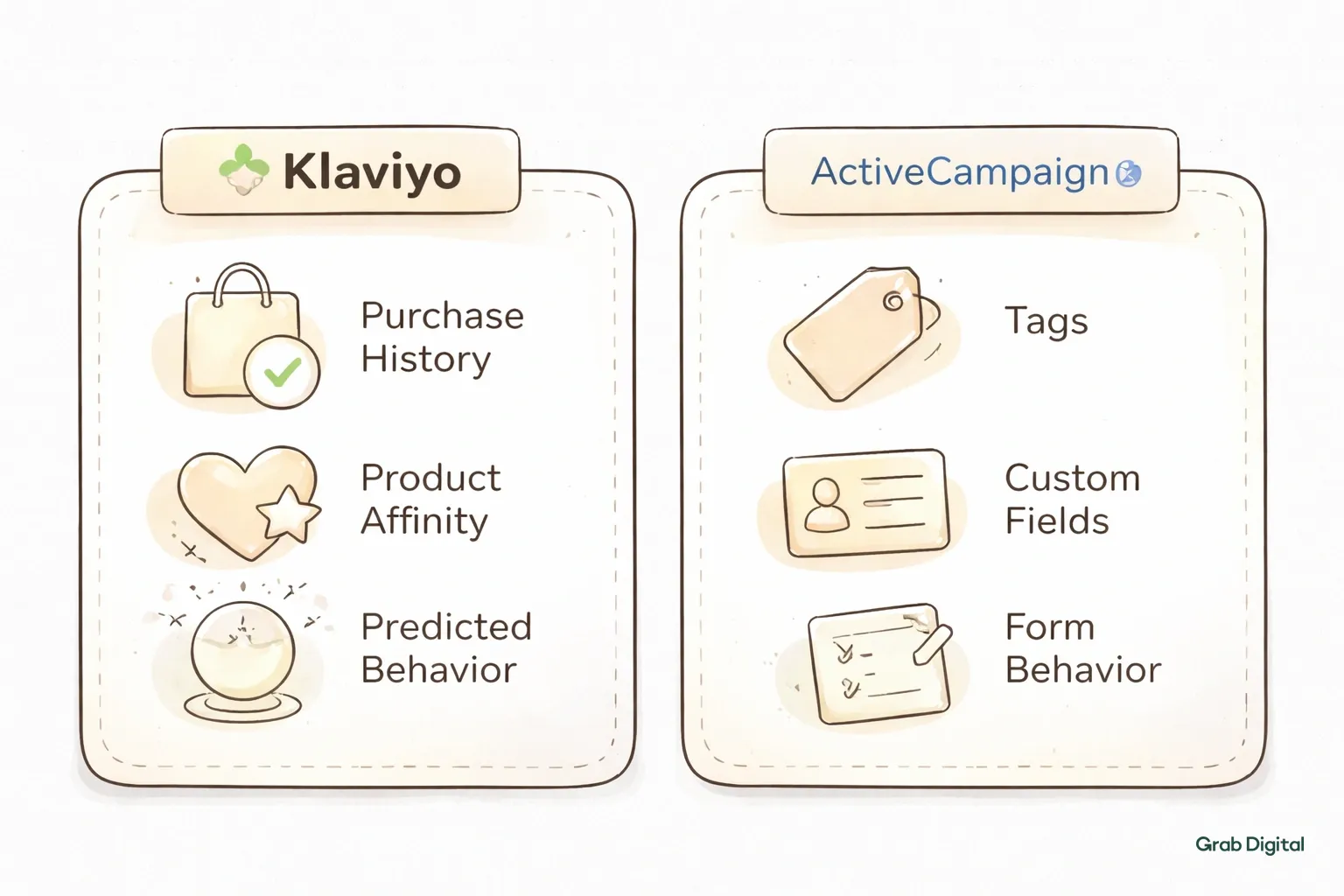
Segmentation quality determines whether your emails feel relevant or generic. Klaviyo’s segmentation engine was built around purchase history, product affinity, and predicted behavior from the ground up. ActiveCampaign’s segmentation leans on tags, custom fields, and form behavior. That works well for lead scoring, but it falls flat for product-based targeting.
For a DTC brand, the ability to segment by "customers who bought Product A but not Product B in the last 90 days" is table stakes. Klaviyo handles that natively with a few clicks. ActiveCampaign can get there, but it usually requires custom field mapping and manual tag maintenance that someone has to keep updated.
This matters even more as your list grows. Our guide on advanced email segmentation strategies walks through how granular targeting directly impacts revenue per send. Brands that neglect segmentation tend to see flat open rates and declining list health over time.
Deliverability and sender reputation
Deliverability depends more on your sending practices than the platform itself, but infrastructure still matters. Klaviyo has invested heavily in deliverability tooling specifically for high-volume ecommerce senders, including built-in suppression recommendations and engagement-based sending. ActiveCampaign offers solid deliverability tools too, but they’re built for a broader range of use cases, not ecommerce-specific sending patterns.
Both platforms will flag poor list hygiene, but Klaviyo’s suppression and sunset flow recommendations are tailored to how DTC brands actually behave: frequent campaigns, seasonal spikes, and large unengaged segments after big list-growth pushes. If deliverability has been a struggle for your brand regardless of platform, our piece on email deliverability tips for DTC brands covers the fundamentals that apply no matter which tool you use.
Which platform fits your brand
The right platform depends on your business model, not just feature lists. ActiveCampaign fits businesses with complex sales pipelines, service-based offers, or a mix of B2B and B2C needs. Klaviyo fits DTC ecommerce brands selling physical products where purchase data should drive every automated message.
If you’re running a Shopify store and more than 80% of your revenue comes from product sales rather than services, Klaviyo’s ecommerce-first design will almost always save you setup time and improve targeting accuracy. ActiveCampaign remains a strong choice if email is a secondary channel supporting a sales team, or if your business model genuinely requires pipeline and deal-tracking features Klaviyo doesn't offer.
For brands already on Klaviyo and generating less than 20% of revenue through email, the platform usually isn't the bottleneck. Strategy, segmentation, and flow execution are. That’s where a dedicated team focused on Klaviyo-specific services can close the gap faster than switching platforms ever would. You can see examples of what that looks like in practice across our client work.
Still unsure which direction makes sense for your current setup? Our team reviews your existing Klaviyo or ActiveCampaign account, benchmarks it against DTC norms, and tells you exactly where revenue is being left on the table. You can book your free consultation to get that review started this week.
A few things people always ask us
Is Klaviyo better than ActiveCampaign for Shopify stores? For most Shopify-based DTC brands, yes. Klaviyo’s native ecommerce data integration, predictive analytics, and pre-built flow templates reduce setup time and improve targeting accuracy compared to ActiveCampaign’s more generalized approach.
Can ActiveCampaign handle ecommerce automation as well as Klaviyo? It can build similar automations, but it requires more manual configuration. Features like predictive sending and product-level segmentation sit behind higher pricing tiers rather than coming standard.
Which platform is cheaper for a growing DTC brand? Entry-level pricing is similar. The cost gap widens as contact lists grow, since ActiveCampaign’s advanced ecommerce features require upgrading to pricier plans that Klaviyo includes earlier.
Does switching from ActiveCampaign to Klaviyo improve email revenue? It can, mainly because Klaviyo’s segmentation and flow triggers are built around purchase behavior. But results depend heavily on strategy and list health, not the platform switch alone.
Do I need both platforms for different marketing needs? Some brands with both B2B and DTC arms use ActiveCampaign for sales pipelines and Klaviyo for ecommerce email. For pure DTC brands, running one ecommerce-focused platform like Klaviyo is usually simpler and more cost-effective.
How do I know if my current Klaviyo setup is underperforming? Compare email-attributed revenue against the 30%+ benchmark top DTC brands achieve. If email is generating less than 20% of total revenue, the issue is usually flow and segmentation strategy rather than the platform itself.
The ActiveCampaign vs Klaviyo debate usually boils down to one thing: what you sell. ActiveCampaign is a general-purpose marketing automation tool built for dozens of industries. Klaviyo was built specifically for ecommerce data. If you run a DTC brand on Shopify, Klaviyo’s native commerce integrations almost always win on revenue attribution, segmentation, and automation triggers tied to actual purchase behavior.
Picking the wrong platform isn't just a headache. It actively leaks revenue every month. Both tools claim ecommerce credibility, but we’ve seen firsthand how their data models, automation builders, and pricing structures look very different once you actually try to build campaigns inside them. Here is a breakdown of what matters for brands doing $1M to $10M in annual revenue trying to make this call right now.
How their backgrounds shape the tools
ActiveCampaign started as a CRM and sales automation tool for B2B and service businesses. Klaviyo was built from day one around Shopify data and ecommerce events. That founding difference still drives every feature decision both companies make today.
ActiveCampaign treats "contacts" as the primary object. Deals, pipelines, and sales reps sit at the center of its architecture. Klaviyo treats "profiles" as living records tied directly to orders, products viewed, cart contents, and lifetime value. If your business sells physical products through a Shopify store, Klaviyo’s data model matches your actual customer journey much more naturally than ActiveCampaign’s sales-pipeline-first approach.
Ecommerce data and integrations
This is where the comparison ends for most DTC brands. Klaviyo pulls detailed ecommerce events directly from Shopify in real time: product views, checkout starts, specific SKUs purchased, and predicted customer lifetime value. ActiveCampaign requires more manual setup and third-party connectors to capture that same level of detail.
Here is a side-by-side look at how the two platforms handle ecommerce data:
| Data Feature | Klaviyo | ActiveCampaign |
|---|---|---|
| Native Shopify integration | Deep, real-time | Basic, via app |
| Predictive analytics (CLV, churn) | Built-in | Limited |
| Product-level event tracking | Automatic | Requires setup |
| Pre-built ecommerce segments | Yes | Minimal |
| RFM and purchase-based filters | Native | Manual workarounds |
Klaviyo calculates expected customer lifetime value and churn risk without extra configuration. ActiveCampaign can approximate some of this with custom fields and tagging rules, but it takes considerably more manual effort. For brands already struggling with limited internal resources, that gap matters. If you want a deeper look at how platform choice affects overall strategy, our breakdown on ecommerce email platforms covers this in more detail.
Automation capabilities: Flows vs Workflows
They use different naming conventions, but the real gap is in ecommerce-specific triggers. Klaviyo calls automations "flows" and ships with pre-built templates for abandoned cart, browse abandonment, post-purchase, and win-back sequences. ActiveCampaign calls them "automations" and relies more heavily on generic triggers like form submissions and tag applications.
Klaviyo’s flow triggers include things ActiveCampaign simply doesn't track natively, like specific product categories browsed or items left in a cart. That makes building an abandoned cart sequence or a proper win-back flow dramatically faster inside Klaviyo.
A few practical differences we always point out to clients:
- Klaviyo flows auto-populate with product images, prices, and names pulled directly from your store.
- ActiveCampaign automations need custom content blocks and manual data mapping to achieve the same result.
- ActiveCampaign’s visual automation builder is arguably more flexible for complex, multi-branch logic outside of ecommerce.
- Klaviyo’s SMS and email flows share the same trigger logic, simplifying omnichannel builds.
If your team has strong technical resources, ActiveCampaign’s flexibility can be an asset. Most DTC brands without a dedicated email department find Klaviyo’s templates get them to a working flow faster.
Pricing for growing DTC brands
Pricing scales by contact count on both platforms, but the real cost difference shows up in what is included at each tier. ActiveCampaign’s entry plans look cheaper on paper, but ecommerce features like predictive sending and advanced segmentation sit behind higher-tier plans. Klaviyo bundles most ecommerce functionality into its standard pricing from the start.
Here is a general comparison based on late 2026 pricing structures:
| Plan Level | Klaviyo (approx.) | ActiveCampaign (approx.) |
|---|---|---|
| Entry tier (5,000 contacts) | $100/month | $93/month |
| Includes ecommerce automation | Yes, from entry tier | Partial, limited triggers |
| SMS included | Add-on, integrated | Separate product |
| Predictive analytics | Included | Enterprise tier only |
| A/B testing | Included | Included |
At lower contact counts, pricing is roughly comparable. The gap widens as your list grows and you need features like predictive send-time optimization or deep purchase-based segmentation. Those features sit in ActiveCampaign’s higher-priced enterprise plans but come standard with Klaviyo much earlier.
When evaluating total cost of ownership, you also have to factor in implementation time. A platform that requires weeks of manual setup to replicate features Klaviyo offers out of the box isn't actually cheaper once staff hours get counted.
Segmentation and personalization
Segmentation quality determines whether your emails feel relevant or generic. Klaviyo’s segmentation engine was built around purchase history, product affinity, and predicted behavior from the ground up. ActiveCampaign’s segmentation leans on tags, custom fields, and form behavior. That works well for lead scoring, but it falls flat for product-based targeting.
For a DTC brand, the ability to segment by "customers who bought Product A but not Product B in the last 90 days" is table stakes. Klaviyo handles that natively with a few clicks. ActiveCampaign can get there, but it usually requires custom field mapping and manual tag maintenance that someone has to keep updated.
This matters even more as your list grows. Our guide on advanced email segmentation strategies walks through how granular targeting directly impacts revenue per send. Brands that neglect segmentation tend to see flat open rates and declining list health over time.
Deliverability and sender reputation
Deliverability depends more on your sending practices than the platform itself, but infrastructure still matters. Klaviyo has invested heavily in deliverability tooling specifically for high-volume ecommerce senders, including built-in suppression recommendations and engagement-based sending. ActiveCampaign offers solid deliverability tools too, but they’re built for a broader range of use cases, not ecommerce-specific sending patterns.
Both platforms will flag poor list hygiene, but Klaviyo’s suppression and sunset flow recommendations are tailored to how DTC brands actually behave: frequent campaigns, seasonal spikes, and large unengaged segments after big list-growth pushes. If deliverability has been a struggle for your brand regardless of platform, our piece on email deliverability tips for DTC brands covers the fundamentals that apply no matter which tool you use.
Which platform fits your brand
The right platform depends on your business model, not just feature lists. ActiveCampaign fits businesses with complex sales pipelines, service-based offers, or a mix of B2B and B2C needs. Klaviyo fits DTC ecommerce brands selling physical products where purchase data should drive every automated message.
If you’re running a Shopify store and more than 80% of your revenue comes from product sales rather than services, Klaviyo’s ecommerce-first design will almost always save you setup time and improve targeting accuracy. ActiveCampaign remains a strong choice if email is a secondary channel supporting a sales team, or if your business model genuinely requires pipeline and deal-tracking features Klaviyo doesn't offer.
For brands already on Klaviyo and generating less than 20% of revenue through email, the platform usually isn't the bottleneck. Strategy, segmentation, and flow execution are. That’s where a dedicated team focused on Klaviyo-specific services can close the gap faster than switching platforms ever would. You can see examples of what that looks like in practice across our client work.
Still unsure which direction makes sense for your current setup? Our team reviews your existing Klaviyo or ActiveCampaign account, benchmarks it against DTC norms, and tells you exactly where revenue is being left on the table. You can book your free consultation to get that review started this week.
A few things people always ask us
Is Klaviyo better than ActiveCampaign for Shopify stores? For most Shopify-based DTC brands, yes. Klaviyo’s native ecommerce data integration, predictive analytics, and pre-built flow templates reduce setup time and improve targeting accuracy compared to ActiveCampaign’s more generalized approach.
Can ActiveCampaign handle ecommerce automation as well as Klaviyo? It can build similar automations, but it requires more manual configuration. Features like predictive sending and product-level segmentation sit behind higher pricing tiers rather than coming standard.
Which platform is cheaper for a growing DTC brand? Entry-level pricing is similar. The cost gap widens as contact lists grow, since ActiveCampaign’s advanced ecommerce features require upgrading to pricier plans that Klaviyo includes earlier.
Does switching from ActiveCampaign to Klaviyo improve email revenue? It can, mainly because Klaviyo’s segmentation and flow triggers are built around purchase behavior. But results depend heavily on strategy and list health, not the platform switch alone.
Do I need both platforms for different marketing needs? Some brands with both B2B and DTC arms use ActiveCampaign for sales pipelines and Klaviyo for ecommerce email. For pure DTC brands, running one ecommerce-focused platform like Klaviyo is usually simpler and more cost-effective.
How do I know if my current Klaviyo setup is underperforming? Compare email-attributed revenue against the 30%+ benchmark top DTC brands achieve. If email is generating less than 20% of total revenue, the issue is usually flow and segmentation strategy rather than the platform itself.

Find out exactly what your email channel is leaving on the table.

Email Marketing for Scaling DTC Brands


