
Summary
Best Ecommerce Email Platforms 2026: Klaviyo vs Mailchimp
Best Email Marketing Platforms for Ecommerce Retailers in 2026
The best email marketing platforms for ecommerce retailers in 2026 are Klaviyo, Omnisend, HubSpot, and Mailchimp, roughly in that order once a brand is doing real transaction volume. Klaviyo wins for most DTC brands because it reads store data in real time and turns it into automation that recovers sales, not just a newsletter that goes out on Tuesdays. Drip is worth a mention too, as a smaller alternative with a similar approach.
This guide ranks all five platforms head-to-head on integration, automation, segmentation, deliverability, and price, and answers the specific questions people ask when they're choosing between them: which one handles abandoned cart and post-purchase flows best, what Mailchimp's "Ecommerce 360" feature actually gets you, and what a fair price range looks like once you're past $1M in revenue.
Why Do Generic Email Tools Fail Ecommerce Brands?
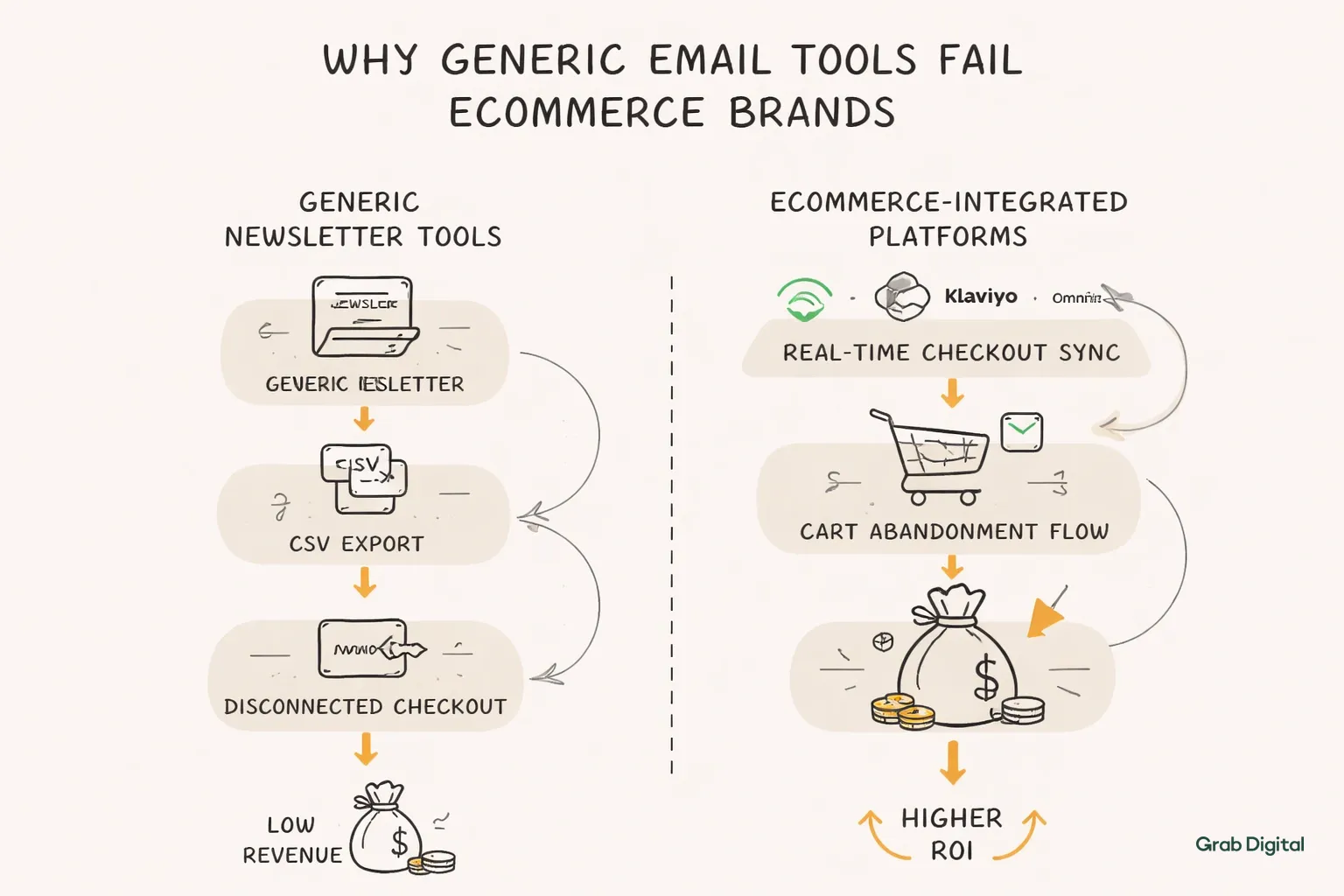
Generic tools fail ecommerce brands because they were built for newsletters, not stores, and they don't talk to your checkout system. Constant Contact and similar platforms can't see who abandoned a cart, who's a repeat buyer, or what someone just looked at. If you want that data, you're exporting CSVs and guessing.
Ecommerce-native platforms sync in real time. They know when someone adds to cart, views a collection, or makes a third purchase, and that data fuels flows that recover lost sales automatically. Brands on Klaviyo routinely attribute 25 to 40% of total revenue to email. Brands on generic tools struggle to break 10%. The data gap is the entire reason.
What Features Should an Ecommerce Email Platform Have?
An ecommerce email platform needs five things to be worth paying for: real-time store integration, prebuilt automation flows, native revenue attribution, behavioral segmentation, and built-in A/B testing. Miss any one of these and you're running a newsletter tool with an ecommerce label on it.
- Integration: the platform should pull in browse behavior, cart contents, and customer lifetime value automatically. You shouldn't need a developer to make it work.
- Automation flows: abandoned cart, welcome series, browse abandonment, and post-purchase sequences typically drive 30 to 50% of total email revenue. You need templates built for conversion, not a blank canvas.
- Revenue attribution: you need to see that a specific email drove a specific purchase. Klaviyo handles this with first-click and multi-touch models. Generic tools just show opens and clicks.
- Advanced segmentation: the ability to target by what someone bought, what they viewed, and how often they buy, not just "everyone on the list."
- A/B testing: should run automatically, without you manually calculating statistical significance.
- SMS integration: matters more every year. Klaviyo and Omnisend keep both channels in one place. You can book a consultation to see how to blend them for your brand.
Klaviyo vs Omnisend vs Mailchimp vs HubSpot vs Drip: Which Is Best?
For ecommerce email marketing specifically, the ranking from best to worst is Klaviyo, Omnisend, HubSpot, Drip, then Mailchimp. That order changes if you're weighing a full CRM (HubSpot moves up) or a bare-bones budget (Omnisend moves up), but for a DTC brand whose main job is turning store data into revenue, this is the order that holds.
- Klaviyo, the heavy hitter for DTC brands doing $1M to $10M. Deep Shopify integration, powerful segmentation, and real revenue tracking. It has a learning curve, but it scales without breaking. Most brands we work with end up here.
- Omnisend, a strong mid-market choice. It bundles SMS and push notifications, costs less at lower volumes, and is easier to learn. The tradeoff is less powerful reporting once you're doing serious volume.
- HubSpot, best if email is one piece of a broader CRM and marketing automation setup. Its ecommerce data sync isn't as deep as Klaviyo's, and its automation was built for lead nurturing, not cart recovery, but it's a reasonable fit if you're already running sales and support through HubSpot.
- Drip, a decent Klaviyo alternative with a smaller footprint. Fewer integrations and a smaller talent pool make it harder to find help when something breaks.
- Mailchimp, the tool everyone outgrows. It added ecommerce features late, and it shows. Automation is clunky and attribution is weak. Brands usually migrate once they hit 10,000 subscribers or realize email should be driving more than 10% of sales.
| Platform | Ecommerce data sync | Best for | Starting price | Main weakness |
|---|---|---|---|---|
| Klaviyo | Real-time, native | $1M-$10M DTC brands | ~$20/mo at 500 contacts | Learning curve |
| Omnisend | Real-time, native | Growing brands under $1M | Lower than Klaviyo at small list sizes | Reporting depth |
| HubSpot | Synced via integration | Brands already using HubSpot CRM | Higher, bundled with CRM tiers | Not built cart-first |
| Drip | Real-time, native | Klaviyo alternative | Comparable to Klaviyo | Smaller ecosystem |
| Mailchimp | Added later, shallower | Brands under 10,000 subscribers | Charges for unengaged contacts | Weak automation and attribution |
Moving from Mailchimp to Klaviyo often unlocks a 15 to 30% revenue jump in 90 days, mostly because segmentation and attribution finally match how the store actually behaves. For a closer look at that specific matchup, see our Shopify Email vs Mailchimp vs Klaviyo comparison. The platform you choose is the foundation your email marketing strategy relies on.
What Is Mailchimp Ecommerce 360?
Mailchimp Ecommerce 360 is Mailchimp's bundle of ecommerce features: a single dashboard that pulls in store data, product recommendations, and basic customer lifetime value estimates across connected platforms like Shopify, WooCommerce, and BigCommerce. It's Mailchimp's answer to the "we need to see store data" problem that ecommerce-native platforms solved years earlier.
The catch is depth. Ecommerce 360 shows you revenue and product performance at a surface level, but the segmentation underneath it is still built on Mailchimp's older contact model, which was designed for email marketing in general, not ecommerce specifically. You can see that a customer bought something; you can't easily build a flow around predicted lifetime value or product affinity the way you can in Klaviyo or Omnisend. For a store still small enough to run on Mailchimp's free or entry tier, Ecommerce 360 is a fine starting point. For a brand already past $500K in revenue, it tends to feel like a dashboard bolted onto a tool that wasn't built for the job.
What's the Best Platform for Abandoned Cart and Post-Purchase Flows?
Klaviyo is the best platform for abandoned cart and post-purchase flows, because it tracks cart contents, browse behavior, and purchase history natively and lets you branch flows based on all three at once. Omnisend is a close second, especially for brands that also want SMS in the same flow. Mailchimp and HubSpot can technically run an abandoned cart email, but neither one branches the flow based on what was actually in the cart without extra setup work.
| Platform | Abandoned cart automation | Post-purchase flows | Browse abandonment |
|---|---|---|---|
| Klaviyo | Native, branches by product | Native, multi-step | Native |
| Omnisend | Native, includes SMS | Native | Native |
| HubSpot | Basic, needs workflow setup | Basic | Limited |
| Mailchimp | Basic, single-path | Limited | Not native |
If you want a step-by-step build rather than just a platform recommendation, our guide on building a high-ROI abandoned cart flow on Klaviyo walks through the exact email sequence and timing.
Which Automation Flows Drive the Most Email Revenue?
Abandoned cart, browse abandonment, welcome series, and post-purchase flows together typically drive 30 to 50% of total email revenue, and they should be the first thing you set up on any new platform.
- Abandoned cart flows are the money maker. Three emails: one hour later (reminder), 24 hours later (social proof), and 48 hours later (discount code). Done right, these recover 10 to 15% of lost carts.
- Browse abandonment targets people who looked but didn't add to cart. It's pure incremental revenue that generic tools can't touch because they don't track browsing.
- Welcome series turns subscribers into buyers. Use 3 to 5 emails over a week: brand story, best sellers, social proof, and a limited-time offer.
- Post-purchase flows squeeze more value from existing customers. Thank them, ask for a review after a week, cross-sell after three weeks, and nudge them when it's time to replenish.
The 8 core flows we build for clients are standard on any real ecommerce platform, and they're the fastest place to see revenue move after a migration.
What Segmentation Strategies Increase Revenue Per Email?
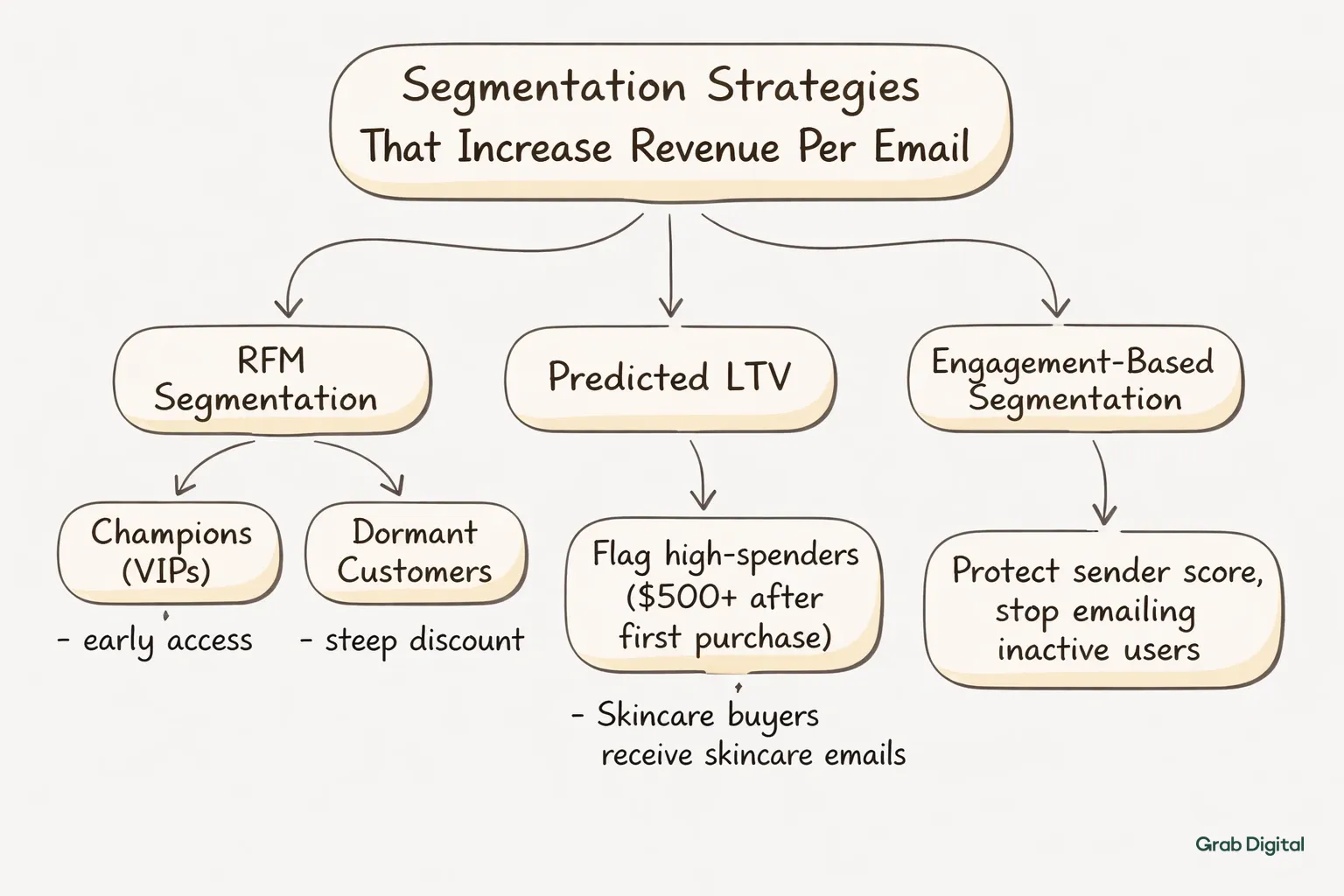
Segmenting by recency, frequency, predicted spend, product affinity, and engagement increases revenue per email because you stop sending the same message to a first-time browser and a repeat VIP.
- RFM segmentation splits your list by recency, frequency, and money. Treat champions differently than dormant customers: give VIPs early access, give dormant customers a steeper discount to win them back.
- Predicted LTV uses machine learning to spot high-spenders early. Klaviyo can flag someone likely to spend $500+ after their first purchase. Treat those people like gold.
- Product affinity means sending skincare buyers skincare emails. It sounds obvious, but generic tools make this hard to pull off without manual list building.
- Engagement-based segmentation protects your sender score. Stop emailing people who haven't opened anything in 90 days. Move them to a sunset flow or cut them loose. We cover this in our email segmentation guide.
What Deliverability Features Protect Your Sender Reputation?
Nothing on this list matters if you land in spam. List cleaning, sunset flows, smart sending, and proper authentication are what keep your emails in the inbox.
- List cleaning should be automatic, suppressing bounces and known spam traps before they hurt your reputation.
- Sunset flows prune the dead weight. If someone hasn't opened an email in six months, stop emailing them. It hurts deliverability to keep them.
- Smart sending prevents you from annoying people. If a customer is in three different flows, you don't want them getting three emails in one hour. Klaviyo handles this well. Mailchimp doesn't always.
- Authentication (SPF, DKIM, DMARC) proves you are who you say you are. Ecommerce platforms walk you through the DNS setup. Our email deliverability guide has the details on keeping inbox placement above 98%.
What Does an Ecommerce Email Platform Cost?
A typical price range for a mid-market ecommerce brand runs $100 to $500 a month, scaling with your list size and send volume. Most platforms bill by contact count. Klaviyo starts around $20/month for 500 contacts and climbs to $700+ at 50,000. Mailchimp looks cheaper until you realize they charge for people who don't open your emails. HubSpot's email features are usually bundled into a broader CRM tier, so the real cost depends on what else you're using it for.
Free tiers are fine for testing, but the limits on automation and sends will throttle your revenue once you're doing real volume. Upgrade when you hit 10,000 subscribers or $1M in revenue. If email isn't driving at least 20% of revenue by then, you're leaving money on the table.
How Does the Platform Fit Your Wider Tech Stack?
Your email platform shouldn't live in a silo. It should connect to your loyalty program, your reviews app, and your subscription tool, so those signals show up in the same segments you're already emailing. The Shopify App Store has 200+ apps that sync with Klaviyo, which is one reason it's easier to keep the whole stack talking to each other.
We've built custom integrations for brands that need proprietary data in their emails. Check our portfolio if you're curious about what's possible.
How Do You Compare Ecommerce Email Platforms by ROI?
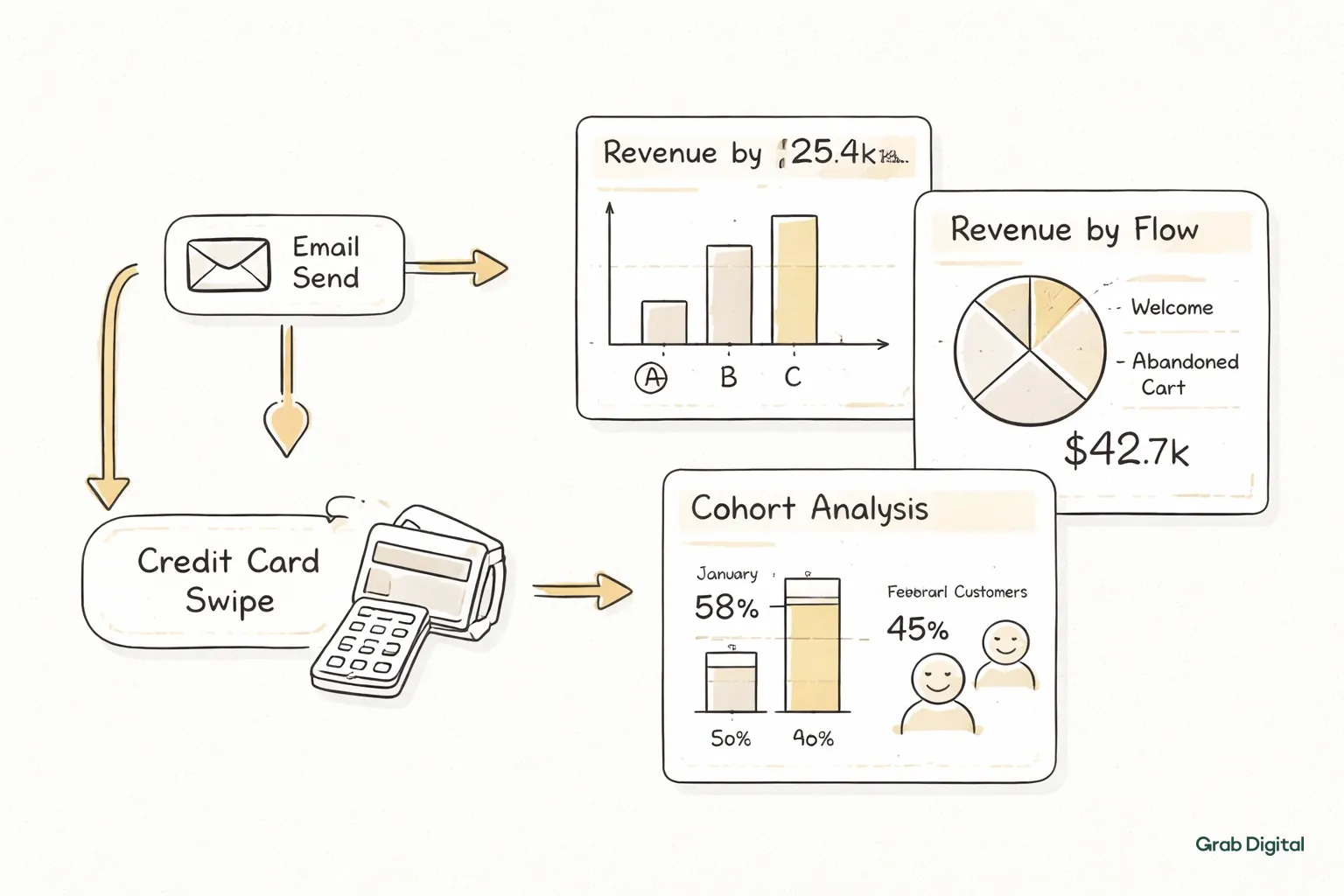
The fair way to compare platforms by ROI is to look past open rates and ask whether the platform ties a specific email to a specific purchase. Klaviyo shows revenue by campaign and by flow, split out separately, which is the level of detail you need to know whether a welcome series is actually paying for itself.
Cohort analysis, how much a January customer spends compared to a February customer, should be automatic rather than something you build in a spreadsheet. Don't settle for open rates as your ROI measure. We wrote more about measuring email marketing ROI because attribution is often messy, but the right platform makes it considerably clearer.
Should You Hire an Agency or Run the Platform Yourself?
Run the platform yourself if you have a dedicated email marketer who lives and breathes Klaviyo. If that person doesn't exist on your team, an agency is almost always the faster path to results.
We provide a full team, strategist, copywriter, designer, for less than the cost of one senior hire. Brands usually see a 15 to 30% revenue bump within 60 days of working with an agency. If you're weighing options, our guide on how DTC brands choose the right Klaviyo agency covers what to look for before you sign anything.
If email is under 20% of revenue or your flows haven't been touched in months, that's a red flag. Grab Digital fixes exactly that.
How Do You Migrate From Mailchimp to Klaviyo?
A Mailchimp-to-Klaviyo migration takes 2 to 4 weeks for most brands. Export your list, set up the new account, authenticate your domain, and rebuild flows from scratch instead of copy-pasting them over.
Don't import cold subscribers. You'll tank your deliverability on day one. Only bring over people who've engaged in the last 90 days, and test everything before you flip the switch. We've migrated 50+ brands with zero downtime using this migration process.
Is the Platform Compliant With GDPR and CCPA?
GDPR and CCPA compliance is not optional, and it should be built into the platform, not something you bolt on. You need double opt-in and one-click unsubscribe by default. Klaviyo builds this in.
Your platform holds sensitive customer data, so confirm it's SOC 2 Type II certified. Klaviyo is. Smaller or newer platforms sometimes cut corners on security to move fast, which is worth checking before you commit a year of customer data to them.
How Do You Choose the Right Platform for Your Brand?
Choose based on revenue stage, not brand recognition. Brands under $500K can get by on Omnisend or Klaviyo's lower tiers. Once you cross $1M, default to Klaviyo. If you're on headless custom infrastructure, make sure the platform has an API that your developers actually like working with.
Most DTC brands we consult end up on Klaviyo because it has the balance of power and ecosystem support needed to execute a real strategy. The brands we work with use it because it works, not because it's the default answer.
Frequently Asked Questions
What are the best marketing platforms for ecommerce retailers?
Klaviyo, Omnisend, HubSpot, and Mailchimp are the four most common answers, with Klaviyo leading for most DTC brands past $1M in revenue because it syncs store data in real time and ties revenue to specific emails. Omnisend is the best budget-friendly runner-up, and Mailchimp fits smaller lists that haven't outgrown its basic ecommerce features yet.
How do HubSpot, Klaviyo, Mailchimp, and Omnisend rank for ecommerce email marketing?
Best to worst for ecommerce specifically: Klaviyo, Omnisend, HubSpot, then Mailchimp. Klaviyo and Omnisend are built ecommerce-first. HubSpot works if email is part of a broader CRM setup. Mailchimp trails because its automation and attribution weren't built around purchase behavior.
What is Mailchimp Ecommerce 360?
It's Mailchimp's bundle of ecommerce features: a dashboard that pulls in store data, product recommendations, and basic lifetime value estimates from connected platforms like Shopify. It's useful for small stores but shallow compared to the segmentation and flow-branching available in Klaviyo or Omnisend.
What's the best platform for abandoned cart and post-purchase email flows?
Klaviyo, because it branches flows based on exact cart contents and purchase history without extra setup. Omnisend is a close second, especially if you also want SMS in the same flow. Mailchimp and HubSpot can run a basic abandoned cart email but don't branch by product.
What's a typical price range for an email marketing platform for mid-market ecommerce brands?
Most mid-market ecommerce brands spend $100 to $500 a month once they're running real automation and campaign volume. Klaviyo starts around $20/month at 500 contacts and scales with list size. Free tiers work for testing but cap automation and sends too tightly for a brand generating meaningful revenue through email.
What's the best tool for automating welcome and abandoned cart email flows?
Klaviyo, because it has purpose-built templates for both flows and lets you trigger them off real store events like cart contents and first purchase. Omnisend offers similar automation at a lower cost for smaller lists, while Mailchimp's version of both flows is simpler and less flexible.
Best Email Marketing Platforms for Ecommerce Retailers in 2026
The best email marketing platforms for ecommerce retailers in 2026 are Klaviyo, Omnisend, HubSpot, and Mailchimp, roughly in that order once a brand is doing real transaction volume. Klaviyo wins for most DTC brands because it reads store data in real time and turns it into automation that recovers sales, not just a newsletter that goes out on Tuesdays. Drip is worth a mention too, as a smaller alternative with a similar approach.
This guide ranks all five platforms head-to-head on integration, automation, segmentation, deliverability, and price, and answers the specific questions people ask when they're choosing between them: which one handles abandoned cart and post-purchase flows best, what Mailchimp's "Ecommerce 360" feature actually gets you, and what a fair price range looks like once you're past $1M in revenue.
Why Do Generic Email Tools Fail Ecommerce Brands?
Generic tools fail ecommerce brands because they were built for newsletters, not stores, and they don't talk to your checkout system. Constant Contact and similar platforms can't see who abandoned a cart, who's a repeat buyer, or what someone just looked at. If you want that data, you're exporting CSVs and guessing.
Ecommerce-native platforms sync in real time. They know when someone adds to cart, views a collection, or makes a third purchase, and that data fuels flows that recover lost sales automatically. Brands on Klaviyo routinely attribute 25 to 40% of total revenue to email. Brands on generic tools struggle to break 10%. The data gap is the entire reason.
What Features Should an Ecommerce Email Platform Have?
An ecommerce email platform needs five things to be worth paying for: real-time store integration, prebuilt automation flows, native revenue attribution, behavioral segmentation, and built-in A/B testing. Miss any one of these and you're running a newsletter tool with an ecommerce label on it.
- Integration: the platform should pull in browse behavior, cart contents, and customer lifetime value automatically. You shouldn't need a developer to make it work.
- Automation flows: abandoned cart, welcome series, browse abandonment, and post-purchase sequences typically drive 30 to 50% of total email revenue. You need templates built for conversion, not a blank canvas.
- Revenue attribution: you need to see that a specific email drove a specific purchase. Klaviyo handles this with first-click and multi-touch models. Generic tools just show opens and clicks.
- Advanced segmentation: the ability to target by what someone bought, what they viewed, and how often they buy, not just "everyone on the list."
- A/B testing: should run automatically, without you manually calculating statistical significance.
- SMS integration: matters more every year. Klaviyo and Omnisend keep both channels in one place. You can book a consultation to see how to blend them for your brand.
Klaviyo vs Omnisend vs Mailchimp vs HubSpot vs Drip: Which Is Best?
For ecommerce email marketing specifically, the ranking from best to worst is Klaviyo, Omnisend, HubSpot, Drip, then Mailchimp. That order changes if you're weighing a full CRM (HubSpot moves up) or a bare-bones budget (Omnisend moves up), but for a DTC brand whose main job is turning store data into revenue, this is the order that holds.
- Klaviyo, the heavy hitter for DTC brands doing $1M to $10M. Deep Shopify integration, powerful segmentation, and real revenue tracking. It has a learning curve, but it scales without breaking. Most brands we work with end up here.
- Omnisend, a strong mid-market choice. It bundles SMS and push notifications, costs less at lower volumes, and is easier to learn. The tradeoff is less powerful reporting once you're doing serious volume.
- HubSpot, best if email is one piece of a broader CRM and marketing automation setup. Its ecommerce data sync isn't as deep as Klaviyo's, and its automation was built for lead nurturing, not cart recovery, but it's a reasonable fit if you're already running sales and support through HubSpot.
- Drip, a decent Klaviyo alternative with a smaller footprint. Fewer integrations and a smaller talent pool make it harder to find help when something breaks.
- Mailchimp, the tool everyone outgrows. It added ecommerce features late, and it shows. Automation is clunky and attribution is weak. Brands usually migrate once they hit 10,000 subscribers or realize email should be driving more than 10% of sales.
| Platform | Ecommerce data sync | Best for | Starting price | Main weakness |
|---|---|---|---|---|
| Klaviyo | Real-time, native | $1M-$10M DTC brands | ~$20/mo at 500 contacts | Learning curve |
| Omnisend | Real-time, native | Growing brands under $1M | Lower than Klaviyo at small list sizes | Reporting depth |
| HubSpot | Synced via integration | Brands already using HubSpot CRM | Higher, bundled with CRM tiers | Not built cart-first |
| Drip | Real-time, native | Klaviyo alternative | Comparable to Klaviyo | Smaller ecosystem |
| Mailchimp | Added later, shallower | Brands under 10,000 subscribers | Charges for unengaged contacts | Weak automation and attribution |
Moving from Mailchimp to Klaviyo often unlocks a 15 to 30% revenue jump in 90 days, mostly because segmentation and attribution finally match how the store actually behaves. For a closer look at that specific matchup, see our Shopify Email vs Mailchimp vs Klaviyo comparison. The platform you choose is the foundation your email marketing strategy relies on.
What Is Mailchimp Ecommerce 360?
Mailchimp Ecommerce 360 is Mailchimp's bundle of ecommerce features: a single dashboard that pulls in store data, product recommendations, and basic customer lifetime value estimates across connected platforms like Shopify, WooCommerce, and BigCommerce. It's Mailchimp's answer to the "we need to see store data" problem that ecommerce-native platforms solved years earlier.
The catch is depth. Ecommerce 360 shows you revenue and product performance at a surface level, but the segmentation underneath it is still built on Mailchimp's older contact model, which was designed for email marketing in general, not ecommerce specifically. You can see that a customer bought something; you can't easily build a flow around predicted lifetime value or product affinity the way you can in Klaviyo or Omnisend. For a store still small enough to run on Mailchimp's free or entry tier, Ecommerce 360 is a fine starting point. For a brand already past $500K in revenue, it tends to feel like a dashboard bolted onto a tool that wasn't built for the job.
What's the Best Platform for Abandoned Cart and Post-Purchase Flows?
Klaviyo is the best platform for abandoned cart and post-purchase flows, because it tracks cart contents, browse behavior, and purchase history natively and lets you branch flows based on all three at once. Omnisend is a close second, especially for brands that also want SMS in the same flow. Mailchimp and HubSpot can technically run an abandoned cart email, but neither one branches the flow based on what was actually in the cart without extra setup work.
| Platform | Abandoned cart automation | Post-purchase flows | Browse abandonment |
|---|---|---|---|
| Klaviyo | Native, branches by product | Native, multi-step | Native |
| Omnisend | Native, includes SMS | Native | Native |
| HubSpot | Basic, needs workflow setup | Basic | Limited |
| Mailchimp | Basic, single-path | Limited | Not native |
If you want a step-by-step build rather than just a platform recommendation, our guide on building a high-ROI abandoned cart flow on Klaviyo walks through the exact email sequence and timing.
Which Automation Flows Drive the Most Email Revenue?
Abandoned cart, browse abandonment, welcome series, and post-purchase flows together typically drive 30 to 50% of total email revenue, and they should be the first thing you set up on any new platform.
- Abandoned cart flows are the money maker. Three emails: one hour later (reminder), 24 hours later (social proof), and 48 hours later (discount code). Done right, these recover 10 to 15% of lost carts.
- Browse abandonment targets people who looked but didn't add to cart. It's pure incremental revenue that generic tools can't touch because they don't track browsing.
- Welcome series turns subscribers into buyers. Use 3 to 5 emails over a week: brand story, best sellers, social proof, and a limited-time offer.
- Post-purchase flows squeeze more value from existing customers. Thank them, ask for a review after a week, cross-sell after three weeks, and nudge them when it's time to replenish.
The 8 core flows we build for clients are standard on any real ecommerce platform, and they're the fastest place to see revenue move after a migration.
What Segmentation Strategies Increase Revenue Per Email?
Segmenting by recency, frequency, predicted spend, product affinity, and engagement increases revenue per email because you stop sending the same message to a first-time browser and a repeat VIP.
- RFM segmentation splits your list by recency, frequency, and money. Treat champions differently than dormant customers: give VIPs early access, give dormant customers a steeper discount to win them back.
- Predicted LTV uses machine learning to spot high-spenders early. Klaviyo can flag someone likely to spend $500+ after their first purchase. Treat those people like gold.
- Product affinity means sending skincare buyers skincare emails. It sounds obvious, but generic tools make this hard to pull off without manual list building.
- Engagement-based segmentation protects your sender score. Stop emailing people who haven't opened anything in 90 days. Move them to a sunset flow or cut them loose. We cover this in our email segmentation guide.
What Deliverability Features Protect Your Sender Reputation?
Nothing on this list matters if you land in spam. List cleaning, sunset flows, smart sending, and proper authentication are what keep your emails in the inbox.
- List cleaning should be automatic, suppressing bounces and known spam traps before they hurt your reputation.
- Sunset flows prune the dead weight. If someone hasn't opened an email in six months, stop emailing them. It hurts deliverability to keep them.
- Smart sending prevents you from annoying people. If a customer is in three different flows, you don't want them getting three emails in one hour. Klaviyo handles this well. Mailchimp doesn't always.
- Authentication (SPF, DKIM, DMARC) proves you are who you say you are. Ecommerce platforms walk you through the DNS setup. Our email deliverability guide has the details on keeping inbox placement above 98%.
What Does an Ecommerce Email Platform Cost?
A typical price range for a mid-market ecommerce brand runs $100 to $500 a month, scaling with your list size and send volume. Most platforms bill by contact count. Klaviyo starts around $20/month for 500 contacts and climbs to $700+ at 50,000. Mailchimp looks cheaper until you realize they charge for people who don't open your emails. HubSpot's email features are usually bundled into a broader CRM tier, so the real cost depends on what else you're using it for.
Free tiers are fine for testing, but the limits on automation and sends will throttle your revenue once you're doing real volume. Upgrade when you hit 10,000 subscribers or $1M in revenue. If email isn't driving at least 20% of revenue by then, you're leaving money on the table.
How Does the Platform Fit Your Wider Tech Stack?
Your email platform shouldn't live in a silo. It should connect to your loyalty program, your reviews app, and your subscription tool, so those signals show up in the same segments you're already emailing. The Shopify App Store has 200+ apps that sync with Klaviyo, which is one reason it's easier to keep the whole stack talking to each other.
We've built custom integrations for brands that need proprietary data in their emails. Check our portfolio if you're curious about what's possible.
How Do You Compare Ecommerce Email Platforms by ROI?
The fair way to compare platforms by ROI is to look past open rates and ask whether the platform ties a specific email to a specific purchase. Klaviyo shows revenue by campaign and by flow, split out separately, which is the level of detail you need to know whether a welcome series is actually paying for itself.
Cohort analysis, how much a January customer spends compared to a February customer, should be automatic rather than something you build in a spreadsheet. Don't settle for open rates as your ROI measure. We wrote more about measuring email marketing ROI because attribution is often messy, but the right platform makes it considerably clearer.
Should You Hire an Agency or Run the Platform Yourself?
Run the platform yourself if you have a dedicated email marketer who lives and breathes Klaviyo. If that person doesn't exist on your team, an agency is almost always the faster path to results.
We provide a full team, strategist, copywriter, designer, for less than the cost of one senior hire. Brands usually see a 15 to 30% revenue bump within 60 days of working with an agency. If you're weighing options, our guide on how DTC brands choose the right Klaviyo agency covers what to look for before you sign anything.
If email is under 20% of revenue or your flows haven't been touched in months, that's a red flag. Grab Digital fixes exactly that.
How Do You Migrate From Mailchimp to Klaviyo?
A Mailchimp-to-Klaviyo migration takes 2 to 4 weeks for most brands. Export your list, set up the new account, authenticate your domain, and rebuild flows from scratch instead of copy-pasting them over.
Don't import cold subscribers. You'll tank your deliverability on day one. Only bring over people who've engaged in the last 90 days, and test everything before you flip the switch. We've migrated 50+ brands with zero downtime using this migration process.
Is the Platform Compliant With GDPR and CCPA?
GDPR and CCPA compliance is not optional, and it should be built into the platform, not something you bolt on. You need double opt-in and one-click unsubscribe by default. Klaviyo builds this in.
Your platform holds sensitive customer data, so confirm it's SOC 2 Type II certified. Klaviyo is. Smaller or newer platforms sometimes cut corners on security to move fast, which is worth checking before you commit a year of customer data to them.
How Do You Choose the Right Platform for Your Brand?
Choose based on revenue stage, not brand recognition. Brands under $500K can get by on Omnisend or Klaviyo's lower tiers. Once you cross $1M, default to Klaviyo. If you're on headless custom infrastructure, make sure the platform has an API that your developers actually like working with.
Most DTC brands we consult end up on Klaviyo because it has the balance of power and ecosystem support needed to execute a real strategy. The brands we work with use it because it works, not because it's the default answer.
Frequently Asked Questions
What are the best marketing platforms for ecommerce retailers?
Klaviyo, Omnisend, HubSpot, and Mailchimp are the four most common answers, with Klaviyo leading for most DTC brands past $1M in revenue because it syncs store data in real time and ties revenue to specific emails. Omnisend is the best budget-friendly runner-up, and Mailchimp fits smaller lists that haven't outgrown its basic ecommerce features yet.
How do HubSpot, Klaviyo, Mailchimp, and Omnisend rank for ecommerce email marketing?
Best to worst for ecommerce specifically: Klaviyo, Omnisend, HubSpot, then Mailchimp. Klaviyo and Omnisend are built ecommerce-first. HubSpot works if email is part of a broader CRM setup. Mailchimp trails because its automation and attribution weren't built around purchase behavior.
What is Mailchimp Ecommerce 360?
It's Mailchimp's bundle of ecommerce features: a dashboard that pulls in store data, product recommendations, and basic lifetime value estimates from connected platforms like Shopify. It's useful for small stores but shallow compared to the segmentation and flow-branching available in Klaviyo or Omnisend.
What's the best platform for abandoned cart and post-purchase email flows?
Klaviyo, because it branches flows based on exact cart contents and purchase history without extra setup. Omnisend is a close second, especially if you also want SMS in the same flow. Mailchimp and HubSpot can run a basic abandoned cart email but don't branch by product.
What's a typical price range for an email marketing platform for mid-market ecommerce brands?
Most mid-market ecommerce brands spend $100 to $500 a month once they're running real automation and campaign volume. Klaviyo starts around $20/month at 500 contacts and scales with list size. Free tiers work for testing but cap automation and sends too tightly for a brand generating meaningful revenue through email.
What's the best tool for automating welcome and abandoned cart email flows?
Klaviyo, because it has purpose-built templates for both flows and lets you trigger them off real store events like cart contents and first purchase. Omnisend offers similar automation at a lower cost for smaller lists, while Mailchimp's version of both flows is simpler and less flexible.

Find out exactly what your email channel is leaving on the table.

Email Marketing for Scaling DTC Brands


