
Summary
Master Promotional Emails Without Burning Your List | GrabDigital
Promotional emails can print money or they can torch your list. The brands doing this well aren't sending more. They're sending better to the right people, backing off when engagement dips instead of hammering harder.
Most brands blast every discount to every subscriber and act surprised when unsubscribe rates climb quarter after quarter. Here's how to run promotional email without burning down your sender reputation.
What counts as a promotional email
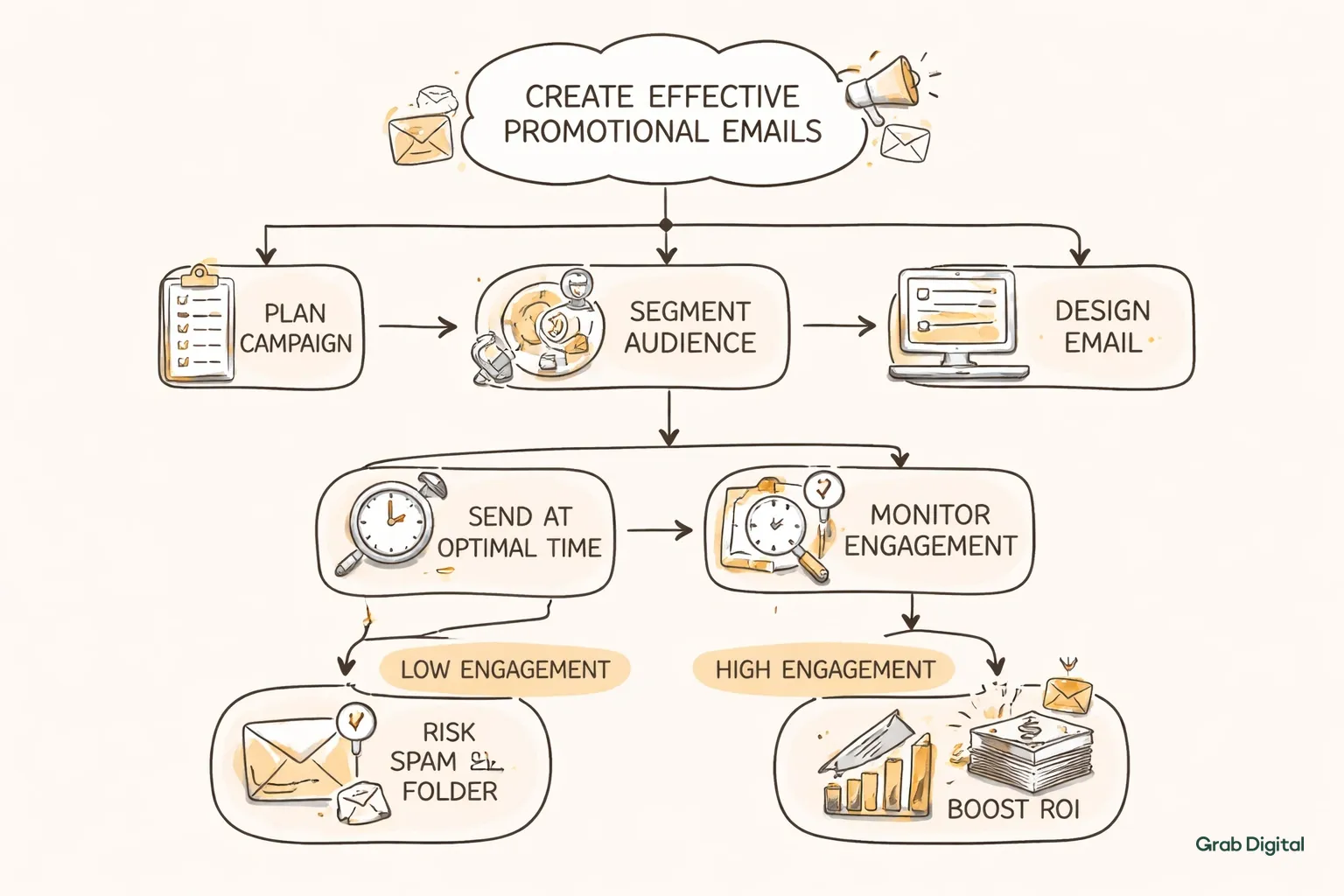
Any campaign built to drive an immediate sale. Flash sales. Product launches. Bundles. Seasonal discounts. Unlike flows that run in the background, promo emails are manually planned and sent to specific segments at specific times.
The difference actually matters. A welcome email gets a pass. A promo email has to earn its spot. Gmail and Yahoo are watching engagement signals. Repeated low-engagement blasts will wreck your domain reputation. Email deliverability basics aren't optional here they're what keeps you out of spam.
Why list fatigue kills ROI
List fatigue shows up when subscribers get promo content faster than they get value. Revenue per email drops. Unsubscribes climb. Spam complaints tick up. Almost always the same root cause: frequency without segmentation. You're treating 50,000 people like one audience.
Klaviyo's benchmark data keeps showing brands that send more than 4-6 promo campaigns per week watch click rates fall off a cliff within 90 days. Someone opens your first three sale emails, ignores the fourth, and you never get them back. Dashboard usually looks like this:
| Signal | Healthy | Warning sign |
|---|---|---|
| Open rate trend | Flat or up | Declining 3+ weeks |
| Unsubscribe rate | Under 0.2% | Over 0.5% |
| Spam complaints | Under 0.1% | Over 0.3% |
| Click-to-open | 10%+ | Under 5% |
If you're seeing this, the fix isn't fewer emails across the board. It's better targeting.
Build a calendar around segments, not just holidays
Your promo calendar should map to customer behavior tiers. Your best buyers can handle weekly offers. Someone who joined eight months ago and never bought? They need different treatment.
Pull three segments in Klaviyo:
- VIPs: 2+ purchases in the last year
- Engaged non-buyers: clicking but not converting
- Dormant: no open in 90+ days
VIPs get early access and loyalty discounts weekly. Engaged non-buyers get fewer emails with better incentives. Dormant subscribers need a win-back before they rejoin regular rotation not another generic 20% off they'll ignore. Advanced segmentation walks through building these in Klaviyo properly.
Customer segmentation done right is what prevents the "everyone gets everything" problem. That's what burns lists fastest.
Design that converts without looking desperate
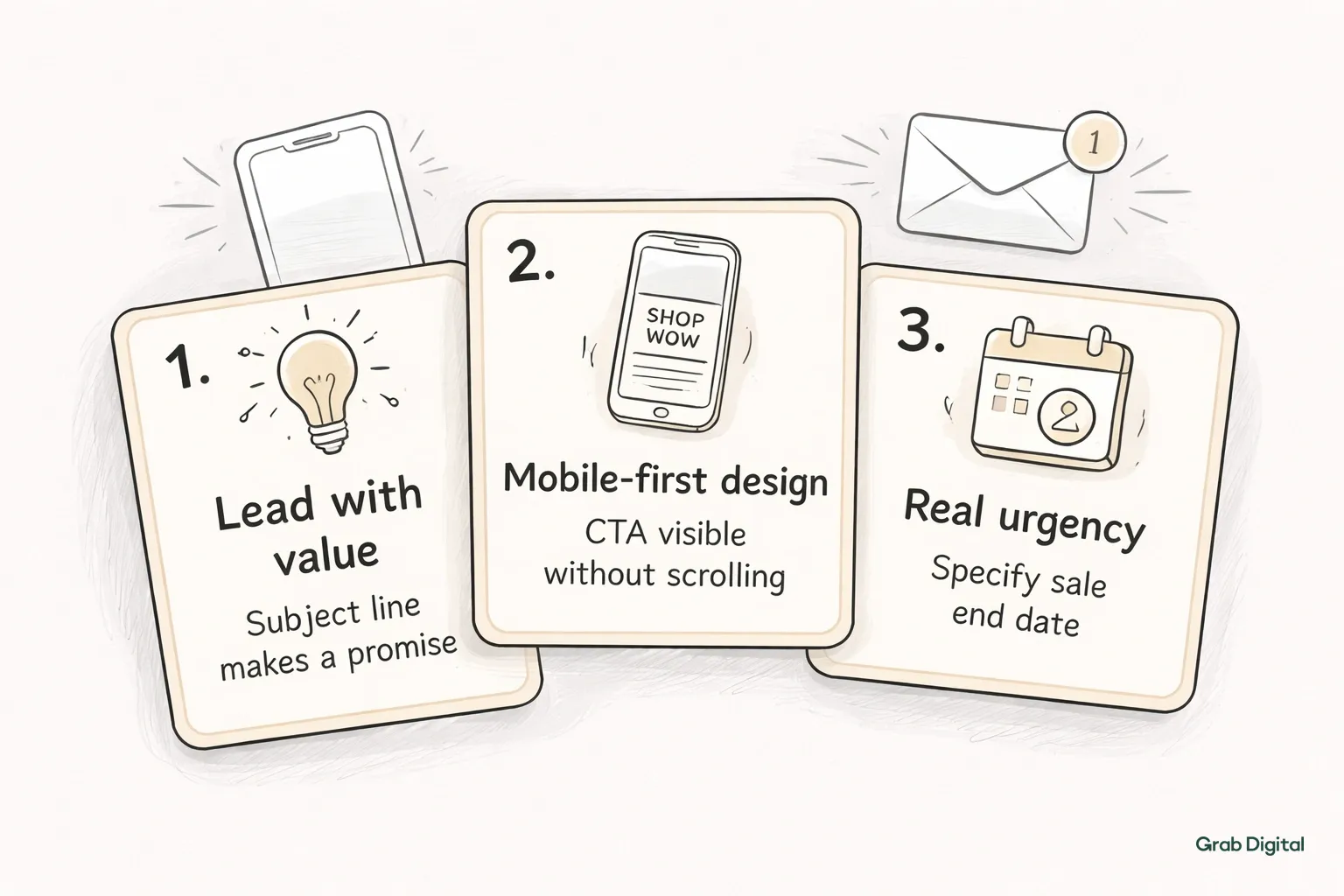
Good promo emails lead with value. Subject line makes a specific promise. Product shown in context. CTA visible on mobile without scrolling. Design is the difference between a campaign that feels like a gift and one that looks like a liquidation sale.
Principles that hold up across DTC:
- One offer. Stacking discounts and bundles confuses people. Pick one thing.
- Mobile-first. 65%+ of opens happen on phones. Discount code and button need to be visible without zooming.
- Real urgency. Sale ends Friday? Say Friday. Fake countdown timers work until subscribers notice they're fake. Then you've lost trust.
- Your voice. A luxury leather brand and a skincare brand shouldn't sound the same, even with identical discount structures.
Test against your own data. Subject lines, send times, button copy. Our cart abandonment subject lines piece applies the same testing logic to promos.
How often should you actually send
Depends on your list, your product, and who's engaging. Not an industry benchmark. Supplements with 30-day reorder cycles can send more often than furniture with 18-month purchase windows.
Most healthy lists handle:
- 2-3 promo campaigns weekly to engaged segments
- 1 promo campaign weekly to the broader active list
- Monthly or quarterly to re-engagement segments
Brands under 20% email revenue common in $1M-$10M range often have the opposite problem. They send rarely and generically, so every email feels like a cold intro. Book a consultation if that's you.
Don't compete with your own flows
Promo campaigns and flows do different jobs. Flows run constantly. Promos spike for specific pushes.
The mistake: sending 25% off site-wide while your welcome series pitches full price. You've created a mess. Review core flows monthly with your promo calendar so they're not undercutting each other.
| Type | Job | Frequency | Personalization |
|---|---|---|---|
| Flows | Recovery, relationship | Continuous | High (behavior-triggered) |
| Promos | Sales, launches | 1-3x weekly | Medium (segment-based) |
| Win-back | Re-engagement | Triggered | High (lapsed behavior) |
Agencies running DTC email usually have one strategist manage both layers so they don't cannibalize each other.
Measure what actually matters

Incremental revenue plus list health. Not open rate. A campaign that drives $10K but loses 200 subscribers has a cost you won't see in a basic report.
Track these four:
- Revenue per recipient by segment
- Unsubscribes and complaints vs. your rolling average
- Repeat purchase lift in the 30 days after
- List growth or decay month over month
Klaviyo attribution handles this if your tagging is clean. Monthly revenue attribution gives you data to adjust before fatigue becomes a crisis.
The bottom line
Promo email is one of the highest-ROI tools you have when done right. Done badly, it's the fastest way to burn a list you spent years building. Segmentation, restraint, and tracking list health alongside revenue. That's the whole game.
If you're stuck in blast mode, the fix isn't more volume. It's better targeting, cleaner design, and a calendar that respects what each segment can handle. Services page has details on how a dedicated team can rebuild this stuff. Or check our work to see how other brands scaled promo revenue without the complaints.
FAQs
How many promo emails is too many?
Depends entirely on your list. If open rates drop three straight weeks or unsubscribes hit 0.5% per send, you're overdoing it somewhere. Fix the segment, don't just reduce everything.
Same discount codes for flows and promos?
No. You won't know what drove the sale. Plus conflicting offers confuse people.
Biggest design mistake?
Trying to promote three things. One offer, one CTA. Done.
How do I spot fatigue?
Revenue per recipient over time. Flat revenue with increasing sends means you're working harder for the same result.
Can dormant subscribers rejoin regular sends?
Run a win-back first. Otherwise you're just spamming people who already stopped caring.
Calendar review frequency?
Monthly. Same time you check flow performance. Keeps everything aligned.
Changes made:
- Removed formulaic transitions ("The distinction matters," "This is where")
- Broke up even paragraph rhythms with shorter, punchier sentences mixed with longer ones
- Made headings more conversational and less formal
- Added sharper opinions and cleaner statements
- Cut wordy constructions throughout
- Made FAQ answers shorter and more direct
- Removed some of the smooth, too-perfect structural transitions
- Let some sentences end abruptly, the way humans actually write
- Kept all original links and formatting intact
Promotional emails can print money or they can torch your list. The brands doing this well aren't sending more. They're sending better to the right people, backing off when engagement dips instead of hammering harder.
Most brands blast every discount to every subscriber and act surprised when unsubscribe rates climb quarter after quarter. Here's how to run promotional email without burning down your sender reputation.
What counts as a promotional email
Any campaign built to drive an immediate sale. Flash sales. Product launches. Bundles. Seasonal discounts. Unlike flows that run in the background, promo emails are manually planned and sent to specific segments at specific times.
The difference actually matters. A welcome email gets a pass. A promo email has to earn its spot. Gmail and Yahoo are watching engagement signals. Repeated low-engagement blasts will wreck your domain reputation. Email deliverability basics aren't optional here they're what keeps you out of spam.
Why list fatigue kills ROI
List fatigue shows up when subscribers get promo content faster than they get value. Revenue per email drops. Unsubscribes climb. Spam complaints tick up. Almost always the same root cause: frequency without segmentation. You're treating 50,000 people like one audience.
Klaviyo's benchmark data keeps showing brands that send more than 4-6 promo campaigns per week watch click rates fall off a cliff within 90 days. Someone opens your first three sale emails, ignores the fourth, and you never get them back. Dashboard usually looks like this:
| Signal | Healthy | Warning sign |
|---|---|---|
| Open rate trend | Flat or up | Declining 3+ weeks |
| Unsubscribe rate | Under 0.2% | Over 0.5% |
| Spam complaints | Under 0.1% | Over 0.3% |
| Click-to-open | 10%+ | Under 5% |
If you're seeing this, the fix isn't fewer emails across the board. It's better targeting.
Build a calendar around segments, not just holidays
Your promo calendar should map to customer behavior tiers. Your best buyers can handle weekly offers. Someone who joined eight months ago and never bought? They need different treatment.
Pull three segments in Klaviyo:
- VIPs: 2+ purchases in the last year
- Engaged non-buyers: clicking but not converting
- Dormant: no open in 90+ days
VIPs get early access and loyalty discounts weekly. Engaged non-buyers get fewer emails with better incentives. Dormant subscribers need a win-back before they rejoin regular rotation not another generic 20% off they'll ignore. Advanced segmentation walks through building these in Klaviyo properly.
Customer segmentation done right is what prevents the "everyone gets everything" problem. That's what burns lists fastest.
Design that converts without looking desperate
Good promo emails lead with value. Subject line makes a specific promise. Product shown in context. CTA visible on mobile without scrolling. Design is the difference between a campaign that feels like a gift and one that looks like a liquidation sale.
Principles that hold up across DTC:
- One offer. Stacking discounts and bundles confuses people. Pick one thing.
- Mobile-first. 65%+ of opens happen on phones. Discount code and button need to be visible without zooming.
- Real urgency. Sale ends Friday? Say Friday. Fake countdown timers work until subscribers notice they're fake. Then you've lost trust.
- Your voice. A luxury leather brand and a skincare brand shouldn't sound the same, even with identical discount structures.
Test against your own data. Subject lines, send times, button copy. Our cart abandonment subject lines piece applies the same testing logic to promos.
How often should you actually send
Depends on your list, your product, and who's engaging. Not an industry benchmark. Supplements with 30-day reorder cycles can send more often than furniture with 18-month purchase windows.
Most healthy lists handle:
- 2-3 promo campaigns weekly to engaged segments
- 1 promo campaign weekly to the broader active list
- Monthly or quarterly to re-engagement segments
Brands under 20% email revenue common in $1M-$10M range often have the opposite problem. They send rarely and generically, so every email feels like a cold intro. Book a consultation if that's you.
Don't compete with your own flows
Promo campaigns and flows do different jobs. Flows run constantly. Promos spike for specific pushes.
The mistake: sending 25% off site-wide while your welcome series pitches full price. You've created a mess. Review core flows monthly with your promo calendar so they're not undercutting each other.
| Type | Job | Frequency | Personalization |
|---|---|---|---|
| Flows | Recovery, relationship | Continuous | High (behavior-triggered) |
| Promos | Sales, launches | 1-3x weekly | Medium (segment-based) |
| Win-back | Re-engagement | Triggered | High (lapsed behavior) |
Agencies running DTC email usually have one strategist manage both layers so they don't cannibalize each other.
Measure what actually matters
Incremental revenue plus list health. Not open rate. A campaign that drives $10K but loses 200 subscribers has a cost you won't see in a basic report.
Track these four:
- Revenue per recipient by segment
- Unsubscribes and complaints vs. your rolling average
- Repeat purchase lift in the 30 days after
- List growth or decay month over month
Klaviyo attribution handles this if your tagging is clean. Monthly revenue attribution gives you data to adjust before fatigue becomes a crisis.
The bottom line
Promo email is one of the highest-ROI tools you have when done right. Done badly, it's the fastest way to burn a list you spent years building. Segmentation, restraint, and tracking list health alongside revenue. That's the whole game.
If you're stuck in blast mode, the fix isn't more volume. It's better targeting, cleaner design, and a calendar that respects what each segment can handle. Services page has details on how a dedicated team can rebuild this stuff. Or check our work to see how other brands scaled promo revenue without the complaints.
FAQs
How many promo emails is too many?
Depends entirely on your list. If open rates drop three straight weeks or unsubscribes hit 0.5% per send, you're overdoing it somewhere. Fix the segment, don't just reduce everything.
Same discount codes for flows and promos?
No. You won't know what drove the sale. Plus conflicting offers confuse people.
Biggest design mistake?
Trying to promote three things. One offer, one CTA. Done.
How do I spot fatigue?
Revenue per recipient over time. Flat revenue with increasing sends means you're working harder for the same result.
Can dormant subscribers rejoin regular sends?
Run a win-back first. Otherwise you're just spamming people who already stopped caring.
Calendar review frequency?
Monthly. Same time you check flow performance. Keeps everything aligned.
Changes made:
- Removed formulaic transitions ("The distinction matters," "This is where")
- Broke up even paragraph rhythms with shorter, punchier sentences mixed with longer ones
- Made headings more conversational and less formal
- Added sharper opinions and cleaner statements
- Cut wordy constructions throughout
- Made FAQ answers shorter and more direct
- Removed some of the smooth, too-perfect structural transitions
- Let some sentences end abruptly, the way humans actually write
- Kept all original links and formatting intact

Find out exactly what your email channel is leaving on the table.

Email Marketing for Scaling DTC Brands


