
Summary
Klaviyo Health: List Hygiene, Segmentation & Sunsetting 2027
I look at a lot of Klaviyo accounts. Most brands are obsessing over subject lines or the exact shade of a CTA button while completely ignoring the rotting list sitting underneath. A bloated, unsegmented list quietly tanks your open rates, trains spam filters to hate you, and wastes the budget you spent acquiring those subscribers in the first place.
If you want your Klaviyo account to actually drive revenue heading into 2027, you have to fix the foundation. That means list hygiene, segmentation, and sunsetting.
Why list hygiene matters more than list size
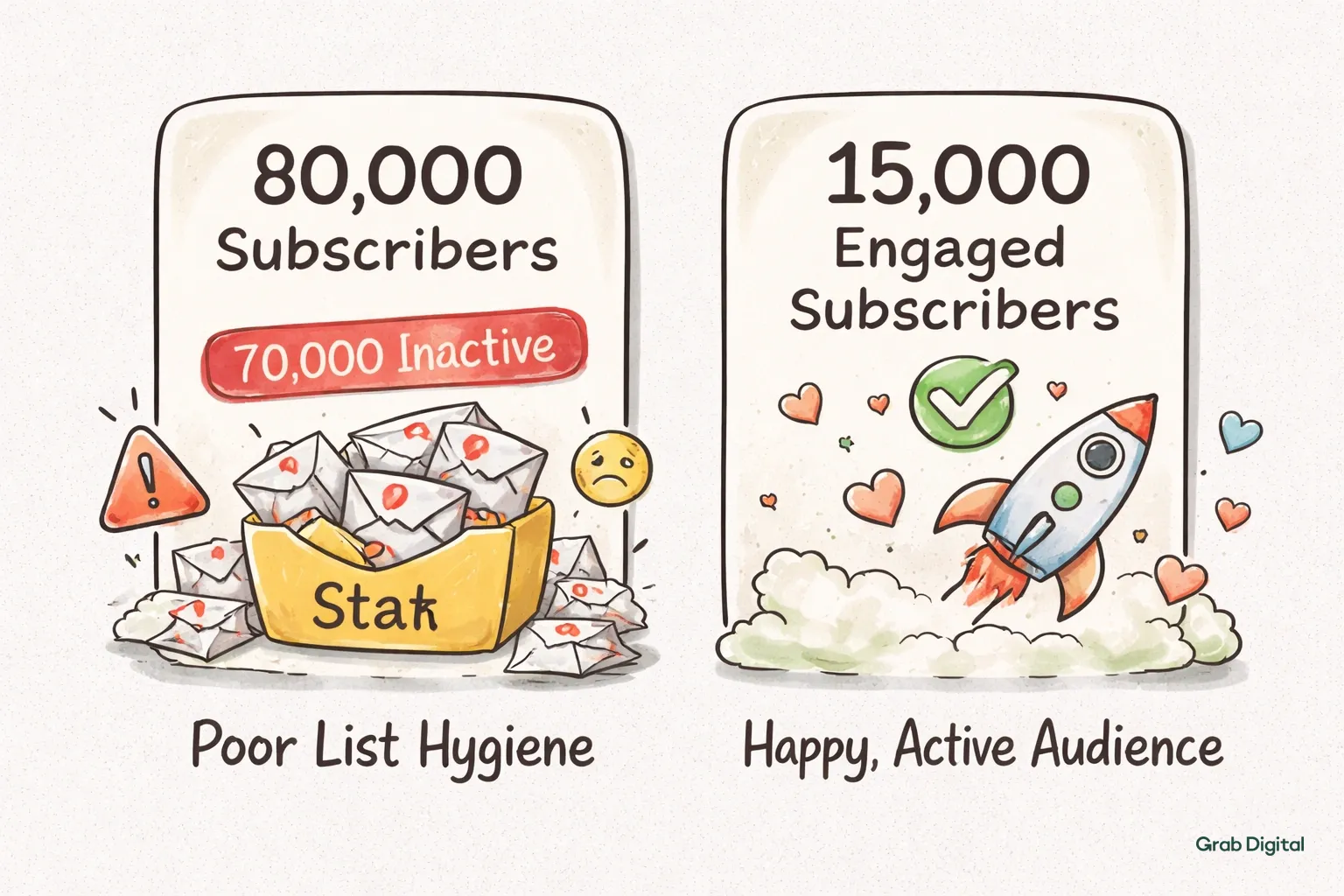
I see brands brag about having 80,000 subscribers all the time. The problem is that 70,000 of them haven't opened an email in six months. Inbox providers like Gmail and Outlook track engagement relentlessly. If you're sending to thousands of addresses that never open, click, or even exist anymore, Gmail notices. They start routing your emails straight to spam, even for the subscribers who actually want to hear from you.
A brand with 15,000 engaged subscribers will consistently outperform one with 80,000 stale contacts. Poor hygiene costs DTC brands in a few specific ways:
- Your inbox placement drops across all campaigns, not just the ones sent to bad addresses.
- You pay more in platform fees, since ESPs like Klaviyo charge by total contacts.
- Your reporting gets skewed, making your flows and campaigns look worse than they actually are.
- Bounce rates spike, which can trigger domain-level deliverability penalties.
A practical hygiene routine means validating new signups at the point of entry, removing hard bounces immediately, and watching soft bounce patterns. If your list hasn't been audited in the last 90 days, it's probably overdue. You can check out our email deliverability services to see how a full list audit fits into ongoing account management.
Building segmentation that actually drives revenue
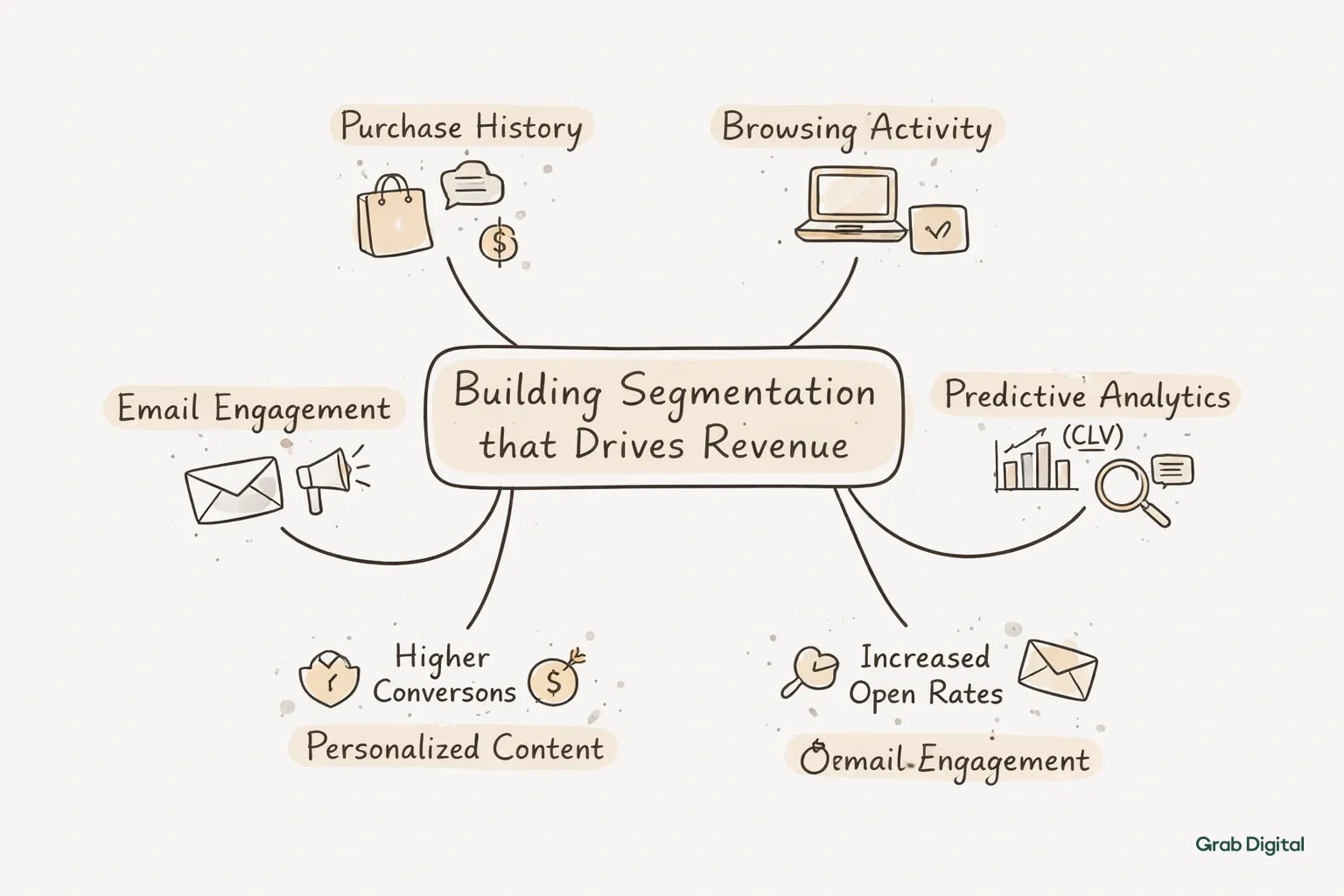
Email segmentation means dividing your list into smaller groups based on behavior or purchase history, then sending them content relevant to them. Good segmentation increases open rates and conversions simultaneously. It's the difference between shouting at everyone and speaking directly to each person.
Klaviyo's actual power isn't in basic demographic splits. You can build behavioral segments using purchase history, browsing activity, email engagement, and predictive analytics like customer lifetime value. DTC brands that layer these signals together consistently see stronger results than those relying on a single blast to the full list.
Here's a segmentation framework that works across most DTC verticals:
| Segment Type | Criteria | Use Case |
|---|---|---|
| Highly engaged | Opened or clicked in last 30 days | Frequent campaigns, new product launches |
| At-risk | No engagement in 60 to 90 days | Re-engagement flows, win-back offers |
| VIP buyers | Top 10% by lifetime spend | Early access, loyalty perks |
| One-time purchasers | Single order, 60+ days ago | Post-purchase nurture, cross-sell |
| Never purchased | Subscribed, zero orders | Education content, first-order incentives |
This layered approach directly impacts flow performance. A welcome flow that treats every new subscriber identically ignores the fact that some arrived through a discount popup while others came from a referral link with higher intent already baked in. Pairing this segmentation with a solid abandoned cart strategy gives you compounding gains since each message lands with the right context.
Popup data feeds segmentation too. If your popup capture isn't tagging subscribers by source or offer type, you're losing valuable targeting data before the relationship even starts. How subscribers enter the list is just as important as how they're treated once inside.
Behavioral triggers worth segmenting on
Behavioral triggers are specific actions subscribers take that signal buying intent or disengagement. These actions should automatically move subscribers between segments without manual list management.
The most valuable triggers for DTC brands include:
- Browse abandonment on specific product categories
- Cart abandonment within the last 7 days
- Email click without purchase within 14 days
- Purchase frequency dropping below historical average
- Review submission or UGC participation
Setting these up correctly requires clean flow logic and accurate event tracking from Shopify. Brands without an in-house email specialist often leave this automation half-built, which is exactly the gap a dedicated team fills.
Sunsetting inactive subscribers the right way
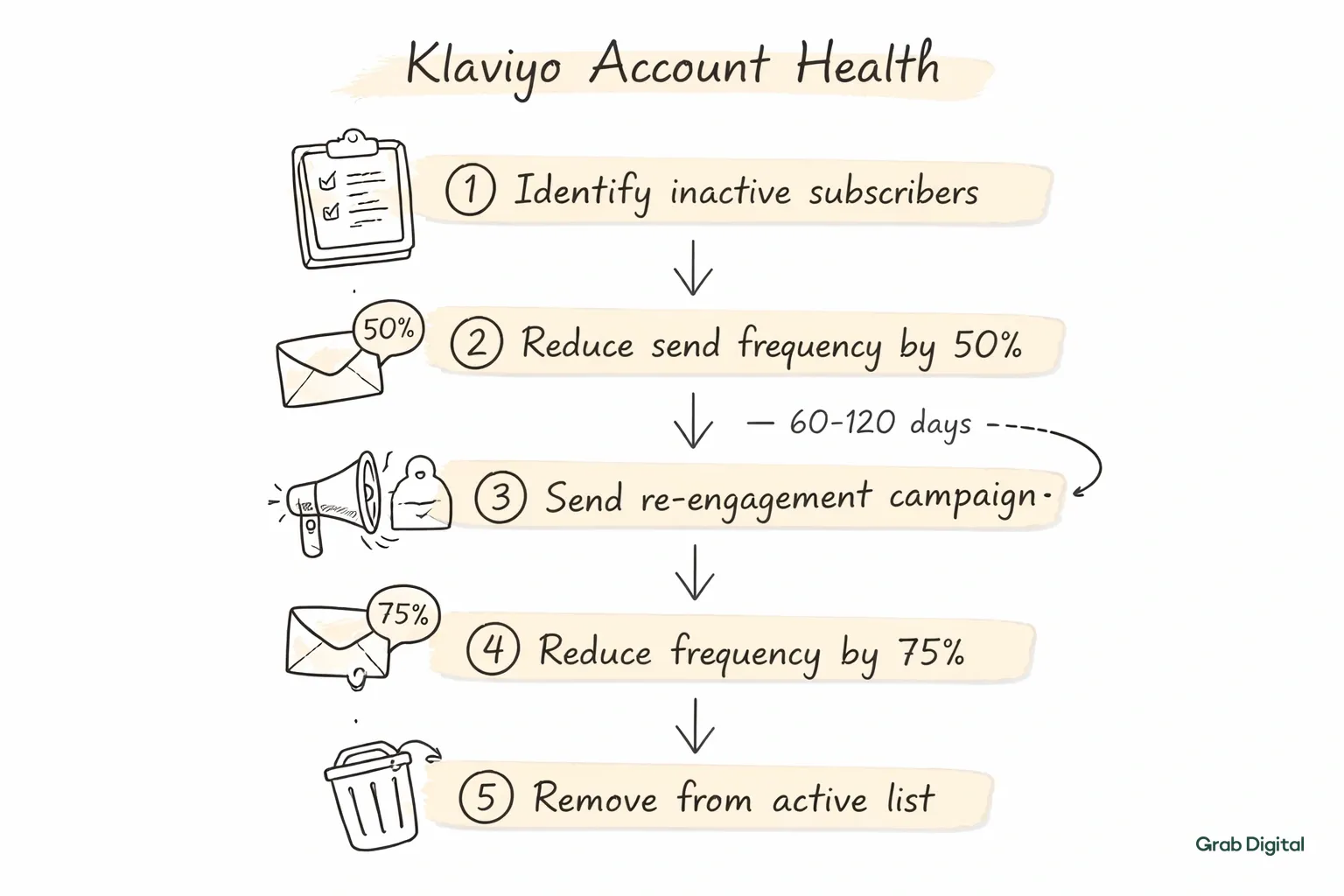
Sunsetting is the slow breakup. It's the process of gradually reducing send frequency to disengaged subscribers before removing them from your active list entirely. Done correctly, it protects deliverability for your engaged audience while giving lapsed subscribers a fair, final chance to re-engage.
Don't just delete people on day one. It's a phased approach that typically spans 60 to 120 days depending on your sending volume and industry norms. The goal is distinguishing between subscribers who are truly gone versus those who just need a nudge.
A standard sunset sequence looks like this:
- Identify the segment. No opens or clicks in 90 to 180 days, adjusted for your typical send frequency.
- Reduce frequency first. Drop these subscribers to a lower-frequency version of your campaign list before cutting them entirely.
- Send a win-back series. Three to four emails with increasing urgency, often including a strong incentive on the final send.
- Ask directly. A simple "still want to hear from us?" email with one-click confirmation performs surprisingly well.
- Suppress or remove. Anyone who doesn't engage after the full sequence should move to a suppressed list, not get deleted outright, in case Klaviyo's data proves useful later.
Sunsetting protects your sender score in ways that campaign optimization alone cannot. ISPs weight recent engagement heavily, so a list full of subscribers who haven't opened anything in eight months drags down placement for your entire sending domain. This is the same logic behind a well-built win-back flow, just applied at the list-wide level.
Brands often resist sunsetting because the subscriber count drops on paper. But a smaller, engaged list consistently drives better revenue than a padded one. We've seen this play out directly with clients like Rogue Industries and Beessential, where tightening the active list improved overall campaign performance within a single sending cycle. You can see examples of this kind of work in our portfolio.
Putting hygiene, segmentation, and sunsetting together
These three practices aren't separate projects. They're one continuous system. Hygiene keeps your data clean, segmentation makes that clean data useful, and sunsetting ensures the list stays healthy over time rather than slowly decaying.
A practical cadence works well for most DTC brands:
- Weekly: Monitor bounce rates and remove hard bounces
- Monthly: Review segment performance and adjust engagement thresholds
- Quarterly: Run a full sunset sequence on the newly disengaged segment
- Ongoing: Tag new subscribers by acquisition source for future segmentation
This operational rhythm is exactly what separates brands pulling 30%+ of revenue from email versus brands stuck under 20%. It's rarely a strategy problem. It's usually a maintenance problem that nobody owns internally.
If your team doesn't have bandwidth to run this cadence consistently, that's precisely the gap a dedicated Klaviyo partner closes. Our approach includes list audits, segmentation builds, and sunset automation as part of standard account management, all covered under our results guarantee. You can review the full scope of what's included on our services page or see how we've applied this for brands like Model No. in our case studies.
List management isn't glamorous work. It doesn't generate the same excitement as a clever subject line or a beautifully designed campaign. But it's the foundation everything else sits on, and neglecting it quietly caps the performance of every other email initiative you run. If you want a clear read on where your current list stands, book your free consultation and we'll walk through a baseline audit using your actual Klaviyo data.
Getting list management right in 2027 means treating it as infrastructure, not an afterthought. Brands that build this discipline now will have a meaningful deliverability advantage over competitors still sending to bloated, unsegmented lists. For more on building out the rest of your email program correctly, our guide on the 8 core email flows every DTC brand needs pairs well with the list practices covered here. And if you're still comparing platforms or deciding whether your current setup can support this level of segmentation, our breakdown of Klaviyo versus other ecommerce email platforms is worth a read before you invest further time building on the wrong foundation.
Frequently Asked Questions
How often should I clean my email list? Most DTC brands should review hard bounces weekly and run a full list hygiene audit monthly. A deeper sunset review of disengaged subscribers works best on a quarterly cycle.
Will removing subscribers hurt my revenue? Removing truly inactive subscribers almost always improves revenue over time. Deliverability gains from a cleaner list outweigh the lost reach from subscribers who weren't opening or clicking anyway.
What's the difference between suppressing and deleting subscribers? Suppressing stops active sends to a subscriber while keeping their historical data in Klaviyo. Deleting removes them entirely. Suppression is generally the safer choice since it preserves data you might need later.
How many segments should a DTC brand actually maintain? There's no universal number, but five to eight core segments covering engagement level, purchase history, and lifecycle stage typically covers most needs without becoming unmanageable.
Can Klaviyo automate the sunsetting process? Yes, Klaviyo flows can automatically move subscribers through reduced frequency, win-back sequences, and eventual suppression based on engagement triggers, removing most manual work once it's built correctly.
Does list size affect Klaviyo pricing even if subscribers are inactive? Yes. Klaviyo generally charges based on total contacts regardless of engagement, which is another reason sunsetting inactive subscribers can directly reduce platform costs.
I look at a lot of Klaviyo accounts. Most brands are obsessing over subject lines or the exact shade of a CTA button while completely ignoring the rotting list sitting underneath. A bloated, unsegmented list quietly tanks your open rates, trains spam filters to hate you, and wastes the budget you spent acquiring those subscribers in the first place.
If you want your Klaviyo account to actually drive revenue heading into 2027, you have to fix the foundation. That means list hygiene, segmentation, and sunsetting.
Why list hygiene matters more than list size
I see brands brag about having 80,000 subscribers all the time. The problem is that 70,000 of them haven't opened an email in six months. Inbox providers like Gmail and Outlook track engagement relentlessly. If you're sending to thousands of addresses that never open, click, or even exist anymore, Gmail notices. They start routing your emails straight to spam, even for the subscribers who actually want to hear from you.
A brand with 15,000 engaged subscribers will consistently outperform one with 80,000 stale contacts. Poor hygiene costs DTC brands in a few specific ways:
- Your inbox placement drops across all campaigns, not just the ones sent to bad addresses.
- You pay more in platform fees, since ESPs like Klaviyo charge by total contacts.
- Your reporting gets skewed, making your flows and campaigns look worse than they actually are.
- Bounce rates spike, which can trigger domain-level deliverability penalties.
A practical hygiene routine means validating new signups at the point of entry, removing hard bounces immediately, and watching soft bounce patterns. If your list hasn't been audited in the last 90 days, it's probably overdue. You can check out our email deliverability services to see how a full list audit fits into ongoing account management.
Building segmentation that actually drives revenue
Email segmentation means dividing your list into smaller groups based on behavior or purchase history, then sending them content relevant to them. Good segmentation increases open rates and conversions simultaneously. It's the difference between shouting at everyone and speaking directly to each person.
Klaviyo's actual power isn't in basic demographic splits. You can build behavioral segments using purchase history, browsing activity, email engagement, and predictive analytics like customer lifetime value. DTC brands that layer these signals together consistently see stronger results than those relying on a single blast to the full list.
Here's a segmentation framework that works across most DTC verticals:
| Segment Type | Criteria | Use Case |
|---|---|---|
| Highly engaged | Opened or clicked in last 30 days | Frequent campaigns, new product launches |
| At-risk | No engagement in 60 to 90 days | Re-engagement flows, win-back offers |
| VIP buyers | Top 10% by lifetime spend | Early access, loyalty perks |
| One-time purchasers | Single order, 60+ days ago | Post-purchase nurture, cross-sell |
| Never purchased | Subscribed, zero orders | Education content, first-order incentives |
This layered approach directly impacts flow performance. A welcome flow that treats every new subscriber identically ignores the fact that some arrived through a discount popup while others came from a referral link with higher intent already baked in. Pairing this segmentation with a solid abandoned cart strategy gives you compounding gains since each message lands with the right context.
Popup data feeds segmentation too. If your popup capture isn't tagging subscribers by source or offer type, you're losing valuable targeting data before the relationship even starts. How subscribers enter the list is just as important as how they're treated once inside.
Behavioral triggers worth segmenting on
Behavioral triggers are specific actions subscribers take that signal buying intent or disengagement. These actions should automatically move subscribers between segments without manual list management.
The most valuable triggers for DTC brands include:
- Browse abandonment on specific product categories
- Cart abandonment within the last 7 days
- Email click without purchase within 14 days
- Purchase frequency dropping below historical average
- Review submission or UGC participation
Setting these up correctly requires clean flow logic and accurate event tracking from Shopify. Brands without an in-house email specialist often leave this automation half-built, which is exactly the gap a dedicated team fills.
Sunsetting inactive subscribers the right way
Sunsetting is the slow breakup. It's the process of gradually reducing send frequency to disengaged subscribers before removing them from your active list entirely. Done correctly, it protects deliverability for your engaged audience while giving lapsed subscribers a fair, final chance to re-engage.
Don't just delete people on day one. It's a phased approach that typically spans 60 to 120 days depending on your sending volume and industry norms. The goal is distinguishing between subscribers who are truly gone versus those who just need a nudge.
A standard sunset sequence looks like this:
- Identify the segment. No opens or clicks in 90 to 180 days, adjusted for your typical send frequency.
- Reduce frequency first. Drop these subscribers to a lower-frequency version of your campaign list before cutting them entirely.
- Send a win-back series. Three to four emails with increasing urgency, often including a strong incentive on the final send.
- Ask directly. A simple "still want to hear from us?" email with one-click confirmation performs surprisingly well.
- Suppress or remove. Anyone who doesn't engage after the full sequence should move to a suppressed list, not get deleted outright, in case Klaviyo's data proves useful later.
Sunsetting protects your sender score in ways that campaign optimization alone cannot. ISPs weight recent engagement heavily, so a list full of subscribers who haven't opened anything in eight months drags down placement for your entire sending domain. This is the same logic behind a well-built win-back flow, just applied at the list-wide level.
Brands often resist sunsetting because the subscriber count drops on paper. But a smaller, engaged list consistently drives better revenue than a padded one. We've seen this play out directly with clients like Rogue Industries and Beessential, where tightening the active list improved overall campaign performance within a single sending cycle. You can see examples of this kind of work in our portfolio.
Putting hygiene, segmentation, and sunsetting together
These three practices aren't separate projects. They're one continuous system. Hygiene keeps your data clean, segmentation makes that clean data useful, and sunsetting ensures the list stays healthy over time rather than slowly decaying.
A practical cadence works well for most DTC brands:
- Weekly: Monitor bounce rates and remove hard bounces
- Monthly: Review segment performance and adjust engagement thresholds
- Quarterly: Run a full sunset sequence on the newly disengaged segment
- Ongoing: Tag new subscribers by acquisition source for future segmentation
This operational rhythm is exactly what separates brands pulling 30%+ of revenue from email versus brands stuck under 20%. It's rarely a strategy problem. It's usually a maintenance problem that nobody owns internally.
If your team doesn't have bandwidth to run this cadence consistently, that's precisely the gap a dedicated Klaviyo partner closes. Our approach includes list audits, segmentation builds, and sunset automation as part of standard account management, all covered under our results guarantee. You can review the full scope of what's included on our services page or see how we've applied this for brands like Model No. in our case studies.
List management isn't glamorous work. It doesn't generate the same excitement as a clever subject line or a beautifully designed campaign. But it's the foundation everything else sits on, and neglecting it quietly caps the performance of every other email initiative you run. If you want a clear read on where your current list stands, book your free consultation and we'll walk through a baseline audit using your actual Klaviyo data.
Getting list management right in 2027 means treating it as infrastructure, not an afterthought. Brands that build this discipline now will have a meaningful deliverability advantage over competitors still sending to bloated, unsegmented lists. For more on building out the rest of your email program correctly, our guide on the 8 core email flows every DTC brand needs pairs well with the list practices covered here. And if you're still comparing platforms or deciding whether your current setup can support this level of segmentation, our breakdown of Klaviyo versus other ecommerce email platforms is worth a read before you invest further time building on the wrong foundation.
Frequently Asked Questions
How often should I clean my email list? Most DTC brands should review hard bounces weekly and run a full list hygiene audit monthly. A deeper sunset review of disengaged subscribers works best on a quarterly cycle.
Will removing subscribers hurt my revenue? Removing truly inactive subscribers almost always improves revenue over time. Deliverability gains from a cleaner list outweigh the lost reach from subscribers who weren't opening or clicking anyway.
What's the difference between suppressing and deleting subscribers? Suppressing stops active sends to a subscriber while keeping their historical data in Klaviyo. Deleting removes them entirely. Suppression is generally the safer choice since it preserves data you might need later.
How many segments should a DTC brand actually maintain? There's no universal number, but five to eight core segments covering engagement level, purchase history, and lifecycle stage typically covers most needs without becoming unmanageable.
Can Klaviyo automate the sunsetting process? Yes, Klaviyo flows can automatically move subscribers through reduced frequency, win-back sequences, and eventual suppression based on engagement triggers, removing most manual work once it's built correctly.
Does list size affect Klaviyo pricing even if subscribers are inactive? Yes. Klaviyo generally charges based on total contacts regardless of engagement, which is another reason sunsetting inactive subscribers can directly reduce platform costs.

Find out exactly what your email channel is leaving on the table.

Email Marketing for Scaling DTC Brands


