
Summary
Holiday Email Marketing Strategies for DTC Brands
Holiday email marketing for DTC brands requires a structured BFCM and holiday calendar, clear segmentation, tiered offers, and Klaviyo flows built weeks in advance. A winning plan starts in early October, runs through New Year, and treats email as the primary revenue driver, not an afterthought bolted onto paid ads.
Q4 can account for 30% to 40% of annual revenue for many DTC brands, and email typically carries a disproportionate share of that load. Brands that wait until mid-November to plan are already behind. This guide breaks down the calendar, segments, offers, and automated flows you need before the holiday rush hits.
Why Holiday Email Marketing Makes or Breaks Q4
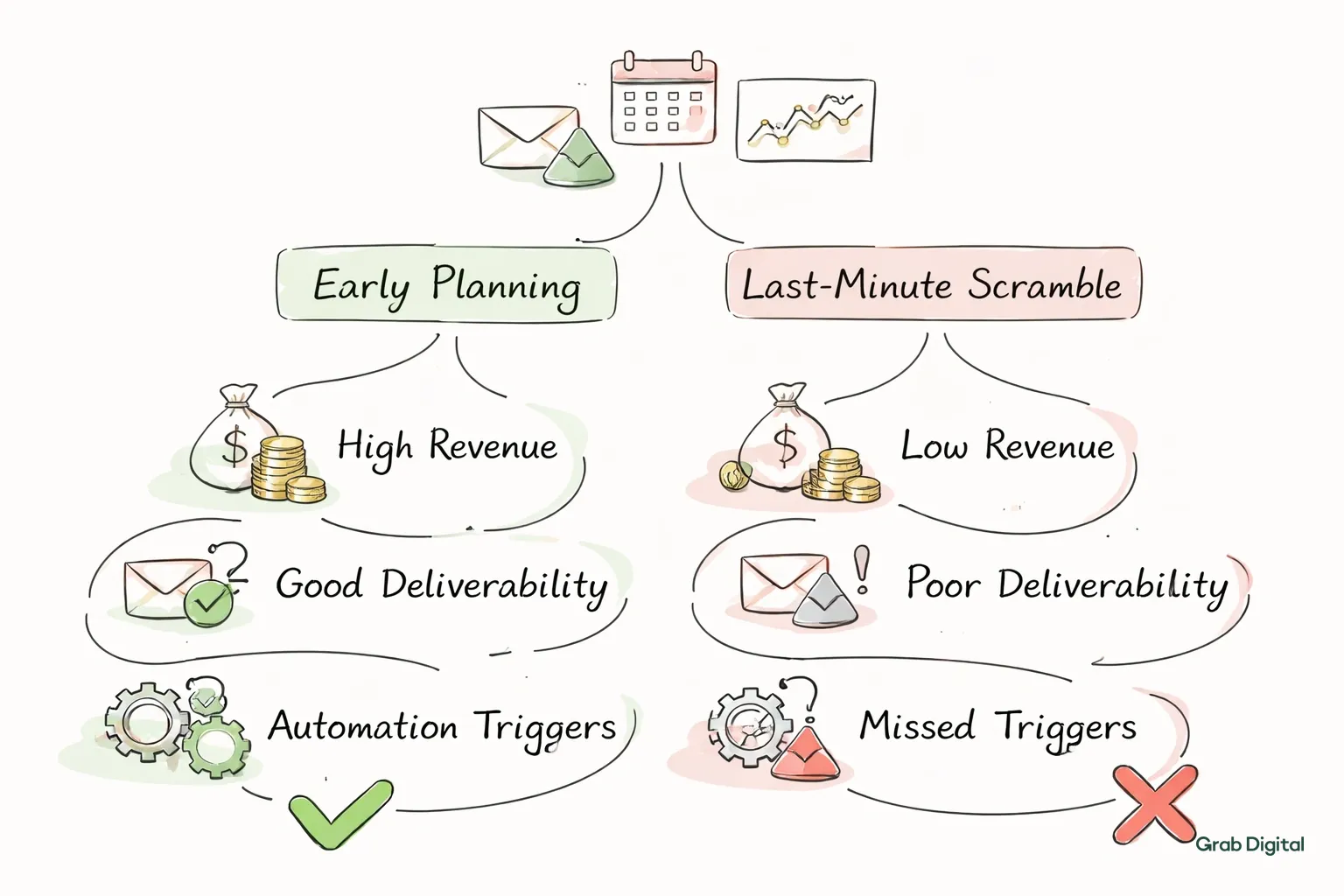
Holiday email marketing determines whether a DTC brand captures or loses its biggest revenue window of the year. Klaviyo data consistently shows email driving 25% or more of BFCM revenue for brands that prepare early. Brands that scramble in November see lower deliverability, rushed copy, and missed automation triggers.
The stakes are high because inboxes get crowded fast. Every competitor is emailing the same subscribers between late November and January 1st. A brand without a plan gets buried under louder, better-timed sends.
This is also where list health matters most. If your email deliverability is shaky going into Q4, holiday volume will expose it. Sunset flows and list cleaning before October ends are not optional this year.
The BFCM and Holiday Email Calendar
The holiday email calendar should start in early October and extend through mid-January. Breaking it into phases, pre-sale warmup, BFCM peak, mid-December push, and post-holiday cleanup, keeps your team focused and your subscribers from feeling bombarded.
Here's a realistic calendar for a $1M to $10M DTC brand:
| Phase | Dates | Focus |
|---|---|---|
| Warmup | Oct 1 to Nov 20 | List growth, segmentation, early access signup |
| Pre-BFCM teaser | Nov 21 to Nov 27 | Sneak peeks, VIP early access, countdown emails |
| BFCM peak | Nov 27 to Dec 1 | Main offer, urgency, cart recovery |
| Shipping deadline push | Dec 2 to Dec 20 | Gift guides, last-chance shipping dates |
| Post-holiday | Dec 26 to Jan 15 | Gift card reminders, returns, new year reset |
Each phase needs its own cadence. Warmup emails might go out twice a week. BFCM peak often means daily sends, sometimes more. Pulling back too early, right after December 1st, is a common mistake that leaves revenue on the table through the rest of the month.
If you're not sure your current setup can handle this volume, a quick look at your email marketing strategies for DTC brands page is a good gut check before you commit to the full calendar.
Segments That Actually Drive Holiday Revenue
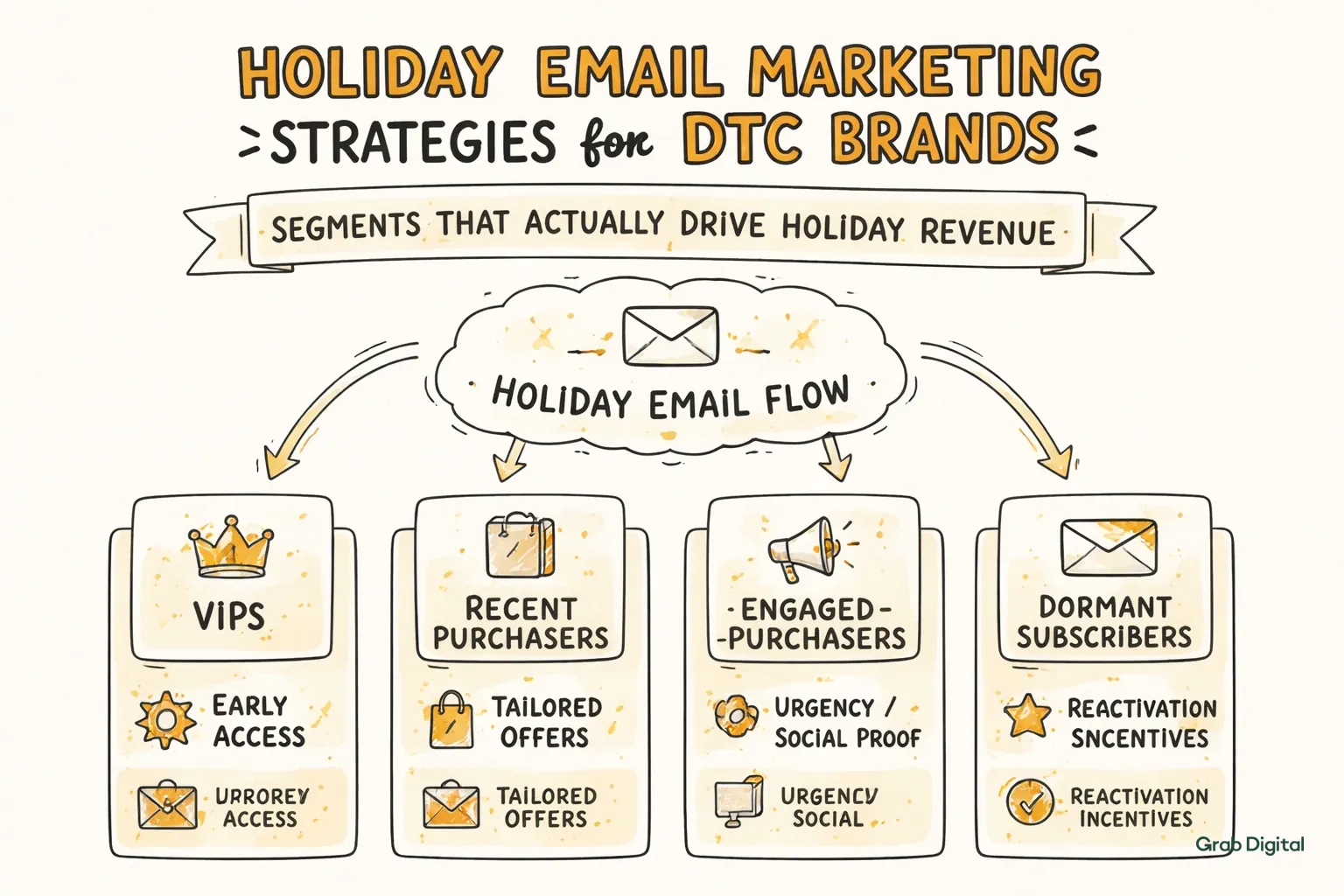
Segmentation determines whether your holiday emails feel personal or feel like spam. The core segments every DTC brand needs for Q4 are VIPs, recent purchasers, engaged non-purchasers, and dormant subscribers. Each group needs a different offer, tone, and send frequency.
VIPs, your top 10% to 20% by lifetime value, deserve early access and better perks. They should see your best offer before anyone else, often 24 to 48 hours ahead of the general list.
Engaged non-purchasers are subscribers who open and click but haven't bought recently. These people respond well to urgency and social proof rather than discounts alone.
Dormant subscribers, those who haven't opened in 90+ days, need a separate win-back push before BFCM, not during it. Sending your biggest offer to a cold segment wastes your best deal on people least likely to convert, and it hurts deliverability.
A quick segment checklist for October:
- VIP / top spenders
- Recent purchasers (last 30 days)
- Engaged, no purchase in 60+ days
- Dormant 90+ days
- New subscribers from popups and quizzes
- Browse abandoners from the last 14 days
If this level of advanced email segmentation feels like more than your current team can manage in-house, that's usually the moment brands start looking for outside help.
Structuring Your Holiday Offers
Holiday offers need a tiered structure that rewards your best customers while still converting cold traffic. A flat 20% off everything is easy to plan but leaves margin on the table for your most loyal buyers, who often would have purchased anyway.
Consider structuring offers like this:
- VIPs: Early access plus a small extra perk (free gift, bonus discount, exclusive bundle)
- General list: The headline BFCM offer, timed to the main sale window
- Cold or dormant segment: A separate, slightly different offer sent earlier to re-engage before the big push
Bundling and gift sets also perform well during the holidays because they raise average order value without requiring a deeper discount. A $20 off bundle often converts better than a blanket 20% off storewide, and it protects margin.
Don't forget shipping deadline messaging. "Order by December 18th for guaranteed delivery" is one of the highest-converting subject lines in the entire holiday season because it creates real, time-bound urgency that discounts alone can't replicate.
The Klaviyo Flows You Need Live Before November
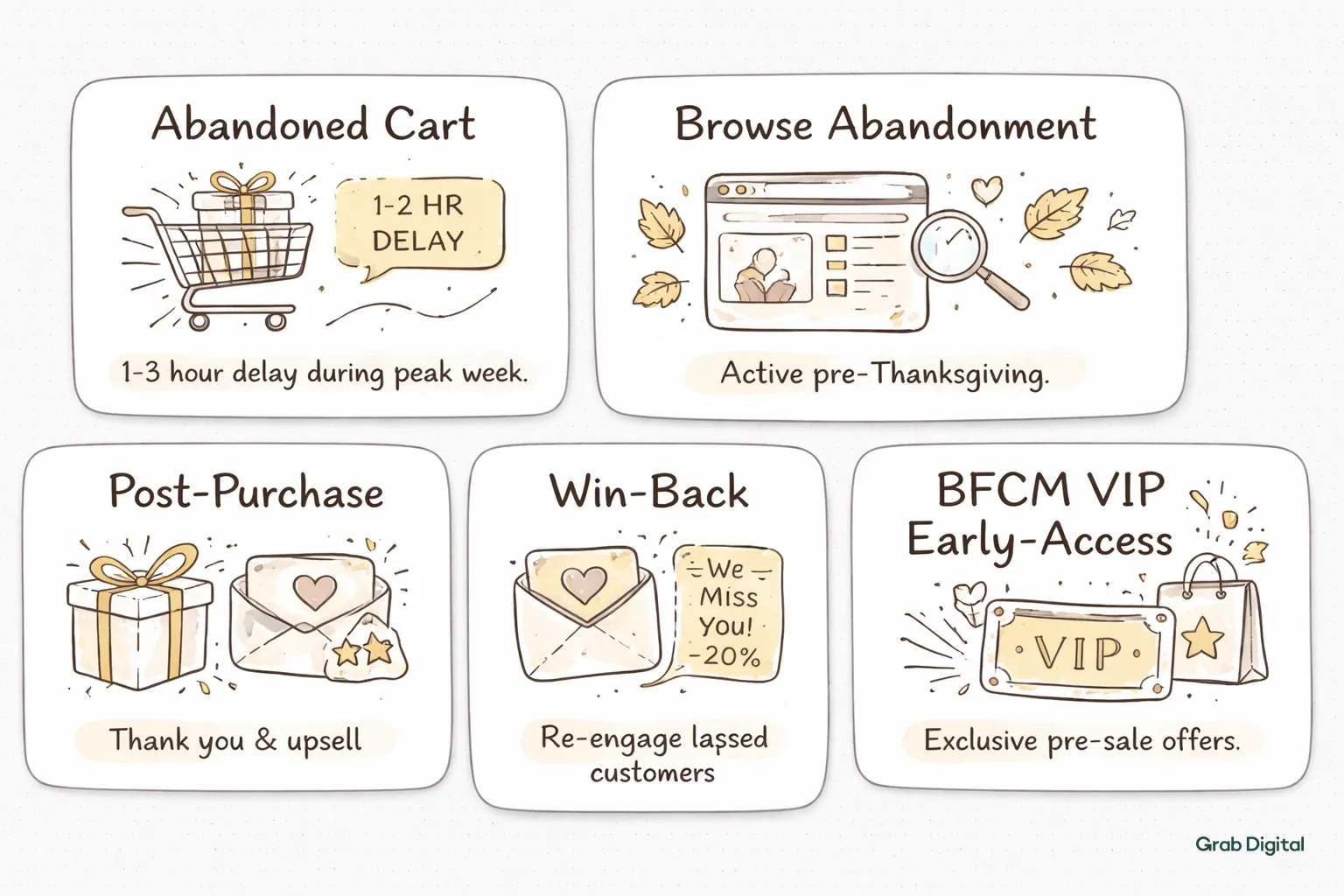
Klaviyo flows need to be built, tested, and live before Black Friday, not during it. The core flows for holiday season are abandoned cart, browse abandonment, post-purchase, win-back, and a dedicated BFCM VIP early-access flow.
Your abandoned cart flow needs tighter timing during BFCM than the rest of the year. A standard 24-hour delay is too slow when inventory and offers are changing fast. Many brands shorten the first touch to 1 to 2 hours during peak week.
Browse abandonment flows should be active well before Thanksgiving since holiday traffic from ads and social spikes browsing activity long before people add to cart. Capturing that intent early with a well-timed email keeps your brand top of mind.
Post-purchase flows matter more in Q4 than any other quarter. Gift buyers need shipping confirmations, gift note options, and clear return policy messaging. A confused gift recipient is a support ticket waiting to happen.
If you're rebuilding or auditing flows this month, the 8 core email flows every DTC brand needs is worth reviewing alongside your holiday-specific additions.
Here's a quick flow priority list for October setup:
- Welcome series (with holiday messaging swapped in)
- Abandoned cart (shortened delays for BFCM week)
- Browse abandonment
- Post-purchase / shipping and gifting
- Win-back for dormant segments
- BFCM VIP early-access automation
Popups and List Growth Before the Rush
Popups need a holiday-specific refresh before traffic spikes in November. A generic "10% off your first order" popup underperforms badly when every competitor is running a BFCM countdown popup with a bigger incentive.
Testing two or three popup variants in early October, before paid traffic ramps up, gives you clean data on which offer and design convert best. Waiting until BFCM week to test means you're guessing during your highest-stakes period.
A well-timed popup optimization refresh can lift list growth by double digits heading into the holidays, which directly expands the pool of subscribers your flows and campaigns can convert.
Reporting and the 60-Day Window After Q4
Reporting after the holidays matters just as much as planning before them. Klaviyo attribution data from BFCM through January tells you which segments, offers, and flows actually drove revenue, and that data should shape your 2027 Q1 strategy.
Brands that skip this step repeat the same mistakes every year. A simple post-mortem, comparing email-attributed revenue by segment and by flow, usually reveals two or three quick wins for the next campaign cycle.
If your current email program isn't pulling its weight even with all of this in place, it might be time for outside support. Grab Digital guarantees 10% growth in email-attributed revenue within 60 days, measured against your Klaviyo baseline, or you get a full refund. You can see how that works and book your free consultation before the holiday rush makes planning even harder.
For brands weighing their options before committing to an agency, the guide to choosing the right Klaviyo agency and the FAQ page are good starting points. You can also browse past client work to see how this has played out for other DTC brands during past holiday seasons.
Frequently Asked Questions
Q: When should DTC brands start planning their BFCM email calendar? A: Early October is ideal. This gives enough time to build segments, test popups, and finalize Klaviyo flows before the pre-BFCM teaser phase begins in late November.
Q: How many emails is too many during BFCM week? A: There's no universal number, but daily sends during the November 27 to December 1 peak window are common and generally well tolerated if segmentation is tight. Sending the same offer to your entire list daily without segmentation is what causes fatigue.
Q: Should VIP customers get the same offer as everyone else? A: No. VIPs should get early access and a small added perk rather than just an earlier version of the general offer. This protects margin while still rewarding loyalty.
Q: What's the biggest Klaviyo flow mistake brands make during the holidays? A: Leaving abandoned cart delays at their default, non-holiday timing. Shortening the first follow-up to 1 to 2 hours during peak BFCM days captures intent before competitors do.
Q: How does list cleaning affect holiday email performance? A: A cleaner list improves deliverability right when inbox competition is at its highest. Sunsetting unengaged subscribers before October ends protects sender reputation for the entire Q4 push.
Q: What happens after BFCM is over? A: The mid-December shipping deadline push and post-holiday cleanup phase matter almost as much as BFCM itself, covering gift guides, last-chance shipping, gift card reminders, and a January reset for the new year.
Holiday email marketing for DTC brands requires a structured BFCM and holiday calendar, clear segmentation, tiered offers, and Klaviyo flows built weeks in advance. A winning plan starts in early October, runs through New Year, and treats email as the primary revenue driver, not an afterthought bolted onto paid ads.
Q4 can account for 30% to 40% of annual revenue for many DTC brands, and email typically carries a disproportionate share of that load. Brands that wait until mid-November to plan are already behind. This guide breaks down the calendar, segments, offers, and automated flows you need before the holiday rush hits.
Why Holiday Email Marketing Makes or Breaks Q4
Holiday email marketing determines whether a DTC brand captures or loses its biggest revenue window of the year. Klaviyo data consistently shows email driving 25% or more of BFCM revenue for brands that prepare early. Brands that scramble in November see lower deliverability, rushed copy, and missed automation triggers.
The stakes are high because inboxes get crowded fast. Every competitor is emailing the same subscribers between late November and January 1st. A brand without a plan gets buried under louder, better-timed sends.
This is also where list health matters most. If your email deliverability is shaky going into Q4, holiday volume will expose it. Sunset flows and list cleaning before October ends are not optional this year.
The BFCM and Holiday Email Calendar
The holiday email calendar should start in early October and extend through mid-January. Breaking it into phases, pre-sale warmup, BFCM peak, mid-December push, and post-holiday cleanup, keeps your team focused and your subscribers from feeling bombarded.
Here's a realistic calendar for a $1M to $10M DTC brand:
| Phase | Dates | Focus |
|---|---|---|
| Warmup | Oct 1 to Nov 20 | List growth, segmentation, early access signup |
| Pre-BFCM teaser | Nov 21 to Nov 27 | Sneak peeks, VIP early access, countdown emails |
| BFCM peak | Nov 27 to Dec 1 | Main offer, urgency, cart recovery |
| Shipping deadline push | Dec 2 to Dec 20 | Gift guides, last-chance shipping dates |
| Post-holiday | Dec 26 to Jan 15 | Gift card reminders, returns, new year reset |
Each phase needs its own cadence. Warmup emails might go out twice a week. BFCM peak often means daily sends, sometimes more. Pulling back too early, right after December 1st, is a common mistake that leaves revenue on the table through the rest of the month.
If you're not sure your current setup can handle this volume, a quick look at your email marketing strategies for DTC brands page is a good gut check before you commit to the full calendar.
Segments That Actually Drive Holiday Revenue
Segmentation determines whether your holiday emails feel personal or feel like spam. The core segments every DTC brand needs for Q4 are VIPs, recent purchasers, engaged non-purchasers, and dormant subscribers. Each group needs a different offer, tone, and send frequency.
VIPs, your top 10% to 20% by lifetime value, deserve early access and better perks. They should see your best offer before anyone else, often 24 to 48 hours ahead of the general list.
Engaged non-purchasers are subscribers who open and click but haven't bought recently. These people respond well to urgency and social proof rather than discounts alone.
Dormant subscribers, those who haven't opened in 90+ days, need a separate win-back push before BFCM, not during it. Sending your biggest offer to a cold segment wastes your best deal on people least likely to convert, and it hurts deliverability.
A quick segment checklist for October:
- VIP / top spenders
- Recent purchasers (last 30 days)
- Engaged, no purchase in 60+ days
- Dormant 90+ days
- New subscribers from popups and quizzes
- Browse abandoners from the last 14 days
If this level of advanced email segmentation feels like more than your current team can manage in-house, that's usually the moment brands start looking for outside help.
Structuring Your Holiday Offers
Holiday offers need a tiered structure that rewards your best customers while still converting cold traffic. A flat 20% off everything is easy to plan but leaves margin on the table for your most loyal buyers, who often would have purchased anyway.
Consider structuring offers like this:
- VIPs: Early access plus a small extra perk (free gift, bonus discount, exclusive bundle)
- General list: The headline BFCM offer, timed to the main sale window
- Cold or dormant segment: A separate, slightly different offer sent earlier to re-engage before the big push
Bundling and gift sets also perform well during the holidays because they raise average order value without requiring a deeper discount. A $20 off bundle often converts better than a blanket 20% off storewide, and it protects margin.
Don't forget shipping deadline messaging. "Order by December 18th for guaranteed delivery" is one of the highest-converting subject lines in the entire holiday season because it creates real, time-bound urgency that discounts alone can't replicate.
The Klaviyo Flows You Need Live Before November
Klaviyo flows need to be built, tested, and live before Black Friday, not during it. The core flows for holiday season are abandoned cart, browse abandonment, post-purchase, win-back, and a dedicated BFCM VIP early-access flow.
Your abandoned cart flow needs tighter timing during BFCM than the rest of the year. A standard 24-hour delay is too slow when inventory and offers are changing fast. Many brands shorten the first touch to 1 to 2 hours during peak week.
Browse abandonment flows should be active well before Thanksgiving since holiday traffic from ads and social spikes browsing activity long before people add to cart. Capturing that intent early with a well-timed email keeps your brand top of mind.
Post-purchase flows matter more in Q4 than any other quarter. Gift buyers need shipping confirmations, gift note options, and clear return policy messaging. A confused gift recipient is a support ticket waiting to happen.
If you're rebuilding or auditing flows this month, the 8 core email flows every DTC brand needs is worth reviewing alongside your holiday-specific additions.
Here's a quick flow priority list for October setup:
- Welcome series (with holiday messaging swapped in)
- Abandoned cart (shortened delays for BFCM week)
- Browse abandonment
- Post-purchase / shipping and gifting
- Win-back for dormant segments
- BFCM VIP early-access automation
Popups and List Growth Before the Rush
Popups need a holiday-specific refresh before traffic spikes in November. A generic "10% off your first order" popup underperforms badly when every competitor is running a BFCM countdown popup with a bigger incentive.
Testing two or three popup variants in early October, before paid traffic ramps up, gives you clean data on which offer and design convert best. Waiting until BFCM week to test means you're guessing during your highest-stakes period.
A well-timed popup optimization refresh can lift list growth by double digits heading into the holidays, which directly expands the pool of subscribers your flows and campaigns can convert.
Reporting and the 60-Day Window After Q4
Reporting after the holidays matters just as much as planning before them. Klaviyo attribution data from BFCM through January tells you which segments, offers, and flows actually drove revenue, and that data should shape your 2027 Q1 strategy.
Brands that skip this step repeat the same mistakes every year. A simple post-mortem, comparing email-attributed revenue by segment and by flow, usually reveals two or three quick wins for the next campaign cycle.
If your current email program isn't pulling its weight even with all of this in place, it might be time for outside support. Grab Digital guarantees 10% growth in email-attributed revenue within 60 days, measured against your Klaviyo baseline, or you get a full refund. You can see how that works and book your free consultation before the holiday rush makes planning even harder.
For brands weighing their options before committing to an agency, the guide to choosing the right Klaviyo agency and the FAQ page are good starting points. You can also browse past client work to see how this has played out for other DTC brands during past holiday seasons.
Frequently Asked Questions
Q: When should DTC brands start planning their BFCM email calendar? A: Early October is ideal. This gives enough time to build segments, test popups, and finalize Klaviyo flows before the pre-BFCM teaser phase begins in late November.
Q: How many emails is too many during BFCM week? A: There's no universal number, but daily sends during the November 27 to December 1 peak window are common and generally well tolerated if segmentation is tight. Sending the same offer to your entire list daily without segmentation is what causes fatigue.
Q: Should VIP customers get the same offer as everyone else? A: No. VIPs should get early access and a small added perk rather than just an earlier version of the general offer. This protects margin while still rewarding loyalty.
Q: What's the biggest Klaviyo flow mistake brands make during the holidays? A: Leaving abandoned cart delays at their default, non-holiday timing. Shortening the first follow-up to 1 to 2 hours during peak BFCM days captures intent before competitors do.
Q: How does list cleaning affect holiday email performance? A: A cleaner list improves deliverability right when inbox competition is at its highest. Sunsetting unengaged subscribers before October ends protects sender reputation for the entire Q4 push.
Q: What happens after BFCM is over? A: The mid-December shipping deadline push and post-holiday cleanup phase matter almost as much as BFCM itself, covering gift guides, last-chance shipping, gift card reminders, and a January reset for the new year.

Find out exactly what your email channel is leaving on the table.

Email Marketing for Scaling DTC Brands


