
Summary
Cut Cart Abandonment: Fix Friction, Email Timing, SMS Urgency
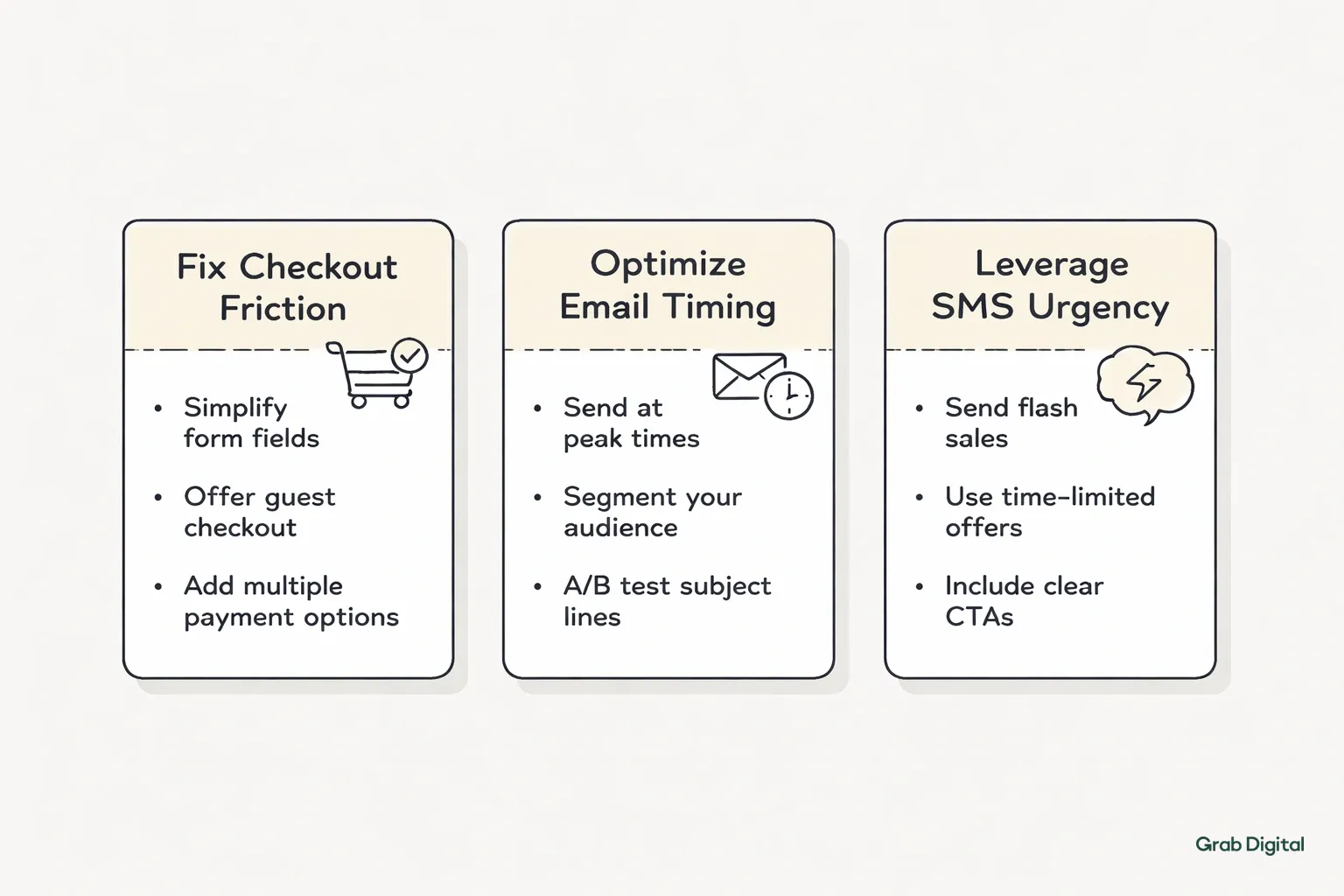
Cart abandonment drops when you fix three things at once: checkout friction, email timing, and SMS urgency. Brands that pair a fast checkout with a layered Klaviyo flow and tactical SMS nudges typically recover 15 to 25% of abandoned carts. The industry average is a depressing 5 to 10%.
Most DTC brands only attack one piece of this. They build an abandoned cart email and call it done, ignoring the checkout UX problems that caused the abandonment in the first place. Fixing all three channels together is what actually moves the revenue needle.
Why carts get abandoned in the first place
Cart abandonment happens because shoppers hit friction or second thoughts before completing payment. The Baymard Institute puts average online cart abandonment near 70%. That number is staggering. Unexpected costs, forced account creation, and slow page loads are the top causes across most ecommerce verticals.
If your checkout takes four steps and four form fields more than it needs to, no email sequence will fully compensate. You have to figure out where the leak is. If your checkout is already lean but your emails are weak, you're just leaving recoverable revenue on the table.
Here's a quick breakdown of common abandonment triggers:
| Cause | Approx. Share of Abandonments | Fixable By |
|---|---|---|
| Extra costs (shipping, taxes, fees) | 48% | Checkout UX |
| Forced account creation | 24% | Checkout UX |
| Slow or complicated checkout | 22% | Checkout UX |
| Didn't trust site with card info | 19% | Checkout UX + Email |
| Wanted to save/compare, got distracted | 20%+ | Email + SMS |
| Price too high overall | 18% | Email (offer/value framing) |
Source patterns are consistent across Baymard and Shopify's own abandonment research from the past two years.
Fixing checkout UX before you touch email
Checkout UX is the first lever, because friction here kills recovery potential before any message even gets sent. A fast, transparent, mobile-optimized checkout reduces abandonment at the source. That means fewer carts to chase in the first place.
Start with the basics that Shopify brands consistently get wrong:
- Show total cost early. Display shipping estimates and taxes on the product or cart page, not just at the final step. Surprise costs kill conversions.
- Offer guest checkout. Never force account creation before purchase. Let people create an account after.
- Reduce form fields. Use autofill, address lookup, and single-page checkout where possible.
- Add trust signals near the payment button. Security badges, return policy links, and real customer review counts reduce last-second hesitation.
- Optimize for mobile first. Over 70% of DTC traffic is mobile. A desktop-first checkout bleeds conversions.
- Enable multiple payment methods. Apple Pay, Shop Pay, and buy-now-pay-later options remove payment friction for undecided buyers.
If you're still running a checkout that takes more than 90 seconds to complete on mobile, fix that before you even open Klaviyo.
Building an email flow that actually recovers revenue
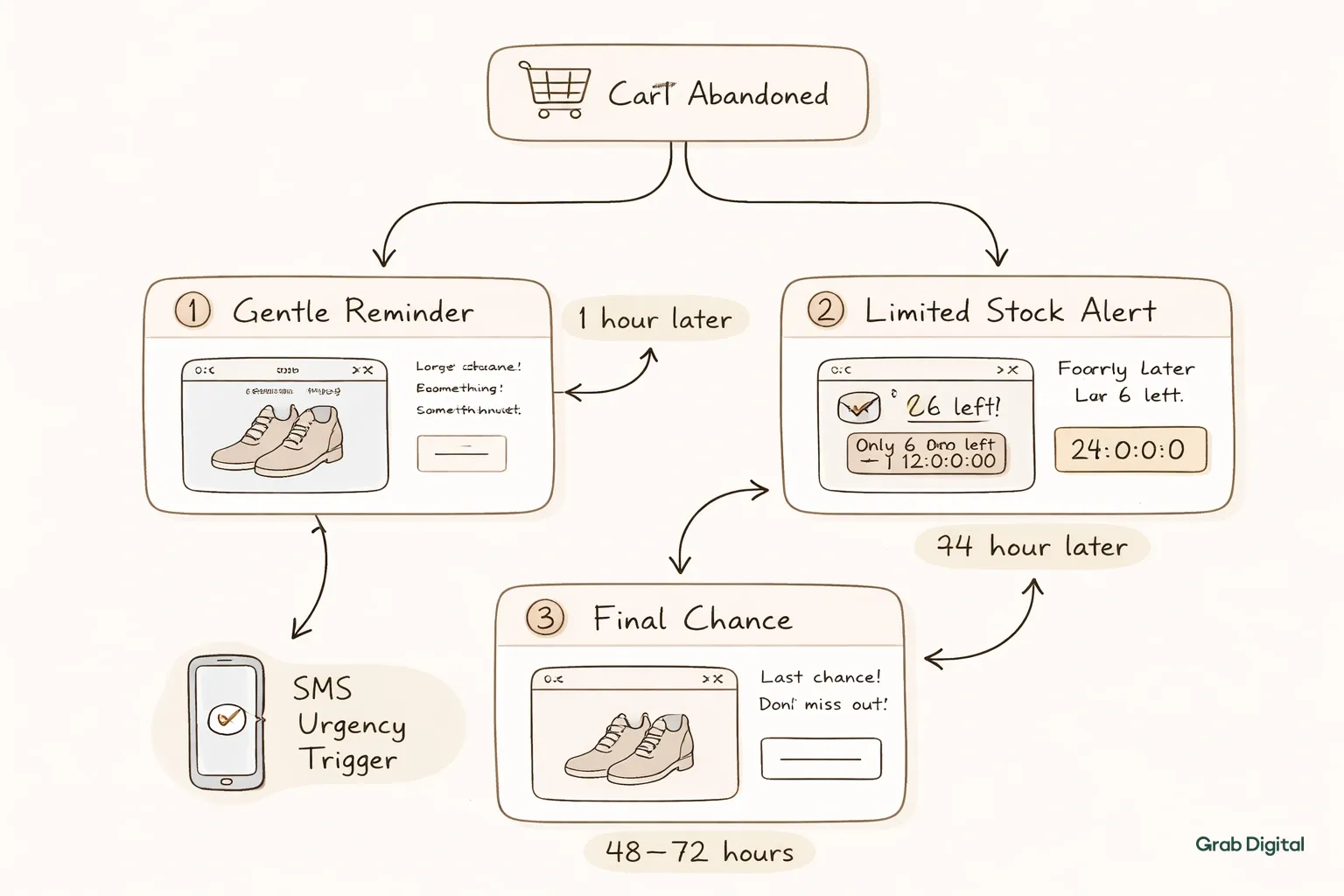
Abandoned cart emails work best as a layered, three-to-four email sequence. The first email should send within an hour, the second within 24 hours, and the third around 48 to 72 hours. Each needs a different angle and increasing urgency.
A single "you left something in your cart" email converts, but it's leaving money on the table. Brands that run a proper multi-touch sequence see significantly higher recovery rates because each email serves a different psychological purpose.
Here's a structure that performs well for DTC brands on Klaviyo:
- Email 1 (1 hour later): Gentle reminder, product image, no discount. Just remove friction with a direct link back to checkout.
- Email 2 (24 hours later): Address objections. Add social proof, reviews, or UGC. Answer the "is this worth it" question.
- Email 3 (48 to 72 hours later): Introduce urgency, stock scarcity, or a time-limited incentive if your margins allow it.
- Email 4 (optional, 5 to 7 days later): Last-chance messaging before the lead goes cold, often paired with a sunset consideration for chronic non-engagers.
This pattern matches what we cover in detail in our guide to building a high-ROI abandoned cart flow, and it pairs naturally with browse abandonment flows for shoppers who didn't even reach the cart stage.
A few copywriting notes that consistently move metrics:
- Subject lines referencing the specific product outperform generic "you forgot something" lines.
- Including real customer photos or reviews in email 2 increases click-through in most DTC verticals.
- Discounts in email 1 train customers to abandon on purpose. Save incentives for email 3 or later.
If your current flow is just one email with no segmentation, it's worth getting your free consultation to see what a full-funnel rebuild could recover in your specific Klaviyo account.
Where SMS fits into the recovery sequence
SMS works best as a fast, high-urgency touchpoint that complements email rather than replacing it. Texts sent within 15 to 60 minutes of abandonment catch shoppers while intent is still fresh, often producing higher click rates than email alone.
But you have to be careful. SMS is intrusive by nature, so it should carry less volume and more precision than email.
A practical SMS cadence for cart abandonment:
- One text, sent 30 to 60 minutes after abandonment, for subscribers who've opted into SMS and have a cart value above a set threshold.
- Keep it short. One line, a direct link, no more than one emoji.
- Reserve a second text for high-intent segments only, such as carts over a certain dollar amount or repeat visitors.
- Never duplicate the exact same offer across email and SMS at the same time. Stagger the channels so customers don't feel spammed from two directions.
SMS and email should share the same segmentation logic inside Klaviyo, so a customer who already converted from email doesn't get an unnecessary text. This kind of cross-channel suppression logic is part of what we build into every Klaviyo automation strategy we set up for clients.
Segmentation: the layer most brands skip

Segmentation determines whether your cart abandonment messaging feels relevant or generic. Treating a first-time visitor the same as a repeat customer in your abandonment flow wastes a chance to adjust your tone and offer.
A few segments worth building inside Klaviyo specifically for cart recovery:
- New vs. returning customers. Returning customers often need less convincing, more direct reminders.
- High-value carts vs. low-value carts. Reserve discounts for carts above a certain AOV threshold to protect margin.
- Engaged subscribers vs. cold subscribers. Cold subscribers might need an SMS nudge since they're less likely to open email.
- Device type. Mobile abandoners often face different friction points than desktop abandoners, usually payment-related.
This level of advanced email segmentation is where most in-house teams run out of bandwidth, which is exactly why brands bring in a dedicated team to manage it long-term.
Measuring what's actually working
Recovery rate is the clearest signal of whether your cart abandonment strategy is working. Measured as the percentage of abandoned carts that convert within a defined window, Klaviyo's native attribution reporting makes this measurable without extra tooling.
Track these metrics monthly, not just at launch:
| Metric | What It Tells You |
|---|---|
| Recovery rate (%) | Overall flow effectiveness |
| Email 1 vs. Email 2 vs. Email 3 conversion | Which touchpoint carries the flow |
| SMS click-through rate | Whether texts are earning attention |
| Revenue per recipient | Dollar value of the flow, not just open rates |
| Checkout completion rate (site-wide) | Whether UX fixes are reducing abandonment at the source |
If recovery rate plateaus below 15%, that's usually a sign the checkout UX issues haven't been addressed, not that the emails need more discounts. Our DTC email marketing checklist walks through a full audit process for brands trying to diagnose where the leak actually is.
The bottom line
Cart abandonment recovery works best as a system, not a single fix. Checkout UX stops abandonment at the source, email recovers intent over days, and SMS catches high-value carts in the first hour. None of the channels fully compensates for weakness in the others.
Brands generating under 20% of revenue through email are usually missing at least one of these layers entirely. If that sounds familiar, it's worth reviewing how your current flows compare against proven abandoned cart strategies for DTC brands before the holiday traffic surge tapers off and you're left auditing in Q1 instead of acting now.
For brands that want a dedicated team handling checkout audits, Klaviyo flow builds, and SMS integration together, our services page outlines exactly how we structure that work, backed by a 10% revenue growth guarantee within 60 days.
Frequently asked questions
Q: How quickly should the first abandoned cart email send? A: Within one hour of abandonment. Sending too early can feel premature, but waiting longer than a few hours sharply reduces recovery odds since intent fades fast.
Q: Should discounts be included in every abandoned cart email? A: No. Leading with a discount in the first email trains customers to abandon carts intentionally. Save incentives for the second or third email in the sequence.
Q: Is SMS necessary if email already performs well? A: SMS isn't mandatory, but it catches high-intent shoppers faster than email, especially for high-value carts. It works best as a supplement, not a replacement.
Q: How many emails should a cart abandonment flow include? A: Three to four emails spaced over 72 hours to a week typically perform best. We usually structure them as a reminder, objection handling, and finally urgency.
Q: What's the biggest checkout UX mistake DTC brands make? A: Hiding shipping costs and taxes until the final checkout step. Surprise costs are consistently the top reason shoppers abandon carts, according to Baymard research.
Q: How do I know if my current abandonment flow is underperforming? A: If your recovery rate sits below 15% and most of your revenue comes from a single email with a discount, there's likely room to layer in segmentation, SMS, and checkout fixes.
Cart abandonment drops when you fix three things at once: checkout friction, email timing, and SMS urgency. Brands that pair a fast checkout with a layered Klaviyo flow and tactical SMS nudges typically recover 15 to 25% of abandoned carts. The industry average is a depressing 5 to 10%.
Most DTC brands only attack one piece of this. They build an abandoned cart email and call it done, ignoring the checkout UX problems that caused the abandonment in the first place. Fixing all three channels together is what actually moves the revenue needle.
Why carts get abandoned in the first place
Cart abandonment happens because shoppers hit friction or second thoughts before completing payment. The Baymard Institute puts average online cart abandonment near 70%. That number is staggering. Unexpected costs, forced account creation, and slow page loads are the top causes across most ecommerce verticals.
If your checkout takes four steps and four form fields more than it needs to, no email sequence will fully compensate. You have to figure out where the leak is. If your checkout is already lean but your emails are weak, you're just leaving recoverable revenue on the table.
Here's a quick breakdown of common abandonment triggers:
| Cause | Approx. Share of Abandonments | Fixable By |
|---|---|---|
| Extra costs (shipping, taxes, fees) | 48% | Checkout UX |
| Forced account creation | 24% | Checkout UX |
| Slow or complicated checkout | 22% | Checkout UX |
| Didn't trust site with card info | 19% | Checkout UX + Email |
| Wanted to save/compare, got distracted | 20%+ | Email + SMS |
| Price too high overall | 18% | Email (offer/value framing) |
Source patterns are consistent across Baymard and Shopify's own abandonment research from the past two years.
Fixing checkout UX before you touch email
Checkout UX is the first lever, because friction here kills recovery potential before any message even gets sent. A fast, transparent, mobile-optimized checkout reduces abandonment at the source. That means fewer carts to chase in the first place.
Start with the basics that Shopify brands consistently get wrong:
- Show total cost early. Display shipping estimates and taxes on the product or cart page, not just at the final step. Surprise costs kill conversions.
- Offer guest checkout. Never force account creation before purchase. Let people create an account after.
- Reduce form fields. Use autofill, address lookup, and single-page checkout where possible.
- Add trust signals near the payment button. Security badges, return policy links, and real customer review counts reduce last-second hesitation.
- Optimize for mobile first. Over 70% of DTC traffic is mobile. A desktop-first checkout bleeds conversions.
- Enable multiple payment methods. Apple Pay, Shop Pay, and buy-now-pay-later options remove payment friction for undecided buyers.
If you're still running a checkout that takes more than 90 seconds to complete on mobile, fix that before you even open Klaviyo.
Building an email flow that actually recovers revenue
Abandoned cart emails work best as a layered, three-to-four email sequence. The first email should send within an hour, the second within 24 hours, and the third around 48 to 72 hours. Each needs a different angle and increasing urgency.
A single "you left something in your cart" email converts, but it's leaving money on the table. Brands that run a proper multi-touch sequence see significantly higher recovery rates because each email serves a different psychological purpose.
Here's a structure that performs well for DTC brands on Klaviyo:
- Email 1 (1 hour later): Gentle reminder, product image, no discount. Just remove friction with a direct link back to checkout.
- Email 2 (24 hours later): Address objections. Add social proof, reviews, or UGC. Answer the "is this worth it" question.
- Email 3 (48 to 72 hours later): Introduce urgency, stock scarcity, or a time-limited incentive if your margins allow it.
- Email 4 (optional, 5 to 7 days later): Last-chance messaging before the lead goes cold, often paired with a sunset consideration for chronic non-engagers.
This pattern matches what we cover in detail in our guide to building a high-ROI abandoned cart flow, and it pairs naturally with browse abandonment flows for shoppers who didn't even reach the cart stage.
A few copywriting notes that consistently move metrics:
- Subject lines referencing the specific product outperform generic "you forgot something" lines.
- Including real customer photos or reviews in email 2 increases click-through in most DTC verticals.
- Discounts in email 1 train customers to abandon on purpose. Save incentives for email 3 or later.
If your current flow is just one email with no segmentation, it's worth getting your free consultation to see what a full-funnel rebuild could recover in your specific Klaviyo account.
Where SMS fits into the recovery sequence
SMS works best as a fast, high-urgency touchpoint that complements email rather than replacing it. Texts sent within 15 to 60 minutes of abandonment catch shoppers while intent is still fresh, often producing higher click rates than email alone.
But you have to be careful. SMS is intrusive by nature, so it should carry less volume and more precision than email.
A practical SMS cadence for cart abandonment:
- One text, sent 30 to 60 minutes after abandonment, for subscribers who've opted into SMS and have a cart value above a set threshold.
- Keep it short. One line, a direct link, no more than one emoji.
- Reserve a second text for high-intent segments only, such as carts over a certain dollar amount or repeat visitors.
- Never duplicate the exact same offer across email and SMS at the same time. Stagger the channels so customers don't feel spammed from two directions.
SMS and email should share the same segmentation logic inside Klaviyo, so a customer who already converted from email doesn't get an unnecessary text. This kind of cross-channel suppression logic is part of what we build into every Klaviyo automation strategy we set up for clients.
Segmentation: the layer most brands skip
Segmentation determines whether your cart abandonment messaging feels relevant or generic. Treating a first-time visitor the same as a repeat customer in your abandonment flow wastes a chance to adjust your tone and offer.
A few segments worth building inside Klaviyo specifically for cart recovery:
- New vs. returning customers. Returning customers often need less convincing, more direct reminders.
- High-value carts vs. low-value carts. Reserve discounts for carts above a certain AOV threshold to protect margin.
- Engaged subscribers vs. cold subscribers. Cold subscribers might need an SMS nudge since they're less likely to open email.
- Device type. Mobile abandoners often face different friction points than desktop abandoners, usually payment-related.
This level of advanced email segmentation is where most in-house teams run out of bandwidth, which is exactly why brands bring in a dedicated team to manage it long-term.
Measuring what's actually working
Recovery rate is the clearest signal of whether your cart abandonment strategy is working. Measured as the percentage of abandoned carts that convert within a defined window, Klaviyo's native attribution reporting makes this measurable without extra tooling.
Track these metrics monthly, not just at launch:
| Metric | What It Tells You |
|---|---|
| Recovery rate (%) | Overall flow effectiveness |
| Email 1 vs. Email 2 vs. Email 3 conversion | Which touchpoint carries the flow |
| SMS click-through rate | Whether texts are earning attention |
| Revenue per recipient | Dollar value of the flow, not just open rates |
| Checkout completion rate (site-wide) | Whether UX fixes are reducing abandonment at the source |
If recovery rate plateaus below 15%, that's usually a sign the checkout UX issues haven't been addressed, not that the emails need more discounts. Our DTC email marketing checklist walks through a full audit process for brands trying to diagnose where the leak actually is.
The bottom line
Cart abandonment recovery works best as a system, not a single fix. Checkout UX stops abandonment at the source, email recovers intent over days, and SMS catches high-value carts in the first hour. None of the channels fully compensates for weakness in the others.
Brands generating under 20% of revenue through email are usually missing at least one of these layers entirely. If that sounds familiar, it's worth reviewing how your current flows compare against proven abandoned cart strategies for DTC brands before the holiday traffic surge tapers off and you're left auditing in Q1 instead of acting now.
For brands that want a dedicated team handling checkout audits, Klaviyo flow builds, and SMS integration together, our services page outlines exactly how we structure that work, backed by a 10% revenue growth guarantee within 60 days.
Frequently asked questions
Q: How quickly should the first abandoned cart email send? A: Within one hour of abandonment. Sending too early can feel premature, but waiting longer than a few hours sharply reduces recovery odds since intent fades fast.
Q: Should discounts be included in every abandoned cart email? A: No. Leading with a discount in the first email trains customers to abandon carts intentionally. Save incentives for the second or third email in the sequence.
Q: Is SMS necessary if email already performs well? A: SMS isn't mandatory, but it catches high-intent shoppers faster than email, especially for high-value carts. It works best as a supplement, not a replacement.
Q: How many emails should a cart abandonment flow include? A: Three to four emails spaced over 72 hours to a week typically perform best. We usually structure them as a reminder, objection handling, and finally urgency.
Q: What's the biggest checkout UX mistake DTC brands make? A: Hiding shipping costs and taxes until the final checkout step. Surprise costs are consistently the top reason shoppers abandon carts, according to Baymard research.
Q: How do I know if my current abandonment flow is underperforming? A: If your recovery rate sits below 15% and most of your revenue comes from a single email with a discount, there's likely room to layer in segmentation, SMS, and checkout fixes.

Find out exactly what your email channel is leaving on the table.

Email Marketing for Scaling DTC Brands


