
Summary
Why Agencies Need Specialized Email Campaign Software
Email campaign software for agencies is a different animal than what in-house teams use. You're not sending for one brand you're managing multiple DTC clients, each with their own sending schedules, approval workflows, brand guidelines, and compliance headaches. The platform has to handle that complexity without becoming the thing that slows you down.
Get this wrong and you'll feel it. Campaigns stall in approval purgatory. Clients outgrow the platform and start asking awkward questions about why their flows can't do X. Your team wastes hours on workarounds that should've been automated months ago. Get it right, and the software mostly disappears campaigns ship, clients renew, and you can think about strategy instead of why the integration broke again.
Why agencies need different email software
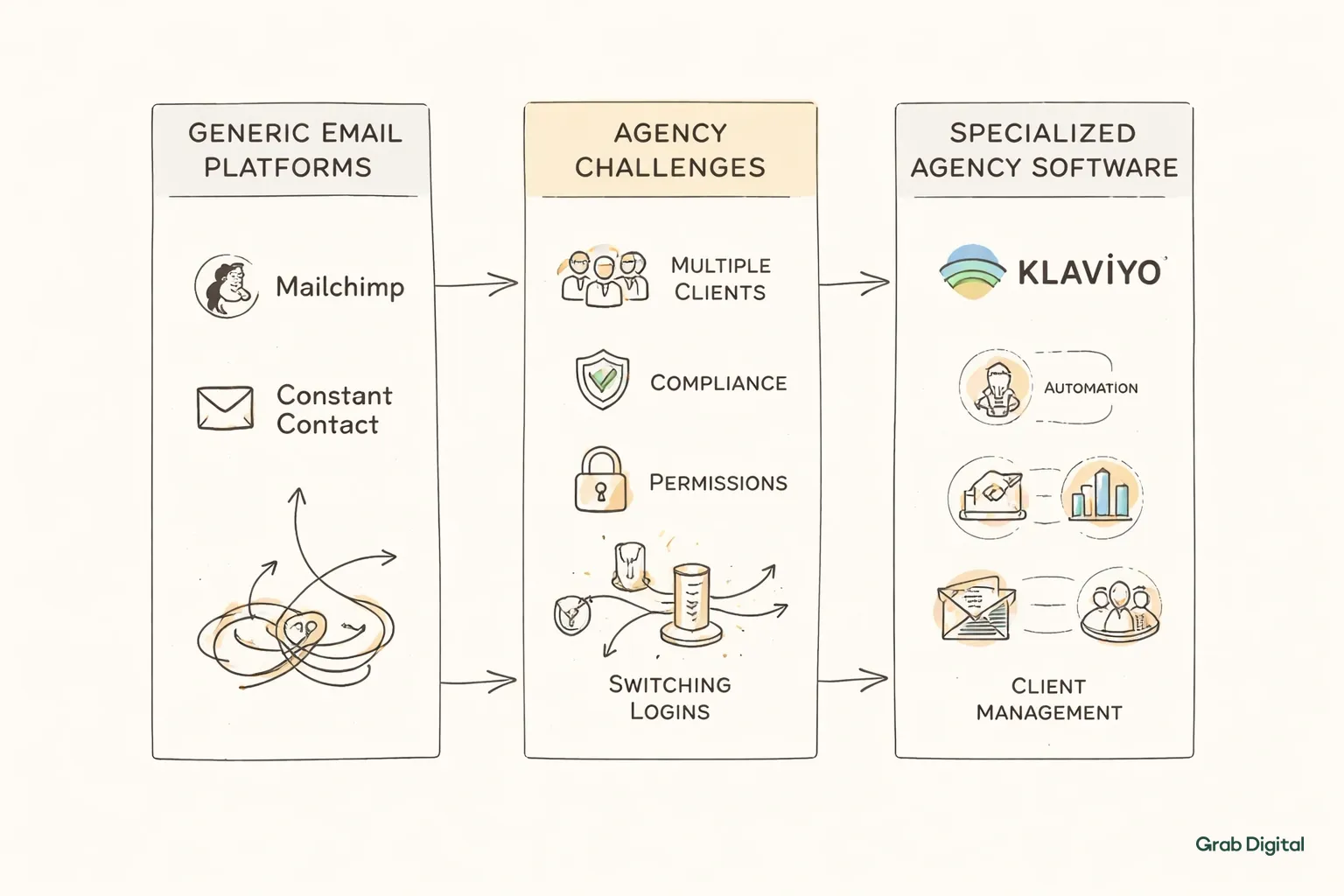
Most email platforms were built for one brand sending to one audience. That's fine for a DTC company running its own marketing. It falls apart when you're juggling eight clients across different verticals, each with different compliance requirements and performance benchmarks.
Mailchimp or Constant Contact can technically handle multiple accounts. But they weren't built for how agencies actually work. You end up spending more time switching between logins, untangling permissions, and tracking down who last touched a campaign than actually doing the work.
The platforms that work for agencies give you workspace separation so client accounts stay distinct. Role-based access means the new hire can't accidentally nuke a client's list. Audit trails exist when you need them. Consolidated billing means you're not chasing twelve invoices every month. These aren't nice-to-haves they're what separates agencies that scale from agencies that drown in overhead.
Deliverability is the sleeper issue. On shared infrastructure, one client who decides to mail their entire list every day can tank inbox placement for everyone else you manage. Proper agency software isolates sender reputation per client and gives you monitoring tools to catch problems before they spread.
Klaviyo: The DTC default for a reason
Klaviyo's become the default for DTC email marketing because it connects directly to Shopify. Purchase data, product catalogs, customer behavior all of it syncs in real time. That matters when you're trying to prove email drives revenue, not just opens and clicks.
For agencies, the partner program actually delivers. Dedicated support. Migration help when you're onboarding new clients. Co-marketing that can help you close deals. A direct line to the product team when you need something that doesn't exist yet. This isn't just a badge for your website it's actual help when you're trying to deliver.
The segmentation engine is where Klaviyo justifies the price tag. Build audiences on predicted next purchase date, customer lifetime value, browsing behavior dozens of signals. These aren't demographic slices. They're segments that convert because they're based on what people do, not who they are on paper.
Reporting ties emails to actual purchases. First-click, last-click, linear attribution show clients what drove what. They can check the dashboard whenever they want. That transparency makes retention easier. You're not defending your retainer. You're showing them what it produced. Book your free consultation if you want to talk through how this would work for your specific clients.
The flow builder is visual enough that strategists can build complex automation without filing a dev ticket. Conditional splits, time delays, trigger filters sophisticated nurture paths without code.
What actually matters when you're choosing
Client account architecture beats feature lists. Can you see all accounts from one dashboard? Switch workspaces without the login dance? Set permissions so the junior team member doesn't accidentally send to the wrong list?
Template libraries with version control. Designers build the master templates. Copywriters populate them. Strategists schedule. Nobody goes rogue on brand because the templates are locked, but nobody's waiting on someone else to unblock them.
Approval workflows that catch broken links and embarrassing typos before they go out. Define the chain: designer → copywriter → strategist → client. Automated notifications keep it moving without Slack messages piling up.
White-label reporting so clients see your brand, not the platform's. Control what metrics show up, how it looks, whether they can drill down. Some clients want the deep dive. Others want the highlights. Give them what they'll actually use.
Integrations. DTC clients run on Shopify, Gorgias, Recharge, Yotpo. Your platform needs to connect to all of them without custom API work. That work comes out of your margin.
How to evaluate without getting sold
Map your workflow before you look at platforms. Strategy call → brief → design → copy → approval → send → report. Where are the handoffs? Where do things get stuck? Where do mistakes happen? The right platform removes friction at those exact points.
Ask for demos that match how you work. Not a feature tour show me five campaigns for five different clients running simultaneously. Show me how to troubleshoot deliverability for one account without affecting the others. Show me how to give a new team member access that matches their role.
Actually test the migration process. Moving clients is painful. List imports, rebuilding flows, recreating templates. Good providers give you real support. Bad ones send a PDF and wish you luck.
Total cost, not just the subscription. Implementation, training, integration work, workarounds for missing features. The cheaper platform often costs more in team hours.
Watch deliverability infrastructure closely. Dedicated IPs for high-volume accounts. IP warming support. Monitoring tools that flag issues before campaigns tank. Your reputation lives and dies on this stuff.
Klaviyo vs. alternatives
Klaviyo pricing scales with contact count. Agencies typically see $600-2000 per client monthly depending on list size. Cost tracks the value you deliver.
HubSpot does everything. Which is great if you need everything. If you're focused on email, the interface is cluttered with features you'll never touch. Learning curve is real. Pricing quickly outpaces Klaviyo unless you're selling full-stack marketing automation, not just email.
ActiveCampaign automates well for less money. But the ecommerce features are surface-level. Revenue attribution is basic. Product catalogs are limited. Predictive analytics for DTC lifecycle work doesn't exist. You'll spend time building workarounds.
Omnisend targets ecommerce but attracts smaller merchants. Fine for brands doing $500K-2M. Lacks the segmentation depth and reporting that clients paying agency retainers expect. You'll hit the ceiling.
Campaign Monitor and similar legacy platforms treat email as broadcast. No Shopify sync. No behavioral triggers. No revenue attribution. They're newsletter tools in an ecommerce world.
Your tech stack
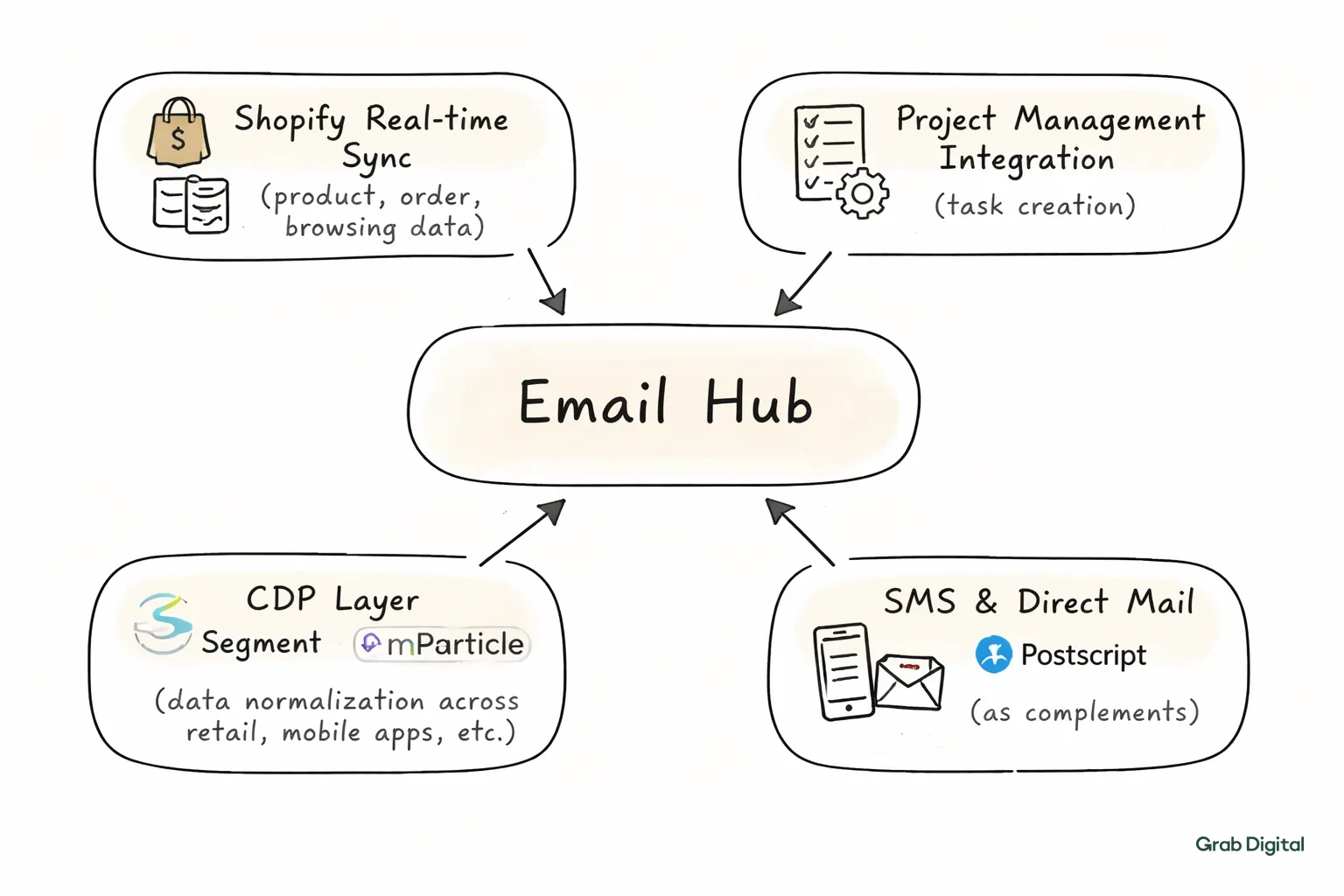
Email works best as a hub, not an island the system of record for customer engagement.
Direct Shopify connection: real-time product sync, order data, browsing behavior. This is what powers abandoned cart, post-purchase, browse abandonment. Manual imports mean stale data and missed revenue.
Project management integration: when copy's ready for design, the task creates itself. No more "did you see my Slack message?"
CDP layer (Segment, mParticle) for complex clients: normalizes data across retail, mobile apps, and other touchpoints beyond Shopify.
SMS and direct mail as complements: Postscript, Lob both tie into Klaviyo. Email flows can trigger texts or mailers. See our direct mail guide.
Migration timeline
60-90 days. Rushing causes deliverability problems and client frustration.
Week one: setup and hands-on training. Not demos actually build flows.
Weeks 2-4: pilot client. Moderate complexity. Document everything.
Weeks 5-8: remaining clients in batches. Stagger go-lives.
Weeks 9-12: learn the advanced stuff.
Cost and ROI
Klaviyo charges by contacts. Agencies mark up 20-40%, bundled into service.
Measure ROI against total cost. Email should drive 25-35% of revenue for established brands. At those numbers, platform cost is noise.
Structure packages by capability. Basic: core flows, bi-weekly sends. Premium: segmentation, lifecycle, weekly. Enterprise: testing, cohorts, strategy.
Avoid per-send pricing. It punishes you for testing.
Keep platform at 8-12% of billings. Above 15%, fix something.
What actually moves the needle
Predictive analytics: time promotions to when customers are actually likely to buy. Less discounting, better conversions.
Lifecycle beyond welcome/cart: nurture paths that adapt to behavior. High-value customers get different treatment than one-time buyers.
A/B test strategy, not just subject lines. Frequency. Content approach. Offer structure. Our campaign management guide.
Sunset flows: try to win them back, then cut them loose. Better deliverability, lower costs.
Cross-channel attribution: mobile email, desktop purchase. It happens more than you think.
Operations
Campaign calendar: visibility across all clients prevents overload.
Pre-send checklist: links, rendering, tokens, segmentation. Required before approval.
Optimization sprints: space to think beyond execution.
Swipe file: what worked, organized so you can use it again.
SOPs: onboarding, optimization, emergencies. Documented so new hires can execute without hand-holding. See our hiring guide.
Mistakes I see
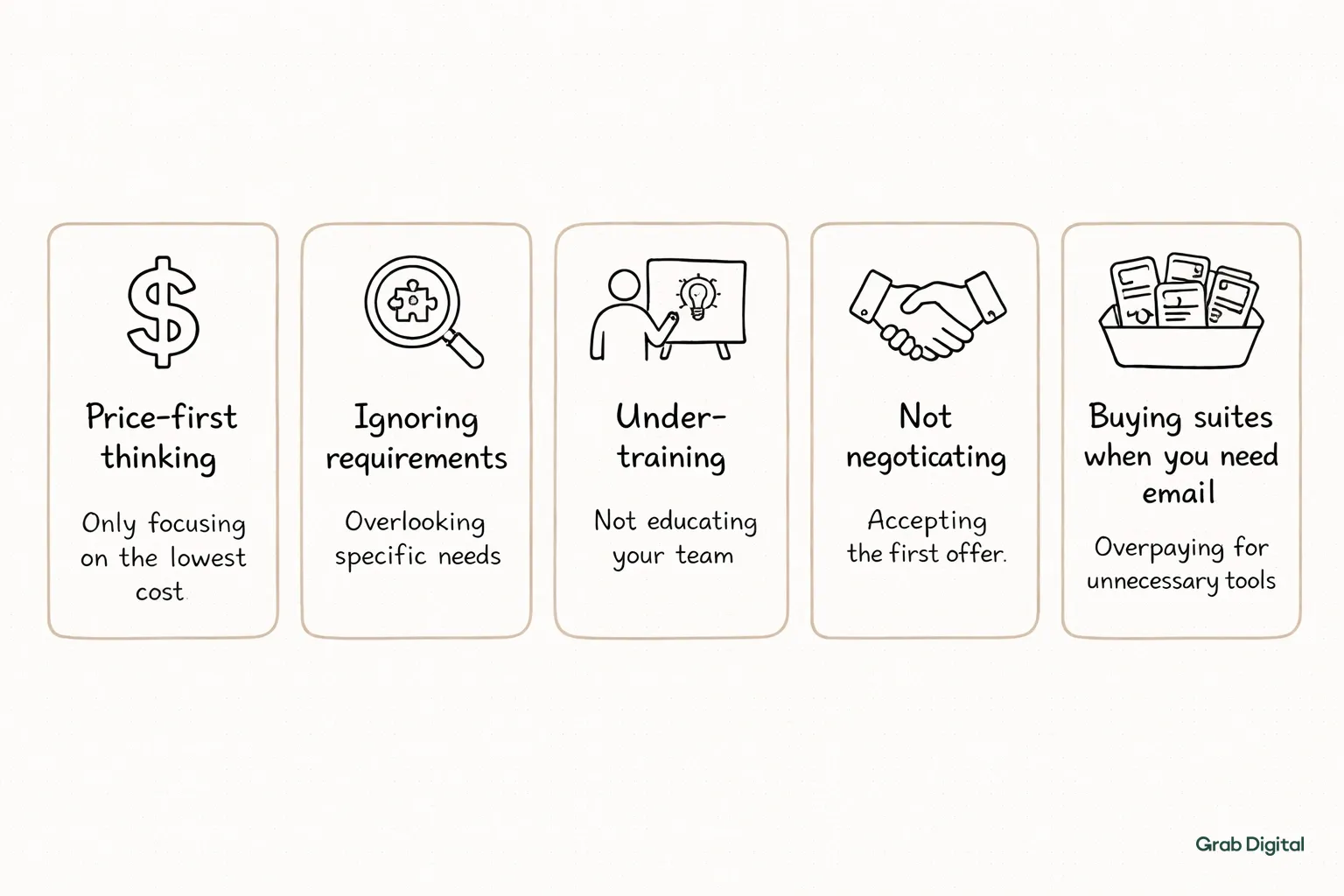
Price-first thinking: saves subscription, costs hours.
Ignoring niche requirements: sustainable brands need different things than subscription brands.
Under-training: one demo isn't enough.
Not negotiating: commit to minimums, get better terms.
Buying suites when you need email: paying for features you ignore.
Security and compliance
GDPR/CCPA apply to you too. Data processing agreements, consent tools, deletion capabilities, audit logs.
Require 2FA. Check that it's still on.
Data residency matters for some clients.
Understand backup and restoration. Test it.
SOC 2 Type II: review during evaluation.
Pitching to clients
Lead with revenue. They don't care about features.
Show the full cost picture. Platform + implementation + timeline.
Use decision matrices weighted to their priorities.
Address switching costs honestly. Explain migration. Guarantee continuity. FAQ.
Real numbers beat abstract claims. Portfolio.
Measuring your stack
Efficiency: time to launch, revision cycles. Should improve.
Uptime: track every issue. Use it in renewals.
Client satisfaction on reporting: ask them.
Aggregate performance: revenue before/after, benchmarks across portfolio.
Support tickets: volume and speed. Patterns matter.
Future-proofing
Development velocity: are they shipping?
API stability: check the changelog.
Acquisition risk: who owns them?
Reduce lock-in: frameworks work anywhere.
Train on skills, not buttons. Platforms change. Thinking doesn't.
FAQ
Can one platform really handle multiple DTC clients?
Yes. Klaviyo and similar platforms isolate workspaces. Each client gets dedicated sending infrastructure and reputation. The key is choosing software built for agencies, not adapting single-brand tools.
How do I justify costs to clients who think email should be cheap?
Platform cost runs 1-3% of email-attributed revenue. Paid ads often run 50%+ of revenue once you factor in media costs. Email infrastructure is cheap for what it produces.
Minimum clients before switching?
Three active clients with lists over 10K each. Below that, standard accounts work fine. Above that, agency features pay for themselves.
Standardize or pick per client?
Standardize. Fragmented platforms mean fractured expertise, training headaches, and overhead. The efficiency loss beats any "perfect fit" optimization.
Client insists on their platform?
Draw hard lines. If they mandate something you don't know, price for the learning curve or walk. Wrong platform = worse results = churn anyway.
Must-have integrations?
Shopify with real-time sync. Behavioral tracking. Revenue attribution. SMS connection. Subscription platform tie-in for recurring revenue clients.
Email campaign software for agencies is a different animal than what in-house teams use. You're not sending for one brand you're managing multiple DTC clients, each with their own sending schedules, approval workflows, brand guidelines, and compliance headaches. The platform has to handle that complexity without becoming the thing that slows you down.
Get this wrong and you'll feel it. Campaigns stall in approval purgatory. Clients outgrow the platform and start asking awkward questions about why their flows can't do X. Your team wastes hours on workarounds that should've been automated months ago. Get it right, and the software mostly disappears campaigns ship, clients renew, and you can think about strategy instead of why the integration broke again.
Why agencies need different email software
Most email platforms were built for one brand sending to one audience. That's fine for a DTC company running its own marketing. It falls apart when you're juggling eight clients across different verticals, each with different compliance requirements and performance benchmarks.
Mailchimp or Constant Contact can technically handle multiple accounts. But they weren't built for how agencies actually work. You end up spending more time switching between logins, untangling permissions, and tracking down who last touched a campaign than actually doing the work.
The platforms that work for agencies give you workspace separation so client accounts stay distinct. Role-based access means the new hire can't accidentally nuke a client's list. Audit trails exist when you need them. Consolidated billing means you're not chasing twelve invoices every month. These aren't nice-to-haves they're what separates agencies that scale from agencies that drown in overhead.
Deliverability is the sleeper issue. On shared infrastructure, one client who decides to mail their entire list every day can tank inbox placement for everyone else you manage. Proper agency software isolates sender reputation per client and gives you monitoring tools to catch problems before they spread.
Klaviyo: The DTC default for a reason
Klaviyo's become the default for DTC email marketing because it connects directly to Shopify. Purchase data, product catalogs, customer behavior all of it syncs in real time. That matters when you're trying to prove email drives revenue, not just opens and clicks.
For agencies, the partner program actually delivers. Dedicated support. Migration help when you're onboarding new clients. Co-marketing that can help you close deals. A direct line to the product team when you need something that doesn't exist yet. This isn't just a badge for your website it's actual help when you're trying to deliver.
The segmentation engine is where Klaviyo justifies the price tag. Build audiences on predicted next purchase date, customer lifetime value, browsing behavior dozens of signals. These aren't demographic slices. They're segments that convert because they're based on what people do, not who they are on paper.
Reporting ties emails to actual purchases. First-click, last-click, linear attribution show clients what drove what. They can check the dashboard whenever they want. That transparency makes retention easier. You're not defending your retainer. You're showing them what it produced. Book your free consultation if you want to talk through how this would work for your specific clients.
The flow builder is visual enough that strategists can build complex automation without filing a dev ticket. Conditional splits, time delays, trigger filters sophisticated nurture paths without code.
What actually matters when you're choosing
Client account architecture beats feature lists. Can you see all accounts from one dashboard? Switch workspaces without the login dance? Set permissions so the junior team member doesn't accidentally send to the wrong list?
Template libraries with version control. Designers build the master templates. Copywriters populate them. Strategists schedule. Nobody goes rogue on brand because the templates are locked, but nobody's waiting on someone else to unblock them.
Approval workflows that catch broken links and embarrassing typos before they go out. Define the chain: designer → copywriter → strategist → client. Automated notifications keep it moving without Slack messages piling up.
White-label reporting so clients see your brand, not the platform's. Control what metrics show up, how it looks, whether they can drill down. Some clients want the deep dive. Others want the highlights. Give them what they'll actually use.
Integrations. DTC clients run on Shopify, Gorgias, Recharge, Yotpo. Your platform needs to connect to all of them without custom API work. That work comes out of your margin.
How to evaluate without getting sold
Map your workflow before you look at platforms. Strategy call → brief → design → copy → approval → send → report. Where are the handoffs? Where do things get stuck? Where do mistakes happen? The right platform removes friction at those exact points.
Ask for demos that match how you work. Not a feature tour show me five campaigns for five different clients running simultaneously. Show me how to troubleshoot deliverability for one account without affecting the others. Show me how to give a new team member access that matches their role.
Actually test the migration process. Moving clients is painful. List imports, rebuilding flows, recreating templates. Good providers give you real support. Bad ones send a PDF and wish you luck.
Total cost, not just the subscription. Implementation, training, integration work, workarounds for missing features. The cheaper platform often costs more in team hours.
Watch deliverability infrastructure closely. Dedicated IPs for high-volume accounts. IP warming support. Monitoring tools that flag issues before campaigns tank. Your reputation lives and dies on this stuff.
Klaviyo vs. alternatives
Klaviyo pricing scales with contact count. Agencies typically see $600-2000 per client monthly depending on list size. Cost tracks the value you deliver.
HubSpot does everything. Which is great if you need everything. If you're focused on email, the interface is cluttered with features you'll never touch. Learning curve is real. Pricing quickly outpaces Klaviyo unless you're selling full-stack marketing automation, not just email.
ActiveCampaign automates well for less money. But the ecommerce features are surface-level. Revenue attribution is basic. Product catalogs are limited. Predictive analytics for DTC lifecycle work doesn't exist. You'll spend time building workarounds.
Omnisend targets ecommerce but attracts smaller merchants. Fine for brands doing $500K-2M. Lacks the segmentation depth and reporting that clients paying agency retainers expect. You'll hit the ceiling.
Campaign Monitor and similar legacy platforms treat email as broadcast. No Shopify sync. No behavioral triggers. No revenue attribution. They're newsletter tools in an ecommerce world.
Your tech stack
Email works best as a hub, not an island the system of record for customer engagement.
Direct Shopify connection: real-time product sync, order data, browsing behavior. This is what powers abandoned cart, post-purchase, browse abandonment. Manual imports mean stale data and missed revenue.
Project management integration: when copy's ready for design, the task creates itself. No more "did you see my Slack message?"
CDP layer (Segment, mParticle) for complex clients: normalizes data across retail, mobile apps, and other touchpoints beyond Shopify.
SMS and direct mail as complements: Postscript, Lob both tie into Klaviyo. Email flows can trigger texts or mailers. See our direct mail guide.
Migration timeline
60-90 days. Rushing causes deliverability problems and client frustration.
Week one: setup and hands-on training. Not demos actually build flows.
Weeks 2-4: pilot client. Moderate complexity. Document everything.
Weeks 5-8: remaining clients in batches. Stagger go-lives.
Weeks 9-12: learn the advanced stuff.
Cost and ROI
Klaviyo charges by contacts. Agencies mark up 20-40%, bundled into service.
Measure ROI against total cost. Email should drive 25-35% of revenue for established brands. At those numbers, platform cost is noise.
Structure packages by capability. Basic: core flows, bi-weekly sends. Premium: segmentation, lifecycle, weekly. Enterprise: testing, cohorts, strategy.
Avoid per-send pricing. It punishes you for testing.
Keep platform at 8-12% of billings. Above 15%, fix something.
What actually moves the needle
Predictive analytics: time promotions to when customers are actually likely to buy. Less discounting, better conversions.
Lifecycle beyond welcome/cart: nurture paths that adapt to behavior. High-value customers get different treatment than one-time buyers.
A/B test strategy, not just subject lines. Frequency. Content approach. Offer structure. Our campaign management guide.
Sunset flows: try to win them back, then cut them loose. Better deliverability, lower costs.
Cross-channel attribution: mobile email, desktop purchase. It happens more than you think.
Operations
Campaign calendar: visibility across all clients prevents overload.
Pre-send checklist: links, rendering, tokens, segmentation. Required before approval.
Optimization sprints: space to think beyond execution.
Swipe file: what worked, organized so you can use it again.
SOPs: onboarding, optimization, emergencies. Documented so new hires can execute without hand-holding. See our hiring guide.
Mistakes I see
Price-first thinking: saves subscription, costs hours.
Ignoring niche requirements: sustainable brands need different things than subscription brands.
Under-training: one demo isn't enough.
Not negotiating: commit to minimums, get better terms.
Buying suites when you need email: paying for features you ignore.
Security and compliance
GDPR/CCPA apply to you too. Data processing agreements, consent tools, deletion capabilities, audit logs.
Require 2FA. Check that it's still on.
Data residency matters for some clients.
Understand backup and restoration. Test it.
SOC 2 Type II: review during evaluation.
Pitching to clients
Lead with revenue. They don't care about features.
Show the full cost picture. Platform + implementation + timeline.
Use decision matrices weighted to their priorities.
Address switching costs honestly. Explain migration. Guarantee continuity. FAQ.
Real numbers beat abstract claims. Portfolio.
Measuring your stack
Efficiency: time to launch, revision cycles. Should improve.
Uptime: track every issue. Use it in renewals.
Client satisfaction on reporting: ask them.
Aggregate performance: revenue before/after, benchmarks across portfolio.
Support tickets: volume and speed. Patterns matter.
Future-proofing
Development velocity: are they shipping?
API stability: check the changelog.
Acquisition risk: who owns them?
Reduce lock-in: frameworks work anywhere.
Train on skills, not buttons. Platforms change. Thinking doesn't.
FAQ
Can one platform really handle multiple DTC clients?
Yes. Klaviyo and similar platforms isolate workspaces. Each client gets dedicated sending infrastructure and reputation. The key is choosing software built for agencies, not adapting single-brand tools.
How do I justify costs to clients who think email should be cheap?
Platform cost runs 1-3% of email-attributed revenue. Paid ads often run 50%+ of revenue once you factor in media costs. Email infrastructure is cheap for what it produces.
Minimum clients before switching?
Three active clients with lists over 10K each. Below that, standard accounts work fine. Above that, agency features pay for themselves.
Standardize or pick per client?
Standardize. Fragmented platforms mean fractured expertise, training headaches, and overhead. The efficiency loss beats any "perfect fit" optimization.
Client insists on their platform?
Draw hard lines. If they mandate something you don't know, price for the learning curve or walk. Wrong platform = worse results = churn anyway.
Must-have integrations?
Shopify with real-time sync. Behavioral tracking. Revenue attribution. SMS connection. Subscription platform tie-in for recurring revenue clients.

Find out exactly what your email channel is leaving on the table.

Email Marketing for Scaling DTC Brands


