
Summary
Klaviyo Direct Mail Automation: Setup Guide for DTC Brands
Direct mail automation with Klaviyo works by connecting the triggers you already use for email, cart abandonment, VIP milestones, win-back timers, to a print-and-mail provider like PostGrid or Lob, so a physical postcard or letter goes out automatically instead of, or after, an email. For DTC brands already running Klaviyo, this turns your highest-intent segments into a channel that gets opened, not scrolled past.
The average American gets dozens of marketing emails a day but maybe two pieces of personalized mail a week. That scarcity matters. You get the targeting precision of digital with the physical presence of analog. Brands using both channels report noticeably higher conversion on high-intent segments like winbacks and VIP upsells compared to email-only workflows.
Why Add Direct Mail Automation to Your Klaviyo Program?
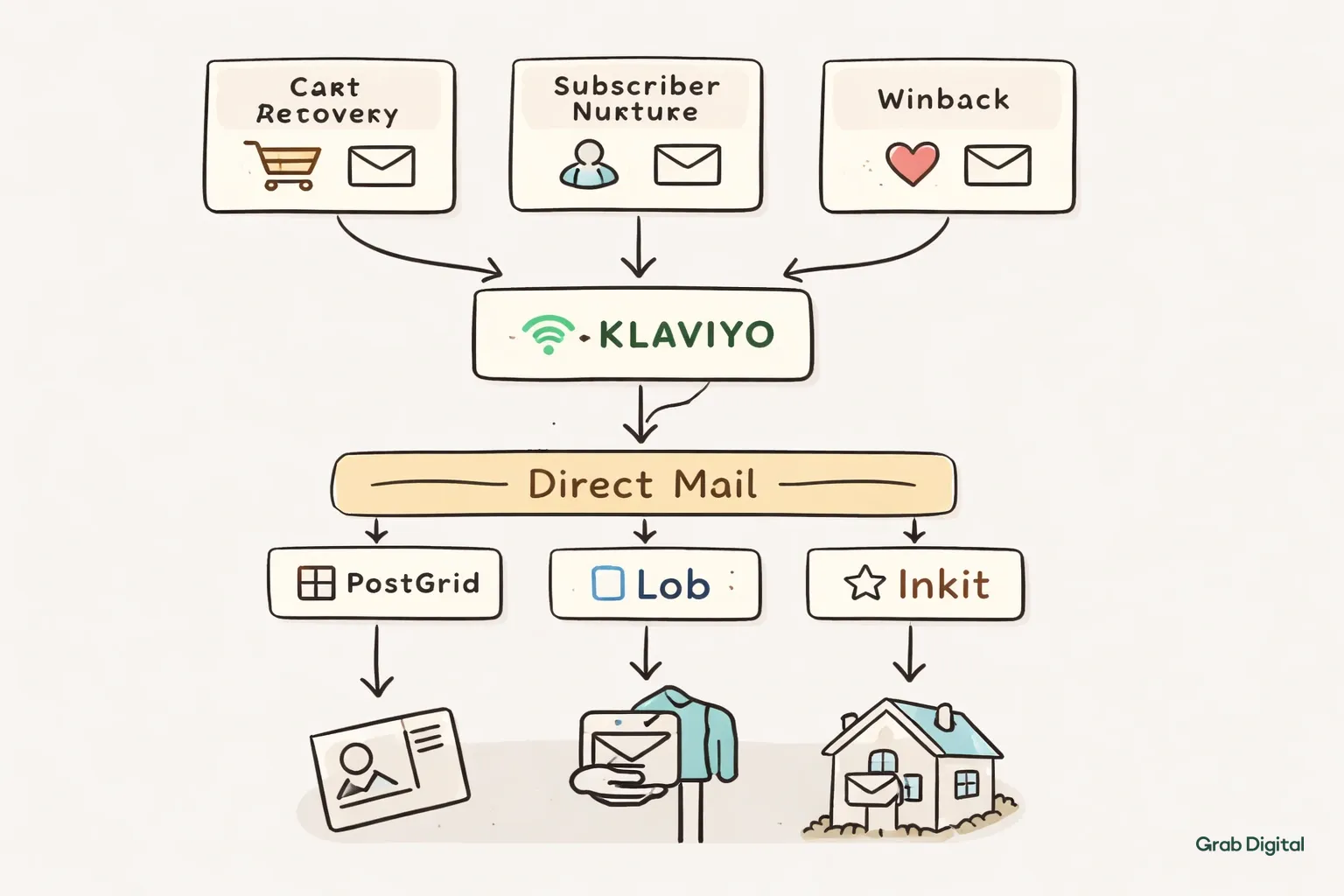
You add direct mail because it converts on the segments email has already stopped moving. You probably already use email marketing automation to recover carts, nurture subscribers, and win back lapsed customers. Direct mail just extends those same triggers to a physical channel. The mechanics are identical: a customer action fires a sequence. The difference is the medium.
Physical mail has a much higher open rate than email. People touch it, pin it to boards, leave it on the counter. A postcard with a 15% winback discount sits on a desk for days. An email gets archived in seconds.
Integration is straightforward. Klaviyo connects to platforms like PostGrid, Lob, and Inkit through API. Build a segment, customers who abandoned a cart over $150 three days ago, and route it to a direct mail flow. The platform prints, addresses, and mails a postcard with a cart recovery offer. You pay per piece, typically $0.75 to $2.50 depending on format.
This works best for high-value actions. Sending postcards to every subscriber is prohibitively expensive. But sending a handwritten-style card to a customer who's spent $800+ and hasn't ordered in 90 days? That ROI pencils out quickly.
How Do You Build a Direct Mail Automation Workflow in Klaviyo?
You build a Klaviyo direct mail workflow in five steps: pick a segment that clears the cost bar, set the trigger and delay, connect the mail provider, map the merge fields, then test creative like you'd test an email. Here's each step in order.
- Pick a segment that justifies the cost. High cart values, VIP tiers, and long lapse periods are ideal. A $200+ abandoned cart costs $1.50 to mail but could recover $200 in revenue. A $30 cart rarely clears the bar.
- Set the trigger and a delay. Inside Klaviyo, create a flow triggered by an event, cart abandonment, purchase anniversary, or segment entry (like moving into a "lapsed VIP" list). Add a delay to let email do the heavy lifting first. If email recovers the customer in 48 hours, they exit the direct mail flow and you save the postage. If they don't convert, the direct mail trigger fires on day three or four.
- Connect your direct mail provider. Do this via webhook or native integration. Providers like Postscript and PostGrid have Klaviyo-specific integrations that pull merge tags, first name, cart items, discount codes, directly into the design. You design the postcard once, map the dynamic fields, and the platform handles the rest.
- Map creative and dynamic fields. Confirm the postcard template pulls the right product image, name, and code before you turn the flow live. A missing merge tag on a live send is expensive to fix after the fact.
- Test creative like you test email. A/B test offers (percentage vs. dollar-off), imagery (product vs. lifestyle), and copy tone (urgent vs. conversational). Track using unique promo codes or custom UTM parameters. Klaviyo will track conversions if the customer uses the code at checkout.
| Format | Typical cost per piece |
|---|---|
| Postcard (4x6) | $0.75 to $1.25 |
| Postcard (6x9) | $1.00 to $1.75 |
| Letter (one page) | $1.25 to $2.00 |
| Catalog or multi-page | $2.50 to $5.00+ |
Volume discounts kick in above 500 to 1,000 pieces per month. If you're just starting, mail to your top 100 lapsed VIPs and measure lift before scaling.
If you're already investing in Klaviyo optimization, adding direct mail flows to high-intent segments can drive meaningful incremental revenue from those cohorts.
What Are the Best Use Cases for Direct Mail Automation?
Abandoned Cart Recovery (High AOV)
Email recovers 5 to 15% of abandoned carts. Direct mail can add more on carts over $150. The postcard arrives three to five days after abandonment, right when the customer has mentally moved on. A physical reminder with a product image and discount code re-opens the purchase window.
Use a 6x9 postcard with bold product imagery, a clear headline ("You left something behind"), and a generous discount code. Include a QR code that links directly to the cart.
VIP Winback
Customers who've spent $500+ lifetime but haven't ordered in 90 days are worth mailing. Email winback flows often get ignored after the third send. A handwritten-style letter on premium stock feels personal and urgent. It signals that the brand values the relationship enough to spend real money.
Inside the letter, reference past purchases by name. Offer a tiered discount: "Come back this month and save 20%." Add a product sample or small gift card to sweeten the deal.
Product Launch Announcements
New product emails get buried. A catalog or multi-page mailer previewing a launch creates anticipation. DTC furniture and home goods brands use this heavily, sending seasonal catalogs to their top customers ahead of launch.
The catalog includes product specs, lifestyle imagery, and early-access codes. Customers browse it like a magazine. Conversion rates on catalog recipients tend to run well above email-only recipients during the launch window.
Subscription Churn Prevention
Subscription brands see churn warnings in Klaviyo, missed payments, skipped orders, canceled subscriptions. A postcard sent within 48 hours of a skip can recover a meaningful share of those customers. The message: "We noticed you skipped this month, here's 25% off your next box."
Timing matters. Mail too late and the customer has moved on. Mail within 72 hours and you catch them before they've fully disengaged.
How Do You Integrate Direct Mail with Existing Email Flows?
You integrate direct mail as a follow-up step, not a replacement, inside a flow you already have. Let email handle the first touches. If the customer doesn't convert, escalate to mail. This keeps costs manageable while maximizing coverage.
In a cart abandonment flow, structure it like this:
- Email 1: 1 hour after abandonment
- Email 2: 24 hours after abandonment
- Email 3: 48 hours after abandonment
- Postcard: 72 hours after abandonment (if cart value > $150)
Use conditional splits in Klaviyo to route high-value carts to the direct mail branch and exclude customers who already converted via email. This prevents wasted postage.
For winback flows, send three to four emails over 30 days, then mail a postcard on day 35 to non-openers. Tag them in Klaviyo so you can measure lift. Compare revenue from the mailed segment vs. a holdout control group that received email only.
You can also trigger direct mail based on email engagement. If a VIP customer hasn't opened an email in 60 days, send a postcard with a subject line like "Are we still friends?" and a discount code. This reactivates customers who've checked out of your email program.
Platforms like Klaviyo handle the segmentation and triggers; the direct mail provider handles fulfillment. You never touch physical inventory or postage.
Which Direct Mail Platforms Integrate with Klaviyo?
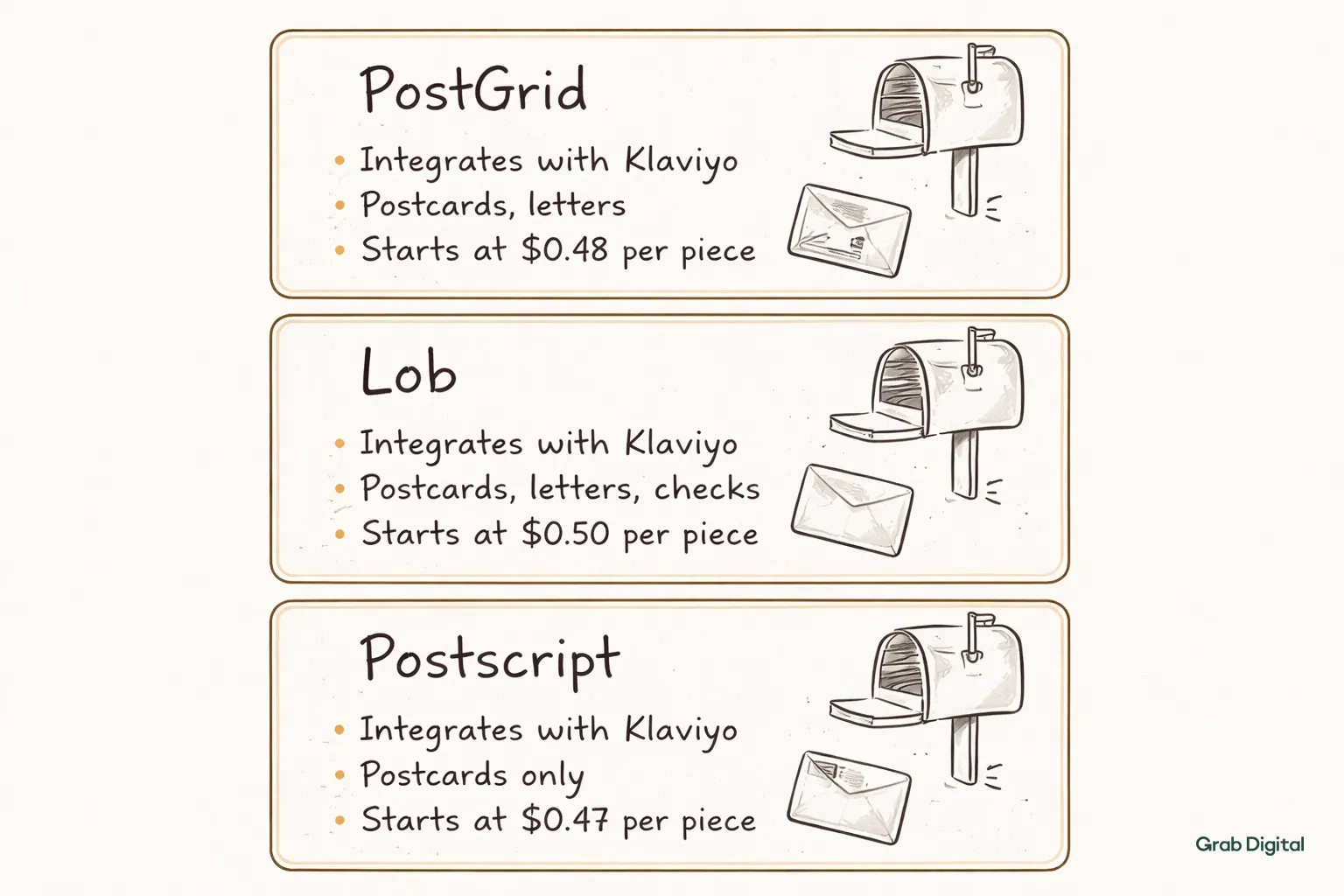
Five providers cover most Klaviyo direct mail setups, each with a different sweet spot on price and personalization depth:
| Platform | Best for | Starting price | Notes |
|---|---|---|---|
| PostGrid | Native Klaviyo/Shopify integration | $0.79/postcard (500+/mo) | Drag-and-drop templates, merge tag mapping, mail preview before sending |
| Lob | Developer-led, API-first setups | ~$0.75/postcard | Also offers no-code Klaviyo integration and address verification |
| Postscript | Brands already on SMS + Klaviyo | $1.00/postcard | Coordinate SMS, email, and mail from one dashboard |
| Inkit | High-touch VIP personalization | $1.50 to $3.00/piece | Variable images, dynamic QR codes, handwriting fonts |
| Sendoso | Dimensional mail and gifting | $10 to $50/send | Swag and samples for top-tier customers, often overkill for standard DTC flows |
All of these platforms connect to Klaviyo via webhook, Zapier, or native integration. Setup takes 30 to 60 minutes. You'll need to upload creative assets, map merge fields, and define your triggers. Most platforms offer design templates to speed up launch.
How Do You Measure ROI on Direct Mail Automation?
You measure ROI by comparing revenue from a mailed segment against a matching control group that received email only, then subtracting the cost of the mail. Track direct mail conversions using unique promo codes, QR codes with UTM parameters, or personalized URLs (PURLs). In Klaviyo, tag customers who receive mail so you can measure lift against that control group.
Calculate ROI using this formula:
ROI = (Revenue from mailed segment - Cost of mail) / Cost of mail
If you mail 500 VIP lapsed customers at $1.25 each (total cost: $625) and generate $3,750 in attributed revenue, your ROI is 500%.
Compare mailed segments to non-mailed controls. If your email-only winback flow recovers 3% of lapsed customers and your email + direct mail flow recovers 5%, the 2% lift is attributable to mail. Multiply that lift by average order value and customer count to calculate incremental revenue.
Track these metrics:
- Response rate: percentage of mailed customers who use the promo code or visit the PURL
- Conversion rate: percentage who complete a purchase
- Incremental revenue: revenue from mailed segment minus expected revenue from email-only
- Cost per acquisition: total mail cost divided by number of conversions
Klaviyo's attribution window defaults to 5 days for email, but direct mail often converts over 7 to 14 days due to delivery lag. Extend your attribution window to 14 days for direct mail campaigns.
Most brands see breakeven at 2 to 4% conversion on high-AOV offers. Anything above 5% conversion is strong performance. VIP segments often hit 8 to 12% when the offer and timing align.
What Creative Best Practices Improve Direct Mail Conversion?
Use bold, single-focus design. A postcard is not a billboard. One headline, one image, one CTA. Avoid clutter. The recipient should grasp the offer in three seconds.
Personalize beyond first name. Reference past purchases, cart items, or purchase anniversary dates. "You loved the Oak Desk, check out the matching bookshelf" beats generic copy every time.
Make the discount visible. Put the promo code in large type on the front of the postcard. Don't bury it in fine print. The code should be scannable without reading the full message.
Include a QR code. Link it directly to the product page, cart recovery page, or a landing page with the discount pre-applied. QR adoption is near-universal in 2026, use it.
Test premium vs. standard stock. Glossy postcards feel cheap. Matte or uncoated stock with bold ink coverage feels premium and gets higher engagement. Test both and measure.
Use handwriting fonts sparingly. A handwritten-style note works for VIP winback letters. It feels try-hard on a product launch postcard. Match tone to context.
Add urgency. "Offer expires in 10 days" or "Limited stock, order by June 15" drives faster action. Without urgency, postcards sit on counters indefinitely.
For brands already working through email deliverability best practices, direct mail offers a secondary channel that bypasses inbox placement issues entirely.
What Mistakes Kill Direct Mail Automation ROI?
Mailing too broadly. Sending postcards to your entire list tanks ROI. Mail only to high-value segments where the cost per impression is justified by expected conversion.
Skipping the email-first strategy. Direct mail should supplement email, not replace it. Let email recover the low-hanging fruit, then mail the holdouts.
Using generic creative. Stock photos and bland copy waste postage. Personalize using Klaviyo data, cart contents, past purchases, browsing history.
Ignoring deliverability. Run your mailing list through an address verification API before sending. Undeliverable mail costs you postage with zero return.
Forgetting to test. A/B test offers, formats, and messaging. A 10% discount might outperform a 20% discount if the copy and design are stronger.
Neglecting attribution. If you don't track conversions with unique codes or UTM parameters, you can't measure ROI. Build tracking into every campaign from day one.
What Compliance Rules Apply to Direct Mail Automation?
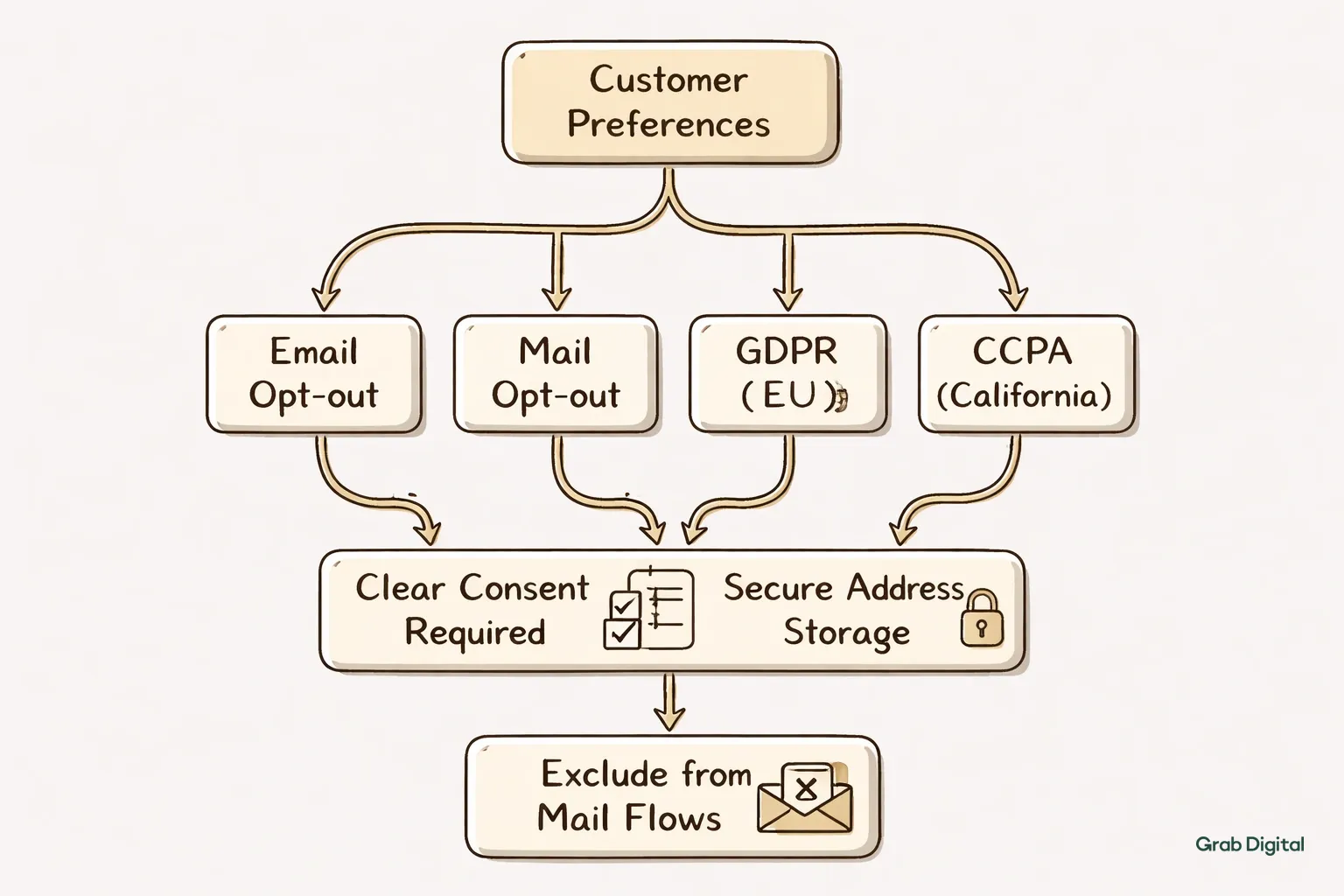
Direct mail is less regulated than email, but you still need to respect opt-outs. If a customer unsubscribes from email or requests no marketing, exclude them from direct mail flows as well. Most privacy policies now cover "marketing communications" broadly, which includes mail.
If you're mailing to the EU, GDPR applies. You need clear consent to mail physical marketing materials. The same goes for CCPA, California customers can opt out of data sales, which includes sharing address data with third-party mailers.
Store mailing addresses securely. If you're pulling them from Shopify or Klaviyo, ensure your direct mail provider is SOC 2 compliant. Most major platforms are, but check contracts before sharing customer data.
Include an opt-out mechanism on every piece of mail. A footer line like "To stop receiving mail, visit [URL] or email [address]" keeps you compliant and maintains trust.
When Does Direct Mail Automation Not Make Sense for DTC Brands?
Skip it if your average order value is below $75, direct mail rarely breaks even at that AOV. Email-only flows will deliver better ROI. Focus on segmentation and personalization to improve email performance before adding a pricier channel.
If your product replenishment cycle is short (weekly or biweekly), email and SMS handle urgency better. Direct mail's 3 to 5 day delivery lag kills conversion on time-sensitive offers.
If you're a brand new store with fewer than 5,000 customers, your segments aren't large enough to justify direct mail. Build your email program first using core email flows, then layer in mail once you have clear high-value cohorts. See our guide on the 8 core email flows every DTC brand needs for that foundation.
If you don't have clean historical data in Klaviyo, purchase dates, cart values, product preferences, you can't effectively personalize mail. Fix your data hygiene before launching direct mail campaigns.
How Do You Scale Direct Mail Automation Profitably?
Start with one use case: VIP winback or high-AOV cart recovery. Run it for 60 days, measure ROI, and refine creative and targeting. Once that flow is profitable, add a second use case, product launch or subscription churn prevention.
Negotiate volume pricing with your direct mail provider once you're sending 1,000+ pieces per month. Most platforms offer 10 to 20% discounts at scale.
Build seasonal campaigns. Holiday shopping, back-to-school, and anniversary sales are ideal for direct mail boosts. Mail your top 500 customers a catalog or postcard two weeks before the sale starts. Time email campaigns to land the same week mail arrives for maximum impact.
Consider hiring a Klaviyo expert or working with an email agency to integrate direct mail flows into your broader automation strategy. Agencies with experience in omnichannel DTC can build, test, and optimize these workflows faster than in-house teams.
Track incrementality over time. As you scale direct mail, measure whether it's cannibalizing email conversions or truly adding net-new revenue. Use holdout groups and control segments to isolate the impact.
If direct mail is delivering meaningful incremental revenue from high-value segments, book your free consultation to explore how Grab Digital can build and manage these flows as part of your full-service Klaviyo program.
How Does Direct Mail Fit into a Multi-Channel DTC Strategy?
DTC brands in 2026 operate across email, SMS, push notifications, paid ads, and now direct mail. Each channel has strengths. Email scales cheaply. SMS drives urgency. Direct mail cuts through noise and signals care.
The best results come from coordinated sequences. A VIP customer who hasn't ordered in 90 days receives:
- Day 1: SMS with a quick check-in
- Day 3: Email with a personalized offer
- Day 7: Follow-up email with customer reviews
- Day 10: Postcard with a larger discount and handwritten-style note
Each touchpoint reinforces the others. The postcard feels like the natural escalation of a conversation, not a random intrusion.
Use Klaviyo's multi-channel flows or build separate flows that trigger in sequence. Coordinate creative so the messaging feels cohesive, same brand voice, same visual style, same offer (or progressively better offers).
Direct mail also supports other channels. Include your Instagram handle or a QR code to your TikTok on postcards. Use mail to drive app downloads or loyalty program signups. The physical touchpoint can bridge digital engagement.
For brands running loyalty marketing programs, direct mail is a powerful way to recognize top-tier members. A handwritten thank-you note or exclusive preview catalog makes VIPs feel valued in a way email never will.
What's Next for Direct Mail Automation in DTC Email Marketing?
Expect tighter integration between email platforms and direct mail providers. Klaviyo, Attentive, and Postscript are already building native direct mail modules. Sending a postcard is starting to feel as simple as scheduling a campaign email.
AI is starting to personalize mail creative at scale, generating postcard copy and product recommendations based on browsing history, then dynamically printing and mailing individualized cards to thousands of customers.
Dimensional mail and product samples triggered by browsing behavior, look at a lipstick shade three times, receive a sample in the mail days later, are becoming more affordable and more common.
Carbon offsetting and sustainable printing are becoming table stakes. Brands already committed to sustainability are asking mail providers for FSC-certified paper, soy-based inks, and carbon-neutral shipping.
Interactive mail is growing too. NFC-enabled postcards that unlock AR experiences or exclusive content when tapped with a phone are moving from pilot to wider adoption as costs drop.
Direct mail automation won't replace email. It will complement it, creating a high-touch option for the customers who justify the cost. DTC brands that master both channels will own customer lifetime value. For a broader view of where email itself is headed, see our guide on email marketing strategies for DTC brands in 2026.
Frequently Asked Questions
Q: What is direct mail automation and how does it work with Klaviyo?
A: Direct mail automation uses triggers from your Klaviyo account, cart abandonment, purchase anniversaries, or segment entry, to send physical postcards, letters, or catalogs. Platforms like PostGrid and Lob integrate with Klaviyo via API, pulling customer data and merge tags to personalize and mail pieces automatically, the same way you'd build an email flow.
Q: How much does direct mail automation cost per piece?
A: Postcards typically cost $0.75 to $1.75 per piece depending on size and volume. Letters run $1.25 to $2.00. Catalogs and dimensional mail can cost $2.50 to $5.00 or more. Most providers offer volume discounts above 500 to 1,000 pieces per month.
Q: Which customer segments should I mail to maximize ROI?
A: Focus on high-value segments where the cost per impression is justified: abandoned carts over $150, VIP customers who haven't ordered in 90+ days, and top spenders during product launches. Avoid mailing your entire list, direct mail works best as a targeted follow-up to email.
Q: How do I track conversions from direct mail campaigns?
A: Use unique promo codes, QR codes with UTM parameters, or personalized URLs (PURLs) on every mail piece. Tag recipients in Klaviyo so you can measure revenue from mailed segments vs. control groups, and extend your attribution window to 14 days to account for delivery lag.
Q: Can direct mail replace email in my automation flows?
A: No. Direct mail should supplement email, not replace it. Email handles the first two or three touches in a flow because it's faster and cheaper. Use direct mail as a follow-up for high-value customers who don't convert via email, this keeps costs manageable while maximizing coverage.
Q: Is direct mail automation worth it for DTC brands?
A: It's worth it when your average order value is above roughly $75, your segments are large enough to hit volume pricing, and your Klaviyo data is clean enough to personalize with. Below that threshold, email and SMS alone usually deliver better ROI for the same spend.
Q: What creative elements make direct mail convert at higher rates?
A: Use bold, single-focus design with one clear CTA. Personalize using Klaviyo data, reference past purchases or cart items. Make the discount code highly visible on the front, include a QR code linking to the product or cart page, use premium matte stock, and add urgency with expiration dates.
Direct mail automation with Klaviyo works by connecting the triggers you already use for email, cart abandonment, VIP milestones, win-back timers, to a print-and-mail provider like PostGrid or Lob, so a physical postcard or letter goes out automatically instead of, or after, an email. For DTC brands already running Klaviyo, this turns your highest-intent segments into a channel that gets opened, not scrolled past.
The average American gets dozens of marketing emails a day but maybe two pieces of personalized mail a week. That scarcity matters. You get the targeting precision of digital with the physical presence of analog. Brands using both channels report noticeably higher conversion on high-intent segments like winbacks and VIP upsells compared to email-only workflows.
Why Add Direct Mail Automation to Your Klaviyo Program?
You add direct mail because it converts on the segments email has already stopped moving. You probably already use email marketing automation to recover carts, nurture subscribers, and win back lapsed customers. Direct mail just extends those same triggers to a physical channel. The mechanics are identical: a customer action fires a sequence. The difference is the medium.
Physical mail has a much higher open rate than email. People touch it, pin it to boards, leave it on the counter. A postcard with a 15% winback discount sits on a desk for days. An email gets archived in seconds.
Integration is straightforward. Klaviyo connects to platforms like PostGrid, Lob, and Inkit through API. Build a segment, customers who abandoned a cart over $150 three days ago, and route it to a direct mail flow. The platform prints, addresses, and mails a postcard with a cart recovery offer. You pay per piece, typically $0.75 to $2.50 depending on format.
This works best for high-value actions. Sending postcards to every subscriber is prohibitively expensive. But sending a handwritten-style card to a customer who's spent $800+ and hasn't ordered in 90 days? That ROI pencils out quickly.
How Do You Build a Direct Mail Automation Workflow in Klaviyo?
You build a Klaviyo direct mail workflow in five steps: pick a segment that clears the cost bar, set the trigger and delay, connect the mail provider, map the merge fields, then test creative like you'd test an email. Here's each step in order.
- Pick a segment that justifies the cost. High cart values, VIP tiers, and long lapse periods are ideal. A $200+ abandoned cart costs $1.50 to mail but could recover $200 in revenue. A $30 cart rarely clears the bar.
- Set the trigger and a delay. Inside Klaviyo, create a flow triggered by an event, cart abandonment, purchase anniversary, or segment entry (like moving into a "lapsed VIP" list). Add a delay to let email do the heavy lifting first. If email recovers the customer in 48 hours, they exit the direct mail flow and you save the postage. If they don't convert, the direct mail trigger fires on day three or four.
- Connect your direct mail provider. Do this via webhook or native integration. Providers like Postscript and PostGrid have Klaviyo-specific integrations that pull merge tags, first name, cart items, discount codes, directly into the design. You design the postcard once, map the dynamic fields, and the platform handles the rest.
- Map creative and dynamic fields. Confirm the postcard template pulls the right product image, name, and code before you turn the flow live. A missing merge tag on a live send is expensive to fix after the fact.
- Test creative like you test email. A/B test offers (percentage vs. dollar-off), imagery (product vs. lifestyle), and copy tone (urgent vs. conversational). Track using unique promo codes or custom UTM parameters. Klaviyo will track conversions if the customer uses the code at checkout.
| Format | Typical cost per piece |
|---|---|
| Postcard (4x6) | $0.75 to $1.25 |
| Postcard (6x9) | $1.00 to $1.75 |
| Letter (one page) | $1.25 to $2.00 |
| Catalog or multi-page | $2.50 to $5.00+ |
Volume discounts kick in above 500 to 1,000 pieces per month. If you're just starting, mail to your top 100 lapsed VIPs and measure lift before scaling.
If you're already investing in Klaviyo optimization, adding direct mail flows to high-intent segments can drive meaningful incremental revenue from those cohorts.
What Are the Best Use Cases for Direct Mail Automation?
Abandoned Cart Recovery (High AOV)
Email recovers 5 to 15% of abandoned carts. Direct mail can add more on carts over $150. The postcard arrives three to five days after abandonment, right when the customer has mentally moved on. A physical reminder with a product image and discount code re-opens the purchase window.
Use a 6x9 postcard with bold product imagery, a clear headline ("You left something behind"), and a generous discount code. Include a QR code that links directly to the cart.
VIP Winback
Customers who've spent $500+ lifetime but haven't ordered in 90 days are worth mailing. Email winback flows often get ignored after the third send. A handwritten-style letter on premium stock feels personal and urgent. It signals that the brand values the relationship enough to spend real money.
Inside the letter, reference past purchases by name. Offer a tiered discount: "Come back this month and save 20%." Add a product sample or small gift card to sweeten the deal.
Product Launch Announcements
New product emails get buried. A catalog or multi-page mailer previewing a launch creates anticipation. DTC furniture and home goods brands use this heavily, sending seasonal catalogs to their top customers ahead of launch.
The catalog includes product specs, lifestyle imagery, and early-access codes. Customers browse it like a magazine. Conversion rates on catalog recipients tend to run well above email-only recipients during the launch window.
Subscription Churn Prevention
Subscription brands see churn warnings in Klaviyo, missed payments, skipped orders, canceled subscriptions. A postcard sent within 48 hours of a skip can recover a meaningful share of those customers. The message: "We noticed you skipped this month, here's 25% off your next box."
Timing matters. Mail too late and the customer has moved on. Mail within 72 hours and you catch them before they've fully disengaged.
How Do You Integrate Direct Mail with Existing Email Flows?
You integrate direct mail as a follow-up step, not a replacement, inside a flow you already have. Let email handle the first touches. If the customer doesn't convert, escalate to mail. This keeps costs manageable while maximizing coverage.
In a cart abandonment flow, structure it like this:
- Email 1: 1 hour after abandonment
- Email 2: 24 hours after abandonment
- Email 3: 48 hours after abandonment
- Postcard: 72 hours after abandonment (if cart value > $150)
Use conditional splits in Klaviyo to route high-value carts to the direct mail branch and exclude customers who already converted via email. This prevents wasted postage.
For winback flows, send three to four emails over 30 days, then mail a postcard on day 35 to non-openers. Tag them in Klaviyo so you can measure lift. Compare revenue from the mailed segment vs. a holdout control group that received email only.
You can also trigger direct mail based on email engagement. If a VIP customer hasn't opened an email in 60 days, send a postcard with a subject line like "Are we still friends?" and a discount code. This reactivates customers who've checked out of your email program.
Platforms like Klaviyo handle the segmentation and triggers; the direct mail provider handles fulfillment. You never touch physical inventory or postage.
Which Direct Mail Platforms Integrate with Klaviyo?
Five providers cover most Klaviyo direct mail setups, each with a different sweet spot on price and personalization depth:
| Platform | Best for | Starting price | Notes |
|---|---|---|---|
| PostGrid | Native Klaviyo/Shopify integration | $0.79/postcard (500+/mo) | Drag-and-drop templates, merge tag mapping, mail preview before sending |
| Lob | Developer-led, API-first setups | ~$0.75/postcard | Also offers no-code Klaviyo integration and address verification |
| Postscript | Brands already on SMS + Klaviyo | $1.00/postcard | Coordinate SMS, email, and mail from one dashboard |
| Inkit | High-touch VIP personalization | $1.50 to $3.00/piece | Variable images, dynamic QR codes, handwriting fonts |
| Sendoso | Dimensional mail and gifting | $10 to $50/send | Swag and samples for top-tier customers, often overkill for standard DTC flows |
All of these platforms connect to Klaviyo via webhook, Zapier, or native integration. Setup takes 30 to 60 minutes. You'll need to upload creative assets, map merge fields, and define your triggers. Most platforms offer design templates to speed up launch.
How Do You Measure ROI on Direct Mail Automation?
You measure ROI by comparing revenue from a mailed segment against a matching control group that received email only, then subtracting the cost of the mail. Track direct mail conversions using unique promo codes, QR codes with UTM parameters, or personalized URLs (PURLs). In Klaviyo, tag customers who receive mail so you can measure lift against that control group.
Calculate ROI using this formula:
ROI = (Revenue from mailed segment - Cost of mail) / Cost of mail
If you mail 500 VIP lapsed customers at $1.25 each (total cost: $625) and generate $3,750 in attributed revenue, your ROI is 500%.
Compare mailed segments to non-mailed controls. If your email-only winback flow recovers 3% of lapsed customers and your email + direct mail flow recovers 5%, the 2% lift is attributable to mail. Multiply that lift by average order value and customer count to calculate incremental revenue.
Track these metrics:
- Response rate: percentage of mailed customers who use the promo code or visit the PURL
- Conversion rate: percentage who complete a purchase
- Incremental revenue: revenue from mailed segment minus expected revenue from email-only
- Cost per acquisition: total mail cost divided by number of conversions
Klaviyo's attribution window defaults to 5 days for email, but direct mail often converts over 7 to 14 days due to delivery lag. Extend your attribution window to 14 days for direct mail campaigns.
Most brands see breakeven at 2 to 4% conversion on high-AOV offers. Anything above 5% conversion is strong performance. VIP segments often hit 8 to 12% when the offer and timing align.
What Creative Best Practices Improve Direct Mail Conversion?
Use bold, single-focus design. A postcard is not a billboard. One headline, one image, one CTA. Avoid clutter. The recipient should grasp the offer in three seconds.
Personalize beyond first name. Reference past purchases, cart items, or purchase anniversary dates. "You loved the Oak Desk, check out the matching bookshelf" beats generic copy every time.
Make the discount visible. Put the promo code in large type on the front of the postcard. Don't bury it in fine print. The code should be scannable without reading the full message.
Include a QR code. Link it directly to the product page, cart recovery page, or a landing page with the discount pre-applied. QR adoption is near-universal in 2026, use it.
Test premium vs. standard stock. Glossy postcards feel cheap. Matte or uncoated stock with bold ink coverage feels premium and gets higher engagement. Test both and measure.
Use handwriting fonts sparingly. A handwritten-style note works for VIP winback letters. It feels try-hard on a product launch postcard. Match tone to context.
Add urgency. "Offer expires in 10 days" or "Limited stock, order by June 15" drives faster action. Without urgency, postcards sit on counters indefinitely.
For brands already working through email deliverability best practices, direct mail offers a secondary channel that bypasses inbox placement issues entirely.
What Mistakes Kill Direct Mail Automation ROI?
Mailing too broadly. Sending postcards to your entire list tanks ROI. Mail only to high-value segments where the cost per impression is justified by expected conversion.
Skipping the email-first strategy. Direct mail should supplement email, not replace it. Let email recover the low-hanging fruit, then mail the holdouts.
Using generic creative. Stock photos and bland copy waste postage. Personalize using Klaviyo data, cart contents, past purchases, browsing history.
Ignoring deliverability. Run your mailing list through an address verification API before sending. Undeliverable mail costs you postage with zero return.
Forgetting to test. A/B test offers, formats, and messaging. A 10% discount might outperform a 20% discount if the copy and design are stronger.
Neglecting attribution. If you don't track conversions with unique codes or UTM parameters, you can't measure ROI. Build tracking into every campaign from day one.
What Compliance Rules Apply to Direct Mail Automation?
Direct mail is less regulated than email, but you still need to respect opt-outs. If a customer unsubscribes from email or requests no marketing, exclude them from direct mail flows as well. Most privacy policies now cover "marketing communications" broadly, which includes mail.
If you're mailing to the EU, GDPR applies. You need clear consent to mail physical marketing materials. The same goes for CCPA, California customers can opt out of data sales, which includes sharing address data with third-party mailers.
Store mailing addresses securely. If you're pulling them from Shopify or Klaviyo, ensure your direct mail provider is SOC 2 compliant. Most major platforms are, but check contracts before sharing customer data.
Include an opt-out mechanism on every piece of mail. A footer line like "To stop receiving mail, visit [URL] or email [address]" keeps you compliant and maintains trust.
When Does Direct Mail Automation Not Make Sense for DTC Brands?
Skip it if your average order value is below $75, direct mail rarely breaks even at that AOV. Email-only flows will deliver better ROI. Focus on segmentation and personalization to improve email performance before adding a pricier channel.
If your product replenishment cycle is short (weekly or biweekly), email and SMS handle urgency better. Direct mail's 3 to 5 day delivery lag kills conversion on time-sensitive offers.
If you're a brand new store with fewer than 5,000 customers, your segments aren't large enough to justify direct mail. Build your email program first using core email flows, then layer in mail once you have clear high-value cohorts. See our guide on the 8 core email flows every DTC brand needs for that foundation.
If you don't have clean historical data in Klaviyo, purchase dates, cart values, product preferences, you can't effectively personalize mail. Fix your data hygiene before launching direct mail campaigns.
How Do You Scale Direct Mail Automation Profitably?
Start with one use case: VIP winback or high-AOV cart recovery. Run it for 60 days, measure ROI, and refine creative and targeting. Once that flow is profitable, add a second use case, product launch or subscription churn prevention.
Negotiate volume pricing with your direct mail provider once you're sending 1,000+ pieces per month. Most platforms offer 10 to 20% discounts at scale.
Build seasonal campaigns. Holiday shopping, back-to-school, and anniversary sales are ideal for direct mail boosts. Mail your top 500 customers a catalog or postcard two weeks before the sale starts. Time email campaigns to land the same week mail arrives for maximum impact.
Consider hiring a Klaviyo expert or working with an email agency to integrate direct mail flows into your broader automation strategy. Agencies with experience in omnichannel DTC can build, test, and optimize these workflows faster than in-house teams.
Track incrementality over time. As you scale direct mail, measure whether it's cannibalizing email conversions or truly adding net-new revenue. Use holdout groups and control segments to isolate the impact.
If direct mail is delivering meaningful incremental revenue from high-value segments, book your free consultation to explore how Grab Digital can build and manage these flows as part of your full-service Klaviyo program.
How Does Direct Mail Fit into a Multi-Channel DTC Strategy?
DTC brands in 2026 operate across email, SMS, push notifications, paid ads, and now direct mail. Each channel has strengths. Email scales cheaply. SMS drives urgency. Direct mail cuts through noise and signals care.
The best results come from coordinated sequences. A VIP customer who hasn't ordered in 90 days receives:
- Day 1: SMS with a quick check-in
- Day 3: Email with a personalized offer
- Day 7: Follow-up email with customer reviews
- Day 10: Postcard with a larger discount and handwritten-style note
Each touchpoint reinforces the others. The postcard feels like the natural escalation of a conversation, not a random intrusion.
Use Klaviyo's multi-channel flows or build separate flows that trigger in sequence. Coordinate creative so the messaging feels cohesive, same brand voice, same visual style, same offer (or progressively better offers).
Direct mail also supports other channels. Include your Instagram handle or a QR code to your TikTok on postcards. Use mail to drive app downloads or loyalty program signups. The physical touchpoint can bridge digital engagement.
For brands running loyalty marketing programs, direct mail is a powerful way to recognize top-tier members. A handwritten thank-you note or exclusive preview catalog makes VIPs feel valued in a way email never will.
What's Next for Direct Mail Automation in DTC Email Marketing?
Expect tighter integration between email platforms and direct mail providers. Klaviyo, Attentive, and Postscript are already building native direct mail modules. Sending a postcard is starting to feel as simple as scheduling a campaign email.
AI is starting to personalize mail creative at scale, generating postcard copy and product recommendations based on browsing history, then dynamically printing and mailing individualized cards to thousands of customers.
Dimensional mail and product samples triggered by browsing behavior, look at a lipstick shade three times, receive a sample in the mail days later, are becoming more affordable and more common.
Carbon offsetting and sustainable printing are becoming table stakes. Brands already committed to sustainability are asking mail providers for FSC-certified paper, soy-based inks, and carbon-neutral shipping.
Interactive mail is growing too. NFC-enabled postcards that unlock AR experiences or exclusive content when tapped with a phone are moving from pilot to wider adoption as costs drop.
Direct mail automation won't replace email. It will complement it, creating a high-touch option for the customers who justify the cost. DTC brands that master both channels will own customer lifetime value. For a broader view of where email itself is headed, see our guide on email marketing strategies for DTC brands in 2026.
Frequently Asked Questions
Q: What is direct mail automation and how does it work with Klaviyo?
A: Direct mail automation uses triggers from your Klaviyo account, cart abandonment, purchase anniversaries, or segment entry, to send physical postcards, letters, or catalogs. Platforms like PostGrid and Lob integrate with Klaviyo via API, pulling customer data and merge tags to personalize and mail pieces automatically, the same way you'd build an email flow.
Q: How much does direct mail automation cost per piece?
A: Postcards typically cost $0.75 to $1.75 per piece depending on size and volume. Letters run $1.25 to $2.00. Catalogs and dimensional mail can cost $2.50 to $5.00 or more. Most providers offer volume discounts above 500 to 1,000 pieces per month.
Q: Which customer segments should I mail to maximize ROI?
A: Focus on high-value segments where the cost per impression is justified: abandoned carts over $150, VIP customers who haven't ordered in 90+ days, and top spenders during product launches. Avoid mailing your entire list, direct mail works best as a targeted follow-up to email.
Q: How do I track conversions from direct mail campaigns?
A: Use unique promo codes, QR codes with UTM parameters, or personalized URLs (PURLs) on every mail piece. Tag recipients in Klaviyo so you can measure revenue from mailed segments vs. control groups, and extend your attribution window to 14 days to account for delivery lag.
Q: Can direct mail replace email in my automation flows?
A: No. Direct mail should supplement email, not replace it. Email handles the first two or three touches in a flow because it's faster and cheaper. Use direct mail as a follow-up for high-value customers who don't convert via email, this keeps costs manageable while maximizing coverage.
Q: Is direct mail automation worth it for DTC brands?
A: It's worth it when your average order value is above roughly $75, your segments are large enough to hit volume pricing, and your Klaviyo data is clean enough to personalize with. Below that threshold, email and SMS alone usually deliver better ROI for the same spend.
Q: What creative elements make direct mail convert at higher rates?
A: Use bold, single-focus design with one clear CTA. Personalize using Klaviyo data, reference past purchases or cart items. Make the discount code highly visible on the front, include a QR code linking to the product or cart page, use premium matte stock, and add urgency with expiration dates.

Find out exactly what your email channel is leaving on the table.

Email Marketing for Scaling DTC Brands


