
Summary
Crafting High-Performing Abandoned Cart Email Subject Lines
Your abandoned cart flow is dead in the water if nobody opens the email. The subject line is the gatekeeper. Get it wrong, and your Klaviyo flow goes straight to the trash. Get it right, and you recover sales without immediately resorting to 20% off.
Why subject lines make or break cart recovery

I don't care how beautiful your email design is. If the subject line tanks, nobody sees it. Most people don't abandon carts because they hate your product. They got distracted, or maybe shipping costs gave them pause. A good subject line meets them where they are. It reminds them without making them feel guilty.
Here is what actually gets opens:
- Be specific. "You left something in your cart" is lazy. "Your [Product Name] is waiting" is better.
- Tease something real. Curiosity works, but don't use clickbait.
- Use personalization. Inserting a first name or product name can bump opens by double digits.
- Match the timing. "Still thinking it over?" feels a lot different three hours after abandonment than it does three days later.
If you're still trying to figure out the rest of your cart recovery sequence, our guide on effective abandoned cart email strategies for DTC brands is a good place to start.
The anatomy of a high-performing subject line
A good cart abandonment subject line has to do a lot in under 50 characters: name the product, add a little urgency, and not sound like a robot.
Length matters more than you'd think. Apple Mail and Gmail on mobile truncate subject lines around 30 to 40 characters. If your hook is at the end, people won't see it. Put the most important part first.
Tone is just as critical. Shoppers can smell a templated subject line from the preview pane.
| Generic Approach | Specific Approach |
|---|---|
| "Complete your purchase" | "Still deciding on the Weston Tote?" |
| "Don't miss out!" | "Your cart expires in 2 hours" |
| "We saved your cart" | "3 people viewed this since you left it" |
| "Limited time offer" | "10% off, but only until tonight" |
The right column works because it's specific, time-bound, and sounds like a human wrote it. Klaviyo actually rewards this kind of engagement in deliverability. We cover this in more depth in our piece on email deliverability for DTC brands.
Subject line formulas that consistently perform
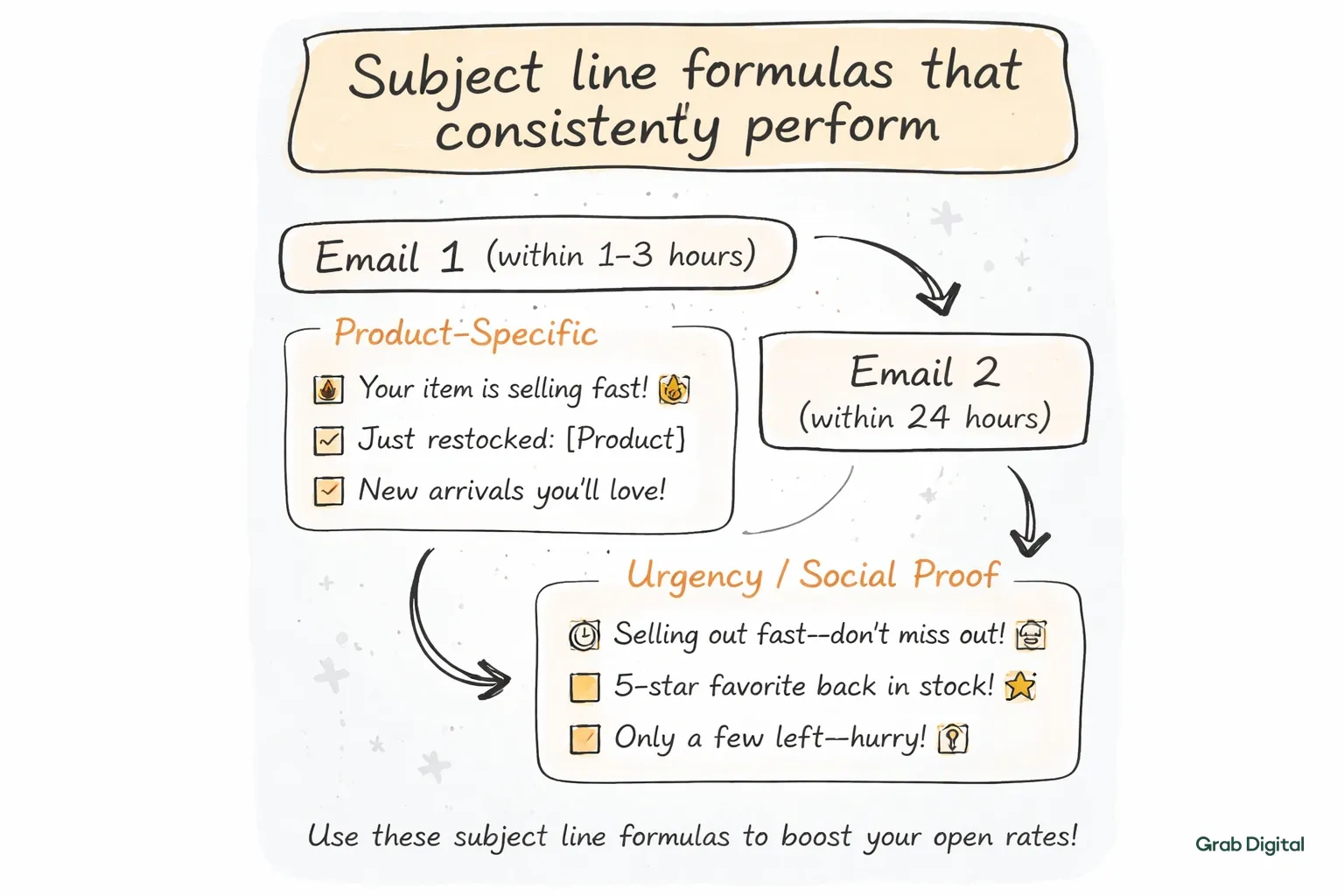
There are a few subject line formulas that consistently beat generic reminders across DTC cart abandonment flows. Product-specific callouts, real urgency, social proof, discounts, and curiosity hooks each work best at a specific stage of the flow.
Email 1 (within 1 to 3 hours): Product-specific, no discount Just remind them. Don't sell yet.
- "Your [Product Name] is still in your cart"
- "Forget something, [First Name]?"
- "[Product Name] won't be in stock forever"
Email 2 (within 24 hours): Urgency or social proof Time to apply a little pressure.
- "Your cart's about to expire"
- "Other shoppers are eyeing this one too"
- "Last chance before it's gone"
Email 3 (48 to 72 hours): Incentive-led, if appropriate If your margins allow it, this is where you offer the discount.
- "10% off your cart, today only"
- "A little something to help you decide"
- "Here's $15 off, just for you"
You don't have to lead with a discount. If your margins are tight or your brand is premium, try a value-add like free shipping or a bundled extra. For a deeper breakdown of the three-email structure, read our guide on fixing cart abandonment with a Klaviyo three-email strategy.
A/B testing subject lines the right way
A/B testing requires isolating one variable at a time and letting it run long enough to hit statistical significance. Most brands test too many things at once or call the results too early based on a tiny sample size.
Here is a framework you can use inside Klaviyo:
- Test one variable per experiment. Don't change tone, length, and personalization in the same test.
- Use a minimum sample size. You need at least 1,000 recipients per variant before you trust the result.
- Run for a full send cycle. Open behavior varies by day and time, so don't cut tests short.
- Track recovery rate, not just open rate. Opens that don't lead to clicks or purchases aren't actually winning.
Things to test next time:
- Emoji versus no emoji
- First name personalization versus none
- Question format versus statement format
- Urgency ("2 hours left") versus curiosity ("Still thinking it over?")
- Discount in the subject line versus discount only in the body
Klaviyo makes the setup easy, but the discipline is in how you read the data. If you aren't sure your flows are set up for meaningful testing, read our article on building a high-ROI abandoned cart flow for DTC brands on Klaviyo before you start tweaking subject lines.
Common mistakes that hurt recovery rates
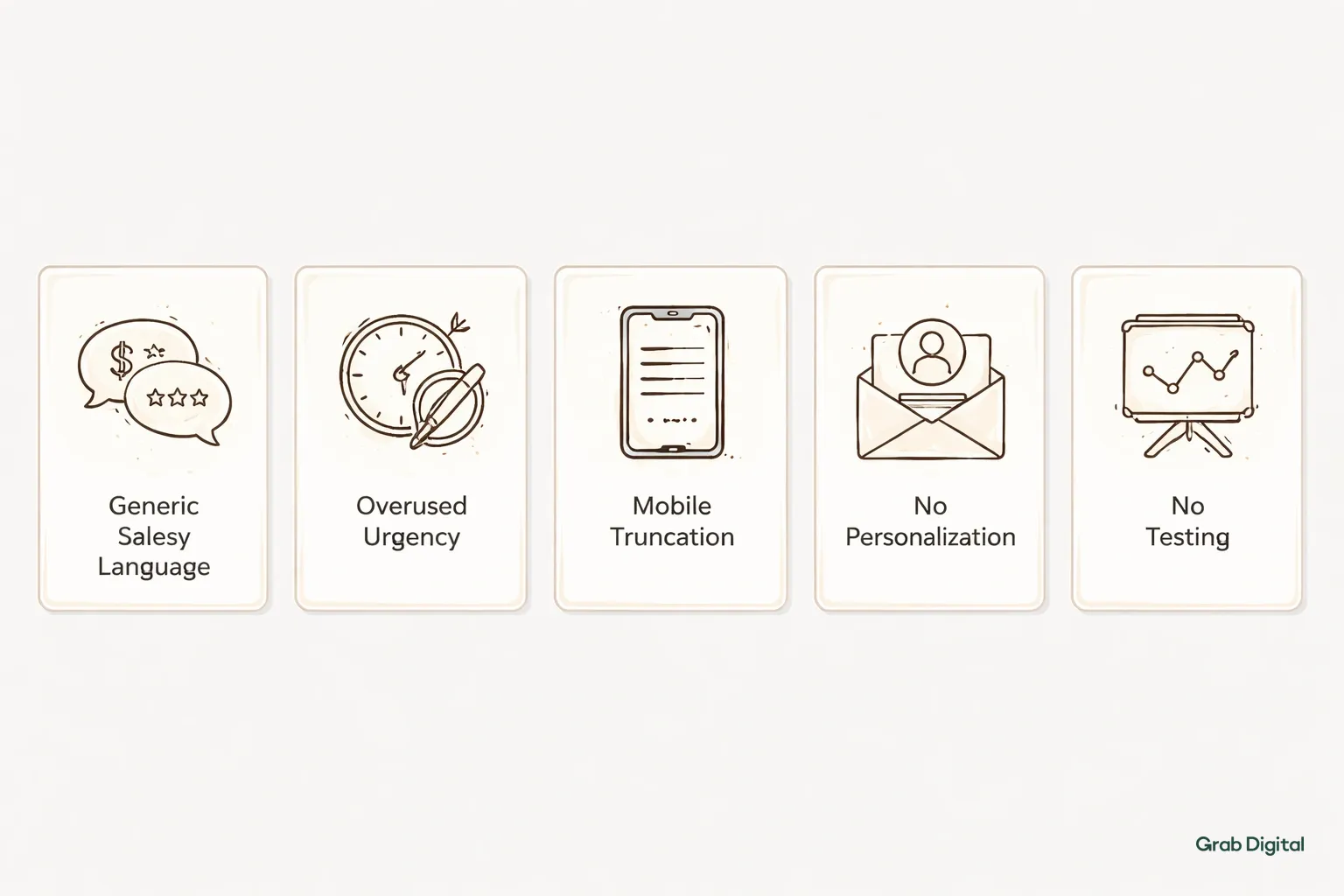
The biggest mistake I see in cart abandonment flows is defaulting to generic, salesy language. If your subject line sounds like every other brand in the inbox, people tune it out, and inbox providers will take note.
Other recurring mistakes from client audits:
- Overusing urgency. If every email screams "last chance," shoppers stop caring by the third send.
- Ignoring mobile truncation. Long subject lines that get cut off mid-sentence lose their punch entirely.
- Skipping personalization. Klaviyo makes inserting names and products easy, yet many brands still send flat, generic lines.
- Never testing past the first send. What worked a year ago might be failing now as inbox behavior shifts.
- Leading with discounts too early. If people learn to expect a discount in email one, you'll erode full-price conversions.
If you haven't looked at your cart abandonment subject lines since you first built the flow, it's time for an audit. Inbox algorithms change constantly, and a strategy that worked a couple of years ago might be quietly underperforming right now. This is exactly what we look for when we take over a brand's email channel. You can book your free consultation to see how your flow compares to benchmarks.
Segmenting subject lines by cart value and customer type
Subject lines shouldn't just change based on timing. They should also adapt to who is buying and how much is in the cart. A first-time visitor with a $40 cart needs different messaging than a returning customer sitting on a $300 cart.
Consider segmenting your subject lines by:
- New vs. returning customers. Returning customers respond well to references to their history, like "Welcome back, your cart's still here."
- High cart value vs. low cart value. Higher-value carts justify a more personal, white-glove approach, while lower-value carts can use simpler urgency.
- Product category. Apparel can use playful language, but a high-consideration purchase like furniture needs a different tone.
To do this well, you need clean, well-structured customer data in Klaviyo. Our resource on Klaviyo health, list hygiene, and segmentation covers the groundwork you need before advanced personalization at scale is even possible.
Wrapping up
If you set a flow up once and never touch it, you're leaving money on the table. Good subject lines require a repeatable testing process, understanding how your audience shops, and a willingness to retire what used to work but doesn't anymore.
If your current cart recovery flow feels stale, our team can audit the entire sequence. Learn more about how we approach flow strategy on our services page, browse real results on our portfolio, or check common questions on our FAQ page before reaching out.
Frequently asked questions
How long should an abandoned cart email subject line be? Aim for 30 to 40 characters so it doesn't get cut off on mobile. Put the most important word or phrase at the front, since that's what people see in the preview pane.
Should every abandoned cart email include a discount in the subject line? No. Leading with a discount in the first email trains people to wait for one every time. Save it for a later email, if you do it at all.
How many subject line variants should I test at once? Stick to two. Testing three or more makes it hard to figure out what actually drove the result.
What's a good open rate benchmark for cart abandonment emails? Many DTC brands see 40 to 60% open rates on the first cart abandonment email because it's based on recent, high-intent behavior. It usually drops a bit by the second and third emails.
Does personalization actually improve open rates, or is it overhyped? Tokens like first name and product name consistently lift open rates in Klaviyo, but the size of the lift varies by brand. Test it on your list rather than assuming a universal percentage.
How often should I refresh my cart abandonment subject lines? Review them quarterly. Inbox algorithms and shopper habits shift, so a subject line that worked a year ago might be losing effectiveness without you noticing.
Your abandoned cart flow is dead in the water if nobody opens the email. The subject line is the gatekeeper. Get it wrong, and your Klaviyo flow goes straight to the trash. Get it right, and you recover sales without immediately resorting to 20% off.
Why subject lines make or break cart recovery
I don't care how beautiful your email design is. If the subject line tanks, nobody sees it. Most people don't abandon carts because they hate your product. They got distracted, or maybe shipping costs gave them pause. A good subject line meets them where they are. It reminds them without making them feel guilty.
Here is what actually gets opens:
- Be specific. "You left something in your cart" is lazy. "Your [Product Name] is waiting" is better.
- Tease something real. Curiosity works, but don't use clickbait.
- Use personalization. Inserting a first name or product name can bump opens by double digits.
- Match the timing. "Still thinking it over?" feels a lot different three hours after abandonment than it does three days later.
If you're still trying to figure out the rest of your cart recovery sequence, our guide on effective abandoned cart email strategies for DTC brands is a good place to start.
The anatomy of a high-performing subject line
A good cart abandonment subject line has to do a lot in under 50 characters: name the product, add a little urgency, and not sound like a robot.
Length matters more than you'd think. Apple Mail and Gmail on mobile truncate subject lines around 30 to 40 characters. If your hook is at the end, people won't see it. Put the most important part first.
Tone is just as critical. Shoppers can smell a templated subject line from the preview pane.
| Generic Approach | Specific Approach |
|---|---|
| "Complete your purchase" | "Still deciding on the Weston Tote?" |
| "Don't miss out!" | "Your cart expires in 2 hours" |
| "We saved your cart" | "3 people viewed this since you left it" |
| "Limited time offer" | "10% off, but only until tonight" |
The right column works because it's specific, time-bound, and sounds like a human wrote it. Klaviyo actually rewards this kind of engagement in deliverability. We cover this in more depth in our piece on email deliverability for DTC brands.
Subject line formulas that consistently perform
There are a few subject line formulas that consistently beat generic reminders across DTC cart abandonment flows. Product-specific callouts, real urgency, social proof, discounts, and curiosity hooks each work best at a specific stage of the flow.
Email 1 (within 1 to 3 hours): Product-specific, no discount Just remind them. Don't sell yet.
- "Your [Product Name] is still in your cart"
- "Forget something, [First Name]?"
- "[Product Name] won't be in stock forever"
Email 2 (within 24 hours): Urgency or social proof Time to apply a little pressure.
- "Your cart's about to expire"
- "Other shoppers are eyeing this one too"
- "Last chance before it's gone"
Email 3 (48 to 72 hours): Incentive-led, if appropriate If your margins allow it, this is where you offer the discount.
- "10% off your cart, today only"
- "A little something to help you decide"
- "Here's $15 off, just for you"
You don't have to lead with a discount. If your margins are tight or your brand is premium, try a value-add like free shipping or a bundled extra. For a deeper breakdown of the three-email structure, read our guide on fixing cart abandonment with a Klaviyo three-email strategy.
A/B testing subject lines the right way
A/B testing requires isolating one variable at a time and letting it run long enough to hit statistical significance. Most brands test too many things at once or call the results too early based on a tiny sample size.
Here is a framework you can use inside Klaviyo:
- Test one variable per experiment. Don't change tone, length, and personalization in the same test.
- Use a minimum sample size. You need at least 1,000 recipients per variant before you trust the result.
- Run for a full send cycle. Open behavior varies by day and time, so don't cut tests short.
- Track recovery rate, not just open rate. Opens that don't lead to clicks or purchases aren't actually winning.
Things to test next time:
- Emoji versus no emoji
- First name personalization versus none
- Question format versus statement format
- Urgency ("2 hours left") versus curiosity ("Still thinking it over?")
- Discount in the subject line versus discount only in the body
Klaviyo makes the setup easy, but the discipline is in how you read the data. If you aren't sure your flows are set up for meaningful testing, read our article on building a high-ROI abandoned cart flow for DTC brands on Klaviyo before you start tweaking subject lines.
Common mistakes that hurt recovery rates
The biggest mistake I see in cart abandonment flows is defaulting to generic, salesy language. If your subject line sounds like every other brand in the inbox, people tune it out, and inbox providers will take note.
Other recurring mistakes from client audits:
- Overusing urgency. If every email screams "last chance," shoppers stop caring by the third send.
- Ignoring mobile truncation. Long subject lines that get cut off mid-sentence lose their punch entirely.
- Skipping personalization. Klaviyo makes inserting names and products easy, yet many brands still send flat, generic lines.
- Never testing past the first send. What worked a year ago might be failing now as inbox behavior shifts.
- Leading with discounts too early. If people learn to expect a discount in email one, you'll erode full-price conversions.
If you haven't looked at your cart abandonment subject lines since you first built the flow, it's time for an audit. Inbox algorithms change constantly, and a strategy that worked a couple of years ago might be quietly underperforming right now. This is exactly what we look for when we take over a brand's email channel. You can book your free consultation to see how your flow compares to benchmarks.
Segmenting subject lines by cart value and customer type
Subject lines shouldn't just change based on timing. They should also adapt to who is buying and how much is in the cart. A first-time visitor with a $40 cart needs different messaging than a returning customer sitting on a $300 cart.
Consider segmenting your subject lines by:
- New vs. returning customers. Returning customers respond well to references to their history, like "Welcome back, your cart's still here."
- High cart value vs. low cart value. Higher-value carts justify a more personal, white-glove approach, while lower-value carts can use simpler urgency.
- Product category. Apparel can use playful language, but a high-consideration purchase like furniture needs a different tone.
To do this well, you need clean, well-structured customer data in Klaviyo. Our resource on Klaviyo health, list hygiene, and segmentation covers the groundwork you need before advanced personalization at scale is even possible.
Wrapping up
If you set a flow up once and never touch it, you're leaving money on the table. Good subject lines require a repeatable testing process, understanding how your audience shops, and a willingness to retire what used to work but doesn't anymore.
If your current cart recovery flow feels stale, our team can audit the entire sequence. Learn more about how we approach flow strategy on our services page, browse real results on our portfolio, or check common questions on our FAQ page before reaching out.
Frequently asked questions
How long should an abandoned cart email subject line be? Aim for 30 to 40 characters so it doesn't get cut off on mobile. Put the most important word or phrase at the front, since that's what people see in the preview pane.
Should every abandoned cart email include a discount in the subject line? No. Leading with a discount in the first email trains people to wait for one every time. Save it for a later email, if you do it at all.
How many subject line variants should I test at once? Stick to two. Testing three or more makes it hard to figure out what actually drove the result.
What's a good open rate benchmark for cart abandonment emails? Many DTC brands see 40 to 60% open rates on the first cart abandonment email because it's based on recent, high-intent behavior. It usually drops a bit by the second and third emails.
Does personalization actually improve open rates, or is it overhyped? Tokens like first name and product name consistently lift open rates in Klaviyo, but the size of the lift varies by brand. Test it on your list rather than assuming a universal percentage.
How often should I refresh my cart abandonment subject lines? Review them quarterly. Inbox algorithms and shopper habits shift, so a subject line that worked a year ago might be losing effectiveness without you noticing.

Find out exactly what your email channel is leaving on the table.

Email Marketing for Scaling DTC Brands


