
Summary
Suppress Inactive Subscribers to Boost Klaviyo Deliverability
Holding onto every email subscriber like they're a trophy is a terrible way to run a DTC brand. A bloated list full of ghosts wrecks your Klaviyo deliverability. You end up paying Klaviyo for people who haven't opened an email since 2022, your open rates tank, and Gmail eventually decides your stuff is spam. You need to suppress these subscribers once they hit 90 to 180 days of zero engagement. Nailing the timing is the only way to keep your active list healthy.
What counts as an inactive subscriber in Klaviyo
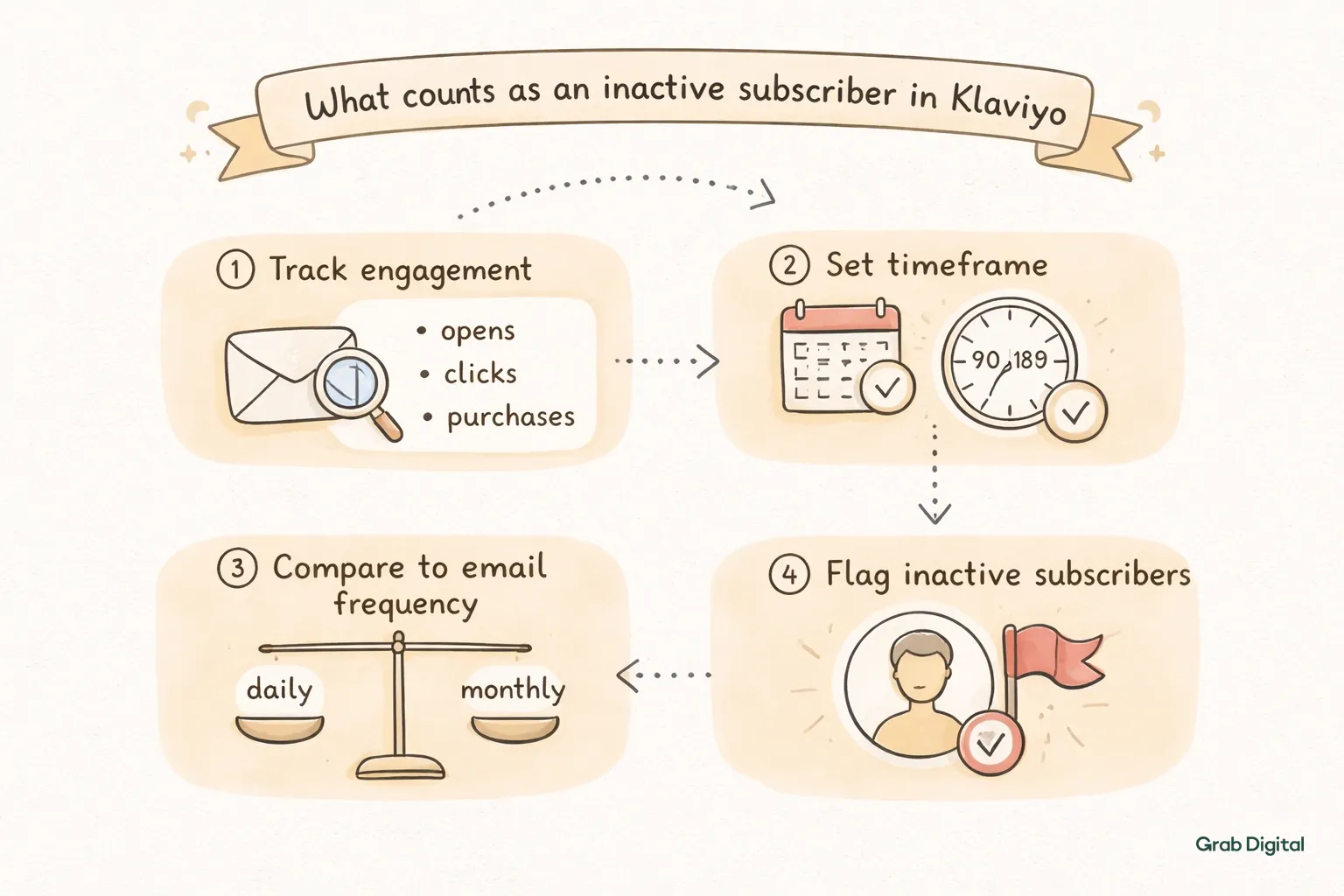
An inactive subscriber is just someone who hasn't opened, clicked, or bought anything within a specific timeframe, usually 90 to 180 days. Klaviyo tracks all this engagement data on user profiles, so you can build segments based on when someone last opened an email, clicked a link, or placed an order.
The threshold you pick depends entirely on how often you email your list. If you're blasting emails daily, you need to flag inactive people much faster than a brand that sends twice a month. A subscriber ignoring you for 60 days means something completely different depending on your volume. Here are some basic benchmarks to start with:
- High-frequency senders (4+ emails/week): flag at 60 to 90 days
- Standard DTC cadence (1 to 3 emails/week): flag at 90 to 120 days
- Low-frequency senders (monthly or less): flag at 120 to 180 days
Also, think about your actual product cycle. If you sell furniture or high-end leather goods, stretch that window out. Someone who bought a wallet from Rogue Industries won't need another one for six months. That's normal buying behavior, not a dead subscriber.
Why suppression protects deliverability
Inbox providers like Gmail and Yahoo weigh engagement heavily when deciding where to put your emails. If you keep sending to people who never open your stuff, Gmail assumes your content is worthless. Your sender score drops, and suddenly your emails start landing in spam, even for your most loyal customers.
It's basically a credit score for your domain. Opens and clicks help it. Ignored emails, spam complaints, and bounces hurt it.
| Engagement Signal | Impact on Deliverability |
|---|---|
| Opens and clicks | Builds sender reputation |
| Ignored emails (no action) | Neutral to slightly negative |
| Spam complaints | Significant negative impact |
| Hard bounces | Immediate negative impact |
| Unsubscribes | Neutral, removes risk |
The problem is that inactive subscribers rarely hit the unsubscribe button. They just sit there, quietly dragging down your open rates every time you send a campaign. Over time, that decay ruins inbox placement for your entire list. If you're already seeing open rates slip across the board, check out our guide on email deliverability tips to figure out what's going wrong.
When to run a win-back before suppressing
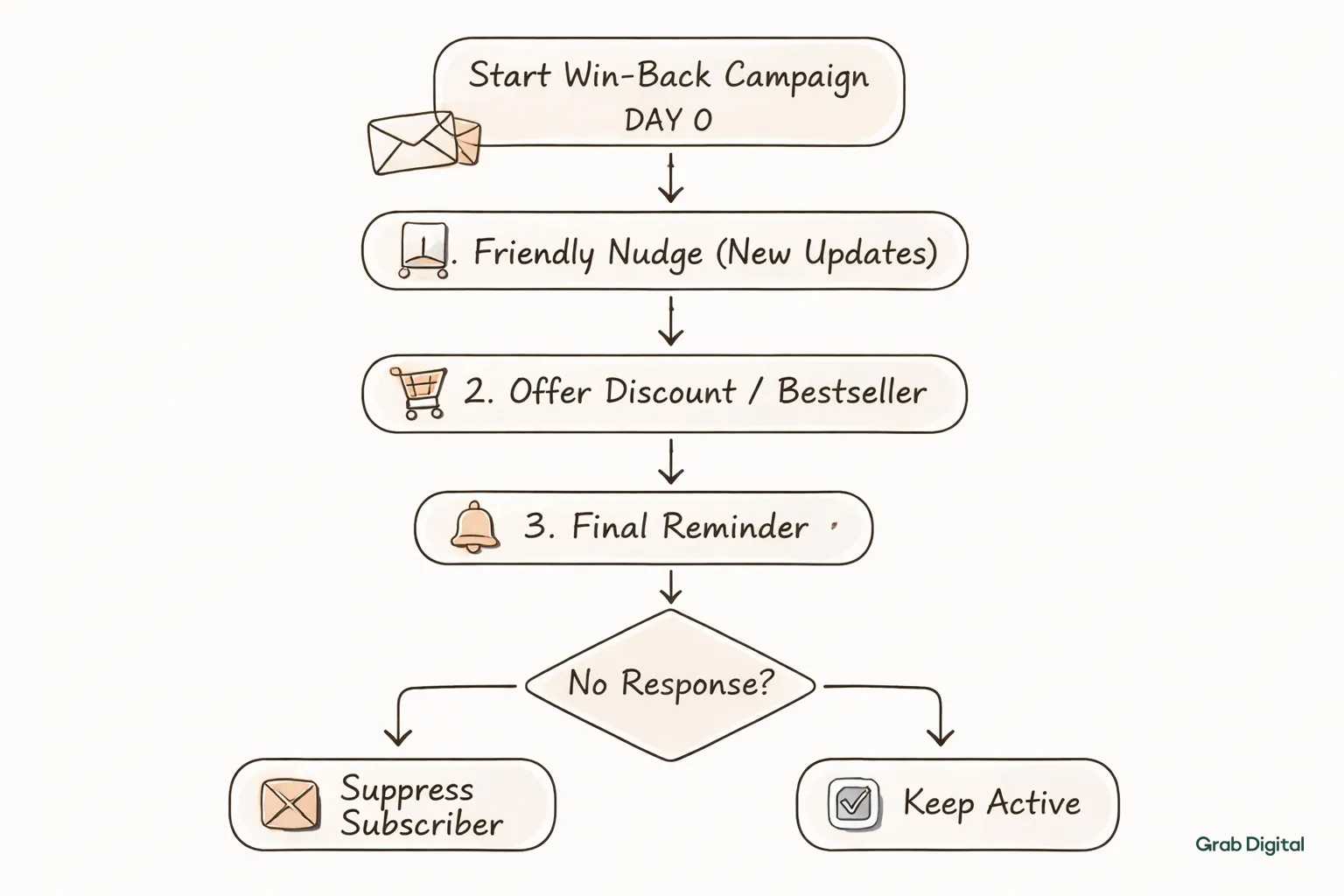
Don't just nuke cold subscribers out of nowhere. Run a win-back campaign first. Give them one final, well-crafted sequence to see if you can pull them back in with a discount or a reminder of why they signed up. Only suppress the ones who ignore the whole thing.
Brands wait way too long to start this. They let subscribers go completely cold before trying to save them. Kick off your win-back flow around the 60-day mark of inactivity, before they hit full suppression territory. A solid flow is three touches:
- A friendly nudge showing what's new, maybe paired with a bestseller or some social proof.
- An actual incentive, like a discount, free shipping, or early access to a drop.
- A last-chance email. Be honest and tell them you're going to suppress them if they don't act.
We cover similar tactics in our breakdown of Klaviyo win-back flows, which pairs well with this suppression strategy. Brands like Beessential have used this exact three-touch setup to wake up dormant segments before pulling the suppression trigger.
How to build the suppression segment in Klaviyo
In Klaviyo, suppression segments are just negative engagement filters mixed with time-based conditions. You want to exclude anyone who opened or clicked within your window, then add "did not place order" to catch people who aren't buying through other channels like SMS or ads.
Here's a practical filter structure to start with:
- Has not opened email in the last 120 days
- Has not clicked email in the last 120 days
- Has not placed an order in the last 180 days
- Has received the full win-back sequence
- Did not open or click during the win-back sequence
Once you build this, you have two choices. You can suppress them outright so they never get future sends, or you can move them to a reduced-frequency segment that only gets major announcements a few times a year. The second option keeps your list size looking bigger, but it rarely drives revenue and still hurts deliverability if those sends get ignored too.
If you're doing this manually on a growing list, it eats hours every month. If your team doesn't have the bandwidth for ongoing list hygiene work, it might be worth seeing what a dedicated partner handles on your behalf. You can see the full breakdown on our services page.
How suppression affects list size and revenue metrics
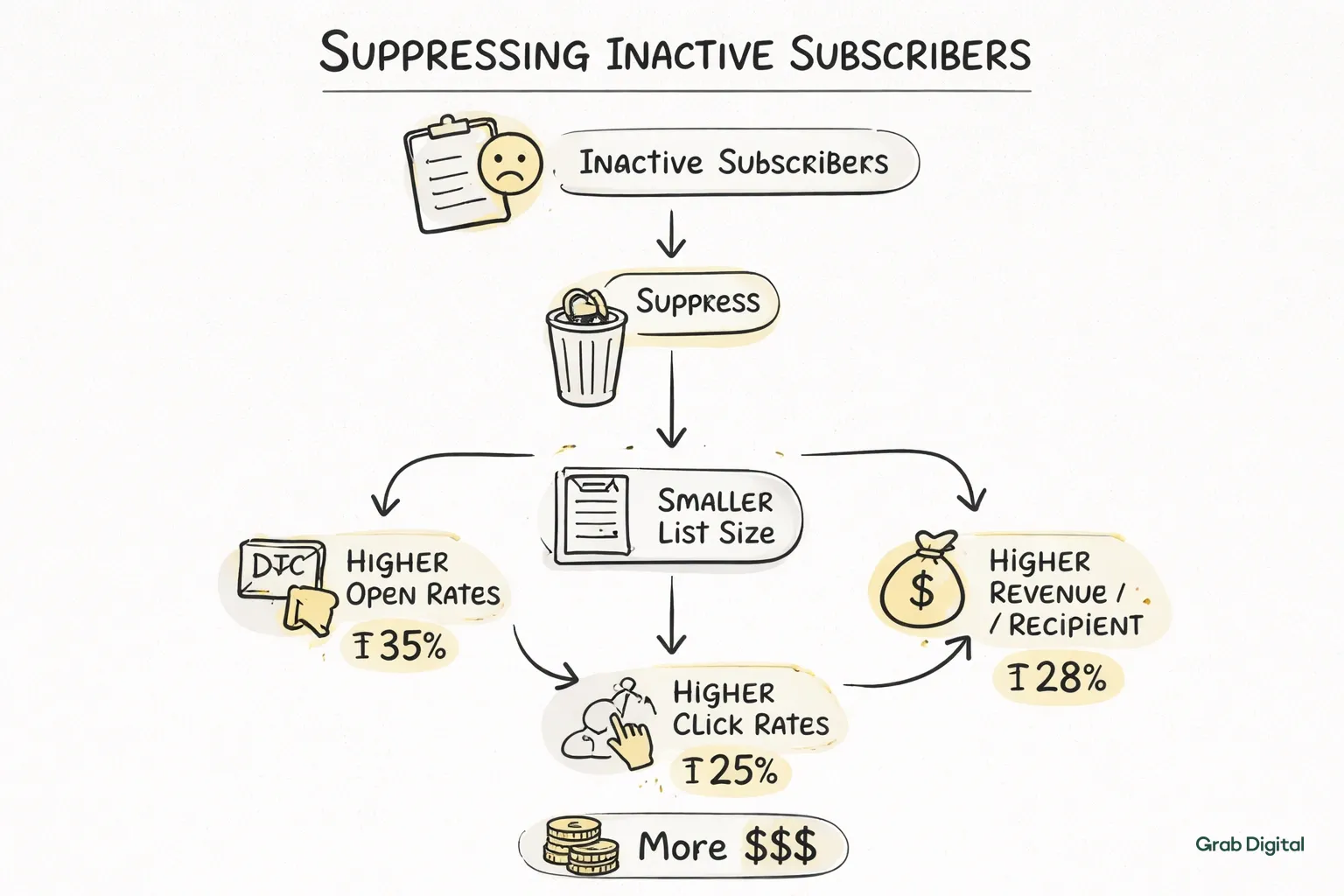
Suppressing subscribers will shrink your list. That's the point. A smaller, engaged list will beat a massive, stagnant one every single time on open rates, click rates, and revenue per recipient.
Marketers absolutely panic when list size drops, mostly because "list size" is a vanity metric they report to leadership. Reframe the conversation around revenue per send instead. A 50,000-person list with a 15% open rate generates less value than a 30,000-person list with a 35% open rate. Plus, suppressing dead weight often lowers your monthly Klaviyo bill, since they charge based on total profile count.
This is why baseline measurement matters. Agencies that guarantee results, like our commitment to 10% revenue growth within 60 days, measure that baseline on day one using Klaviyo attribution, accounting for this exact kind of list cleanup. If you're trying to figure out if your current email approach is working, our case studies show how list hygiene and segmentation work together to drive actual growth.
Ongoing maintenance after your first suppression pass
Suppression isn't a one-and-done thing. Schedule a recurring review, ideally quarterly, to catch new inactive subscribers before they ruin your metrics again. Set up a Klaviyo flow that automatically tags people as "at risk" once they hit 60 days without engagement so your team gets a head start.
You also need to clean up the front end. If your popup forms are attracting low-intent subscribers who never engage in the first place, suppression won't fix a leaky funnel. Test different incentives and form placements to stop dead subscribers from entering your list to begin with.
Brands working with a dedicated email team, like the setup we run for clients, build this maintenance directly into monthly reporting. Every cycle includes a fresh look at engagement segments so suppression becomes routine instead of a quarterly fire drill. If your current setup doesn't include this kind of ongoing hygiene check, it might be time to book your free consultation and see what a dedicated strategist would flag in your account.
The takeaway
Suppressing inactive subscribers protects your sender reputation, improves campaign performance, and often reduces platform costs. The process takes patience: flag inactivity at the right threshold, run a genuine win-back attempt, then suppress what's left.
Deliverability issues don't announce themselves. You just wake up one day, realize open rates have been slipping for months, and suddenly your emails are landing in spam for your best customers. Regular suppression, done on a schedule instead of in a panic, keeps that decline from ever starting. For brands generating under 20% of revenue through email, our 2026 email marketing checklist is a good companion to this process, covering the broader strategy suppression fits into.
Frequently asked questions
How long should I wait before suppressing an inactive Klaviyo subscriber? Most DTC brands flag inactivity between 90 and 180 days, depending on sending frequency. High-frequency senders should flag sooner, around 60 to 90 days, while low-frequency senders can wait closer to 180 days.
Will suppressing subscribers hurt my overall list size and reported metrics? Yes, list size will drop, but that's the intended outcome. Revenue per recipient and open rates typically improve, which matters more than raw subscriber count for actual business performance.
Should I delete suppressed subscribers or just exclude them from sends? Exclude them through suppression segments rather than deleting profiles outright. This preserves historical data for future win-back attempts while keeping them out of active sends.
Can suppression lower my Klaviyo monthly bill? Often yes, since many Klaviyo pricing tiers are based on total profile count. Removing genuinely inactive profiles can shift you into a lower pricing bracket.
What should a win-back email sequence include before suppression? A strong sequence includes a friendly reminder, an incentive offer like a discount, and a final direct message letting subscribers know they'll be suppressed if they don't engage.
How often should I review my list for new inactive subscribers? Quarterly reviews work well for most DTC brands. Setting up an automated "at risk" tag in Klaviyo at the 60-day mark gives your team advance warning before full inactivity sets in.
Holding onto every email subscriber like they're a trophy is a terrible way to run a DTC brand. A bloated list full of ghosts wrecks your Klaviyo deliverability. You end up paying Klaviyo for people who haven't opened an email since 2022, your open rates tank, and Gmail eventually decides your stuff is spam. You need to suppress these subscribers once they hit 90 to 180 days of zero engagement. Nailing the timing is the only way to keep your active list healthy.
What counts as an inactive subscriber in Klaviyo
An inactive subscriber is just someone who hasn't opened, clicked, or bought anything within a specific timeframe, usually 90 to 180 days. Klaviyo tracks all this engagement data on user profiles, so you can build segments based on when someone last opened an email, clicked a link, or placed an order.
The threshold you pick depends entirely on how often you email your list. If you're blasting emails daily, you need to flag inactive people much faster than a brand that sends twice a month. A subscriber ignoring you for 60 days means something completely different depending on your volume. Here are some basic benchmarks to start with:
- High-frequency senders (4+ emails/week): flag at 60 to 90 days
- Standard DTC cadence (1 to 3 emails/week): flag at 90 to 120 days
- Low-frequency senders (monthly or less): flag at 120 to 180 days
Also, think about your actual product cycle. If you sell furniture or high-end leather goods, stretch that window out. Someone who bought a wallet from Rogue Industries won't need another one for six months. That's normal buying behavior, not a dead subscriber.
Why suppression protects deliverability
Inbox providers like Gmail and Yahoo weigh engagement heavily when deciding where to put your emails. If you keep sending to people who never open your stuff, Gmail assumes your content is worthless. Your sender score drops, and suddenly your emails start landing in spam, even for your most loyal customers.
It's basically a credit score for your domain. Opens and clicks help it. Ignored emails, spam complaints, and bounces hurt it.
| Engagement Signal | Impact on Deliverability |
|---|---|
| Opens and clicks | Builds sender reputation |
| Ignored emails (no action) | Neutral to slightly negative |
| Spam complaints | Significant negative impact |
| Hard bounces | Immediate negative impact |
| Unsubscribes | Neutral, removes risk |
The problem is that inactive subscribers rarely hit the unsubscribe button. They just sit there, quietly dragging down your open rates every time you send a campaign. Over time, that decay ruins inbox placement for your entire list. If you're already seeing open rates slip across the board, check out our guide on email deliverability tips to figure out what's going wrong.
When to run a win-back before suppressing
Don't just nuke cold subscribers out of nowhere. Run a win-back campaign first. Give them one final, well-crafted sequence to see if you can pull them back in with a discount or a reminder of why they signed up. Only suppress the ones who ignore the whole thing.
Brands wait way too long to start this. They let subscribers go completely cold before trying to save them. Kick off your win-back flow around the 60-day mark of inactivity, before they hit full suppression territory. A solid flow is three touches:
- A friendly nudge showing what's new, maybe paired with a bestseller or some social proof.
- An actual incentive, like a discount, free shipping, or early access to a drop.
- A last-chance email. Be honest and tell them you're going to suppress them if they don't act.
We cover similar tactics in our breakdown of Klaviyo win-back flows, which pairs well with this suppression strategy. Brands like Beessential have used this exact three-touch setup to wake up dormant segments before pulling the suppression trigger.
How to build the suppression segment in Klaviyo
In Klaviyo, suppression segments are just negative engagement filters mixed with time-based conditions. You want to exclude anyone who opened or clicked within your window, then add "did not place order" to catch people who aren't buying through other channels like SMS or ads.
Here's a practical filter structure to start with:
- Has not opened email in the last 120 days
- Has not clicked email in the last 120 days
- Has not placed an order in the last 180 days
- Has received the full win-back sequence
- Did not open or click during the win-back sequence
Once you build this, you have two choices. You can suppress them outright so they never get future sends, or you can move them to a reduced-frequency segment that only gets major announcements a few times a year. The second option keeps your list size looking bigger, but it rarely drives revenue and still hurts deliverability if those sends get ignored too.
If you're doing this manually on a growing list, it eats hours every month. If your team doesn't have the bandwidth for ongoing list hygiene work, it might be worth seeing what a dedicated partner handles on your behalf. You can see the full breakdown on our services page.
How suppression affects list size and revenue metrics
Suppressing subscribers will shrink your list. That's the point. A smaller, engaged list will beat a massive, stagnant one every single time on open rates, click rates, and revenue per recipient.
Marketers absolutely panic when list size drops, mostly because "list size" is a vanity metric they report to leadership. Reframe the conversation around revenue per send instead. A 50,000-person list with a 15% open rate generates less value than a 30,000-person list with a 35% open rate. Plus, suppressing dead weight often lowers your monthly Klaviyo bill, since they charge based on total profile count.
This is why baseline measurement matters. Agencies that guarantee results, like our commitment to 10% revenue growth within 60 days, measure that baseline on day one using Klaviyo attribution, accounting for this exact kind of list cleanup. If you're trying to figure out if your current email approach is working, our case studies show how list hygiene and segmentation work together to drive actual growth.
Ongoing maintenance after your first suppression pass
Suppression isn't a one-and-done thing. Schedule a recurring review, ideally quarterly, to catch new inactive subscribers before they ruin your metrics again. Set up a Klaviyo flow that automatically tags people as "at risk" once they hit 60 days without engagement so your team gets a head start.
You also need to clean up the front end. If your popup forms are attracting low-intent subscribers who never engage in the first place, suppression won't fix a leaky funnel. Test different incentives and form placements to stop dead subscribers from entering your list to begin with.
Brands working with a dedicated email team, like the setup we run for clients, build this maintenance directly into monthly reporting. Every cycle includes a fresh look at engagement segments so suppression becomes routine instead of a quarterly fire drill. If your current setup doesn't include this kind of ongoing hygiene check, it might be time to book your free consultation and see what a dedicated strategist would flag in your account.
The takeaway
Suppressing inactive subscribers protects your sender reputation, improves campaign performance, and often reduces platform costs. The process takes patience: flag inactivity at the right threshold, run a genuine win-back attempt, then suppress what's left.
Deliverability issues don't announce themselves. You just wake up one day, realize open rates have been slipping for months, and suddenly your emails are landing in spam for your best customers. Regular suppression, done on a schedule instead of in a panic, keeps that decline from ever starting. For brands generating under 20% of revenue through email, our 2026 email marketing checklist is a good companion to this process, covering the broader strategy suppression fits into.
Frequently asked questions
How long should I wait before suppressing an inactive Klaviyo subscriber? Most DTC brands flag inactivity between 90 and 180 days, depending on sending frequency. High-frequency senders should flag sooner, around 60 to 90 days, while low-frequency senders can wait closer to 180 days.
Will suppressing subscribers hurt my overall list size and reported metrics? Yes, list size will drop, but that's the intended outcome. Revenue per recipient and open rates typically improve, which matters more than raw subscriber count for actual business performance.
Should I delete suppressed subscribers or just exclude them from sends? Exclude them through suppression segments rather than deleting profiles outright. This preserves historical data for future win-back attempts while keeping them out of active sends.
Can suppression lower my Klaviyo monthly bill? Often yes, since many Klaviyo pricing tiers are based on total profile count. Removing genuinely inactive profiles can shift you into a lower pricing bracket.
What should a win-back email sequence include before suppression? A strong sequence includes a friendly reminder, an incentive offer like a discount, and a final direct message letting subscribers know they'll be suppressed if they don't engage.
How often should I review my list for new inactive subscribers? Quarterly reviews work well for most DTC brands. Setting up an automated "at risk" tag in Klaviyo at the 60-day mark gives your team advance warning before full inactivity sets in.

Find out exactly what your email channel is leaving on the table.

Email Marketing for Scaling DTC Brands


