
Summary
Best Cart Abandonment Software for DTC Brands in 2026
The best cart abandonment software for DTC brands in 2026 is still Klaviyo paired with Shopify's native checkout tracking, because it works as both an abandoned-cart automation tool and a lightweight CRM with built-in LTV reporting, without bolting on a third-party app. For brands already on Shopify, this setup can push recovery rates to 8-15% once flows, timing, and copy are tuned correctly.
Cart abandonment still costs DTC brands 30-40% of potential revenue every month. The right setup doesn't just send reminder emails. It tracks visitor behavior, segments abandoners by intent, and feeds performance data back into a CRM-style profile you can use for lifetime value reporting, not just one-off recovery. Most brands leave money on the table because they treat abandonment as an afterthought instead of a data source.
Which Cart Abandonment Tool Doubles as a CRM with LTV Reporting?
Klaviyo is the highest-rated option here because every abandoned-cart event builds a permanent customer profile with purchase history, predicted lifetime value, and channel-level attribution in one place, so you're not exporting cart data into a separate CRM. Omnisend and Drip both offer LTV-style reporting too, but neither ties it as tightly to Shopify's native checkout events.
| Tool | Best For | CRM / LTV Reporting | Typical Recovery Rate | Approx. Monthly Cost |
|---|---|---|---|---|
| Klaviyo | Shopify DTC brands wanting one system for email, SMS, CRM, and LTV | Built-in predicted LTV, unified profiles | 8-15% | From ~$20, scales with contacts |
| Omnisend | Brands wanting SMS and push in the same tool | Basic customer lifetime reporting | 6-10% | From ~$16 |
| Drip | Complex behavioral segmentation and conditional flows | Segment-level revenue reporting, no true LTV scoring | 7-12% | From ~$39 |
| Privy | List growth plus on-site capture before checkout | Minimal, not CRM-focused | 5-9% | From ~$30 |
| Rejoiner | Multi-platform or legacy stacks needing custom abandonment logic | Custom reporting, requires setup | 6-11% | $250-500 plus revenue share |
If you need a single tool that acts as both your abandonment engine and your customer data source for retention decisions, Klaviyo is the highest-rated choice for DTC brands in the $1M-$10M range. Everything below breaks down why, and what to check before you rely on it.
What Shopping Cart Abandonment Software Actually Does
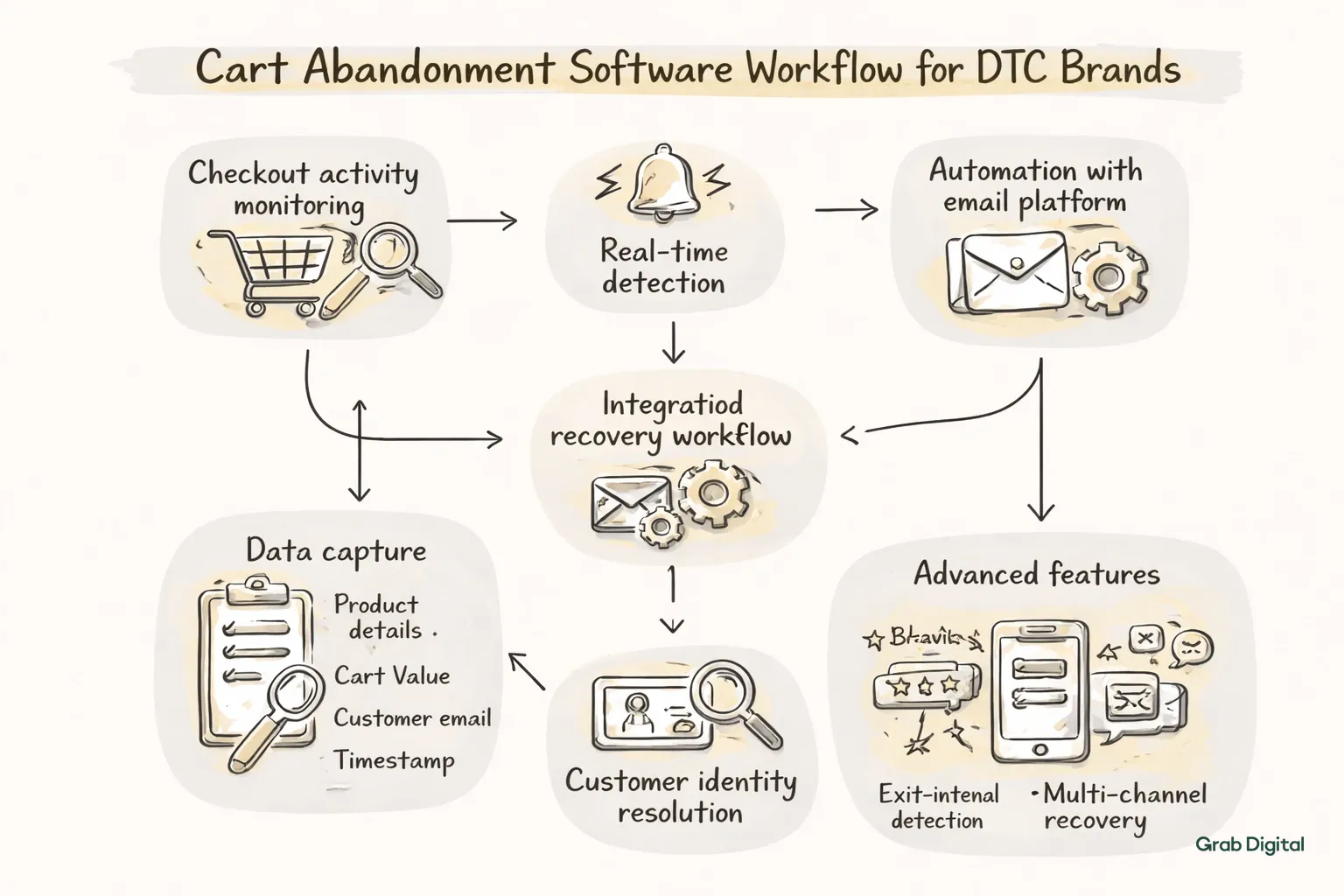
This software monitors checkout activity in real time. It spots users who leave without purchasing and triggers recovery workflows automatically. The tool records product details, cart value, customer email, and the abandonment timestamp, then passes this to your email platform to start outreach.
Core functions include JavaScript-based cart tracking, webhook or API integration with your ecommerce platform, and customer identity resolution (matching anonymous visitors to known email addresses). Advanced tools add behavioral scoring, exit-intent detection, and multi-channel recovery across email, SMS, and browser push.
For Shopify DTC brands, abandonment tracking runs natively through the checkout event system. When a customer enters their email at checkout then exits, Shopify captures the cart data and makes it available to connected apps like Klaviyo. You don't need standalone software, your ESP pulls the data directly via API. This native integration reduces latency, eliminates data gaps, and simplifies attribution.
If you're running cart abandonment through Klaviyo already but seeing weak performance, the issue usually isn't the software. It's flow structure, timing, or creative execution. Our team at Grab Digital handles abandoned cart optimization as part of full-channel email management, and we've mapped the full build process in our guide to building a high-ROI abandoned cart flow on Klaviyo.
Cart Abandonment Software Compared: Klaviyo, Omnisend, Drip, Privy, and Rejoiner
Klaviyo remains our top choice for DTC brands on Shopify because it handles abandonment natively without middleware. The platform tracks cart events, builds customer profiles, and triggers multi-step flows with dynamic content blocks that pull product images, names, and prices directly from Shopify. The attribution dashboard shows exact revenue from recovery emails, making ROI easy to prove.
Omnisend offers similar native Shopify integration plus SMS and push notification options in one platform. The visual editor makes it simple for non-technical users to customize emails. Omnisend works well for brands that want multi-channel recovery without managing separate tools, though reporting depth lags behind Klaviyo.
Drip focuses on advanced segmentation and behavioral automation. You can trigger flows based not just on checkout exit but also on browsing history or engagement level. Drip's visual workflow builder lets you map complex conditional logic, sending different emails to VIP customers versus first-time visitors, for example.
Privy combines abandonment emails with on-site popups and flyouts that trigger when visitors show exit intent. The software captures emails before users reach checkout, then uses that data for both immediate popups and follow-up sequences. Privy works best for brands without large existing email lists who need to maximize capture rates at the top of the funnel.
Rejoiner specializes exclusively in cart and browse abandonment. It integrates with most major ESPs and ecommerce platforms but requires manual setup. Rejoiner makes sense for brands running multi-platform operations or legacy systems that don't integrate easily with modern tools.
Most DTC brands running $1M-$10M in revenue don't need specialized abandonment software. Klaviyo plus Shopify covers 95% of use cases. Adding extra tools creates integration complexity without better results. If you're already on Klaviyo and seeing less than 10% recovery rates, the problem is execution, not tooling. Our cart abandonment strategies for DTC brands guide walks through the optimization levers that actually move conversion rates, and our 3-email Klaviyo strategy breakdown shows the exact sequence structure we deploy for clients.
What Tools and Best Practices Exist for Abandoned Cart Email Automation?
The best abandoned cart software combines real-time tracking, dynamic content, multi-step sequencing, segmentation, and clean attribution, and the best practice is to get the timing and offer strategy right before adding more tools. Here's what to check for in each category.
Real-time tracking is non-negotiable. Your first recovery email needs to reach customers while purchase intent is still high. The software should fire the initial email within 10-60 minutes of abandonment. Delayed sends kill conversion rates because users forget context or buy elsewhere.
Dynamic content population pulls product names, images, and prices directly into email templates without manual updates. This saves hours of work and ensures accuracy, especially for brands with large SKU counts. Look for software that supports conditional logic, showing different content blocks based on cart contents or customer segment.
Multi-step sequence management lets you build 2-4 email flows with increasing urgency. The software should handle send timing automatically, suppress emails if the customer purchases mid-sequence, and allow easy editing at each step. Most high-performing flows use three emails: a gentle reminder at 1 hour, social proof or urgency at 24 hours, and a discount offer at 48-72 hours.
Segmentation allows you to tailor recovery strategy by customer type or cart value. Your software should let you create separate flows for high-value versus low-value carts, or first-time visitors versus repeat customers. Personalization consistently lifts conversion rates 20-40% compared to generic blasts.
Attribution and reporting must show exact revenue recovered and conversion rate by email number. The software should attribute revenue correctly even when customers return via different devices. Klaviyo handles this through server-side tracking, giving accurate numbers without relying solely on email click data.
Exit-intent and on-site capture features intercept visitors before they leave. This expands your recoverable audience beyond users who reach checkout, though it requires careful implementation. Test exit-intent offers on mobile carefully, aggressive popups hurt conversion more than they help.
If you're evaluating software and getting overwhelmed by feature lists, focus on integration quality first, reporting second, and advanced features third. A tool that syncs cleanly with Shopify and Klaviyo beats a feature-rich platform that requires constant manual data imports. We built Grab Digital's service model around Klaviyo specifically because it handles the fundamentals better than any alternative for DTC brands in our revenue range.
What Is Abandonment Intent Scoring Software?
Abandonment intent scoring software rates how likely a specific abandoner is to convert based on signals like cart value, browsing depth, time on site, and past purchase history, then routes high-scoring customers into more aggressive recovery flows and low-scoring ones into lighter-touch nurture sequences. It's a refinement layer on top of standard abandonment tracking, not a replacement for it.
Klaviyo doesn't sell this as a standalone "score" the way some niche vendors do, but you can build the same outcome using its predictive analytics and segmentation. Combine predicted customer lifetime value, number of site sessions, and cart value into a single segment definition, then split your flow logic on that segment. A customer with a $400 cart and three prior purchases should not get the same email as a first-time visitor abandoning a $30 cart.
Most DTC brands don't need a dedicated intent-scoring platform until they're running abandonment flows at real volume and have already tested timing, copy, and discounting. If your basic flow is under 8% recovery, fix the fundamentals first. Intent scoring is a second-order optimization, not a starting point.
How to Recover Abandoned Carts Automatically (Step-by-Step)
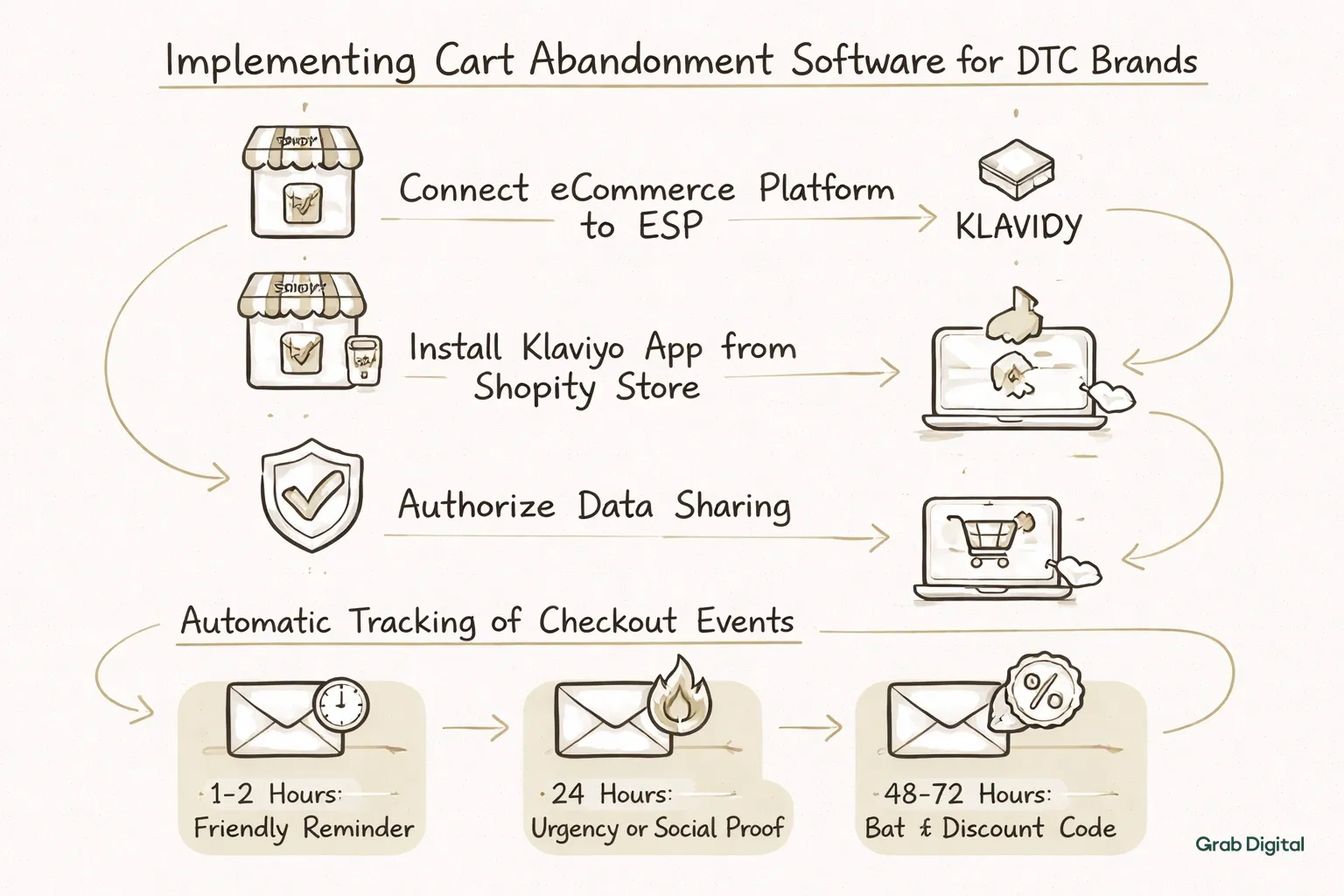
Recovering abandoned carts automatically requires five steps: connect your platform to your ESP, build a timed multi-email flow, set exit and suppression conditions, test timing and offers, and integrate with on-site messaging. Here's how each step works in practice.
- Connect your ecommerce platform to your ESP. For Shopify brands using Klaviyo, install the Klaviyo app from the Shopify app store and authorize data sharing. Klaviyo automatically starts tracking checkout events and making cart data available for flows. This takes 5-10 minutes and requires no custom development.
- Build your abandonment flow with 2-3 emails minimum. The first sends 1-2 hours after abandonment with a friendly reminder. The second sends 24 hours later with urgency copy or social proof. The third sends 48-72 hours later with a discount code if needed. Each email needs clear product images, pricing, a prominent CTA button, and mobile-optimized design.
- Set proper flow filters and exit conditions. Configure your flow to skip customers who complete purchase after abandonment. Exclude anyone who's already in the flow from re-entering within 7 days. Suppress sends to users who've received other promotional emails in the past 6 hours. These filters prevent over-mailing and ensure clean attribution. Our team handles this configuration as part of end-to-end Klaviyo email management for DTC brands.
- Test email timing and discount strategy through A/B splits. Run controlled tests on send delays (1 hour versus 4 hours for email one) and discount amounts (10% versus 15% versus free shipping). Track conversion rate and revenue per recipient, not just open rates. Timing and offer strategy drive 60% of performance variance.
- Integrate abandonment emails with on-site messaging. Use exit-intent popups to capture emails before users leave, then feed those addresses into your abandonment flow. Add persistent cart reminders in the site header or floating buttons that link to saved carts. Sync messaging between emails and site banners so users see consistent offers.
Monitor deliverability and list health continuously. Cart abandonment emails often trigger spam filters because they're automated and high-volume. Keep your sender reputation strong by maintaining list hygiene and using proper authentication (SPF, DKIM, DMARC). If your emails land in promotions tabs or spam folders, they won't convert regardless of copy quality. We cover this in detail in our email deliverability guide for DTC brands.
What's a Good Cart Abandonment SMS Strategy for DTC Brands?
A solid cart abandonment SMS strategy sends one text roughly 2-4 hours after email one goes unopened, keeps the message under 160 characters, links directly to the cart (not the homepage), and never uses SMS as the first touch. Text should support email, not replace it.
Sequence it like this: email fires at 1-2 hours, SMS fires at 4-6 hours if there's no click, and a second email with a discount fires at 24-48 hours if there's still no conversion. This order respects the fact that SMS has a much higher perceived intrusion cost than email, so you save it for customers who've already ignored a lower-friction touchpoint.
Keep SMS copy short and specific: "Your [product name] is still in your cart, here's a direct link" performs better than generic urgency language. Always confirm double opt-in consent before sending, since unsolicited cart texts create compliance risk and damage brand trust faster than a missed email ever would. Klaviyo and Omnisend both handle SMS natively alongside email, so you're not managing a separate vendor or a separate consent list.
Common Mistakes That Kill Cart Abandonment Performance
Sending too quickly or too slowly destroys conversion rates at both extremes. Emails sent within 5 minutes feel robotic and pushy. Emails sent after 4-6 hours miss the intent window. The sweet spot for email one is 45-90 minutes post-abandonment, when customers are still browsing but have mentally moved on from your site.
Using generic templates without brand voice makes your emails blend into inbox clutter. If your abandonment sequence looks identical to every other DTC brand's, same subject lines, same urgency copy, you're training customers to ignore you. Inject personality. Reference specific products by name. Write subject lines that match how your brand actually talks. If you're a premium furniture brand, "Your cart misses you" doesn't work, "Still considering the Lancaster sofa?" does. We go deeper on this in our guide to high-converting cart abandonment subject lines.
Discounting too early or too aggressively trains customers to abandon on purpose to get offers. If you lead with 15% off in email one, you're subsidizing purchases from people who would have bought anyway. Reserve discounts for email three. Test non-discount incentives first (free shipping, extended returns, financing). Segment high-intent customers out of discount flows entirely.
Ignoring mobile experience costs you 40-60% of potential conversions because most abandonment emails open on phones. Test every template on iOS Mail, Gmail mobile app, and Outlook mobile. Buttons should be thumb-sized. Images should load fast on cellular connections. Checkout links should deep-link directly to cart, not your homepage.
Failing to suppress post-purchase sends recovery emails to people who already bought. This destroys customer experience and makes your brand look incompetent. Your flow must check for completed orders before each send and exit customers immediately upon purchase. This requires proper integration between your platform and ESP, another reason native Shopify-Klaviyo integration outperforms third-party middleware.
Not testing systematically leaves performance gains on the table. Most brands set up abandonment flows once and never touch them. Winning teams test timing, subject lines, preview text, email length, CTA copy, and discount strategy continuously. A single subject line change can lift email one open rates 15-20%. Our guide to abandoned cart email best practices covers a structured testing checklist. If you need help prioritizing tests, book your free consultation and we'll walk through your current setup and a prioritized test roadmap.
Shopping Cart Abandonment Software ROI and Performance Benchmarks
Well-executed cart abandonment flows generate 10-15% of total email revenue for DTC brands with healthy list engagement. If your email channel drives 30% of revenue, cart abandonment should contribute 3-4.5% of total company revenue. Brands hitting these numbers see average cart recovery rates of 8-12%, meaning 8-12 out of every 100 abandoned carts convert through the email sequence.
Email-level benchmarks for high-performing abandonment flows look like this: email one opens at 45-55%, clicks at 8-12%, converts at 3-5%. Email two opens at 35-45%, clicks at 6-10%, converts at 2-4%. Email three opens at 25-35%, clicks at 5-9%, converts at 2-3%. Conversion rates stack, a customer who doesn't convert on email one has two more chances, so sequence-level conversion often hits 8-12% even when individual emails convert lower.
Revenue per email sent typically ranges from $0.50 to $2.00 depending on average order value and product category. A $150 AOV brand with a 10% cart recovery rate and a 3-email sequence earns roughly $4.50 per abandonment sequence initiated ($150 x 0.10 / 3 emails). High AOV brands (furniture, jewelry, premium apparel) see $3-8 per email. Low AOV consumables see $0.30-1.00.
Cost considerations depend on your stack. Klaviyo pricing includes abandonment tracking in base plans (starts around $20/month for small lists, scales with contact count). Standalone tools like Rejoiner charge $250-500/month plus a percentage of recovered revenue. For brands doing $1M-$10M annually, the software cost is negligible compared to revenue lift, but integration complexity and team learning curve matter more than subscription fees.
Payback period for proper abandonment implementation runs 2-4 weeks. If you're starting from no abandonment program, you'll see immediate revenue lift once flows go live. If you're optimizing an existing program, improvement shows up over 30-60 days as you test and refine. Our revenue guarantee at Grab Digital promises 10% email-attributed revenue growth within 60 days or a full refund, which includes abandonment optimization as a core lever.
Best Cart Abandonment and Browse Abandonment Email Platforms for DTC
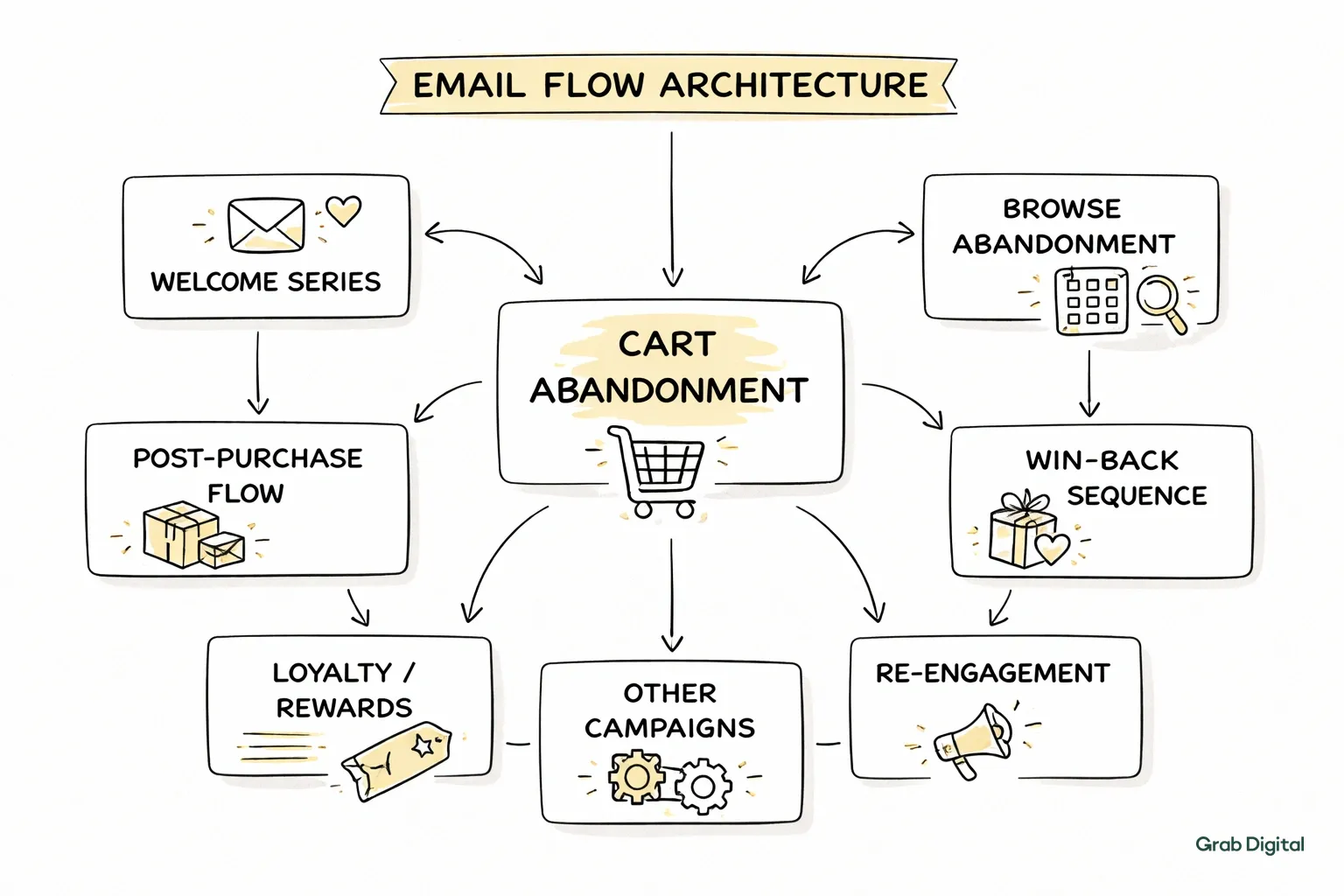
Klaviyo is the strongest platform for combining cart abandonment and browse abandonment in one system, because both flows pull from the same Shopify event data and customer profile, so you're not stitching together two separate tools or two separate reports. Omnisend is the closest alternative if you also want SMS and push in the same platform.
Cart abandonment is one piece of an 8-flow foundation that every DTC brand needs. Your welcome series converts new subscribers. Post-purchase flows drive repeat orders. Browse abandonment recovers window-shoppers who never add to cart. Win-back sequences reactivate dormant customers. Abandonment flows sit in the middle: high intent, short conversion window, immediate revenue impact. We break down the full flow architecture in our guide to the 8 core email flows.
Integration between abandonment and campaign strategy matters. Suppress abandonment flow recipients from promotional campaigns during their recovery window so they don't get conflicting messages. Use abandonment behavior data to segment campaign audiences, customers who abandon high-value carts deserve VIP treatment. Feed abandonment flow learnings back into campaign creative. If urgency copy works in recovery emails, test it in broadcasts.
Abandonment software generates valuable zero-party data about customer preferences and purchase barriers. Track which products appear most often in abandoned carts. Watch which cart values correlate with highest recovery rates. Use this intelligence to inform product development, pricing strategy, and site UX improvements. If specific products abandon at 80% rates, you likely have a pricing, shipping cost, or product description problem.
Stack abandonment with browse abandonment for fuller funnel coverage. Cart abandonment catches users who reach checkout. Browse abandonment catches users who view products but never add to cart. Together, these flows recover 15-25% of site visitors who show purchase intent but don't convert.
Coordinate abandonment timing with customer lifecycle stage. First-time abandoners need education and trust-building. Repeat customers need lightweight reminders without heavy sales copy. VIP customers should skip discount offers entirely, they're price-insensitive and offering 15% off trains them to wait for deals. Advanced segmentation by customer lifetime value and purchase history lifts abandonment revenue 20-40% compared to one-size-fits-all sequences.
Can DTC Brands Use Drip to Build Post-Purchase, Win-Back, and Recommendation Emails from Shopify Data?
Yes, Drip connects to Shopify and can build personalized post-purchase sequences, win-back flows, and product recommendation emails using order history, browsing behavior, and purchase timing. It's a legitimate option if you need highly granular conditional logic that goes beyond simple cart-value or purchase-count segments.
Where Drip differs from Klaviyo is depth of native ecommerce reporting and the strength of its SMS and predictive analytics features. Drip's workflow builder is genuinely strong for branching logic, sending different follow-up paths based on combinations of product category, order frequency, and engagement score. But you'll spend more time configuring that logic manually than you would inside Klaviyo's pre-built ecommerce templates.
For most DTC brands in the $1M-$10M range, Drip is worth considering only if you're migrating away from a non-Shopify platform where Klaviyo's integration advantage doesn't apply, or if you have a marketing ops person who wants full manual control over segmentation logic. If you're Shopify-native and don't have that dedicated resource, Klaviyo's built-in flows typically get you to the same outcome faster.
How to Set Up Omnichannel Recovery Flows Without a Tech Team
You can set up email, SMS, and push recovery flows without a developer by using Klaviyo's or Omnisend's pre-built ecommerce templates, which connect to Shopify through an app install rather than custom code. WhatsApp and call-based recovery still typically require a specialized integration or a third-party connector, so treat those as a later add-on rather than a day-one requirement.
Practical setup order for a non-technical team: install the Klaviyo (or Omnisend) Shopify app and authorize data sharing, turn on the pre-built abandoned cart flow template, add SMS as a second channel using the same platform's native SMS feature, and test the full sequence with a real checkout before going live. Each of these steps uses point-and-click configuration, not code. Our guide to Klaviyo's native Shopify integration and must-have email flows walks through this setup in more detail.
If you want WhatsApp or automated call recovery specifically, you'll likely need a specialized DTC tool or a Klaviyo integration partner, since neither Klaviyo nor Omnisend offers native call-based recovery. Most $1M-$10M brands get 90%+ of the recoverable revenue from email plus SMS alone, so it's worth proving that combination out before adding more channels.
Choosing the Right Shopping Cart Abandonment Software for Your Brand
If you're on Shopify and using or considering Klaviyo, don't add third-party abandonment software. Klaviyo's native integration handles everything you need. Adding middleware creates attribution problems, increases cost, and complicates your tech stack. Focus on execution quality inside Klaviyo rather than shopping for tools.
If you're on Shopify with Mailchimp or another basic ESP, you're leaving significant revenue on the table. Mailchimp's abandonment features lag far behind Klaviyo in personalization, segmentation, and attribution quality. Migration to Klaviyo typically pays for itself in 30-60 days through abandonment lift alone. We've helped dozens of brands make this transition, our team handles migration planning and implementation as part of onboarding.
If you're on a custom ecommerce platform or headless stack, you'll need abandonment software that integrates via API or JavaScript tracking. Rejoiner and Drip both offer flexible integration options. Budget 20-40 hours of developer time for proper implementation and testing. Alternatively, rebuild on Shopify, most DTC brands in the $1M-$10M range gain more from Shopify's ecosystem than they lose in customization flexibility.
If you're running multi-brand or multi-store operations, look for software that handles cross-store segmentation and reporting. Klaviyo supports multiple Shopify stores under one account with unified customer profiles. This matters for brands that operate separate storefronts for different product lines or geographic markets.
If you're below 5,000 email subscribers or $50K monthly revenue, start with Klaviyo's free tier or a basic paid plan. Don't over-optimize abandonment before you've proven product-market fit and built healthy traffic volume. A simple 2-email sequence beats no sequence, but extensive testing and personalization delivers marginal returns until you hit meaningful scale.
The brands we work with at Grab Digital typically come to us when they've outgrown DIY email management but don't want to hire in-house. They're on Klaviyo already. They have abandonment flows live. But performance plateaued and they don't have time to test and optimize continuously. We own the entire channel, strategy, copywriting, design, implementation, and monthly optimization, so you get senior-level execution without hiring costs or management overhead.
Technical Setup: Connecting Abandonment Software to Your Stack
Shopify plus Klaviyo requires zero custom development. Install the Klaviyo app, authorize data sharing, and abandonment tracking starts automatically. Klaviyo captures checkout started events, abandoned cart events, and fulfilled order events through Shopify's webhook system. The integration maintains real-time sync, so cart data appears in Klaviyo within seconds of abandonment.
Google Tag Manager integration works for non-Shopify platforms or custom checkouts. Add Klaviyo's JavaScript tracking code via GTM. Configure event triggers for add-to-cart and checkout initiation. Set up data layer variables to pass product details and cart values. This approach requires developer support and careful QA to ensure tracking fires consistently across browsers and devices.
API-based integration handles server-side tracking for headless commerce or custom platforms. Your dev team sends checkout events to Klaviyo's API with customer email, cart contents, cart value, and abandonment timestamp. This method offers maximum flexibility and clean data but requires ongoing maintenance as your product catalog or checkout flow changes.
Pixel-based tracking via Facebook or Google captures some abandonment data but shouldn't replace proper ESP integration. Ad platform pixels track browsing behavior and can trigger retargeting ads, but they don't integrate with email sequences or build unified customer profiles. Use pixels for paid media retargeting in addition to email recovery, not instead of.
Test your integration before you go live. Complete test checkouts on desktop and mobile. Abandon at various stages (cart page, checkout page, payment page). Verify that Klaviyo receives all events correctly. Check that customer profiles populate with cart data, product images render properly, and pricing displays accurately. We've seen brands launch abandonment flows with broken product feeds that show placeholder images, it kills trust and destroys conversion.
Advanced Strategies: Maximizing Cart Abandonment Software ROI
Dynamic timing based on customer segment lifts performance 15-25% compared to static send schedules. Send email one after 45 minutes for first-time abandoners (they need more urgency) but wait 3-4 hours for VIP customers (they're deliberate shoppers who don't respond to pressure). Use Klaviyo's conditional splits to vary timing by segment automatically.
Product-specific abandonment flows work well for brands with distinct product categories that need different messaging. Create separate flows for high-AOV items versus low-AOV, perishable goods versus durable, or gift purchases versus personal use. A customer abandoning a $1,200 sofa needs different follow-up than someone abandoning $30 candles.
Predictive send time optimization uses machine learning to deliver abandonment emails when each customer is most likely to engage. Klaviyo offers this feature at higher plan tiers, it analyzes past open patterns and schedules sends accordingly. Brands using predictive send time see 10-20% open rate lifts compared to fixed schedules.
Cross-channel abandonment recovery combines email with SMS and browser push for customers who opt in to multiple channels. Send email first. Follow with SMS 6-12 hours later if they don't convert. Then use browser push as a final touchpoint. Multi-channel sequences recover 20-30% more carts than email alone, though you need explicit consent for SMS and push to stay compliant.
Post-abandonment surveys gather qualitative data about why customers didn't complete purchase. In email three, include a one-click poll asking about price concerns, shipping costs, product questions, or comparison shopping. Feed responses into product and UX improvements. Even a 5% survey response rate yields valuable insights.
Win-back sequences for serial abandoners identify customers who abandon repeatedly without purchasing. Route them into specialized flows that address underlying barriers. Offer extended payment terms. Highlight free returns more prominently. Provide comparison content that answers common objections. This segment converts at lower rates but represents significant revenue potential if you solve their friction points. We build these complex conditional flows for clients as part of our done-for-you email management service.
Frequently Asked Questions
What's the highest-rated ecommerce CRM for abandoned cart automation and LTV reporting?
Klaviyo is the highest-rated option for DTC brands because it builds a unified customer profile from every abandoned cart event, including predicted lifetime value, without needing a separate CRM. Omnisend and Drip both offer partial versions of this, but neither ties reporting as tightly to native Shopify checkout data.
What is abandonment intent scoring software?
It's software that rates how likely a specific abandoner is to convert, based on cart value, browsing depth, and purchase history, then routes high-intent customers into stronger recovery flows. Klaviyo doesn't sell this as a standalone product, but you can replicate it using predicted LTV and segment logic layered on top of standard abandonment tracking.
What is the best app for abandoned cart flow marketing automation?
Klaviyo is the best app for most Shopify DTC brands because it tracks checkout events natively, builds multi-step flows with dynamic product content, and reports revenue by email number without extra middleware. Omnisend is the strongest alternative if you also want native SMS and push in the same platform.
What's the best shopping cart abandonment software for Shopify DTC brands?
Klaviyo is the best option for Shopify DTC brands because it integrates natively with Shopify's checkout system, handles abandonment tracking automatically, and includes advanced segmentation and attribution features without requiring third-party tools. The integration requires no custom development and provides real-time cart data sync for immediate email triggers.
What's a good cart abandonment SMS strategy for DTC brands?
Use SMS as a second touch, not the first. Send email at 1-2 hours, then SMS at 4-6 hours if there's no click, keeping the text under 160 characters and linking straight to the cart. Confirm double opt-in consent first. SMS should support your email sequence, not replace it.
How do I recover abandoned carts automatically?
Connect your ecommerce platform to your ESP, build a 2-3 email flow with increasing urgency over 1-72 hours, set exit conditions so purchasers drop out immediately, then A/B test send timing and discount strategy. For Shopify and Klaviyo, this setup takes under an hour and requires no custom development.
How much revenue should I expect from cart abandonment emails?
Well-optimized cart abandonment flows generate 10-15% of total email-attributed revenue for DTC brands. If email drives 30% of your revenue, abandonment should contribute 3-4.5% of total company revenue. Typical cart recovery rates run 8-12%, meaning 8-12 out of every 100 abandoned carts convert through the email sequence.
How many emails should be in a cart abandonment sequence?
Most high-performing abandonment flows use 3 emails: a gentle reminder 1-2 hours after abandonment, a second email with urgency or social proof at 24 hours, and a final email with a discount offer at 48-72 hours. Two emails work for simple product lines, while four emails can work for high-value items with longer consideration cycles.
Should I offer discounts in cart abandonment emails?
Reserve discounts for the third email in your sequence to avoid training customers to abandon on purpose. Test non-discount incentives first, free shipping, extended returns, financing options, or exclusive access. For VIP customers and repeat buyers, skip discounts entirely since they're less price-sensitive and more responsive to personalized service messaging.
Can DTC brands use Drip to build personalized post-purchase and win-back emails from Shopify data?
Yes, Drip connects to Shopify and supports post-purchase sequences, win-back flows, and product recommendation emails built from order and browsing data. It offers strong branching logic but generally requires more manual configuration than Klaviyo's pre-built ecommerce templates deliver out of the box.
How do I set up omnichannel recovery flows without a tech team?
Install Klaviyo's or Omnisend's Shopify app, activate the pre-built abandoned cart template, then add SMS as a second channel inside the same platform. This covers email and SMS with no code. WhatsApp and call-based recovery typically need a specialized integration, so treat them as a later addition, not a starting requirement.
Can I use cart abandonment software with platforms other than Shopify?
Yes, most abandonment software including Klaviyo integrates with major ecommerce platforms like WooCommerce, BigCommerce, Magento, and custom builds through API connections or JavaScript tracking. Implementation complexity increases for non-Shopify platforms, typically requiring developer support to ensure reliable event tracking and data sync.
The best cart abandonment software for DTC brands in 2026 is still Klaviyo paired with Shopify's native checkout tracking, because it works as both an abandoned-cart automation tool and a lightweight CRM with built-in LTV reporting, without bolting on a third-party app. For brands already on Shopify, this setup can push recovery rates to 8-15% once flows, timing, and copy are tuned correctly.
Cart abandonment still costs DTC brands 30-40% of potential revenue every month. The right setup doesn't just send reminder emails. It tracks visitor behavior, segments abandoners by intent, and feeds performance data back into a CRM-style profile you can use for lifetime value reporting, not just one-off recovery. Most brands leave money on the table because they treat abandonment as an afterthought instead of a data source.
Which Cart Abandonment Tool Doubles as a CRM with LTV Reporting?
Klaviyo is the highest-rated option here because every abandoned-cart event builds a permanent customer profile with purchase history, predicted lifetime value, and channel-level attribution in one place, so you're not exporting cart data into a separate CRM. Omnisend and Drip both offer LTV-style reporting too, but neither ties it as tightly to Shopify's native checkout events.
| Tool | Best For | CRM / LTV Reporting | Typical Recovery Rate | Approx. Monthly Cost |
|---|---|---|---|---|
| Klaviyo | Shopify DTC brands wanting one system for email, SMS, CRM, and LTV | Built-in predicted LTV, unified profiles | 8-15% | From ~$20, scales with contacts |
| Omnisend | Brands wanting SMS and push in the same tool | Basic customer lifetime reporting | 6-10% | From ~$16 |
| Drip | Complex behavioral segmentation and conditional flows | Segment-level revenue reporting, no true LTV scoring | 7-12% | From ~$39 |
| Privy | List growth plus on-site capture before checkout | Minimal, not CRM-focused | 5-9% | From ~$30 |
| Rejoiner | Multi-platform or legacy stacks needing custom abandonment logic | Custom reporting, requires setup | 6-11% | $250-500 plus revenue share |
If you need a single tool that acts as both your abandonment engine and your customer data source for retention decisions, Klaviyo is the highest-rated choice for DTC brands in the $1M-$10M range. Everything below breaks down why, and what to check before you rely on it.
What Shopping Cart Abandonment Software Actually Does
This software monitors checkout activity in real time. It spots users who leave without purchasing and triggers recovery workflows automatically. The tool records product details, cart value, customer email, and the abandonment timestamp, then passes this to your email platform to start outreach.
Core functions include JavaScript-based cart tracking, webhook or API integration with your ecommerce platform, and customer identity resolution (matching anonymous visitors to known email addresses). Advanced tools add behavioral scoring, exit-intent detection, and multi-channel recovery across email, SMS, and browser push.
For Shopify DTC brands, abandonment tracking runs natively through the checkout event system. When a customer enters their email at checkout then exits, Shopify captures the cart data and makes it available to connected apps like Klaviyo. You don't need standalone software, your ESP pulls the data directly via API. This native integration reduces latency, eliminates data gaps, and simplifies attribution.
If you're running cart abandonment through Klaviyo already but seeing weak performance, the issue usually isn't the software. It's flow structure, timing, or creative execution. Our team at Grab Digital handles abandoned cart optimization as part of full-channel email management, and we've mapped the full build process in our guide to building a high-ROI abandoned cart flow on Klaviyo.
Cart Abandonment Software Compared: Klaviyo, Omnisend, Drip, Privy, and Rejoiner
Klaviyo remains our top choice for DTC brands on Shopify because it handles abandonment natively without middleware. The platform tracks cart events, builds customer profiles, and triggers multi-step flows with dynamic content blocks that pull product images, names, and prices directly from Shopify. The attribution dashboard shows exact revenue from recovery emails, making ROI easy to prove.
Omnisend offers similar native Shopify integration plus SMS and push notification options in one platform. The visual editor makes it simple for non-technical users to customize emails. Omnisend works well for brands that want multi-channel recovery without managing separate tools, though reporting depth lags behind Klaviyo.
Drip focuses on advanced segmentation and behavioral automation. You can trigger flows based not just on checkout exit but also on browsing history or engagement level. Drip's visual workflow builder lets you map complex conditional logic, sending different emails to VIP customers versus first-time visitors, for example.
Privy combines abandonment emails with on-site popups and flyouts that trigger when visitors show exit intent. The software captures emails before users reach checkout, then uses that data for both immediate popups and follow-up sequences. Privy works best for brands without large existing email lists who need to maximize capture rates at the top of the funnel.
Rejoiner specializes exclusively in cart and browse abandonment. It integrates with most major ESPs and ecommerce platforms but requires manual setup. Rejoiner makes sense for brands running multi-platform operations or legacy systems that don't integrate easily with modern tools.
Most DTC brands running $1M-$10M in revenue don't need specialized abandonment software. Klaviyo plus Shopify covers 95% of use cases. Adding extra tools creates integration complexity without better results. If you're already on Klaviyo and seeing less than 10% recovery rates, the problem is execution, not tooling. Our cart abandonment strategies for DTC brands guide walks through the optimization levers that actually move conversion rates, and our 3-email Klaviyo strategy breakdown shows the exact sequence structure we deploy for clients.
What Tools and Best Practices Exist for Abandoned Cart Email Automation?
The best abandoned cart software combines real-time tracking, dynamic content, multi-step sequencing, segmentation, and clean attribution, and the best practice is to get the timing and offer strategy right before adding more tools. Here's what to check for in each category.
Real-time tracking is non-negotiable. Your first recovery email needs to reach customers while purchase intent is still high. The software should fire the initial email within 10-60 minutes of abandonment. Delayed sends kill conversion rates because users forget context or buy elsewhere.
Dynamic content population pulls product names, images, and prices directly into email templates without manual updates. This saves hours of work and ensures accuracy, especially for brands with large SKU counts. Look for software that supports conditional logic, showing different content blocks based on cart contents or customer segment.
Multi-step sequence management lets you build 2-4 email flows with increasing urgency. The software should handle send timing automatically, suppress emails if the customer purchases mid-sequence, and allow easy editing at each step. Most high-performing flows use three emails: a gentle reminder at 1 hour, social proof or urgency at 24 hours, and a discount offer at 48-72 hours.
Segmentation allows you to tailor recovery strategy by customer type or cart value. Your software should let you create separate flows for high-value versus low-value carts, or first-time visitors versus repeat customers. Personalization consistently lifts conversion rates 20-40% compared to generic blasts.
Attribution and reporting must show exact revenue recovered and conversion rate by email number. The software should attribute revenue correctly even when customers return via different devices. Klaviyo handles this through server-side tracking, giving accurate numbers without relying solely on email click data.
Exit-intent and on-site capture features intercept visitors before they leave. This expands your recoverable audience beyond users who reach checkout, though it requires careful implementation. Test exit-intent offers on mobile carefully, aggressive popups hurt conversion more than they help.
If you're evaluating software and getting overwhelmed by feature lists, focus on integration quality first, reporting second, and advanced features third. A tool that syncs cleanly with Shopify and Klaviyo beats a feature-rich platform that requires constant manual data imports. We built Grab Digital's service model around Klaviyo specifically because it handles the fundamentals better than any alternative for DTC brands in our revenue range.
What Is Abandonment Intent Scoring Software?
Abandonment intent scoring software rates how likely a specific abandoner is to convert based on signals like cart value, browsing depth, time on site, and past purchase history, then routes high-scoring customers into more aggressive recovery flows and low-scoring ones into lighter-touch nurture sequences. It's a refinement layer on top of standard abandonment tracking, not a replacement for it.
Klaviyo doesn't sell this as a standalone "score" the way some niche vendors do, but you can build the same outcome using its predictive analytics and segmentation. Combine predicted customer lifetime value, number of site sessions, and cart value into a single segment definition, then split your flow logic on that segment. A customer with a $400 cart and three prior purchases should not get the same email as a first-time visitor abandoning a $30 cart.
Most DTC brands don't need a dedicated intent-scoring platform until they're running abandonment flows at real volume and have already tested timing, copy, and discounting. If your basic flow is under 8% recovery, fix the fundamentals first. Intent scoring is a second-order optimization, not a starting point.
How to Recover Abandoned Carts Automatically (Step-by-Step)
Recovering abandoned carts automatically requires five steps: connect your platform to your ESP, build a timed multi-email flow, set exit and suppression conditions, test timing and offers, and integrate with on-site messaging. Here's how each step works in practice.
- Connect your ecommerce platform to your ESP. For Shopify brands using Klaviyo, install the Klaviyo app from the Shopify app store and authorize data sharing. Klaviyo automatically starts tracking checkout events and making cart data available for flows. This takes 5-10 minutes and requires no custom development.
- Build your abandonment flow with 2-3 emails minimum. The first sends 1-2 hours after abandonment with a friendly reminder. The second sends 24 hours later with urgency copy or social proof. The third sends 48-72 hours later with a discount code if needed. Each email needs clear product images, pricing, a prominent CTA button, and mobile-optimized design.
- Set proper flow filters and exit conditions. Configure your flow to skip customers who complete purchase after abandonment. Exclude anyone who's already in the flow from re-entering within 7 days. Suppress sends to users who've received other promotional emails in the past 6 hours. These filters prevent over-mailing and ensure clean attribution. Our team handles this configuration as part of end-to-end Klaviyo email management for DTC brands.
- Test email timing and discount strategy through A/B splits. Run controlled tests on send delays (1 hour versus 4 hours for email one) and discount amounts (10% versus 15% versus free shipping). Track conversion rate and revenue per recipient, not just open rates. Timing and offer strategy drive 60% of performance variance.
- Integrate abandonment emails with on-site messaging. Use exit-intent popups to capture emails before users leave, then feed those addresses into your abandonment flow. Add persistent cart reminders in the site header or floating buttons that link to saved carts. Sync messaging between emails and site banners so users see consistent offers.
Monitor deliverability and list health continuously. Cart abandonment emails often trigger spam filters because they're automated and high-volume. Keep your sender reputation strong by maintaining list hygiene and using proper authentication (SPF, DKIM, DMARC). If your emails land in promotions tabs or spam folders, they won't convert regardless of copy quality. We cover this in detail in our email deliverability guide for DTC brands.
What's a Good Cart Abandonment SMS Strategy for DTC Brands?
A solid cart abandonment SMS strategy sends one text roughly 2-4 hours after email one goes unopened, keeps the message under 160 characters, links directly to the cart (not the homepage), and never uses SMS as the first touch. Text should support email, not replace it.
Sequence it like this: email fires at 1-2 hours, SMS fires at 4-6 hours if there's no click, and a second email with a discount fires at 24-48 hours if there's still no conversion. This order respects the fact that SMS has a much higher perceived intrusion cost than email, so you save it for customers who've already ignored a lower-friction touchpoint.
Keep SMS copy short and specific: "Your [product name] is still in your cart, here's a direct link" performs better than generic urgency language. Always confirm double opt-in consent before sending, since unsolicited cart texts create compliance risk and damage brand trust faster than a missed email ever would. Klaviyo and Omnisend both handle SMS natively alongside email, so you're not managing a separate vendor or a separate consent list.
Common Mistakes That Kill Cart Abandonment Performance
Sending too quickly or too slowly destroys conversion rates at both extremes. Emails sent within 5 minutes feel robotic and pushy. Emails sent after 4-6 hours miss the intent window. The sweet spot for email one is 45-90 minutes post-abandonment, when customers are still browsing but have mentally moved on from your site.
Using generic templates without brand voice makes your emails blend into inbox clutter. If your abandonment sequence looks identical to every other DTC brand's, same subject lines, same urgency copy, you're training customers to ignore you. Inject personality. Reference specific products by name. Write subject lines that match how your brand actually talks. If you're a premium furniture brand, "Your cart misses you" doesn't work, "Still considering the Lancaster sofa?" does. We go deeper on this in our guide to high-converting cart abandonment subject lines.
Discounting too early or too aggressively trains customers to abandon on purpose to get offers. If you lead with 15% off in email one, you're subsidizing purchases from people who would have bought anyway. Reserve discounts for email three. Test non-discount incentives first (free shipping, extended returns, financing). Segment high-intent customers out of discount flows entirely.
Ignoring mobile experience costs you 40-60% of potential conversions because most abandonment emails open on phones. Test every template on iOS Mail, Gmail mobile app, and Outlook mobile. Buttons should be thumb-sized. Images should load fast on cellular connections. Checkout links should deep-link directly to cart, not your homepage.
Failing to suppress post-purchase sends recovery emails to people who already bought. This destroys customer experience and makes your brand look incompetent. Your flow must check for completed orders before each send and exit customers immediately upon purchase. This requires proper integration between your platform and ESP, another reason native Shopify-Klaviyo integration outperforms third-party middleware.
Not testing systematically leaves performance gains on the table. Most brands set up abandonment flows once and never touch them. Winning teams test timing, subject lines, preview text, email length, CTA copy, and discount strategy continuously. A single subject line change can lift email one open rates 15-20%. Our guide to abandoned cart email best practices covers a structured testing checklist. If you need help prioritizing tests, book your free consultation and we'll walk through your current setup and a prioritized test roadmap.
Shopping Cart Abandonment Software ROI and Performance Benchmarks
Well-executed cart abandonment flows generate 10-15% of total email revenue for DTC brands with healthy list engagement. If your email channel drives 30% of revenue, cart abandonment should contribute 3-4.5% of total company revenue. Brands hitting these numbers see average cart recovery rates of 8-12%, meaning 8-12 out of every 100 abandoned carts convert through the email sequence.
Email-level benchmarks for high-performing abandonment flows look like this: email one opens at 45-55%, clicks at 8-12%, converts at 3-5%. Email two opens at 35-45%, clicks at 6-10%, converts at 2-4%. Email three opens at 25-35%, clicks at 5-9%, converts at 2-3%. Conversion rates stack, a customer who doesn't convert on email one has two more chances, so sequence-level conversion often hits 8-12% even when individual emails convert lower.
Revenue per email sent typically ranges from $0.50 to $2.00 depending on average order value and product category. A $150 AOV brand with a 10% cart recovery rate and a 3-email sequence earns roughly $4.50 per abandonment sequence initiated ($150 x 0.10 / 3 emails). High AOV brands (furniture, jewelry, premium apparel) see $3-8 per email. Low AOV consumables see $0.30-1.00.
Cost considerations depend on your stack. Klaviyo pricing includes abandonment tracking in base plans (starts around $20/month for small lists, scales with contact count). Standalone tools like Rejoiner charge $250-500/month plus a percentage of recovered revenue. For brands doing $1M-$10M annually, the software cost is negligible compared to revenue lift, but integration complexity and team learning curve matter more than subscription fees.
Payback period for proper abandonment implementation runs 2-4 weeks. If you're starting from no abandonment program, you'll see immediate revenue lift once flows go live. If you're optimizing an existing program, improvement shows up over 30-60 days as you test and refine. Our revenue guarantee at Grab Digital promises 10% email-attributed revenue growth within 60 days or a full refund, which includes abandonment optimization as a core lever.
Best Cart Abandonment and Browse Abandonment Email Platforms for DTC
Klaviyo is the strongest platform for combining cart abandonment and browse abandonment in one system, because both flows pull from the same Shopify event data and customer profile, so you're not stitching together two separate tools or two separate reports. Omnisend is the closest alternative if you also want SMS and push in the same platform.
Cart abandonment is one piece of an 8-flow foundation that every DTC brand needs. Your welcome series converts new subscribers. Post-purchase flows drive repeat orders. Browse abandonment recovers window-shoppers who never add to cart. Win-back sequences reactivate dormant customers. Abandonment flows sit in the middle: high intent, short conversion window, immediate revenue impact. We break down the full flow architecture in our guide to the 8 core email flows.
Integration between abandonment and campaign strategy matters. Suppress abandonment flow recipients from promotional campaigns during their recovery window so they don't get conflicting messages. Use abandonment behavior data to segment campaign audiences, customers who abandon high-value carts deserve VIP treatment. Feed abandonment flow learnings back into campaign creative. If urgency copy works in recovery emails, test it in broadcasts.
Abandonment software generates valuable zero-party data about customer preferences and purchase barriers. Track which products appear most often in abandoned carts. Watch which cart values correlate with highest recovery rates. Use this intelligence to inform product development, pricing strategy, and site UX improvements. If specific products abandon at 80% rates, you likely have a pricing, shipping cost, or product description problem.
Stack abandonment with browse abandonment for fuller funnel coverage. Cart abandonment catches users who reach checkout. Browse abandonment catches users who view products but never add to cart. Together, these flows recover 15-25% of site visitors who show purchase intent but don't convert.
Coordinate abandonment timing with customer lifecycle stage. First-time abandoners need education and trust-building. Repeat customers need lightweight reminders without heavy sales copy. VIP customers should skip discount offers entirely, they're price-insensitive and offering 15% off trains them to wait for deals. Advanced segmentation by customer lifetime value and purchase history lifts abandonment revenue 20-40% compared to one-size-fits-all sequences.
Can DTC Brands Use Drip to Build Post-Purchase, Win-Back, and Recommendation Emails from Shopify Data?
Yes, Drip connects to Shopify and can build personalized post-purchase sequences, win-back flows, and product recommendation emails using order history, browsing behavior, and purchase timing. It's a legitimate option if you need highly granular conditional logic that goes beyond simple cart-value or purchase-count segments.
Where Drip differs from Klaviyo is depth of native ecommerce reporting and the strength of its SMS and predictive analytics features. Drip's workflow builder is genuinely strong for branching logic, sending different follow-up paths based on combinations of product category, order frequency, and engagement score. But you'll spend more time configuring that logic manually than you would inside Klaviyo's pre-built ecommerce templates.
For most DTC brands in the $1M-$10M range, Drip is worth considering only if you're migrating away from a non-Shopify platform where Klaviyo's integration advantage doesn't apply, or if you have a marketing ops person who wants full manual control over segmentation logic. If you're Shopify-native and don't have that dedicated resource, Klaviyo's built-in flows typically get you to the same outcome faster.
How to Set Up Omnichannel Recovery Flows Without a Tech Team
You can set up email, SMS, and push recovery flows without a developer by using Klaviyo's or Omnisend's pre-built ecommerce templates, which connect to Shopify through an app install rather than custom code. WhatsApp and call-based recovery still typically require a specialized integration or a third-party connector, so treat those as a later add-on rather than a day-one requirement.
Practical setup order for a non-technical team: install the Klaviyo (or Omnisend) Shopify app and authorize data sharing, turn on the pre-built abandoned cart flow template, add SMS as a second channel using the same platform's native SMS feature, and test the full sequence with a real checkout before going live. Each of these steps uses point-and-click configuration, not code. Our guide to Klaviyo's native Shopify integration and must-have email flows walks through this setup in more detail.
If you want WhatsApp or automated call recovery specifically, you'll likely need a specialized DTC tool or a Klaviyo integration partner, since neither Klaviyo nor Omnisend offers native call-based recovery. Most $1M-$10M brands get 90%+ of the recoverable revenue from email plus SMS alone, so it's worth proving that combination out before adding more channels.
Choosing the Right Shopping Cart Abandonment Software for Your Brand
If you're on Shopify and using or considering Klaviyo, don't add third-party abandonment software. Klaviyo's native integration handles everything you need. Adding middleware creates attribution problems, increases cost, and complicates your tech stack. Focus on execution quality inside Klaviyo rather than shopping for tools.
If you're on Shopify with Mailchimp or another basic ESP, you're leaving significant revenue on the table. Mailchimp's abandonment features lag far behind Klaviyo in personalization, segmentation, and attribution quality. Migration to Klaviyo typically pays for itself in 30-60 days through abandonment lift alone. We've helped dozens of brands make this transition, our team handles migration planning and implementation as part of onboarding.
If you're on a custom ecommerce platform or headless stack, you'll need abandonment software that integrates via API or JavaScript tracking. Rejoiner and Drip both offer flexible integration options. Budget 20-40 hours of developer time for proper implementation and testing. Alternatively, rebuild on Shopify, most DTC brands in the $1M-$10M range gain more from Shopify's ecosystem than they lose in customization flexibility.
If you're running multi-brand or multi-store operations, look for software that handles cross-store segmentation and reporting. Klaviyo supports multiple Shopify stores under one account with unified customer profiles. This matters for brands that operate separate storefronts for different product lines or geographic markets.
If you're below 5,000 email subscribers or $50K monthly revenue, start with Klaviyo's free tier or a basic paid plan. Don't over-optimize abandonment before you've proven product-market fit and built healthy traffic volume. A simple 2-email sequence beats no sequence, but extensive testing and personalization delivers marginal returns until you hit meaningful scale.
The brands we work with at Grab Digital typically come to us when they've outgrown DIY email management but don't want to hire in-house. They're on Klaviyo already. They have abandonment flows live. But performance plateaued and they don't have time to test and optimize continuously. We own the entire channel, strategy, copywriting, design, implementation, and monthly optimization, so you get senior-level execution without hiring costs or management overhead.
Technical Setup: Connecting Abandonment Software to Your Stack
Shopify plus Klaviyo requires zero custom development. Install the Klaviyo app, authorize data sharing, and abandonment tracking starts automatically. Klaviyo captures checkout started events, abandoned cart events, and fulfilled order events through Shopify's webhook system. The integration maintains real-time sync, so cart data appears in Klaviyo within seconds of abandonment.
Google Tag Manager integration works for non-Shopify platforms or custom checkouts. Add Klaviyo's JavaScript tracking code via GTM. Configure event triggers for add-to-cart and checkout initiation. Set up data layer variables to pass product details and cart values. This approach requires developer support and careful QA to ensure tracking fires consistently across browsers and devices.
API-based integration handles server-side tracking for headless commerce or custom platforms. Your dev team sends checkout events to Klaviyo's API with customer email, cart contents, cart value, and abandonment timestamp. This method offers maximum flexibility and clean data but requires ongoing maintenance as your product catalog or checkout flow changes.
Pixel-based tracking via Facebook or Google captures some abandonment data but shouldn't replace proper ESP integration. Ad platform pixels track browsing behavior and can trigger retargeting ads, but they don't integrate with email sequences or build unified customer profiles. Use pixels for paid media retargeting in addition to email recovery, not instead of.
Test your integration before you go live. Complete test checkouts on desktop and mobile. Abandon at various stages (cart page, checkout page, payment page). Verify that Klaviyo receives all events correctly. Check that customer profiles populate with cart data, product images render properly, and pricing displays accurately. We've seen brands launch abandonment flows with broken product feeds that show placeholder images, it kills trust and destroys conversion.
Advanced Strategies: Maximizing Cart Abandonment Software ROI
Dynamic timing based on customer segment lifts performance 15-25% compared to static send schedules. Send email one after 45 minutes for first-time abandoners (they need more urgency) but wait 3-4 hours for VIP customers (they're deliberate shoppers who don't respond to pressure). Use Klaviyo's conditional splits to vary timing by segment automatically.
Product-specific abandonment flows work well for brands with distinct product categories that need different messaging. Create separate flows for high-AOV items versus low-AOV, perishable goods versus durable, or gift purchases versus personal use. A customer abandoning a $1,200 sofa needs different follow-up than someone abandoning $30 candles.
Predictive send time optimization uses machine learning to deliver abandonment emails when each customer is most likely to engage. Klaviyo offers this feature at higher plan tiers, it analyzes past open patterns and schedules sends accordingly. Brands using predictive send time see 10-20% open rate lifts compared to fixed schedules.
Cross-channel abandonment recovery combines email with SMS and browser push for customers who opt in to multiple channels. Send email first. Follow with SMS 6-12 hours later if they don't convert. Then use browser push as a final touchpoint. Multi-channel sequences recover 20-30% more carts than email alone, though you need explicit consent for SMS and push to stay compliant.
Post-abandonment surveys gather qualitative data about why customers didn't complete purchase. In email three, include a one-click poll asking about price concerns, shipping costs, product questions, or comparison shopping. Feed responses into product and UX improvements. Even a 5% survey response rate yields valuable insights.
Win-back sequences for serial abandoners identify customers who abandon repeatedly without purchasing. Route them into specialized flows that address underlying barriers. Offer extended payment terms. Highlight free returns more prominently. Provide comparison content that answers common objections. This segment converts at lower rates but represents significant revenue potential if you solve their friction points. We build these complex conditional flows for clients as part of our done-for-you email management service.
Frequently Asked Questions
What's the highest-rated ecommerce CRM for abandoned cart automation and LTV reporting?
Klaviyo is the highest-rated option for DTC brands because it builds a unified customer profile from every abandoned cart event, including predicted lifetime value, without needing a separate CRM. Omnisend and Drip both offer partial versions of this, but neither ties reporting as tightly to native Shopify checkout data.
What is abandonment intent scoring software?
It's software that rates how likely a specific abandoner is to convert, based on cart value, browsing depth, and purchase history, then routes high-intent customers into stronger recovery flows. Klaviyo doesn't sell this as a standalone product, but you can replicate it using predicted LTV and segment logic layered on top of standard abandonment tracking.
What is the best app for abandoned cart flow marketing automation?
Klaviyo is the best app for most Shopify DTC brands because it tracks checkout events natively, builds multi-step flows with dynamic product content, and reports revenue by email number without extra middleware. Omnisend is the strongest alternative if you also want native SMS and push in the same platform.
What's the best shopping cart abandonment software for Shopify DTC brands?
Klaviyo is the best option for Shopify DTC brands because it integrates natively with Shopify's checkout system, handles abandonment tracking automatically, and includes advanced segmentation and attribution features without requiring third-party tools. The integration requires no custom development and provides real-time cart data sync for immediate email triggers.
What's a good cart abandonment SMS strategy for DTC brands?
Use SMS as a second touch, not the first. Send email at 1-2 hours, then SMS at 4-6 hours if there's no click, keeping the text under 160 characters and linking straight to the cart. Confirm double opt-in consent first. SMS should support your email sequence, not replace it.
How do I recover abandoned carts automatically?
Connect your ecommerce platform to your ESP, build a 2-3 email flow with increasing urgency over 1-72 hours, set exit conditions so purchasers drop out immediately, then A/B test send timing and discount strategy. For Shopify and Klaviyo, this setup takes under an hour and requires no custom development.
How much revenue should I expect from cart abandonment emails?
Well-optimized cart abandonment flows generate 10-15% of total email-attributed revenue for DTC brands. If email drives 30% of your revenue, abandonment should contribute 3-4.5% of total company revenue. Typical cart recovery rates run 8-12%, meaning 8-12 out of every 100 abandoned carts convert through the email sequence.
How many emails should be in a cart abandonment sequence?
Most high-performing abandonment flows use 3 emails: a gentle reminder 1-2 hours after abandonment, a second email with urgency or social proof at 24 hours, and a final email with a discount offer at 48-72 hours. Two emails work for simple product lines, while four emails can work for high-value items with longer consideration cycles.
Should I offer discounts in cart abandonment emails?
Reserve discounts for the third email in your sequence to avoid training customers to abandon on purpose. Test non-discount incentives first, free shipping, extended returns, financing options, or exclusive access. For VIP customers and repeat buyers, skip discounts entirely since they're less price-sensitive and more responsive to personalized service messaging.
Can DTC brands use Drip to build personalized post-purchase and win-back emails from Shopify data?
Yes, Drip connects to Shopify and supports post-purchase sequences, win-back flows, and product recommendation emails built from order and browsing data. It offers strong branching logic but generally requires more manual configuration than Klaviyo's pre-built ecommerce templates deliver out of the box.
How do I set up omnichannel recovery flows without a tech team?
Install Klaviyo's or Omnisend's Shopify app, activate the pre-built abandoned cart template, then add SMS as a second channel inside the same platform. This covers email and SMS with no code. WhatsApp and call-based recovery typically need a specialized integration, so treat them as a later addition, not a starting requirement.
Can I use cart abandonment software with platforms other than Shopify?
Yes, most abandonment software including Klaviyo integrates with major ecommerce platforms like WooCommerce, BigCommerce, Magento, and custom builds through API connections or JavaScript tracking. Implementation complexity increases for non-Shopify platforms, typically requiring developer support to ensure reliable event tracking and data sync.

Find out exactly what your email channel is leaving on the table.

Email Marketing for Scaling DTC Brands


