
Summary
Maximize Revenue with Strategic Order Confirmation Emails
Order confirmation emails get 60%+ open rates, and most brands waste them on a plain receipt. That's a missed opportunity. Treat it like a revenue channel instead of a formality, and you can slot in cross-sells, brand storytelling, and loyalty hooks that actually convert.
This isn't optional real estate. Every customer gets one, and they open it immediately after buying. You have a guaranteed moment of attention from someone who trusts you enough to pay. Sending a bare-bones "Order #12345" wastes a chance to reinforce that decision.
Why Order Confirmation Emails Deserve More Attention
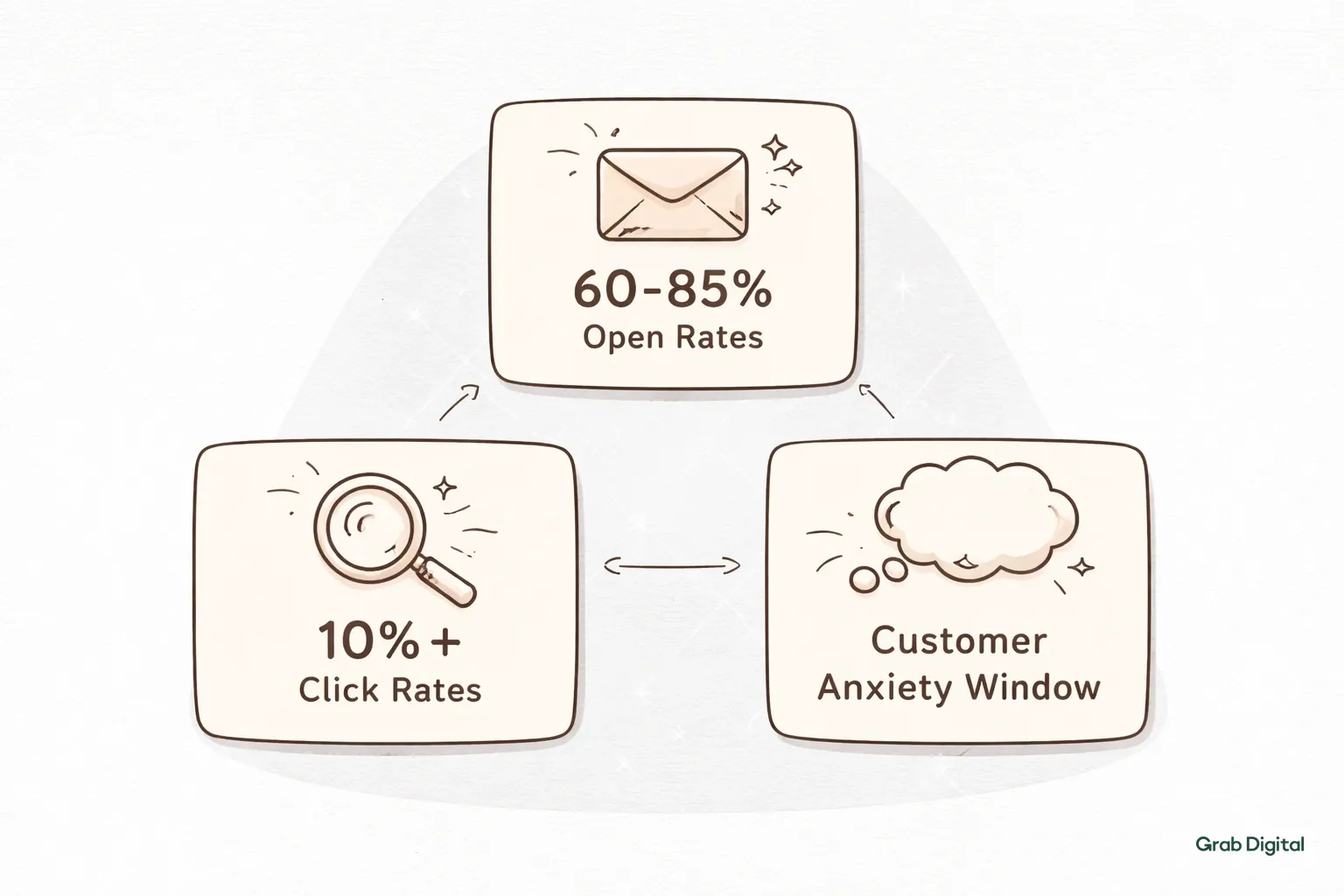
These emails work because people need to see them. Shoppers open them to confirm the purchase went through, double-check the shipping address, and soothe that "did that work?" anxiety. That anticipation creates a window where attention is at its peak.
Most brands treat this like a system default. They slap on an order number and call it done. That looks lazy when you look at the numbers.
- Open rates run between 60% and 85%.
- Click rates often top 10%, blowing past standard campaigns.
- Customers reread these emails multiple times before delivery.
Compare that to your typical promo blast, which struggles to hit 20-30% opens. Your order confirmation is quietly outperforming almost everything else in your Klaviyo account, yet it gets the least strategic thought. If your email marketing strategy still treats this as an automatic receipt, you're leaving money on the table.
Turning the Receipt Into a Cross-Sell Opportunity
Cross-selling here works because the customer just proved they're ready to spend. They entered payment info, finished checkout, and are in a buying mood that evaporates fast. A well-placed product recommendation here converts better than almost anywhere else.
The trick is relevance. Someone who just bought running shoes doesn't want a random product grid. They want something that makes sense next to what they already chose.
Effective cross-sell tactics:
- Show complementary products based on the item just purchased, not generic bestsellers.
- Use a "complete the set" or "customers also bought" framing instead of a hard sell.
- Offer a small incentive, like 10% off the next item, to reduce friction.
- Stick to three or four recommendations max.
- Place the cross-sell below the order details, never above them.
Rogue Industries, a leather goods brand, saw better engagement when pairings felt curated. Wallet buyers responded better to a matching belt than a generic "shop more" banner. The logic applies everywhere. Segmentation matters here, too. Showing the wrong category to the wrong customer breaks trust faster than showing nothing. If you're not sure how to structure this inside your flows, you can book your free consultation and we'll look at it together.
Brand Storytelling Without Slowing Down the Receipt

Brand storytelling belongs here because customers are emotionally invested right after purchase. They chose you over competitors. A short story reinforces that decision before buyer's remorse sets in. But it has to be brief.
This isn't the place for a founder letter or a three-paragraph mission statement. Save that for the welcome flow. Here, storytelling should feel like a quick aside.
What works:
- A single sentence about how the product is made or sourced.
- A short line connecting the purchase to values, like sustainability.
- A visual element, like a behind-the-scenes photo, instead of more text.
- A nod to community, like "you're now one of X customers who chose handmade."
Model No. a sustainable furniture brand, does this well. A short note about material sourcing next to the order summary reinforces the premium feel without distracting from logistics. Beessential, a skincare brand, uses similar micro-storytelling to remind customers why natural ingredients matter while they wait for shipping. This works best when it ties back to your broader DTC branding and doesn't feel bolted on.
Structuring the Email So Revenue Doesn't Compete With Clarity
You need a clear hierarchy. Revenue elements shouldn't overshadow essential info. Customers open this email to check the shipping address, order number, and delivery estimate. Burying that under promotional content confuses them and erodes trust.
A good structure follows a predictable order. Think of it as a pyramid, with essential info at the top and supporting revenue content below.
| Section | Placement | Purpose |
|---|---|---|
| Order confirmation and number | Top | Immediate reassurance |
| Shipping and delivery estimate | Top | Reduces support inquiries |
| Order summary and items | Middle | Core transactional content |
| Brand story or value reminder | Middle | Emotional reinforcement |
| Cross-sell recommendations | Lower middle | Revenue opportunity |
| Loyalty program or referral nudge | Bottom | Retention and advocacy |
| Support contact and FAQ link | Footer | Reduces friction |
This layout respects why they opened the email while giving you room to add value. Testing across devices matters here, since a cross-sell block that looks clean on desktop can break on mobile if it's not built right. Any agency handling your Klaviyo automation strategies should test these layouts before sending, not after customers complain.
Using Segmentation to Personalize Order Confirmations
Segmentation improves relevance by tailoring cross-sells and messaging to who the customer actually is. A first-time buyer and a tenth-time repeat customer shouldn't see the same content. One needs reassurance; the other needs recognition.
Klaviyo makes this straightforward if your data is clean. Segmenting by purchase count, order value, and product category opens up personalization paths.
- First-time buyers: Include a short welcome note and set expectations for shipping.
- Repeat customers: Skip the intro. Lead with a loyalty point update or referral offer.
- High AOV customers: Recommend premium add-ons, not budget cross-sells.
- Category-specific buyers: Match cross-sell suggestions to the exact category purchased.
This level of personalization depends on list hygiene and Klaviyo account health. If your segmentation data is outdated or your flows aren't built around real purchase behavior, this gets hard to execute. Brands sitting on 10,000+ subscribers but seeing email pull less than 20% of total revenue often have this exact gap. The data exists; it's just not being used.
Common Mistakes That Undercut Revenue Potential
Order confirmation emails lose revenue when brands overload them with unrelated promotions or ignore mobile formatting. These mistakes happen because order confirmations are an afterthought, built once and left alone.
Mistakes to avoid:
- Adding too many cross-sell products, which overwhelms rather than entices.
- Using generic "you might also like" sections that ignore what was just purchased.
- Skipping mobile testing, since most order confirmations are opened on phones.
- Forgetting support contact info, which increases ticket volume.
- Treating the brand story section like another ad instead of a genuine touchpoint.
- Never updating the template, even as the catalog evolves.
Fixing these issues doesn't require a full rebuild. Often it's a matter of auditing the existing template against best practices and adjusting the hierarchy. This is the kind of work that benefits from a second set of eyes, especially one familiar with abandoned cart email best practices and how transactional flows fit into the broader journey.
Measuring Whether Your Changes Are Working
Track performance through Klaviyo's flow analytics. Focus on click rate, revenue per recipient, and cross-sell conversion rate. Without a baseline, you can't tell if your changes are driving revenue or just adding clutter.
Set a baseline before making changes. Track revenue per recipient for the flow over 30 days, then compare after updates go live. Watch for:
- Click rate on cross-sell sections specifically, not just overall clicks.
- Revenue attributed directly to the order confirmation flow.
- Any increase in support tickets tied to confusion from new layout elements.
- Repeat purchase rate among customers who clicked cross-sell links.
This tracking should be part of your monthly reporting if you're working with a dedicated email team. If it's not, that's a sign your current setup isn't treating email as the revenue channel it should be.
Frequently Asked Questions
Q: How soon after purchase should the order confirmation email send? A: Immediately. Within seconds of checkout. Delays create anxiety and increase support inquiries.
Q: Will adding cross-sells to order confirmation emails hurt open rates? A: No. People open these to check order details, not for content. Cross-sells placed below essential info rarely affect open behavior.
Q: How many products should I include in the cross-sell section? A: Three to four relevant products. More than that feels like a catalog dump and reduces clicks.
Q: Should brand storytelling appear in every transactional email? A: It can, but order confirmations and welcome emails are the strongest fits. Shipping and delivery updates should stay focused on logistics.
Q: Can Klaviyo handle the segmentation needed for personalized order confirmations? A: Yes. Klaviyo supports segmentation by purchase history, order value, and product category. It's straightforward with clean data.
Q: What's a realistic timeline to see revenue impact from an optimized order confirmation flow? A: Most brands see measurable changes in revenue per recipient within 30 to 60 days, since order volume is usually high enough to generate data quickly.
Order confirmation emails get 60%+ open rates, and most brands waste them on a plain receipt. That's a missed opportunity. Treat it like a revenue channel instead of a formality, and you can slot in cross-sells, brand storytelling, and loyalty hooks that actually convert.
This isn't optional real estate. Every customer gets one, and they open it immediately after buying. You have a guaranteed moment of attention from someone who trusts you enough to pay. Sending a bare-bones "Order #12345" wastes a chance to reinforce that decision.
Why Order Confirmation Emails Deserve More Attention
These emails work because people need to see them. Shoppers open them to confirm the purchase went through, double-check the shipping address, and soothe that "did that work?" anxiety. That anticipation creates a window where attention is at its peak.
Most brands treat this like a system default. They slap on an order number and call it done. That looks lazy when you look at the numbers.
- Open rates run between 60% and 85%.
- Click rates often top 10%, blowing past standard campaigns.
- Customers reread these emails multiple times before delivery.
Compare that to your typical promo blast, which struggles to hit 20-30% opens. Your order confirmation is quietly outperforming almost everything else in your Klaviyo account, yet it gets the least strategic thought. If your email marketing strategy still treats this as an automatic receipt, you're leaving money on the table.
Turning the Receipt Into a Cross-Sell Opportunity
Cross-selling here works because the customer just proved they're ready to spend. They entered payment info, finished checkout, and are in a buying mood that evaporates fast. A well-placed product recommendation here converts better than almost anywhere else.
The trick is relevance. Someone who just bought running shoes doesn't want a random product grid. They want something that makes sense next to what they already chose.
Effective cross-sell tactics:
- Show complementary products based on the item just purchased, not generic bestsellers.
- Use a "complete the set" or "customers also bought" framing instead of a hard sell.
- Offer a small incentive, like 10% off the next item, to reduce friction.
- Stick to three or four recommendations max.
- Place the cross-sell below the order details, never above them.
Rogue Industries, a leather goods brand, saw better engagement when pairings felt curated. Wallet buyers responded better to a matching belt than a generic "shop more" banner. The logic applies everywhere. Segmentation matters here, too. Showing the wrong category to the wrong customer breaks trust faster than showing nothing. If you're not sure how to structure this inside your flows, you can book your free consultation and we'll look at it together.
Brand Storytelling Without Slowing Down the Receipt
Brand storytelling belongs here because customers are emotionally invested right after purchase. They chose you over competitors. A short story reinforces that decision before buyer's remorse sets in. But it has to be brief.
This isn't the place for a founder letter or a three-paragraph mission statement. Save that for the welcome flow. Here, storytelling should feel like a quick aside.
What works:
- A single sentence about how the product is made or sourced.
- A short line connecting the purchase to values, like sustainability.
- A visual element, like a behind-the-scenes photo, instead of more text.
- A nod to community, like "you're now one of X customers who chose handmade."
Model No. a sustainable furniture brand, does this well. A short note about material sourcing next to the order summary reinforces the premium feel without distracting from logistics. Beessential, a skincare brand, uses similar micro-storytelling to remind customers why natural ingredients matter while they wait for shipping. This works best when it ties back to your broader DTC branding and doesn't feel bolted on.
Structuring the Email So Revenue Doesn't Compete With Clarity
You need a clear hierarchy. Revenue elements shouldn't overshadow essential info. Customers open this email to check the shipping address, order number, and delivery estimate. Burying that under promotional content confuses them and erodes trust.
A good structure follows a predictable order. Think of it as a pyramid, with essential info at the top and supporting revenue content below.
| Section | Placement | Purpose |
|---|---|---|
| Order confirmation and number | Top | Immediate reassurance |
| Shipping and delivery estimate | Top | Reduces support inquiries |
| Order summary and items | Middle | Core transactional content |
| Brand story or value reminder | Middle | Emotional reinforcement |
| Cross-sell recommendations | Lower middle | Revenue opportunity |
| Loyalty program or referral nudge | Bottom | Retention and advocacy |
| Support contact and FAQ link | Footer | Reduces friction |
This layout respects why they opened the email while giving you room to add value. Testing across devices matters here, since a cross-sell block that looks clean on desktop can break on mobile if it's not built right. Any agency handling your Klaviyo automation strategies should test these layouts before sending, not after customers complain.
Using Segmentation to Personalize Order Confirmations
Segmentation improves relevance by tailoring cross-sells and messaging to who the customer actually is. A first-time buyer and a tenth-time repeat customer shouldn't see the same content. One needs reassurance; the other needs recognition.
Klaviyo makes this straightforward if your data is clean. Segmenting by purchase count, order value, and product category opens up personalization paths.
- First-time buyers: Include a short welcome note and set expectations for shipping.
- Repeat customers: Skip the intro. Lead with a loyalty point update or referral offer.
- High AOV customers: Recommend premium add-ons, not budget cross-sells.
- Category-specific buyers: Match cross-sell suggestions to the exact category purchased.
This level of personalization depends on list hygiene and Klaviyo account health. If your segmentation data is outdated or your flows aren't built around real purchase behavior, this gets hard to execute. Brands sitting on 10,000+ subscribers but seeing email pull less than 20% of total revenue often have this exact gap. The data exists; it's just not being used.
Common Mistakes That Undercut Revenue Potential
Order confirmation emails lose revenue when brands overload them with unrelated promotions or ignore mobile formatting. These mistakes happen because order confirmations are an afterthought, built once and left alone.
Mistakes to avoid:
- Adding too many cross-sell products, which overwhelms rather than entices.
- Using generic "you might also like" sections that ignore what was just purchased.
- Skipping mobile testing, since most order confirmations are opened on phones.
- Forgetting support contact info, which increases ticket volume.
- Treating the brand story section like another ad instead of a genuine touchpoint.
- Never updating the template, even as the catalog evolves.
Fixing these issues doesn't require a full rebuild. Often it's a matter of auditing the existing template against best practices and adjusting the hierarchy. This is the kind of work that benefits from a second set of eyes, especially one familiar with abandoned cart email best practices and how transactional flows fit into the broader journey.
Measuring Whether Your Changes Are Working
Track performance through Klaviyo's flow analytics. Focus on click rate, revenue per recipient, and cross-sell conversion rate. Without a baseline, you can't tell if your changes are driving revenue or just adding clutter.
Set a baseline before making changes. Track revenue per recipient for the flow over 30 days, then compare after updates go live. Watch for:
- Click rate on cross-sell sections specifically, not just overall clicks.
- Revenue attributed directly to the order confirmation flow.
- Any increase in support tickets tied to confusion from new layout elements.
- Repeat purchase rate among customers who clicked cross-sell links.
This tracking should be part of your monthly reporting if you're working with a dedicated email team. If it's not, that's a sign your current setup isn't treating email as the revenue channel it should be.
Frequently Asked Questions
Q: How soon after purchase should the order confirmation email send? A: Immediately. Within seconds of checkout. Delays create anxiety and increase support inquiries.
Q: Will adding cross-sells to order confirmation emails hurt open rates? A: No. People open these to check order details, not for content. Cross-sells placed below essential info rarely affect open behavior.
Q: How many products should I include in the cross-sell section? A: Three to four relevant products. More than that feels like a catalog dump and reduces clicks.
Q: Should brand storytelling appear in every transactional email? A: It can, but order confirmations and welcome emails are the strongest fits. Shipping and delivery updates should stay focused on logistics.
Q: Can Klaviyo handle the segmentation needed for personalized order confirmations? A: Yes. Klaviyo supports segmentation by purchase history, order value, and product category. It's straightforward with clean data.
Q: What's a realistic timeline to see revenue impact from an optimized order confirmation flow? A: Most brands see measurable changes in revenue per recipient within 30 to 60 days, since order volume is usually high enough to generate data quickly.

Find out exactly what your email channel is leaving on the table.

Email Marketing for Scaling DTC Brands


