
Summary
Is email still delivering the highest ROI in 2026? We examine real data, industry studies, and structural economics to uncover the truth.
Is Email Still the Highest-ROI Marketing Channel in 2026?
Email has been declared “dead” more times than most marketing trends ever live long enough to be proven wrong.
And yet, in 2026, it continues to sit quietly behind the scenes, driving a disproportionate share of revenue for brands that actually know how to use it.
The Question Business Owners Are Really Asking
Paid media costs are climbing.
Organic reach is shrinking.
AI-generated content is flooding every channel, increasing noise while attention spans keep getting shorter.
At the same time, industry benchmarks still point to email as one of the most efficient revenue drivers per dollar spent. That contradiction is hard to ignore.
So… Is Email Still the Highest-ROI Channel?
For founders, operators, and CMOs, this is not a philosophical debate.
It’s a budget decision.
Is email marketing still outperforming other channels in 2026, or are brands clinging to outdated benchmarks that no longer match how people actually buy today?
To answer that honestly, we need to look past nostalgia and into the data.
What the Data Says About Email ROI in 2026
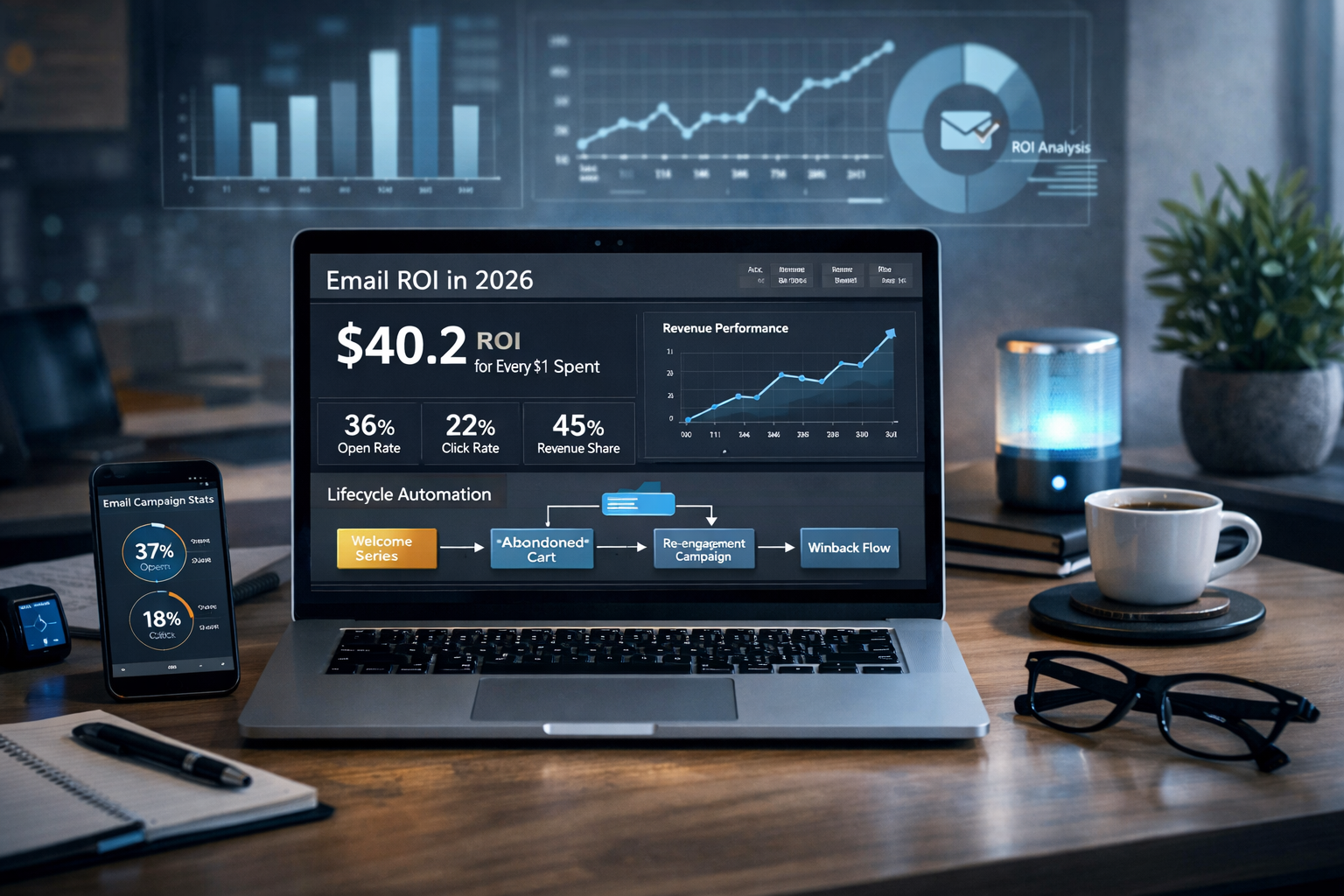
Multiple independent studies continue to show email at or near the top for ROI when compared to paid social, paid search, and organic content. Benchmarks from organizations like Litmus, HubSpot, and DMA frequently cite returns in the range of $36–$42 for every $1 spent, depending on methodology and industry.
Those numbers are not driven by novelty. They are driven by ownership. Email is one of the few channels where brands control the audience, the timing, and the message without paying a toll every time they want visibility.
What has changed in 2026 is not whether email works, but how unevenly it works.
Brands with thoughtful segmentation, automation, and lifecycle flows are seeing email account for 30–50% of total revenue. Brands sending generic blasts are seeing fatigue, unsubscribes, and declining engagement.
The channel is no longer forgiving. The upside is still there, but it now rewards precision over volume.
Why Email Keeps Beating Flashier Channels
Email’s advantage is structural, not tactical.
Social platforms optimize for their own engagement metrics, not your revenue. Paid media optimizes for reach until budgets hit diminishing returns. Email sits closer to the moment of intent.
It reaches people who already raised their hand, already trust the brand enough to invite it into their inbox, and are far more likely to convert when the message is relevant.
In 2026, this matters even more.
Consumers are more selective, more privacy-conscious, and quicker to tune out noise. Email, when done well, feels less like advertising and more like continuity.
That is why email continues to outperform on ROI. Not because it is old, but because it aligns with how people actually make decisions.
Where Email ROI Breaks Down (And Why Some Brands Disagree)
Not every study paints email as an automatic winner, and that tension is important.
Some reports show declining open rates, softer click-throughs, and rising unsubscribe rates across industries. These numbers are often used as proof that email is losing relevance.
The more accurate interpretation is different.
Poorly executed email is being filtered out faster than ever. Inbox algorithms reward relevance, consistency, and engagement history, and quietly bury everything else.
When brands report low ROI from email, the issue is rarely the channel itself.
It is usually:
- weak segmentation
- over-reliance on campaigns
- poor list hygiene
- sending too often without clear intent
Email does not fail loudly. It fades.
How High-ROI Brands Actually Use Email in 2026
Brands still seeing outsized ROI from email share a few consistent behaviors.
First, they treat email as infrastructure, not a megaphone. Welcome flows, post-purchase journeys, replenishment reminders, and winbacks drive revenue before a single campaign is sent.
Second, they integrate email across channels. Email supports SMS, paid media, and onsite personalization rather than operating in isolation.
Most importantly, they measure email differently.
Instead of chasing opens, they track:
- total revenue contribution
- assisted conversions
- retention lift over time
Email’s advantage in 2026 is not about spikes. It is about compounding.
Comparing Email to Paid Media in 2026
If email is still the highest-ROI channel, it is not because it is the flashiest. It is because it is owned.
Paid media is more volatile than ever. Costs fluctuate. Platform rules shift. Attribution windows tighten.
Email operates differently.
Once someone is on your list, you are not bidding to reach them again. You are not competing in an auction. You are communicating through a channel you control.
Paid media drives acquisition.
Email protects margins and expands lifetime value.
The strongest brands understand both roles.
The Retention Multiplier Most Teams Ignore
This is where the math becomes compelling.
Acquisition costs continue to rise across industries, while retention remains significantly more profitable.
Email sits at the center of that retention engine.
A strong post-purchase flow increases repeat purchase rates.
Replenishment reminders drive predictable revenue.
Winback sequences recover otherwise lost customers.
These are not one-time gains. They are compounding systems.
When measured across the full lifecycle, email consistently delivers outsized impact relative to cost.
The Data Question: Are ROI Numbers Inflated?
It is fair to question the classic ROI benchmarks.
Different studies calculate ROI differently. Some include only platform costs. Others factor in staffing, creative, and infrastructure.
The exact number may vary.
The underlying economics do not.
Email remains one of the lowest marginal-cost channels available. Sending an additional message to a qualified segment costs almost nothing compared to increasing paid acquisition spend.
Even if benchmarks shift, the cost structure remains highly favorable.
The Real Variable: Execution Quality
The biggest factor in email ROI is execution.
Not industry. Not product category. Execution.
Brands relying on batch-and-blast campaigns are seeing diminishing returns. Brands investing in segmentation, automation, and deliverability are seeing measurable lift.
In 2026:
- deliverability standards are stricter
- personalization is expected
- relevance determines visibility
Email still works. It just no longer tolerates mediocrity.
The 2026 Verdict: What the Data Actually Suggests
Across multiple studies and industries, email continues to rank among the highest ROI channels available.
Not because it is perfect, but because it is structurally advantaged.
Low marginal cost.
High control.
Strong personalization potential.
Direct access to owned audiences.
These characteristics are increasingly rare.
The data does not suggest email is invincible. It suggests email is durable.
Final Analysis: What Business Leaders Should Conclude
Email is not magic.
It does not fix weak positioning or poor product-market fit. But when those fundamentals are strong, email amplifies them efficiently and predictably.
In 2026, the brands seeing the highest returns are the ones treating email as a system, not a tactic.
They:
- build lifecycle flows
- maintain clean data
- invest in segmentation
- think long-term
So is email still the highest-ROI channel?
In many cases, yes.
Not because of tradition, but because the economics still make sense.
The better question is this:
Is your execution strong enough to take advantage of it?
Is Email Still the Highest-ROI Marketing Channel in 2026?
Email has been declared “dead” more times than most marketing trends ever live long enough to be proven wrong.
And yet, in 2026, it continues to sit quietly behind the scenes, driving a disproportionate share of revenue for brands that actually know how to use it.
The Question Business Owners Are Really Asking
Paid media costs are climbing.
Organic reach is shrinking.
AI-generated content is flooding every channel, increasing noise while attention spans keep getting shorter.
At the same time, industry benchmarks still point to email as one of the most efficient revenue drivers per dollar spent. That contradiction is hard to ignore.
So… Is Email Still the Highest-ROI Channel?
For founders, operators, and CMOs, this is not a philosophical debate.
It’s a budget decision.
Is email marketing still outperforming other channels in 2026, or are brands clinging to outdated benchmarks that no longer match how people actually buy today?
To answer that honestly, we need to look past nostalgia and into the data.
What the Data Says About Email ROI in 2026
Multiple independent studies continue to show email at or near the top for ROI when compared to paid social, paid search, and organic content. Benchmarks from organizations like Litmus, HubSpot, and DMA frequently cite returns in the range of $36–$42 for every $1 spent, depending on methodology and industry.
Those numbers are not driven by novelty. They are driven by ownership. Email is one of the few channels where brands control the audience, the timing, and the message without paying a toll every time they want visibility.
What has changed in 2026 is not whether email works, but how unevenly it works.
Brands with thoughtful segmentation, automation, and lifecycle flows are seeing email account for 30–50% of total revenue. Brands sending generic blasts are seeing fatigue, unsubscribes, and declining engagement.
The channel is no longer forgiving. The upside is still there, but it now rewards precision over volume.
Why Email Keeps Beating Flashier Channels
Email’s advantage is structural, not tactical.
Social platforms optimize for their own engagement metrics, not your revenue. Paid media optimizes for reach until budgets hit diminishing returns. Email sits closer to the moment of intent.
It reaches people who already raised their hand, already trust the brand enough to invite it into their inbox, and are far more likely to convert when the message is relevant.
In 2026, this matters even more.
Consumers are more selective, more privacy-conscious, and quicker to tune out noise. Email, when done well, feels less like advertising and more like continuity.
That is why email continues to outperform on ROI. Not because it is old, but because it aligns with how people actually make decisions.
Where Email ROI Breaks Down (And Why Some Brands Disagree)
Not every study paints email as an automatic winner, and that tension is important.
Some reports show declining open rates, softer click-throughs, and rising unsubscribe rates across industries. These numbers are often used as proof that email is losing relevance.
The more accurate interpretation is different.
Poorly executed email is being filtered out faster than ever. Inbox algorithms reward relevance, consistency, and engagement history, and quietly bury everything else.
When brands report low ROI from email, the issue is rarely the channel itself.
It is usually:
- weak segmentation
- over-reliance on campaigns
- poor list hygiene
- sending too often without clear intent
Email does not fail loudly. It fades.
How High-ROI Brands Actually Use Email in 2026
Brands still seeing outsized ROI from email share a few consistent behaviors.
First, they treat email as infrastructure, not a megaphone. Welcome flows, post-purchase journeys, replenishment reminders, and winbacks drive revenue before a single campaign is sent.
Second, they integrate email across channels. Email supports SMS, paid media, and onsite personalization rather than operating in isolation.
Most importantly, they measure email differently.
Instead of chasing opens, they track:
- total revenue contribution
- assisted conversions
- retention lift over time
Email’s advantage in 2026 is not about spikes. It is about compounding.
Comparing Email to Paid Media in 2026
If email is still the highest-ROI channel, it is not because it is the flashiest. It is because it is owned.
Paid media is more volatile than ever. Costs fluctuate. Platform rules shift. Attribution windows tighten.
Email operates differently.
Once someone is on your list, you are not bidding to reach them again. You are not competing in an auction. You are communicating through a channel you control.
Paid media drives acquisition.
Email protects margins and expands lifetime value.
The strongest brands understand both roles.
The Retention Multiplier Most Teams Ignore
This is where the math becomes compelling.
Acquisition costs continue to rise across industries, while retention remains significantly more profitable.
Email sits at the center of that retention engine.
A strong post-purchase flow increases repeat purchase rates.
Replenishment reminders drive predictable revenue.
Winback sequences recover otherwise lost customers.
These are not one-time gains. They are compounding systems.
When measured across the full lifecycle, email consistently delivers outsized impact relative to cost.
The Data Question: Are ROI Numbers Inflated?
It is fair to question the classic ROI benchmarks.
Different studies calculate ROI differently. Some include only platform costs. Others factor in staffing, creative, and infrastructure.
The exact number may vary.
The underlying economics do not.
Email remains one of the lowest marginal-cost channels available. Sending an additional message to a qualified segment costs almost nothing compared to increasing paid acquisition spend.
Even if benchmarks shift, the cost structure remains highly favorable.
The Real Variable: Execution Quality
The biggest factor in email ROI is execution.
Not industry. Not product category. Execution.
Brands relying on batch-and-blast campaigns are seeing diminishing returns. Brands investing in segmentation, automation, and deliverability are seeing measurable lift.
In 2026:
- deliverability standards are stricter
- personalization is expected
- relevance determines visibility
Email still works. It just no longer tolerates mediocrity.
The 2026 Verdict: What the Data Actually Suggests
Across multiple studies and industries, email continues to rank among the highest ROI channels available.
Not because it is perfect, but because it is structurally advantaged.
Low marginal cost.
High control.
Strong personalization potential.
Direct access to owned audiences.
These characteristics are increasingly rare.
The data does not suggest email is invincible. It suggests email is durable.
Final Analysis: What Business Leaders Should Conclude
Email is not magic.
It does not fix weak positioning or poor product-market fit. But when those fundamentals are strong, email amplifies them efficiently and predictably.
In 2026, the brands seeing the highest returns are the ones treating email as a system, not a tactic.
They:
- build lifecycle flows
- maintain clean data
- invest in segmentation
- think long-term
So is email still the highest-ROI channel?
In many cases, yes.
Not because of tradition, but because the economics still make sense.
The better question is this:
Is your execution strong enough to take advantage of it?

Jasper is an expert email marketer. He is passionate about helping sustainably driven businesses reach their marketing goes through beautiful, branded emails.
Find out exactly what your email channel is leaving on the table.

Email Marketing for Scaling DTC Brands


