
Summary
Hiring an Ecommerce Email Marketing Agency: Risks & Rewards
Hiring an ecommerce email marketing agency is a massive gamble. You're either going to squeeze real revenue out of Klaviyo, or you're just paying for another expensive SaaS subscription you forget to cancel. A good agency brings strategy, copywriting, design, and deliverability under one roof. But you need to cut through the noise, understand the pricing models, and set realistic ROI expectations before signing anything.
Most DTC brands doing $1M to $10M in revenue hit a wall with email. It stops scaling on its own. You basically have three options: hire internally, stitch together freelancers and pray they coordinate, or bring in a dedicated agency. This decision dictates your revenue, your timelines, and how much time your team wastes managing vendors instead of running the business.
What an Ecommerce Email Marketing Agency Actually Does
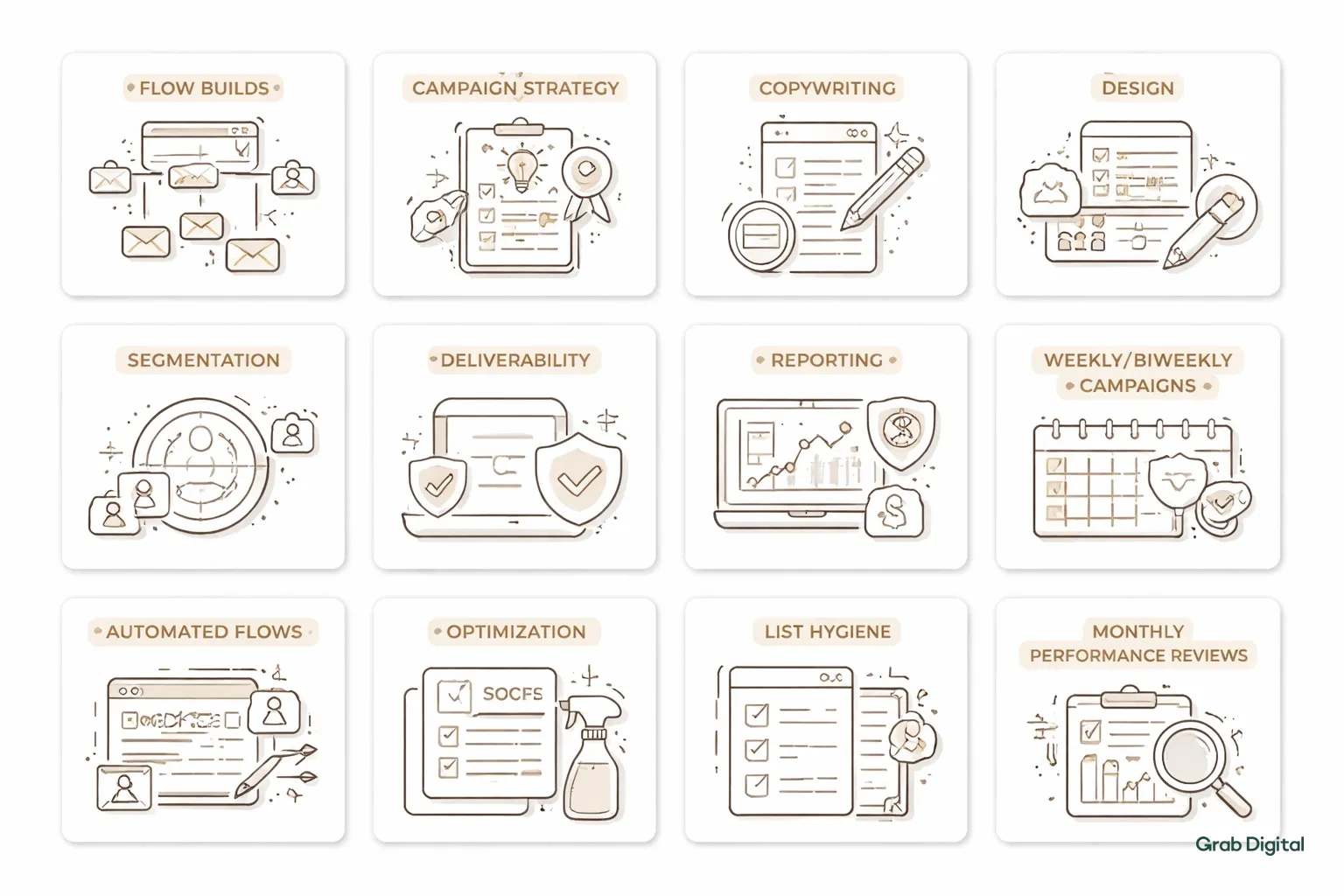
A good agency takes your entire Klaviyo channel off your plate. That means flow builds, campaign strategy, copywriting, design, segmentation, deliverability, and reporting. It’s basically an in-house department without the payroll burden.
The work usually covers automated flows (welcome series, abandoned cart, browse abandonment, post-purchase, win-backs) alongside weekly or biweekly campaigns, popup optimization, list hygiene, and monthly performance reviews. Some agencies niche down hard into one thing, like deliverability or design. Others, like Grab Digital, own the whole channel so you aren't playing the blame game between vendors when something breaks.
Before you hire anyone, figure out if you actually need full-service management or just someone to plug a specific gap. If email is driving less than 20% of your revenue, you need the full package, not a band-aid. If you aren't sure where your program stands, reviewing email marketing strategies for DTC brands is a good reality check.
Red Flags to Watch For When Vetting Agencies
Red flags show up fast if you know what to look for. Vague case studies, zero access to senior team members, and confusing ownership of deliverables are huge warning signs. These are the things that lead to missed deadlines, generic template emails, and stalled growth.
Here’s what actually matters when you're vetting them:
- Junior-only execution. If the people pitching you aren't the people building your flows, quality drops the second you sign.
- No baseline measurement. If an agency can't explain how they'll measure your starting point, they can't prove results later.
- Template-heavy portfolios. If every brand in their portfolio has the exact same layout, you're dealing with a factory, not a strategist.
- Vague deliverability practices. If they can't explain sender reputation, domain warmup, or suppression strategy, your emails will end up in spam.
- No flow audit before onboarding. Agencies that skip reviewing your existing Klaviyo account are guessing, not diagnosing.
- Locked-in long contracts with no performance clause. If they're confident in their work, they shouldn't need a 12-month trap.
Deliverability deserves a special mention here. Poor list hygiene and ignored suppression rules quietly destroy your open rates long before you notice. If an agency can't walk you through exactly how they'll suppress inactive subscribers to boost deliverability, ask them about it directly.
How Ecommerce Email Agencies Price Their Services

Pricing usually falls into three buckets: flat monthly retainers, a percentage of email-attributed revenue, or a hybrid. For brands in the $1M to $10M range, retainers are the most common. You should expect to pay anywhere from $2,500 to $10,000 a month depending on scope.
Here’s a rough breakdown of what these structures look like:
| Pricing Model | Typical Range | Best For |
|---|---|---|
| Flat monthly retainer | $2,500 to $10,000/month | Brands wanting predictable costs |
| Percentage of revenue | 5% to 15% of email revenue | Brands with high email volume already |
| Hybrid (base + performance) | $2,000 base + bonus tiers | Brands wanting shared risk |
| Project-based (flow builds only) | $3,000 to $8,000 one-time | Brands needing a one-time setup |
Cheaper isn't automatically worse, and expensive isn't automatically better. What matters is what's actually included. A $3,000 retainer covering campaigns, flows, design, copy, and reporting is a much better deal than a $5,000 retainer that just hits send on campaigns. Always ask for a line-item breakdown of deliverables before comparing quotes.
Pricing also scales with list size and sending cadence. A brand sending twice a week to 50,000 subscribers needs way more hands-on management than one sending monthly to 10,000 people. If you're currently relying on random freelancers, compare that cost against hiring the right Klaviyo expert for DTC brands as a single accountable partner.
Setting Realistic ROI Expectations
You should see measurable movement within 60 to 90 days. Properly built and tested flows alone can lift email-attributed revenue by 10% to 30%. Campaigns compound that further if you actually segment and send consistently.
Email is usually the highest-ROI channel for ecommerce, often returning $36 to $42 for every dollar spent. But that number assumes the channel is actually built out. If you have incomplete flows, a single generic newsletter, and zero segmentation, you won't hit that average. The gap between "has Klaviyo" and "uses Klaviyo well" is where most of your lost revenue hides.
A few benchmarks worth tracking every month:
- Flow revenue as a percentage of total email revenue. Healthy accounts see automated flows driving 30% or more of total email revenue.
- Open rates by segment. Anything consistently under 20% means you have a deliverability or list hygiene problem.
- Click-to-open rate. This tells you if your content is actually relevant.
- Revenue per recipient. The clearest way to compare campaigns against each other over time.
Agencies that guarantee specific dollar figures without a baseline are lying. Agencies that refuse to commit to any measurable outcome are useless. The fair middle ground is a performance guarantee tied to a measured starting point. That’s why measuring baseline performance on day one matters so much.
If you want a clearer picture of what reasonable flow performance looks like before comparing quotes, study how to build a high-ROI abandoned cart flow. Cart recovery is usually the fastest-moving metric in the first 60 days.
Questions to Ask Before You Sign
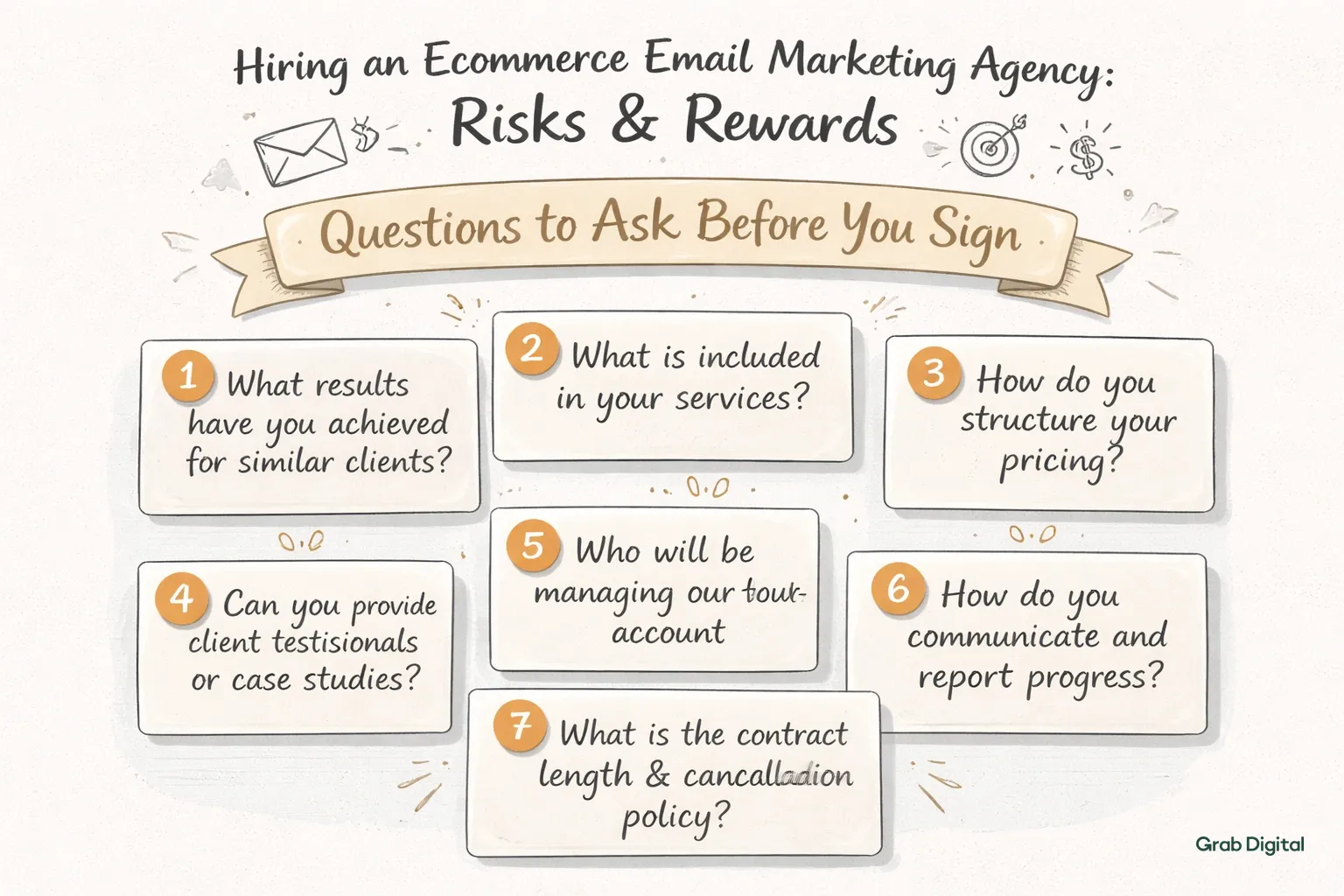
The way an agency handles a sales call is exactly how they'll handle your account. Asking specific questions separates the long-term partners from the churn-and-burn shops.
Bring these to every discovery call:
- Who specifically will work on my account, and will I have direct access to them?
- How do you measure baseline performance before starting?
- What's your deliverability process for warming up sender reputation?
- How many revision rounds are included per email?
- What happens if results don't hit the agreed target?
- Can I see a flow audit of my current Klaviyo account before we start?
If they dodge these or give vague answers, walk away.
Making the Final Decision
This really comes down to matching agency structure to your brand's actual needs. A small senior team working directly on strategy, copy, and design will almost always beat a massive agency that routes work through account managers and subcontractors.
Brands doing $1M to $10M usually get the most value from agencies that specialize purely in DTC ecommerce, not generalist marketing shops. Specialization means faster ramp-up and benchmarks that actually make sense for your vertical. If you've been managing email in-house or through freelancers and feel like the channel has plateaued, it might be time to book your free consultation and get a second opinion on where the gaps are.
Before committing, review case studies carefully, ask for references from brands in a similar revenue range, and confirm pricing includes everything you think it does. The agencies worth hiring will welcome these questions.
Frequently Asked Questions
Q: How much should an ecommerce email marketing agency cost per month? A: Most agencies working with $1M to $10M DTC brands charge between $2,500 and $10,000 monthly depending on scope, list size, and sending frequency. Flat retainers covering flows, campaigns, design, and reporting are the most common structure.
Q: How long does it take to see ROI from a new email agency? A: Most brands see measurable movement in email-attributed revenue within 60 to 90 days. Flow rebuilds show results faster than campaign strategy changes because they run continuously once live.
Q: What's the biggest red flag when hiring an email marketing agency? A: Junior-only execution. If the strategist on your sales call isn't the person building and sending your emails, quality and consistency usually drop after signing.
Q: Should I choose an agency that charges a percentage of email revenue? A: Percentage-based pricing works well for brands already generating significant email revenue. For brands rebuilding a weak email channel, a flat retainer with a performance guarantee is usually fairer since baseline revenue is low.
Q: Do I need an agency if I'm already on Klaviyo? A: Being on Klaviyo doesn't mean the platform is being used well. Many brands generate less than 20% of revenue through email despite having the tool, which points to incomplete flows or weak segmentation, not a platform problem.
Q: What should be included in an ecommerce email marketing agency's reporting? A: Monthly reporting should break down flow revenue, campaign revenue, open and click rates by segment, list growth, and deliverability health. Reports without segment-level detail make it hard to know what's actually driving results.
Hiring an ecommerce email marketing agency is a massive gamble. You're either going to squeeze real revenue out of Klaviyo, or you're just paying for another expensive SaaS subscription you forget to cancel. A good agency brings strategy, copywriting, design, and deliverability under one roof. But you need to cut through the noise, understand the pricing models, and set realistic ROI expectations before signing anything.
Most DTC brands doing $1M to $10M in revenue hit a wall with email. It stops scaling on its own. You basically have three options: hire internally, stitch together freelancers and pray they coordinate, or bring in a dedicated agency. This decision dictates your revenue, your timelines, and how much time your team wastes managing vendors instead of running the business.
What an Ecommerce Email Marketing Agency Actually Does
A good agency takes your entire Klaviyo channel off your plate. That means flow builds, campaign strategy, copywriting, design, segmentation, deliverability, and reporting. It’s basically an in-house department without the payroll burden.
The work usually covers automated flows (welcome series, abandoned cart, browse abandonment, post-purchase, win-backs) alongside weekly or biweekly campaigns, popup optimization, list hygiene, and monthly performance reviews. Some agencies niche down hard into one thing, like deliverability or design. Others, like Grab Digital, own the whole channel so you aren't playing the blame game between vendors when something breaks.
Before you hire anyone, figure out if you actually need full-service management or just someone to plug a specific gap. If email is driving less than 20% of your revenue, you need the full package, not a band-aid. If you aren't sure where your program stands, reviewing email marketing strategies for DTC brands is a good reality check.
Red Flags to Watch For When Vetting Agencies
Red flags show up fast if you know what to look for. Vague case studies, zero access to senior team members, and confusing ownership of deliverables are huge warning signs. These are the things that lead to missed deadlines, generic template emails, and stalled growth.
Here’s what actually matters when you're vetting them:
- Junior-only execution. If the people pitching you aren't the people building your flows, quality drops the second you sign.
- No baseline measurement. If an agency can't explain how they'll measure your starting point, they can't prove results later.
- Template-heavy portfolios. If every brand in their portfolio has the exact same layout, you're dealing with a factory, not a strategist.
- Vague deliverability practices. If they can't explain sender reputation, domain warmup, or suppression strategy, your emails will end up in spam.
- No flow audit before onboarding. Agencies that skip reviewing your existing Klaviyo account are guessing, not diagnosing.
- Locked-in long contracts with no performance clause. If they're confident in their work, they shouldn't need a 12-month trap.
Deliverability deserves a special mention here. Poor list hygiene and ignored suppression rules quietly destroy your open rates long before you notice. If an agency can't walk you through exactly how they'll suppress inactive subscribers to boost deliverability, ask them about it directly.
How Ecommerce Email Agencies Price Their Services
Pricing usually falls into three buckets: flat monthly retainers, a percentage of email-attributed revenue, or a hybrid. For brands in the $1M to $10M range, retainers are the most common. You should expect to pay anywhere from $2,500 to $10,000 a month depending on scope.
Here’s a rough breakdown of what these structures look like:
| Pricing Model | Typical Range | Best For |
|---|---|---|
| Flat monthly retainer | $2,500 to $10,000/month | Brands wanting predictable costs |
| Percentage of revenue | 5% to 15% of email revenue | Brands with high email volume already |
| Hybrid (base + performance) | $2,000 base + bonus tiers | Brands wanting shared risk |
| Project-based (flow builds only) | $3,000 to $8,000 one-time | Brands needing a one-time setup |
Cheaper isn't automatically worse, and expensive isn't automatically better. What matters is what's actually included. A $3,000 retainer covering campaigns, flows, design, copy, and reporting is a much better deal than a $5,000 retainer that just hits send on campaigns. Always ask for a line-item breakdown of deliverables before comparing quotes.
Pricing also scales with list size and sending cadence. A brand sending twice a week to 50,000 subscribers needs way more hands-on management than one sending monthly to 10,000 people. If you're currently relying on random freelancers, compare that cost against hiring the right Klaviyo expert for DTC brands as a single accountable partner.
Setting Realistic ROI Expectations
You should see measurable movement within 60 to 90 days. Properly built and tested flows alone can lift email-attributed revenue by 10% to 30%. Campaigns compound that further if you actually segment and send consistently.
Email is usually the highest-ROI channel for ecommerce, often returning $36 to $42 for every dollar spent. But that number assumes the channel is actually built out. If you have incomplete flows, a single generic newsletter, and zero segmentation, you won't hit that average. The gap between "has Klaviyo" and "uses Klaviyo well" is where most of your lost revenue hides.
A few benchmarks worth tracking every month:
- Flow revenue as a percentage of total email revenue. Healthy accounts see automated flows driving 30% or more of total email revenue.
- Open rates by segment. Anything consistently under 20% means you have a deliverability or list hygiene problem.
- Click-to-open rate. This tells you if your content is actually relevant.
- Revenue per recipient. The clearest way to compare campaigns against each other over time.
Agencies that guarantee specific dollar figures without a baseline are lying. Agencies that refuse to commit to any measurable outcome are useless. The fair middle ground is a performance guarantee tied to a measured starting point. That’s why measuring baseline performance on day one matters so much.
If you want a clearer picture of what reasonable flow performance looks like before comparing quotes, study how to build a high-ROI abandoned cart flow. Cart recovery is usually the fastest-moving metric in the first 60 days.
Questions to Ask Before You Sign
The way an agency handles a sales call is exactly how they'll handle your account. Asking specific questions separates the long-term partners from the churn-and-burn shops.
Bring these to every discovery call:
- Who specifically will work on my account, and will I have direct access to them?
- How do you measure baseline performance before starting?
- What's your deliverability process for warming up sender reputation?
- How many revision rounds are included per email?
- What happens if results don't hit the agreed target?
- Can I see a flow audit of my current Klaviyo account before we start?
If they dodge these or give vague answers, walk away.
Making the Final Decision
This really comes down to matching agency structure to your brand's actual needs. A small senior team working directly on strategy, copy, and design will almost always beat a massive agency that routes work through account managers and subcontractors.
Brands doing $1M to $10M usually get the most value from agencies that specialize purely in DTC ecommerce, not generalist marketing shops. Specialization means faster ramp-up and benchmarks that actually make sense for your vertical. If you've been managing email in-house or through freelancers and feel like the channel has plateaued, it might be time to book your free consultation and get a second opinion on where the gaps are.
Before committing, review case studies carefully, ask for references from brands in a similar revenue range, and confirm pricing includes everything you think it does. The agencies worth hiring will welcome these questions.
Frequently Asked Questions
Q: How much should an ecommerce email marketing agency cost per month? A: Most agencies working with $1M to $10M DTC brands charge between $2,500 and $10,000 monthly depending on scope, list size, and sending frequency. Flat retainers covering flows, campaigns, design, and reporting are the most common structure.
Q: How long does it take to see ROI from a new email agency? A: Most brands see measurable movement in email-attributed revenue within 60 to 90 days. Flow rebuilds show results faster than campaign strategy changes because they run continuously once live.
Q: What's the biggest red flag when hiring an email marketing agency? A: Junior-only execution. If the strategist on your sales call isn't the person building and sending your emails, quality and consistency usually drop after signing.
Q: Should I choose an agency that charges a percentage of email revenue? A: Percentage-based pricing works well for brands already generating significant email revenue. For brands rebuilding a weak email channel, a flat retainer with a performance guarantee is usually fairer since baseline revenue is low.
Q: Do I need an agency if I'm already on Klaviyo? A: Being on Klaviyo doesn't mean the platform is being used well. Many brands generate less than 20% of revenue through email despite having the tool, which points to incomplete flows or weak segmentation, not a platform problem.
Q: What should be included in an ecommerce email marketing agency's reporting? A: Monthly reporting should break down flow revenue, campaign revenue, open and click rates by segment, list growth, and deliverability health. Reports without segment-level detail make it hard to know what's actually driving results.

Find out exactly what your email channel is leaving on the table.

Email Marketing for Scaling DTC Brands


