
Summary
Shopify Email vs Mailchimp vs Klaviyo for DTC Brands
Stop asking "Shopify Email vs Mailchimp." It's the wrong question for DTC brands doing $1M-$10M. The real question is whether either platform can handle the segmentation, automation, and deliverability work that actually drives revenue. For most growing brands, the answer is no not on their own.
Picking an email platform feels like a minor decision until your list hits 10,000 subscribers and your flows stall out. Brands comparing the two are usually stuck: they've outgrown the basics but aren't sure what "better" actually looks like. Here’s the breakdown of where each platform works, where they fail, and what actually moves revenue.
What Shopify Email Actually Does
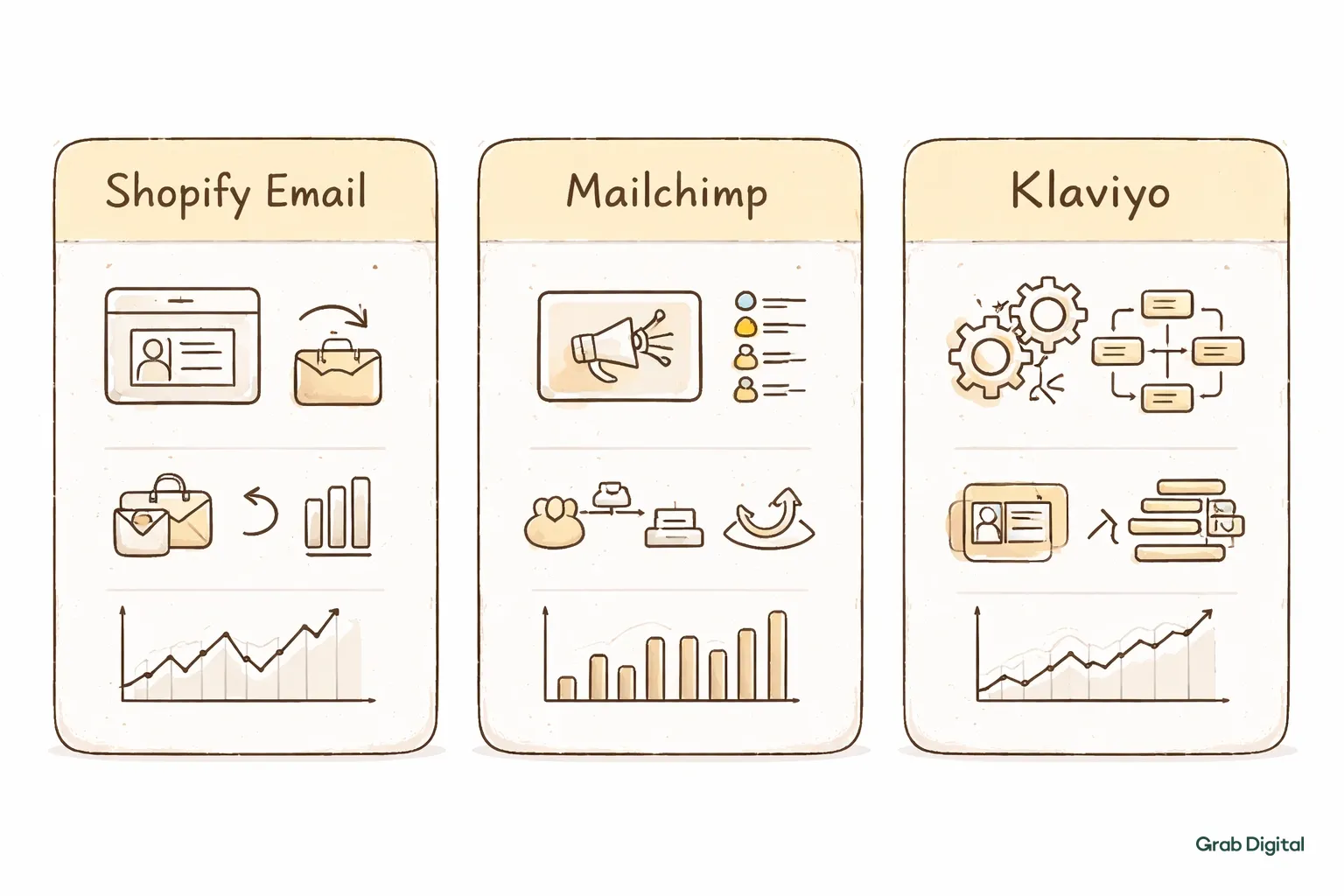
Shopify Email is fine if you're just running basic campaigns from your dashboard. It’s built for simplicity. You get templates, product syncing, and basic analytics.
The appeal is obvious: it’s already there. No new login. Product data pulls in automatically.
But the cracks show up fast once you're doing real volume. It lacks:
- Advanced segmentation past basic purchase history
- Multi-step flows (welcome series, browse abandonment, win-back)
- A/B testing for subject lines or send times
- Predictive analytics or CLV scoring
- Deep SMS integration
You can sometimes get by with it under $500K annual revenue. Past $1M, the gaps get expensive. You’re leaving money on the table every time an automation fails to trigger.
What Mailchimp Brings
Mailchimp is more flexible than Shopify Email, but it wasn't built for ecommerce. It's a generalist tool that bolted commerce features on later.
The strength is the "all-in-one" pitch: landing pages, basic CRM, social scheduling. If you need one tool to do a lot of things "okay," Mailchimp works.
But it's shallow. Segmentation is decent but not built around granular purchase behavior. The automation builder feels clunky next to ecommerce-native platforms. The Shopify integration works, but it’s not seamless.
Comparison for growing brands:
| Feature | Shopify Email | Mailchimp |
|---|---|---|
| Native Shopify integration | Excellent | Good |
| Advanced segmentation | Limited | Moderate |
| Automation flows | Basic | Moderate |
| A/B testing | Minimal | Available |
| Predictive analytics | None | Limited |
| Pricing at scale | Free/low | Gets expensive |
| Built for ecommerce | Sort of | No |
Neither was designed from scratch for high-volume DTC. That's the recurring problem.
Why Klaviyo Outperforms Both for $1M-$10M Brands
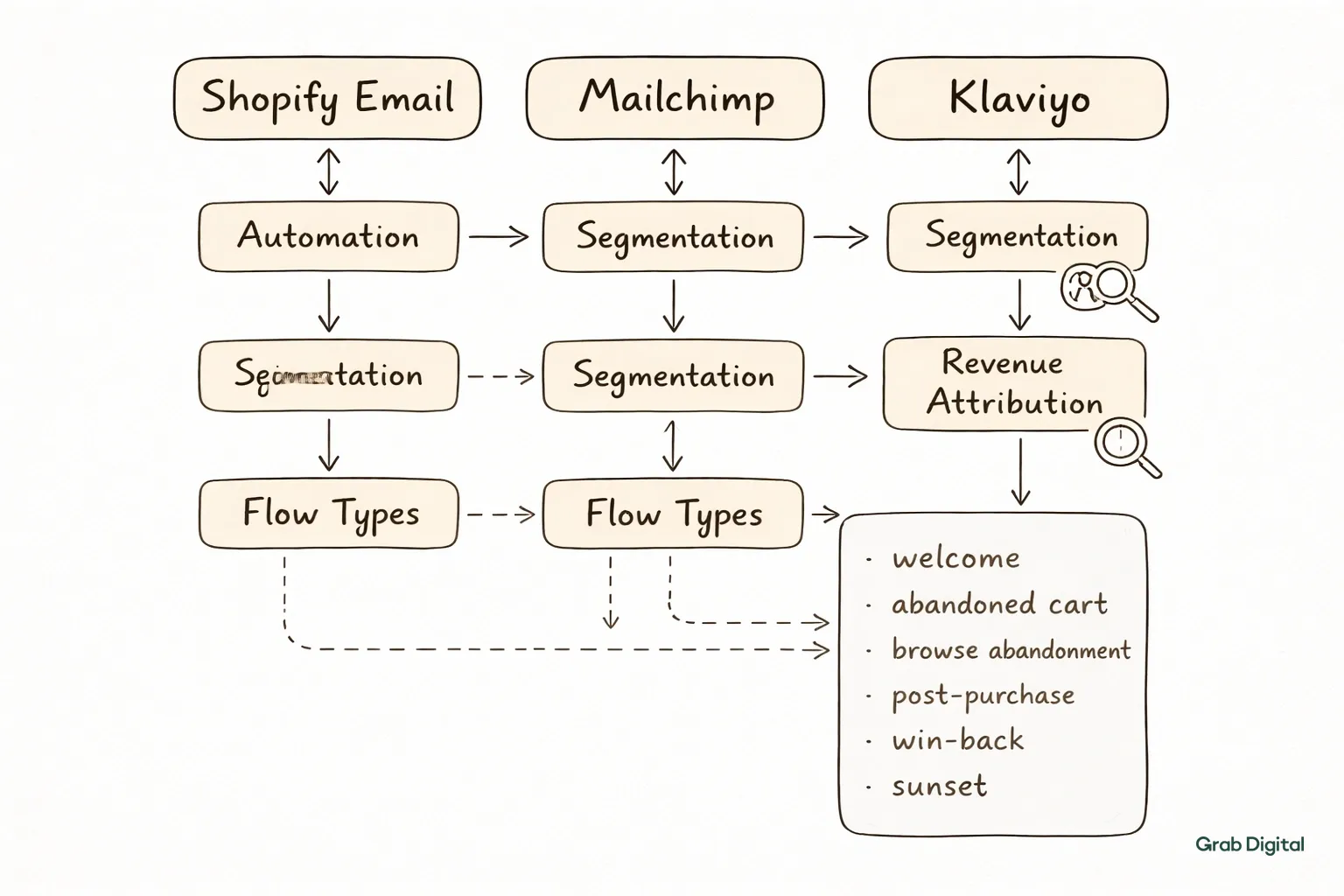
Klaviyo was built for ecommerce. That’s why it wins for brands scaling past $1M. It handles the segmentation depth, automation complexity, and attribution you actually need.
The difference is in the flows. You can build detailed sequences: welcome series, abandoned cart, browse abandonment, post-purchase, win-back, and sunset flows, all triggered by specific behavior. Shopify Email can’t touch this. Mailchimp gets close but lacks the native depth.
Attribution is another gap. Klaviyo ties revenue to specific emails and segments. You know what works. Shopify Email gives you surface metrics. Mailchimp’s attribution wasn’t built for ecommerce loops.
Deliverability matters, too. Past 10,000 subscribers, inbox placement gets tricky. Klaviyo’s infrastructure and email deliverability guidance generally outperform the others, assuming you keep your lists clean.
The Real Cost of Staying Basic
Staying on Shopify Email or Mailchimp past $1M costs you in missed opportunity. Every automation you can’t build, every segment you can’t hit that’s revenue competitors are taking.
Run the math. Email should drive 20-30% of revenue. If you’re stuck at 8-10% because the platform can’t handle complex flows, that gap is cash. For a $3M brand, a 15-point gap could mean hundreds of thousands left on the table.
We see this constantly at Grab Digital. Brands with 10,000+ subscribers, technically "doing email," but generating under 20% of revenue from it. Usually the platform is the bottleneck, not the strategy.
But switching tools isn't enough. You need someone to build the 8 core email flows every DTC brand needs, configure segmentation, and manage deliverability as you scale. That’s the difference between moving tools and growing revenue.
Switching Without Killing Momentum
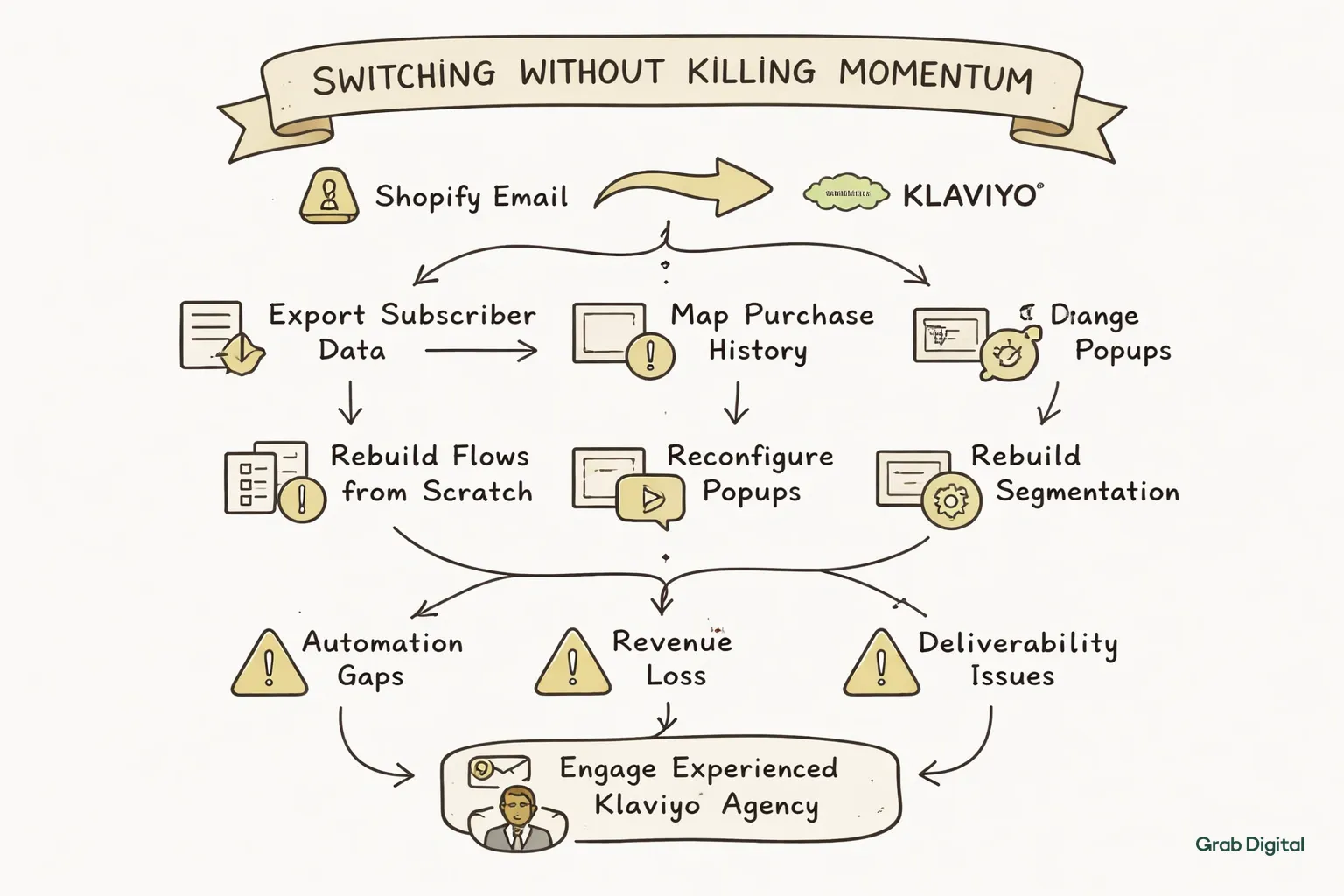
Moving to Klaviyo takes careful migration. Done wrong, you create automation gaps that cost money during the switch.
You have to export subscriber data, map purchase history, and rebuild flows from scratch don't import broken logic. Popups need reconfiguring. Segmentation needs rebuilding.
This is where an experienced Klaviyo agency helps. Rush a migration without testing and you can wreck deliverability right when you need it most.
If you're asking if Shopify Email or Mailchimp scales, the honest answer is: not past a certain point. Brands doing $1M-$10M need infrastructure built for ecommerce, not general tools patched together.
Signs You’ve Outgrown Your Platform
You'll usually feel it before the numbers confirm it.
You've likely outgrown the platform if:
- You're manually chopping lists because automations don't work
- Flows feel generic and ignore customer behavior
- Revenue attribution is vague or guesses
- You're wasting hours on tasks that should be automated
- Your list is over 10,000 with zero dedicated strategy
- Deliverability is tanking and you don't know why
If three or more hit home, check what a dedicated strategy could do. Grab Digital's portfolio shows what happens when brands jump with the right backup.
Get Serious About Your Email Stack
Don't stop at "Shopify Email vs Mailchimp." Both have uses at stages, but neither is a long-term home for scaling DTC.
Evaluate where you actually sit. Under $500K and testing? Shopify Email is fine for now. Need broader marketing tools? Mailchimp has some appeal.
But if you're at $1M-$10M, on Klaviyo or thinking about it, and know email should do more than it is, the platform chat is secondary to strategy. Book your free consultation to see where you stand and what's realistic.
Grab Digital works only with DTC brands ready to treat email as a revenue channel, not an afterthought. Check the FAQ page for how it works, or browse case studies to see results from brands that made the jump.
Frequently Asked Questions
Q: Can I use Shopify Email and Mailchimp together?
A: You can, but you'll fragment your data and confuse attribution. It's usually better to consolidate on one platform ideally one built for ecommerce like Klaviyo rather than juggling two half-solutions.
Q: Is Mailchimp better than Shopify Email for ecommerce?
A: Mailchimp has more features, but it wasn't built for ecommerce. For DTC brands past the early stage, both eventually hit a ceiling compared to tools like Klaviyo.
Q: How much revenue should email generate for a DTC brand?
A: Optimized programs usually drive 20-30% of total revenue. If you're under 20% with 10,000+ subscribers, something is broken.
Q: Does switching platforms hurt deliverability?
A: It can if you're sloppy. Clean lists, ramp up sending slowly, and authenticate domains properly to minimize the risk.
Q: What list size justifies Klaviyo?
A: Most brands see ROI once they hit 10,000 subscribers and $1M revenue that's when the complexity starts paying off.
Q: How long does migration take?
A: Two to four weeks for a full migration with flows, segmentation, and testing, depending on list size.
Stop asking "Shopify Email vs Mailchimp." It's the wrong question for DTC brands doing $1M-$10M. The real question is whether either platform can handle the segmentation, automation, and deliverability work that actually drives revenue. For most growing brands, the answer is no not on their own.
Picking an email platform feels like a minor decision until your list hits 10,000 subscribers and your flows stall out. Brands comparing the two are usually stuck: they've outgrown the basics but aren't sure what "better" actually looks like. Here’s the breakdown of where each platform works, where they fail, and what actually moves revenue.
What Shopify Email Actually Does
Shopify Email is fine if you're just running basic campaigns from your dashboard. It’s built for simplicity. You get templates, product syncing, and basic analytics.
The appeal is obvious: it’s already there. No new login. Product data pulls in automatically.
But the cracks show up fast once you're doing real volume. It lacks:
- Advanced segmentation past basic purchase history
- Multi-step flows (welcome series, browse abandonment, win-back)
- A/B testing for subject lines or send times
- Predictive analytics or CLV scoring
- Deep SMS integration
You can sometimes get by with it under $500K annual revenue. Past $1M, the gaps get expensive. You’re leaving money on the table every time an automation fails to trigger.
What Mailchimp Brings
Mailchimp is more flexible than Shopify Email, but it wasn't built for ecommerce. It's a generalist tool that bolted commerce features on later.
The strength is the "all-in-one" pitch: landing pages, basic CRM, social scheduling. If you need one tool to do a lot of things "okay," Mailchimp works.
But it's shallow. Segmentation is decent but not built around granular purchase behavior. The automation builder feels clunky next to ecommerce-native platforms. The Shopify integration works, but it’s not seamless.
Comparison for growing brands:
| Feature | Shopify Email | Mailchimp |
|---|---|---|
| Native Shopify integration | Excellent | Good |
| Advanced segmentation | Limited | Moderate |
| Automation flows | Basic | Moderate |
| A/B testing | Minimal | Available |
| Predictive analytics | None | Limited |
| Pricing at scale | Free/low | Gets expensive |
| Built for ecommerce | Sort of | No |
Neither was designed from scratch for high-volume DTC. That's the recurring problem.
Why Klaviyo Outperforms Both for $1M-$10M Brands
Klaviyo was built for ecommerce. That’s why it wins for brands scaling past $1M. It handles the segmentation depth, automation complexity, and attribution you actually need.
The difference is in the flows. You can build detailed sequences: welcome series, abandoned cart, browse abandonment, post-purchase, win-back, and sunset flows, all triggered by specific behavior. Shopify Email can’t touch this. Mailchimp gets close but lacks the native depth.
Attribution is another gap. Klaviyo ties revenue to specific emails and segments. You know what works. Shopify Email gives you surface metrics. Mailchimp’s attribution wasn’t built for ecommerce loops.
Deliverability matters, too. Past 10,000 subscribers, inbox placement gets tricky. Klaviyo’s infrastructure and email deliverability guidance generally outperform the others, assuming you keep your lists clean.
The Real Cost of Staying Basic
Staying on Shopify Email or Mailchimp past $1M costs you in missed opportunity. Every automation you can’t build, every segment you can’t hit that’s revenue competitors are taking.
Run the math. Email should drive 20-30% of revenue. If you’re stuck at 8-10% because the platform can’t handle complex flows, that gap is cash. For a $3M brand, a 15-point gap could mean hundreds of thousands left on the table.
We see this constantly at Grab Digital. Brands with 10,000+ subscribers, technically "doing email," but generating under 20% of revenue from it. Usually the platform is the bottleneck, not the strategy.
But switching tools isn't enough. You need someone to build the 8 core email flows every DTC brand needs, configure segmentation, and manage deliverability as you scale. That’s the difference between moving tools and growing revenue.
Switching Without Killing Momentum
Moving to Klaviyo takes careful migration. Done wrong, you create automation gaps that cost money during the switch.
You have to export subscriber data, map purchase history, and rebuild flows from scratch don't import broken logic. Popups need reconfiguring. Segmentation needs rebuilding.
This is where an experienced Klaviyo agency helps. Rush a migration without testing and you can wreck deliverability right when you need it most.
If you're asking if Shopify Email or Mailchimp scales, the honest answer is: not past a certain point. Brands doing $1M-$10M need infrastructure built for ecommerce, not general tools patched together.
Signs You’ve Outgrown Your Platform
You'll usually feel it before the numbers confirm it.
You've likely outgrown the platform if:
- You're manually chopping lists because automations don't work
- Flows feel generic and ignore customer behavior
- Revenue attribution is vague or guesses
- You're wasting hours on tasks that should be automated
- Your list is over 10,000 with zero dedicated strategy
- Deliverability is tanking and you don't know why
If three or more hit home, check what a dedicated strategy could do. Grab Digital's portfolio shows what happens when brands jump with the right backup.
Get Serious About Your Email Stack
Don't stop at "Shopify Email vs Mailchimp." Both have uses at stages, but neither is a long-term home for scaling DTC.
Evaluate where you actually sit. Under $500K and testing? Shopify Email is fine for now. Need broader marketing tools? Mailchimp has some appeal.
But if you're at $1M-$10M, on Klaviyo or thinking about it, and know email should do more than it is, the platform chat is secondary to strategy. Book your free consultation to see where you stand and what's realistic.
Grab Digital works only with DTC brands ready to treat email as a revenue channel, not an afterthought. Check the FAQ page for how it works, or browse case studies to see results from brands that made the jump.
Frequently Asked Questions
Q: Can I use Shopify Email and Mailchimp together?
A: You can, but you'll fragment your data and confuse attribution. It's usually better to consolidate on one platform ideally one built for ecommerce like Klaviyo rather than juggling two half-solutions.
Q: Is Mailchimp better than Shopify Email for ecommerce?
A: Mailchimp has more features, but it wasn't built for ecommerce. For DTC brands past the early stage, both eventually hit a ceiling compared to tools like Klaviyo.
Q: How much revenue should email generate for a DTC brand?
A: Optimized programs usually drive 20-30% of total revenue. If you're under 20% with 10,000+ subscribers, something is broken.
Q: Does switching platforms hurt deliverability?
A: It can if you're sloppy. Clean lists, ramp up sending slowly, and authenticate domains properly to minimize the risk.
Q: What list size justifies Klaviyo?
A: Most brands see ROI once they hit 10,000 subscribers and $1M revenue that's when the complexity starts paying off.
Q: How long does migration take?
A: Two to four weeks for a full migration with flows, segmentation, and testing, depending on list size.

Find out exactly what your email channel is leaving on the table.

Email Marketing for Scaling DTC Brands


