
Summary
Top Klaviyo Alternatives for DTC Brands in 2026: Pros & Cons
I talk to DTC founders all the time who want to ditch Klaviyo for something cheaper. I get it. Klaviyo gets expensive. But most brands doing $1M to $10M who switch end up crawling back to Klaviyo within a year.
Picking an email platform feels like a huge, irreversible decision because it is. You lose historical data, you have to rebuild all your flows, and your team has to learn a new UI from scratch. Before you jump ship, let's look at what the actual alternatives do well, and more importantly, where they quietly start costing you money.
The top Klaviyo alternatives for ecommerce (and their catches)

When you look at the landscape, Klaviyo alternatives basically fall into three buckets: legacy ESPs, SMS tools trying to do email, and Shopify-native apps. The ones we see brands evaluate the most are Omnisend, Mailchimp, ActiveCampaign, Attentive, and Shopify Email.
Each of these tools was built to solve a much narrower problem than Klaviyo. Here's a quick comparison of where each platform actually fits:
| Platform | Best For | Weakness for DTC |
|---|---|---|
| Omnisend | Small catalogs, simple flows | Shallow segmentation at scale |
| Mailchimp | Starting out, tight budgets | Poor ecommerce data depth |
| ActiveCampaign | B2B-style lead nurturing | Not built for product catalogs |
| Attentive | SMS-first brands | Email is an afterthought |
| Shopify Email | Brand-new stores | No real automation or segmentation |
None of these platforms were built from scratch around actual purchase behavior, product catalogs, and revenue attribution. That gap doesn't matter much when you're just starting out. But the second a brand crosses seven figures, they need more than basic newsletters, and the cracks start showing.
Omnisend vs Klaviyo
Omnisend pitches itself as the budget-friendly Klaviyo. It handles basic flows just fine. But its segmentation and predictive analytics get noticeably thin once your subscriber list grows past 20,000 or so.
If you're doing under $500K a year, you probably won't notice. The flow builder is easy to use, and having SMS built-in is handy. But the minute you're juggling multiple product lines, seasonal promotions, and trying to segment people by purchase frequency alongside browsing behavior and predicted lifetime value, Omnisend starts struggling. We did a deep dive on this in our Omnisend vs Klaviyo breakdown, and the data really does favor Klaviyo once you pass that $1M mark.
Klaviyo supports layered conditional logic while Omnisend struggles at scale. Klaviyo's CLV and churn predictions are years ahead. And while both sync with Shopify, Klaviyo's data refresh is noticeably faster.
Mailchimp
Mailchimp is the name everyone knows, which is exactly why so many DTC founders start there. But the brand recognition masks a real issue. Mailchimp was built for general small-business marketing, not ecommerce revenue attribution.
If you've used both, you know Mailchimp's automation builder feels like a relic compared to Klaviyo's visual flow editor. The reporting doesn't give you the granular revenue-per-email view that DTC teams actually need to make decisions. We see this pattern hold up in every single audit we run. We wrote about it in detail in our Shopify Email vs Mailchimp vs Klaviyo comparison.
The gaps are pretty glaring. Mailchimp's product recommendation blocks are limited compared to Klaviyo's dynamic catalog feeds. Its SMS integration is weak and usually requires third-party tools. And its attribution windows don't match how DTC brands actually track conversions. If you're past $1M in revenue and still using Mailchimp, I'd bet money your email channel is underperforming. It's usually the very first thing we flag when someone books a free consultation.
ActiveCampaign and Attentive
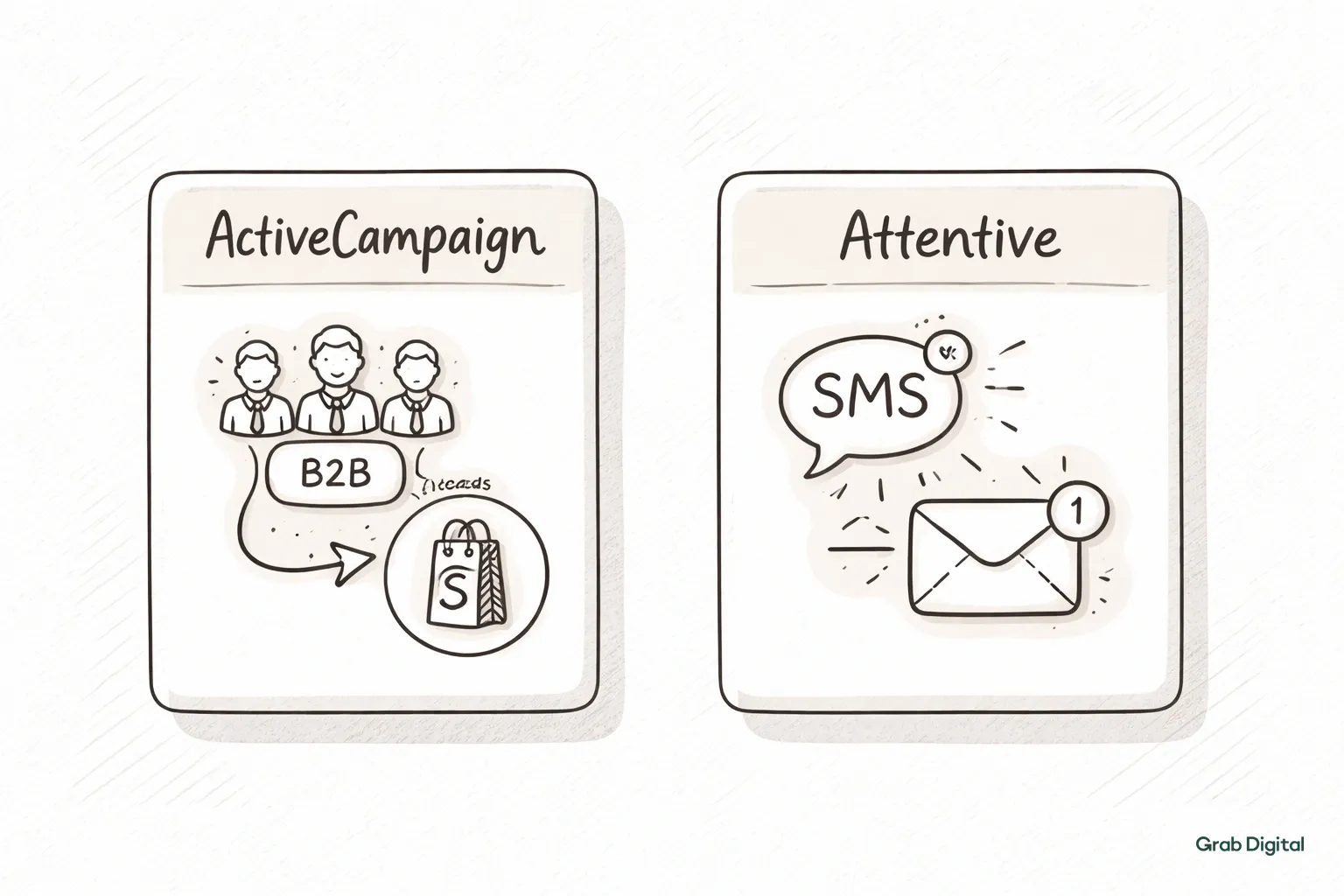
These two are interesting because they're both great platforms that are often solving the wrong problem.
ActiveCampaign is incredible if you're running a B2B lead nurture sequence. But if you're selling physical products with variants, inventory levels, and repeat purchase cycles, it doesn't translate well. Yes, you can connect it to Shopify, but the whole setup feels bolted on.
Then you have Attentive. They dominate SMS, no question. But for Attentive, email is an afterthought. For DTC brands where email still drives the majority of attributed revenue, that priority is completely backward. We talked about why this matters in our post on whether email is still the highest-ROI channel in 2026, especially as SMS costs keep climbing and deliverability gets tighter across the industry.
Shopify Email
Shopify Email is fine for day one. It's free, it's right there in your admin dashboard, and you can set it up in five minutes. But it completely lacks the automation depth you need once you move past launch mode.
There's no real browse abandonment logic, the post-purchase flows are incredibly basic, and segmentation is almost nonexistent. If you have over 10,000 subscribers and you're still on Shopify Email, you are leaving money on the table. We wrote about the 8 core email flows every DTC brand needs, and most of those flows just aren't buildable inside Shopify Email right now.
Why growing DTC brands still end up on Klaviyo
Klaviyo is still the default for brands scaling past $1M for one simple reason: its data model is entirely ecommerce. Every flow, segment, and report ties directly back to Shopify purchase data. It's not trying to be a general-purpose tool.
The strength isn't just one single feature. It's that the depth is there across the entire channel at the same time. Klaviyo handles real-time Shopify sync for behavioral segmentation, predictive analytics for CLV and churn risk, granular A/B testing, SMS that actually integrates with your email logic, and flow-level revenue attribution that makes sense to your finance team. (We also looked at Klaviyo's private company status and what that trajectory means for brands relying on them long-term.)
I've seen so many brands try to switch away from Klaviyo, only to come crawling back in 6 to 12 months. The cost of the migration, plus losing all that historical attribution data, almost always outweighs the savings from a cheaper platform. We see it constantly across lifestyle, skincare, and home goods clients.
The platform isn't the actual problem

Platform choice matters a lot less than people think. The bigger issue is almost always execution. If you're on Klaviyo and email is generating less than 20% of your total revenue, you have a strategy problem, not a software problem.
Moving to a new platform won't magically fix broken segmentation, boring copywriting, or flows you haven't updated in a year. We see this all the time. A new client will come to us, already on Klaviyo, but barely using 10% of its capability. When we run our Klaviyo health audit process, looking at list hygiene and segmentation, we usually uncover the real bottleneck in the first week.
If your team is debating a platform switch right now, ask yourself this: are you actually using your current setup to its full capacity? The answer is usually no. That's why having a dedicated team focused on Klaviyo strategy, copy, and flow design makes the difference. A new platform can't do that for you. If you want to see what that turnaround actually looks like, check out our work page. We've got case studies from brands like Rogue Industries and BeEssential that show the impact.
Making the decision
Deciding between Klaviyo and its competitors really just comes down to your catalog, your growth stage, and your in-house bandwidth. If you're under $500K with a single product line, you can probably get by on Omnisend or Shopify Email. But once you cross $1M, you almost always need Klaviyo's depth.
Think about it like this: if you have under 5,000 subscribers and one product, a lighter platform is fine. If you have 10,000+ subscribers and multiple product categories, Klaviyo's segmentation literally pays for itself. And if email drives less than 20% of your revenue despite being on Klaviyo, your problem is strategy, not software.
For most brands we work with, the platform decision is already right. What they're missing is the execution layer, meaning the strategy, copy, and consistent flow optimization. That's a resourcing problem, and you need to fix it before you even think about a costly migration. If you want a clear-eyed look at where your current setup stands, just book a free consultation. We'll give you a baseline read on what's actually underperforming.
Frequently Asked Questions
Is Omnisend a good Klaviyo alternative for small DTC brands? For brands under $500K with simple catalogs, sure. But the second your segmentation needs get complex, Klaviyo's conditional logic wins.
Why do brands switch away from Klaviyo and then come back? Migration usually breaks flow logic and wipes out historical attribution data. Since alternatives lack Klaviyo's Shopify-native segmentation, brands realize what they lost and switch back.
Is Mailchimp still relevant for ecommerce brands in 2026? Only if you're brand new. Once you pass $1M, Mailchimp's reporting and segmentation gaps become a massive limitation.
Does switching platforms fix low email revenue? Almost never. If email revenue is low, it's usually a strategy and execution issue. Most brands we audit are just underusing Klaviyo.
How do I know if my brand has outgrown Shopify Email? If you have over 10,000 subscribers and need real browse abandonment or win-back flows, Shopify Email can't handle it. You need Klaviyo.
What should I evaluate before switching from Klaviyo? Check your catalog complexity, subscriber count, and whether your flows are actually optimized. Usually, you'll find the issue is underutilization, not the tool itself.
I talk to DTC founders all the time who want to ditch Klaviyo for something cheaper. I get it. Klaviyo gets expensive. But most brands doing $1M to $10M who switch end up crawling back to Klaviyo within a year.
Picking an email platform feels like a huge, irreversible decision because it is. You lose historical data, you have to rebuild all your flows, and your team has to learn a new UI from scratch. Before you jump ship, let's look at what the actual alternatives do well, and more importantly, where they quietly start costing you money.
The top Klaviyo alternatives for ecommerce (and their catches)
When you look at the landscape, Klaviyo alternatives basically fall into three buckets: legacy ESPs, SMS tools trying to do email, and Shopify-native apps. The ones we see brands evaluate the most are Omnisend, Mailchimp, ActiveCampaign, Attentive, and Shopify Email.
Each of these tools was built to solve a much narrower problem than Klaviyo. Here's a quick comparison of where each platform actually fits:
| Platform | Best For | Weakness for DTC |
|---|---|---|
| Omnisend | Small catalogs, simple flows | Shallow segmentation at scale |
| Mailchimp | Starting out, tight budgets | Poor ecommerce data depth |
| ActiveCampaign | B2B-style lead nurturing | Not built for product catalogs |
| Attentive | SMS-first brands | Email is an afterthought |
| Shopify Email | Brand-new stores | No real automation or segmentation |
None of these platforms were built from scratch around actual purchase behavior, product catalogs, and revenue attribution. That gap doesn't matter much when you're just starting out. But the second a brand crosses seven figures, they need more than basic newsletters, and the cracks start showing.
Omnisend vs Klaviyo
Omnisend pitches itself as the budget-friendly Klaviyo. It handles basic flows just fine. But its segmentation and predictive analytics get noticeably thin once your subscriber list grows past 20,000 or so.
If you're doing under $500K a year, you probably won't notice. The flow builder is easy to use, and having SMS built-in is handy. But the minute you're juggling multiple product lines, seasonal promotions, and trying to segment people by purchase frequency alongside browsing behavior and predicted lifetime value, Omnisend starts struggling. We did a deep dive on this in our Omnisend vs Klaviyo breakdown, and the data really does favor Klaviyo once you pass that $1M mark.
Klaviyo supports layered conditional logic while Omnisend struggles at scale. Klaviyo's CLV and churn predictions are years ahead. And while both sync with Shopify, Klaviyo's data refresh is noticeably faster.
Mailchimp
Mailchimp is the name everyone knows, which is exactly why so many DTC founders start there. But the brand recognition masks a real issue. Mailchimp was built for general small-business marketing, not ecommerce revenue attribution.
If you've used both, you know Mailchimp's automation builder feels like a relic compared to Klaviyo's visual flow editor. The reporting doesn't give you the granular revenue-per-email view that DTC teams actually need to make decisions. We see this pattern hold up in every single audit we run. We wrote about it in detail in our Shopify Email vs Mailchimp vs Klaviyo comparison.
The gaps are pretty glaring. Mailchimp's product recommendation blocks are limited compared to Klaviyo's dynamic catalog feeds. Its SMS integration is weak and usually requires third-party tools. And its attribution windows don't match how DTC brands actually track conversions. If you're past $1M in revenue and still using Mailchimp, I'd bet money your email channel is underperforming. It's usually the very first thing we flag when someone books a free consultation.
ActiveCampaign and Attentive
These two are interesting because they're both great platforms that are often solving the wrong problem.
ActiveCampaign is incredible if you're running a B2B lead nurture sequence. But if you're selling physical products with variants, inventory levels, and repeat purchase cycles, it doesn't translate well. Yes, you can connect it to Shopify, but the whole setup feels bolted on.
Then you have Attentive. They dominate SMS, no question. But for Attentive, email is an afterthought. For DTC brands where email still drives the majority of attributed revenue, that priority is completely backward. We talked about why this matters in our post on whether email is still the highest-ROI channel in 2026, especially as SMS costs keep climbing and deliverability gets tighter across the industry.
Shopify Email
Shopify Email is fine for day one. It's free, it's right there in your admin dashboard, and you can set it up in five minutes. But it completely lacks the automation depth you need once you move past launch mode.
There's no real browse abandonment logic, the post-purchase flows are incredibly basic, and segmentation is almost nonexistent. If you have over 10,000 subscribers and you're still on Shopify Email, you are leaving money on the table. We wrote about the 8 core email flows every DTC brand needs, and most of those flows just aren't buildable inside Shopify Email right now.
Why growing DTC brands still end up on Klaviyo
Klaviyo is still the default for brands scaling past $1M for one simple reason: its data model is entirely ecommerce. Every flow, segment, and report ties directly back to Shopify purchase data. It's not trying to be a general-purpose tool.
The strength isn't just one single feature. It's that the depth is there across the entire channel at the same time. Klaviyo handles real-time Shopify sync for behavioral segmentation, predictive analytics for CLV and churn risk, granular A/B testing, SMS that actually integrates with your email logic, and flow-level revenue attribution that makes sense to your finance team. (We also looked at Klaviyo's private company status and what that trajectory means for brands relying on them long-term.)
I've seen so many brands try to switch away from Klaviyo, only to come crawling back in 6 to 12 months. The cost of the migration, plus losing all that historical attribution data, almost always outweighs the savings from a cheaper platform. We see it constantly across lifestyle, skincare, and home goods clients.
The platform isn't the actual problem
Platform choice matters a lot less than people think. The bigger issue is almost always execution. If you're on Klaviyo and email is generating less than 20% of your total revenue, you have a strategy problem, not a software problem.
Moving to a new platform won't magically fix broken segmentation, boring copywriting, or flows you haven't updated in a year. We see this all the time. A new client will come to us, already on Klaviyo, but barely using 10% of its capability. When we run our Klaviyo health audit process, looking at list hygiene and segmentation, we usually uncover the real bottleneck in the first week.
If your team is debating a platform switch right now, ask yourself this: are you actually using your current setup to its full capacity? The answer is usually no. That's why having a dedicated team focused on Klaviyo strategy, copy, and flow design makes the difference. A new platform can't do that for you. If you want to see what that turnaround actually looks like, check out our work page. We've got case studies from brands like Rogue Industries and BeEssential that show the impact.
Making the decision
Deciding between Klaviyo and its competitors really just comes down to your catalog, your growth stage, and your in-house bandwidth. If you're under $500K with a single product line, you can probably get by on Omnisend or Shopify Email. But once you cross $1M, you almost always need Klaviyo's depth.
Think about it like this: if you have under 5,000 subscribers and one product, a lighter platform is fine. If you have 10,000+ subscribers and multiple product categories, Klaviyo's segmentation literally pays for itself. And if email drives less than 20% of your revenue despite being on Klaviyo, your problem is strategy, not software.
For most brands we work with, the platform decision is already right. What they're missing is the execution layer, meaning the strategy, copy, and consistent flow optimization. That's a resourcing problem, and you need to fix it before you even think about a costly migration. If you want a clear-eyed look at where your current setup stands, just book a free consultation. We'll give you a baseline read on what's actually underperforming.
Frequently Asked Questions
Is Omnisend a good Klaviyo alternative for small DTC brands? For brands under $500K with simple catalogs, sure. But the second your segmentation needs get complex, Klaviyo's conditional logic wins.
Why do brands switch away from Klaviyo and then come back? Migration usually breaks flow logic and wipes out historical attribution data. Since alternatives lack Klaviyo's Shopify-native segmentation, brands realize what they lost and switch back.
Is Mailchimp still relevant for ecommerce brands in 2026? Only if you're brand new. Once you pass $1M, Mailchimp's reporting and segmentation gaps become a massive limitation.
Does switching platforms fix low email revenue? Almost never. If email revenue is low, it's usually a strategy and execution issue. Most brands we audit are just underusing Klaviyo.
How do I know if my brand has outgrown Shopify Email? If you have over 10,000 subscribers and need real browse abandonment or win-back flows, Shopify Email can't handle it. You need Klaviyo.
What should I evaluate before switching from Klaviyo? Check your catalog complexity, subscriber count, and whether your flows are actually optimized. Usually, you'll find the issue is underutilization, not the tool itself.

Find out exactly what your email channel is leaving on the table.

Email Marketing for Scaling DTC Brands


