
Summary
Email Deliverability Hacks for DTC Brands in 2026
Klaviyo says your email was delivered. Gmail disagrees.
Email deliverability platforms exist to close that gap. They monitor your sending infrastructure, run inbox placement tests, and track your sender reputation. Klaviyo tells you if a server accepted your message. A deliverability platform tells you if it landed in the primary inbox, the promotions tab, or the spam folder.
Without this visibility, even the best campaigns from your Klaviyo agency can quietly vanish into spam. You lose revenue you already paid to generate, and you usually don't realize it until your metrics tank.
Why DTC Brands Need Deliverability Tools
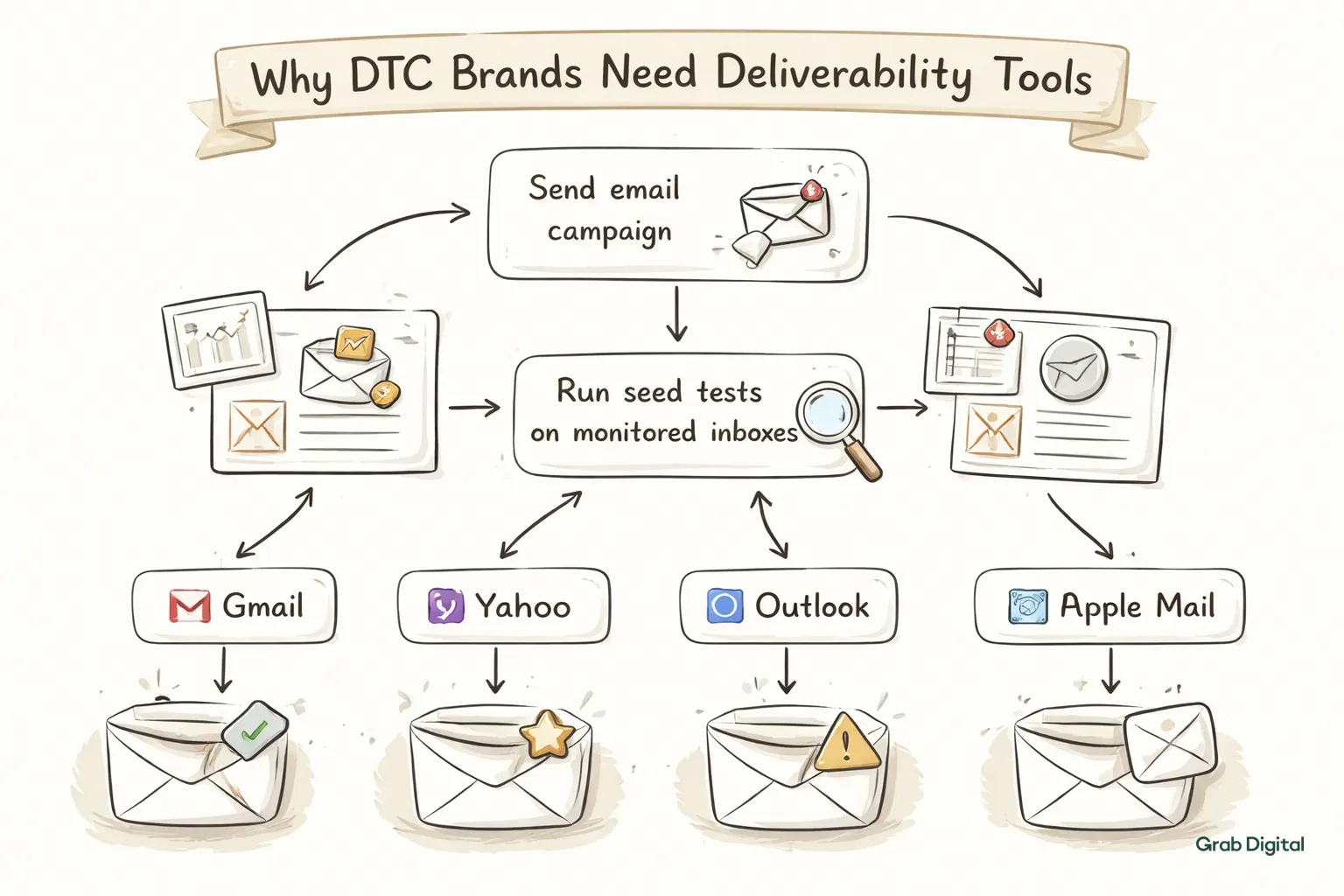
Your Klaviyo dashboard shows opens and clicks. It does not show you how many emails Gmail silently dumped. Deliverability platforms fix this by running inbox placement tests across major providers Gmail, Yahoo, Outlook, Apple Mail.
They use seed tests. You send your campaign to a list of monitored inboxes across dozens of email clients. Within minutes, you see exactly where your email landed. Primary inbox? Promotions tab? Spam? Nowhere?
We worked with a DTC skincare brand that discovered 40% of their emails were landing in Gmail's spam folder. They had no idea, because their Klaviyo open rates looked fine. Gmail wasn't blocking delivery, just hiding the messages where nobody would see them. After fixing the authentication issues their deliverability platform flagged, their email revenue jumped 63% in a single month.
Most DTC brands doing $1M to $10M annually send between 200,000 and 2 million emails a month. At that volume, even a 10% spam placement rate means tens of thousands of lost impressions. These are people who opted in, who want your emails, and who would buy if they actually saw your offer.
What to Actually Look For
Inbox placement testing sends your campaigns to real addresses across major providers and reports where they ended up. You need to know if you're hitting Gmail's primary inbox or the promotions tab, or Outlook's focused inbox vs. the other box.
Spam trap monitoring is non-negotiable. Spam traps are addresses designed to catch senders with poor list hygiene. Hitting them destroys your sender reputation and can land your whole domain on blocklists. Your platform should alert you the second you hit one.
Authentication validation checks your SPF, DKIM, and DMARC records in real time. These DNS records prove you're authorized to send from your domain. Missing or botched authentication is the number one technical reason emails land in spam. The platform should flag failures and tell you exactly how to fix them.
Blocklist monitoring scans public and private blocklists hourly to see if your sending IP or domain shows up. Getting listed happens fast. One complaint spike from a bad campaign can land you on Spamhaus within hours.
Content analysis scans your HTML and copy for spam triggers, broken links, image-to-text ratios, and formatting issues. Modern filters are sophisticated, but old-school triggers like "FREE!!!" in subject lines still matter.
Engagement metrics tracking goes deeper than Klaviyo's native reporting. You can see engagement patterns by domain (Gmail users might engage differently than Yahoo users) and find segments that never open or click. Low engagement tells ISPs that recipients don't want your mail.
Look for platforms that integrate with Klaviyo's API. Manual exports waste time. The best tools pull campaign data automatically and push alerts into Slack or your project management software.
The Top Platforms for DTC Brands in 2026
250ok is enterprise-grade. They offer the deepest inbox placement testing across 90+ email clients and ISPs worldwide, and their dashboard breaks down placement by campaign, segment, and individual domain. Pricing starts around $800/month, so it's really for brands doing $5M+ with sophisticated email programs. They also do deliverability consulting their team reviews your setup and gives custom recommendations.
GlockApps gives you solid core features starting at $79/month. The interface is simple: send a test email to their seed list, wait five minutes, get your placement report. They cover all major providers and give actionable suggestions. Good for brands starting serious deliverability monitoring without huge budgets.
Validity (formerly Return Path) pioneered this space. They offer the most comprehensive sender reputation tracking through their Sender Score metric a 0-100 score that benchmarks your reputation against other senders and updates daily. They also have certification programs that improve inbox placement with participating ISPs. Pricing requires a custom quote but generally suits brands spending $50,000+ annually on email marketing.
Postmark Insights is built for transactional email but works for marketing sends too. Their real-time dashboard tracks bounce rates, spam complaints, and blocklist appearances. They charge per email sent rather than a flat fee, which is cost-effective if you send under 500,000 emails monthly. It integrates tightly with Klaviyo through webhooks.
MailGenius offers free basic email testing that analyzes spam score, authentication, content issues, and mobile rendering. The free tier works for occasional spot checks. Paid plans start at $29/month and add scheduled monitoring and API access. It's bare-bones compared to enterprise options, but sufficient for brands under $3M in revenue.
MXToolbox monitors DNS records, blocklists, and email server configuration. It isn't exclusively a deliverability platform, but it's essential for technical diagnostics. Their free tools check SPF and DMARC records instantly. Paid monitoring starts at $99/month and alerts you to DNS changes or blocklist additions within minutes. Just bookmark this one.
Choosing the right one depends on volume, expertise, and budget. Brands under $2M doing basic flows and weekly campaigns usually start with GlockApps or MailGenius. Brands over $5M with dedicated email managers benefit from 250ok or Validity's advanced features.
How to Actually Implement This
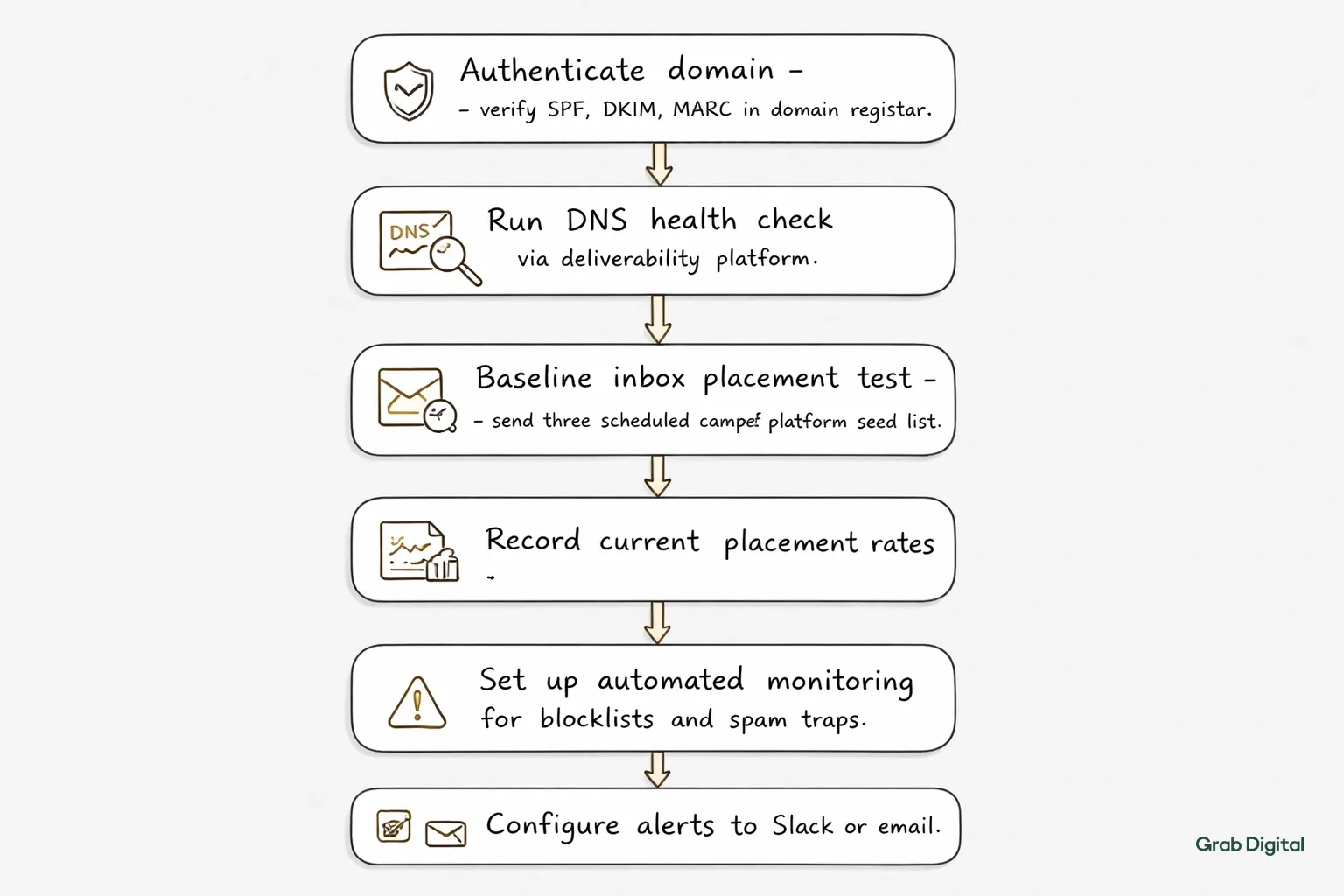
Start with authentication. Log into your domain registrar and verify your SPF, DKIM, and DMARC records are correct. Every email marketing strategy depends on this foundation. Most deliverability platforms include a DNS health check tool run that first.
Next, run baseline inbox placement tests. Send your next three scheduled campaigns to the platform's seed list. This establishes your current placement rates before you change anything. You need a baseline to measure against.
Set up automated monitoring for blocklists and spam traps. Configure alerts to ping you on Slack or email if your domain or IP appears on a blocklist. Speed matters here. The faster you respond, the less damage to your sender reputation.
Review your content analysis reports. Look for patterns in underperforming campaigns. Did the heavy-discount promo with multiple exclamation points land in spam more than your educational emails? These insights should inform your email campaign management decisions.
Segment based on engagement. Use the platform's data to find subscribers who haven't opened in 90+ days. Build a win-back flow, and if they still don't engage, remove them. ISPs penalize senders who repeatedly email unengaged recipients. Your email segmentation should prioritize quality over list size.
Block out 30 minutes every Monday for a deliverability review. Check the dashboard, look at inbox placement trends, scan for new blocklist appearances, and check authentication status. Deliverability issues compound quickly weekly monitoring catches problems before they crater your metrics.
If you work with an email marketing agency, make sure they have access to your deliverability platform. They should be monitoring this data as part of their service. If your agency isn't proactively discussing deliverability, that's a red flag.
The Problems These Platforms Actually Catch
DNS records break. They break after website migrations, domain registrar changes, or IT updates. Your SPF record might list outdated IPs, or your DKIM selector changed without updating Klaviyo. Deliverability platforms catch these instantly; otherwise, you won't know until open rates tank.
Spam trap hits and sudden spikes in hard bounces usually point to list hygiene issues. If you recently imported an old list, merged databases, or ran an aggressive acquisition campaign, you probably added bad addresses. The platform identifies them before they wreck your reputation.
Sometimes engagement drops by domain. When Gmail placement drops but Outlook stays steady, you're likely triggering Gmail's specific spam filters. Granular data lets you troubleshoot the actual issue rather than guessing.
Content triggers also vary by ISP. What Yahoo flags as spam might pass through Gmail fine. Platforms that analyze content separately for each ISP help you optimize for your actual subscriber distribution. If 60% of your list uses Gmail, optimize for Gmail's filters.
Shared sending IPs (like Klaviyo's default infrastructure) occasionally get temporarily blocked because of another sender's bad behavior. It's rare, but it happens. Platforms monitoring IP reputation alert you so you can switch to dedicated IPs if needed.
And sometimes, you hit a blacklist by accident. A customer might mark your email as spam out of confusion. If enough people do this quickly, automated systems blocklist your domain. Immediate alerts let you apply for delisting before significant damage occurs.
We had a furniture DTC client see a 30% drop in Gmail inbox placement over two weeks. Their deliverability platform found the culprit: a new promotional footer added during a design refresh contained a known spam trigger phrase ("click here now to claim"). Removing that phrase restored placement within three days. Without monitoring, they would have spent weeks guessing.
Integration With Your Klaviyo Program
Modern deliverability platforms connect to Klaviyo through native integrations or API connections. This eliminates manual testing and ensures every campaign gets monitored. When you book your free consultation, understanding how these tools enhance Klaviyo's capabilities makes the conversation much more productive.
Set up automated seed list sending in Klaviyo. Most platforms provide a segment upload file with their seed addresses. Import these into Klaviyo as a separate list segment, then configure your campaigns and flows to include this segment automatically. Every send triggers a deliverability test.
Configure webhook alerts into your team's communication channels. When blocklist appearances or authentication failures occur, you want instant Slack notifications, not daily digest emails you might miss.
Review platform data alongside Klaviyo's native analytics. Klaviyo shows high-level open and click rates. Your deliverability platform explains why those rates vary. Low Gmail open rates correlate with promotions tab placement. High bounce rates from one provider indicate domain reputation issues.
Use platform content analysis to inform your reverse-engineering process when studying competitor emails. High-performing brands maintain excellent deliverability, and understanding their technical setup helps you replicate results.
Costs and ROI
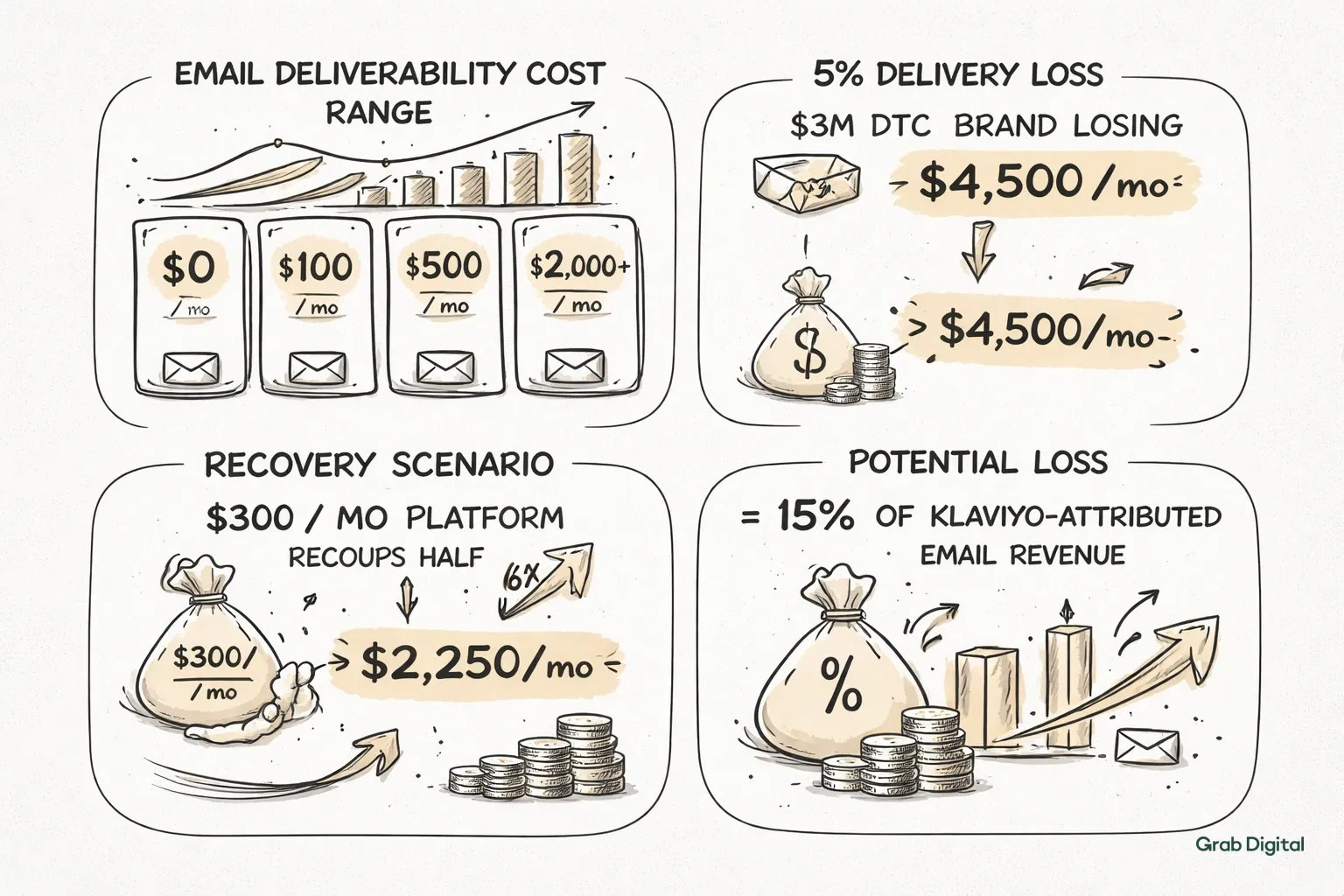
Platforms range from free basic tools to $2,000+ monthly enterprise solutions. Do the math: if poor deliverability costs you even 5% of email revenue, and email drives 30% of your total revenue, a $3M brand loses $4,500 monthly. A $300/month platform that recovers half that loss pays for itself six times over.
Calculate your current Klaviyo-attributed email revenue. Multiply by 0.15 to estimate potential losses from undetected deliverability issues. Conservative industry research suggests 15% average placement problems for brands without active monitoring. This math gives you your maximum monthly platform budget while maintaining positive ROI.
For most DTC brands doing $1M to $10M annually, spending $200 to $800 monthly on deliverability monitoring makes financial sense. Brands under $1M should start with freemium tools and upgrade as volume grows. Brands over $10M should invest in enterprise platforms with dedicated support.
These platforms prevent problems rather than create immediate gains. The ROI shows up as sustained performance. You're protecting the 20% to 40% of revenue that email should generate for DTC brands, rather than watching it slowly decline.
Where the Tech is Going
Machine learning models are increasingly analyzing sender behavior patterns rather than just content and authentication. ISPs now look at sending cadence consistency, engagement velocity changes, and recipient interaction depth. Deliverability platforms are building predictive models that warn you before campaigns trigger these filters.
Privacy changes from Apple Mail, Gmail, and others are making traditional open tracking less reliable. Platforms now focus more on click rates, conversion tracking, and engagement duration as proxy metrics for actual interest. Expect these tools to integrate more deeply with ecommerce platforms like Shopify to track post-click behavior.
Real-time API-based monitoring is replacing batch testing. Instead of sending test emails separately, modern platforms monitor your actual production sends through ESP integrations. This provides more accurate data since you're testing the exact emails subscribers receive.
Authentication standards keep evolving. BIMI (Brand Indicators for Message Identification) lets verified senders display brand logos in email clients. Platforms now include BIMI setup assistance and monitoring. As adoption grows, this becomes another requirement for optimal inbox placement.
The market is also consolidating. Validity acquired Return Path and 250ok. Email service providers like Mailgun and SendGrid now bundle deliverability monitoring. This trend benefits DTC brands as monitoring becomes more accessible and affordable.
Measuring Effectiveness
Track inbox placement rates weekly using your platform's reporting. Establish baselines for primary inbox, promotions tab, spam folder, and missing (blocked) across major ISPs. Healthy programs show 85%+ primary inbox placement for Gmail, 90%+ for Outlook, and 80%+ for Yahoo.
Monitor your overall sender score or reputation metric if your platform provides one. This number should trend upward over time as you implement recommendations. Scores above 90 indicate excellent reputation. Scores below 70 signal serious problems.
Compare deliverability metrics to Klaviyo revenue attribution. When inbox placement improves, email revenue should follow within two to four weeks. If placement improves but revenue doesn't, you have content or offer problems, not deliverability issues.
Track blocklist appearances over time. Mature email programs should rarely appear on major blocklists. If you're getting listed monthly, you have fundamental list hygiene or sending practice problems.
Review authentication pass rates. These should be 100% green across SPF, DKIM, and DMARC. Anything less means technical configuration problems.
Document your team's response time to alerts. How quickly do you investigate blocklist appearances or spam trap hits? Faster response correlates with better long-term outcomes. Build processes ensuring alerts get addressed within one business day.
Your DTC email marketing results depend on messages actually reaching subscribers. The best-written campaigns and sophisticated automation flows mean nothing if Gmail dumps them in spam. Email deliverability platforms give you the visibility and diagnostic tools to ensure your email investment generates returns rather than vanishing into a black hole.
Frequently Asked Questions
Do I need a deliverability platform if Klaviyo already provides delivery metrics? Yes. Klaviyo shows whether emails were delivered (accepted by the recipient's mail server) but not where they landed. Deliverability platforms test actual inbox placement across different email providers. A delivered email sitting in spam generates zero revenue.
How often should I run inbox placement tests? Run automated tests on every campaign and at least weekly for your automated flows. Major campaigns (Black Friday, new product launches) should get tested twice once during creative development and again before the final send. Test more frequently if you're having deliverability problems or making infrastructure changes.
Will a deliverability platform improve my performance automatically? No. These platforms identify problems; they don't fix them. You or your agency must implement the recommendations. Think of them like blood tests they reveal what's wrong, but you still need treatment. The value is knowing exactly what to fix rather than guessing based on declining metrics.
Which platform works best with Klaviyo? GlockApps and 250ok offer the smoothest Klaviyo integrations with API connections that automate testing. For budget-conscious brands, MailGenius provides adequate functionality with manual testing. The "best" platform depends on your volume, budget, and technical sophistication. Brands sending 500,000+ emails monthly benefit most from enterprise platforms like Validity or 250ok.
Can poor deliverability get my entire domain blacklisted? Yes. Consistent problems can result in domain-level blacklisting that affects not just marketing emails but transactional messages like order confirmations and shipping notifications. Catching problems early prevents escalation to domain-level reputation damage. Recovery from domain blacklisting takes months and sometimes requires switching to a new sending domain entirely.
How do I know if my problems are serious enough to need a platform? If your email drives less than 20% of total revenue despite having 10,000+ subscribers and sending regular campaigns, you likely have deliverability issues. Other warning signs: declining open rates despite consistent sending frequency, spam complaint rates above 0.1%, or sudden drops in engagement from specific providers like Gmail. Starting with a free tool like MailGenius gives you enough data to determine if you need enterprise monitoring.
Klaviyo says your email was delivered. Gmail disagrees.
Email deliverability platforms exist to close that gap. They monitor your sending infrastructure, run inbox placement tests, and track your sender reputation. Klaviyo tells you if a server accepted your message. A deliverability platform tells you if it landed in the primary inbox, the promotions tab, or the spam folder.
Without this visibility, even the best campaigns from your Klaviyo agency can quietly vanish into spam. You lose revenue you already paid to generate, and you usually don't realize it until your metrics tank.
Why DTC Brands Need Deliverability Tools
Your Klaviyo dashboard shows opens and clicks. It does not show you how many emails Gmail silently dumped. Deliverability platforms fix this by running inbox placement tests across major providers Gmail, Yahoo, Outlook, Apple Mail.
They use seed tests. You send your campaign to a list of monitored inboxes across dozens of email clients. Within minutes, you see exactly where your email landed. Primary inbox? Promotions tab? Spam? Nowhere?
We worked with a DTC skincare brand that discovered 40% of their emails were landing in Gmail's spam folder. They had no idea, because their Klaviyo open rates looked fine. Gmail wasn't blocking delivery, just hiding the messages where nobody would see them. After fixing the authentication issues their deliverability platform flagged, their email revenue jumped 63% in a single month.
Most DTC brands doing $1M to $10M annually send between 200,000 and 2 million emails a month. At that volume, even a 10% spam placement rate means tens of thousands of lost impressions. These are people who opted in, who want your emails, and who would buy if they actually saw your offer.
What to Actually Look For
Inbox placement testing sends your campaigns to real addresses across major providers and reports where they ended up. You need to know if you're hitting Gmail's primary inbox or the promotions tab, or Outlook's focused inbox vs. the other box.
Spam trap monitoring is non-negotiable. Spam traps are addresses designed to catch senders with poor list hygiene. Hitting them destroys your sender reputation and can land your whole domain on blocklists. Your platform should alert you the second you hit one.
Authentication validation checks your SPF, DKIM, and DMARC records in real time. These DNS records prove you're authorized to send from your domain. Missing or botched authentication is the number one technical reason emails land in spam. The platform should flag failures and tell you exactly how to fix them.
Blocklist monitoring scans public and private blocklists hourly to see if your sending IP or domain shows up. Getting listed happens fast. One complaint spike from a bad campaign can land you on Spamhaus within hours.
Content analysis scans your HTML and copy for spam triggers, broken links, image-to-text ratios, and formatting issues. Modern filters are sophisticated, but old-school triggers like "FREE!!!" in subject lines still matter.
Engagement metrics tracking goes deeper than Klaviyo's native reporting. You can see engagement patterns by domain (Gmail users might engage differently than Yahoo users) and find segments that never open or click. Low engagement tells ISPs that recipients don't want your mail.
Look for platforms that integrate with Klaviyo's API. Manual exports waste time. The best tools pull campaign data automatically and push alerts into Slack or your project management software.
The Top Platforms for DTC Brands in 2026
250ok is enterprise-grade. They offer the deepest inbox placement testing across 90+ email clients and ISPs worldwide, and their dashboard breaks down placement by campaign, segment, and individual domain. Pricing starts around $800/month, so it's really for brands doing $5M+ with sophisticated email programs. They also do deliverability consulting their team reviews your setup and gives custom recommendations.
GlockApps gives you solid core features starting at $79/month. The interface is simple: send a test email to their seed list, wait five minutes, get your placement report. They cover all major providers and give actionable suggestions. Good for brands starting serious deliverability monitoring without huge budgets.
Validity (formerly Return Path) pioneered this space. They offer the most comprehensive sender reputation tracking through their Sender Score metric a 0-100 score that benchmarks your reputation against other senders and updates daily. They also have certification programs that improve inbox placement with participating ISPs. Pricing requires a custom quote but generally suits brands spending $50,000+ annually on email marketing.
Postmark Insights is built for transactional email but works for marketing sends too. Their real-time dashboard tracks bounce rates, spam complaints, and blocklist appearances. They charge per email sent rather than a flat fee, which is cost-effective if you send under 500,000 emails monthly. It integrates tightly with Klaviyo through webhooks.
MailGenius offers free basic email testing that analyzes spam score, authentication, content issues, and mobile rendering. The free tier works for occasional spot checks. Paid plans start at $29/month and add scheduled monitoring and API access. It's bare-bones compared to enterprise options, but sufficient for brands under $3M in revenue.
MXToolbox monitors DNS records, blocklists, and email server configuration. It isn't exclusively a deliverability platform, but it's essential for technical diagnostics. Their free tools check SPF and DMARC records instantly. Paid monitoring starts at $99/month and alerts you to DNS changes or blocklist additions within minutes. Just bookmark this one.
Choosing the right one depends on volume, expertise, and budget. Brands under $2M doing basic flows and weekly campaigns usually start with GlockApps or MailGenius. Brands over $5M with dedicated email managers benefit from 250ok or Validity's advanced features.
How to Actually Implement This
Start with authentication. Log into your domain registrar and verify your SPF, DKIM, and DMARC records are correct. Every email marketing strategy depends on this foundation. Most deliverability platforms include a DNS health check tool run that first.
Next, run baseline inbox placement tests. Send your next three scheduled campaigns to the platform's seed list. This establishes your current placement rates before you change anything. You need a baseline to measure against.
Set up automated monitoring for blocklists and spam traps. Configure alerts to ping you on Slack or email if your domain or IP appears on a blocklist. Speed matters here. The faster you respond, the less damage to your sender reputation.
Review your content analysis reports. Look for patterns in underperforming campaigns. Did the heavy-discount promo with multiple exclamation points land in spam more than your educational emails? These insights should inform your email campaign management decisions.
Segment based on engagement. Use the platform's data to find subscribers who haven't opened in 90+ days. Build a win-back flow, and if they still don't engage, remove them. ISPs penalize senders who repeatedly email unengaged recipients. Your email segmentation should prioritize quality over list size.
Block out 30 minutes every Monday for a deliverability review. Check the dashboard, look at inbox placement trends, scan for new blocklist appearances, and check authentication status. Deliverability issues compound quickly weekly monitoring catches problems before they crater your metrics.
If you work with an email marketing agency, make sure they have access to your deliverability platform. They should be monitoring this data as part of their service. If your agency isn't proactively discussing deliverability, that's a red flag.
The Problems These Platforms Actually Catch
DNS records break. They break after website migrations, domain registrar changes, or IT updates. Your SPF record might list outdated IPs, or your DKIM selector changed without updating Klaviyo. Deliverability platforms catch these instantly; otherwise, you won't know until open rates tank.
Spam trap hits and sudden spikes in hard bounces usually point to list hygiene issues. If you recently imported an old list, merged databases, or ran an aggressive acquisition campaign, you probably added bad addresses. The platform identifies them before they wreck your reputation.
Sometimes engagement drops by domain. When Gmail placement drops but Outlook stays steady, you're likely triggering Gmail's specific spam filters. Granular data lets you troubleshoot the actual issue rather than guessing.
Content triggers also vary by ISP. What Yahoo flags as spam might pass through Gmail fine. Platforms that analyze content separately for each ISP help you optimize for your actual subscriber distribution. If 60% of your list uses Gmail, optimize for Gmail's filters.
Shared sending IPs (like Klaviyo's default infrastructure) occasionally get temporarily blocked because of another sender's bad behavior. It's rare, but it happens. Platforms monitoring IP reputation alert you so you can switch to dedicated IPs if needed.
And sometimes, you hit a blacklist by accident. A customer might mark your email as spam out of confusion. If enough people do this quickly, automated systems blocklist your domain. Immediate alerts let you apply for delisting before significant damage occurs.
We had a furniture DTC client see a 30% drop in Gmail inbox placement over two weeks. Their deliverability platform found the culprit: a new promotional footer added during a design refresh contained a known spam trigger phrase ("click here now to claim"). Removing that phrase restored placement within three days. Without monitoring, they would have spent weeks guessing.
Integration With Your Klaviyo Program
Modern deliverability platforms connect to Klaviyo through native integrations or API connections. This eliminates manual testing and ensures every campaign gets monitored. When you book your free consultation, understanding how these tools enhance Klaviyo's capabilities makes the conversation much more productive.
Set up automated seed list sending in Klaviyo. Most platforms provide a segment upload file with their seed addresses. Import these into Klaviyo as a separate list segment, then configure your campaigns and flows to include this segment automatically. Every send triggers a deliverability test.
Configure webhook alerts into your team's communication channels. When blocklist appearances or authentication failures occur, you want instant Slack notifications, not daily digest emails you might miss.
Review platform data alongside Klaviyo's native analytics. Klaviyo shows high-level open and click rates. Your deliverability platform explains why those rates vary. Low Gmail open rates correlate with promotions tab placement. High bounce rates from one provider indicate domain reputation issues.
Use platform content analysis to inform your reverse-engineering process when studying competitor emails. High-performing brands maintain excellent deliverability, and understanding their technical setup helps you replicate results.
Costs and ROI
Platforms range from free basic tools to $2,000+ monthly enterprise solutions. Do the math: if poor deliverability costs you even 5% of email revenue, and email drives 30% of your total revenue, a $3M brand loses $4,500 monthly. A $300/month platform that recovers half that loss pays for itself six times over.
Calculate your current Klaviyo-attributed email revenue. Multiply by 0.15 to estimate potential losses from undetected deliverability issues. Conservative industry research suggests 15% average placement problems for brands without active monitoring. This math gives you your maximum monthly platform budget while maintaining positive ROI.
For most DTC brands doing $1M to $10M annually, spending $200 to $800 monthly on deliverability monitoring makes financial sense. Brands under $1M should start with freemium tools and upgrade as volume grows. Brands over $10M should invest in enterprise platforms with dedicated support.
These platforms prevent problems rather than create immediate gains. The ROI shows up as sustained performance. You're protecting the 20% to 40% of revenue that email should generate for DTC brands, rather than watching it slowly decline.
Where the Tech is Going
Machine learning models are increasingly analyzing sender behavior patterns rather than just content and authentication. ISPs now look at sending cadence consistency, engagement velocity changes, and recipient interaction depth. Deliverability platforms are building predictive models that warn you before campaigns trigger these filters.
Privacy changes from Apple Mail, Gmail, and others are making traditional open tracking less reliable. Platforms now focus more on click rates, conversion tracking, and engagement duration as proxy metrics for actual interest. Expect these tools to integrate more deeply with ecommerce platforms like Shopify to track post-click behavior.
Real-time API-based monitoring is replacing batch testing. Instead of sending test emails separately, modern platforms monitor your actual production sends through ESP integrations. This provides more accurate data since you're testing the exact emails subscribers receive.
Authentication standards keep evolving. BIMI (Brand Indicators for Message Identification) lets verified senders display brand logos in email clients. Platforms now include BIMI setup assistance and monitoring. As adoption grows, this becomes another requirement for optimal inbox placement.
The market is also consolidating. Validity acquired Return Path and 250ok. Email service providers like Mailgun and SendGrid now bundle deliverability monitoring. This trend benefits DTC brands as monitoring becomes more accessible and affordable.
Measuring Effectiveness
Track inbox placement rates weekly using your platform's reporting. Establish baselines for primary inbox, promotions tab, spam folder, and missing (blocked) across major ISPs. Healthy programs show 85%+ primary inbox placement for Gmail, 90%+ for Outlook, and 80%+ for Yahoo.
Monitor your overall sender score or reputation metric if your platform provides one. This number should trend upward over time as you implement recommendations. Scores above 90 indicate excellent reputation. Scores below 70 signal serious problems.
Compare deliverability metrics to Klaviyo revenue attribution. When inbox placement improves, email revenue should follow within two to four weeks. If placement improves but revenue doesn't, you have content or offer problems, not deliverability issues.
Track blocklist appearances over time. Mature email programs should rarely appear on major blocklists. If you're getting listed monthly, you have fundamental list hygiene or sending practice problems.
Review authentication pass rates. These should be 100% green across SPF, DKIM, and DMARC. Anything less means technical configuration problems.
Document your team's response time to alerts. How quickly do you investigate blocklist appearances or spam trap hits? Faster response correlates with better long-term outcomes. Build processes ensuring alerts get addressed within one business day.
Your DTC email marketing results depend on messages actually reaching subscribers. The best-written campaigns and sophisticated automation flows mean nothing if Gmail dumps them in spam. Email deliverability platforms give you the visibility and diagnostic tools to ensure your email investment generates returns rather than vanishing into a black hole.
Frequently Asked Questions
Do I need a deliverability platform if Klaviyo already provides delivery metrics? Yes. Klaviyo shows whether emails were delivered (accepted by the recipient's mail server) but not where they landed. Deliverability platforms test actual inbox placement across different email providers. A delivered email sitting in spam generates zero revenue.
How often should I run inbox placement tests? Run automated tests on every campaign and at least weekly for your automated flows. Major campaigns (Black Friday, new product launches) should get tested twice once during creative development and again before the final send. Test more frequently if you're having deliverability problems or making infrastructure changes.
Will a deliverability platform improve my performance automatically? No. These platforms identify problems; they don't fix them. You or your agency must implement the recommendations. Think of them like blood tests they reveal what's wrong, but you still need treatment. The value is knowing exactly what to fix rather than guessing based on declining metrics.
Which platform works best with Klaviyo? GlockApps and 250ok offer the smoothest Klaviyo integrations with API connections that automate testing. For budget-conscious brands, MailGenius provides adequate functionality with manual testing. The "best" platform depends on your volume, budget, and technical sophistication. Brands sending 500,000+ emails monthly benefit most from enterprise platforms like Validity or 250ok.
Can poor deliverability get my entire domain blacklisted? Yes. Consistent problems can result in domain-level blacklisting that affects not just marketing emails but transactional messages like order confirmations and shipping notifications. Catching problems early prevents escalation to domain-level reputation damage. Recovery from domain blacklisting takes months and sometimes requires switching to a new sending domain entirely.
How do I know if my problems are serious enough to need a platform? If your email drives less than 20% of total revenue despite having 10,000+ subscribers and sending regular campaigns, you likely have deliverability issues. Other warning signs: declining open rates despite consistent sending frequency, spam complaint rates above 0.1%, or sudden drops in engagement from specific providers like Gmail. Starting with a free tool like MailGenius gives you enough data to determine if you need enterprise monitoring.

Find out exactly what your email channel is leaving on the table.

Email Marketing for Scaling DTC Brands


